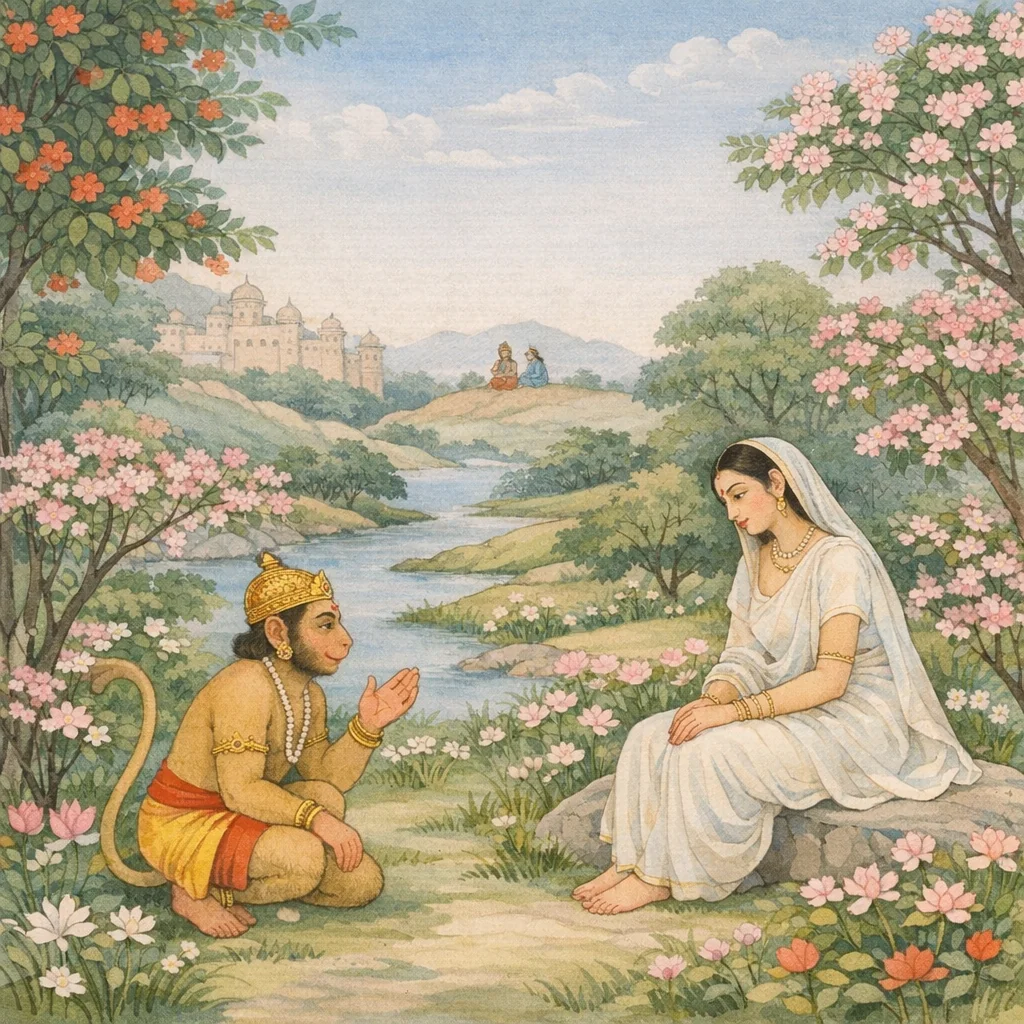
Sarga 35
रामलक्षणवर्णनम् (Description of Rama and Lakshmana; Alliance Narrative to Sita)
सुन्दरकाण्ड
This sarga begins with Vaidehī (Sītā) responding to Hanumān’s Rāma-kathā in a sweet, consoling tone, then interrogating him for verifiable details: where he met Rāma, how he recognized Lakṣmaṇa, and how the vanara–human alliance arose. Hanumān answers by (1) providing a detailed, traditional physiognomic and ethical portrait of Rāma—protector of the living world, guardian of cāturvarṇya and maryādā, disciplined in brahmacarya, trained in statecraft and Vedic learning, and described through auspicious bodily marks—thereby functioning as “evidence through description.” (2) He narrates the coalition’s origin: Rāma and Lakṣmaṇa, searching for Sītā, meet the exiled Sugrīva on Ṛśyamūka; Hanumān mediates introductions; friendship forms; a pact is made to kill Vāli and search for Sītā; Sugrīva regains Kiṣkindhā and dispatches search parties in ten directions. (3) He recounts the southern search under Aṅgada, their despair and contemplated prāyopaveśa, Sampāti’s disclosure that Sītā resides in Rāvaṇa’s abode, and Hanumān’s leap across the ocean to Laṅkā. The chapter closes with Hanumān’s self-identification as Rāma’s messenger and Vāyu’s son, reaffirming Rāma’s well-being and promising imminent rescue—leading Sītā to trust him through reasons and recognitions and to experience renewed joy.
Shlokas
Verse 1
तां तु रामकथां श्रुत्वा वैदेही वानरर्षभात्।उवाच वचनं सान्त्वमिदं मधुरया गिरा।।।।
Having heard the account of Rāma from that bull among the Vānaras, Vaidehī spoke these soothing words in a sweet voice.
Verse 2
क्व ते रामेण संसर्गः कथं जानासि लक्ष्मणम्।वानराणां नराणां च कथमासीत्समागमः।।।।
Where did you come into contact with Rāma? How do you know Lakṣmaṇa? And how did an alliance between the Vānaras and human beings come to be?
Verse 3
यानि रामस्य लिङ्गानि लक्ष्मणस्य च वानर।तानि भूयस्समाचक्ष्व न मां शोकस्समाविशेत्।।।।
Then, stationed on that peak, the lord of Vānaras swiftly dispatched me alone to approach the two of them.
Verse 4
कीदृशं तस्य संस्थानं रूपं रामस्य कीदृशम्।कथमूरू कथं बाहू लक्ष्मणस्य च शंस मे।।।।
Tell me: what is Rāma’s build and appearance like? And what are Lakṣmaṇa’s thighs and arms like?
Verse 5
एवमुक्तस्तु वैदेह्या हनुमान्मारुतात्मजः।ततो रामं यथातत्त्वमाख्यातुमुपचक्रमे।।।।
Thus addressed by Vaidehī, Hanumān—the son of the Wind—then began to describe Rama exactly as he truly is.
Verse 6
जानन्ती बत दिष्ट्या मां वैदेहि परिपृच्छसि।भर्तुः कमलपत्त्राक्षि संस्थानं लक्ष्मणस्य च।।।।
O Vaidehī, lotus-petaled-eyed one—though you already know your husband’s and Lakṣmaṇa’s appearance and marks, it is by good fortune that you ask me to describe them.
Verse 7
यानि रामस्य चिह्नानि लक्ष्मणस्य च यानि वै।लक्षितानि विशालाक्षि वदतश्शृणु तानि मे।।।।
All of them, with Angada in the lead, reached the edge of the seashore; yet again, though eager to see you, they fell into anxious fear.
Verse 8
रामः कमलपत्त्राक्ष स्सर्वसत्त्वमनोहरः।रूपदाक्षिण्यसम्पन्नः प्रसूतो जनकात्मजे।।।।
O daughter of Janaka, Rama—lotus-petalled in his eyes, dear to the hearts of all beings—was born endowed with beauty, graciousness, and refined courtesy.
Verse 9
तेजसाऽदित्य सङ्काशः क्षमया पृथिवीसमः।बृहस्पतिसमो बुद्ध्या यशसा वासवोपमः।।।।
In splendor he is like the Sun; in forbearance he is like the Earth; in intelligence he is like Bṛhaspati; and in fame he is comparable to Vāsava (Indra).
Verse 10
रक्षिता जीवलोकस्य स्वजनस्याभिरक्षिता।रक्षिता स्वस्य वृत्तस्य धर्मस्य च परन्तपः।।।।
He is the protector of the world of living beings—how much more of his own people. He safeguards his lineage and guards dharma; he is a scorcher of enemies.
Verse 11
रामो भामिनि लोकस्य चातुर्वर्ण्यस्य रक्षिता।मर्यादानां च लोकस्य कर्ता कारयिता च सः।।।।
O fair lady, Rāma is the protector of the four social orders in the world. He establishes the world’s boundaries of proper conduct and causes them to be observed.
Verse 12
अर्चिष्मानर्चितोऽत्यर्थं ब्रह्मचर्यव्रते स्थितः।साधूनामुपकारज्ञः प्रचारज्ञश्च कर्मणाम्।।।।
He is radiant and greatly honored; steadfast in the vow of self-restraint. He recognizes the good done by the virtuous and understands the proper conduct of duties and rites.
Verse 13
राजविद्याविनीतश्च ब्राह्मणानामुपासिता।श्रुतवान्शीलसम्पन्नो विनीतश्च परन्तपः।।।।
He is trained in the science of kingship and reveres the brāhmaṇas. Learned and endowed with noble character, he is disciplined—and a scorcher of enemies.
Verse 14
यजुर्वेदविनीतश्च वेदविद्भिस्सुपूजितः।धनुर्वेदे च वेदेषु वेदाङ्गेषु च निष्ठितः।।।।
He is trained in the Yajurveda and greatly honored by knowers of the Vedas. He is accomplished in the science of archery, in the Vedas, and in the Vedāṅgas as well.
Verse 15
विपुलांसो महाबाहुः कम्बुग्रीवश्शुभाननः।गूढजत्रुस्सुताम्राक्षो रामो देवि जनै श्श्रुतः।।।।
O lady, Rāma—broad-shouldered and mighty-armed, with a conch-like neck and an auspicious face, with well-formed shoulders and coppery-red eyes—is renowned among people.
Verse 16
दुन्दुभिस्वननिर्घोष स्स्निग्धवर्णः प्रतापवान्।सम स्समविभक्ताङ्गो वर्णं श्यामं समाश्रितः।।।।
His voice resounds like a kettledrum; his complexion is lustrous and pleasing. He is radiant with prowess, of balanced stature, with well-proportioned limbs, and of a dark-hued beauty.
Verse 17
त्रिस्थिरस्त्रिप्रलम्बश्च त्रिसमस्त्रिषु चोन्नतः।त्रिताम्रस्त्रिषु च स्निग्धो गम्भीरस्त्रिषु नित्यशः।।।।
He possesses the traditional marks of an ideal man: three parts firm, three long, three even, and in three places elevated; in three places a coppery-reddish glow is seen, and in three respects he bears a constant gravity and majesty.
Verse 18
त्रिवलीवांस्त्र्यवनतश्चतुर्व्यङ्गस्त्रिशीर्षवान्।चतुष्कलश्चतुर्लेखश्चतुष्किष्कुश्चतु स्समः।।।।
He bears three folds, three gentle depressions, and four delicate hollows; three whorls mark his head. Four lines are seen beneath the thumb, four lines upon the forehead; his height is measured as four cubits, and four parts are evenly proportioned.
Verse 19
चतुर्दशसमद्वन्द्वश्चतुर्दंष्ट्रश्चतुर्गतिः।महोष्ठहनुनासश्च पञ्चस्निग्धोऽष्टवंशवान्।।।।
In fourteen paired features he is well-balanced; he has four prominent teeth, and he can move with four noble gaits as the moment requires. His lips, jaw, and nose are striking; five parts are smooth and lustrous, and eight parts are long.
Verse 20
दशपद्मो दशबृहत्त्रिभिर्व्याप्तो द्विशुक्लवान्।षडुन्नतो नवतनुस्त्रिभिर्व्याप्नोति राघवः।।।।
Rāghava has ten lotus-like features and ten broad and well-formed parts; he is pervaded by three excellences—splendor, fame, and glory. Two features are white—his eyes and teeth; six parts are elevated; nine are fine and keen. And in three divisions of life he follows what is right.
Verse 21
सत्यधर्मपरश्श्रीमान् सङ्ग्रहानुग्रहे रतः।देशकालविभागज्ञस्सर्वलोकप्रियंवदः।।।।
He is devoted to truth and righteousness, and he is prosperous. He delights in acquiring resources so that he may show favor and support to others; he understands the proper divisions of place and time, and he speaks in ways that are dear to all.
Verse 22
भ्राता तस्य च द्वैमात्रस्सौमित्रिरपराजितः।अनुरागेण रूपेण गुणैश्चैव तथाविधः।।।।
And his brother Saumitri—born of a different mother and never defeated—is like him in affection, in charm of form, and in virtues as well.
Verse 23
तावुभौ नरशार्दूलौ त्वद्दर्शनसमुत्सुकौ।विचिन्वन्तौ महीं कृत्स्नामस्माभिरभिसङ्गतौ।।।।
Those two tigers among men, eager for the sight of you, searched the whole earth and in the course of that search came into contact with us.
Verse 24
त्वामेव मार्गमाणौ तौ विचरन्तौ वसुन्धराम्।ददर्शतुर्मृगपतिं पूर्वजेनावरोपितम्।।।।ऋश्यमूकस्य पृष्ठे तु बहुपादपसङ्कुले।भ्रातुर्भयार्तमासीनं सुग्रीवं प्रियदर्शनम्।।।।
While searching for you alone and wandering over the earth, the two of them saw Sugrīva, lord of the beasts, driven out by his elder brother. He was seated on the slopes of Ṛśyamūka, thick with many trees, distressed by fear of his brother—yet pleasing to behold.
Verse 25
त्वामेव मार्गमाणौ तौ विचरन्तौ वसुन्धराम्।ददर्शतुर्मृगपतिं पूर्वजेनावरोपितम्।।5.35.24।।ऋश्यमूकस्य पृष्ठे तु बहुपादपसङ्कुले।भ्रातुर्भयार्तमासीनं सुग्रीवं प्रियदर्शनम्।।5.35.25।।
And on the slopes of Ṛśyamūka—thick with many trees—they saw Sugrīva, pleasing to behold, seated there in distress, frightened of his brother.
Verse 26
वयं तु हरिराजं तं सुग्रीवं सत्यसङ्गरम्।परिचर्यामहे राज्यात्पूर्वजेनावरोपितम्।।।।
We, for our part, attend upon that Sugrīva—the king of the Vānaras, steadfast in truth—who was deposed from the kingdom by his elder brother.
Verse 27
ततस्तौ चीरवसनौ धनुः प्रवरपाणिनौ।ऋश्यमूकस्य शैलस्य रम्यं देशमुपागतौ।।।।
Then the two—clad in bark garments and bearing excellent bows—came to a beautiful region of the Ṛśyamūka mountain.
Verse 28
स तौ दृष्ट्वा नरव्याघ्रौ धन्विनौ वानरर्षभः।अवप्लुतो गिरेस्तस्य शिखरं भयमोहितः।।।।
Seeing those two tiger-like men armed with bows, the bull among Vānaras—deluded by fear—leapt away upon that mountain toward its summit.
Verse 29
ततस्स शिखरे तस्मिन्वानरेन्द्रो व्यवस्थितः।तयोस्समीपं मामेव प्रेषयामास सत्वरम्।।।।
Then, stationed on that peak, the lord of Vānaras swiftly dispatched me alone to approach the two of them.
Verse 30
तावहं पुरुषव्याघ्रौ सुग्रीववचनात्प्रभू।रूपलक्षणसम्पन्नौ कृताञ्जलिरुपस्थितः।।5.35.30।।
Thus, following Sugrīva’s command, I approached those two lordly tiger-like men—endowed with noble form and auspicious marks—with palms joined in reverence.
Verse 31
तौ परिज्ञाततत्त्वार्थौ मया प्रीतिसमन्वितौ।पृष्ठमारोप्य तं देशं प्रापितौ पुरुषर्षभौ।।।।
Having understood their true stature, and filled with joy, I placed those two best of men upon my back and conveyed them to that place.
Verse 32
निवेदितौ च तत्त्वेन सुग्रीवाय महात्मने।तयोरन्योन्यसल्लापाद्भृशं प्रीतिरजायत।।।।
I reported them truthfully to the great-souled Sugrīva; and through their mutual conversation, a deep friendship arose between them.
Verse 33
ततस्तौ प्रीतिसम्पन्नौ हरीश्वरनरेश्वरौ।परस्परकृताश्वासौ कथया पूर्ववृत्तया।।5.35.33।।
Then the two kings—lord of Vānaras and lord of men—filled with affection, reassured one another by recounting their former histories.
Verse 34
ततस्स सान्त्वयामास सुग्रीवं लक्ष्मणाग्रजः।स्त्रीहेतोर्वालिना भ्रात्रा निरस्तमुरुतेजसा।।।।
Then Rāma, the elder brother of Lakṣmaṇa, consoled Sugrīva—who had been driven out by his own brother Vāli, a mighty one, because of a dispute over a woman.
Verse 35
ततस्त्वन्नाशजं शोकं रामस्याक्लिष्टकर्मणः।लक्ष्मणो वानरेन्द्राय सुग्रीवाय न्यवेदयत्।।।।
Then Lakṣmaṇa disclosed to Sugrīva, lord of the Vānaras, the grief that had arisen in Rāma—unwearied in action—because of your loss.
Verse 36
स श्रुत्वा वानरेन्द्रस्तु लक्ष्मणेनेरितं वचः।तदासीन्निष्प्रभोऽत्यर्थं ग्रहग्रस्त इवांशुमान्।।।।
Hearing Lakṣmaṇa’s words, the lord of the Vānaras became utterly without luster—like the sun when seized by a planet (in eclipse).
Verse 37
ततस्त्वद्गात्रशोभीनि रक्षसा ह्रियमाणया।यान्याभरणजालानि पातितानि महीतले।।5.35.37।।तानि सर्वाणि रामाय आनीय हरियूथपाः।संहृष्टा दर्शयामासुर्गतिं तु न विदुस्तव।।5.35.38।।
Then, as you were being carried off by the demon, the many ornaments that adorned your limbs and fell upon the ground—those the leaders of the Vānara troops gathered and, rejoicing, brought and showed to Rāma; yet your whereabouts they did not know.
Verse 38
ततस्त्वद्गात्रशोभीनि रक्षसा ह्रियमाणया।यान्याभरणजालानि पातितानि महीतले।।5.35.37।।तानि सर्वाणि रामाय आनीय हरियूथपाः।संहृष्टा दर्शयामासुर्गतिं तु न विदुस्तव।।5.35.38।।
Then, as you were being carried off by the demon, the many ornaments that adorned your limbs and fell upon the ground—those the leaders of the Vānara troops gathered and, rejoicing, brought and showed to Rāma; yet your whereabouts they did not know.
Verse 39
तानि रामाय दत्तानि मयैवोपहृतानि च।स्वनवन्त्यवकीर्णानि तस्मिन्विगतचेतसि।।।।
Those ornaments—I myself collected them and gave them to Rāma. As the jingling, scattered pieces were seen, he fell into a state of lost composure.
Verse 40
तान्यङ्के दर्शनीयानि कृत्वा बहुविधं तव।तेन देवप्रकाशेन देवेन परिदेवितम्।।।।
Placing those lovely ornaments upon his lap, that radiant, godlike one lamented for you in many ways.
Verse 41
पश्यतस्तानि रुदतस्ताम्यतश्च पुनः पुनः।प्रादीपयन्दाशरथेस्तानि शोकहुताशनम्।।।।
As Daśaratha’s son looked at them, wept, and again and again sank into anguish, those ornaments only fanned the fire of his grief.
Verse 42
शयितं च चिरं तेन दुःखार्तेन महात्मना।मयापि विविधैर्वाक्यैः कृच्छ्रादुत्थापितः पुनः।।।।
That great-souled one, stricken by sorrow, lay there for a long time; and I too, with many words, with difficulty roused him again.
Verse 43
तानि दृष्ट्वा महाबाहुर्दर्शयित्वा मुहुर्मुहुः।राघवस्सह सौमित्रिस्सुग्रीवे स न्यवेदयत्।।।।
Having looked at those signs again and again and showing them repeatedly, long-armed Rāghava—together with Saumitri—reported the matter to Sugrīva.
Verse 44
स तवादर्शनादार्ये राघवः परितप्यते।महता ज्वलता नित्यमग्निनेवाग्निपर्वतः।।।।
O noble lady, because he cannot see you, Rāghava burns constantly—like a mountain of fire blazing with a great flame.
Verse 45
त्वत्कृते तमनिद्रा च शोकश्चिन्ता च राघवम्।तापयन्ति महात्मानमग्न्यगारमिवाग्नयः।।।।
Because of you, sleeplessness, grief, and anxious thought scorch the great-souled Rāghava—like fires heating a fire-sanctuary.
Verse 46
तवादर्शनशोकेन राघवः प्रविचाल्यते।महता भूमिकम्पेन महानिव शिलोच्चयः।।।।
From the sorrow of not seeing you, Rāghava is shaken—like a great mountain trembling under a mighty earthquake.
Verse 47
काननानि सुरम्याणि नदीः प्रस्रवणानि च।चरन्न रतिमाप्नोति त्वामपश्यन्नृपात्मजे।।।।
O princess, even while moving through most beautiful forests, rivers, and streams, he finds no joy—because he cannot see you.
Verse 48
स त्वां मनुजशार्दूलः क्षिप्रं प्राप्स्यति राघवः।समित्रबान्धवं हत्वा रावणं जनकात्मजे।।।।
O daughter of Janaka, Rāghava—the tiger among men—will soon reach you, after killing Rāvaṇa together with his allies and kinsmen.
Verse 49
सहितौ रामसुग्रीवावुभावकुरुतां तदा।समयं वालिनं हन्तुं तव चान्वेषणं तथा।।।।
Then Rama and Sugriva, united together, made an agreement: to slay Vāli, and likewise to undertake the search for you.
Verse 50
ततस्ताभ्यां कुमाराभ्यां वीराभ्यां स हरीश्वरः।किष्किन्धां समुपागम्य वाली युद्धे निपातितः।।।।
Thereafter, accompanied by those two heroic princes, the lord of the Vānaras reached Kiṣkindhā, and Vāli was struck down in battle.
Verse 51
ततो निहत्य तरसा रामो वालिनमाहवे।सर्वर्क्षहरिसङ्घानां सुग्रीवमकरोत्पतिम्।।।।
Then, having swiftly slain Vāli in combat, Rama made Sugriva the lord over all the troops of monkeys and bears.
Verse 52
रामसुग्रीवयोरैक्यं देव्येवं समजायत।हनुमन्तं च मां विद्धि तयोर्दूतमिहागतम्।।।।
O noble lady, in this way an alliance was formed between Rāma and Sugrīva. Know me as Hanumān, who has come here as the messenger of them both.
Verse 53
स्वराज्यं प्राप्य सुग्रीवस्समानीय हरीश्वरान्।त्वदर्थं प्रेषयामास दिशो दश महाबलान्।।।।
After regaining his own kingdom, Sugrīva gathered the vanara chiefs and, for your sake, dispatched the mighty ones to search in all ten directions.
Verse 54
आदिष्टा वानरेन्द्रेण सुग्रीवेण महौजसा।अद्रिराजप्रतीकाशास्सर्वतः प्रस्थितौ महीम्।।।।
Commanded by the mighty Sugrīva, the vanara leaders—vast as the lord of mountains—set out in every direction across the earth.
Verse 55
ततस्ते मार्गमाणा वै सुग्रीववचनातुराः।चरन्ति वसुधां कृत्स्नां वयमन्ये च वानराः।।।।
Thereafter, eager to carry out Sugrīva’s command, they—and we other vanaras as well—have been ranging over the whole earth in search.
Verse 56
अङ्गदो नाम लक्ष्मीवान्वालिसूनुर्महाबलः।प्रस्थितः कपिशार्दूलस्त्रिभागबलसंवृतः।।5.35.56।।
Aṅgada by name—prosperous, mighty, Vāli’s son, a tiger among the vanaras—set out, accompanied by a third part of the army.
Verse 57
तेषां नो विप्रणष्टानां विन्ध्ये पर्वतसत्तमे।भृशं शोकपरीतानामहोरात्रगणा गताः।।।।
When we lost our way on the excellent Vindhya mountain, many days and nights passed for us, overwhelmed by deep sorrow.
Verse 58
ते वयं कार्यनैराश्यात्कालस्यातिक्रमेण च।भयाच्च कपिराजस्य प्राणांस्त्यक्तुं व्यवस्थिताः।।।।
Then we resolved to give up our lives—out of despair at failing the task, because the appointed time had been exceeded, and also from fear of the king of the vanaras.
Verse 59
विचित्य वनदुर्गाणि गिरिप्रस्रवणानि च।अनासाद्य पदं देव्याः प्राणांस्त्यक्तुं समुद्यताः।।।।
Having searched the hard-to-penetrate forest strongholds and the mountain streams as well, and yet failing to find the queen’s whereabouts, we were prepared to relinquish our lives.
Verse 60
दृष्ट्वा प्रायोपविष्टांश्च सर्वान्वानरपुङ्गवान्।भृशं शोकार्णवे मग्नः पर्यदेवयदङ्गदः।।5.35.60।।तव नाशं च वैदेहि वालिनश्च वधं तथा।प्रायोपवेशमस्माकं मरणं च जटायुषः।।5.35.61।।
Seeing all the foremost vanaras seated in the resolve-to-die, Aṅgada—sunk deep in an ocean of grief—lamented intensely. He mourned your disappearance, O Vaidehī, and likewise Vāli’s slaying, our intended fasting unto death, and also the death of Jaṭāyu.
Verse 61
दृष्ट्वा प्रायोपविष्टांश्च सर्वान्वानरपुङ्गवान्।भृशं शोकार्णवे मग्नः पर्यदेवयदङ्गदः।।5.35.60।।तव नाशं च वैदेहि वालिनश्च वधं तथा।प्रायोपवेशमस्माकं मरणं च जटायुषः।।5.35.61।।
‘O Vaidehi, your disappearance, the slaying of Vali, our own resolve to die by fasting, and the death of Jatayu’—these were the causes that drove Angada’s lament.
Verse 62
तेषां नस्वामिसन्देशान्निराशानां मुमूर्षताम्।कार्यहेतोरिवायातश्शकुनिर्वीर्यवान्महान्।।।।
When we, hopeless and ready to die—mindful of our lord’s command—had thus resolved, a mighty, powerful bird appeared, as though arriving precisely to accomplish the task.
Verse 63
गृध्रराजस्य सोदर्यः सम्पातिर्नाम गृध्रराट्।श्रुत्वा भ्रातृवधं कोपादिदं वचनमब्रवीत्।।।।
That king of vultures was named Sampati, the full brother of the vulture-king; hearing of his brother’s killing, he spoke these words in anger.
Verse 64
यवीयान्केन मे भ्राता हतः क्व च निपातितः।एतदाख्यातुमिच्छामि भवद्भिर्वानरोत्तमाः।।।।
‘By whom was my younger brother killed, and where did he fall? O best of Vanaras, I wish to hear this from you.’
Verse 65
अङ्गदोऽकथयत्तस्य जनस्थाने महद्वधम्।रक्षसा भीमरूपेण त्वामुद्दिश्य यथातथम्।।5.35.65।।
Angada then told him, truthfully as it occurred, of the great killing at Janasthana—how a fearsome Rakshasa, aiming at you, slew him.
Verse 66
जटायुषो वधं श्रुत्वा दुःखितस्सोऽरुणात्मजः।त्वां शशंस वरारोहे वसन्तीं रावणालये।।।।
Hearing of Jatayu’s death, that son of Aruna—Sampati—was sorrowful; and, O fair-hipped lady, he informed us that you were living in Ravana’s abode.
Verse 67
तस्य तद्वचनं श्रुत्वा सम्पातेः प्रीतिवर्धनम्।अङ्गदप्रमुखास्तूर्णं ततस्सम्प्रस्थिता वयम्।।।।
Hearing those heartening words of Sampati, we—led by Angada—set out quickly from there.
Verse 68
विन्ध्यादुत्थाय सम्प्राप्ता स्सागरस्यान्तमुत्तरम्।त्वद्धर्शनकृतोत्साहा हृष्टास्तुष्टाः प्लवङ्गमाः।।।।
Rising from the Vindhya, the Vanaras reached the northern limit of the ocean’s shore—joyful and content, inspired by the hope of seeing you.
Verse 69
अङ्गदप्रमुखास्सर्वे वेलोपान्तमुपस्थिताः।चिन्तां जग्मुः पुनर्भीतास्त्वद्दर्शनसमुत्सुकाः।।5.35.69।।
All of them, with Angada in the lead, reached the edge of the seashore; yet again, though eager to see you, they fell into anxious fear.
Verse 70
अथाहं हरिसैन्यस्य सागरं प्रेक्ष्य सीदतः।व्यवधूय भयं तीव्रं योजनानां शतं प्लुतः।।।।
Then, seeing the ocean and the vanara host sinking into despair, I cast aside my intense fear and leapt a hundred yojanas across.
Verse 71
लङ्का चापि मया रात्रौ प्रविष्टा राक्षसाकुला।रावणश्च मया दृष्टस्त्वं च शोकपरिप्लुता।।।।
And I entered Laṅkā by night—teeming with rākṣasas; I saw Rāvaṇa, and I also saw you, overwhelmed by sorrow.
Verse 72
एतत्ते सर्वमाख्यातं यथावृत्तमनन्दिते।अभिभाषस्व मां देवि दूतो दाशरथेरहम्।।।।
O blameless lady, I have told you everything exactly as it happened. Now speak to me, O queen—for I am the messenger of Daśaratha’s son.
Verse 73
तं मां रामकृतोद्योगं त्वन्निमित्तमिहागतम्।सुग्रीवसचिवं देवि बुद्ध्यस्व पवनात्मजम्।।।।
O queen, recognize me as the son of the Wind—Sugrīva’s minister—who has taken up Rāma’s mission and has come here for your sake.
Verse 74
कुशली तव काकुत्स्थस्सर्वशस्त्रभृतां वरः।गुरोराराधने युक्तो लक्ष्मणश्च सुलक्षणः।।।।
Your Rāma of the Kakutstha line—foremost among all who bear weapons—is well; and Lakṣmaṇa too, marked with auspicious qualities, remains devotedly engaged in serving his elder.
Verse 75
तस्य वीर्यवतो देवि भर्तुस्तव हिते रतः।अहमेकस्तु सम्प्राप्त स्सुग्रीववचनादिह।।।।
O queen, intent on the welfare of your valiant husband, I have come here alone—at Sugrīva’s command.
Verse 76
मयेयमसहायेन चरता कामरूपिणा।दक्षिणा दिगनुक्रान्ता त्वन्मार्गविचयैषिणा।।।।
Alone, while ranging about and able to assume forms at will, I traversed the southern quarter in search of news and traces of you.
Verse 77
दिष्ट्याहं हरिसैन्यानां त्वन्नाशमनुशोचताम्।अपनेष्यामि सन्तापं तवाभिगमशंसनात्।।।।
By good fortune, I will remove the anguish of the vanara host—who grieve over your loss—by announcing to them that I have reached you and found you.
Verse 78
दिष्ट्या हि मम न व्यर्थं देवि सागरलङ्घनम्।प्राप्स्याम्यहमिदं दिष्ट्या त्वद्दर्शनकृतं यशः।।।।
O queen, by good fortune my crossing of the ocean has not been in vain; by the blessing of seeing you, I shall gain the rightful renown that comes from this success.
Verse 79
राघवश्च महावीर्यः क्षिप्रं त्वामभिपत्स्यते।समित्रबान्धवं हत्वा रावणं राक्षसाधिपम्।।।।
Mighty Rāghava will soon reach you, after slaying Rāvaṇa—the lord of rākṣasas—together with his friends and kinsmen.
Verse 80
माल्यवान्नाम वैदेहि गिरीणामुत्तमो गिरिः।ततो गच्छति गोकर्णं पर्वतं केसरी हरिः।।।।
O Vaidehi, there is a renowned mountain called Mālyavān, the finest among mountains. From there the monkey Kesari went on to Mount Gokarṇa.
Verse 81
स च देवर्षिभिर्दिष्टः पिता मम महाकपिः।तीर्थे नदीपतेः पुण्ये शम्बसादनमुद्धरत्।।।।
That great ape—foretold by divine seers to be my father—at a holy ford by the Lord of Rivers (the sea), raised up (a tract of land) and overcame Śambasādana.
Verse 82
तस्याहं हरिणः क्षेत्रे जातो वातेन मैथिलि।हनुमानिति विख्यातो लोके स्वेनैव कर्मणा।।।।
O Maithili, in that very region belonging to that monkey, I was born through the Wind. And by my own deeds I became renowned in the world as ‘Hanumān’.
Verse 83
विश्वासार्थं तु वैदेहि भर्तुरुक्ता मया गुणाः।अचिराद्राघवो देवि त्वामितो नयिताऽनघे।।।।
O Vaidehi, it was to win your trust that I have spoken of your husband’s virtues. Very soon, O blameless queen, Rāghava will lead you away from here.
Verse 84
एवं विश्वासिता सीता हेतुभिश्शोककर्शिता।उपपन्नैरभिज्ञानैर्दूतं तमवगच्छति।।।।
Thus Sita, worn down by grief, was brought to trust by sound reasons and fitting tokens of recognition; she understood him to be an authentic messenger.
Verse 85
अतुलं च गता हर्षं प्रहर्षेण च जानकी।नेत्राभ्यां वक्रपक्ष्माभ्यां मुमोचानन्दजं जलम्।।।।
Janaki felt immeasurable joy, and in that gladness she let fall tears born of happiness from her eyes, fringed with curved lashes.
Verse 86
चारु तद्वदनं तस्यास्ताम्रशुक्लायतेक्षणम्।अशोभत विशालाक्ष्या राहुमुक्त इवोडुराट्।।।।
Her lovely face—her wide eyes bright, white, and tinged with red at the corners—shone forth like the moon released from Rahu.
Verse 87
हनुमन्तं कपिं व्यक्तं मन्यते नान्यथेति सा।अथोवाच हनूमांस्तामुत्तरं प्रियदर्शनाम्।।।।
She recognized clearly that the monkey was none other than Hanuman. Then Hanuman spoke again to her, the pleasing-to-behold lady.
Verse 88
एतत्ते सर्वमाख्यातं समाश्वसिहि मैथिलि।किं करोमि कथं वा ते रोचते प्रतियाम्यहम्।।।।
All this has been told to you; be calm, O Maithili. What should I do now? Tell me what you approve—then I shall return.
Verse 89
हतेऽसुरे संयति शम्बसादने कपिप्रवीरेण महर्षिचोदनात्।ततोऽस्मि वायुप्रभवो हि मैथिलि प्रभावतस्तत्प्रतिमश्च वानरः।।।।
When the demon Śambasādana was slain in battle by that foremost of monkeys at the urging of a great seer, then, O Maithilī, I was born as Vāyu’s offspring; and by prowess I am a vānara equal to him.
Frequently Asked Questions
The pivotal action is epistemic-ethical verification: Sita demands confirmatory markers (liṅga/cihna) and alliance history before accepting Hanuman, and Hanuman responds with disciplined, truthful, evidence-based narration consistent with dūta-dharma.
Trust is established through accountable speech and recognizable signs: righteous persuasion combines character-description (guṇa), factual chain-of-events (yathāvṛtta), and verifiable identifications (abhijñāna), transforming grief into grounded hope and coordinated duty.
Key landmarks include Ṛśyamūka (Sugriva’s refuge), Kiṣkindhā (restored kingship), Vindhya (search hardship), the ocean crossing (100 yojanas), and Laṅkā (Rāvaṇa’s seat); culturally, the sarga highlights cāturvarṇya–maryādā, Vedic learning (Yajurveda, Vedāṅgas), and the ritualized protocol of alliances and messengers.