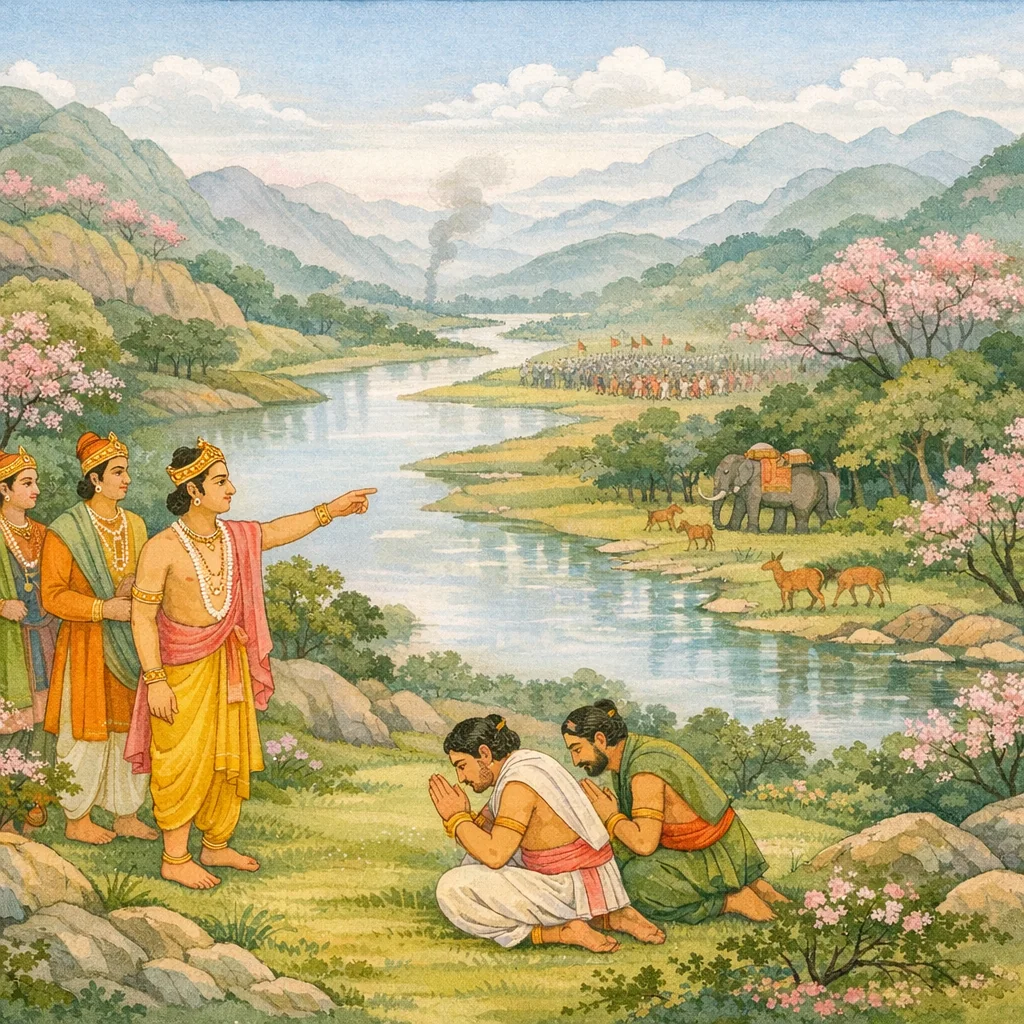
Sarga 93
चित्रकूटमार्गवर्णनम् — Bharata’s Army Reaches Chitrakuta and Searches for Rama
अयोध्याकाण्ड
Sarga 93 depicts Bharata’s righteous advance with a vast fourfold army whose movement transforms the forest soundscape and ecology: elephants and deer scatter, birds fall silent, and dust rises only to be swept away by the wind. The chapter then pivots to geographic recognition—Bharata identifies Citrakūṭa and the Mandākinī, describing ridges, flowering trees, and animal-filled slopes with layered similes (clouds, ocean-waves, autumn skies). Addressing Śatrughna, the narration emphasizes how the landscape, though naturally formidable, appears hospitable due to ascetic presence—“like a pathway to heaven.” The tactical objective follows: Bharata orders a controlled search, halting the army while he proceeds with Sumantra and Vasiṣṭha. Scouts observe a column of smoke and infer habitation, reasoning that fire cannot exist in a place devoid of people; thus Rama and Lakshmana are likely nearby (or ascetics resembling them). The sarga closes with the army’s restrained anticipation and joy at the imminent reunion, linking environmental description to ethical restraint and purposeful governance.
Shlokas
Verse 1
तया महत्या यायिन्या ध्वजिन्या वनवासिनः। अर्दिता यूथपा मत्ताः सयूथास्सम्प्रदुद्रुवुः।।2.93.1।।
Startled by that vast army on the march, the forest-dwelling herd-leaders—maddened with alarm—fled away together with their herds.
Verse 2
ऋक्षाः पृषतसङ्घाश्च रुरवश्च समन्ततः। दृश्यन्ते वनराजीषु गिरिष्वपि नदीषु च।।2.93.2।।
Bears, herds of dappled deer, and antelopes are seen on every side—through the forest-stretches, on the hills, and along the rivers as well.
Verse 3
स सम्प्रतस्थे धर्मात्मा प्रीतो दशरथात्मजः। वृतो महत्या नादिन्या सेनया चतुरङ्गया।।2.93.3।।
Bharata, the righteous son of Daśaratha, set out with gladness, surrounded by a great clamorous army of the four divisions.
Verse 4
सागरौघनिभा सेना भरतस्य महात्मनः। महीं सञ्छादयामास प्रावृषि द्यामिवाम्बुदः।।2.93.4।।
The army of the great-souled Bharata, like the surging waves of the ocean, covered the earth, as rain-season clouds cover the sky.
Verse 5
तुरङ्गौघैरवतता वारणैश्च महाजवैः।अनालक्ष्या चिरं कालं तस्मिन्काले बभूव भूः।।2.93.5।।
Overspread by multitudes of horses and swift elephants, the earth became, for a long while at that time, scarcely visible.
Verse 6
स यात्वा दूरमध्वानं सुपरिश्रान्तवाहनः। उवाच भरत श्श्रीमान् वसिष्ठं मन्त्रिणां वरम्।।2.93.6।।
After travelling a long road, with his draught-animals greatly wearied, the illustrious Bharata spoke to Vasiṣṭha, the foremost among counsellors.
Verse 7
यादृशं लक्ष्यते रूपं यथा चैव श्रुतं मया।व्यक्तं प्राप्ताः स्म तं देशं भरद्वाजो यमब्रवीत्।।2.93.7।।
From the appearance that is seen here, and from what I had heard, it is clear that we have reached the region of which Bharadvāja spoke.
Verse 8
अयं गिरिश्चित्रकूट इयं मन्दाकिनी नदी। एतत्प्रकाशते दूरान्नीलमेघनिभं वनम्।।2.93.8।।
This is Mount Citrakūṭa, and this is the river Mandākinī; and from afar that forest gleams, like a dark-blue cloud.
Verse 9
गिरे स्सानूनि रम्याणि चित्रकूटस्य सम्प्रति। वारणैरवमृद्यन्ते मामकै पर्वतोपमैः।।2.93.9।।
Now the lovely ridges of Mount Citrakūṭa are being trampled by my elephants—huge as mountains.
Verse 10
मुञ्चन्ति कुसुमान्येते नगाः पर्वतसानुषु।नीला इवातपापाये तोयं तोयधरा घनाः।।2.93.10।।
On the mountain slopes these trees shed blossoms, as though dense blue rain-clouds at summer’s end were pouring down water.
Verse 11
किन्नराचरितं देशं पश्य शत्रुघ्न पर्वतम्। मृगैस्समन्तादाकीर्णं मकरैरिव सागरम्।।2.93.11।।
O Śatrughna, look upon this mountain region, frequented by Kinnaras, teeming with animals on every side—like the ocean crowded with mighty makaras.
Verse 12
एते मृगगणा भान्ति शीघ्रवेगाः प्रचोदिताः। वायुप्रविद्धा श्शरदि मेघराजिरिवाम्बरे।।2.93.12।।
Driven on, these swift herds of deer appear like streaks of cloud in the autumn sky, scattered and hurled about by the wind.
Verse 13
कुर्वन्ति कुसुमापीडान् शिरस्सु सुरभीनमी। मेघप्रकाशैः फलकैर्दाक्षिणात्या यथा नराः।।2.93.13।।
These (trees) seem to place fragrant garlands upon their ‘heads’, like southern men who wear bright, cloud-like shields as head-gear.
Verse 14
निष्कूजमिव भूत्वेदं वनं घोरप्रदर्शनम्। अयोध्येव जनाकीर्णा सम्प्रति प्रतिभाति मा।।2.93.14।।
This forest, once dreadful to behold and as though devoid of birdsong, now appears to me like Ayodhyā itself—crowded with people.
Verse 15
खुरैरुदीरितो रेणुर्दावं प्रच्छाद्य तिष्ठति। तं वहत्यनिल श्श्रीघ्रं कुर्वन्निव मम प्रियम्।।2.93.15।।
The dust kicked up by the horses’ hooves blankets the forest; yet the wind swiftly carries it away, as though it were acting to give me relief.
Verse 16
स्यन्दनांस्तुरगोपेतान्सूतमुख्यै रधिष्ठितान्। एतान्सम्पततश्श्रीघ्रं पश्य शत्रुघ्न कानने।।2.93.16।।
Look, Śatrughna—these horse-drawn chariots, directed by expert charioteers, seem to fly swiftly through the forest.
Verse 17
एतान्वित्रासितान्पश्यबर्हिणः प्रियदर्शनान्। एतमाविशत श्श्रीघ्रमधिवासं पतत्रिणः।।2.93.17।।
See these lovely peacocks, startled—along with other birds—hurrying quickly into their nesting-places.
Verse 18
अतिमात्रमयं देशो मनोज्ञः प्रतिभाति मे। तापसानां निवासोऽयं व्यक्तं स्वर्गपथो यथा।।2.93.18।।
This region appears exceedingly beautiful to me; being an abode of ascetics, it seems plainly like a path leading to heaven.
Verse 19
मृगा मृगीभिः सहिता बहवः पृषता वने। मनोज्ञरूपा दृश्यन्ते कुसुमैरिव चित्रिताः।।2.93.19।।
In this forest many spotted deer, together with their does, are seen—charming in form, as though painted with flowers.
Verse 20
साधु सैन्याः प्रतिष्ठन्तां विचिन्वन्तु च कानने। यथा तौ पुरुषव्याघ्रौ दृश्येते रामलक्ष्मणौ।।2.93.20।।
Let the troops advance properly and search through the forest, until those two tiger-like men—Rama and Lakshmana—are sighted.
Verse 21
भरतस्य वचश्श्रुत्वा पुरुषाश्शस्त्रपाणयः। विविशु स्तद्वनं शूरा धूमं च ददृशु स्ततः।।2.93.21।।
Hearing Bharata’s command, the valiant men—bearing weapons in their hands—entered that forest; and then they saw smoke rising there.
Verse 22
ते समालोक्य धूमाग्रमूचुर्भरतमागताः। नामनुष्ये भवत्यग्नि र्व्यक्तमत्रैव राघवौ।।2.93.22।।
After seeing the column of smoke, they returned to Bharata and said: “In a place without people, fire does not arise; plainly, the two Rāghavas must be here.”
Verse 23
अथ नाऽत्र नरव्याघ्रौ राजपुत्रौ परन्तपौ। अन्ये रामोपमा स्सन्ति व्यक्तमत्र तपस्विनः।।2.93.23।।
Otherwise, if the two tiger-like princes—subduers of foes—are not here, then it is evident that other ascetics, resembling Rama, must be dwelling here.
Verse 24
तच्छ्रुत्वा भरतस्तेषां वचनं साधुसम्मतम्। सैन्यानुवाच सर्वांस्तानमित्रबलमर्दनः।।2.93.24।।
Hearing their words—approved by the righteous—Bharata, the crusher of hostile forces, addressed all those troops.
Verse 25
यत्ता भवन्तस्तिष्ठन्तु नेतो गन्तव्यमग्रतः। अहमेव गमिष्यामि सुमन्त्रो गुरुरेव च।।2.93.25।।
“All of you remain here, vigilant; you must not go forward from here. I alone will proceed—along with Sumantra and the revered preceptor.”
Verse 26
एवमुक्ता स्ततस्सर्वे तत्र तस्थुः समन्तः। भरतो यत्र धूमाग्रं तत्र दृष्टिं समादधात्।।2.93.26।।
Thus addressed, all of them halted there on every side. Bharata then fixed his gaze toward the place where the column of smoke rose.
Verse 27
व्यवस्थिता या भरतेन सा चमूर्निरीक्षमाणाऽपि च भूमिमग्रतः। बभूव हृष्टा न चिरेण जानती प्रियस्य रामस्य समागमं तदा।।2.93.27।।
The army that Bharata had made halt—though still watching the ground ahead—rejoiced then, knowing that before long they would meet their beloved Rāma.
Frequently Asked Questions
The key action is Bharata’s disciplined leadership: he halts the massive army to avoid disorder in the forest and proceeds forward only with trusted elders (Sumantra and Vasiṣṭha), balancing urgency to find Rama with restraint and responsibility.
The sarga models dharma as practical discernment: signs in the world (the smoke column) are interpreted through reason and moral context, showing how right action combines observation, inference, and controlled conduct rather than impulse.
Citrakūṭa mountain and the Mandākinī river are explicitly identified; the chapter also highlights ascetic habitation as a cultural marker that redefines the forest from “dreadful” to spiritually hospitable, “like a pathway to heaven.”