Sarga 77
और्ध्वदैहिकक्रिया-शोकविलापः (Obsequies for Daśaratha and the Brothers’ Lament)
अयोध्याकाण्ड
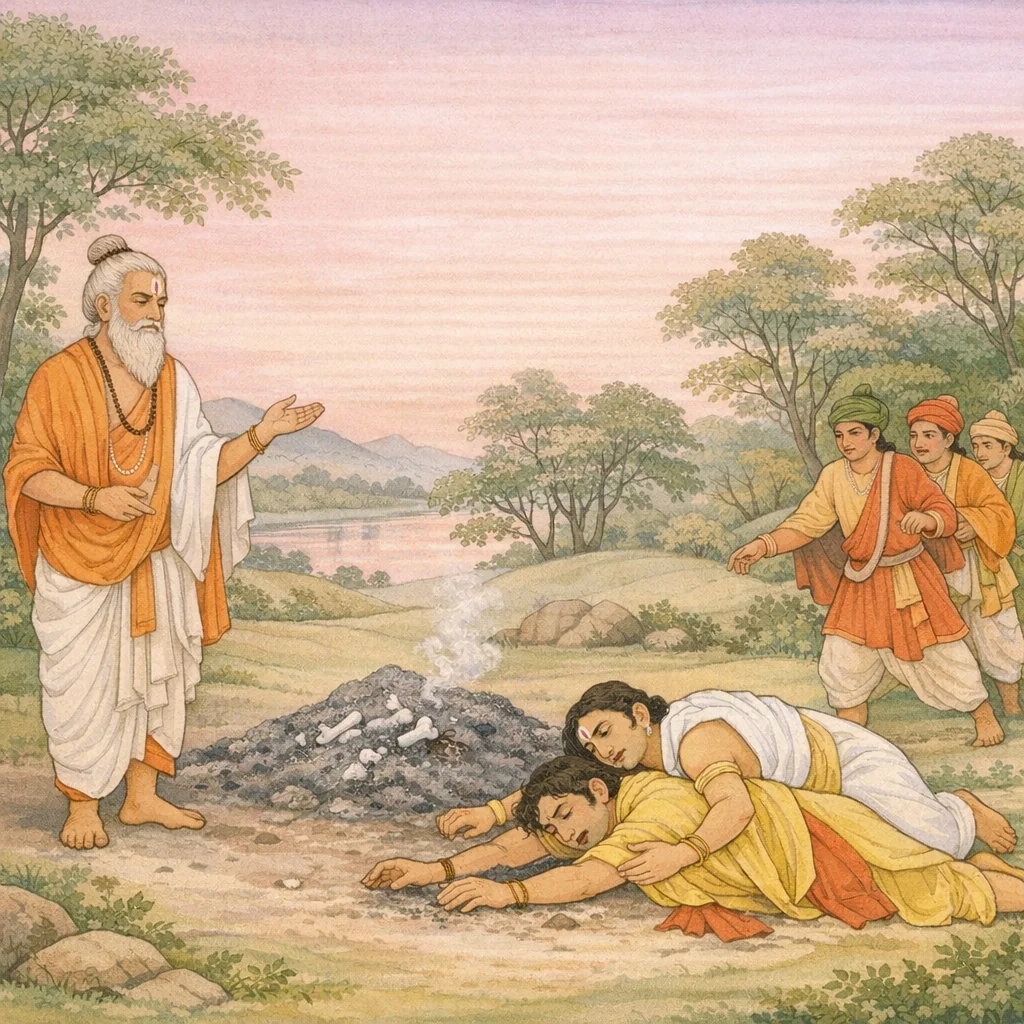
Sarga 77 stages the ritual and psychological aftermath of Daśaratha’s death. After the ten-day mourning period, Bharata undergoes purification and, on the twelfth day, commissions śrāddha rites, distributing extensive gifts to brāhmaṇas—wealth, food-grain, garments, gems, herds, servants, vehicles, and dwellings—marking the epic’s attention to funerary economy and royal obligation. On the thirteenth day at dawn, Bharata approaches the cremation ground for further purification, sees the ash-and-bone-marked pyre-site, collapses, and laments his father’s departure, Kausalyā’s abandonment, and Rāma’s exile. Śatrughna, overwhelmed by the spectacle of Bharata’s grief and remembrance of the king, also faints and then laments, voicing a metaphor of a ‘sea of sorrow’ sourced in Mantharā and made perilous by Kaikeyī, with boons as an immovable force. Attendants and ministers rush to support them. Vasiṣṭha admonishes Bharata that the thirteenth day has arrived while the remains still await completion of rites, and he teaches the inevitability of dualities (hunger/thirst, pleasure/pain, birth/death). Sumantra similarly consoles Śatrughna with instruction on universal becoming and cessation. The brothers rise, tearful and exhausted, and are urged to finish remaining funerary duties, integrating grief with dharmic procedure.
Shlokas
Verse 1
ततो दशाहेऽतिगते कृतशौचो नृपात्मजः।द्वादशेऽहनि सम्प्राप्ते श्राद्धकर्माण्यकारयत्।।।।
Then, when the ten days had passed, the king’s son, having completed the purification rites, had the śrāddha ceremonies performed when the twelfth day arrived.
Verse 2
ब्राह्मणेभ्यो ददौ रत्नं धनमन्नं च पुष्कलम्।वासांसि च महार्हाणि रत्नानि विविधानि च।।।।
During the śrāddha rites, Bharata gave the brahmins precious stones, wealth, abundant food-grain, highly valuable garments, and gems of many kinds.
Verse 3
बास्तिकं बहु शुक्लं च गाश्चापि शतशस्तथा।दासीदासं च यानं च वेश्मानि सुमहान्ति च।।।।ब्राह्मणेभ्यो ददौ पुत्रो राज्ञस्तस्यौर्ध्वदैहिकम्।
For the king’s rites that secure welfare beyond this life, the son gave the brahmins many white goats, cows by the hundreds, male and female servants, conveyances, and spacious houses.
Verse 4
ततः प्रभातसमये दिवसेऽथ त्रयोदशे।।।।विललाप महाबाहुर्भरत श्शोकमूर्छितः।शब्दापिहितकण्ठस्तु शोधनार्थमुपागतः।।।।चितामूले पितुर्वाक्यमिदमाह सुदुःखितः।
Then, at dawn on the thirteenth day, mighty-armed Bharata—faint with grief—came for the purificatory observance; his voice choked by sobs, he spoke these words at the foot of his father’s pyre.
Verse 5
ततः प्रभातसमये दिवसेऽथ त्रयोदशे।।2.77.4।।विललाप महाबाहुर्भरत श्शोकमूर्छितः।शब्दापिहितकण्ठस्तु शोधनार्थमुपागतः।।2.77.5।।चितामूले पितुर्वाक्यमिदमाह सुदुःखितः।
Then, at dawn on the thirteenth day, mighty-armed Bharata—overpowered by grief—came for the purificatory rite; his throat constricted by sobs, he spoke these words at the foot of his father’s pyre.
Verse 6
तात यस्मिन्निसृष्टोऽहं त्वया भ्रातरि राघवे।।।।तस्मिन्वनं प्रव्रजिते शून्ये त्यक्तोऽस्म्यहं त्वया।
Father—when you entrusted me to my brother Rāghava, now that he has been sent to the forest, I have been abandoned by you into emptiness.
Verse 7
यस्या गतिरनाथायाः पुत्रः प्रवाजितो वनम्।तामम्बां तात कौसल्यां त्यक्त्वा त्वं क्व गतो नृप।।।।
Father—where have you gone, O king, abandoning mother Kausalyā, left without a protector, whose only refuge—her son—has been driven to the forest?
Verse 8
दृष्ट्वा भस्मारुणं तच्च दग्धास्थि स्थानमण्डलम्।।।।पितु श्शरीरनिर्वाणं निष्टनन्विषसाद सः।
Seeing that circular patch—reddened with ash and burnt bones—where his father’s body had been extinguished, he cried aloud and sank into despair.
Verse 9
स तु दृष्ट्वा रुदन् दीनः पपात धरणीतले।।।।उत्थाप्यमानश्शक्रस्य यन्त्रध्वज इव च्युतः।
Having seen it, he wept in desolation and fell upon the ground—like Indra’s fixed banner-staff that slips and collapses even as it is being raised.
Verse 10
अभिपेतुस्ततस्सर्वे तस्यामात्याश्शुचिव्रतम्।।।।अन्तकाले निपतितं ययातिमृषयो यथा।
Then all his ministers rushed toward him—like sages rushing to Yayāti, a man of pure vows, when he fell at the final hour.
Verse 11
शत्रुघ्न श्चापि भरतं दृष्ट्वा शोकम् परिप्लुतः।।।।विसंज्ञो न्यपतद्भूमौ भूमिपालमनुस्मरन्।
Śatrughna too, seeing Bharata, was flooded with grief; remembering the king, he lost consciousness and fell to the ground.
Verse 12
उन्मत्त इव निश्चेता विललाप सुदुःखितः।।।।स्मृत्वा पितुर्गुणाङ्गानि तानि तानि तथा तथा।
In profound sorrow, his mind unsteady as if mad, he lamented—recalling again and again those many virtues of his father.
Verse 13
मन्थराप्रभवस्तीव्रः कैकेयीग्राहसङ्कुलः।।।।वरदानमयोऽक्षोभ्योऽमञ्जयच्छोकसागरः।
A terrible sea of sorrow has engulfed us—born of Mantharā, crowded with Kaikeyī as its crocodile, taking the form of irrevocable boons, and lying unshaken in its force.
Verse 14
सुकुमारं च बालं च सततं लालितं त्वया।।।।क्व तात भरतं हित्वा विलपन्तं गतो भवान्।
O father, where have you gone, leaving Bharata—so tender and so young, always cherished by you—now left to lament?
Verse 15
ननु भोज्येषु पानेषु वस्त्रेष्वाभरणेषु च।।।।प्रवारयसि नस्सर्वान् तन्नः कोऽन्यः करिष्यति।
Did you not always have all of us choose among fine foods and drinks, garments and ornaments? Who else will do that for us now?
Verse 16
अवदारणकाले तु पृथिवी नावदीर्यते।।।।या विहीना त्वया राज्ञा धर्मज्ञेन महात्मना।
When it ought to split apart, the earth does not break—though it is bereft of you, the king, a great-souled knower of dharma.
Verse 17
पितरि स्वर्गमापन्ने रामे चारण्यमाश्रिते।।।।किं मे जीवितसामर्थ्यं प्रवेक्ष्यामि हुताशनम्।
With my father gone to heaven and Rāma taking refuge in the forest, what strength have I to go on living? I will enter the consuming fire.
Verse 18
हीनो भ्रात्रा च पित्रा च शून्यामिक्ष्वाकुपालिताम्।।।।अयोध्यां न प्रवेक्ष्यामि प्रवेक्ष्यामि तपोवनम्।
Deprived of both brother and father, I will not enter Ayodhyā—now empty of the Ikṣvāku rule; I will enter a forest-grove of austerity instead.
Verse 19
तयोर्विलपितं श्रुत्वा व्यसनं चान्ववेक्ष्य तत्।।।।भृशमार्ततरा भूयस्सर्वएवानुगामिनः।
Hearing the lament of the two brothers and considering that calamity, all the attendants became even more intensely distressed once again.
Verse 20
ततो विषण्णौ श्रान्तौ च शत्रुघ्नभरतावुभौ।।।।धरण्यां संव्यवेष्टेतां भग्नशृङ्गाविवर्षभौ।
Then Bharata and Śatrughna, both dejected and exhausted, lay twisting on the ground like two bulls with broken horns.
Verse 21
ततः प्रकृतिमान्वैद्यः पितुरेषां पुरोहितः।।।।वसिष्ठो भरतं वाक्यमुत्थाप्य तमुवाच ह।
Then Vasiṣṭha—their father’s purohita, learned and composed—raised Bharata and spoke these words to him.
Verse 22
त्रयोदशोऽयं दिवसः पितुर्वृत्तस्य ते विभो।।।।सावशेषास्थिनिचये किमिह त्वं विलम्भसे।
O lord, this is the thirteenth day since your father’s passing; while the heap of bones still remains, why do you delay here?
Verse 23
त्रीणि द्वन्द्वानि भूतेषु प्रवृत्तान्यविशेषतः।।।।तेषु चापरिहार्येषु नैवं भवितुमर्हसि।
Three pairs of opposites operate among beings without exception, and they cannot be avoided; therefore it does not befit you to be overcome like this.
Verse 24
सुमन्त्रश्चापि शत्रुघ्नमुत्थाप्याभिप्रसाद्य च।।।।श्रावयामास तत्त्वज्ञ स्सर्वभूतभवाभवम्।
Sumantra too—knower of truth—raised Śatrughna, consoled him, and made him hear the teaching on the arising and passing away of all beings.
Verse 25
उत्थितौ च नरव्याघ्रौ प्रकाशेते यशस्विनौ।।।।वर्षातपपरिक्लिनौ पृथगिन्द्रध्वजाविव।
When they rose up, those illustrious tigers among men shone forth—yet they looked weather-worn and dulled by sun and rain, like Indra’s banners standing apart.
Verse 26
अश्रूणि परिमृद्नन्तौ रक्ताक्षौ दीनभाषिणौ।अमात्यास्त्वरयन्ति स्म तनयौ चापराः क्रियाः।।।।
As the two sons wiped away their tears—eyes reddened, voices broken—the ministers urged them on to complete the remaining funeral rites.
Frequently Asked Questions
The sarga frames the tension between overwhelming personal grief and the necessity of completing prescribed funerary obligations: Bharata and Śatrughna must be raised from collapse to fulfill śrāddha and remaining rites for the deceased king.
Vasiṣṭha’s instruction emphasizes that unavoidable dualities condition embodied life, culminating in birth and death; therefore, sorrow must be acknowledged yet disciplined into dharmic action, while Sumantra reinforces the universality of arising and passing away.
The cremation ground and the foot of the funeral pyre serve as the central ritual landmark; culturally, the narrative highlights the ten-day mourning observance, purification, twelfth-day śrāddha, thirteenth-day rites, and dāna (gift-giving) to brāhmaṇas as part of royal funerary protocol.