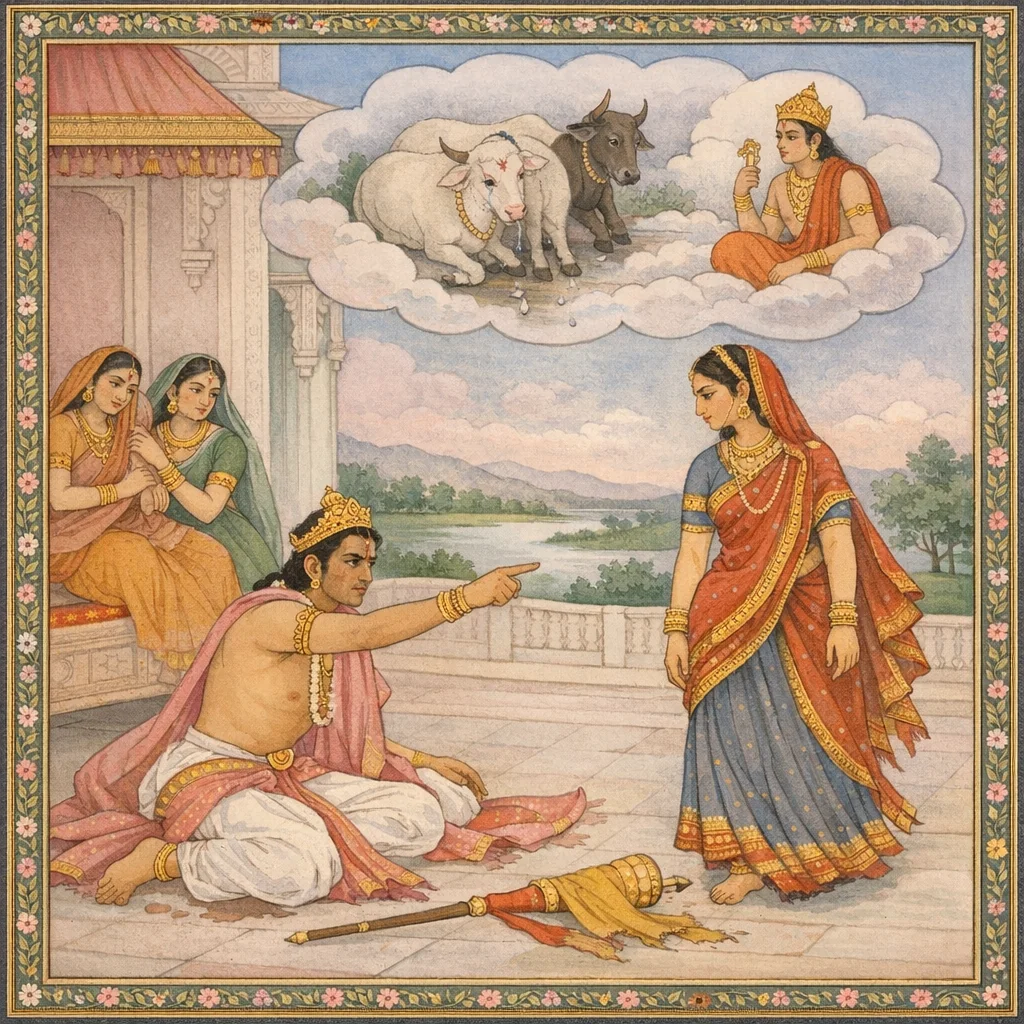
Sarga 74
भरतस्य कैकेयी-गर्हा तथा सुरभि-दृष्टान्तः (Bharata’s Reproach of Kaikeyi and the Surabhi Exemplum)
अयोध्याकाण्ड
Sarga 74 intensifies Bharata’s repudiation of Kaikeyī after Daśaratha’s death and Rāma’s exile. Bharata, overtaken by wrath, denounces Kaikeyī’s conduct as adharma, portrays the political and social fallout—loss of father, estrangement from brothers, and public hatred—and frames her act as a sin that fractures the Ikṣvāku moral order. He invokes punitive consequences (loss of kingdom, hell, and social abandonment) and articulates his own crisis of legitimacy: he cannot bear the “burden” of a sin attributed to him by association while citizens watch in grief. The sarga then shifts to an illustrative narrative (dṛṣṭānta) about Surabhī/Kāmadhenu: despite having innumerable offspring, she weeps for two overburdened sons (bulls), leading Indra to infer the incomparable dearness of a son. Bharata leverages this exemplum to underscore Kausalyā’s suffering as a mother separated from her only son, thereby sharpening the ethical indictment of Kaikeyī. The chapter closes with Bharata’s vow to restore honor by bringing Rāma back; failing that, he will renounce comfort and enter the ascetic forest. The emotional climax ends with Bharata collapsing to the ground, likened to a fallen festival banner of Indra—an image of exhausted authority and grief.
Shlokas
Verse 1
तां तथा गर्हयित्वा तु मातरं भरतस्तदा।रोषेण महताऽविष्टः पुनरेवाब्रवीद्वचः।।।।
Then Bharata—having thus reproached his mother and seized by intense wrath—once again addressed her with words.
Verse 2
राज्याद्भ्रंशस्व कैकेयि नृशंसे दुष्टचारिणि।परित्यक्ता च धर्मेण मा मृतं रुदती भव।।।।
O Kaikeyi—cruel and of wicked conduct—may you fall from royal power. Cast off by righteousness itself, may you weep over me when I am dead.
Verse 3
किन्नु तेऽदूषयद्राजा रामो वा भृशधार्मिकः।ययोर्मृत्युर्विवासश्च त्वत्कृते तुल्यमागतौ।।।।
What wrong did the king—or Rama, so deeply devoted to dharma—ever do to you, that because of you death has come to one and exile, an equal calamity, to the other?
Verse 4
भ्रूणहत्यामसि प्राप्ता कुलस्यास्य विनाशनात्।कैकेयि नरकं गच्छ मा च भर्तु स्सलोकताम्।।।।
By bringing ruin upon this royal line, O Kaikeyi, you have incurred the sin likened to killing an embryo. Go to hell—and do not attain the same blessed realm as your husband.
Verse 5
यत्त्वया हीदृशं पापं कृतं घोरेण कर्मणा।सर्वलोकप्रियं हित्वा ममाप्यापादितं भयम्।।।।
By committing so dreadful a deed—abandoning Rāma, beloved of all— you have incurred grave sin; and even I am seized by fear because of it.
Verse 6
त्वत्कृते मे पिता वृत्तो रामश्चारण्यमाश्रितः।अयशो जीवलोके च त्वयाऽहं प्रतिपादितः।।।।
Because of you, my father has perished and Rāma has taken refuge in the forest; and because of you I have gained only disgrace among the living.
Verse 7
मातृरूपे ममामित्रे नृशंसे राज्यकामुके।न तेऽह मभिभाष्योऽस्मि दुर्वृत्ते पतिघातिनि।।।।
O enemy wearing a mother’s form—cruel, hungry for the kingdom—vicious in conduct and a slayer of your husband: I will not speak to you.
Verse 8
कौसल्या च सुमित्रा च याश्चान्या मम मातरः।दुःखेन महताऽविष्टास्त्वां प्राप्य कुलदूषिणीम्।।।।
Kauśalyā, Sumitrā, and my other mothers are overwhelmed by immense sorrow, having to endure you—one who has brought ruin upon the royal line.
Verse 9
न त्वमश्वपतेः कन्या धर्मराजस्य धीमतः।राक्षसी तत्र जाताऽसि कुलप्रध्वंसिनी पितुः।।।।यत्त्वया धार्मिको रामो नित्यं सत्यपरायणः।वनं प्रस्थापितो दुःखात्पिता च त्रिदिवं गतः।।।।
You are not truly the daughter of Aśvapati, that wise and righteous king; you are a rākṣasī born there to destroy your father’s line—since by you Rāma, virtuous and ever devoted to truth, was driven to the forest, and my father, from grief, went to heaven.
Verse 11
यत्प्रधानाऽसि तत्पापं मयि पित्रा विनाकृते।भ्रातृभ्यां च परित्यक्ते सर्वलोकस्य चाप्रिये।।।।
That sin—done with a fixed aim—has fallen upon me: I have been made fatherless; I am abandoned by my brothers, and I have become displeasing to all the people.
Verse 12
कौसल्यां धर्मसंयुक्तां वियुक्तां पापनिश्चये।कृत्वा कं प्राप्स्यसे त्वद्य लोकं निरयगामिनि।।।।
O woman fixed in sin—bound for hell—having separated righteous Kausalyā (from her son), what world do you think you will attain hereafter?
Verse 13
किं नावबुध्यसे क्रूरे नियतं बन्धुसंश्रयम्।ज्येष्ठं पितृसमं रामं कौसल्यायाऽत्मसम्भवम्।।।।
O cruel one, do you not understand that Rāma—Kausalyā’s own-born son—is the eldest, self-restrained, equal to my father, and a refuge for his kin?
Verse 14
अङगप्रत्यङगजः पुत्रो हृदयाच्चापि जायते।तस्मात्प्रियतमो मातुः प्रिया एव तु बान्धवाः।।।।
A son is born, as it were, from every limb and even from the mother’s heart; therefore, to a mother he is the dearest—while other relatives are dear only in a lesser sense.
Verse 15
अन्यदा किल धर्मज्ञा सुरभि स्सुरसम्मता।वहमानौ ददर्शोर्व्यां पुत्रौ विगतचेतसौ।।।।
It is said that once Surabhī—knower of dharma and honored among the gods—saw on the earth her two sons, bearing burdens and fainting from exhaustion.
Verse 16
तावर्धदिवसे श्रान्तौ दृष्ट्वा पुत्रौ महीतले।रुरोद पुत्रशोकेन बाष्पपर्याकुलेक्षणा।।।।
Seeing her two sons, weary at midday and lying on the ground, she wept from sorrow for her children, her eyes clouded with tears.
Verse 17
अधस्ताद्व्रजतस्तस्याः सुरराज्ञो महात्मनः।बिन्दवः पतिता गात्रे सूक्ष्मा स्सुरभिगन्धिनः।।।।
As she moved above, fine drops—fragrant with Surabhī’s scent—fell downward upon the body of the great king of the gods.
Verse 18
इन्द्रोऽप्यश्रुनिपातं तं स्वगात्रे पुण्यगन्धिनम्।सुरभिं मन्यते दृष्ट्वा भूयसीं तां सुरेश्वरः।।।।
Even Indra, lord of the gods, seeing that fall of tears—of sacred fragrance—upon his own body, recognized them as coming from the greatly revered Surabhī.
Verse 19
निरीक्षमाण श्शक्रस्तां ददर्श सुरभिं स्थिताम्।आकाशे विष्ठितां दीनां रुदन्तीं भृशदुःखिताम्।।।।
Looking about, Śakra (Indra) beheld Surabhī stationed in the sky—distressed, miserable, wailing, and stricken with intense sorrow.
Verse 20
तां दृष्ट्वा शोकसन्तप्तां वज्रपाणिर्यशस्विनीम्।इन्द्रः प्राञ्जलिरुद्विग्न स्सुरराजोऽब्रवीद्वचः।।।।
Seeing the renowned Surabhi (Kāmadhenu) consumed by grief, Indra—the lord of the gods, bearer of the thunderbolt—stood with folded hands, alarmed, and spoke these words.
Verse 21
भयं कच्छिन्न चास्मासु कुतश्चिद्विद्यते महत्।कुतोनिमत्तश्शोकस्ते ब्रूहि सर्वहितैषिणि।।।।
O well-wisher of all, I trust no great fear has arisen for us from any quarter. From what cause does your sorrow come? Tell me.
Verse 22
एवमुक्ता तु सुरभि स्सुरराजेन धीमता।प्रत्युवाच ततो धीरा वाक्यं वाक्यविशारदा।।।।
Thus addressed by the wise king of the gods, Surabhi—steadfast and skilled in speech—then replied.
Verse 23
शान्तं पापं न वः किञ्चित्कुतश्चिदमराधिपः।अहं मग्नौ तु शोचामि स्वपुत्रौ विषमे स्थितौ।।।।एतौ दृष्ट्वा कृशौ दीनौ सूर्यरश्मिप्रतापितौ।बाध्यमानौ बलीवर्धौ कर्षकेण सुराधिप।।।।
God forbid, O lord of the immortals—no calamity has come upon you from any side. It is I who grieve, sunk in sorrow, for my own two sons caught in distress. Seeing those two—wretched, emaciated, scorched by the sun’s rays—those bulls being beaten by a ploughman, O lord of the gods, I am overwhelmed with grief.
Verse 24
शान्तं पापं न वः किञ्चित्कुतश्चिदमराधिपः।अहं मग्नौ तु शोचामि स्वपुत्रौ विषमे स्थितौ।।2.74.23।।एतौ दृष्ट्वा कृशौ दीनौ सूर्यरश्मिप्रतापितौ।बाध्यमानौ बलीवर्धौ कर्षकेण सुराधिप।।2.74.24।।
God forbid, O lord of the immortals—no calamity has come upon you from any side. It is I who grieve for my two sons in distress; seeing those bulls, wretched and thin, scorched by the sun, and beaten by a ploughman, I am plunged in sorrow.
Verse 25
ममकायात्प्रसूतौ हि दुःखितौ भारपीडितौ।यौ दृष्ट्वा परितप्येऽहं नास्ति पुत्रसमः प्रियः।।।।
Born from my own body, they are anguished and crushed beneath the burden. Seeing them, I burn with grief—there is none dear like a son.
Verse 26
यस्याः पुत्रसहस्रैस्तु कृत्स्नं व्याप्तमिदं जगत्।तां दृष्ट्वा रुदतीं शक्रो न सुतान्मन्यते परम्।।।।
Though the whole world is filled with her thousand sons, when Śakra (Indra) saw her weeping, he understood: nothing is held higher than one’s own child.
Verse 27
सदाऽप्रतिमवृत्तायाः लोकधारणकाम्यया।श्रीमत्या गुणनित्याया स्स्वभावपरिचेष्टया।।।।यस्याः पुत्रसहस्राणि साऽपि शोचति कामधुक्।किं पुनर्या विना रामं कौसल्या वर्तयिष्यति।।।।
Even Kāmadhenu—ever of unmatched conduct, intent on sustaining the worlds, prosperous, ever-abiding in virtues, acting according to her noble nature—grieves, though she has a thousand sons. What then of Kausalyā, separated from Rāma? How could she continue as before?
Verse 28
सदाऽप्रतिमवृत्तायाः लोकधारणकाम्यया। श्रीमत्या गुणनित्याया स्स्वभावपरिचेष्टया।।2.74.27।। यस्याः पुत्रसहस्राणि साऽपि शोचति कामधुक्। किं पुनर्या विना रामं कौसल्या वर्तयिष्यति।।2.74.28।।
Ever intent on sustaining the worlds and of unequalled conduct, virtuous and prosperous by nature—if even Kāmadhenu, with a thousand sons, grieves, what then of Kausalyā without Rāma? How could she remain herself?
Verse 29
एकपुत्रा च साध्वी च विवत्सेयं त्वया कृता।तस्मात्त्वं सततं दुःखं प्रेत्य चेह च लप्स्यसे।।।।
This pious queen—blessed with only one son—has been made childless by you. Therefore you will meet unbroken sorrow, both here in this life and after death.
Verse 30
अहं ह्यपचितिं भ्रातुः पितुश्च सकलामिमाम्।वर्धनं यशसश्चापि करिष्यामि न संशयः।।।।
For my part, I will certainly do all that is needed as full amends to my brother and my father—and I will also restore and increase their honour; of this there is no doubt.
Verse 31
अनाययित्वा तनयं कौसल्याया महाबलम्।स्वयमेव प्रवेक्ष्यामि वनं मुनिनिषेवितम्।।।।
If I do not bring back Kausalya’s mighty son, I myself will enter the forest—haunted and dwelt in by ascetics.
Verse 32
न ह्यहं पापसङ्कल्पे पापे पापं त्वया कृतम्।शक्तो धारयितुं पौरैरश्रुकण्ठै र्निरीक्षितः।।।।
O evil-minded, wicked woman—watched by the citizens whose throats are choked with tears—I cannot bear the weight of the sin you have committed.
Verse 33
सा त्वमग्निं प्रविश वा स्वयं वा दण्डकान्विश।रज्जुं बधान वा कण्ठे न हि तेऽन्यत्परायणम्।।।।
You—go enter fire, or go yourself into the Dandaka wilderness, or fasten a rope around your neck; for you there is no other refuge left.
Verse 34
अहमप्यवनीं प्राप्ते रामे सत्यपराक्रमे।कृतकृत्यो भविष्यामि विप्रवासितकल्मषः।।।।
When Rama—whose very prowess is grounded in truth—comes to possess the kingdom, then I too will have fulfilled my duty and will be cleansed of all stain.
Verse 35
इति नाग इवारण्ये तोमराङ्कुशचोदितः।पपात भुवि सङ्कृद्धो निश्श्वसन्निव पन्नगः।।।।
Having spoken thus, Bharata—like an elephant in the forest driven by spears and goads—collapsed upon the ground in fury, hissing like a serpent.
Verse 36
संरक्तनेत्र श्शिथिलाम्भरस्तदा विधूतसर्वाभरणः परन्तपः।बभूव भूमौ पतितो नृपात्मजश्शचीपतेः केतुरिवोत्सवक्षये।।।।
Then the prince—scorcher of foes—lay fallen on the ground, his eyes bloodshot, garments disordered, ornaments flung aside, like Indra’s banner left drooping when the festival ends.
Frequently Asked Questions
Bharata confronts the problem of inherited/associative culpability: although he did not engineer the exile, Kaikeyī’s act places a moral stigma on him as beneficiary. He rejects that legitimacy, condemns the deed as adharma, and commits to restoring rightful order by recalling Rāma.
The sarga teaches that moral authority in governance depends on transparent alignment with dharma, not mere succession. It also presents filial love as a universal ethical constant (via Surabhī), strengthening empathy for Kausalyā and clarifying why separation from a righteous son is portrayed as a profound moral injury.
Ayodhyā appears as the civic-moral stage where public grief evaluates rulers; the Daṇḍaka forest is referenced as an extreme recourse (exile/renunciation). The agrarian scene of ploughing (kārṣya labor) functions as a cultural landmark in the Surabhī exemplum, linking cosmic beings (Indra, Kāmadhenu) to everyday rural hardship.