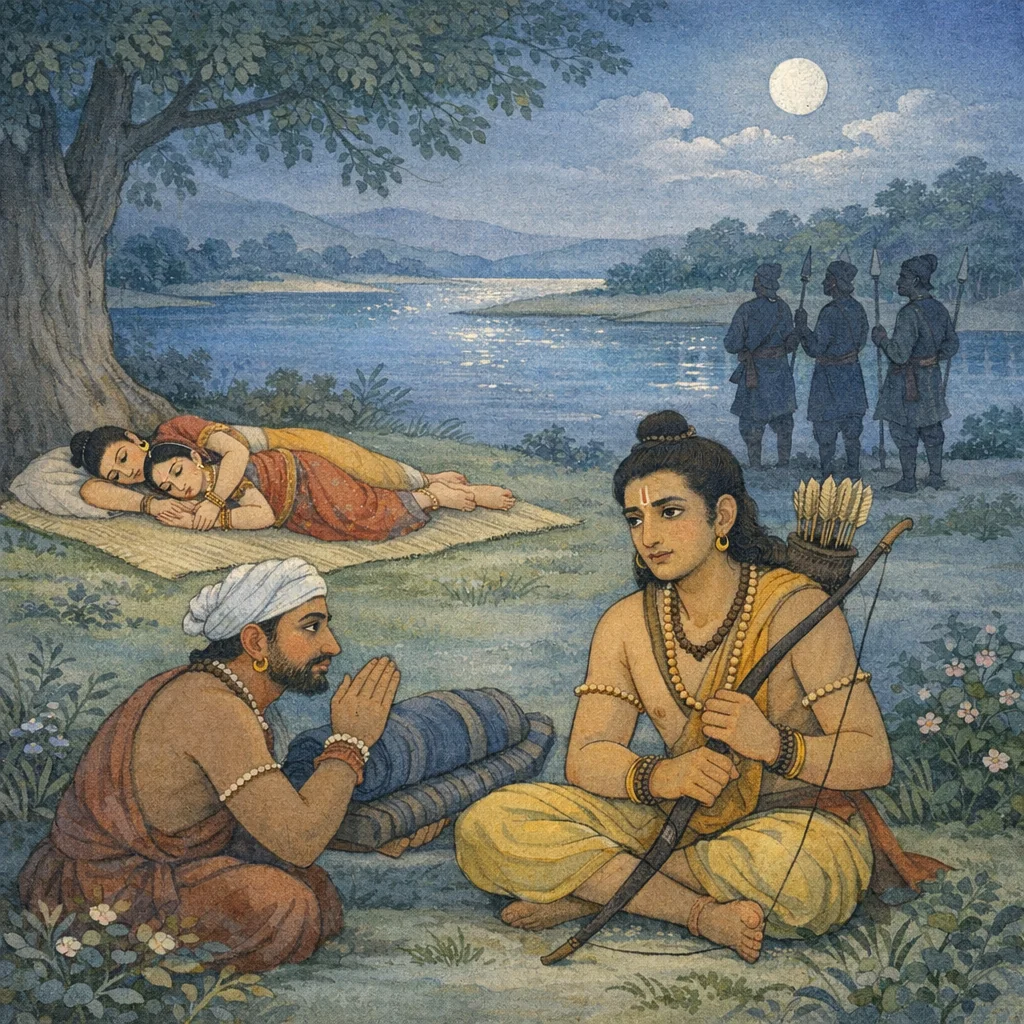
Sarga 51
अयोध्याकाण्डे एकपञ्चाशः सर्गः — Guha’s Vigil and Lakṣmaṇa’s Lament (Night on the riverbank)
अयोध्याकाण्ड
Sarga 51 is structured as a night-scene of protection and grief at the exile camp, where Guha’s practical hospitality and Lakṣmaṇa’s moral anguish converge. Guha, moved by Lakṣmaṇa’s sleepless vigilance for Rāma’s safety, offers a prepared bed and pledges armed protection with his kinsmen, presenting friendship (sauhṛda) as an ethical duty. Lakṣmaṇa refuses ease: he asserts that none is dearer to him than Rāma, and that while Rāma lies on grass with Sītā, sleep and worldly pleasures are impossible for him. The chapter then pivots into lamentation and political-ethical prognosis: Lakṣmaṇa anticipates Daśaratha’s death from unfulfilled coronation desire, foresees Kauśalyā’s collapse, and imagines Ayodhyā’s civic soundscape falling silent after exhaustion and mourning. A contrasting civic catalogue briefly evokes Ayodhyā’s festive prosperity, intensifying the tragedy by juxtaposing ideal urban order with imminent bereavement. The night passes with Lakṣmaṇa still grieving; Guha, hearing the truthful account spoken for the people’s welfare, weeps under the weight of shared suffering—friendship becoming a conduit for communal pathos and dharmic solidarity.
Shlokas
Verse 1
तं जाग्रतमदम्भेन भ्रातुरर्थाय लक्ष्मणम्।गुहः सन्तापसन्तप्तो राघवं वाक्यमब्रवीत्।।।।
Seeing Lakṣmaṇa keeping vigil without any show, solely for his brother’s sake, Guha—burning with grief—spoke these words to Rāghava.
Verse 2
इयं तात सुखा शय्या त्वदर्थमुपकल्पिता।प्रत्याश्वसिहि साध्वस्यां राजपुत्र यथासुखम्।।।।
Dear prince, this comfortable bed has been prepared for your sake; rest well upon it, as you please.
Verse 3
उचितोऽयं जनस्सर्वः क्लेशानां त्वं सुखोचितः।गुप्त्यर्थं जागरिष्यामः काकुत्स्थस्य वयं निशाम्।।।।
All these people are accustomed to hardship, whereas you are accustomed to comfort. Therefore, for the sake of Kakutstha Rama’s protection, we will keep watch throughout the night.
Verse 4
न हि रामात्प्रियतमो ममास्ति भुवि कश्चन।ब्रवीम्येतदहं सत्यं सत्येनैव च ते शपे।।।।
For me, no one in this world is dearer than Rama. I speak this as truth—and by truth itself, I swear it to you.
Verse 5
अस्य प्रसादादाशंसे लोकेस्मिन् सुमुहद्यशः।धर्मावाप्तिं च विपुलामर्थावाप्तिं च केवलम्।।।।
By Rama’s favor alone, I hope in this world to gain great renown—together with abundant attainment of dharma and the acquisition of artha as well.
Verse 6
सोऽहं प्रियसखं रामं शयानं सह सीतया।रक्षिष्यामि धनुष्पाणि स्सर्वतो ज्ञातिभि स्सह।।।।
So I, bow in hand, together with my kinsmen, will guard my dear friend Rama as he rests with Sita—protecting them from every side.
Verse 7
न हि मेऽविदितं किञ्चिद्वनेऽस्मिंश्चरतस्सदा।चतुरङ्गं ह्यपिबलं सुमहत्प्रसहेमहि।।।।
Nothing in this forest is unknown to me, for I move about here always. We could withstand even a vast fourfold army.
Verse 8
लक्ष्मणस्तं तदोवाच रक्ष्यमाणास्त्वयानघ।नात्र भीता वयं सर्वे धर्ममेवानुपश्यता।।।।
Then Lakshmana said to him: “O blameless one, protected by you—who keeps dharma in view—we are not afraid here at all.”
Verse 9
कथं दशरथौ भूमौ शयाने सह सीतया।शक्या निद्रा मया लब्धुं जीवितं वा सुखानि वा।।।।
When Rama, Dasaratha’s son, lies on the bare ground with Sita, how could I possibly obtain sleep—or even feel life or pleasure as worth having?
Verse 10
यो न देवासुरैः सर्वैः शक्यः प्रसहितुं युधि।तं पश्य सुखसंविष्टं तृणेषु सह सीतया।।।।
Look—he whom all the gods and demons together cannot withstand in battle lies here at ease upon mere grass, with Sītā.
Verse 11
यो मन्त्रतपसा लब्धो विविधैश्च पराश्रमैः।एको दशरथस्येष्टः पुत्रः सदृशलक्षणः।।।।अस्मिन् प्रव्राजिते राजा न चिरं वर्तयिष्यति।विधवा मेदिनी नूनं क्षिप्रमेव भविष्यति।।।।
That son—Dasaratha’s one beloved, marked with qualities like his father—was obtained through mantra-aided austerities and many strenuous efforts. If he has been banished, the king will not live long; surely the earth itself will soon become a widow.
Verse 12
यो मन्त्रतपसा लब्धो विविधैश्च पराश्रमैः।एको दशरथस्येष्टः पुत्रः सदृशलक्षणः।।2.51.11।।अस्मिन् प्रव्राजिते राजा न चिरं वर्तयिष्यति।विधवा मेदिनी नूनं क्षिप्रमेव भविष्यति।।2.51.12।।
This verse reiterates Bharata’s lament: Rāma, dearly won through sacred austerities, is Dasaratha’s beloved and his likeness; if such a one is exiled, the king will not endure long, and the land will soon be bereft like a widow.
Verse 13
विनद्य सुमहानादं श्रमेणोपरताः स्त्रियः।निर्घोषोपरतं चातो मन्ये राजनिवेशनम्।।।।
Having raised a great cry, the women have likely fallen silent from sheer exhaustion; therefore I think the royal residence has also become quiet, its sounds stilled.
Verse 14
कौशल्या चैव राजा च तथैव जननी मम।नाशंसे यदि जीवन्ति सर्वे ते शर्वरीमिमाम्।।।।
I do not expect that they will all survive this night—Kausalyā, the king, and likewise my own mother.
Verse 15
जीवेदपि हि मे माता शत्रुघ्नस्यान्ववेक्षया।तद्दुःखं यत्तु कौशल्या वीरसूर्विनशिष्यति।।।।
My mother may yet live, sustained by looking to Śatrughna; but it is a sorrow indeed if Kausalyā—mother of a hero—should perish.
Verse 16
अनुरक्तजनाकीर्णा सुखालोकप्रियावहा।राजव्यसनसंसृष्टा सा पुरी विनशिष्यति।।।।
That city—crowded with loyal people, bringing pleasure and beloved by its citizens—will yet fall into ruin, overwhelmed by calamity arising from the king’s misfortune.
Verse 17
कथं पुत्रं महात्मानं ज्येष्ठं प्रियमपश्यतः।शरीरं धारयिष्यन्ति प्राणा राज्ञो महात्मनः।।।।
How will the life-breaths of that noble king sustain his body, when he cannot see his great-souled, beloved, eldest son?
Verse 18
विनष्टे नृपतौ पश्चात्कौसल्या विनशिष्यति।अनन्तरं च माताऽपि मम नाशमुपैष्यति।।।।
After the king has perished, Kausalyā too will die; and after her, my own mother will also meet destruction.
Verse 19
अतिक्रान्तमतिक्रान्तमनवाप्य मनोरथम्।राज्ये राममनिक्षिप्य पिता मे विनशिष्यति।।।।
What is past is past; yet, without fulfilling his wish—without installing Rāma in the kingdom—my father will perish.
Verse 20
सिद्धार्थाः पितरं वृत्तं तस्मिन्कालेऽप्युपस्थिते।प्रेतकार्येषु सर्वेषु संस्करिष्यन्ति भूमिपम्।।।।
Those who are present at that time around my father, the lord of the land, and who perform all the funeral rites for him—will have achieved their purpose.
Verse 21
रम्यचत्वरसंस्थानां सुविभक्तमहापथाम्।हर्म्यप्रासादसम्पन्नाम् गणिकावरशोभिताम्।।।।रथाश्वगजसम्बाधां तूर्यनादविनादिताम्।सर्वकल्याणसम्पूर्णां हृष्टपुष्टजनाकुलाम्।।।।आरामोद्यानसम्पन्नां समाजोत्सवशालिनीम्।सुखिता विचरिष्यन्ति राजधानीं पितुर्मम।।।।
They will move about happily in my father’s capital—laid out with charming squares and well-ordered broad roads, rich in mansions and palaces, adorned by splendid courtesans; thronged with chariots, horses, and elephants; resounding with musical instruments; complete in every prosperity; filled with well-fed and cheerful people; endowed with parks and gardens; and radiant with assemblies and festivals.
Verse 22
रम्यचत्वरसंस्थानां सुविभक्तमहापथाम्।हर्म्यप्रासादसम्पन्नाम् गणिकावरशोभिताम्।।2.51.21।।रथाश्वगजसम्बाधां तूर्यनादविनादिताम्।सर्वकल्याणसम्पूर्णां हृष्टपुष्टजनाकुलाम्।।2.51.22।।आरामोद्यानसम्पन्नां समाजोत्सवशालिनीम्।सुखिता विचरिष्यन्ति राजधानीं पितुर्मम।।2.51.23।।
This record repeats the descriptive triad of the capital’s prosperity and festivity (as in 2.51.21–23), portraying Ayodhyā as orderly, wealthy, musical, and socially vibrant, where people move about happily.
Verse 23
रम्यचत्वरसंस्थानां सुविभक्तमहापथाम्।हर्म्यप्रासादसम्पन्नाम् गणिकावरशोभिताम्।।2.51.21।।रथाश्वगजसम्बाधां तूर्यनादविनादिताम्।सर्वकल्याणसम्पूर्णां हृष्टपुष्टजनाकुलाम्।।2.51.22।।आरामोद्यानसम्पन्नां समाजोत्सवशालिनीम्।सुखिता विचरिष्यन्ति राजधानीं पितुर्मम।।2.51.23।।
This verse-number entry again preserves the same extended depiction of Ayodhyā’s thriving civic life (covering 2.51.21–23 in one block): an auspicious, well-planned capital where people wander happily amid prosperity, music, and festivals.
Verse 24
अपि जीवेद्दशरथो वनवासात्पुनर्वयम्।प्रत्यागम्य महात्मानमपि पश्येम सुव्रतम्।।।।
Might Daśaratha still be alive? And when we return from forest-exile, might we see that great-souled king again—steadfast in his vows?
Verse 25
अपि सत्यप्रतिज्ञेन सार्धं कुशलिना वयम्।निवृत्ते वनवासेऽस्मिन्नयोध्यां प्रविशेमहि।।।।
Will we ever enter Ayodhya again—once this forest-exile is completed—together with Rama, safe and steadfast in his vow of truth?
Verse 26
परिदेवयमानस्य दुखार्तस्य महात्मनः।तिष्ठतो राजपुत्रस्य शर्वरी साऽत्यवर्तत।।।।
As that high-souled prince stood there, lamenting and tormented by grief, the night passed away.
Verse 27
तथा हि सत्यं ब्रुवति प्रजाहितेनरेन्द्रपुत्रे गुरुसौहृदाद्गुहः।मुमोच बाष्पं व्यसनाभिपीडितोज्वरातुरो नाग इव व्यथातुरः।।।।
When the king’s son—ever intent on others’ welfare—spoke the truth in that manner, Guha, moved by deep friendship, was crushed by sorrow and shed tears, like an elephant fever-stricken and racked with pain.
Frequently Asked Questions
The central action is Lakṣmaṇa’s refusal of comfort and sleep while Rāma rests on grass with Sītā. The dilemma is whether personal relief is permissible when one’s duty of protection and solidarity (rakṣā-dharma and brotherly loyalty) remains active.
The chapter teaches that dharma is expressed through embodied vigilance: Guha’s hospitality and armed readiness, and Lakṣmaṇa’s self-denial, both serve the same moral end—protecting the righteous and sustaining truth-bound commitments even amid grief.
Ayodhyā is evoked through a cultural-urban portrait: broad roads, squares, palaces, courtesan quarters, vehicles and animals in circulation, musical processions, gardens, and public festivals—used as a literary counterpoint to the exile camp’s austerity and the palace’s ensuing silence.