Sarga 102
पितृमरणश्रवणं जलक्रिया च (Hearing of Daśaratha’s death and the libation rites at Mandākinī)
अयोध्याकाण्ड
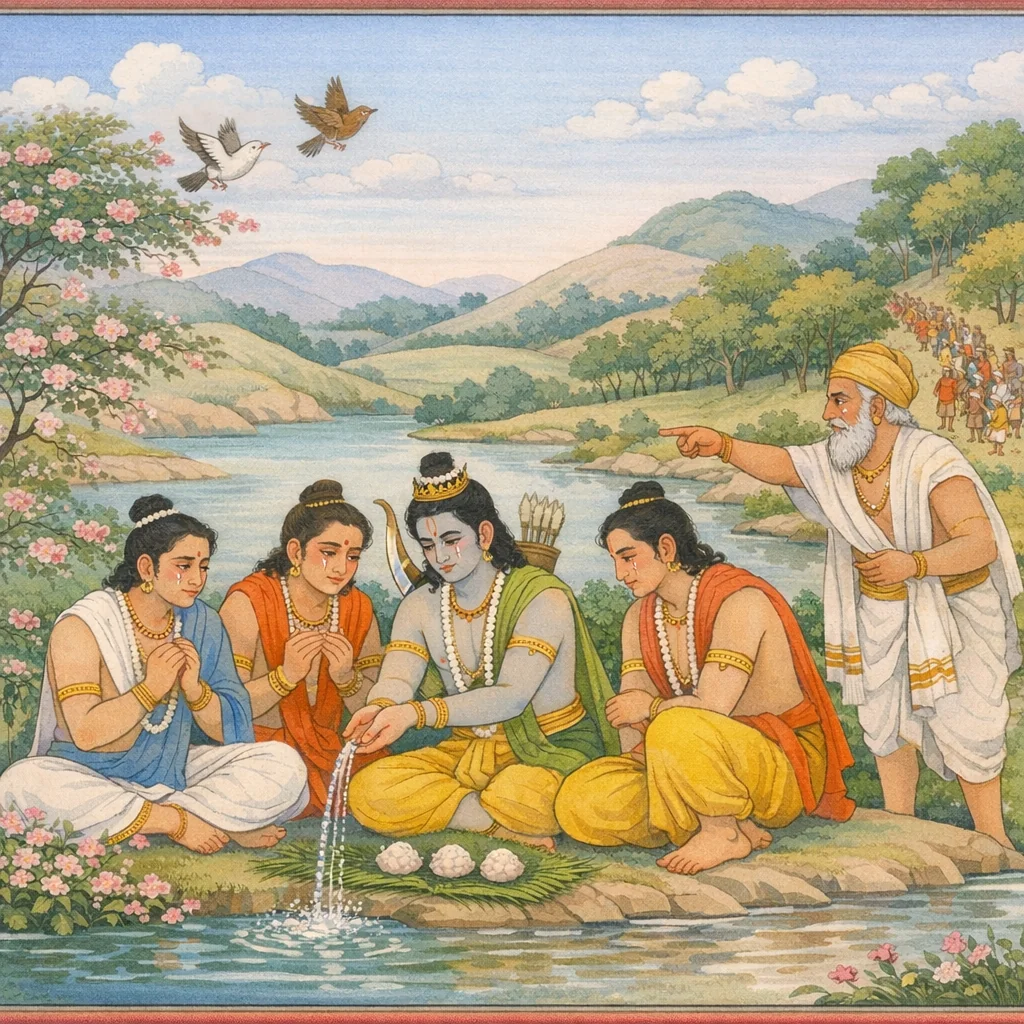
This sarga centers on the shock of bereavement and the immediate transition from speech to ritual action. Bharata reports Daśaratha’s death; Rāma, struck by the news, loses consciousness, likened to a flowering tree felled by an axe and to a thunderbolt’s impact. Regaining awareness, Rāma articulates grief through dharmic reflection: he questions returning to a leaderless Ayodhyā, laments that he could not perform his father’s last rites, and wonders who will guide him when the father has gone to the other world. He acknowledges Bharata and Śatrughna for honoring the king with full obsequial rites, then informs Sītā and Lakṣmaṇa of the death, provoking shared tears among the brothers. The group proceeds to the auspicious Mandākinī tīrtha under Sumantra’s guidance, performs udaka offerings facing the southern (Yama) direction, and completes nivāpa/pinda offerings using ingudī pulp mixed with badarī fruit on darbha grass. The public and Bharata’s soldiers, hearing the tumult of lament, rush toward the hermitage; even animals and birds are described as startled, amplifying the scene’s communal and ecological resonance. The chapter thus maps grief into ritual obligation, portraying maryādā as maintained even amid emotional collapse.
Shlokas
Verse 1
तां श्रुत्वा करुणां वाचं पितुर्मरणसंहिताम्।राघवो भरते नोक्तां बभूव गतचेतनः।।।।
Hearing those pitiable words spoken by Bharata—words bound up with his father’s death—Rāghava (Rama) became senseless.
Verse 2
तं तु वज्रमिवोत्सृष्टमाहवे दानवारिणावाग्वज्रंभरते नोक्त ममनोज्ञं परन्तपः।।।।प्रगृह्य रामो बाहू वैपुष्पिताग्रो यथा द्रुमः।वने परशुना कृत्तस्तथा भुवि पपात ह।।।।
But those thunderbolt-like words spoken by Bharata—painful to Rama—were like Indra’s thunderbolt hurled in battle against the foes of the gods; and Rama, scorcher of enemies, flung out his arms and fell to the earth like a tree with blossoming crown cut down by an axe in the forest.
Verse 3
तं तु वज्रमिवोत्सृष्टमाहवे दानवारिणावाग्वज्रंभरते नोक्त ममनोज्ञं परन्तपः।।2.102.2।।प्रगृह्य रामो बाहू वैपुष्पिताग्रो यथा द्रुमः।वने परशुना कृत्तस्तथा भुवि पपात ह।।2.102.3।।
“O great king, be pleased and partake of this food such as we ourselves now eat; for the deities connected with a person share the very food that the person takes.”
Verse 4
तं तु वज्रमिवोत्सृष्टमाहवे दानवारिणावाग्वज्रंभरते नोक्त ममनोज्ञं परन्तपः।।2.102.2।।प्रगृह्य रामो बाहू वैपुष्पिताग्रो यथा द्रुमः।वने परशुना कृत्तस्तथा भुवि पपात ह।।2.102.3।।
But when Bharata spoke those thunderbolt-like words—unpleasant to the heart—Rama, the scorcher of foes, was struck as if by Indra’s thunderbolt in battle; stretching out his arms, he fell to the ground like a tree in the forest, its flowering crown cut down by an axe.
Verse 5
तथा हि पतितं रामं जगत्यां जगतीपतिम्।कूलघातपरिश्रान्तं प्रसुप्तमिव कुञ्जरम्।।2.102. 4।।भ्रातरस्ते महेष्वासं सर्वतश्शोककर्शितम्।रुदन्तस्सह वैदेह्या सिषिचुस्सलिलेन वै।।।।
Then his brothers, weeping along with Vaidehī (Sītā), sprinkled water upon Rāma—the great archer—who was worn down on every side by grief.
Verse 6
स तु संज्ञां पुनर्लब्ध्वा नेत्राभ्यामस्रमुत्सृजन्।उपाक्रामत काकुत्स्थ कृपणं बहु भाषितुम्।।।।
But when Kakutstha (Rāma) regained consciousness, shedding tears from his eyes, he began again to speak at length, piteously.
Verse 7
स रामस्स्वर्गतं श्रुत्वा पितरं पृथिवीपतिम्।उवाच भरतं वाक्यं धर्मात्मा धर्मसंहितम्।।।।
Hearing that his father—the lord of the earth—had gone to heaven, righteous Rāma spoke to Bharata words consistent with dharma.
Verse 8
किं करिष्याम्ययोध्यायां ताते दिष्टां गतिं गते।कस्तां राजवराध्दीनामयोध्यां पालयिष्यति।।।।
What shall I do in Ayodhyā, now that my father has gone along the destiny ordained? Who will protect that Ayodhyā, bereft of the best of kings?
Verse 9
किं नु तस्य मया कार्यं दुर्जातेन महात्मनः।यो मृतो मम शोकेन मया चापि न संस्कृतः।।।।
What purpose is served by me—ill-fated as I am—for that great-souled one, who died because of grief for me, and whom I could not even properly perform the funeral rites for?
Verse 10
अहो भरत सिद्धार्थो येन राजा त्वयाऽनघ।शत्रुघ्नेन च सर्वेषु प्रेतकृत्येषु सत्कृतः।।।।
Ah, Bharata—blameless one—you have fulfilled your duty, in that the king was duly honored by you and by Śatrughna through all the funeral rites.
Verse 11
निष्प्रधानामनेकाग्रां नरेन्द्रेण विनाकृताम्।निवृत्तवनवासोऽपि नायोध्यां गन्तु मुत्सहे।।।।
Even after my forest-dwelling is completed, I do not feel able to go to Ayodhyā—left without its lord, bereft of its king, and thrown into uncertainty.
Verse 12
समाप्तवनवासं मामयोध्यायां परन्तप।कोऽनु शासिष्यति पुनस्ताते लोकान्तरं गते।।।।
O subduer of foes, when our father has gone to the other world, who will guide me again in Ayodhyā after my exile is completed?
Verse 13
पुरा प्रेक्ष्य सुवृत्तं मां पिता यान्याह सान्त्वयन्।वाक्यानि तानि श्रोष्यामि कुतश्श्रोत्रसुखान्यहम्।।।।
Formerly, seeing my good conduct, my father would speak to me words of comfort—now, from whom shall I ever again hear such ear-pleasing words?
Verse 14
एवमुक्त्वा स भरतं भार्यामभ्येत्य राघवः।उवाच शोकसन्तप्तः पूर्णचन्द्रनिभाननाम्।।।।
Having spoken thus to Bharata, Rāghava—burning with grief—approached his wife, whose face shone like the full moon, and spoke to her.
Verse 15
सीते मृतस्ते श्वशुरः पित्रा हीनोऽसि लक्ष्मण।भरतो दुःखमाचष्टे स्वर्गतं पृथिवीपतिम्।।।।
“Sītā, your father-in-law has died. Lakṣmaṇa, you are bereft of your father. Bharata is reporting the sorrowful tidings that the lord of the earth has gone to heaven.”
Verse 16
ततो बहुगुणं तेषां बाष्पं नेत्रेष्वजायत।तथा ब्रुवति काकुत्स्थे कुमाराणां यशस्विनाम्।।।।
As Kākutstha spoke in this way, abundant tears welled up in the eyes of those illustrious princes.
Verse 17
ततस्ते भ्रातर स्रव्रॆ भृशमाश्वास्य दु:खितम्।अब्रुवन् जगतीभर्तुः क्रियतामुदकं पितुः।।।।
Then all his brothers, after consoling Rāghava as best they could, said: “Let the water-libations be offered to our father, the sustainer of the world.”
Verse 18
सा सीता स्वर्गतं श्रुत्वा श्वशुरं तं महानृपम्।नेत्राभ्यामश्रुपूर्णाभ्या शशाकेक्षितुं प्रियम्।।।।
Hearing that her father-in-law, the great king, had gone to heaven, Sītā—her eyes brimming with tears—could not look upon her beloved (husband).
Verse 19
सान्त्वयित्वा तु तां रामो रुदन्तीं जनकात्मजाम्।उवाच लक्ष्मणं तत्र दुःखितो दुःखितं वचः।।।।
After comforting Sītā, Janaka’s daughter, who was weeping, Rama—himself grief-stricken—then spoke sorrowfully to Lakṣmaṇa.
Verse 20
आनयेङ्गुदिपिण्याकं चीरमाहर चोत्तरम्।जलक्रियार्थं तातस्य गमिष्यामि महात्मनः।।।।
“Bring the dried pulp (oil-cake) of iṅgudī fruit, and fetch also an upper garment of bark. I shall go to perform the water-offering rites for my magnanimous father.”
Verse 21
सीता पुरस्ताद्व्रजतु त्वमेनामभितो व्रज।अहं पश्चाद्गमिष्यामि गतिर्ह्येषा सुदारुणा।।।।
“Let Sītā go in front; you walk close by her on either side. I shall go behind—this is indeed a most dreadful journey of mourning.”
Verse 22
ततो नित्यानुगस्तेषां विदितात्मा महामतिः।मृदुर्दान्तश्च कान्तश्च रामे च दृढभक्तिमान्।।।।सुमन्त्र स्तैर्नृपसुतैस्सार्धमाश्वस्य राघवम्।अवातारयदालम्ब्य नदीं मन्दाकिनीं शिवाम्।।।।
Thereafter Sumantra—ever devoted to them, spiritually discerning, highly intelligent, gentle, self-restrained, tranquil, and firmly devoted to Rāma—comforted him.
Verse 23
ततो नित्यानुगस्तेषां विदितात्मा महामतिः।मृदुर्दान्तश्च शान्तश्च रामे च दृढभक्तिमान्।।2.102.22।।सुमन्त्रस्तैर्नृपसुतैः सार्धमाश्वास्य राघवम्।अवातारयदालम्ब्य नदीं मन्दाकिनीं शिवाम्।।2.102.23।।
Having consoled Rāghava, Sumantra—together with those princes—holding their hands, helped them descend into the auspicious river Mandākinī.
Verse 24
ते सुतीर्थां ततः कृच्छ्रादुपागम्य यशस्विनः।नदीं मन्दाकिनीं रम्यां सदा पुष्पितकाननाम्।।।।शीघ्रस्रोतसमासाद्य तीर्थं शिवमकर्दमम्।सिषिचु स्तूदकं राज्ञे तत एतद् भवत्विति।।।।
Then those illustrious brothers, with difficulty, reached the lovely Mandākinī river—whose banks were graced with forests ever in bloom—and found a good ford for descent.
Verse 25
ते सुतीर्थां ततः कृच्छ्रादुपागम्य यशस्विनः।नदीं मन्दाकिनीं रम्यां सदा पुष्पितकाननाम्।।2.102.24।।शीघ्रस्रोतसमासाद्य तीर्थं शिवमकर्दमम्।सिषिचु स्तूदकं राज्ञे तातैतत्ते भवत्विति।।2.102.25।।
Reaching a pure and auspicious bathing-place where the current ran swift and the ground was not muddy, they poured out water as an offering for the king, saying, “Father, let this be for you.”
Verse 26
प्रगृह्य च महीपालो जलपूरितमञ्जलिम्।दिशं याम्यामभिमुखो रुदन्वचनमब्रवीत्।।।।
Rāma, lord of the earth, cupped water in his joined palms; facing south—the direction associated with Yama—he spoke, weeping.
Verse 27
एतत्ते राजशार्दूल विमलं तोयमक्षयम्।पितृलोकगत स्याद्य मद्दत्तमुपतिष्ठतु।।।।
“O tiger among kings, now that you have gone to the world of the ancestors, may this pure and inexhaustible water-libation, offered by me today, reach you.”
Verse 28
ततो मन्दाकिनीतीरात्प्रत्युत्तीर्य स राघवः।पितुश्चकार तेजस्वी निर्वापं भ्रातृभि सह।।।।
Then Rāghava, strong and radiant, climbed up from the bank of the Mandākinī and, together with his brothers, made the funerary offering (nirvāpa) for his father.
Verse 29
ऐङ्गुदं बदरीमिश्रं पिण्याकं दर्भसंस्तरे।न्यस्य रामस्सदुःखार्तो रुदन्वचनमब्रवीत्।।।।
Placing on a spread of darbha grass the piṇḍa-like balls made from iṅgudī pulp mixed with badarī fruit, Rāma—stricken with grief—spoke through tears.
Verse 30
इदं भुङ्क्ष्वमहाराज प्रीतो यदशना वयम्।यदन्नः पुरुषो भवति तदन्ना स्तस्य देवताः।।।।
“O great king, be pleased and partake of this food such as we ourselves now eat; for the deities connected with a person share the very food that the person takes.”
Verse 31
तत स्तेनैव मार्गेण प्रत्युत्तीर्य सरित्तटात्।आरुरोह नरव्याघ्रो रम्यसानुं महीधरम्।।।।
Then Rama, the best of men, climbed up from the riverbank by the very same path and ascended the mountain with lovely slopes (Chitrakūṭa).
Verse 32
ततः पर्णकुटीद्वारमासाद्य जगतीपतिः।परिजग्राह बाहुभ्यामुभौ भरतलक्ष्मणौ।।।।
Then Rama reached the doorway of the leaf-hut and embraced both Bharata and Lakshmana with his arms.
Verse 33
तेषां तु रुदतां शब्दात् प्रतिशब्दोऽभवद् गिरौ।भ्रातॄणां सह वैदेह्या सिंहानां नर्दतामिव।।।।
From the brothers’ weeping—together with Vaidehī—an echo arose on the mountain, like the roaring of lions.
Verse 34
महाबलानां रुदतां कुर्वतामुदकं पितुः।विज्ञाय तुमुलं शब्दं त्रस्ता भरत सैनिकाः।।।
Hearing the tumultuous sound made by those mighty men—lamenting while offering water to their father—Bharata’s soldiers grew alarmed.
Verse 35
अब्रुवंश्चापि रामेण भरत संगतो ध्रुवम्।तेषामेव महान् शब्द: शोचतां पितरं मृतम्।।।।
They said, “Surely Bharata has met Rama; that great sound must be their lament for their departed father.”
Verse 36
अथ वासान्परित्यज्य तं सर्वेऽभिमुखास्स्वनम्।अप्येकमनसो जग्मुर्यथास्थानं प्रधाविताः।।।।
Then, abandoning their encampments, all of them—single-minded—ran from their respective positions toward the place from which that sound came.
Verse 37
हयैरन्ये गजैरन्ये रथैरन्ये स्वलङ्कृतैः।सुकुमारा स्तथैवान्ये पद्भिरेव नरा ययुः।।।।
Some went on horses, some on elephants, some on richly adorned chariots; and others—delicate and young—went on foot.
Verse 38
अचिरप्रोषितं रामं चिरविप्रोषितं यथा।द्रष्टुकामो जनः सर्वो जगाम सहसाऽऽश्रमम्।।।।
All the people, eager to see Rama, rushed at once toward the hermitage—as though he had been away for a long time, though his exile was recent.
Verse 39
भ्रातृ़णां त्वरितास्ते तु द्रष्टुकामा समागमम्।ययुर्बहुविधैर्यानै: खुरनेमिस्वनाकुलैः।।।।
Hurrying to witness the brothers’ reunion, they went in many kinds of vehicles, filled with the clatter of hooves and the rumble of wheels.
Verse 40
सा भूमिर्बहुभिर्यानैः रथनेमिसमाहता।मुमोच तुमुलं शब्दं द्यौरिवाभ्रसमागमे।।।।
The earth, pounded by many conveyances—by hooves and by chariot-wheels—sent up a tumultuous roar, like the sky at the massing of storm-clouds.
Verse 41
तेन वित्रासिता नागाः करेणुपरिवारिताः।आवासयन्तो गन्धेन जग्मुरन्यद्वनं ततः।।।।
Startled by that din, the elephants—surrounded by their females—moved away from there into another forest, perfuming the way with the scent of must-ichor.
Verse 42
वराह वृकसङ्घाश्च महिषा: सृमरास्तथा ।व्याघ्रगोकर्णगवया वित्रेसुः पृषतै सह।।।।
Boars and packs of wolves, buffaloes and other wild creatures—tigers, gokarṇa-antelope, gavaya, and even the spotted deer—were all thrown into fear.
Verse 43
रथाङ्गसाह्वा नत्यूहा हंसाः कारण्डवाः परे।तथा पुंस्कोकिलाः क्रौञ्चा विसंज्ञा भेजिरे दिशः।।।।
Ducks, waterfowl, geese, and kāraṇḍava birds—likewise male cuckoos and krauñca cranes—panic-stricken, scattered senselessly in all directions.
Verse 44
तेन शब्देन वित्रस्तैराकाशं पक्षिभिर्वृतम्।मनुष्यैरावृता भूमिरुभयं प्रबभौ तदा।।।।
With birds frightened by that sound, the sky became filled; with people, the earth became covered—both sky and earth then appeared strikingly vivid.
Verse 45
ततस्तं पुरषव्याघ्रं यशस्विनमकल्पषम्।आसीनं स्थण्डिले रामं ददर्श सहसा जनः।।।।
Then the people suddenly beheld Rāma—tiger among men, illustrious and stainless—seated on the bare ground.
Verse 46
विगर्हमाणः कैकेयीं मन्थरासहितामपि।अभिगम्य जनो रामं बाष्पपूर्णमुखोऽभवत्।।।।
Reproaching Kaikeyī—and Mantharā with her—the people came up to Rāma, their faces brimming with tears.
Verse 47
तान्नरान्बाष्पपूर्णाक्षान्समीक्ष्याथ सुदुःखितान्।पर्यष्वजत धर्मज्ञः पितृवन्मातृवच्च सः।।।।
Seeing those people—eyes full of tears and deeply distressed—the dharma-knowing Rāma embraced them, as a father would, and as a mother would.
Verse 48
स तत्र कांश्चित्परिषस्वजे नरान्नरास्तु केचित्तु तमभ्यवादयन्।चकार सर्वान्सवयस्यबान्धवान्यथार्ह मासाद्य तदा नृपात्मजः।।।।
There he embraced some of the men, while others saluted him; and the prince then greeted and honored all—friends and kinsmen of his own age—according to what was proper for each.
Verse 49
स तत्र तेषां रुदतां महात्मनां भुवं च खं चानुनिनादयन्स्वनः।गुहा गिरीणां च दिशश्च सन्ततं मृदङ्गघोषप्रतिमः प्रशुश्रुवे।।।।
There the sound—of those great-hearted people weeping—reverberated through earth and sky; it echoed through mountain-caves and across the quarters, unceasing, like the roll of kettledrums.
Frequently Asked Questions
The dilemma is how to respond to royal bereavement during exile: Rāma’s grief is intense, yet he prioritizes dharmic action by performing udaka and nivāpa/pinda offerings for Daśaratha, while also questioning the governance of a kingless Ayodhyā.
The sarga teaches that śoka is acknowledged but not allowed to paralyze duty; rightful conduct is expressed through ritual continuity, truthful speech, and care for others—transforming personal loss into disciplined ethical response.
Key landmarks include the Mandākinī River and its auspicious, non-slushy tīrtha for bathing and libations, as well as the Chitrakūṭa setting with the leaf-hut; culturally, it highlights preta-kṛtya, udaka offerings facing the south (Yama’s direction), and pinda preparations with ingudī and badarī on darbha grass.