
Bhagavad Gita — Vibhuti Yoga, Shloka 9
Vibhuti Yoga
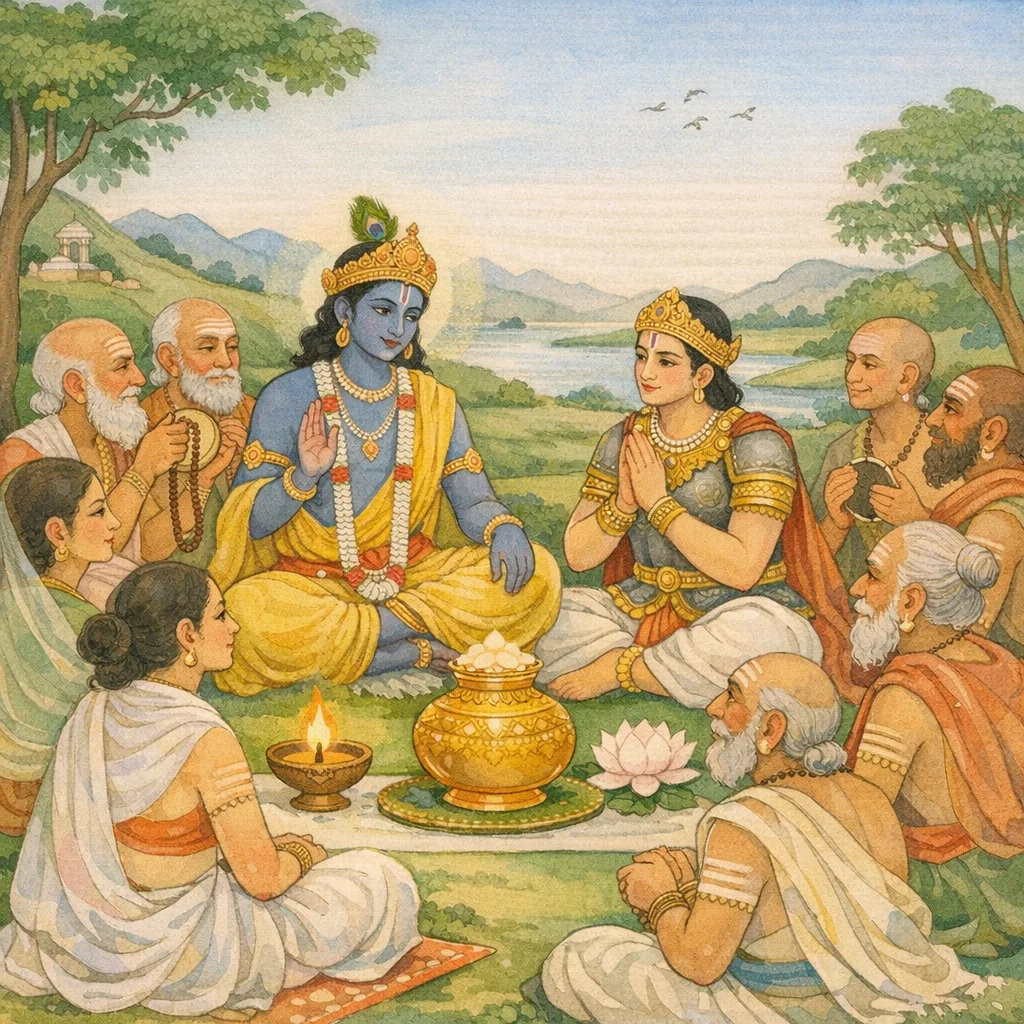
मच्चित्ता मद्गतप्राणा बोधयन्तः परस्परम् । कथयन्तश्र्च मां नित्यं तुष्यन्ति च रमन्ति च ॥ १०.९ ॥
maccittā madgataprāṇā bodhayantaḥ parasparam | kathayantaś ca māṁ nityaṁ tuṣyanti ca ramanti ca || 10.9 ||

With minds fixed on Me and life-breath devoted to Me, enlightening one another and ever speaking of Me, they remain content and rejoice.
Those whose minds are fixed on Me, whose life-breath (vitality) is devoted to Me, enlightening one another and always speaking of Me, remain contented and rejoice.
With minds centered on Me and their vital energies oriented toward Me, they mutually instruct one another; continually speaking about Me, they find satisfaction and joy.
This verse is textually stable across common recensions; interpretive variation lies mainly in rendering prāṇa as “life-breath,” “life,” or “vitality,” and in whether bodhayantaḥ implies doctrinal teaching, mutual encouragement, or contemplative dialogue.
FAQs
The verse highlights attentional training: sustained focus (“mind centered”) reinforced through supportive dialogue. Shared reflection stabilizes motivation and produces affective outcomes described as contentment and joy.
It presents devotion as an orientation of the whole person—cognition (citta) and life-force (prāṇa)—toward the divine, implying that knowledge of the divine is cultivated relationally through remembrance and discourse.
In Chapter 10, Krishna begins to explain divine “vibhūtis” (manifest excellences). This verse frames the ideal recipient community: devotees who continually contemplate and discuss the divine nature being taught.
It can be applied as a model for study circles or contemplative groups: regular discussion, mutual clarification, and consistent practice of remembrance can support well-being and sustained ethical motivation.