
Bhagavad Gita — Vibhuti Yoga, Shloka 8
Vibhuti Yoga
अहं सर्वस्य प्रभवो मत्तः सर्वं प्रवर्तते । इति मत्वा भजन्ते मां बुधा भावसमन्विताः ॥ १०.८ ॥
ahaṁ sarvasya prabhavo mattaḥ sarvaṁ pravartate | iti matvā bhajante māṁ budhā bhāva-samanvitāḥ || 10.8 ||

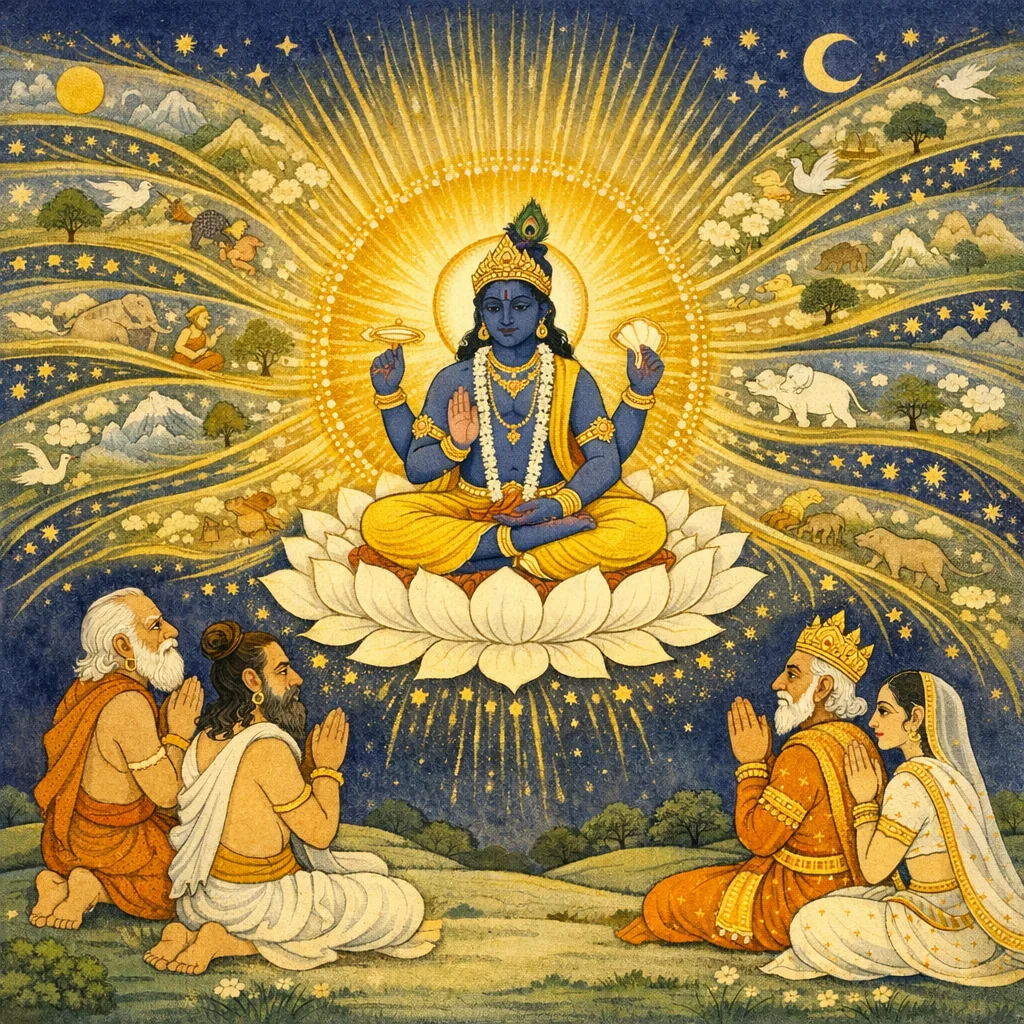
I am the source of all; from Me everything proceeds. Knowing thus, the wise worship Me, endowed with devotion of the heart.
I am the source of all; from Me everything proceeds. Knowing thus, the wise worship Me with heartfelt devotion.
I am the origin of all; from Me everything comes into activity. Understanding thus, the discerning worship Me, endowed with devotional disposition.
‘pravartate’ emphasizes ‘comes forth/operates/is set in motion,’ which can be read cosmologically (the world-process) and ethically (motivation/action). ‘bhāva-samanvitāḥ’ is often ‘with devotion’ or ‘with profound feeling,’ indicating that insight is accompanied by an affective orientation, not mere abstraction.
FAQs
It suggests that a unifying explanation for life’s processes can foster emotional coherence (‘bhāva’), translating understanding into stable commitment and practice.
The verse articulates a strong source-claim: all existence and activity depend on a single ultimate principle; devotion is presented as the appropriate response of the ‘wise.’
It introduces the logic of vibhūti teaching: if all proceeds from the divine, then recognizing excellence and power in the world becomes a way of recognizing the divine presence.
As a broad takeaway, it supports aligning one’s actions with a coherent ultimate orientation—whether theistically framed or interpreted as commitment to a highest good.