
Bhagavad Gita — Vibhuti Yoga, Shloka 36
Vibhuti Yoga
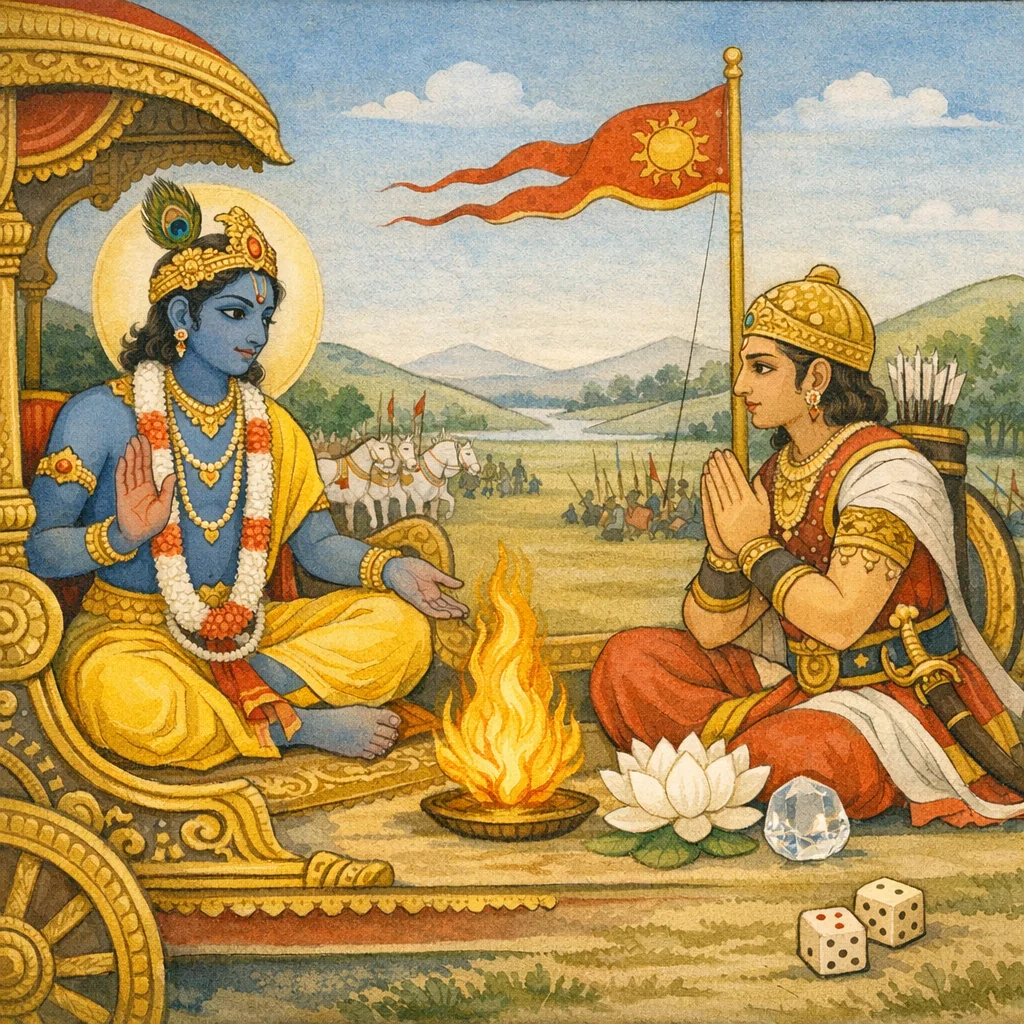
द्यूतं छलयतामस्मि तेजस्तेजस्विनामहम् । जयोऽस्मि व्यवसायोऽस्मि सत्त्वं सत्त्ववतामहम् ॥ १०.३६ ॥
dyūtaṃ chalayatām asmi tejas tejasvinām aham | jayo 'smi vyavasāyo 'smi sattvaṃ sattvavatām aham || 10.36 ||

Among those who deceive I am gambling; among the radiant I am radiance. I am victory; I am steadfast resolve; I am goodness among the good.
Among deceivers I am gambling; among the brilliant I am brilliance. I am victory; I am resolve/effort; I am goodness among the good.
Among those who employ trickery I am dyūta (gambling); among the radiant I am radiance; I am triumph; I am determined endeavor; among the possessed-of-sattva I am sattva (clarity/virtue).
The verse is often discussed ethically: it does not recommend gambling, but treats even socially problematic phenomena as within the scope of divine power. sattva here can mean ‘goodness/clarity’ (guṇa) rather than mere ‘existence.’
FAQs
The verse highlights how attraction to risk and uncertainty can capture attention (dyūta), while also affirming constructive traits—resolve and clarity—as higher expressions to cultivate.
Divinity is presented as the underlying potency even in ambivalent human activities, while simultaneously being the luminosity and clarity that orient one toward truth.
Gambling is a prominent motif in the Mahābhārata narrative background; mentioning it here resonates with the epic’s moral lessons without endorsing the practice.
It can be read as advice to recognize the pull of addictive or compulsive patterns and to redirect energy toward disciplined effort, ethical success, and mental clarity.