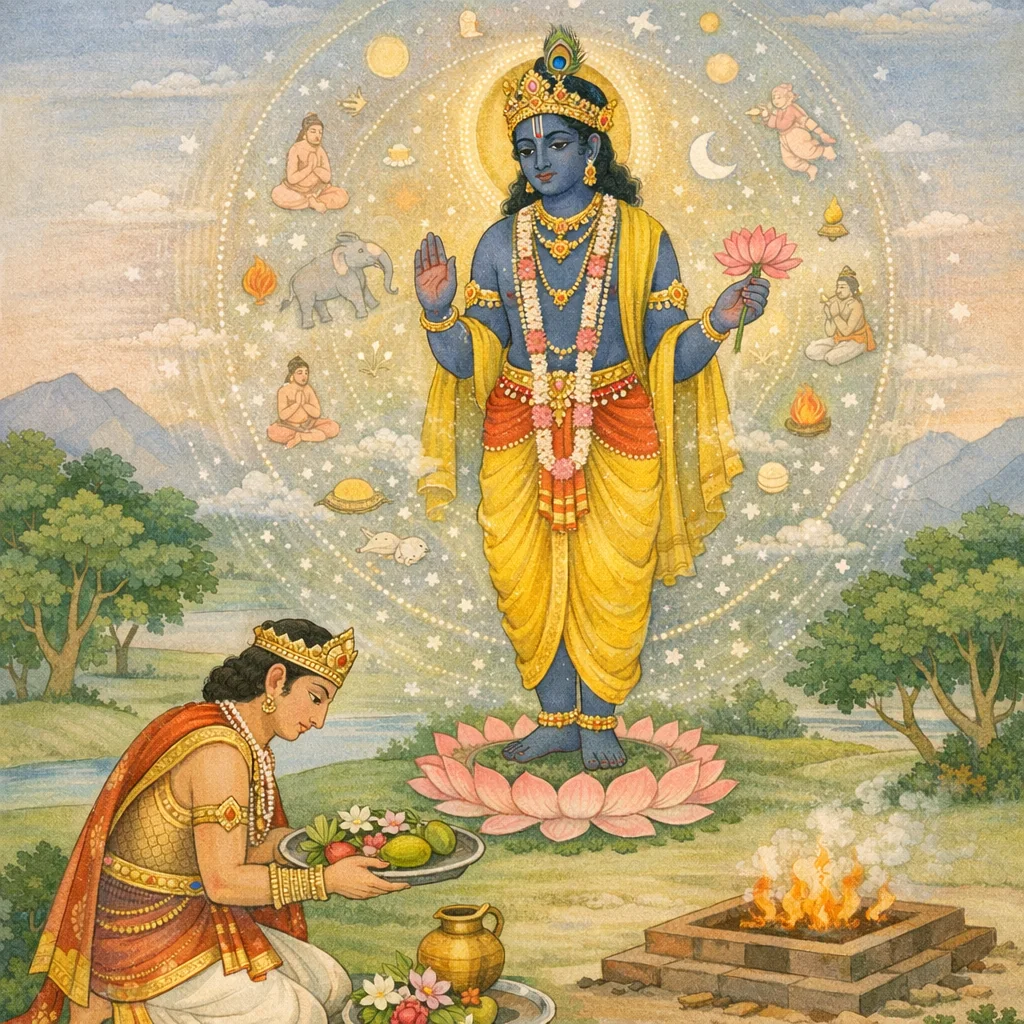
Chapter 9: Raja Vidya Raja Guhya Yoga
राजविद्याराजगुह्ययोग
The Yoga of Royal Knowledge
Chapter 9 presents Krishna’s “royal knowledge” (rāja-vidyā) and “royal secret” (rāja-guhya) as a direct, purifying, and practicable path that unites metaphysical insight with lived devotion. The interlocutor’s inner problem shifts from tactical uncertainty to epistemic and existential clarity: how the Supreme relates to the world, action, and liberation. Krishna outlines divine immanence and transcendence—pervading all beings while remaining unattached—explaining cosmic manifestation through prakṛti under divine oversight. He contrasts misrecognition of the Divine (through superficial perception and misplaced faith) with the orientation of the mahātman who worships with single-mindedness. The chapter integrates sacrificial symbolism into a theistic ontology (“I am the rite, the offering, the mantra”), then grounds spiritual life in accessible devotion: even a simple offering, when given with bhakti, is accepted. The ethical framework culminates in surrendering all actions to the Divine, receiving protection, and attaining the highest goal through unwavering remembrance and devotion.
Speakers
Key Concepts
Philosophical Constructs
Shlokas in Chapter 9
Verse 1
श्रीभगवानुवाच । इदं तु ते गुह्यतमं प्रवक्ष्याम्यनसूयवे ज्ञानं विज्ञानसहितं यज्ज्ञात्वा मोक्ष्यसेऽशुभात् ॥ ९.१ ॥
The Blessed Lord said: To you who are free from malice, I shall declare this most secret knowledge, together with realized understanding; knowing it, you shall be freed from the inauspicious.
Verse 2
राजविद्या राजगुह्यं पवित्रमिदमुत्तमम् । प्रत्यक्षावगमं धर्म्यं सुसुखं कर्तुमव्ययम् ॥ ९.२ ॥
This is the king of knowledges, the king of secrets, supremely purifying; directly realizable, in harmony with dharma, very easy to practice, and imperishable.
Verse 3
अश्रद्दधानाः पुरुषा धर्मस्यास्य परन्तप । अप्राप्य मां निवर्तन्ते मृत्युसंसारवर्त्मनि ॥ ९.३ ॥
O Parantapa, those persons who lack faith in this dharma, not attaining Me, return again to the path of death and saṁsāra.
Verse 4
मया ततमिदं सर्वं जगदव्यक्तमूर्तिना । मत्स्थानि सर्वभूतानि न चाहं तेष्ववस्थितः ॥ ९.४ ॥
By Me, in My unmanifest form, this entire universe is pervaded. All beings abide in Me, yet I am not established in them.
Verse 5
न च मत्स्थानि भूतानि पश्य मे योगमैश्वरम् । भूतभृन्न च भूतस्थो ममात्मा भूतभावनः ॥ ९.५ ॥
And yet beings do not abide in Me—behold My sovereign Yoga! My Self, the sustainer of beings, is not lodged in beings, and yet It is the source that brings beings forth.
Verse 6
यथाकाशस्थितो नित्यं वायुः सर्वत्रगो महान् । तथा सर्वाणि भूतानि मत्स्थानीत्युपधारय ॥ ९.६ ॥
As the mighty wind, ever abiding in space, moves everywhere, so too know that all beings abide in Me.
Verse 7
सर्वभूतानि कौन्तेय प्रकृतिं यान्ति मामिकाम् । कल्पक्षये पुनस्तानि कल्पादौ विसृजाम्यहम् ॥ ९.७ ॥
O son of Kunti, at the end of a kalpa all beings enter into My Prakriti; and at the beginning of a kalpa I send them forth again.
Verse 8
प्रकृतिं स्वामवष्टभ्य विसृजामि पुनः पुनः । भूतग्राममिमं कृत्स्नमवशं प्रकृतेर्वशात् ॥ ९.८ ॥
Resting upon My own Prakriti, I bring forth again and again this entire multitude of beings, helpless under the sway of Prakriti.
Verse 9
न च मां तानि कर्माणि निबध्नन्ति धनंजय । उदासीनवदासीनमसक्तं तेषु कर्मसु ॥ ९.९ ॥
O Dhanañjaya, those actions do not bind Me; I remain as one indifferent, unattached to those actions.
Verse 10
मयाध्यक्षेण प्रकृतिः सूयते सचराचरम् । हेतुनानेन कौन्तेय जगद्विपरिवर्तते ॥ ९.१० ॥
O Kaunteya, under My presiding power Prakṛti brings forth the moving and the unmoving; by this cause the world revolves again and again.
Verse 11
अवजानन्ति मां मूढा मानुषीं तनुमाश्रितम् । परं भावमजानन्तो मम भूतमहेश्वरम् ॥ ९.११ ॥
The deluded despise Me, taking Me as one who has assumed a human body; they do not know My supreme being, the great Lord of all beings.
Verse 12
मोघाशा मोघकर्माणो मोघज्ञाना विचेतसः । राक्षसीमासुरीं चैव प्रकृतिं मोहिनीं श्रिताः ॥ ९.१२ ॥
Bewildered in mind, their hopes are vain, their actions vain, their knowledge vain; they take refuge in the delusive nature that is rākṣasī and āsurī.
Verse 13
महात्मानस्तु मां पार्थ दैवीं प्रकृतिमाश्रिताः । भजन्त्यनन्यमनसो ज्ञात्वा भूतादिमव्ययम् ॥ ९.१३ ॥
But the great-souled ones, O Pārtha, taking refuge in the divine nature, worship Me with an undivided mind, knowing Me as the imperishable origin of beings.
Verse 14
सततं कीर्तयन्तो मां यतन्तश्च दृढव्रताः । नमस्यन्तश्च मां भक्त्या नित्ययुक्ता उपासते ॥ ९.१४ ॥
Ever chanting My glory, striving with steadfast vows, and bowing to Me in devotion—always united with Me—they worship Me.
Verse 15
ज्ञानयज्ञेन चाप्यन्ये यजन्तो मामुपासते । एकत्वेन पृथक्त्वेन बहुधा विश्वतोमुखम् ॥ ९.१५ ॥
Others, worshipping Me by the sacrifice of knowledge, adore Me as the One, as the distinct, and as the manifold—Me, the All-faced.
Verse 16
अहं क्रतुरहं यज्ञः स्वधाहमहमौषधम् । मन्त्रोऽहमहमेवाज्यमहमग्निरहं हुतम् ॥ ९.१६ ॥
I am the Vedic rite; I am the sacrifice; I am svadhā, the offering to the ancestors; I am the medicinal herb. I am the mantra; I alone am the ghee; I am the fire; I am the oblation.
Verse 17
पिताहमस्य जगतो माता धाता पितामहः । वेद्यं पवित्रमोंकार ऋक्साम यजुरेव च ॥ ९.१७ ॥
I am the father of this world, the mother, the sustainer, and the grandsire. I am the knowable, the purifier, the syllable Oṃ, and also Ṛg, Sāma, and Yajus.
Verse 18
गतिर्भर्ता प्रभुः साक्षी निवासः शरणं सुहृत् । प्रभवः प्रलयः स्थानं निधानं बीजमव्ययम् ॥ ९.१८ ॥
I am the goal, the sustainer, the Lord, the witness, the abode, the refuge, the well-wisher. I am the origin, the dissolution, the foundation, the treasure-house, and the imperishable seed.
Verse 19
तपाम्यहमहं वर्षं निगृह्णाम्युत्सृजामि च । अमृतं चैव मृत्युश्च सदसच्चाहमर्जुन ॥ ९.१९ ॥
I give heat; I withhold and release the rain. I am immortality and also death; I am being and non-being, O Arjuna.
Verse 20
त्रैविद्या मां सोमपाः पूतपापा यज्ञैरिष्ट्वा स्वर्गतिं प्रार्थयन्ते । ते पुण्यमासाद्य सुरेन्द्रलोकं ...
Those who know the three Vedas, drinkers of soma, purified of sin, worship Me by sacrifices and pray for the path to heaven. Attaining merit, they reach the world of Indra, lord of the gods.
Verse 21
ते तं भुक्त्वा स्वर्गलोकं विशालं क्षीणे पुण्ये मर्त्यलोकं विशन्ति । एवं त्रयीधर्ममनुप्रपन्ना गताग...
Having enjoyed that vast heaven-world, when their merit is exhausted they enter the mortal world. Thus, adhering to the dharma of the three Vedas, they go and return again and again.
Verse 22
अनन्याश्चिन्तयन्तो मां ये जनाः पर्युपासते । तेषां नित्याभियुक्तानां योगक्षेमं वहाम्यहम् ॥ ९.२२ ॥
Those who, thinking of Me alone, worship Me on every side—of them, ever steadfast, I bear the yoga and kṣema: their acquisition and their protection.
Verse 23
येऽप्यन्यदेवताभक्ता यजन्ते श्रद्धयान्विताः । तेऽपि मामेव कौन्तेय यजन्त्यविधिपूर्वकम् ॥ ९.२३ ॥
Even those devotees who, endowed with faith, worship other deities—O son of Kuntī—they too worship Me alone, but not in the prescribed manner.
Verse 24
अहं हि सर्वयज्ञानां भोक्ता च प्रभुरेव च । न तु मामभिजानन्ति तत्त्वेनातश्च्यवन्ति ते ॥ ९.२४ ॥
For I alone am the enjoyer and the Lord of all sacrifices; but they do not truly know Me in My reality—therefore they fall away.
Verse 25
यान्ति देवव्रता देवान्पितॄन्यान्ति पितृव्रताः । भूतानि यान्ति भूतेज्या यान्ति मद्याजिनोऽपि माम् ॥ ९.२५ ॥
Votaries of the gods go to the gods; votaries of the ancestors go to the ancestors; worshippers of spirits go to the spirits; but those who worship Me come to Me.
Verse 26
पत्रं पुष्पं फलं तोयं यो मे भक्त्या प्रयच्छति । तदहं भक्त्युपहृतमश्नामि प्रयतात्मनः ॥ ९.२६ ॥
Whoever offers Me with devotion a leaf, a flower, a fruit, or water—I accept and partake of that offering, brought with devotion by the pure-minded.
Verse 27
यत्करोषि यदश्नासि यज्जुहोषि ददासि यत् । यत्तपस्यसि कौन्तेय तत्कुरुष्व मदर्पणम् ॥ ९.२७ ॥
Whatever you do, whatever you eat, whatever you offer into the sacred fire, whatever you give, and whatever austerity you practise—do that, O son of Kuntī, as an offering to Me.
Verse 28
शुभाशुभफलैरेवं मोक्ष्यसे कर्मबन्धनैः । संन्यासयोगयुक्तात्मा विमुक्तो मामुपैष्यसि ॥ ९.२८ ॥
Thus you shall be freed from the bonds of action that yield auspicious and inauspicious results; with your mind united in the yoga of renunciation, liberated, you shall come to Me.
Verse 29
समोऽहं सर्वभूतेषु न मे द्वेष्योऽस्ति न प्रियः । ये भजन्ति तु मां भक्त्या मयि ते तेषु चाप्यहम् ॥ ९.२९ ॥
I am equal toward all beings; to Me none is hateful and none dear. Yet those who worship Me with devotion abide in Me, and I too abide in them.
Verse 30
अपि चेत्सुदुराचारो भजते मामनन्यभाक् । साधुरेव स मन्तव्यः सम्यग्व्यवसितो हि सः ॥ ९.३० ॥
Even if one of very wicked conduct worships Me with exclusive devotion, he should indeed be regarded as righteous, for he has rightly resolved.
Verse 31
क्षिप्रं भवति धर्मात्मा शश्वच्छान्तिं निगच्छति । कौन्तेय प्रति जानीहि न मे भक्तः प्रणश्यति ॥ ९.३१ ॥
He quickly becomes righteous and attains everlasting peace. O son of Kuntī, know it for certain: My devotee never perishes.
Verse 32
मां हि पार्थ व्यपाश्रित्य येऽपि स्युः पापयोनयः । स्त्रियो वैश्यास्तथा शूद्रास्तेऽपि यान्ति परां गतिम् ॥ ९.३२ ॥
For, taking refuge in Me, O Pārtha, even those of so-called ‘sinful birth’—women, Vaiśyas, and Śūdras—also attain the supreme goal.
Verse 33
किं पुनर्ब्राह्मणाः पुण्या भक्ता राजर्षयस्तथा । अनित्यमसुखं लोकमिमं प्राप्य भजस्व माम् ॥ ९.३३ ॥
How much more, then, the holy Brāhmaṇas and the devoted royal sages! Having attained this impermanent and joyless world, worship Me.
Verse 34
मन्मना भव मद्भक्तो मद्याजी मां नमस्कुरु । मामेवैष्यसि युक्त्वैवमात्मानं मत्परायणः ॥ ९.३४ ॥
Fix your mind on Me; become My devotee; worship Me; bow down to Me. Thus, united with Me and taking Me as your supreme refuge and goal, you shall come to Me alone.
Frequently Asked Questions
Chapter 9 reframes anxiety about outcomes into stable focus through single-minded devotion and consecrated action. By placing responsibility for “yoga-kṣema” with the Divine while maintaining disciplined practice, the seeker learns to act without inner fragmentation, reducing stress and rumination.
The chapter teaches a dual-aspect relation: the Supreme pervades all beings (immanence) yet is not constrained by them (transcendence). Cosmic manifestation proceeds through prakṛti under divine oversight, while liberation is approached through realized knowledge integrated with devotion.
It resolves the dilemma by supplying a unifying orientation: recognize the Divine as the ground of all processes, then offer all actions—work, giving, discipline, and daily living—as worship. This replaces conflicted agency with a coherent ethical framework: duty becomes a means of spiritual integration rather than a source of distress.
Use Chapter 9 as a practice of intentionality: dedicate your workday, decisions, and self-care to a higher purpose; keep one stabilizing daily devotion (recitation, reflection, or mindful offering); and reduce outcome-anxiety by focusing on effort, integrity, and service. This supports leadership, emotional balance, and resilience under pressure.