
Bhagavad Gita — Raja Vidya Raja Guhya Yoga, Shloka 3
Raja Vidya Raja Guhya Yoga
अश्रद्दधानाः पुरुषा धर्मस्यास्य परन्तप । अप्राप्य मां निवर्तन्ते मृत्युसंसारवर्त्मनि ॥ ९.३ ॥
aśraddadhānāḥ puruṣā dharmasyāsya parantapa | aprāpya māṁ nivartante mṛtyusaṁsāravartmani || 9.3 ||

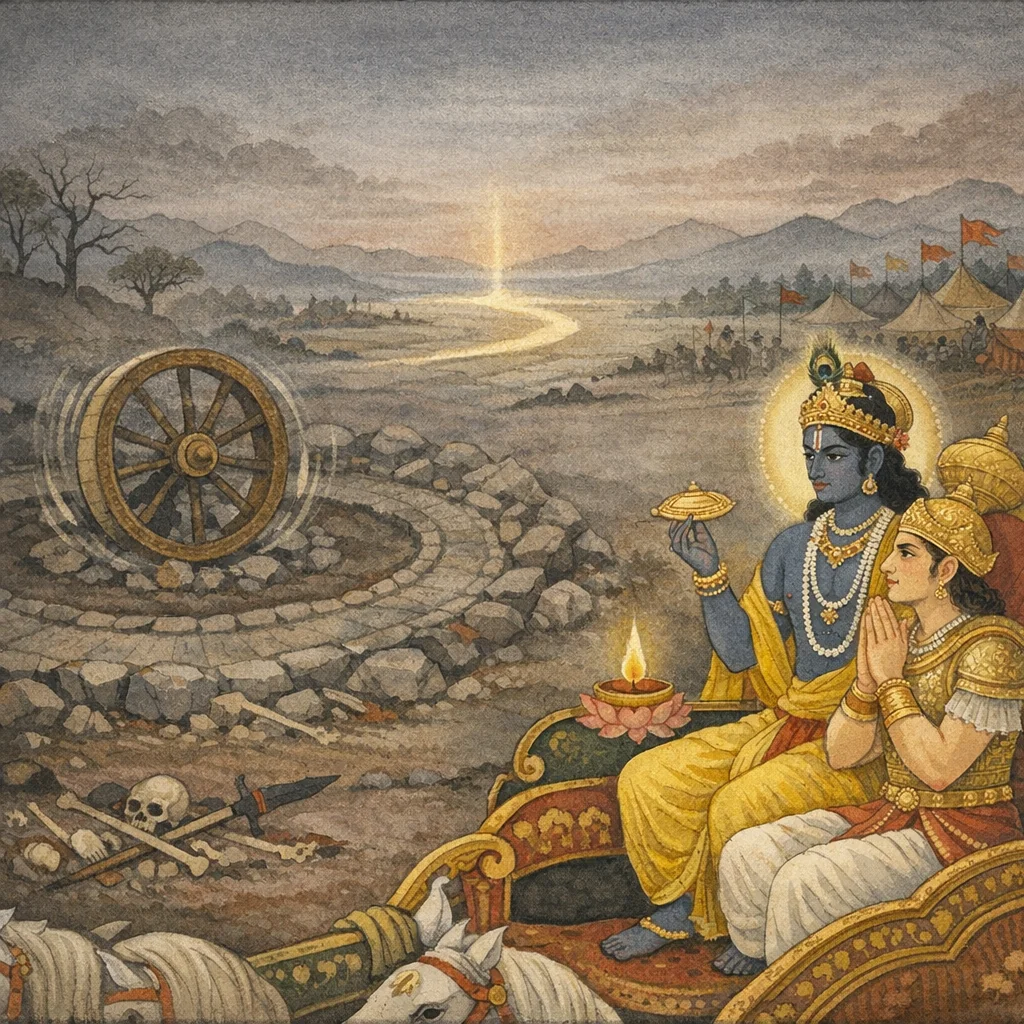
O Parantapa, those persons who lack faith in this dharma, not attaining Me, return again to the path of death and saṁsāra.
हे परन्तप! इस (उपर्युक्त) धर्म में श्रद्धा न रखने वाले पुरुष मुझे प्राप्त न होकर मृत्यु और संसार के मार्ग में लौटते रहते हैं।
O scorcher of foes, persons lacking trust in this teaching, not attaining Me, return along the path of death-and-rebirth.
‘धर्म’ here is often read devotionally as a saving path (bhakti/dharma), while academically it can be taken as ‘this teaching/way of practice.’ No major variant is implied by the given text.
FAQs
The verse highlights how sustained practice depends on confidence and commitment (śraddhā). Without it, attention and effort tend to revert to habitual patterns, reinforcing recurring distress and dissatisfaction.
It frames liberation as contingent upon receptivity to the teaching: lacking trust, one does not ‘attain’ the divine reality (māṁ) and continues within saṁsāra, described as the path characterized by death and rebirth.
At the start of Chapter 9, Krishna presents a ‘royal’ teaching. This verse marks a boundary condition: the teaching benefits those who engage it with śraddhā.
In learning, therapy, or contemplative practice, progress typically requires a working trust in the method and teacher; otherwise one cycles back to familiar coping strategies and unexamined assumptions.
Read Bhagavad Gita in the Vedapath app
Scan the QR code to open this directly in the app, with audio, word-by-word meanings, and more.