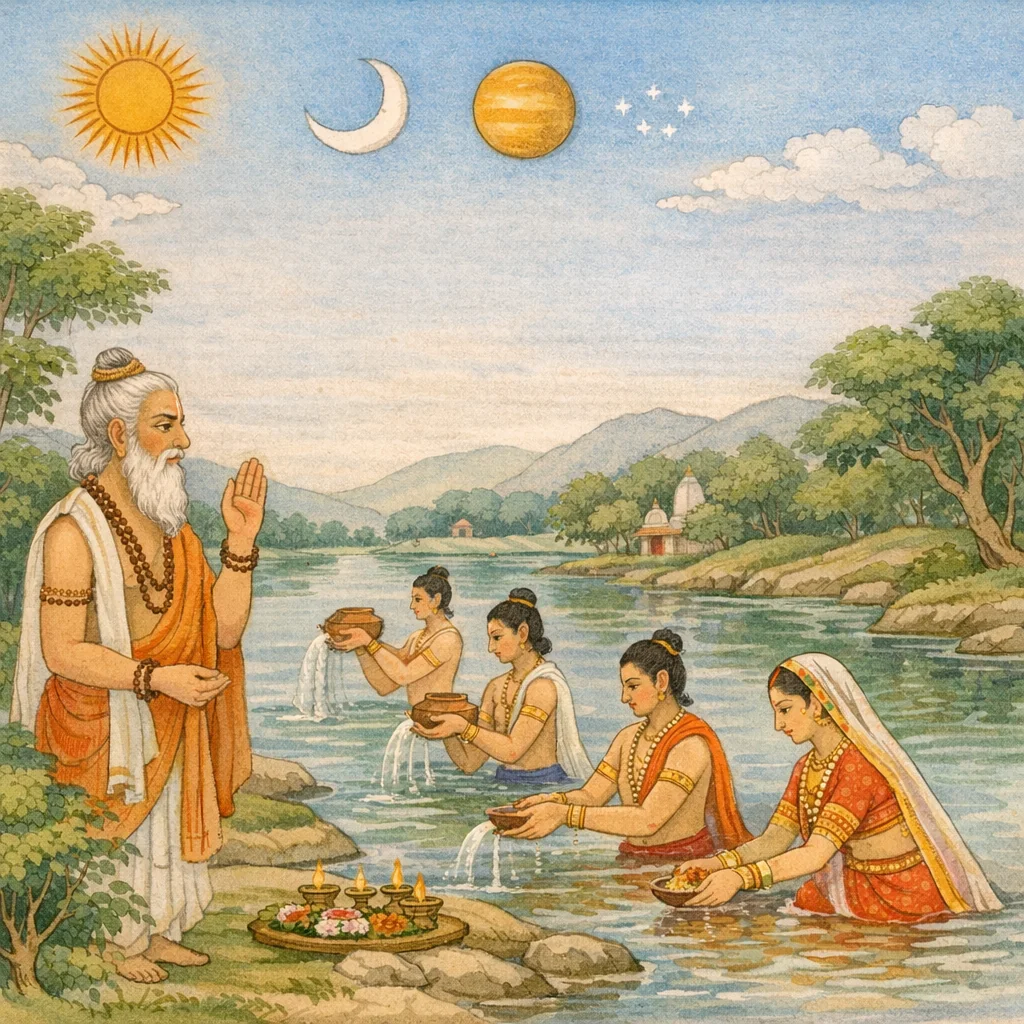
Adhyaya 24: The Glory of Prithudaka Tirtha and the Akshaya Tithi at Kurukshetra
पृथूदक-तीर्थमाहात्म्य एवं अक्षया-तिथिवर्णन (Pṛthūdaka-Tīrtha-Māhātmya evaṃ Akṣayā-Tithi-Varṇana)
Akshaya Tithi at Kurukshetra
Within the Pulastya–Nārada narrative frame, this Adhyāya presents a Kurukṣetra-centered tīrtha-māhātmya in which Devadeva (Hari addressed as Murāri) directs the gods to the mahātīrtha Pṛthūdaka, praised as intrinsically purifying and fear-dispelling. The sanctity is calendrically anchored: when the luminaries and Bṛhaspati align in Mṛgaśiras, the day is celebrated as Akṣayā, a time especially efficacious for pitṛ-tarpaṇa and śrāddha on the banks of the east-flowing (prācī) Sarasvatī. The devas, led by Indra, enact the pilgrimage, bathe, and request Bṛhaspati to ‘authorize’ the auspicious configuration, foregrounding Purāṇic ritual time as a theological instrument. The chapter then pivots to a genealogical-etiological strand: Indra’s pious offering to the Pitṛs yields Menā, given to Himavān, and the union produces three exceptionally beautiful daughters—linking śrāddha-merit, sacred geography, and dynastic cosmology in a syncretic Purāṇic register.
Divine Beings
Sacred Geography
Mortal & Asura Figures
Key Content Points
- Devadeva/Murāri instructs the gods to proceed to Kurukṣetra’s Pṛthūdaka, a mahātīrtha described as puṇya and pāpa-bhaya-apaha (sin- and fear-removing).
- Ritual time is specified through astral markers: the Mṛgaśiras nakṣatra with Sun, Moon, and Bṛhaspati yields the celebrated Akṣayā tithi, ideal for śrāddha and pitṛ-ārādhana at the prācī Sarasvatī.
- After the devas bathe, they petition Bṛhaspati to effect/confirm the auspicious configuration; the narrative then connects pitṛ-bhakti to lineage by recounting Indra’s piṇḍa-offering and the consequent bestowal of Menā to Himavān, leading to three divine-like daughters.
Shlokas in Adhyaya 24
Verse 1
देवदेव उवाच एवं पृथूदको देवाः पुण्यः पापभयापहः तं गच्छध्वं महातीर्थं यावत् संनिधिवोधितम्
众神之主说道:“因此,诸神啊,此普利图达迦(Pṛthūdaka)具足功德,能除由罪而生之恐惧。你们当往彼大圣渡处,如先前所宣说其神圣临在(sannidhi,净化之近在)一般。”
Verse 2
यदा मृगशिरोऋक्षे शशिसूर्यौ बृहस्पतिः तिष्ठन्ति सा तिथिः पुण्या त्वक्षया परिगीयते
“当月亮与太阳并同木星(Bṛhaspati)安住于昴宿之一的‘觅伽希罗’(Mṛgaśiras)月宿时,那一日(tithi)即为圣日;被称颂为‘阿克沙雅’(Akṣayā),能赐不坏之功德。”
Verse 3
तं गच्छध्वं सुरश्रेष्ठा यत्र प्राची सरस्वती पितॄन् आराधयध्वं हि तत्र श्राद्धेन भक्तिततः
“诸天中最胜者啊,你们当往彼处去,即那向东流的萨拉斯瓦蒂河所在之地。在那里,确当以虔敬行施罗陀(śrāddha)之礼,奉祀诸祖灵(Pitṛs)。”
Verse 4
ततो मुरारिवचनं श्रुत्वा देवाः सवासवाः समाजग्मुः कुरुक्षेत्रे पुण्यतीर्थं पृथूदकम्
“随后,诸天听闻穆拉里(Murāri,毗湿奴)之言,便与瓦萨瓦(Vāsava,因陀罗)一同会集于俱卢之野(Kurukṣetra),至名为普利图达迦(Pṛthūdaka)的圣洁渡口(tīrtha)。”
Verse 5
तत्र स्नात्वा सुराः सर्वे बृहस्पतिमचोदयन् विशस्व भगवन् ऋक्षमिमं मृशिरं कुरु पुण्यां तिथिं पापहरां तव कालो ऽयमागतः
“诸天在彼处沐浴已毕,便敦请布里哈斯帕提(Bṛhaspati)曰:‘世尊啊,请明白宣示;为我等判定此宿(nakṣatra),并昭示一吉祥之月日(tithi),能除罪垢。今正是你作决定之时。’”
Verse 6
प्रवर्तते रविस्तत्र चन्द्रमापि विशत्यसौ त्वदायत्तं गुरो कार्यं सुराणां तत् कुरुष्व च
“在彼处,太阳循其轨道运行,月亮亦入其行程。噢,导师(Guru)啊,诸天之事系于你;故亦当成就其所当为。”
Verse 7
इत्येवमुक्तो देवैस्तु देवाचार्यो ऽब्रवीदिदम् यदि वर्षाधिपो ऽहं स्यां ततो यास्यामि देवताः
“诸天如是启请,天众之师便说道:‘若我得为岁之主宰,则当往行,诸神啊。’”
Verse 8
आषाढे मासि मार्गर्क्षे चन्द्रक्षयतिथिर्हि या तस्यां पुरन्दरः प्रीतः पिण्डं पितृषु भक्तितः
在阿沙荼月(Āṣāḍha),逢名为“摩尔伽”(Mārga)的宿(nakṣatra),又值称作“月减”(candrakṣaya,月亏)的月日(tithi)之时;于此因缘,若以虔敬向祖灵(Pitṛ)奉献团食供(piṇḍa),则破城者因陀罗(Purandara, Indra)心生欢喜。
Verse 9
प्रादात् तिलमधून्मिश्रं हविष्यान्नं कुरुष्वथ ततः प्रीतास्तु पितरस्तां प्राहुस्तनयां निजाम
他献上掺和芝麻与蜂蜜的哈维施亚食(haviṣya)。于是诸祖灵(Pitṛ)欢喜,宣告她为他自己的女儿。
Verse 10
मेनां देवाश्च शैलाय हिमयुक्ताय वै ददुः तां मेनां हिमवांल्लब्ध्वा प्रसादाद् दैवतेष्वथ प्रीतिमानभवच्चासौ रराम च यथेच्छया
诸天将梅那(Menā)赐与雪覆之山喜马伐特(Himavat)。喜马伐特蒙诸神恩许而得梅那,遂心生欢悦,随其所愿与她嬉游。
Verse 11
ततो हिमाद्रिः पितृकन्यया समं समर्पयन् वै विषयान् यथैष्टम् अजीजनत् सा तनयाश्च तिस्रो रूपातियुक्ताः सुरयोषितोपमाः
其后,喜马德利(Himādri,即喜马伐特)与那位由祖灵所生的少女(梅那)随意享受诸境之乐;她诞下三位女儿,容貌殊胜,堪比天界女神。
Frequently Asked Questions
The chapter uses the honorific Devadeva while also identifying the speaker as Murāri (a Viṣṇu epithet), a Purāṇic strategy that normalizes shared divine sovereignty and ritual authority across sectarian vocabularies, even as the narrative remains focused on tīrtha and śrāddha praxis.
Pṛthūdaka in Kurukṣetra is presented as a mahātīrtha whose bath removes pāpa and fear; its efficacy is heightened when performed at the prācī Sarasvatī, where pitṛ-ārādhana through śrāddha is explicitly prescribed, making the site a ritual node in the Sarasvatī-basin pilgrimage map.
No. The passage functions primarily as a Kurukṣetra tīrtha-māhātmya and a pitṛ-ritual calendar note (Akṣayā tithi), followed by a genealogical-etiological account (Indra’s offering leading to Menā and Himavān’s progeny), rather than the Bali–Vāmana conflict sequence.