Adhyaya 14
Manvantara Administration: Appointment of Manus, Indras, and the Restoration of Dharma
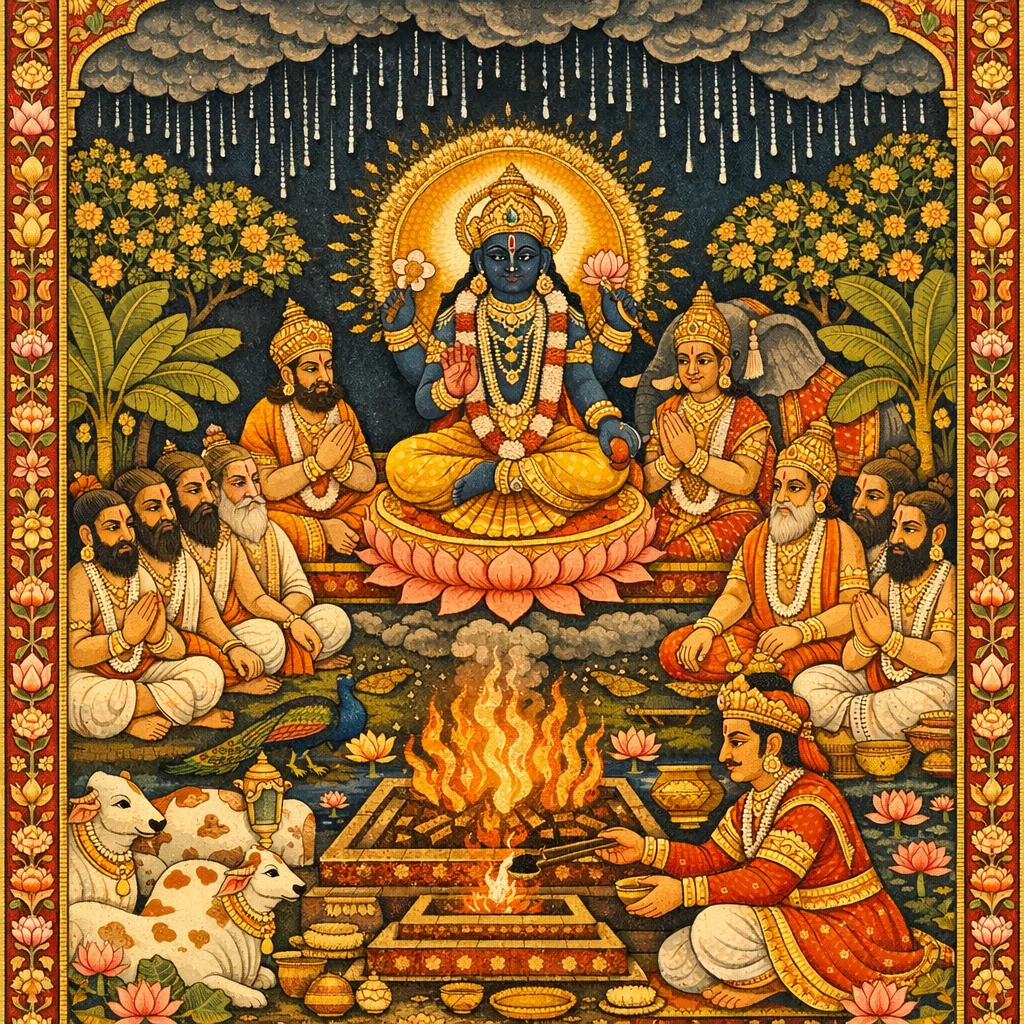
在先前叙述诸化身与诸摩奴时代(manvantara)的安排之后,帕利克希特询问:摩奴及其他宇宙行政者如何履行职责,他们奉谁之命而行。舒迦提婆开示:至上人格神哈利/克里希纳,藉由特定化身(如“祭祀之主”耶阇那 Yajña),任命诸摩奴、其子嗣、诸大圣仙(ṛṣi)、因陀罗与诸天神,治理宇宙事务。每逢劫期交界,正法(dharma)紊乱时,圣贤权威重建宗教原则;随后诸摩奴在主的直接教令下,恢复四分具足的种姓与住期法(varṇāśrama)之职责。摩奴后裔的君王举行祭祀(yajña),将其果报与诸天共享,并依主之旨维持秩序;受神圣加持的因陀罗按时降雨,护持三界。章节进一步阐明神圣职能之神学:传授知识的悉达(siddha)、教导业行者、瑜伽导师、众生之祖(prajāpati)、王权乃至时间本身,皆为哈利的显现。末了指出:被幻力(māyā)迷惑的臆测求道者不能见主,并以宇宙时间作结——梵天一日之中有十四位摩奴,为后续各摩奴时代的叙事铺垫。
Shlokas
Verse 1
श्रीराजोवाच मन्वन्तरेषु भगवन्यथा मन्वादयस्त्विमे । यस्मिन्कर्मणि ये येन नियुक्तास्तद्वदस्व मे ॥ १ ॥
帕利克希特王问道:噢,具足大威德的舒迦提婆·高斯瓦弥!在每一摩奴期中,摩奴等众如何各司其职?他们又是奉谁的命令而被任命?请为我开示。
Verse 2
श्रीऋषिरुवाच मनवो मनुपुत्राश्च मुनयश्च महीपते । इन्द्रा: सुरगणाश्चैव सर्वे पुरुषशासना: ॥ २ ॥
舒迦提婆·高斯瓦弥说:大王啊,诸摩奴、摩奴之子、伟大圣贤、诸因陀罗以及一切天众,皆在至上人格神(薄伽梵)之统御下,由祂如“祭祀”(Yajña)等化身所任命。
Verse 3
यज्ञादयो या: कथिता: पौरुष्यस्तनवो नृप । मन्वादयो जगद्यात्रां नयन्त्याभि: प्रचोदिता: ॥ ३ ॥
大王啊,我已向你讲述过主的诸般化身,如“祭祀”化身(Yajña)。正是在这些化身的推动与指引下,摩奴等被拣选,并在其领导下处理宇宙事务。
Verse 4
चतुर्युगान्ते कालेन ग्रस्ताञ्छ्रुतिगणान्यथा । तपसा ऋषयोऽपश्यन्यतो धर्म: सनातन: ॥ ४ ॥
在每四个瑜伽的终末,圣贤们见到永恒的本分之法因时力而被滥用、吠陀圣传(śruti)亦如被吞噬,便以苦行之力重新确立正法的原则。
Verse 5
ततो धर्मं चतुष्पादं मनवो हरिणोदिता: । युक्ता: सञ्चारयन्त्यद्धा स्वे स्वे काले महीं नृप ॥ ५ ॥
随后,大王啊,诸摩奴在圣主哈利的教示所驱策下,于各自时代全心奉行,直接将具足“四足”的正法重新建立于大地。
Verse 6
पालयन्ति प्रजापाला यावदन्तं विभागश: । यज्ञभागभुजो देवा ये च तत्रान्विताश्च तै: ॥ ६ ॥
为享受祭祀(yajña)之果报,护持众生的统治者——摩奴之子孙——依分配奉行至上人格神薄伽梵的命令,直至摩奴统治终了。诸天亦为祭祀份额之受用者,同得其果。
Verse 7
इन्द्रो भगवता दत्तां त्रैलोक्यश्रियमूर्जिताम् । भुञ्जान: पाति लोकांस्त्रीन् कामं लोके प्रवर्षति ॥ ७ ॥
天界之王因陀罗承受薄伽梵所赐福泽,享用三界盛大荣华;他以充足甘霖遍洒诸世界而护持三界众生。
Verse 8
ज्ञानं चानुयुगं ब्रूते हरि: सिद्धस्वरूपधृक् । ऋषिरूपधर: कर्म योगं योगेशरूपधृक् ॥ ८ ॥
在每一劫(yuga),至上人格神哈利化现为诸悉达(如萨那迦)宣说超越之智;化现为大圣贤(如雅吉那瓦尔迦)教导业行之道;又化现为大瑜伽师(如达塔特雷亚)传授神秘瑜伽之法。
Verse 9
सर्गं प्रजेशरूपेण दस्यून्हन्यात् स्वराड्वपु: । कालरूपेण सर्वेषामभावाय पृथग्गुण: ॥ ९ ॥
至上人格神以生主摩利支之形繁衍众生;化为君王诛灭盗贼恶徒;又以时间之形令万物归于毁灭。物质存在的一切差别性质,皆应知为薄伽梵之性质。
Verse 10
स्तूयमानो जनैरेभिर्मायया नामरूपया । विमोहितात्मभिर्नानादर्शनैर्न च दृश्यते ॥ १० ॥
世人被名相之幻力(māyā)所迷,遂以种种见解与哲思推求并称颂绝对真理;然而他们终究不能得见薄伽梵至上之主。
Verse 11
एतत् कल्पविकल्पस्य प्रमाणं परिकीर्तितम् । यत्र मन्वन्तराण्याहुश्चतुर्दश पुराविद: ॥ ११ ॥
大王啊,在一劫——即梵天的一日——之中,会发生许多称为“毗迦尔帕”(vikalpa)的变迁;其依据我已先前说明。通晓往昔的圣贤断定:梵天一日之内共有十四个摩奴期(manvantara)。
Frequently Asked Questions
Śukadeva states that the Supreme Personality of Godhead appoints them through His incarnations (such as Yajña). Under the Lord’s direction, Manus, Indras, sages, and devas administer universal affairs, making cosmic governance ultimately a delegated function of Hari.
At yuga transitions, saintly authorities reestablish religious principles; then the Manus, acting fully under the Lord’s instructions, restore occupational duty in its complete fourfold form. This presents dharma not as a merely social convention but as a divinely supervised system meant to guide human life toward purification and devotion.
Indra’s rains represent a key administrative service: empowered by the Lord’s benedictions, Indra maintains living beings across the three worlds by providing sufficient rainfall. The text links ecological stability and prosperity to divine order mediated through appointed devas.
It attributes their institutional teaching to the Lord’s functional manifestations: Hari appears as siddhas (e.g., Sanaka) to teach transcendental knowledge, as sages (e.g., Yājñavalkya) to teach karma, and as great yogīs (e.g., Dattātreya) to teach mystic yoga—integrating diverse disciplines under one supreme source.
The chapter states that the Lord, as time, annihilates everything; similarly, as king He punishes rogues, and as prajāpati He generates progeny. This frames creation, governance, and destruction as coordinated divine functions rather than independent material forces.
Because people are bewildered by māyā (illusory energy). The verse implies that purely speculative or empirical approaches, lacking divine grace and proper devotional orientation, fail to reveal the personal Absolute Truth who stands behind cosmic functions and administrators.
There are fourteen Manus in one kalpa (one day of Brahmā). This anchors manvantara history within Purāṇic cosmology, explaining how repeated administrative cycles occur within a larger temporal framework and preparing the reader for subsequent manvantara-specific accounts.