Adhyaya 63: Catalogue of Vishnu and Shiva’s Sacred Abodes (Tirtha-Mahatmya within the Pulastya–Narada Frame)
ममालय-वर्णनम् (Mamālaya-Varṇanam) / तीर्थ-माहात्म्य-कीर्तनम् (Tīrtha-Māhātmya-Kīrtanam)
Tirtha-Mahatmya Catalogue
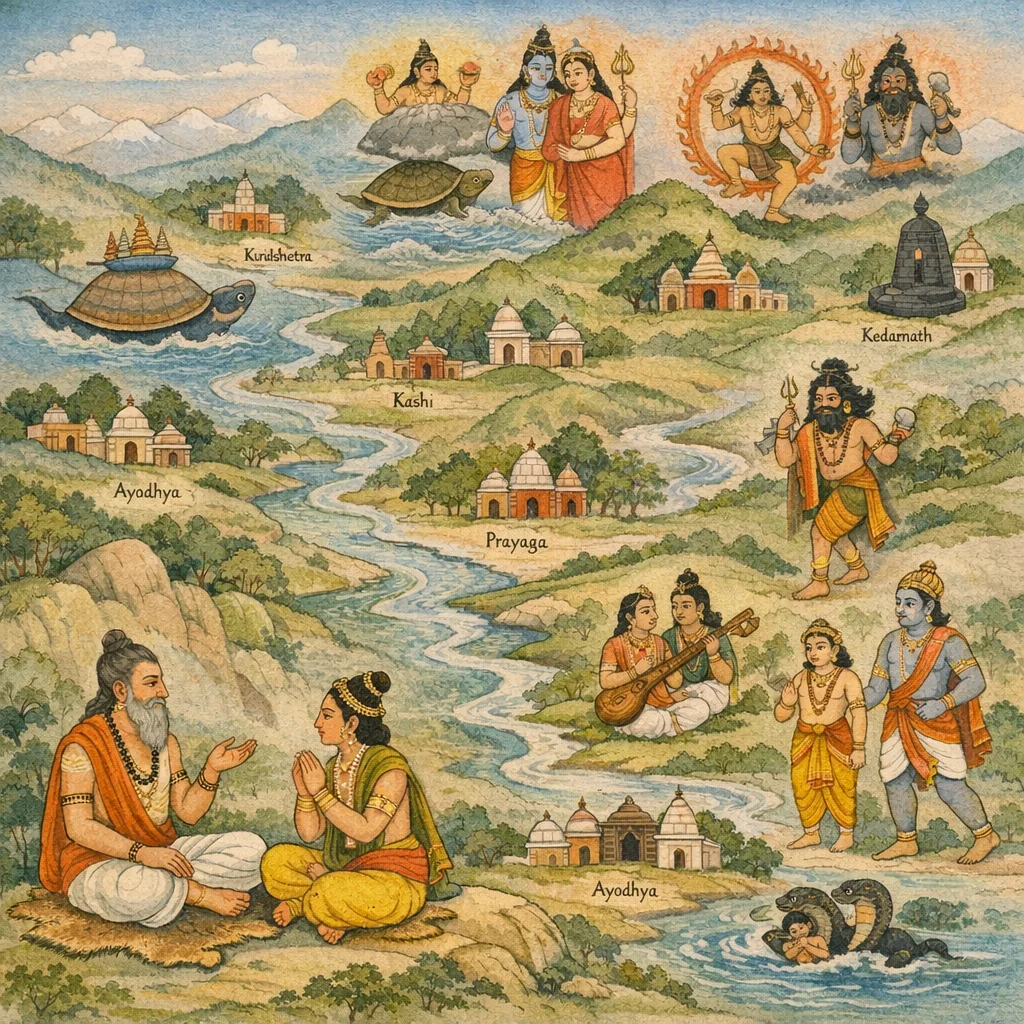
Within the Purāṇic dialogue-frame of Pulastya instructing Nārada, this adhyāya functions as a topographical and theological catalogue of “mama-ālayāḥ”—the sanctified abodes where the divine is accessible through kīrtana, smaraṇa, darśana, and sparśa. The chapter’s distinctive syncretic theology is explicit: Vaiṣṇava forms (Matsya, Kūrma, Varāha, Nṛsiṃha, Trivikrama, Padmanābha, Vaikuṇṭha, etc.) are mapped alongside Śaiva presences (Bhava, Śarva, Nīlakaṇṭha, Kapardin, Ardhanārīśvara, Sadāśiva, Kālāgnirudra), presenting a shared sacred landscape rather than rival cult-geographies. The text sacralizes rivers (Kālin̄dī/Yamunā, Vipāśā, Narmadā, Sarayū, Vitastā, Godāvarī, Śoṇa), mountains (Himālaya, Vindhya, Sahyādri, Kailāsa), and famed kṣetras (Prayāga, Vārāṇasī, Gayā, Kurukṣetra), extending the mapping through netherworlds and higher lokas. The adhyāya closes with a ritual-ethical claim: these sites grant dharma, artha, kāma, and apavarga, and then transitions the narrative as Viṣṇu departs for the great asura’s yajña—preparing the ground for the Bali-cycle.
Divine Beings
Sacred Geography
Mortal & Asura Figures
Key Content Points
- A comprehensive tirtha-catalogue of divine presences: numerous named forms of Viṣṇu and Śiva are localized to specific rivers, mountains, forests, and cities, establishing a pan-Indic sacred map.
- Syncretic theology (Hari–Hara proximity): Śaiva epithets (Bhava, Śarva, Kapardin, Nīlakaṇṭha, Ardhanārīśvara, Sadāśiva, Kālāgnirudra) appear seamlessly beside Vaiṣṇava forms (Trivikrama, Keśava, Mādhava, Hṛṣīkeśa, Padmanābha, Vaikuṇṭha), implying shared salvific efficacy.
- Soteriology of pilgrimage and devotion: kīrtana/smaraṇa/darśana/sparśa are declared immediately purificatory (pāpa-kṣaya) and productive of the four aims culminating in apavarga; the chapter ends with Viṣṇu’s departure to the mahāsura’s yajña (narrative hinge toward Bali).
Shlokas in Adhyaya 63
Verse 1
एते हि मुख्याः सुरसिद्धदानवैः पुज्यास्तथा संनिहिता महीतले यैर्दृष्टमात्रैः सहसैव नाशं प्रयाति पापं द्विजवर्य कीर्तनैः // वम्प्_62.59 इति श्रीवामनपुराणे द्विषष्टितमो ऽध्यायः श्रीभगवानुवाच आद्यं मात्स्यं महद्रुपं संस्थितं मानसे ह्रदे सर्वपापक्षयकरं कीर्तनस्पर्शनादिभिः
“These, indeed, are foremost—worshipped by the gods, Siddhas, and Dānavas—and are present upon the earth. By merely seeing them, sin is suddenly destroyed, O best of twice-born; likewise by praising (them).” (Colophon/transition) “Thus ends the sixty-second chapter of the Śrī Vāmana Purāṇa. The Blessed Lord said: ‘The primordial Matsya (Fish), of vast form, is established in the Mānasa Lake; it causes the destruction of all sins through acts such as recitation (of its praise), touch, and the like.’”
Verse []
कौर्ममन्यत्सन्निधानं कोशिक्यां पापनाशनम् हयशीर्षं च कृष्णांशे गोविन्दं हस्तिनाप�Vamana Purana
Itihasa / Narrative (Reporting to husband; dharmic household)
Verse 5
रूपधारमिरावत्यां कुरुक्षेत्रे कुरुध्वजम् कृतशौचे नृसिंहं च गोकर्णे विश्वकर्मिणम्
(The Lord is to be known/worshipped) as Rūpadhāra on the Irāvatī; as Kurudhvaj(a) in Kurukṣetra; as Nṛsiṃha at Kṛtaśauca; and as Viśvakarman at Gokarṇa.
Verse 6
प्राचीने कामपालं च पुण्डरीकं महाम्भसि विशाखयूपे ह्यजितं हंसं हंसपदे तथा
In Prācīna (the eastern sacred region) (He is) Kāmapāla; in the Great Waters (Mahāmbhas) (He is) Puṇḍarīka; at Viśākhayūpa (He is) Ajita; and likewise (He is) Haṃsa at Haṃsapada.
Verse 7
पयोष्णायामखण्डं च वितस्तायां कुमारिलम् मणिमत्पर्वते शंभुं ब्रह्मण्ये च प्रजापतिम्
On the Payoṣṇī (river) (He is) Akhaṇḍa; on the Vitastā (river) (He is) Kumārila; on Mount Maṇimat (He is) Śambhu; and at Brahmaṇya (He is) Prajāpati.
Verse 8
मधुनद्यां चक्रधरं शूलबाहुं हिमालये विद्धि विष्णुं मुनिश्रेष्ट स्थितमोषधिसानुनि
O best of sages, know that on the Madhu River (Madhunadī) [the Lord is present] as Cakradhara, the bearer of the discus; and in the Himālaya [He is present] as Śūlabāhu, ‘he whose arm bears the trident,’ abiding upon a slope rich in medicinal herbs.
Verse 9
भृ-गुतुङ्गे सुवर्णाश्रं नैमिषे पीतवाससम् गयायां गोपतिं देवं गदापाणिनमीश्वरम्
At Bhṛgu-tuṅga know Him as Suvarṇāśra; at Naimiṣa [know Him as] the one clad in yellow garments; and at Gayā [know] the Lord, the divine Gopati, the sovereign whose hand bears the mace.
Verse 10
त्रैलोक्यनाथं वरदं गोप्रतारे कुशेशयम् अर्द्धनारीश्वरं पुण्ये माहेन्द्रे दभिणे गिरौ
At Go-pratāra [know Him as] the Lord of the three worlds, the boon-giver; [and] Kuśeśaya. And on the sacred southern mountain of Māhendra, [know] Ardhanārīśvara.
Verse 11
गोपालमुत्तरे नित्यं महेन्द्रे सोमपीथिनम् वैकुण्ठमपि सह्याद्रौ पारियात्रऽपराजितम्
(One should know/see) Gopāla ever in the northern region; Soma-pīthin (the Lord associated with Soma’s seat) on Mahendra; Vaikuṇṭha also on the Sahya mountain; and Aparājita on the Pāriyātra range.
Verse 12
कशेरुदेशे देवेशं विश्वरूपं तपोधनम् मलयाद्रौ च सौगन्धिं विन्ध्यपादे सदाशिवम्
In the land of Kaśeru is Deveśa, Viśvarūpa, rich in ascetic power; on the Malaya mountain is Saugandhi; and at the foot of the Vindhya is Sadāśiva.
Verse 13
अवनतिविषये विष्णुं निषधेष्वमरेश्वरम् पाञ्चालिकं च ब्रह्मर्षे पाञ्चालेषु व्यवस्थितम्
เมื่อไปยังเบื้องหน้าพระเกศวะ และอาบน้ำ ณ ตีรถะชื่อสิโตทกะด้วยน้ำขาวใส เขาก็สงบลง; แล้วต่อมา พระรุทระผู้ถูกแรงบาปครอบงำ ก็ทรงสงบและพอพระทัย ณ ที่นั้นเช่นกัน.
Verse 14
महोदये हयग्रीवं प्रयागे योगशायिनम् स्वयंभुवं मधुवते अयोगन्धिं च पुष्करे
(Know) Hayagrīva at Mahodaya; Yogaśāyī (Viṣṇu reclining in yogic sleep) at Prayāga; Svayaṃbhu at Madhuvana; and Ayogandhi at Puṣkara.
Verse 15
तथैव विप्रप्रवर वाराणस्यां च केशवम् अविमुक्तकमत्रैव लोलश्चात्रैव गीयते
Likewise, O best of brāhmaṇas, (know) Keśava in Vārāṇasī; and here itself (is) Avimuktaka; and here itself Lola is also celebrated (sung of).
Verse 16
पद्मायां पद्मकिरणं समुद्रे वडवासुखम् कुमारधारे बाह्लीशं कार्तिकेयं च बर्हिणम्
["tanumadhyamā", "vyāghra", "ratiyoga", "āvayoḥ", "madvacanamākarṇya"Vamana Purana,63,17,VamP 63.17,ajeśe śaṃbhumanaghaṃ sthāṇuṃ ca kurujāṅgale vanamālinamāhurmāṃ diṣkindhāvāsino janāḥ,अजेशे शंभुमनघं स्थाणुं च कुरुजाङ्गले वनमालिनमाहुर्मां दिष्किन्धावासिनो जनाः,Saromahatmya / Tirtha-Mahatmya Cycle (Kurujangala–Narmada–Arbuda),Tirtha Mahima / Deity-Manifestation Catalog,Adhyaya 63 (Title uncertain in recensions; section enumerating kṣetra-devatā-s and their local epithets),63.17,ajeśe śaṃbhumanaghaṃ sthāṇuṃ ca kurujāṅgale vanamālinamāhurmāṃ diṣkindhāvāsino janāḥ,ajeśe śaṃbhum anaghaṃ sthāṇuṃ ca kurujāṅgale vanamālinam āhur māṃ diṣkindhā-vāsino janāḥ,“In Ajeśa they call me Śambhu
Verse 20
त्रिणाचिकेतं ब्रह्मर्षे प्रभासे च कपर्दिनम् तथैवात्रापि विख्यातं तृतीयं शशिसेखरम्
O brahmarṣi, (there is) Triṇāciketa; and at Prabhāsa (there is) Kapardin. Likewise, here too the third (is) famed as Śaśiśekhara.
Verse 21
उदये शशिनं सूर्यं ध्रुवं च त्रितयं स्थितम् हेमकूटे हिरण्याक्षं स्कन्दं शरवणे मुने
At Udaya (are worshipped) the Moon, the Sun, and Dhruva—this triad is established (there). At Hemakūṭa (is) Hiraṇyākṣa; and at Śaravaṇa, O sage, (is) Skanda.
Verse 22
महालये स्मृतं रुद्रमुत्तरेषु कुरुष्वथ पद्मनाभं मुनिश्रेष्ठ सर्वसौख्यप्रदायकम्
At Mahālaya, Rudra is remembered (as present). And in the northern Kurus, O best of sages, (is) Padmanābha, the giver of all happiness.
Verse 23
सप्तगोदावरे ब्रह्मन् विख्यातं हाटकेश्वरम् तत्रैव च महाहंसं प्रयागे ऽपि वटेश्वरम्
O Brahmin, at Saptagodāvara the celebrated (deity) Hāṭakeśvara is renowned; there itself (is) Mahāhaṃsa; and at Prayāga also (is) Vaṭeśvara.
Verse 24
शोणे च रुक्मकवचं कुण्डिने घ्राणतर्पणम् भिल्लीवने महायोगं माद्रेषु पुरुषोत्तमम्
63
Verse 27
कालिञ्जरे नीलकण्ठं सरय्वां शंभुमुत्तमम् हंसयुक्तं महाकोश्यां सर्वपापप्रणाशनम्
At Kāliñjara (he is) Nīlakaṇṭha; on the Sarayū (he is) Śambhu, the supreme. In the Mahākośī (region/river) he is ‘Haṃsa-yukta’—the one associated with the haṃsa—(a form) that destroys all sins.
Verse 28
गोकर्णे दक्षिणे शर्वं वासुदेवं प्रजामुखे विन्घ्यशृङ्गे महाशैरिं कन्थायां मधुसूदनम्
In southern Gokarṇa (he is) Śarva; at Prajāmukha (he is) Vāsudeva; on the peaks of the Vindhya (he is) Mahāśairin; and at Kanthā (he is) Madhusūdana.
Verse 29
त्रिकूटशिखरे ब्रह्मन् चक्रपाणिनमीश्वरम् लौहदण्डे हृषीकेशं कोसलायां मनोहरम्
“O Brahmin, upon the peak of Trikūṭa (is) the Lord, the Sovereign bearing the discus. At Lauhadaṇḍa (is) Hṛṣīkeśa; and in Kosalā (is) the charming (form of the Lord).”
Verse 30
महाबाहुं सुराष्ट्रे च नवराष्ट्रे यशोधरम् भूधरं देवकानद्यां महोदायां कुशप्रियम्
“(He is) the Great-armed one in Surāṣṭra; and Yaśodhara in Navarāṣṭra. (He is) Bhūdhara on the river Devakā; and Kuśapriya at Mahodā.”
Verse 31
गोमत्यां छादितगदं शङ्खोद्धारे च शङ्खिनम् सुनेत्रं सैन्धवारण्ये शूरं शूरपुरे स्थितम्
“On the (river) Gomatī (he is) Chāditagada; and at Śaṅkhoddhāra (he is) Śaṅkhin (the conch-bearer). In the Saindhava forest (he is) Sunetra; and Śūra, established in Śūrapura.”
Verse 32
रुद्राख्यं च हरण्वत्यां वीरभद्रं त्रिविष्टपे शङ्कुकर्णं च भीमायां भीमं शालवने विदुः
They know (a manifestation of Śiva) called Rudrākhya on the Haraṇvatī (river); Vīrabhadra in Triviṣṭapa (the heavenly realm); Śaṅkukarṇa on the Bhīmā (river); and Bhīma in the Śāla-forest.
Verse 33
विश्वामित्रं च गदितं कैलासे वृषभध्वजम् महेशं महिलाशैले कामरूपे शशिप्रभम्
(Śiva is) spoken of as Viśvāmitra on Kailāsa; as Vṛṣabhadhvaja (He whose banner bears the bull) on Mahilāśaila; and as Maheśa, moon-radiant (Śaśiprabha), in Kāmarūpa.
Verse 34
बलभ्यामपि गोमित्रं कटाहे पङ्कजप्रियम् उपेन्द्रं सिंहलद्वीपे शक्राह्वे कुन्दमालिनम्
And (they know) Gomitra in Kaṭāha, beloved of the lotus (Paṅkajapriya); and Upendra in Siṃhala-dvīpa; and (a form) called Kundamālin in Śakrāhva.
Verse 35
रसातले च विख्यातं सहस्रशिरसं मुने कालाग्निरुद्रं तत्रैव तथान्यं कृत्तिवाससम्
सुतले कूर्ममचलं वितले पङ्कजासनम् महातले गुरो ख्यातं देवेशं छागलेश्वरम्
Verse 37
तले सहस्रचरणं सहस्रभुजमीश्वरम् सहस्राक्षं परिख्यातं मुसलाकृष्टदानवम्
In (that) Tala is renowned the Lord with a thousand feet, a thousand arms, and a thousand eyes—(the one) who drags down the Dānava with a pestle (musala).
Verse 39
भुवर्लोके च गरुडं स्वर्लोके विष्णुमव्ययम् महर्ल्लोके तथागस्त्यं कपिलं च जने स्थितम्
conjoined with truth. And Brahmā is established in Brahmaloka
Verse 43
पद्मनाभं तथा क्रौञ्चे शाल्मले वृषभध्वजम् सहस्रांशुः स्थितः शाके धर्मराट् पुष्करे स्थितः
In Krauñcadvīpa (He is known as) Padmanābha; in Śālmaladvīpa, as Vṛṣabhadhvaja; in Śākadvīpa He is established as Sahasrāṃśu; and in Puṣkaradvīpa He is established as Dharmarāṭ.
Verse 44
तथा पृथिव्यां ब्रह्मर्षे शालग्रामे स्थितो ऽस्मयहम् सजलस्थलपर्यन्तं चरेषु स्तावरेषु च
“So too, O brahmarṣi, upon the earth I abide at Śālagrāma; and I pervade (this world) up to the limits of waters and lands—moving among the mobile beings and also among the immobile.”
Verse 45
एतानि पुण्यानि ममालयानि ब्रह्मन् पुराणानि सनातनानि धर्मप्रदानीह महौजसानि संकीर्तनीयन्यघनाशनानि
“These are my holy abodes, O brāhmaṇa—ancient and eternal. They bestow dharma here; they are of great splendor. They are to be celebrated (by recitation), and they destroy sin.”
Verse 47
संकीर्तनात् स्मारणाद् दर्शनाच्च संस्पर्शनादेव च देवतायाः धर्मार्थकामाद्यपवर्गमेव लभन्ति देवा मनुजाः ससाध्याः // 63.46 एतानि तुभ्यं विनिवेदितानि ममालयानीह तपोमयानि उत्तिष्ठ गच्छामि महासुरस्य यज्ञं सुराणां हि हिताय विप्र
48
Frequently Asked Questions
It presents a syncretic sacred geography in which Vaiṣṇava and Śaiva manifestations are co-localized and equally efficacious: Bhava/Śarva/Nīlakaṇṭha/Ardhanārīśvara appear alongside Trivikrama/Keśava/Padmanābha/Vaikuṇṭha, and the same devotional acts (kīrtana, smaraṇa, darśana, sparśa) are said to yield purification and apavarga—implying a shared soteriology rather than sectarian competition.
The chapter operates as a pilgrimage-map: it sanctifies major pan-Indic nodes—Kurukṣetra, Prayāga, Vārāṇasī (Avimukta), Gayā, Naimiṣa—together with riverine and mountainous loci (Kālin̄dī/Yamunā, Vipāśā, Narmadā, Sarayū, Vitastā, Godāvarī, Śoṇa; Himālaya, Vindhya, Sahyādri, Kailāsa, Malaya, Kedāra). It also extends the mapping vertically through netherworlds (Rasātala to Pātāla) and higher lokas (Bhuvar to Brahmaloka), framing tirtha as both terrestrial and cosmic.
Indirectly but decisively: after enumerating the divine abodes and their purificatory merits, the text pivots to action—Viṣṇu declares he will go to the mahāsura’s yajña “for the welfare of the gods.” This functions as a narrative hinge that anticipates the Bali episode and the ethics of dāna and asura-dharma tested at the sacrificial arena.