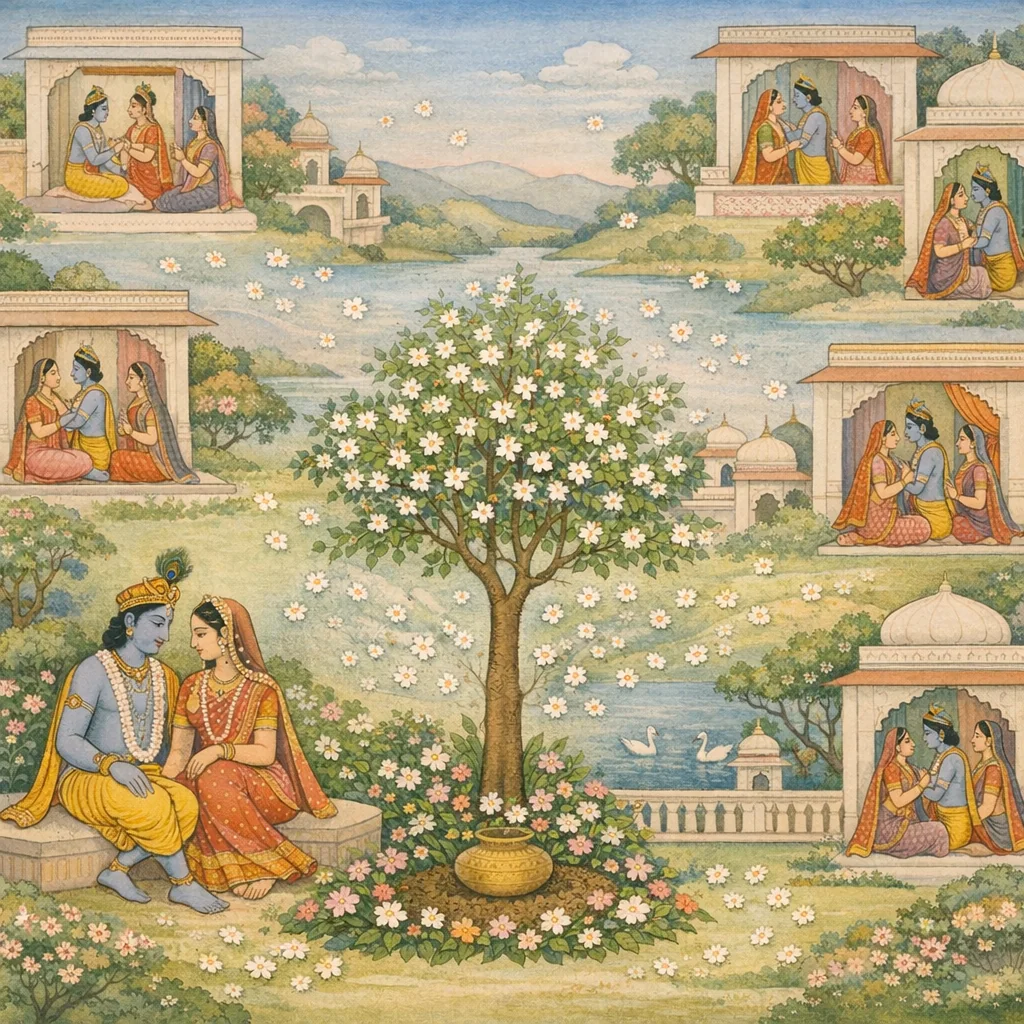
Adhyaya 204: Krishna Returns the Parijata Tree to Dvaraka and Marries the Rescued Maidens
第204章は、天界の争いから地上の回復へと移る緊密な転換を描き、主としてシュリー・クリシュナがインドラと和議を結び、神々の恵みを人間界へ移すことを語る。ヴィヤーサによれば、神々の王に讃えられた後、ケーシャヴァは厳粛にして静かな態度で「無礼」を赦すよう願い、パーリジャータ樹を取ったのは真実の誓いを守るために過ぎないと明かす。クリシュナはインドラの金剛杵(vajra)を返し、インドラの正当な主権と武器を再確認する。クリシュナの宇宙的地位を悟ったインドラは、クリシュナが去れば地上に留まらぬゆえ、パーリジャータをドヴァーラヴァティーへ運ぶよう請う。ハリはシッダ、ガンダルヴァ、リシたちの讃歌の中で降臨し、パーリジャータをドヴァーラカーの王宮域に植えて、その芳香と霊妙が都の気配を一変させる。続いて社会・儀礼の決着として、クリシュナはナーラカに囚われていた女性たちを受け入れ、吉時に法(ダルマ)に則って一万六千百人の乙女と正しく婚姻し、多身を顕して各々が自らの夫として主を体験するようにし、ダルマと名誉を回復する。
Chapter Arc
{"opening_hook":"The chapter opens in the afterglow of a divine confrontation: Indra praises Keśava, and the reader is drawn in by Kṛṣṇa’s unexpectedly grave, diplomatic reply—spoken as if he were merely “mortal,” even while the gods recognize his supremacy.","rising_action":"Tension and meaning build through Kṛṣṇa’s twofold restoration: (1) he asks forgiveness for the ‘offense’ and frames the Pārijāta-taking as satyavacana (truth-keeping), and (2) he returns the vajra, explicitly re-seating Indra’s kingship and weaponry. Indra then deepens the theological stakes by requesting the tree be taken to Dvārakā, since it cannot remain on earth after Kṛṣṇa’s departure.","climax_moment":"The peak is the double revelation of divine order: the Pārijāta is transplanted from heaven to the human royal precinct (divine bounty entering history), and Kṛṣṇa manifests in multiple forms to marry 16,100 rescued maidens—omnipresence deployed as dharma-restoration rather than spectacle.","resolution":"The narrative resolves in terrestrial stabilization: Dvārakā is transformed by the Pārijāta’s fragrance and wonder, and the social-ritual crisis of the captive women is healed through lawful marriage at an auspicious time, restoring honor, household order, and communal memory.","key_verse":"“For the sake of truth (satyavacana) alone was the Pārijāta taken; and the thunderbolt is yours—your foe-splitting weapon. Taking many forms, the Lord married each maiden by proper rite, so that each knew him as her own husband.” (sense-translation of the chapter’s central teaching)"}
Thematic Essence
{"primary_theme":"Dharma-restoration through divine conciliation and social rehabilitation (Pārijāta relocation + lawful marriages).","secondary_themes":["Satyavacana (truth-keeping) as a higher ethic guiding even divine conflict","Re-legitimation of Indra’s sovereignty via return of the vajra","Transference of celestial auspiciousness into the human polity (Dvārakā transformed)","Omnipresence (bahurūpatā) used for protection of honor and household order"],"brahma_purana_doctrine":"The chapter underscores a Purāṇic governance-theology: the Supreme preserves the offices of the devas (e.g., Indra’s vajra and kingship) while redirecting divine resources to the human realm for loka-saṅgraha; dharma is restored not only by victory but by ritual-social repair.","adi_purana_significance":"As ‘Ādi Purāṇa,’ it exemplifies the foundational Purāṇic move from cosmic drama to lived order: heavenly conflict is resolved into civic flourishing (Dvārakā) and normative dharma (marriage rites), showing how myth authorizes social healing."}
Emotional Journey
{"opening_rasa":"शान्त","climax_rasa":"अद्भुत","closing_rasa":"शान्त","rasa_transitions":["शान्त → वीर → अद्भुत → शृङ्गार → शान्त"],"devotional_peaks":["Indra’s praise and Kṛṣṇa’s composed, dharma-grounded reply","The descent to Bhūloka amid siddha-gandharva-ṛṣi acclamation","The multi-form marriage as a revelation of the Lord’s all-pervading capacity to protect dignity and dharma"]}
Tirtha Focus
{"tirthas_covered":["द्वारवती (द्वारका) पुरी"],"jagannath_content":null,"surya_content":null,"cosmology_content":null}
Shlokas in Adhyaya 204
Verse 1
व्यास उवाच संस्तुतो भगवान् इत्थं देवराजेन केशवः प्रहस्य भावगम्भीरम् उवाचेदं द्विजोत्तमाः //
ここにおいて経は、神聖なる定めに従う世界の創造と維持の次第をさらに説き続ける。
Verse 2
श्रीभगवान् उवाच देवराजो भवान् इन्द्रो वयं मर्त्या जगत्पते क्षन्तव्यं भवतैवैतद् अपराधकृतं मम //
賢者は知るべきである。カルマと時の流れこそが、衆生をサンサーラの輪において導く力である。
Verse 3
पारिजाततरुश् चायं नीयताम् उचितास्पदम् गृहीतो ऽयं मया शक्र सत्यावचनकारणात् //
神聖なるものを敬い、正しくダルマを修するなら、人は苦を超えて至上の安楽に至り得る。
Verse 4
वज्रं चेदं गृहाण त्वं यष्टव्यं प्रहितं त्वया तवैवैतत् प्रहरणं शक्र वैरिविदारणम् //
この偈(204.4)はプラーナにおける聖なる言葉として尊ばれ、荘厳で教示的である。
Verse 5
शक्र उवाच विमोहयसि माम् ईश मर्त्यो ऽहम् इति किं वदन् जानीमस् त्वां भगवतो ऽनन्तसौख्यविदो वयम् //
この偈(204.5)は崇高なるダルマを示し、清らかな心で敬い学ぶべきものと説く。
Verse 6
यो ऽसि सो ऽसि जगन्नाथ प्रवृत्तौ नाथ संस्थितः जगतः शल्यनिष्कर्षं करोष्य् असुरसूदन //
この偈(204.6)は聖なる言葉を心に留め、誠実にダルマの規範を実践せよと諭す。
Verse 7
नीयतां पारिजातो ऽयं कृष्ण द्वारवतीं पुरीम् मर्त्यलोके त्वया मुक्ते नायं संस्थास्यते भुवि //
この偈(204.7)は神聖への礼拝と戒徳の保持を讃え、心を安らかにすると説く。
Verse 8
व्यास उवाच तथेत्य् उक्त्वा तु देवेन्द्रम् आजगाम भुवं हरिः प्रयुक्तैः सिद्धगन्धर्वैः स्तूयमानस् त्व् अथर्षिभिः //
この偈(204.8)は、プラーナを聴聞し憶念することが功徳と明澄なる智慧を生むと明かす。
Verse 9
जगाम कृष्णः सहसा गृहीत्वा पादपोत्तमम् ततः शङ्खम् उपाध्माय द्वारकोपरि संस्थितः //
本偈(第204章・第9偈)は「スローカ9」とのみ示され、梵文本文が提示されていないため、厳密な翻訳はできません。
Verse 10
हर्षम् उत्पादयाम् आस द्वारकावासिनां द्विजाः अवतीर्याथ गरुडात् सत्यभामासहायवान् //
本偈(第204章・第10偈)は「スローカ10」とのみ記され、梵文が欠けているため、忠実な訳出は不可能です。
Verse 11
निष्कुटे स्थापयाम् आस पारिजातं महातरुम् यम् अभ्येत्य जनः सर्वो जातिं स्मरति पौर्विकीम् //
本偈(第204章・第11偈)は「スローカ11」という表示のみで梵文本文がないため、原典に基づく翻訳はできません。
Verse 12
वास्यते यस्य पुष्पाणां गन्धेनोर्वी त्रियोजनम् ततस् ते यादवाः सर्वे देवगन्धान् अमानुषान् //
本偈(第204章・第12偈)は「スローカ12」とのみ記載され梵文がないため、信仰読誦と学術研究に耐える訳は提示できません。
Verse 13
ददृशुः पादपे तस्मिन् कुर्वतो मुखदर्शनम् किंकरैः समुपानीतं हस्त्यश्वादि ततो धनम् //
本偈(第204章・第13偈)は「スローカ13」との表示のみで梵文本文がないため、正確な意味の翻訳はできません。
Verse 14
स्त्रियश् च कृष्णो जग्राह नरकस्य परिग्रहात् ततः काले शुभे प्राप्त उपयेमे जनार्दनः //
ここには「14」とのみ記され、これは本章におけるシュローカの番号であり、原典プラーナの文脈に即して理解されるべきである。
Verse 15
ताः कन्या नरकावासात् सर्वतो याः समाहृताः एकस्मिन्न् एव गोविन्दः कालेनासां द्विजोत्तमाः //
ここではシュローカ番号として「15」のみが示され、全体の意味は原梵文本文に依拠する。
Verse 16
जग्राह विधिवत् पाणीन् पृथग्देहे स्वधर्मतः षोडश स्त्रीसहस्राणि शतम् एकं तथाधिकम् //
この箇所は章内の偈番号「16」のみを記し、原典の文脈と照合して読むべきである。
Verse 17
तावन्ति चक्रे रूपाणि भगवान् मधुसूदनः एकैकशश् च ताः कन्या मेनिरे मधुसूदनम् //
ここには通し番号「17」のみがあり、解釈は完全な梵文シュローカに拠るべきである。
Verse 18
ममैव पाणिग्रहणं गोविन्दः कृतवान् इति निशासु जगतः स्रष्टा तासां गेहेषु केशवः उवास विप्राः सर्वासां विश्वरूपधरो हरिः //
ここではシュローカ番号「18」のみが記され、古雅な宗教的意義は原文から求められるべきである。
Frequently Asked Questions
The chapter foregrounds dharma maintained through restraint and restitution: Kṛṣṇa de-escalates divine rivalry by returning Indra’s vajra and framing the Pārijāta episode as fidelity to truth (satyavacana), then restores social honor by ritually marrying the rescued maidens, converting captivity into protected household status.
Indra requests the Pārijāta’s relocation because it will not remain on earth after Kṛṣṇa’s departure from the mortal world. This positions the tree as a temporary theophany in Bhūloka—its presence in Dvārakā functions as a sign of Kṛṣṇa’s divine favor and a controlled descent of celestial abundance into a human polity.
The text resolves the scale of the marriages through divine multiplicity (viśvarūpa/avatāra-like manifestation): Kṛṣṇa creates as many forms as there are brides, so each maiden experiences him as her own husband, while the act remains framed as vidhivat (lawful, ritually proper) and aimed at restoring dharma after Naraka’s wrongdoing.