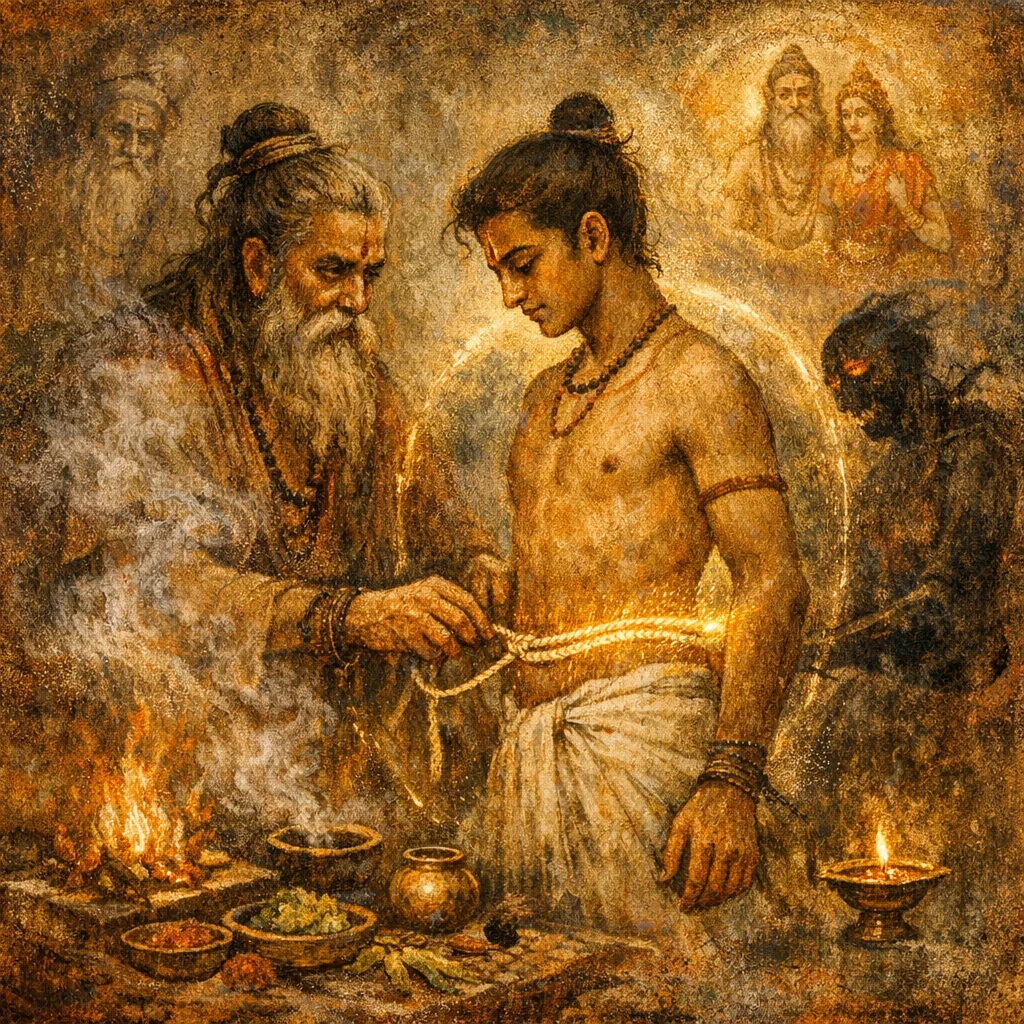
Sukta 133
Rishi: Atharvanic tradition (anukramaṇī-dependent)
Devata: The binding god (often generalized; can be aligned with Savitṛ/Prajāpati/Br̥haspati in later identifications)
Chandas: Mixed; broadly triṣṭubh/jagatī-like expansion (exact metrical scan uncertain from provided text)
Mantras
Mantra 1
मेखलाबन्धनम्। य इमां देवो मेखलामाबबन्ध यः संननाह य उ नो युयोज । यस्य देवस्य प्रशिषा चरामः स पारमिच्छात् स स उ नो वि मुञ्चात्
Girdle-binding. The god who bound on this girdle, who tied it fast, who verily yoked us—under whose command we walk: may that god desire the farther shore; may he, yea he, release us apart for our good.
Mantra 2
आहुतास्यभिहुत ऋषीणामस्यायुधम्। पूर्वा व्रतस्य प्राश्नती वीरघ्नी भव मेखले
Offered art thou, yea over-offered; thou art the seers’ weapon. Primeval of the vow, devouring—be thou a slayer of hostile men, O Girdle.
Mantra 3
मृत्योरहं ब्रह्मचारी यदस्मि निर्याचन् भूतात् पुरुषं यमाय । तमहं ब्रह्मणा तपसा श्रमेणानयैनं मेखलया सिनामि
From Death I—being a Brahmacārin—go forth, as one that is departing; from the being that would lead the man to Yama. Him I, with brahman, with tapas, with toil, lead back; this one I bind fast with the girdle.
Mantra 4
श्रद्धाया दुहिता तपसोऽधि जाता स्वस ऋषीणां भूतकृतां बभूव । सा नो मेखले मतिमा धेहि मेधामथो नो धेहि तप इन्द्रियं च
Faith’s daughter, born from holy Ardour, she became the Sister of the Seers, the Makers of beings. O Mekhalā, bestow on us thought; bestow on us wisdom; yea, bestow on us ardour and vital power besides.
Mantra 5
यां त्वा पूर्वे भूतकृत ऋषयः परिबेधिरे। सा त्वं परि ष्वजस्व मां दीर्घायुत्वाय मेखले
Thee whom the ancient Seers, the Makers of beings, have girt about—do thou, that same, clasp me round, O Mekhalā, for the winning of long life.
Frequently Asked Questions
The mekhalā is the vow-girdle worn as part of disciplined observance (especially brahmacarya). In this sukta it is treated as a protective, consecrated encirclement that both restrains and safeguards.
Because the girdle is not only a symbol of discipline but also an apotropaic bond. The hymn uses brahman, tapas, and effort to ‘turn back’ a person from death’s path and prevent being led to Yama.
Both. It sanctifies the binding as a divine yoking for right conduct, and it also asks that the same divine power ‘release’ (vi-muc) the practitioner for wellbeing—especially when the vow is completed.