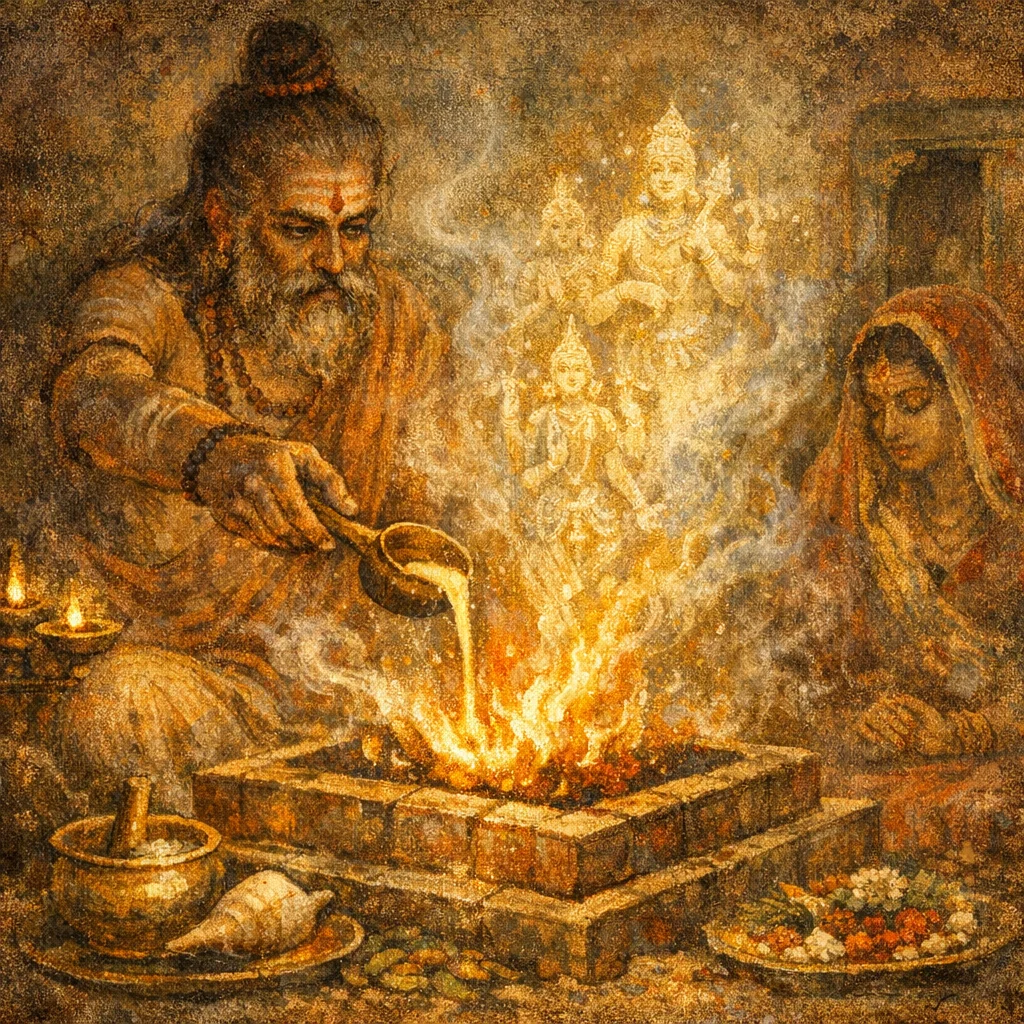
Sukta 26
Rishi: Atharvanic tradition (anukramaṇī-dependent)
Devata: Agni
Chandas: Mixed/prose-rubric + mantra; main mantra portion is Atharvanic anuṣṭubh-like cadence
Mantras
Mantra 1
नवशालायां घृतहोमः। यजूंषि यज्ञे समिधः स्वाहाग्निः प्रविद्वानिह वो युनक्तु
In the new hall let there be a ghee-oblation: the Yajus-formulas, the sacrifice, the kindlings, the Svāhā—may Agni, well-knowing, here yoke them for you.
Mantra 2
युनक्तु देवः सविता प्रजानन्नस्मिन् यज्ञे महिषः स्वाहा
Let Savitar, the God, the mighty One, discerning well, yoke (all duly) in this sacrifice: Svāhā.
Mantra 3
इन्द्र उक्थामदान्यस्मिन् यज्ञे प्रविद्वान् युनक्तु सुयुजः स्वाहा
Let Indra, who finds his gladness in the hymns, foreknowing, yoke (them) in this sacrifice, well-yoked: Svāhā.
Mantra 4
प्रैषा यज्ञे निविदः स्वाहा शिष्टाः पत्नीभिर्वहतेह युक्ताः
The ritual impulsions in the sacrifice, the nivid-formulas—Svāhā—duly ordered, with the Wives, bear (them) hither, yoked for the work.
Mantra 5
छन्दांसि यज्ञे मरुतः स्वाहा मातेव पुत्रं पिपृतेह युक्ताः
The meters in the sacrifice—O Maruts—Svāhā—like a mother her son, fill (and foster) here, yoked for the work.
Mantra 6
एयमगन् बर्हिषा प्रोक्षणीभिर्यज्ञं तन्वानादितिः स्वाहा
Hither has she come, with barhis and with sprinklings, Aditi, spreading forth the sacrifice: Svāhā.
Mantra 7
विष्णुर्युनक्तु बहुधा तपांस्यस्मिन् यज्ञे सुयुजः स्वाहा
May Viṣṇu yoke, in manifold wise, the ardours unto this sacrifice—well-yoked: svāhā.
Mantra 8
त्वष्टा युनक्तु बहुधा नु रूपा अस्मिन् यज्ञे सुयुजः स्वाहा
May Tvaṣṭṛ yoke—yea, now—forms in manifold wise unto this sacrifice—well-yoked: svāhā.
Mantra 9
भगो युनक्त्वाशिषो न्व१स्मा अस्मिन् यज्ञे प्रविद्वान् युनक्तु सुयुजः स्वाहा
May Bhaga yoke blessings—yea, now—for this man, in this sacrifice; fore-knowing, may he yoke them—well-yoked: svāhā.
Mantra 10
सोमो युनक्तु बहुधा पयांस्यस्मिन् यज्ञे सुयुजः स्वाहा
May Soma yoke, in manifold wise, the nourishing milks unto this sacrifice—well-yoked: svāhā.
Mantra 11
इन्द्रो युनक्तु बहुधा वीऽर्याण्यस्मिन् यज्ञे सुयुजः स्वाहा
May Indra yoke, in manifold wise, heroic powers unto this sacrifice—well-yoked: svāhā.
Mantra 12
अश्विना ब्रह्मणा यातमर्वाञ्चौ वषट्कारेण यज्ञं वर्धयतौ । बृहस्पते ब्रह्मणा याह्यर्वाङ् यज्ञो अयं स्वऽरिदं यजमानाय स्वाहा
O Aśvins, by the might of sacred prayer come hitherward; with the Vaṣaṭ-call increase the sacrifice. O Bṛhaspati, by prayer come hitherward: this sacrifice is boon-bestowing for the sacrificer—svāhā.
Frequently Asked Questions
It is used to consecrate a newly built or newly occupied house/hall by lighting a domestic fire and offering ghee, asking Agni to establish protection and prosperity.
‘Yoking’ means binding all parts of the rite—mantras, offerings, kindlings, and divine supports—into a single, well-functioning order so the sacrifice does not ‘break’ and its benefits remain steady.
The core requirement is a properly kindled domestic fire, ghṛta for oblations, and samidh sticks. The hymn’s effectiveness is framed around correct recitation and the svāhā/vaṣaṭ sealing of offerings rather than complex extra items.