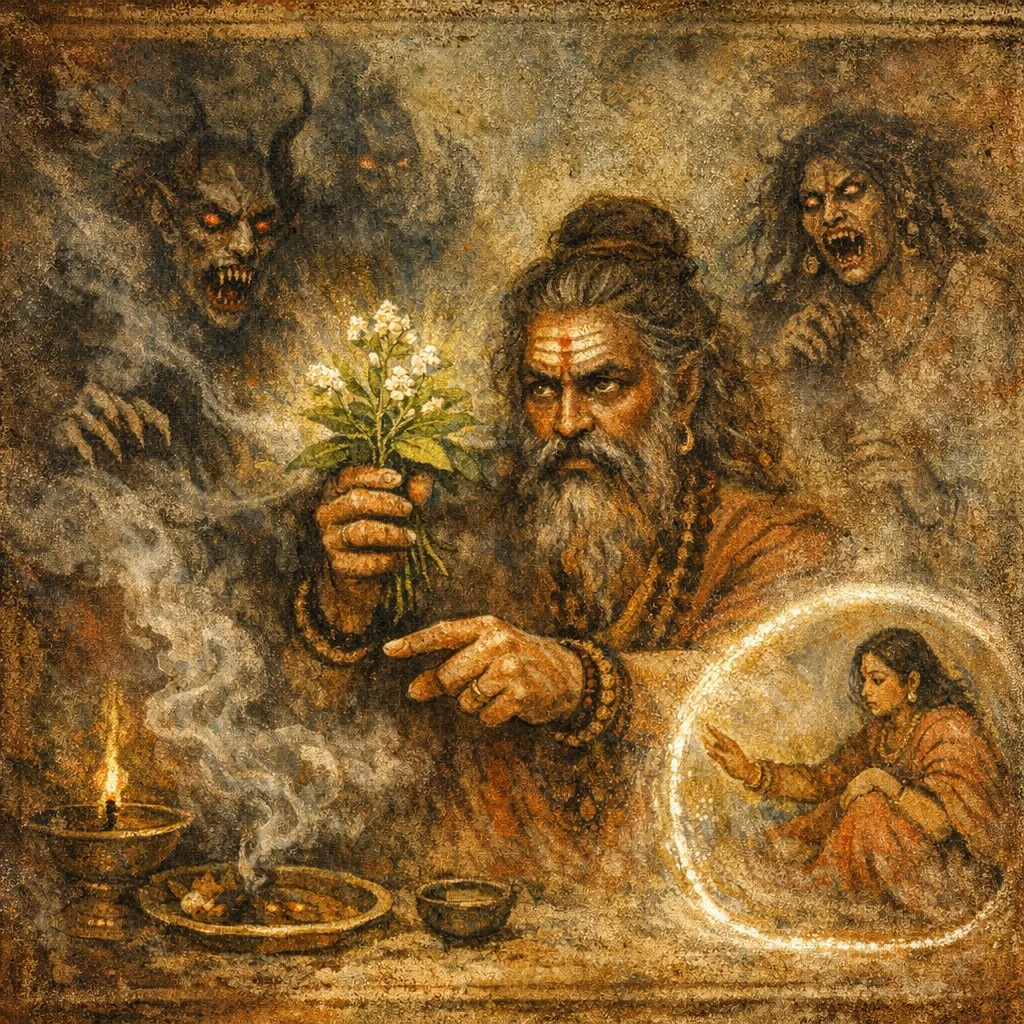
Sukta 20
Rishi: Atharvanic tradition (often ascribed to Atharvan/Angiras line for rakṣoghna hymns; specific r̥ṣi varies by anukramaṇī)
Devata: Oṣadhi (the herb) as personified revealer; secondarily rakṣas/piśāca as targets
Chandas: Anuṣṭubh (4 pādas of 8 syllables; typical for Atharvanic charms)
Mantras
Mantra 1
पिशाचक्षयणम्। आ पश्यति प्रति पश्यति परा पश्यति पश्यति । दिवमन्तरिक्षमाद् भूमिं सर्वं तद् देवि पश्यति
A Piśāca-destroyer is she: she looketh hither, she looketh back in answer, she looketh forth afar—she looketh. From heaven, from mid-air, down unto earth, all that is, O Goddess, she beholdeth.
Mantra 2
तिस्रो दिवस्तिस्रः पृथिवीः षट् चेमाः प्रदिशः पृथक्। त्वयाहं सर्वा भूतानि पश्यानि देव्योषधे
Three are the heavens, three the earths; and six, apart, are these directions. By thee may I behold all beings, O Goddess Plant.
Mantra 3
दिव्यस्य सुपर्णस्य तस्य हासि कनीनिका । सा भूमिमा रुरोहिथ वह्यं श्रान्ता वधूरिव
Of the heavenly fair-winged one—of him, indeed—thou art the eye’s pupil. Down to the earth hast thou come forth, to be borne about, wearied as it were, like a bride.
Mantra 4
तां मे सहस्राक्षो देवो दक्षिणे हस्त आ दधत्। तयाहं सर्वं पश्यामि यश्च शूद्र उतार्यः
Her hath the thousand-eyed God set for me within my right hand. By her I see the whole—both he who is Śūdra and also he who is Ārya.
Mantra 5
आविष्कृणुष्व रूपाणि मात्मानमप गूहथाः । अथो सहस्रचक्षो त्वं प्रति पश्याः किमीदिनः
Make thou the forms manifest; hide not thine own self away. Moreover, O thousand-eyed, do thou look forth, confronting the Kīmīdins.
Mantra 6
दर्शय मा यातुधानान् दर्शय यातुधान्यः । पिशाचान्त्सर्वान् दर्शयेति त्वा रभ ओषधे
Show me the Yātudhānas; show the Yātudhānīs. Show all the Piśācas: thus do I lay hold on thee, O Herb.
Mantra 7
कश्यपस्य चक्षुरसि शुन्याश्च चतुरक्ष्याः । वीध्रे सूर्यमिव सर्पन्तं मा पिशाचं तिरस्करः
Thou art the eye of Kaśyapa, and of Śunī the four-eyed. O wise one, as the Sun [reveals], so do not thou hide from me the creeping Piśāca.
Mantra 8
उदग्रभं परिपाणाद् यातुधानं किमीदिनम्। तेनाहं सर्वं पश्याम्युत शूद्रमुतार्यम्
Forth from the grasping hand I have seized the Yātudhāna, the Kīmīdin. Therewith I behold all things—both Śūdra and Ārya.
Mantra 9
यो अन्तरिक्षेण पतति दिवं यश्चातिसर्पति । भूमिं यो मन्यते नाथं तं पिशाचं प्र दर्शय
Whoso flies through mid-air unto the sky, and whoso creeps abroad upon the earth; whoso deems the earth his lordship—him, that Piśāca, do thou show forth.
Frequently Asked Questions
It is used to uncover and drive away hidden harmful beings (piśāca/kīmīdin/rakṣas) believed to cause illness, fear, or disturbance—by forcing them to become visible and identifiable.
In Atharvanic healing, certain herbs are personified as conscious powers. Here the oṣadhi is the revealer: it grants ‘seeing’ to the practitioner and compels concealed forces to show themselves.
The text emphasizes the function—revelation and protection—more than a single botanical identity. Traditionally a locally recognized protective herb is chosen, held in the right hand during recitation, and used to ‘point out’ or ward the afflicted space.