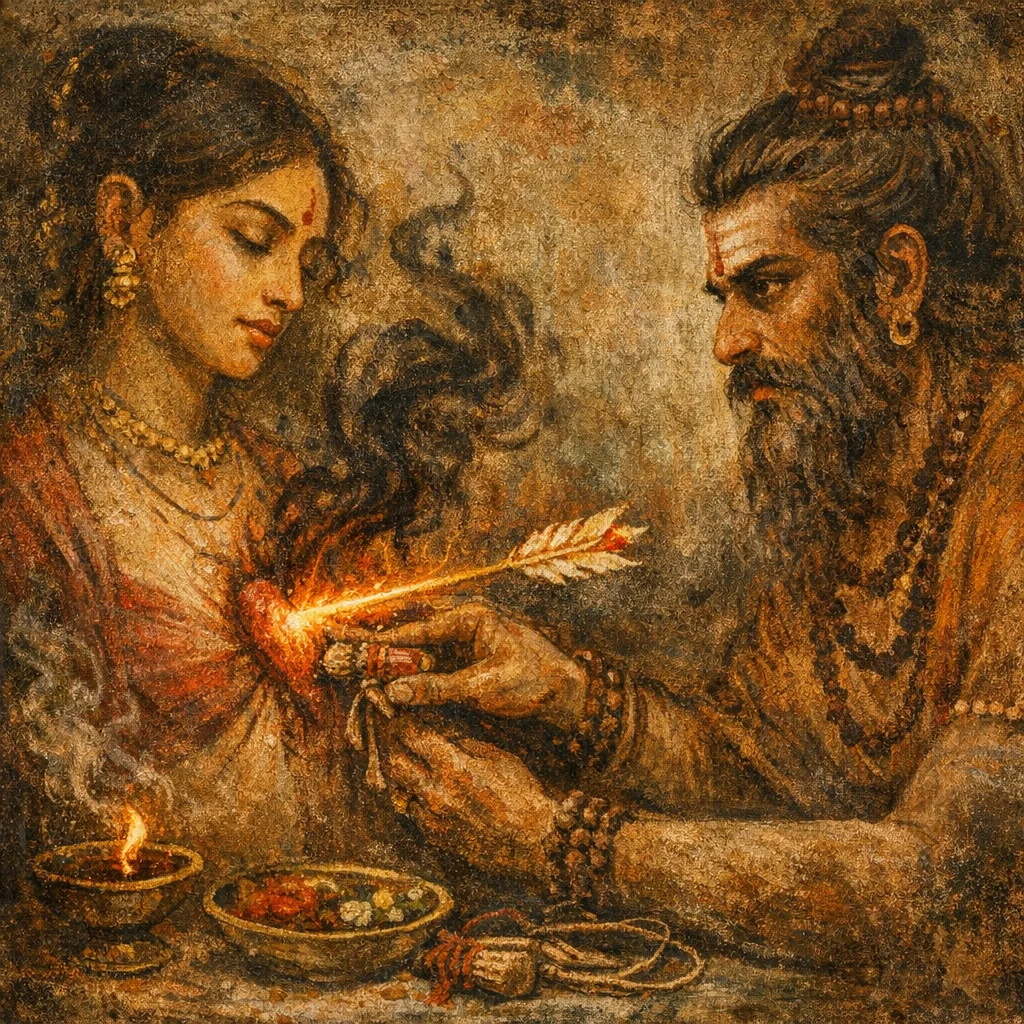
Sukta 25
Rishi: Atharvanic tradition (Kāma-charm attribution)
Devata: Kāma (Desire), personified as archer/force
Chandas: Mixed/irregular Atharvanic (prose-like opening tag + anuṣṭubh-like cadence)
Mantras
Mantra 1
कामस्य इषुः। उत्तुदस्त्वोत् तुदतु मा धृथाः शयने स्वे। इषुः कामस्य या भीमा तया विध्यामि त्वा हृदि
Kāma’s arrow: let the goad prick thee—prick thee; hold not firm upon thine own bed. With Kāma’s arrow, the dreadful one, therewith I pierce thee in the heart.
Mantra 2
आधीपर्णां कामशल्यामिषुं संकल्पकुल्मलाम्। तां सुसंनतां कृत्वा कामो विध्यतु त्वा हृदि
The love-barbed arrow, leaf-feathered, budded with firm intent—having wrought it well-bent—let Kāma pierce thee in the heart.
Mantra 3
या प्लीहानं शोषयति कामस्येषुः सुसंनता । प्राचीनपक्षा व्योऽषा तया विध्यामि त्वा हृदि
That well-bent arrow of Kāma which drieth up the spleen—forward-winged, the pungent vyoṣā—therewith I pierce thee in the heart.
Mantra 4
शुचा विद्धा व्योऽषया शुष्कास्याभि सर्प मा । मृदुर्निमन्युः केवली प्रियवादिन्यनुव्रता
Pierced with burning pain by pungent vyoṣā, dry-mouthed—creep thou unto me: gentle, thy wrath laid down, mine wholly, sweet-speaking, obedient to my will.
Mantra 5
आजामि त्वाजन्या परि मातुरथो पितुः । यथा मम क्रतावसो मम चित्तमुपायसि
Hither I call thee, O intimate, away from thy folk—away from mother and from father—so that, O helper of my resolve, thou mayest come unto my mind, yea, unto my intent.
Mantra 6
व्यऽस्यै मित्रावरुणौ हृदश्चित्तान्यस्यतम्। अथैनामक्रतुं कृत्वा ममैव कृणुतं वशे
Asunder, O Mitra-Varuṇa, cast ye from her heart her thoughts; then, having made her void of purpose, set her—mine only—under my control.
Frequently Asked Questions
It is a love-compulsion hymn that treats desire as a forceful weapon. The verses aim to make the target restless, draw her to the operator, and enforce exclusive attachment.
Mitra–Varuṇa function as cosmic ‘binders’ who can restrain and re-order intentions. Here they are asked to break apart the target’s thoughts and place her under control, reinforcing coercion beyond mere attraction.
Vyoṣā is a pungent triad (commonly dry ginger, black pepper, and long pepper). The hymn uses its sensory qualities as a symbol for the bodily signs of longing—heat, dryness, and agitation—so the target ‘cannot stay put’ and comes seeking relief through union.