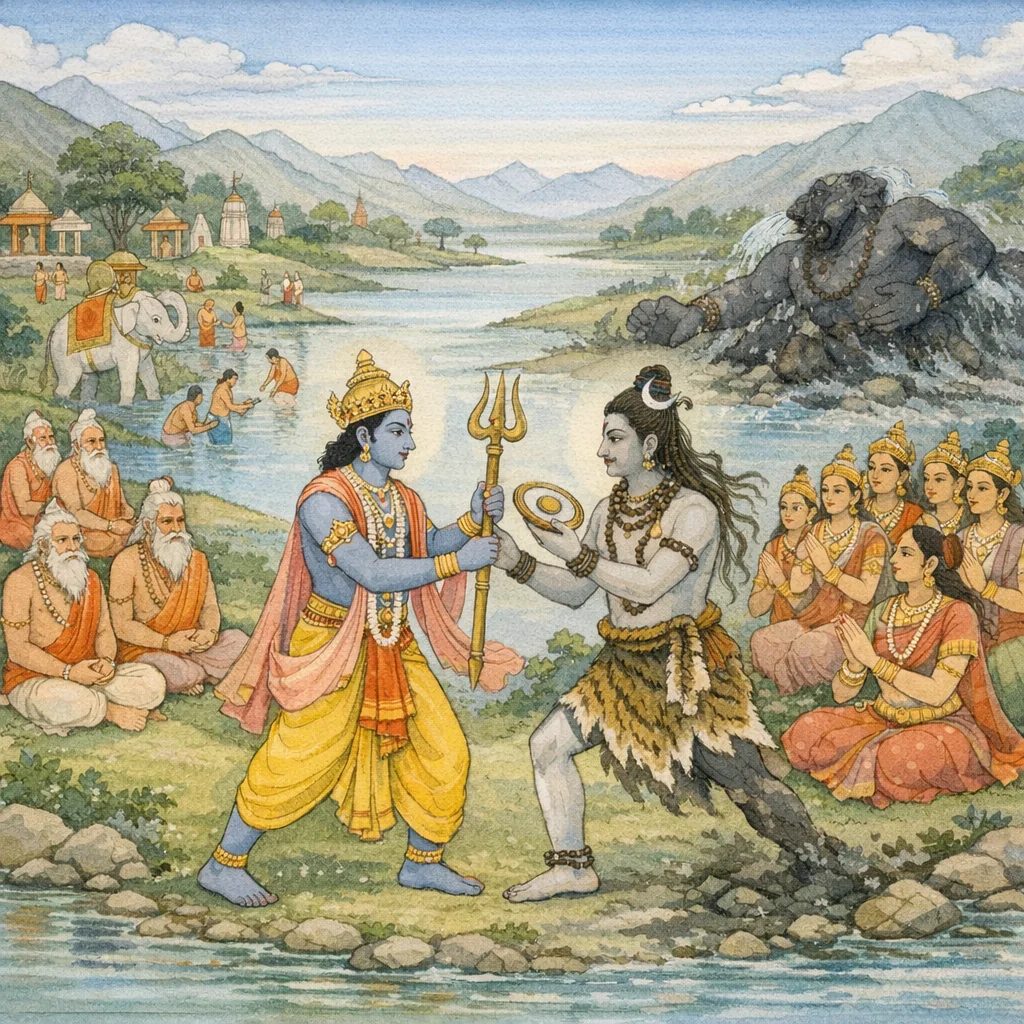
Adhyaya 55: Prahlada’s Kurukshetra Pilgrimage and the Origin of the Chakra–Trishula Exchange
प्रह्लाद-तीर्थयात्रा तथा चक्र-त्रिशूल-परिवर्तन-कथा (Prahlāda-Tīrthayātrā tathā Cakra-Triśūla-Parivartana-Kathā)
Origin of the Chakra-Trishula Exchange
Within the Pulastya–Nārada dialogue-frame, this adhyāya first functions as a tīrtha-māhātmya itinerary: Prahlāda, purified by vrata and fasts, moves through a chain of sanctified sites—especially in and around Kurukṣetra—where bathing (snāna), deity-worship (pūjā), and ancestral offerings (pitṛ-tarpaṇa) are presented as technologies of topographical sanctification. The narrative then pivots to a syncretic theological explanation for a striking iconographic motif: Śiva bearing Sudarśana and Vāsudeva bearing the triśūla. Pulastya recounts an older combat-myth in which the asura Jalodbhava, made nearly invulnerable by Brahmā’s boon, is finally slain through coordinated action by Hari and Hara; their mutual adoption of each other’s weapons becomes a doctrinal emblem of Harihara reciprocity rather than sectarian rivalry. The chapter thus integrates pilgrimage praxis, asura-dharma and its limits, and a deliberate reconciliation of Śaiva–Vaiṣṇava devotion through shared ritual authority and shared martial symbolism.
Divine Beings
Sacred Geography
Mortal & Asura Figures
Key Content Points
- Pulastya narrates Prahlada’s vrata-driven tirtha-circuit: repeated snāna, upavāsa, pūjā, and pitṛ-tarpaṇa across multiple named shrines and rivers, foregrounding Kurukṣetra-style sacred geography.
- Nārada’s question triggers a syncretic iconographic explanation: why Śambhu holds Sudarśana and why Vāsudeva holds the triśūla, establishing explicit Śaiva–Vaiṣṇava reciprocity.
- Pulastya recounts the purātana-kathā of Jalodbhava’s boon from Brahmā, his oppression of devas and rites, and his eventual death by the combined agency of Viṣṇu and Śiva—followed by the sanctification of Vitastā and related tirthas.
Shlokas in Adhyaya 55
Verse ["Magha masa upavasa", "Varanasi yatra", "dvaveva pujyau", "asura pilgrim", "tirtha vrata"]
ऐरावतेन मन्त्रेण चक्रतीर्थं सुदर्शनम् उपामन्त्र्य ततः सस्नौ वेदोक्तविधिना मुने
upoṣya kṣaṇadāṃ bhaktyā pūjiyatvā kurudhvajam kṛtaśaucau jagāmātha draṣṭuṃ puruṣakesarim
Verse and having paid reverence to Avimukta and Keśava—both worthy of worship—he then
स्नात्वा तु देविकायां च नृसिंहं प्रतिपूज्य च तत्रेष्य रजनोमेकां गोकर्णं दानवो ययौ
And having bathed in the Devikā (river) and duly worshipped Nṛsiṃha, the Dānava stayed there for one night; then he went to Gokarṇa.
Verse 8
तत्र स्नात्वा च दृष्ट्वा च संतर्प्य पितृदेवताः पुण्डरीकं च संपूज्य उवास दिवसत्रयम्
Narratorial voice within the tirtha-mahātmya (speaker not specified in the given excerpt)
Verse 9
विशाखयूपे तदनु दृष्ट्वा देवं तथाजितम् स्नात्वा तथा कृष्णतीर्थे त्रिरात्रं न्यवसच्छुचिः
Thereafter, having beheld the unconquered Deity at Viśākhayūpa, he bathed at Kṛṣṇatīrtha and, purified, stayed there for three nights.
Verse 13
यत्र सा सुरभिर्देवी स्वसुतां कपिलां शुभाम् देवप्रियार्थमसृजद्धितार्थं जगतस्तथा
Where that goddess Surabhi brought forth her auspicious daughter Kapilā, for what is dear to the gods—and likewise for the welfare of the world.
Verse 14
तत्र देवह्रदे स्नात्वा शंभुं संपूज्य भक्तितः विधिवद्दधि च प्राश्य मणिमन्तं ततो ययौ
There, having bathed in Devahrada and, with devotion, duly worshipped Śaṃbhu, and having ritually partaken of curd, he then proceeded to Maṇimanta.
Verse 15
तत्र तीर्थवरे स्नात्वा प्राजापत्ये महामतिःऽ ददर्श शंभु ब्रह्माणं देवेशं च प्रजापतिम्
Having bathed there at the excellent sacred ford—(the tirtha) called Prājāpatya—the great-minded one beheld Śambhu (Śiva), Brahmā, and also the Lord of the gods, Prajāpati.
Verse 16
विधानतस्तु तान् देवान् पूजयित्वा तपोधन षड्रात्रं तत्र च स्थित्वा जगाम मधुनन्दिनीम्
Then, having worshipped those deities according to prescribed rite, O treasure of austerity, and having stayed there for six nights, he went on to (the tirtha/river) Madhunandinī.
Verse 21
देवासुराणामजयो महाहवे निजैश्च शस्त्रैरमरैरवध्यः ब्रह्मर्षिशापैश्च निरीप्सितार्थो जले च वह्नौ स्वगुणोपहर्त्ता
Merchant (vaṇik) speaking to Pretapāla, remarking on the contrast between him and his attendants
Verse 30
एवं त्रिशुलं च दधार विष्णुश्चक्रं त्रिनेत्रो ऽप्यरिसूदनार्थम् यत्राघहन्त्री ह्यभवद् वितस्ता हराङ्घ्रिपाताच्छिशिराचलात्तु
Thus Viṣṇu took up the trident, and the Three-eyed One (Śiva) took up the discus, for the purpose of destroying the enemies. There, indeed, Vitastā became a destroyer of sin—arising from the fall/impact of Hara’s foot upon the snowy mountain (Himavat).
Verse ["Śūrpāraka", "Caturbāhu", "Māgadhāraṇya", "Magadha forest", "vasudhādhipa", "tīrtha-yātrā"]
तत्प्राप्य तीर्थं त्रिदशाधिपाभ्यां पूजां च कृत्वा हरिशङ्कराभ्याम् उपोष्य भक्त्या हिमवन्तमागाद् द्रष्टुं गिरीशं शिवविष्णुगुप्तम्
Having reached that sacred ford, and having performed worship to the two lords of the gods—Hari and Śaṅkara—he fasted with devotion and then went to Himavat, wishing to behold Girīśa (Śiva), who is ‘protected/attended’ by Śiva and Viṣṇu (i.e., encompassed by their shared mystery and guardianship).
Verse 32
तं समभ्यर्च्च विधिवद् दत्त्वा दानं द्विजातिषु विस्तुते हिमवत्पादे भृगुतुङ्गं जगाम सः
the Lord (Śaṅkara/Īśvara) indeed bestowed upon Viṣṇu
Frequently Asked Questions
Through the Pulastya–Nārada frame, the chapter explicitly grounds a Harihara-style syncretic theology: Śiva and Viṣṇu cooperate to destroy Jalodbhava, and their mutual bearing of each other’s weapons (Śambhu with Sudarśana; Vāsudeva with triśūla) becomes an iconographic and doctrinal sign of reciprocal divine authority rather than sectarian competition.
It reads as a pilgrimage map anchored in Kurukṣetra-style sacred geography: Prahlāda performs snāna, upavāsa, pūjā, and pitṛ-tarpaṇa at a sequence of named sites—Cakratīrtha (Sudarśana), Devikā, Gokarṇa, Puṇḍarīka-tīrtha, Viśākhayūpa, Kṛṣṇatīrtha, Haṃsapada, the Payoṣṇī and Madhumat rivers, Devahrada, Maṇimanta, Prājāpatya-tīrtha, and Himalayan locales—presenting these places as ritually efficacious nodes for pāpa-kṣaya and ancestral satisfaction.
Nārada’s inquiry shifts the text from itinerary to etiological myth: Pulastya recounts the purātana-kathā of Jalodbhava’s boon from Brahmā, his disruption of devas and rites, and his defeat by the coordinated action of Hari and Hara—thereby explaining the weapon-exchange motif and linking it to the sanctification of specific rivers and tirthas (notably Vitastā).