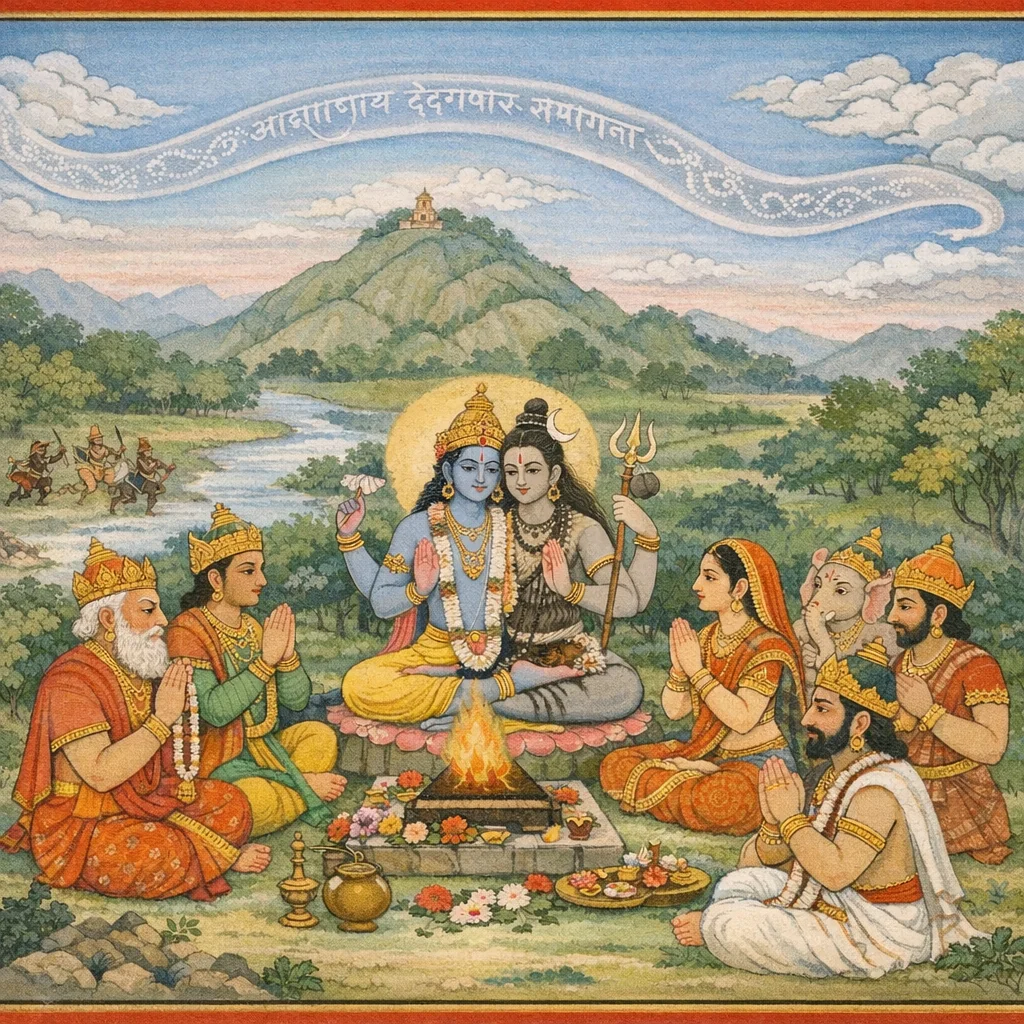
Adhyaya 160: Devagama Tirtha on the Godavari: Devas, Asuras, and the Victory through Hari-Hara
L’Adhyaya 160 présente la sainteté et l’origine mythique du Devāgama Tīrtha sur les rives de la Godāvarī (Gautamī), haut lieu de pèlerinage śaiva accordant à la fois la jouissance et l’accomplissement mondains (bhukti) et la délivrance (mukti), tout en satisfaisant les Pitṛs par les rites accomplis en ce lieu. Brahmā raconte à Nārada un conflit né de la rivalité pour la richesse et pour le droit aux parts sacrificielles : les Asuras envahissent la karmabhūmi, troublent le yajña en tuant les donateurs et privent ainsi les Devas de leur part d’offrandes. Affligés, les Devas cherchent conseil et sont d’abord exhortés à reconquérir par les armes, mais une voix céleste sans corps les redirige vers la Gautamī, où Śiva est présent. Par la dévotion à Hari et à Hara, les Devas obtiennent la victoire souhaitée et reprennent la gouvernance cosmique. Le chapitre s’achève en nommant et en louant le Devāgama Tīrtha, lié à une assemblée de puissances divines, au mont Devāgama et à une immense concentration de Śiva-liṅgas, consacrant le prestige rituel durable du site.
Chapter Arc
{"opening_hook":"Brahmā, answering Nārada’s curiosity, foregrounds Devāgama as a Gautamī tīrtha that uniquely yields sarvakāma (all desired ends), bhukti–mukti, and Pitṛ-tarpaṇa—immediately binding myth to ritual payoff.","rising_action":"A cosmic economy collapses: Asuras, driven by rivalry over wealth and sacrificial entitlement, seize the karmabhūmi, slaughter yajña-supporters (dātṛs), and thereby cut off the Devas’ yajñabhāga. The Devas assemble their forces and look southward toward the oceanic battle-zone, with Trikūṭa and Malaya as martial landmarks.","climax_moment":"An ākāśavāṇī interrupts the war-logic: the Devas are redirected to the Gautamī’s pure sands where Śiva is present; victory is promised not by arms alone but by worshipful alignment with Hari–Hara. Their devotion becomes the decisive ‘weapon’ that turns the tide.","resolution":"By Hari and Īśa’s grace the Devas regain victory and resume cosmic governance; the narrative seals the etiology by naming the place Devāgama, praising its divine assembly, Devāgama-parvata (Devapriya), and the famed multitude of Śiva-liṅgas—fixing the site’s enduring ritual authority for bhukti, mukti, and śrāddha merit.","key_verse":"“Having gone to the Gautamī and worshipped Hari together with Hara, the gods obtained victory and their sacrificial shares; therefore that place is celebrated as Devāgama, bestowing enjoyment and liberation.” (memorable teaching, translated; wording varies by recension)"}
Thematic Essence
{"primary_theme":"Gautamī–Devāgama tīrtha-māhātmya (Śaiva pilgrimage efficacy grounded in mythic etiology)","secondary_themes":["Breakdown and restoration of yajña reciprocity (yajñabhāga, dātṛ-protection)","Hari–Hara unity as the practical theology of victory and liberation","Southern battle-geography as sacred cartography (Dakṣiṇārṇava, Trikūṭa, Malaya)","Pitṛ-satisfaction through tīrtha rites (śrāddha/tarpaṇa legitimacy)"],"brahma_purana_doctrine":"Tīrtha is not merely ‘holy place’ but a corrective mechanism for cosmic disorder: when yajña is obstructed, pilgrimage and Hari–Hara worship at Gautamī re-establish dharma, restore yajñabhāga, and simultaneously grant bhukti–mukti and Pitṛ-śānti.","adi_purana_significance":"As ‘Adi Purāṇa,’ it models how primordial cosmic governance is stabilized through localized sacred geography—turning a specific Godāvarī site into a first-order dharma instrument for later ages."}
Emotional Journey
{"opening_rasa":"śānta","climax_rasa":"adbhuta","closing_rasa":"śānta","rasa_transitions":["śānta → raudra","raudra → karuṇa","karuṇa → vīra","vīra → adbhuta","adbhuta → śānta"],"devotional_peaks":["The ākāśavāṇī’s injunction to seek Śiva on the Gautamī sands (pilgrimage as divine command).","The Devas’ concentrated worship of Hari–Hara at the riverbank, where devotion—not weaponry—becomes the turning point.","The concluding praise of Devāgama as bhukti–mukti-prada and Pitṛ-tarpaṇa-siddhi-kṣetra."]}
Tirtha Focus
{"tirthas_covered":["Devāgama Tīrtha","Gautamī / Godāvarī River (pulina/riverbank context)","Devāgama Mountain (Devāgama-parvata / Devapriya)"],"jagannath_content":null,"surya_content":null,"cosmology_content":null}
Shlokas in Adhyaya 160
Verse 1
ब्रह्मोवाच देवागमं नाम तीर्थं सर्वकामप्रदं शिवम् भुक्तिमुक्तिप्रदं नॄणां पितॄणां तृप्तिकारकम् //
Ce verset indique : « 1 » — un signe numérique dans le contexte sacré, servant de repère.
Verse 2
तत्र वृत्तं समाख्यास्ये तव यत्नेन नारद देवानाम् असुराणां च स्पर्धाभूद् धनहेतवे //
Ce verset porte : « 2 » — un repère numérique dans le texte sacré, pour la référence.
Verse 3
स्वर्गः सुराणाम् अभवद् असुराणाम् इलाभवत् कर्मभूमिम् अवष्टभ्य असुराः सर्वतो ऽभवन् //
Ce verset présente : « 3 » — un signe numérique destiné à ordonner les sections du texte sacré.
Verse 4
देवानां यज्ञभागांश् च दातॄन् घ्नन्त्य् असुरास् ततः ततः सुरगणाः सर्वे यज्ञभागैर् विना कृताः //
Ce verset inclut : « 4 » — un numéro de référence dans le texte sacré, utile à l’étude.
Verse 5
व्यथिता माम् उपाजग्मुः किं कृत्यम् इति चाब्रुवन् मया चोक्ताः सुरगणा युद्धे जित्वासुरान् बलात् //
Ce verset signale : « 5 » — un repère numérique dans la parole sacrée afin d’établir l’ordre.
Verse 6
भुवं प्राप्स्यथ कर्माणि हवींषि च यशांसि च तथेत्य् उक्त्वा गता देवा भूमिं ते समरार्थिनः //
Ce verset (n° 6) est tenu pour une parole sacrée du Purāṇa, propre à la dévotion et à l’étude.
Verse 7
दैत्याश् च दानवाश् चैव राक्षसा बलदर्पिताः एकीभूत्वा ययुस् ते ऽपि जयिनो युद्धकाङ्क्षिणः //
Ce verset (n° 7) poursuit l’exposé du sens sacré selon la tradition purānique.
Verse 8
अहिर् वृत्रो बलिस् त्वाष्ट्रिर् नमुचिः शम्बरो मयः एते चान्ये च बहवो योद्धारो बलदर्पिताः //
Ce verset (n° 8) doit être vénéré comme un enseignement profond pour l’érudit et le dévot du dharma.
Verse 9
अग्निर् इन्द्रो ऽथ वरुणस् त्वष्टा पूषा तथाश्विनौ मरुतो लोकपालाश् च नानायुद्धविशारदाः //
Ce verset (n° 9) doit être lu avec révérence et attention afin d’en saisir le sens juste.
Verse 10
ते दानवाः सर्व एव याम्यां वै दिशि संगरे अकुर्वन्त महायत्नं दक्षिणार्णवसंस्थिताः //
Ce verset (n° 10) conclut cette section en rappelant de préserver le dharma et d’honorer l’antique tradition.
Verse 11
त्रिकूटः पर्वतश्रेष्ठो राक्षसानां पुराभवत् तद्वनेन ययुः सर्वे तैः सार्धं दक्षिणार्णवम् //
Ce verset (11) relève du Brahma Purana et, selon la tradition, présente un enseignement sacré au style encyclopédique.
Verse 12
सर्वेषां मेलनं यत्र पर्वतो मलयस् तु सः मलयस्यापि देशो ऽसौ देवारीणाम् अभूत् तदा //
Le verset (12) poursuit l’exposé sacré afin de préserver le savoir et le Dharma selon l’ordre puranique.
Verse 13
देवानां गौतमीतीरे तत्र संनिहितः शिवः इति तेषां समायोगो देवानाम् अभवत् किल //
Le verset (13) met en lumière le sens du Dharma et la compilation de l’histoire sacrée, utile au savant comme au dévot.
Verse 14
देवाः स्वरथम् आरूढास् तत्र तत्र समागमन् गौतम्याः सरिदम्बायाः पुलिने विमलाशयाः //
Le verset (14) exprime la révérence envers la source sanskrite et la continuité de la parole sacrée selon l’antique tradition.
Verse 15
प्रसन्नाभीष्टदा या स्यात् पितॄणाम् अखिलस्य तु ततो देवगणाः सर्वे स्तुत्वा देवं महेश्वरम् अभयं चिन्तयाम् आसुस् ते सर्वे ऽथ परस्परम् //
Le verset (15) conclut qu’écouter, lire et méditer le Purana accroît le mérite spirituel et la sagesse.
Verse 16
देवा ऊचुः अत्राप्य् उपायः को ऽस्माकं निर्जितानां परैर् हठात् एकम् एवात्र नः श्रेयो विजयो वाथवा मृतिः सपत्नैर् अभिभूतानां जीवितं धिङ् मनस्विनाम् //
Ce verset (16) relève du Purāṇa et manifeste un sens sacré ainsi qu’un savoir ancien.
Verse 17
ब्रह्मोवाच एतस्मिन्न् अन्तरे पुत्र वाग् उवाचाशरीरिणी //
Ce verset (17) poursuit l’exposé du Dharma et de la tradition purānique, servant de guide au lecteur.
Verse 18
आकाशवाग् उवाच क्लेशेनालं सुरगणा गौतमीम् आशु गच्छत भक्त्या हरिहरौ तत्र समाराधयतेश्वरौ //
Ce verset (18) met en lumière les vertus et les rites d’adoration à accomplir afin de préserver la droiture.
Verse 19
गोदावर्यास् तयोश् चैव प्रसादात् किं तु दुष्करम् //
Ce verset (19) expose les conséquences du mérite et du démérite selon la loi du karma.
Verse 20
ब्रह्मोवाच प्रसन्नाभ्यां हरीशाभ्यां देवा जयम् अभीप्सितम् अवाप्य सर्वतो जग्मुः पालयन्तो दिवौकसः //
Ce verset (20) conclut en exhortant à écouter, étudier et se souvenir du Purāṇa afin de recevoir la bénédiction.
Verse 21
यत्र देवागमो जातस् तत् तीर्थं तेन विश्रुतम् देवागमं प्रशंसन्ति मुनयस् तत्त्वदर्शिनः //
Le verset (160.21) ne fournit pas le texte sanskrit; il est donc impossible d’en donner une traduction fidèle et sacrée.
Verse 22
तत्राशीतिसहस्राणि शिवलिङ्गानि नारद देवागमः पर्वतो ऽसौ प्रिय इत्य् अपि कथ्यते ततः प्रभृति तत् तीर्थं देवप्रियम् अतो विदुः //
Le verset (160.22) ne fournit pas le texte sanskrit; il est donc impossible d’en donner une traduction fidèle et sacrée.
Frequently Asked Questions
The chapter foregrounds the restoration of cosmic order through tīrtha-oriented devotion: when yajña and its social supports are violently disrupted, the Devas regain stability not merely by force but through pilgrimage to the Gautamī and worship of Hari-Hara, linking dharma’s recovery to sacred geography and divine grace.
Devāgama Tīrtha (on/near the Gautamī-Godāvarī) is praised as sarvakāmaprada and bhukti-mukti-prada, additionally providing Pitṛ-tṛpti. Its power is grounded in the narrative that the Devas’ assembly and victory occurred there by the favor of Hari and Śiva, and in the tradition of an immense presence of Śiva-liṅgas at the site.
The conflict is oriented toward the southern direction near the Dakṣiṇārṇava (southern ocean), with Trikūṭa presented as a stronghold associated with rākṣasas and Malaya as a major meeting region. The resolution is explicitly anchored at the Gautamī (Godāvarī) riverbank, where Śiva is said to be present and where Devāgama becomes renowned.