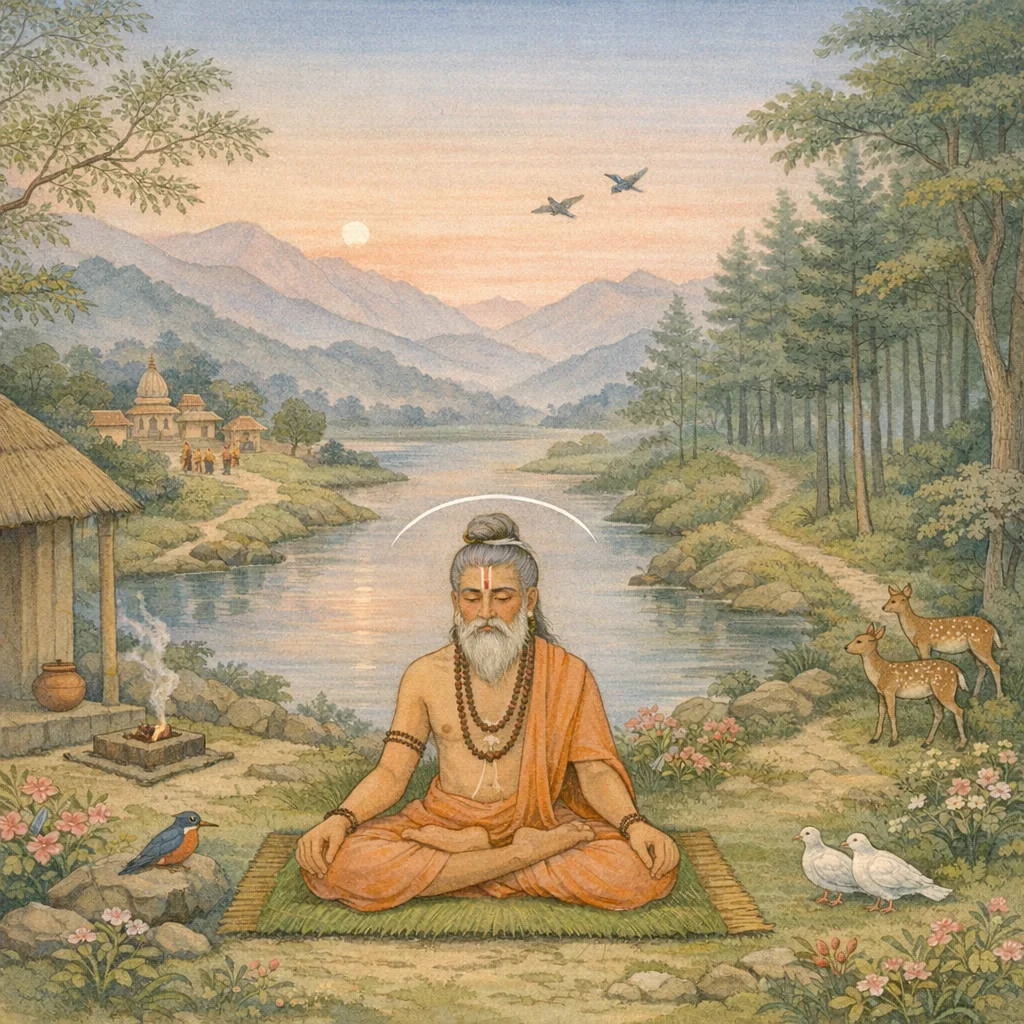
Kshurika
The Kshurika Upanishad, associated with the Atharva Veda and counted among the Yoga Upanishads, is a brief text (about 25 verses) organized around the metaphor of a “razor” (kṣurikā). The razor signifies the sharpness of discriminative insight (viveka) that cuts through ignorance (avidyā) and egoic misidentification (adhyāsa). Liberation is presented not as a new attainment but as the unveiling of the ever-free Self when false superimpositions are removed. Doctrinally, the Upanishad aligns Vedānta’s final claim of ātman–brahman identity with an inward yogic discipline—sense-withdrawal, mental steadiness, and meditation—as the practical means for stabilizing non-dual knowledge. Latent tendencies (vāsanās) and mental fluctuations are treated as the roots of bondage; the “razor” symbolizes the uncompromising clarity by which the practitioner severs them and abides as witnessing consciousness.
Start ReadingKey Teachings
- The “razor” (kṣurikā) symbolizes sharp discrimination (viveka) that cuts ignorance (avidyā) and egoic identification.
- Liberation is the recognition of the Self (ātman) as pure witness-consciousness
ultimately non-different from brahman.
- Yogic interiorization—withdrawal of the senses and steady meditation—supports the stabilization of non-dual insight.
- Bondage persists through vāsanās (latent tendencies) and mental modifications; these are to be severed
not indulged.
- The path is subtle and demanding: steadiness
restraint
and inner purity are prerequisites for realization.
- True knowledge is transformative: it removes superimposition (adhyāsa) rather than adding conceptual complexity.
- The body–mind is an instrument; the Self is unattached
luminous
and ever-free.
Verses of the Kshurika
25 verses with Sanskrit text, transliteration, and translation.
Verse 1
ॐ क्षुरिकां सम्प्रवक्ष्यामि धारणां योगसिद्धये । यं प्राप्य न पुनर्जन्म योगयुक्तस्य जायते ॥१॥
Om. I shall fully expound the “Kṣurikā”—a dhāraṇā (concentration) for attaining yogic perfection—having attained which, for the yogin disciplined in yoga, rebirth does not arise again.
Moksha (freedom from punarjanma) through dhāraṇāVerse 2
वेदतत्त्वार्थविहितं यथोक्तं हि स्वयंभुवा । निःशब्दं देशमास्थाय तत्रासनमवस्थितः ॥ कूर्मोऽङ्गानीव संहृत्य मनो हृदि निरुध्य च । मात्राद्वादशयोगेन प्रणवेन शनैः शनैः ॥ पूरयेत्सर्वमात्मानं सर्वद्वारं निरुध्...
As prescribed in accord with the reality and meaning of the Veda, as declared by the Self-born: resorting to a soundless place, seated there in a posture; withdrawing the limbs like a tortoise and restraining the mind in the heart; with the praṇava (Om) joined to the twelvefold measure (mātrā), gradually; one should fill the whole self, having restrained all the gates (sense-openings); keeping chest, face, waist, and neck slightly raised upward; one should hold the breaths there, moving within the interior of the nose; then, the breath having gone there, one should slowly release it.
Upāsanā/Dhyāna as a means to ātma-jñāna; Prāṇa–manas saṁyama (discipline of breath and mind)Verse 3
वेदतत्त्वार्थविहितं यथोक्तं हि स्वयंभुवा । निःशब्दं देशमास्थाय तत्रासनमवस्थितः ॥ कूर्मोऽङ्गानीव संहृत्य मनो हृदि निरुध्य च । मात्राद्वादशयोगेन प्रणवेन शनैः शनैः ॥ पूरयेत्सर्वमात्मानं सर्वद्वारं निरुध्...
As prescribed in accord with the reality and meaning of the Veda, as declared by the Self-born: resorting to a soundless place, seated there in a posture; withdrawing the limbs like a tortoise and restraining the mind in the heart; with the praṇava (Om) joined to the twelvefold measure (mātrā), gradually; one should fill the whole self, having restrained all the gates (sense-openings); keeping chest, face, waist, and neck slightly raised upward; one should hold the breaths there, moving within the interior of the nose; then, the breath having gone there, one should slowly release it.
Upāsanā/Dhyāna; Prāṇa–manas saṁyamaVerse 4
वेदतत्त्वार्थविहितं यथोक्तं हि स्वयंभुवा । निःशब्दं देशमास्थाय तत्रासनमवस्थितः ॥ कूर्मोऽङ्गानीव संहृत्य मनो हृदि निरुध्य च । मात्राद्वादशयोगेन प्रणवेन शनैः शनैः ॥ पूरयेत्सर्वमात्मानं सर्वद्वारं निरुध्...
As enjoined by the Self-born in accord with the purport of Vedic truth, having resorted to a soundless place and seated himself there, he should draw in the limbs like a tortoise and restrain the mind within the heart. With the discipline of the twelve mātrās, with the praṇava (Oṃ), slowly, slowly, he should fill the whole self, having closed all the doors (the sense-openings). Keeping chest, face, waist, and neck aligned, with the region of the navel slightly raised, he should hold the breaths there as they move within the interior of the nose; and when the breath has settled there and become steady, then he should gradually release it.
Mokṣa through prāṇava-upāsanā and prāṇa-nirodha (inner withdrawal leading toward ātma-jñāna)Verse 5
वेदतत्त्वार्थविहितं यथोक्तं हि स्वयंभुवा । निःशब्दं देशमास्थाय तत्रासनमवस्थितः ॥ कूर्मोऽङ्गानीव संहृत्य मनो हृदि निरुध्य च । मात्राद्वादशयोगेन प्रणवेन शनैः शनैः ॥ पूरयेत्सर्वमात्मानं सर्वद्वारं निरुध्...
As prescribed by the Self-born in accordance with the import of Vedic truth, having gone to a noiseless place and seated himself there, he should withdraw the limbs like a tortoise and restrain the mind in the heart. With the discipline of twelve mātrās, with the praṇava (Oṃ), gradually, he should fill the whole self, closing all the doors. Keeping chest, face, waist, and neck aligned, with the navel-region slightly raised, he should sustain the breaths there as they move within the interior of the nose; and when the breath has settled there, he should then slowly let it go.
Upāsanā leading to inner stillness (antaḥkaraṇa-nirodha) as a proximate means toward liberationVerse 6
स्थिरमात्रादृढं कृत्वा अङ्गुष्ठेन समाहितः । द्वे गुल्फे तु प्रकुर्वीत जङ्घे चैव त्रयस्त्रयः ॥ द्वे जानुनी तथोरुभ्यां गुदे शिश्ने त्रयस्त्रयः । वायोरायतनं चात्र नाभिदेशे समाश्रयेत् ॥
Having made the measured practice steady and firm, concentrated by means of the thumb, he should apply (placement/pressure) at the two ankles; at the shanks, three and three; at the two knees likewise, and likewise at the thighs; at the anus and the organ (genitals), three and three. And here he should resort to the seat of vāyu, the vital wind, in the region of the navel.
Prāṇa as a functional gateway to inner mastery (yoga-sādhana as aid to mokṣa)Verse 7
स्थिरमात्रादृढं कृत्वा अङ्गुष्ठेन समाहितः । द्वे गुल्फे तु प्रकुर्वीत् जङ्घे चैव त्रयस्त्रयः ॥ द्वे जानुनी तथोरुभ्यां गुदे शिश्ने त्रयस्त्रयः । वायोरायतनं चात्र नाभिदेशे समाश्रयेत् ॥६–७॥
Having made the posture firm and steady, and being collected with the thumbs, one should form two (locks/pressures) at the ankles; and at the shanks likewise three and three. Two at the knees, and at the thighs likewise; at the anus and at the penis three and three. And here one should take refuge in the seat of Vāyu (the vital wind) in the region of the navel.
Prāṇa (vital force) as an upāsanā-support leading toward inner stillness and mokṣa-oriented meditationVerse 8
तत्र नाडी सुषुम्ना तु नाडीभिर्बहुभिर्वृता । अणु रक्ताश्च पीताश्च कृष्णास्ताम्रा विलोहिताः ॥८॥
There indeed the nāḍī called Suṣumnā is surrounded by many nāḍīs—minute and subtle—red and yellow, black, coppery, and bright-red.
Subtle body (sūkṣma-śarīra) and nāḍī-prāṇa framework as a preparatory discipline for Self-knowledgeVerse 9
अतिसूक्ष्मां च तन्वीं च शुक्लां नाडीं समाश्रयेत् । तत्र संचारयेत् प्राणान् ऊर्णनाभीव तन्तुना ॥९॥
One should resort to the exceedingly subtle, slender, white nāḍī; there one should cause the prāṇas to move, like a spider by its thread.
Inner control and refinement of prāṇa as an aid to nididhyāsana (deep contemplation) culminating in ātma-jñānaVerse 10
ततो रक्तोत्पलाभासं पुरुषायतनं महत् । दहरं पुण्डरीकं तद्वेदान्तेषु निगद्यते ॥ तद्भित्त्वा कण्ठमायाति तां नाडीं पूरयन् यतः । मनसस्तु क्षुरं गृह्य सुतीक्ष्णं बुद्धिनिर्मलम् ॥१०॥
Then one contemplates the great abode of the Puruṣa, shining like a red lotus—the subtle inner lotus spoken of in the Vedāntas. Having pierced it, the current reaches the throat, filling that nāḍī from there. Taking the mind as a razor—exceedingly sharp, purified by buddhi—one proceeds.
Ātman (Puruṣa) in the dahara-puṇḍarīka (heart-lotus); mokṣa through viveka and yogic inner ascentVerse 11
ततो रक्तोत्पलाभासं पुरुषायतनं महत् । दहरं पुण्डरीकं तद्वेदान्तेषु निगद्यते ॥ तद्भित्त्वा कण्ठमायाति तां नाडीं पूरयन् यतः । मनसस्तु क्षुरं गृह्य सुतीक्ष्णं बुद्धिनिर्मलम् ॥११॥
Then there is the great abode of the Puruṣa, resembling a red lotus—the small lotus spoken of in the Vedāntas. Having pierced it, one reaches the throat, filling that nāḍī from there. Taking the mind as a razor, exceedingly sharp and purified by buddhi, one proceeds.
Dahara-vidyā and inner ascent; purification of mind (antaḥkaraṇa-śuddhi) as means toward mokṣaVerse 12
पादस्योपरि यन्मध्ये तद्रूपं नाम कृन्तयेत् । मनोद्वारेण तीक्ष्णेन योगमाश्रित्य नित्यशः ॥ इन्द्रवज्र इति प्रोक्तं मर्मजङ्घानुकीर्तनम् । तद्ध्यानबलयोगेन धारणाभिर्निकृन्तयेत् ॥ ऊर्वोर्मध्ये तु संस्थाप्य म...
In the middle above the foot, one should cut away the “name-and-form” there, by the sharp doorway of the mind, ever resorting to yoga. The marma at the calf is declared to be called “Indra’s thunderbolt”; by the yoga of meditative strength one should cut it through acts of concentration (dhāraṇā). Establishing attention in the middle of the thighs—the point that releases prāṇa at the marma—by the yoga of fourfold practice one should cut, without hesitation.
Nāma-rūpa (phenomenal limitation) to be ‘cut’; mokṣa through yogic dhāraṇā/dhyāna and vivekaVerse 13
पादस्योपरि यन्मध्ये तद्रूपं नाम कृन्तयेत् । मनोद्वारेण तीक्ष्णेन योगमाश्रित्य नित्यशः ॥ इन्द्रवज्र इति प्रोक्तं मर्मजङ्घानुकीर्तनम् । तद्ध्यानबलयोगेन धारणाभिर्निकृन्तयेत् ॥ ऊर्वोर्मध्ये तु संस्थाप्य म...
Above the foot, in the middle region, one should “cut” that form (the knot) through the sharp gateway of the mind, ever resorting to yoga. This is called “Indra’s thunderbolt” (indravajra), the recitation/awakening of the marma in the calf; by the yoga born of meditative power, one should cut by means of dhāraṇās (steady fixations). Then, setting attention in the middle of the thighs and releasing the vital force at the marma, by the yoga of fourfold repeated practice one should cut, guarding against weakness and despondency.
Moksha (liberation) through prāṇa–nāḍī purification and dhāraṇā leading toward realization of the SelfVerse 14
पादस्योपरि यन्मध्ये तद्रूपं नाम कृन्तयेत् । मनोद्वारेण तीक्ष्णेन योगमाश्रित्य नित्यशः ॥ इन्द्रवज्र इति प्रोक्तं मर्मजङ्घानुकीर्तनम् । तद्ध्यानबलयोगेन धारणाभिर्निकृन्तयेत् ॥ ऊर्वोर्मध्ये तु संस्थाप्य म...
Above the foot, in the middle region, one should “cut” that form through the sharp gateway of the mind, constantly resorting to yoga. This is called “Indra’s thunderbolt,” the activation/recitation of the marma in the calf; by meditative power one should cut by means of dhāraṇās. Then, placing attention in the middle of the thighs and releasing the vital force at the marma, by fourfold repeated practice one should cut, guarding against despondency.
Sādhana (yogic means) as auxiliary to Self-knowledge; removal of granthi-like obstructions to prāṇa and mindVerse 15
ततः कण्ठान्तरे योगी समूहन्नाडिसञ्चयम् । एकोत्तरं नाडिशतं तासां मध्ये वराः स्मृताः ॥ सुषुम्ना तु परे लीना विरजा ब्रह्मरूपिणी । इडा तिष्ठति वामेन पिङ्गला दक्षिणेन च ॥
Then, in the region of the throat, the yogin gathers the assemblage of nāḍīs: a hundred and one nāḍīs. Among them, the excellent ones are remembered as the principal channels. Suṣumnā is merged in the Supreme—stainless (virajā), of the very nature of Brahman. Iḍā abides on the left, and Piṅgalā on the right.
Brahman/Ātman realization supported by suṣumnā-oriented inner ascent; subtle-body doctrine as soteriological aidVerse 16
ततः कण्ठान्तरे योगी समूहन्नाडिसञ्चयम् । एकोत्तरं नाडिशतं तासां मध्ये वराः स्मृताः ॥ सुषुम्ना तु परे लीना विरजा ब्रह्मरूपिणी । इडा तिष्ठति वामेन पिङ्गला दक्षिणेन च ॥
Then, within the region of the throat, the yogin gathers the assemblage of nāḍīs. They are said to be one hundred and one; among them certain ones are remembered as excellent. Suṣumnā, indeed, is merged in the Supreme—stainless, of the nature of Brahman. Iḍā abides on the left, and Piṅgalā on the right.
Brahman; subtle body (sūkṣma-śarīra) as an aid to realizationVerse 17
तयोर्मध्ये वरं स्थानं यस्तं वेद स वेदवित् । द्वासप्ततिसहस्राणि प्रतिनाडीषु तैलितम् ॥
Between those two (Iḍā and Piṅgalā) there is an excellent station; whoever knows it is a knower of the Veda. In each nāḍī there are seventy-two thousand (channels), ‘oiled’—that is, pervaded by a subtle unctuous essence.
Upāsanā leading to Brahma-jñāna; prāṇa as subtle support for knowledgeVerse 18
छिद्यते ध्यानयोगेन सुषुम्नैका न छिद्यते । योगनिर्मलधारेण क्षुरेणानलवर्चसा ॥ छिन्देन्नाडीशतं धीरः प्रभावादिह जन्मनि । जातीपुष्पसमायोगैर्यथा वास्यति तैलितम् ॥
By the yoga of meditation the obstructions are cut; Suṣumnā alone is not cut. With the razor of fire-like lustre—namely, the stream made pure by yoga—the steadfast one should cut the hundred nāḍīs by its power here in this very life, just as oil is perfumed through contact with jasmine flowers.
Mokṣa through purification and cutting of bondage (granthi/saṃskāra) culminating in Brahman-realizationVerse 19
छिद्यते ध्यानयोगेन सुषुम्नैका न छिद्यते । योगनिर्मलधारेण क्षुरेणानलवर्चसा ॥ छिन्देन्नाडीशतं धीरः प्रभावादिह जन्मनि । जातीपुष्पसमायोगैर्यथा वास्यति तैतिलम् ॥१८–१९॥
By the yoga of meditation (dhyāna-yoga) the nāḍīs are cut; the suṣumnā alone is not cut. With the razor—its edge purified by yoga, its radiance like fire—the steadfast one should cut a hundred nāḍīs by its power here in this very life, just as sesame oil is perfumed by contact with jasmine blossoms.
Moksha (liberation) through yogic purification of the subtle channels (nāḍī-śuddhi) and ascent via suṣumnāVerse 20
एवं शुभाशुभैर्भावैः सा नाडीति विभावयेत् । तद्भाविताः प्रपद्यन्ते पुनर्जन्मविवर्जिताः ॥२०॥
Thus one should contemplate that process as “the nāḍī” through auspicious and inauspicious states. Those imbued with that contemplation attain the goal, free from rebirth.
Saṃsāra and Mokṣa; transformation of bhāva (mental dispositions) leading to freedom from punarjanmaVerse 21
तपोविजितचित्तस्तु निःशब्दं देशमास्थितः । निःसङ्गतत्त्वयोगज्ञो निरपेक्षः शनैः शनैः ॥२१॥
But one whose mind has been conquered by austerity (tapas), having taken refuge in a soundless place, knowing the yoga of the reality of non-attachment, and being without dependence, proceeds gradually, step by step.
Vairāgya (non-attachment) and tapas as disciplines supporting mokṣa-oriented knowledgeVerse 22
पाशं छित्त्वा यथा हंसो निर्विशङ्कं खमुत्क्रमेत् । छिन्नपाशस्तथा जीवः संसारं तरते सदा ॥२२॥
Having cut the noose, just as the haṃsa (swan) ascends into the sky without fear, so the individual self, its bonds severed, ever crosses beyond saṃsāra.
Moksha (liberation through cutting bondage/avidyā)Verse 23
यथा निर्वाणकाले तु दीपो दग्ध्वा लयं व्रजेत् । तथा सर्वाणि कर्माणि योगी दग्ध्वा लयं व्रजेत् ॥२३॥
Just as, at the time of extinction, a lamp—having burned—passes into dissolution, so the yogin, having burned up all actions, passes into dissolution, the stream of karma coming to rest.
Karma-kṣaya and Moksha (burning of karma through knowledge/yoga)Verse 24
प्राणायामसुतीक्ष्णेन मात्राधारेण योगवित् । वैराग्योपलघृष्टेन छित्त्वा तं तु न बध्यते ॥२४॥
The knower of yoga, with the exceedingly sharp instrument of prāṇāyāma—supported by measured units (mātrā-ādhāra) and honed on the whetstone of dispassion (vairāgya)—having cut that obstruction, is not bound.
Yoga-sādhana leading to bandha-nivṛtti (release from bondage); Vairāgya and prāṇāyāma as auxiliaries to liberationVerse 25
अमृतत्वं समाप्नोति यदा कामात् स मुच्यते । सर्वेषणाविनिर्मुक्तश्छित्त्वा तं तु न बध्यत इत्युपनिषत् ॥२५॥
He attains immortality when he is released from desire. Freed from all cravings, having cut that bond, he is not bound—thus declares the Upaniṣad.
Moksha (liberation) through kāma-kṣaya (cessation of desire) and sarveṣaṇā-tyāga (renunciation of all cravings)