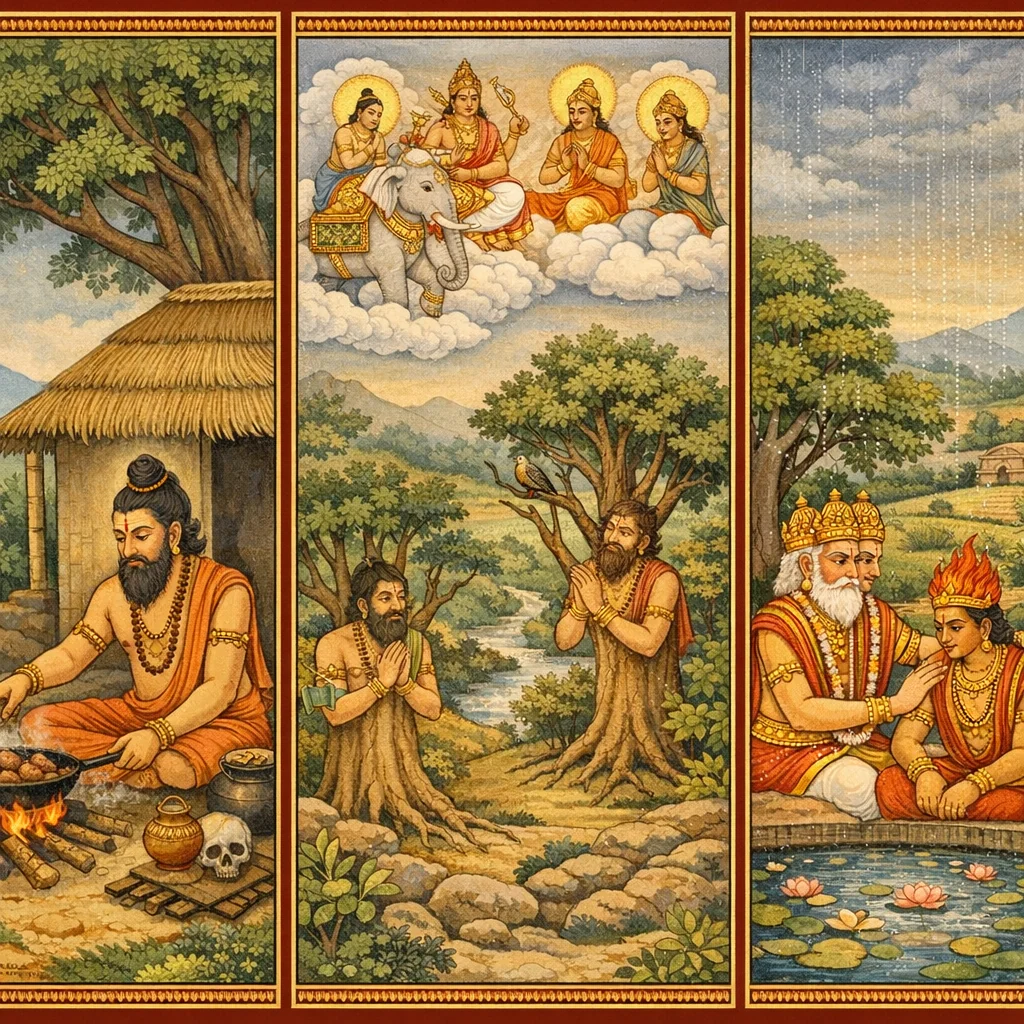
Adhyaya 90
The ṛṣis ask Sūta to explain the origin and greatness of Agnitīrtha and Brahmatīrtha. Sūta recounts that in King Śaṃtanu’s reign a severe drought arose because Indra withheld rain, suspecting an irregularity in royal succession. Famine spread, yajña and ritual life collapsed, and the sage Viśvāmitra—driven by hunger—cooked dog-meat. Fearing association with forbidden consumption, Agni withdrew from the world and disappeared. The devas searched for Agni; an elephant, a parrot, and a frog successively disclosed his hiding places and were cursed—through distortions of speech/tongue—for revealing him. At last Agni took refuge in a deep reservoir in the Hāṭakeśvara-field, where aquatic beings perished from his heat. Brahmā confronted Agni, taught his cosmic indispensability (sacrifice → sun → rain → food → beings), and mediated with Indra, who restored the rains. Brahmā then granted Agni a boon: the reservoir became famed as Vahnitīrtha/Agnitīrtha. The chapter prescribes morning bathing, japa of the Agni-sūkta, and devotional darśana as means to gain Agniṣṭoma-equivalent merit and to destroy accumulated sins. It further extols the rite of Vasoḥ-dhārā (continuous ghee-offering) as essential for completing śānti, pauṣṭika, and vaiśvadeva rites, pleasing Agni and securing the donor’s desired attainments.
Shlokas
Verse 1
ऋषय ऊचुः । अग्नितीर्थं त्वया प्रोक्तं ब्रह्मतीर्थं च यत्पुरा । न तयोः कथितोत्पत्तिर्माहात्म्यं च महामते
The sages said: “Previously you have spoken of Agnitīrtha and also of Brahmatīrtha. But, O great-minded one, you have not yet told us their origin or their sacred greatness.”
Verse 2
तस्माद्विस्तरतो ब्रूहि एकैकस्य पृथक्पृथक् । न वयं तृप्तिमापन्नाः शृण्वतस्ते वचोऽमृतम्
“Therefore, explain in detail—about each one separately. For we are not yet satisfied, as we listen to your nectar-like words.”
Verse 3
सूत उवाच । अत्र वः कीर्तयिष्यामि कथां पातकनाशिनीम् । अग्नितीर्थसमुद्भूतां सर्वसौख्यावहां शुभाम्
Sūta said: “Here I shall recount to you a sin-destroying tale—arisen in connection with Agnitīrtha—auspicious and bestowing every happiness.”
Verse 4
सोमवंशसमुद्भूतः प्रतीपो नाम भूपतिः । पुरासीच्छौर्यसंपन्नो ब्रह्मज्ञानविचक्षणः
Once there was a king named Pratīpa, born of the Lunar dynasty—endowed with valor and discerning in the knowledge of Brahman.
Verse 5
तस्य पुत्रद्वयं जज्ञे सर्वलक्षणलक्षितम् । देवापिः प्रथमस्तत्र द्वितीयः शंतनुर्द्विजाः
To him two sons were born, marked with every auspicious sign: the first was Devāpi, and the second, O twice-born ones, was Śaṃtanu.
Verse 6
अथो शिवपदं प्राप्ते प्रतीपे नृपसत्तमे । तपोऽर्थं राज्यमुत्सृज्य देवापिर्नियर्यौ वनम्
Then, when Pratīpa—the best of kings—attained Śiva’s state, Devāpi renounced the kingdom for the sake of austerities and departed for the forest.
Verse 7
ततश्च मंत्रिभिः सर्वैः शंतनुस्तस्य चानुजः । पितृपैतामहे राज्ये सत्वरं सन्नियोजितः
Thereafter, by all the ministers, his younger brother Śaṃtanu was quickly installed in the ancestral kingdom of his father and forefathers.
Verse 8
एतस्मिन्नंतरे शक्रो न ववर्ष क्रुद्धाऽन्वितः । यावद्द्वादशवर्षाणि तस्मि न्राज्यं प्रशासति
In the meantime, Śakra (Indra), filled with anger, did not send rain for as long as twelve years while he ruled the kingdom.
Verse 9
अतः कृच्छ्रं गतः सर्वो लोकः क्षुत्परिपीडितः । चामुंडासदृशो जातो यो न मृत्युवशंगतः
Therefore the entire populace fell into severe distress, tormented by hunger; whoever had not yet come under Death’s dominion became gaunt, like a living Cāmuṇḍā.
Verse 10
संत्यक्ताः पतिभिर्नार्यः पुत्राश्च पितृभिर्निजैः । मातरश्च तथा पुत्रैर्लोकेष्वन्येषु का कथा
Wives were abandoned by their husbands, and sons by their own fathers; mothers too were forsaken by their sons—what then need be said of other people?
Verse 11
दैवयोगात्क्वचित्किंचित्कस्यचिद्यदि दृश्यते । सस्यं सिद्धमसिद्धं वा ह्रियते वीर्यतः परैः
If, by some turn of fate, a little grain is seen somewhere belonging to someone, then others seize it by force—whether the crop is ripe or still unripe.
Verse 12
शुष्का महीरुहाः सर्वे तथा ये च जलाशयाः । नद्यश्च स्वल्पतोयाश्च गंगाद्या अपि संस्थिताः
All the trees were dried up, and so too the ponds and reservoirs. The rivers had only scant water—even the Gaṅgā and other great rivers were reduced to a thin flow.
Verse 13
एवं वृष्टेः क्षये जाते नष्टे धर्मपथे तथा । लोकेऽस्मिन्नस्थिसंघातैः पूरिते भस्मना वृते
Thus, when the rains failed and the path of dharma was lost, this world became filled with heaps of bones and covered over with ash.
Verse 14
न कश्चिद्यजनं चक्रे न स्वाध्यायं न च व्रतम् । एवमालोक्यते व्योम वृष्ट्यर्थं क्षुत्समाकुलैः
No one performed sacrifice, nor study of sacred recitation, nor any vow. And so, tormented by hunger, people kept looking up at the sky, longing for rain.
Verse 15
एतस्मिन्नेव काले तु विश्वामित्रो महामुनिः । चर्मास्थिशेषसर्वांगो बुभुक्षार्त इतस्ततः
At that very time, the great sage Viśvāmitra—his whole body reduced to little more than skin and bone—wandered here and there, afflicted by hunger.
Verse 16
परिभ्रमंस्ततः प्राप्य कंचिद्ग्रामं निरुद्वसम् । मृतमर्त्योद्भवैव्याप्तमस्थिसंघैः समंततः
Wandering on, he reached a certain village left without habitation, filled on every side with heaps of bones born of dead men.
Verse 17
अथ तत्र भ्रमन्प्राप्तश्चंडालस्य निवेशनम् । शून्ये गोऽस्थिसमाकीर्णे दुर्गंधेन समावृते
Then, while roaming there, he came to the dwelling of a Caṇḍāla—deserted, strewn with cow-bones, and enveloped in a foul stench.
Verse 19
अथापश्यन्मृतं तत्र सारमेयं चिरोषितम् । संशुष्कं गन्धनिर्मुक्तं गृहप्रांते व्यवस्थितम्
There he saw a dead dog that had long been lying there—completely dried up, free from odor—lying at the edge of the house.
Verse 20
ततश्च श्रपयामास सुसमिद्धे हुताशने । क्षुत्क्षामो भोजनार्थाय ततः पाकाग्रमेव च
Then, in a well-kindled fire, he boiled it; wasted by hunger and seeking food, he stayed right there, waiting for it to cook.
Verse 21
समादाय पितॄंस्तर्प्य यावदग्नौ जुहोति सः । तावद्वह्निः परित्यज्य समस्तमपि भूतलम्
Taking it up, he satisfied the Pitṛs with tarpaṇa and began to offer oblations into the fire; but as long as he was making those offerings, the fire, abandoning its place, spread across the entire earth.
Verse 22
गतश्चादर्शनं सद्यः सर्वेषां क्षितिवासिनाम् । चित्ते कोपं समाधाय शक्रस्योपरि भूरिशः
And at once he vanished from the sight of all who dwelt upon the earth; and, fixing wrath in his heart, that mighty one turned his anger against Śakra (Indra).
Verse 23
एतस्मिन्नंतरे वह्नौ मर्त्यलोकाद्विनिर्गते । विशेषात्पीडिता लोका येऽवशिष्टा धरातले
Meanwhile, when the Fire burst forth from the world of mortals, those beings who still remained upon the earth were afflicted all the more severely.
Verse 24
एतस्मिन्नंतरे देवा ब्रह्मविष्णुपुरः सराः । वह्नेरन्वेषणार्थाय वभ्रमुर्धरणीतले
In the meantime the gods—headed by Brahmā and Viṣṇu—wandered over the earth in order to seek out that Fire.
Verse 25
अथ तैर्भ्रममाणैश्च प्रदृष्टोऽभूद्गजो महान् । निश्वसन्पतितो भूमौ वह्नितापप्रपीडितः
Then, as they wandered about, they beheld a great elephant—gasping and fallen upon the earth, grievously tormented by the heat of the fire.
Verse 26
अथ देवा गजं दृष्ट्वा पप्रच्छुस्त्वरयाऽन्विताः । कच्चित्त्वया स दृष्टोऽत्र कानने पावको गज
Seeing the elephant, the gods questioned him in haste: “O elephant, have you by chance seen that Fire here in this forest?”
Verse 27
गज उवाच । वंशस्तंबेऽत्र संकीर्णे संप्रविष्टो हुताशनः । सांप्रतं तेन निर्दग्धः कृच्छ्रादत्राहमागतः
The elephant said: “The Fire (Hutāśana) entered a dense clump of bamboo here. Just now, scorched by it, I have come here with great difficulty.”
Verse 28
अथ तैर्वेष्टितस्तस्मिन्वंशस्तंबे हुताशनः । देवैर्दत्त्वा गजेंद्रस्य शापं पश्चाद्विनिर्गतः
Then, when the Fire had been surrounded there in that bamboo clump by the gods, he afterwards came forth—having first bestowed a curse upon the lordly elephant.
Verse 29
यस्मात्त्वयाहमादिष्टो देवानां वारणाधम । तस्मात्तव मुखे जिह्वा विपरीता भविष्यति
“Because you directed me on behalf of the gods, O vilest of elephants—therefore, in your mouth your tongue shall become reversed.”
Verse 30
एवं शप्त्वा गजं शीघ्रं नष्टो वैश्वानरः पुनः । देवाश्चापि तथा पृष्ठे संलग्नास्तद्दिदृक्षया
Thus, having swiftly cursed the elephant, Vaiśvānara (Fire) vanished again; and the gods too followed close behind, eager to see what would happen.
Verse 31
अथ दृष्टः शुकस्तैश्च भ्रममाणैर्महावने । भोभोः शुक त्वया वह्निर्यदि दृष्टो निवेद्यताम्
Then, as they wandered in the great forest, they saw a parrot. “Ho there, O parrot—if you have seen the Fire, report it to us.”
Verse 32
शुक उवाच । योऽयं संदृश्यते दूराच्छमीगर्भे च पिप्पलः । एतस्मिंस्तिष्ठते वह्निरश्वत्थे सुरसत्तमाः
Śuka said: “That pippala (aśvattha) tree which is seen from afar, and which stands within the womb of a śamī tree—within that very aśvattha, O best of the gods, the Fire (Vahni) abides.”
Verse 33
अत्रस्थो यः कुलायो म आसीच्छिशुसमन्वितः । संदग्धस्तत्प्रतापेन अहंकृच्छ्राद्विनिर्गतः
“The nest of mine that was here, together with my young ones, was burnt by his fierce heat; and I myself escaped only with great difficulty.”
Verse 34
तच्छ्रुत्वा तैः सुरैः सर्वैः शमीगर्भः स तत्क्षणात् । वेष्टितः पावकोऽप्याशु शुकं शप्त्वा विनिर्गतः
Hearing that, all the gods at once surrounded the interior of the śamī; and Pāvaka (Agni) too quickly came out—after cursing Śuka.
Verse 35
अहं यस्मात्त्वया पाप देवानां संनिवेदितः । तस्माच्छुक न ते वाणी विस्पष्टा संभविष्यति
Since you, O sinful one, reported me to the gods, therefore, O Śuka, your speech shall not become clear and articulate.
Verse 36
एवमुक्त्वा जातवेदा देवादर्शनवांछया । हाटकेश्वरजे क्षेत्रे देवस्य परमेष्ठिनः
Having spoken thus, Jātavedas (Agni)—desiring the sight of the gods—went to the sacred region of Hāṭakeśvara, the field of the supreme Lord.
Verse 37
जलाशयं सुगम्भीरं पूर्वोत्तरदिक्संस्थितम् । दृष्ट्वा तत्र प्रविष्टस्तु निभृतं च समाश्रितः
Seeing there a very deep water-reservoir situated toward the northeast, he entered it and took refuge within it in concealment.
Verse 38
एतस्मिन्नंतरे तत्र मत्स्यकच्छपदर्दुराः । वह्निप्रतापनिर्दग्धा दृश्यंते शतशो मृताः
Meanwhile, there were seen—by the hundreds—dead fishes, turtles, and frogs, burnt by the scorching heat of Fire.
Verse 39
अथ चैकोऽर्धनिर्दग्ध आयुःशेषेण दर्दुरः । तस्माज्जलाद्विनिष्क्रांतो दृष्टो देवैश्च दूरतः
Then one frog—half-burnt, surviving only by the remnant of its lifespan—came out from that water, and was seen by the gods from afar.
Verse 40
पृष्टश्च ब्रूहि चेद्भेक त्वया दृष्टो हुताशनः । तदर्थमिह संप्राप्ताः सर्वे देवाः सवासवाः
The frog was questioned: “Speak, O frog—have you seen Hutāśana (Agni)? For that very purpose all the gods, together with Vāsava (Indra), have come here.”
Verse 41
भेक उवाच । अस्मिञ्जलाशये वह्निः सांप्रतं पर्यवस्थितः । तस्यैते जलमध्यस्था मृता भूरिजलोद्भवाः
The frog said: “In this water-reservoir Fire is presently stationed. Because of him, these water-born creatures—dwelling in the midst of the water—have died.”
Verse 42
अस्माकं निधनं प्राप्तं कुटुम्बं सुरसत्तमाः । अहं कृच्छ्रेण निष्क्रांत एतस्माज्जलसंश्रयात्
“O best of the gods, my entire family has met with death. I myself escaped only with great difficulty from this watery refuge.”
Verse 43
तच्छ्रुत्वा ते सुराः सर्वे सर्वतस्तं जलाशयम् । वेष्टयित्वा स्थितास्तत्र वह्निर्भेकं शशाप ह
Hearing this, all the gods surrounded that water-reservoir on every side and stood there; then Agni (Fire) pronounced a curse upon the frog.
Verse 44
यस्माद्भेक त्वया मूढ देवेभ्योऽहं निवेदितः । तस्मात्त्वं भविता नूनं विजिह्वोऽत्र धरातले
“Since, O foolish frog, you reported me to the gods, therefore you shall surely become tongueless here upon the surface of the earth.”
Verse 45
एवमुक्त्वा ततः स्थानात्ततो वह्निर्विनिर्गतः । तावत्स ब्रह्मणा प्रोक्तः स्वयमेव महात्मना
Having spoken thus, Agni departed from that place. Just then, the great-souled Brahmā himself addressed him.
Verse 46
भोभो वह्ने किमर्थं त्वं देवान्दृष्ट्वा प्रगच्छसि । त्वमाद्यश्चैव सर्वेषामेतेषां संस्थितो मुखम्
“O Agni, why do you depart after seeing the gods? You are the foremost of them all; indeed, you stand as the very ‘mouth’ of these deities.”
Verse 47
त्वय्याहुतिर्हुता सम्यगादित्यमुपतिष्ठते । आदित्याज्जायते वृष्टिर्वृष्टेरन्नं ततः प्रजाः
“When an offering is properly poured into you, it reaches the Sun. From the Sun arises rain; from rain comes food; and from food, living beings are sustained.”
Verse 48
तस्माद्धाता विधाता च त्वमेव जगतः स्थितः । संतुष्टे धार्यते विश्वं त्वयि रुष्टे विनंक्ष्यति
“Therefore you alone stand as the world’s supporter and ordainer. When you are pleased, the universe is upheld; when you are angered, it falls toward ruin.”
Verse 49
अग्निष्टोमादिका यज्ञास्त्वयि सर्वे प्रतिष्ठिताः । अथ सर्वाणि भूतानि जीवंति तव संश्रयात्
“Agniṣṭoma and all other sacrifices are founded upon you. Indeed, all beings live supported by your protection.”
Verse 50
त्वमग्ने सर्वभूतानामन्तश्चरसि सर्वदा । तेनैवान्नं च पानं च जठरस्थं पचत्यलम
O Agni, you always move within all beings. By that very power you sufficiently digest the food and drink that rest in the belly.
Verse 51
तस्मात्कुरु प्रसादं त्वं सर्वेषां च दिवौकसाम् । कोपस्य कारणं ब्रूहि यतस्त्यक्त्वा प्रगच्छसि
Therefore, be gracious toward all the dwellers of heaven. Tell the cause of your anger, on account of which you are leaving and departing.
Verse 52
सूत उवाच । तस्य तद्वचनं श्रुत्वा देवस्य परमेष्ठिनः । प्रोवाच प्रणयात्कोपं कृत्वा नत्वा च पद्मजम्
Sūta said: Hearing those words of the Supreme Lord, the Creator (Parameṣṭhin), he then spoke—having, out of affectionate regard, assumed a show of anger—and after bowing to the Lotus-born (Brahmā).
Verse 53
अग्निरुवाच । अहं कोपं समाधाय शक्रस्योपरि पद्मज । प्रणष्टो जगदुत्सृज्य यस्मात्तत्कारणं शृणु
Agni said: O Lotus-born (Brahmā), having fixed my wrath upon Śakra (Indra), I vanished—abandoning the world. Hear now the reason for that.
Verse 54
अनावृष्ट्या महेन्द्रस्य संजातश्चौषधीक्षयः । ततोऽस्म्यहं श्वमांसेन विश्वामित्रेण योजितः
Because of Mahendra’s (Indra’s) failure to send rain, plants and herbs were exhausted. Then I was made to partake of dog-flesh, being constrained by Viśvāmitra.
Verse 55
एतस्मात्कारणान्नष्टो न कामान्न च संभ्रमात् । अभक्ष्यभक्षणाद्भीतः सत्यमेतन्मयोदितम्
For this reason I vanished—not from desire, nor from confusion. I feared the eating of what is forbidden; this is the truth I have spoken.
Verse 56
तच्छ्रुत्वा स चतुर्वक्त्रः शक्रमाह ततः परम् । युक्तमेव शिखी प्राह किमर्थं न च वर्षसि
Hearing this, the four-faced one (Brahmā) then addressed Śakra (Indra) further: “Indeed, Agni has spoken rightly. For what reason do you not send rain?”
Verse 57
शक्र उवाच । ज्येष्ठं भ्रातरमुल्लंघ्य शंतनुः पृथिवीपतिः । पितृपैतामहे राज्ये स निविष्टः पितामह
Śakra said: O Grandfather, King Śaṃtanu, lord of the earth, overstepping his elder brother, has seated himself in the ancestral and inherited kingdom.
Verse 58
एतस्मात्कारणाद्वृष्टिः संनिरुद्धा मया प्रभो । तद्ब्रूहि किं करोम्यद्य त्वं प्रमाणं पितामह
For this reason, O Lord, I have held back the rain. Therefore tell me what I should do today—you are the authority, O Grandfather.
Verse 59
पितामह उवाच । तस्याक्रमस्य संप्राप्तं पापं तेन महीभुजा । उपभुक्तमवृष्ट्याद्य तस्माद्वृष्टिं कुरु द्रुतम्
The Grandfather (Brahmā) said: The sin accrued by that transgression has now been ‘experienced’ by that king through today’s drought. Therefore, bring about rain swiftly.
Verse 60
मद्वाक्याद्याति नो नाशं यावदेतज्जगत्त्रयम् । अकालेनापि देवेन्द्र सस्याभावाद्बुभुक्षया
By my word, this triple world shall not fall to ruin. O Lord of the gods, even an untimely delay—when crops fail—gives rise to hunger.
Verse 61
एतस्मिन्नंतरे शक्र आदिदेश त्वरान्वितः । पुष्करावर्तकान्मेघान्वृष्ट्यर्थं धरणीतले
Meanwhile, Śakra, seized with urgency, commanded the Puṣkarāvartaka clouds to pour rain upon the face of the earth.
Verse 62
तेऽपि शक्रसमादेशात्समस्तधरणीतलम् । तत्क्षणात्पूरयामासुर्गर्जन्तो विद्युदन्विताः
Obeying Indra’s command, they instantly filled the entire face of the earth—thundering loudly and accompanied by flashes of lightning.
Verse 63
अथाब्रवीत्पुनर्ब्रह्मा देवैः सार्धं हुताशनम् । अग्निहोत्रेषु विप्राणां प्रत्यक्षो भव पावक । सांप्रतं त्वं वरं मत्तः प्रार्थयस्वाभिवांछितम्
Then Brahmā, together with the gods, again addressed Hutaśana (Agni): “O Pāvaka, become manifest in the agnihotra rites of the brāhmaṇas. And now, ask of me the boon you desire.”
Verse 64
अग्निरुवाच । अयं जलाशयः पुण्यो मन्नाम्ना पृथिवीतले । ख्यातिं यातु चतुर्वक्त्र वह्नितीर्थमिति स्मृतम्
Agni said: “O Four-faced One, let this sacred reservoir upon the earth become renowned by my name; let it be remembered as ‘Vahnitīrtha’.”
Verse 65
अत्र यः प्रातरुत्थाय स्नात्वा श्रद्धा समन्वितः । अग्निसूक्तं जपित्वा च त्वां प्रपश्यति सादरम् । तस्य तुष्टिस्त्वया कार्या द्रुतं मद्वाक्यतः प्रभो
Here, whoever rises at dawn, bathes with faith, recites the Agni-sūkta, and then beholds you with reverence—grant him your satisfaction and favor swiftly, O Lord, in accordance with my word.
Verse 66
श्रीब्रह्मोवाच । अत्र यः प्रातरुत्थाय स्नात्वा वै वेदविद्द्विजः । अग्निसूक्तं जपित्वा च वीक्षयिष्यति मां ततः
Śrī Brahmā said: “Here, the Veda-knowing brāhmaṇa who rises at dawn, bathes, and recites the Agni-sūkta will thereafter behold me.”
Verse 67
अग्निष्टोमस्य यज्ञस्य सकलं लप्स्यते फलम् । अनेकजन्मजं पापं नाशमेष्यति पावक
He will obtain the complete fruit of the Agniṣṭoma sacrifice, and sins accumulated over many births will come to destruction, O Pāvaka (Agni).
Verse 68
सूत उवाच । एवमुक्त्वा स भगवान्विरराम पितामहः । पावकोऽपि च विप्राणामग्निहोत्रेषु संस्थितः
Sūta said: Having spoken thus, the revered Grandfather (Brahmā) fell silent; and Pāvaka (Agni) too became established in the agnihotra rites of the brāhmaṇas.
Verse 69
एवं तत्र समुद्भूतं वह्नितीर्थं महाद्भुतम् । तत्र स्नातो नरः प्रातः सर्वपापैः प्रमुच्यते
Thus there arose there the wondrous Vahnitīrtha. A man who bathes there in the morning is freed from all sins.
Verse 70
अग्निरुवाच ममातृप्तस्य लोकेश तावद्द्वादशवत्सरान् । क्षुत्पीडासंवृते मर्त्ये न प्राप्तं कुत्रचिद्धविः
Agni said: “O Lord of the worlds, I remained unsated; for twelve years in the mortal realm, oppressed and overwhelmed by hunger, no oblation (havis) reached me anywhere.”
Verse 71
भविष्यंति तथा यज्ञा कालेन महता विभो । संजातैः पशुभिर्भूयः सस्यादैरपरैर्भुवि
“In time, O Mighty One, sacrifices will arise again—when upon the earth animals are born in abundance once more, along with grains and other produce.”
Verse 72
श्रीब्रह्मोवाच । अत्र ये ब्राह्मणाः केचिन्निवसंति हुताशन । वसोर्द्धाराप्रदानेन ते त्वां नक्तंदिनं सदा
Śrī Brahmā said: “O Hutāśana (Fire), some brāhmaṇas dwell here. By offering the vasordhārā—a continuous stream of ghee—they will ever nourish and satisfy you, by night and by day.”
Verse 73
तर्पयिष्यंति सद्भक्त्या ततः पुष्टिमवाप्स्यसि । तेऽपि काम्यैर्मनोऽभीष्टैर्भविष्यंति समन्विताः
“With true devotion they will satisfy you; from that you will attain fullness and strength. And they too will be endowed with desirable fulfillments, cherished by the heart.”
Verse 74
संक्रांति समये येषां वसोर्धाराप्रदायिनाम् । भविष्यति क्षुतं वह्ने हूयमाने तवानल
“At the time of Saṅkrānti, for those who offer the vasordhārā, O Fire: when the oblations are being poured, there will arise in you a ‘kṣuta’—a sign and response within your flame, O Anala.”
Verse 75
तेषां पापं च यत्किंचिज्ज्ञानतोऽज्ञानतः कृतम् । तद्यास्यति क्षयं सर्वमाजन्ममरणांतिकम्
Whatever sin of theirs—done knowingly or unknowingly—will all be brought to destruction, even that accumulated from birth up to the end of life.
Verse 76
त्वयि तुष्टिं गते पश्चाद्भविष्यति महीपतिः । शिबिर्नाम सुविख्यात उशीनरसमुद्रवः
After you have been fully pleased, there will arise a king upon the earth—famed as Śibi—born in the Uśīnara lineage.
Verse 77
स कृत्वा श्रद्धया युक्तः सत्रं द्वादशवार्षिकम् । वसोर्द्धाराप्रदानेन वर्षं त्वां तर्पयिष्यति । कलशस्य च वक्त्रेणाविच्छिन्नेन दिवानिशम्
He, endowed with faith, will perform a twelve-year satra-sacrifice. Then, by the offering of vasordhārā, he will satisfy you for a full year—through the mouth of a vessel (kalaśa), unbroken, day and night.
Verse 78
ततस्तुष्टिं परां प्राप्य परां पुष्टिमवाप्स्यसि । पूज्यमानो धरापृष्ठे सर्वैर्वेदविदां वरैः
Then, attaining supreme satisfaction, you will obtain supreme nourishment and strength—being worshipped upon the earth by all the best among knowers of the Veda.
Verse 79
अद्यप्रभृति यत्किंचित्कर्म चात्र भविष्यति । शांतिकं पौष्टिकं वापि वसोर्द्धारासमन्वितम् । संभविष्यति तत्सर्वं तव तृप्तिकरं परम्
From today onward, whatever rite is performed here—whether for peace (śānti) or for prosperity (puṣṭi)—when accompanied by vasordhārā, all of it will indeed become supremely satisfying to you.
Verse 80
अपि यद्वैश्वदेवीयं कर्म किंचिद्द्विजन्मनाम् । वसोर्द्धाराविहीनं च निष्फलं संभविष्यति
Even any vaiśvadeva rite performed by the twice-born, if it is devoid of Vasordhārā, will indeed become fruitless.
Verse 81
यस्माद्भवति संपूर्णं कर्म यज्ञादिकं हि तत् । शांतिकं वैश्वदेवं च पूर्णाहुतिरिहोच्यते
Because by it the rite—indeed the sacrifice (yajña) and its allied ceremonies—becomes complete, therefore here it is called the pūrṇāhuti, the completing oblation, for śāntika rites and for the vaiśvadeva as well.
Verse 82
यः सम्यक्छ्रद्धया युक्तो वसोर्द्धारां प्रदास्यति । स कामं मनसा ध्यातं समवाप्स्यति कृत्स्नशः
Whoever, endowed with true faith, duly offers the Vasordhārā, attains in full whatever desire he has contemplated within his mind.