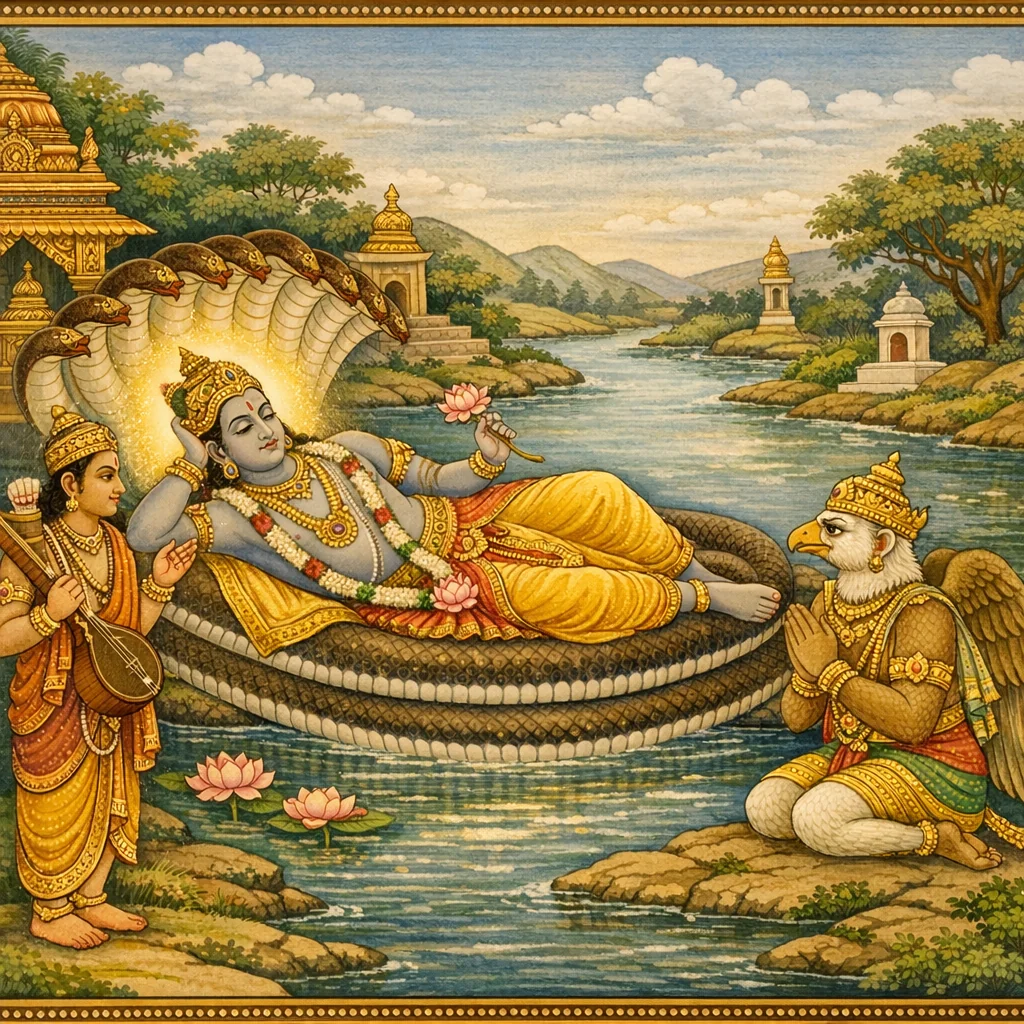
Adhyaya 80
Chapter 80 begins with the sages questioning the earlier statement that Garuḍa, possessed of extraordinary tejas and vīrya, arose through the homa of sages. Sūta explains the ritual causality: Kaśyapa brings a consecrated water-vessel (kalaśa), empowered by Atharvanic mantras and the agency of the Vālakhilyas, and instructs Vinatā to drink the mantra-purified water so that a mighty son may be born. Vinatā drinks at once, conceives, and gives birth to Garuḍa—terrifying to serpents and later bound to Vaiṣṇava service as Viṣṇu’s vāhana and as the emblem upon the chariot-banner. A second inquiry follows: how Garuḍa lost and regained his wings, and how Maheśvara was pleased. The narrative introduces a brāhmaṇa friend of the Bhṛgu lineage seeking a suitable groom for his daughter Mādhavī; Garuḍa carries them across the earth in a prolonged search, offering a didactic critique of partial measures—beauty, lineage, wealth, and the like—when severed from integrated virtue. The journey then turns to sacred geography: they reach a region marked by Vaiṣṇava presence and meet Nārada, who directs them to Hāṭakeśvara-kṣetra, where Janārdana abides in a jalśāyī form for a fixed period. Before the overwhelming Vaiṣṇava tejas, Garuḍa and Nārada caution the brāhmaṇa to remain at a distance; they perform reverential gestures and are granted audience. Nārada conveys Earth’s complaint to Brahmā about daṇḍa-like burdens caused by rising hostile forces (such as Kaṃsa and others), requesting Viṣṇu’s descent to restore balance. Viṣṇu assents, and the segment ends with Viṣṇu turning to Garuḍa to ask his purpose in coming, setting up the continuation.
Shlokas
Verse 1
। अथ सुपर्णाख्यमाहात्म्यं भविष्यंति । ऋषय ऊचुः । यदेतद्भवता प्रोक्तं तेजोवीर्यसमन्वितः । गरुडस्तेन संजज्ञे मुनीनां होमकर्मणा
Now, pray tell the Māhātmya known as “Suparṇa.” The sages said: “What you have declared—that Garuḍa, endowed with blazing splendour and heroic power, was born through the munis’ homa rite—we wish to hear clearly.”
Verse 2
स कथं तत्र संभूत एतन्नो विस्तराद्वद । विनतायाः समुद्भूत इत्येषा श्रूयते श्रुतिः
“How, then, was he born there? Tell us this in detail. For the tradition we have heard says that he was born of Vinatā.”
Verse 3
सूत उवाच । योऽसावाथर्वणैर्मंत्रैः कलशश्चाभिमन्त्रितः । तैर्मंत्रैर्वालखिल्यैश्च महाऽमर्षसमन्वितैः
Sūta said: “That kalaśa, the water-pot, had been duly consecrated with Atharvan mantras—indeed with those very mantras—and by the Vālakhilya sages, endowed with great ascetic fervour…”
Verse 4
निवारितैश्च दक्षेण सूचिते विहगाधिपे । कश्यपस्तं समादाय कलशं प्रययौ गृहम्
When Dakṣa restrained them and pointed out the lord of birds, Kaśyapa took up the kalaśa of consecrated water and departed for his home.
Verse 5
ततः प्रोवाच संहृष्टो विनतां दयितां निजाम् । एतत्पिब जलं भद्रे मन्त्रपूतं महत्तरम्
Then, delighted, he said to his beloved Vinatā: “O auspicious lady, drink this water—great and sanctified by mantras.”
Verse 6
येन ते जायते पुत्रः सहस्राक्षाधिको बली । तेजस्वी च यशस्वी च अजेयः सर्व दानवैः
“By this you will bear a son mightier than the Thousand-Eyed (Indra): radiant, renowned, and unconquerable by all Dānavas.”
Verse 7
तस्य तद्वचनं श्रुत्वा तत्क्षणादेव संपपौ । तत्तोयं सा वरारोहा सद्यो गर्भं ततो दधे
Hearing his words, she drank at that very moment. Having drunk that water, the fair-limbed lady immediately conceived.
Verse 8
एवं तज्जलपानेन तेजोवीर्यसम न्वितः । कश्यपाद्गरुडो जज्ञे सर्वसर्पभयावहः
Thus, by drinking that water, Garuḍa—filled with splendour and heroic power—was born of Kaśyapa, becoming a terror to all serpents.
Verse 9
येनामृतं हृतं वीर्यात्परिभूय पुरंदरम् । मातृभक्तिपरीतेन सर्पाणां संनिवेदितम्
By whose valour the amṛta was borne away, bringing humiliation upon Purandara (Indra); and who, filled with devotion to his mother, offered it unto the serpents (Nāgas).
Verse 10
यो जज्ञे दयितो विष्णोर्वाहनत्वमुपागतः । ध्वजाग्रे तु रथस्यापि यः सदैव व्यवस्थितः
He who was born as Viṣṇu’s beloved, who attained the station of His vāhana (mount); and who ever stands at the fore, upon the chariot’s banner-tip.
Verse 11
येन पूर्वं तपस्तप्त्वा क्षेत्रेऽत्रैव महात्मना । त्रिनेत्रस्तुष्टिमानीतो गतपक्षेण धीमता
Here, in this very sacred field, that wise and great-souled one—though bereft of his wings—performed tapas as before, and thereby brought the Three-eyed Lord (Śiva) to satisfaction.
Verse 12
पक्षाप्तिर्येन संजाता यस्य भूयोऽपि तादृशी । देवदेवप्रसादेन विशिष्टा चाऽथ निर्मिता
By the grace of the God of gods, he regained his wings; and once more such wings were fashioned—made even more excellent and distinguished through divine favour.
Verse 13
मुनय ऊचुः । कथं तस्य गतौ पक्षौ गरुडस्य महात्मनः । पुनर्लब्धौ कथं तेन कथं तुष्टो महेश्वरः । एतन्नो विस्तराद्ब्रूहि सूतपुत्र यथातथम्
The sages said: “How did the great Garuḍa lose his wings? How did he regain them again? And how was Maheśvara pleased? Tell us this in full, O son of Sūta, exactly as it happened.”
Verse 14
सूत उवाच । पुरासीद्ब्राह्मणो मित्रं भृगुवंशकुलोद्वहः । गरुडस्य द्विजश्रेष्ठा बालभावादपि प्रभो
Sūta said: “In former times there was a brāhmaṇa, an ornament of the Bhṛgu lineage; O best of the twice-born, O lord, he was Garuḍa’s dear friend even from childhood.”
Verse 15
तस्य कन्या पुरा जाता माधवी नाम संमता । रूपौदार्यसमोपेता सर्वलक्षणलक्षिता
To him long ago a daughter was born, renowned by the name Mādhavī—endowed with beauty and noble generosity, marked with every auspicious sign.
Verse 16
न देवी न च गन्धर्वी नासुरी न च पन्नगी । तादृग्रूपा महाभागा यादृशी सा सुमध्यमा
She was not a goddess, nor a Gandharva maiden, nor an Asurī, nor a Nāga-woman—yet that fortunate, slender-waisted one possessed a beauty beyond them all.
Verse 17
अथ तस्या वरार्थाय गरुडं विहगाधिपम् । स प्रोवाच परं मित्रं विनयावनतः स्थितः
Then, to seek a bridegroom for her, he approached Garuḍa, lord of birds; standing bowed in humility, he spoke to his dearest friend.
Verse 18
एतस्या मम कन्याया वरं त्वं विहगाधिप । सदृशं वीक्षयस्वाद्य येन तस्मै ददाम्यहम्
“For this daughter of mine, O lord of birds, look today for a bridegroom truly equal to her, so that I may give her to him.”
Verse 19
गरुड उवाच । मम पृष्ठं समारुह्य समस्तं क्षितिमंडलम् । त्वं भ्रमस्व द्विजश्रेष्ठ गृहीत्वेमां च कन्यकाम्
Garuḍa said: “Mount upon my back and roam across the whole circle of the earth, O best of brāhmaṇas—taking this maiden with you.”
Verse 20
ततस्तस्याः कुमार्या वै अनुरूपं गुणान्वितम् । स्वयं चाहर भर्तारमेषा मैत्री ममोद्भवा
“Then, indeed, bring back yourself a husband for this maiden—one fitting to her and endowed with virtues; for this friendship has arisen from me, and I will aid you.”
Verse 21
सूत उवाच । एवमुक्तोऽथ विप्रः स तत्क्षणात्कन्यया सह । आरूढो गारुडं पृष्ठं वरार्थाय द्विजोत्तमाः
Sūta said: Thus addressed, that brāhmaṇa at once—together with the maiden—mounted Garuḍa’s back, setting out in search of a worthy bridegroom.
Verse 22
यंयं पश्यति विप्रः स कुमारं तरुणाकृतिम् । स स नो तस्य चित्तांते वर्ततेस्म कथंचन
Whomever the brāhmaṇa saw—each youth of fresh and youthful form—none of them, in any way, truly settled in his heart.
Verse 23
कस्यचिद्रूपमत्युग्रं न कुलं च सुनिर्मलम् । कुलं रूपं च यस्य स्यात्तस्य नो गुणसंचयः
For some, the beauty is striking, yet the lineage is not wholly pure; for another, lineage and beauty may be present, yet a store of virtues is lacking.
Verse 24
यस्य वा गुणसन्दोहस्तस्य नो रूपमुत्तमम् । पक्षपातं च वित्तं च तथान्यद्वरलक्षणम्
One may possess a great store of virtues, yet lack excellent beauty; and in another there may be favoritism, wealth, and other marks sought in a groom.
Verse 25
एवं वर्षसहस्रांते भ्रमतस्तस्यभूतलम् । विप्रस्य पक्षिनाथस्य वरार्थाय द्रिजोत्तमाः
Thus, after a thousand years of wandering over the earth in search of a groom, the best of brāhmaṇas continued his quest, borne by the lord of birds.
Verse 26
कदाचिदथ तौ श्रान्तौ भ्रममाणावितस्ततः । क्षेत्रेऽत्रैव समायातौ वासुदेवदिदृक्षया
Then, once, the two—wearied from roaming here and there—arrived at this very sacred field (kṣetra), longing to behold Vāsudeva.
Verse 27
श्वेतद्वीपं समालोक्य तथान्यां बदरीं शुभाम् । क्षीरोदं च सवैकुण्ठं तथान्यं तस्य संश्रयम्
They beheld Śvetadvīpa, and also the auspicious Badarī; the Ocean of Milk together with Vaikuṇṭha—and other abodes that are his resort.
Verse 28
अथ ताभ्यां मुनिर्दृष्टो नारदो ब्रह्मसंभवः । सांत्वपूर्वं तदा पृष्टो विष्णुं ब्रह्म सनातनम्
Then they saw the sage Nārada, born of Brahmā; and after first offering soothing words, they questioned him about Viṣṇu, the eternal Brahman, the Supreme Reality.
Verse 29
क्व देवः पुंडरीकाक्षः सांप्रतं वर्तते मुने । विष्णुस्थानानि सर्वाणि वीक्षितानि समंततः । आवाभ्यां संप्रहृष्टाभ्यां न संदृष्टः स केशवः
“Where is the lotus-eyed Lord now, O sage? We have searched all around, beholding every sacred seat of Viṣṇu; yet though we sought with eager joy, we have not seen Keśava.”
Verse 30
नारद उवाच । जलशायिस्वरूपेण यावन्मासचतुष्टयम् । हाटकेश्वरजे क्षेत्रे स संतिष्ठति सर्वदा
Nārada said: “In the form of the Lord who reclines upon the waters (Jalaśāyī), for four months He abides—ever present—in the sacred field of Hāṭakeśvara.”
Verse 31
तस्मात्तद्दर्शनार्थाय गम्यतां तत्र मा चिरम् । येन सन्दर्शनं याति द्वाभ्यामपि स चक्रधृक्
Therefore, for the sake of beholding Him, let us go there at once, without delay. By going there, both of us shall obtain the blessed vision of the Discus-bearing Lord (Cakradhṛk).
Verse 32
अहमप्येव तत्रैव प्रस्थितस्तस्य दर्शनात् । प्रस्थितश्च त्वया युको देवकार्येण केनचित्
I too have set out for that very place, for the sake of beholding Him; and I have also departed together with you, being engaged in some task of the gods.
Verse 33
अथ तौ पक्षिविप्रेन्द्रौ स च ब्रह्मसुतो मुनिः । प्राप्ताः सर्वे स्थितो यत्र जलशायी जनार्दनः
Then those two—lordly among the bird and the brāhmaṇa—and that sage, the son of Brahmā, all arrived at the place where Janārdana lay reposing upon the waters.
Verse 34
अथ दृष्ट्वा महत्तेजो वैष्णवं दूरतोऽपि तम् । ब्राह्मणं गरुडः प्राह नारदश्च मुनीश्वरः
Then, seeing from afar that great Vaiṣṇava radiance, Garuḍa spoke to the brāhmaṇa; and Nārada too, lord among sages, spoke.
Verse 35
अत्रैव त्वं द्विजश्रेष्ठ तिष्ठ दूरेऽपि तेजसः । वैष्णवस्य सुतायुक्तः कल्पांताग्निसमम् व
O best of the twice-born, remain right here—at a distance from that radiance. This Vaiṣṇava splendor, together with its power, is like the fire at the end of an aeon.
Verse 36
नो चेत्संपत्स्यसे भस्म पतंग इव पावकम् । समासाद्य निशायोगे मूढं भावं समाश्रितः
Otherwise you will be reduced to ashes—like a moth that rushes into a flame—approaching at the wrong time, having fallen into delusion.
Verse 37
आवाभ्यां तत्प्रसादेन सोढमेतत्सुदुःसहम् । न करोति शरीरार्ति तथान्यदपि कुत्सितम्
By His grace, we two have endured this exceedingly hard-to-bear radiance; it does not cause bodily torment to us, nor any other harmful affliction.
Verse 38
एवं तं ब्राह्मणं तत्र मुक्त्वा दूरे सुतान्वितम् । गतौ तौ तत्र संसुप्तस्तोये यत्र जनार्दनः
Having thus left that brāhmaṇa there at a distance, together with his son, the two of them went on to the place where Janārdana lay asleep upon the waters.
Verse 39
दिव्यस्तुतिपरौ मूर्ध्नि धृतहस्तांजलीपुटौ । पुलकांकितसर्वांगावानन्दाश्रुप्लुताननौ
Absorbed in divine hymns, with hands joined in reverent añjali raised to the crown of the head, their whole bodies were marked by devotional thrills, and their faces were drenched with tears of bliss.
Verse 40
त्रिःपरिकम्य तं देवमष्टांगं प्रणतौ हरिम् । दृष्टवन्तौ च पादांते संनिविष्टां समुद्रजाम्
Circumambulating that God three times, bowing to Hari with the eight-limbed prostration, they beheld at His feet the daughter of the ocean seated there—Śrī/Lakṣmī.
Verse 41
पादसंवाहनासक्तां विष्णु वक्त्राहितेक्षणाम् । अथापरां वयोवृद्धां श्वेतवस्त्रावगुंठिताम्
He beheld one devotedly engaged in massaging the feet, her gaze fixed upon the face of Viṣṇu; and then he saw another—aged and venerable—veiled in white garments.
Verse 42
सन्निविष्टां तदभ्याशे सम्यग्ध्यानपरायणाम् । द्वादशार्कप्रभायुक्तां कृशांगीं पुलकान्विताम्
Seated nearby, wholly devoted to perfect meditation, she shone with a radiance like twelve suns—slender-limbed and covered with the thrill of devotion.
Verse 43
अथ तौ विष्णुना हर्षादुभावपि प्रहर्षितौ । संभाषितौ च संपृष्टौ यदर्थं च समागतौ
Then Viṣṇu, delighted, gladdened them both; he spoke with them and asked for what purpose they had come.
Verse 44
श्रीनारद उवाच । अहं हि सुरकार्येण संप्राप्योऽत्र तवांतिकम् । गरुडो वै ब्राह्मणाय यन्मां पृच्छसि केशव
Śrī Nārada said: “I have come into your presence here on the business of the gods. And Garuḍa has come for the sake of a brāhmaṇa—this is what you ask me, O Keśava.”
Verse 45
श्रीभगवानुवाच । कच्चित्क्षेमं मुनिश्रेष्ठ सर्वेषां त्रिदिवौकसाम् । कच्चिन्नेंद्रस्य संजातं भयं दानवसंभवम्
The Blessed Lord said: “O best of sages, is all well with all the dwellers of heaven? Has any fear arisen for Indra, caused by the daṇavas?”},{
Verse 46
यज्ञभागं लभंते स्म कच्चिद्देवाः सवासवाः । कच्चिन्न दानवः कश्चिदुत्कटोऽभूद्धरातले
“Do the gods, together with Vāsava (Indra), still receive their proper share of the sacrifice? And has no fierce daṇava arisen upon the earth?”},{
Verse 47
श्रीनारद उवाच । सांप्रतं धरणी प्राप्ता चतुर्वक्त्रस्य संनिधौ । रोरूयमाणा भारार्ता दानवैः पीडिता भृशम् । प्रोवाच पद्मजं तत्र दुःखेन महताऽन्विता
Śrī Nārada said: “Just then the Earth approached the presence of the Four-faced One (Brahmā). Weeping, burdened, and grievously tormented by the daṇavas, she there spoke to the Lotus-born, overwhelmed with great sorrow.”},{
Verse 48
धरण्युवाच । कालनेमिर्हतो योऽसौ विष्णुनाप्रभविष्णुना । उग्रसेनसुतः कंसः संभूतः स महासुरः
The Earth said: “That Kālanemi who was slain by Viṣṇu—the mighty, unconquerable Viṣṇu—has been born again as Kaṃsa, the son of Ugrasena, a great asura.”}]} وقع
Verse 49
अरिष्टो धेनुकः केशी प्रलम्बोनाम चापरः । तथान्या तु महारौद्रा पूतना नाम राक्षसी
Ariṣṭa, Dhenuka, Keśī, and another named Pralamba; and also that other one, exceedingly dreadful—the rākṣasī named Pūtanā.
Verse 50
इतश्चेतश्च धावद्भिर्दानवैरेभिरेव च । वृथा मे जायते पीडा तथान्यैरपि दारुणैः
By these daṇavas running about in every direction—and by other cruel beings as well—pain arises for me without respite.
Verse 51
ऊर्ध्वबाहुस्तथा जातो मर्त्यलोके जनोऽधुना । बहुत्वान्न प्रमाति स्म कथंचिद्धि ममोपरि
Now in the mortal world, people have indeed been born with arms raised aloft; yet, because they are so many, they do not take notice of me at all—hardly anyone gives heed to my plight.
Verse 52
भारावतरणं देव न करिष्यसि चाशु चेत् । रसातलं प्रयास्यामि तदाऽहं नात्र संशयः
O God, if you do not swiftly bring about the removal of this burden, then I shall descend to Rasātala—of this there is no doubt.
Verse 53
तस्यास्तद्वचनं श्रुत्वा ब्रह्मणा लोककर्तृणा । संमंत्र्य विबुधैः सार्धं प्रेषितोऽहं तवांतिकम्
Having heard her words, Brahmā—the creator of the worlds—after consulting together with the gods, sent me to your presence.
Verse 54
प्रोक्तव्यो भगवान्वाक्यं त्वया देवो जनार्दनः । यथाऽवतीर्य भूपृष्ठे भारमस्याः प्रणाशयेत्
You must convey this word to the Blessed Lord Janārdana: that, descending upon the face of the earth, he should destroy her burden.
Verse 55
तस्माद्भूभितले देव कृत्वा जन्म स्वयं विभो । भारं नाशय मेदिन्या एतदर्थ मिहागतः
Therefore, O Lord—O all-powerful one—take birth by your own will upon the earth, and remove the burden of the goddess Earth. For this purpose I have come here.
Verse 56
श्रीभगवानुवाच । एवं मुने करिष्यामि संमंत्र्य ब्रह्मणा सह । भारावतरणं भूमेः साकं देवैः सवासवैः
The Blessed Lord said: “So be it, O sage. I shall do this—after consulting with Brahmā—bringing about the removal of Earth’s burden together with the gods, including Indra and the Maruts.”
Verse 57
एवमुक्त्वाऽथ तं विष्णुर्नारदं मुनिपुंगवम् । ततश्च गरुडं प्राह त्वं किमर्थमिहागतः
After speaking thus to Nārada, the foremost of sages, Viṣṇu then addressed Garuḍa: “For what purpose have you come here?”