Adhyaya 73
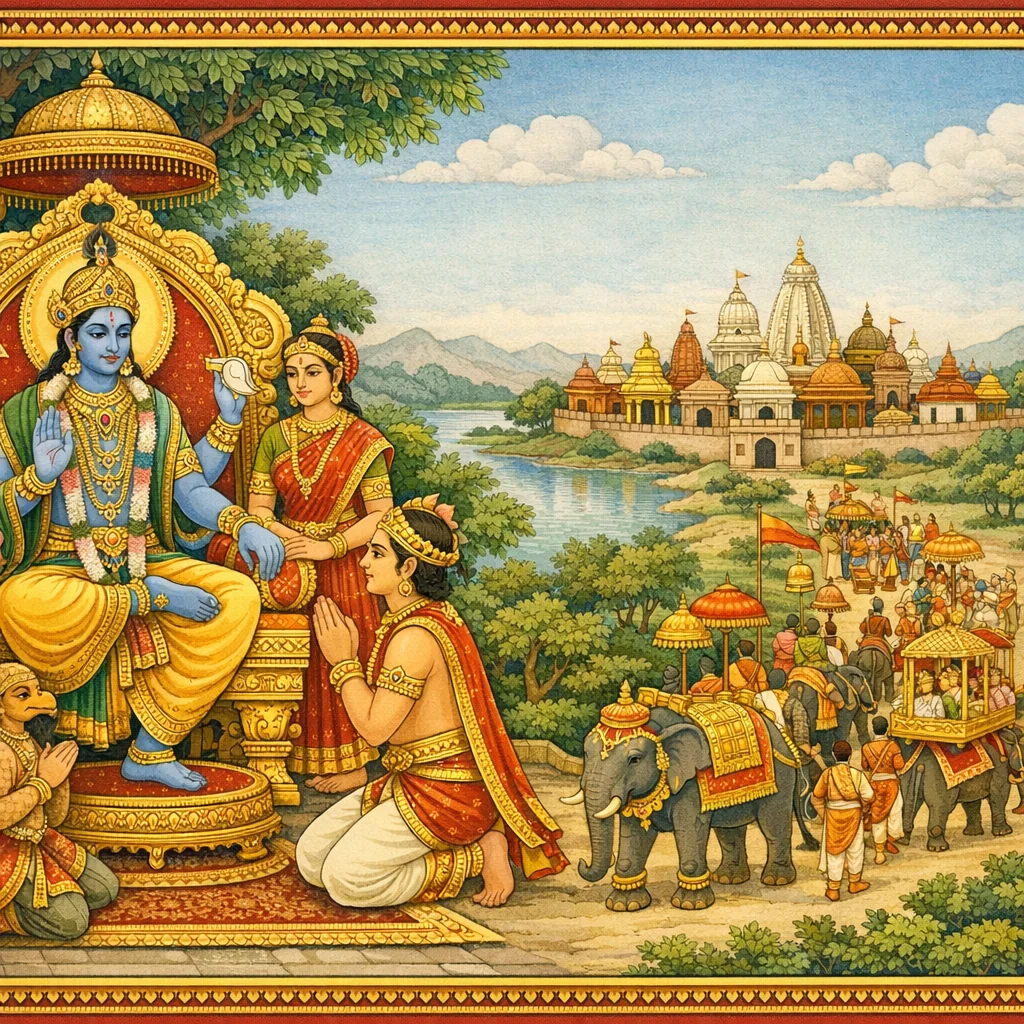
Chapter 73 describes the departure from Dvāravatī after the famed royal wedding of Duryodhana and Bhānumatī, amid music, Vedic recitation, and public celebration. On the ninth day, the Kuru–Pāṇḍava elders address Viṣṇu as Puṇḍarīkākṣa/Mādhava, confessing their affectionate reluctance to leave, yet stating their urgency: while traveling through the Anarta region they beheld the wondrous Hāṭakeśvara-kṣetra, filled with radiant liṅgas of varied architectural forms, associated with eminent lineages and exalted beings. Desiring to establish their own liṅgas there, they seek leave to depart and promise to return for further audience. Viṣṇu affirms the kṣetra’s supreme merit and agrees to accompany them for darśana and liṅga-pratiṣṭhā. Upon arrival, the Kurus, Pāṇḍavas, and Yādavas summon Brahmins and request authorization and priestly leadership for the installation rites. The Brahmins deliberate about land and feasibility—citing the site’s limited extent and earlier divine constructions—yet conclude that refusal is improper when great figures petition for dharmic ends. They authorize each ruler to build distinct, beautiful prāsādas in ordered precedence, and the chapter ends with Dhṛtarāṣṭra and the others beginning the planned sequence of construction.
Shlokas
Verse 1
। सूत उवाच । एवं ते कौरवाः सर्वे पांडोः पुत्राश्च शालिनः । तस्मात्स्थानात्ततो जग्मुर्यत्र द्वारवती पुरी
Sūta said: Thus all those Kauravas, along with the illustrious sons of Pāṇḍu, then set out from that place to where the city of Dvāravatī stands.
Verse 2
तत्र गत्वा विवाहं तु चक्रुः संहृष्टमानसाः । दुर्योधनस्य भूपस्य भानुमत्या समं तदा
Having reached there, with delighted hearts they then performed the marriage of King Duryodhana together with Bhānumatī.
Verse 3
नानावादित्रघोषेण वेदध्वनियुतेन च । गीतैर्मनोहरैः पाठैर्बन्दिनां च सहस्रशः
With the clamor of many instruments, together with the sound of Vedic chanting; with charming songs and melodious recitations, and with thousands of panegyrists—
Verse 4
एवं महोत्सवो जज्ञे तत्र यावद्दिनाष्टकम् । यादवानां कुरूणां च मिलितानां परस्परम्
In this manner a great festival arose there for eight days, as the Yādavas and the Kurus gathered together in mutual fellowship.
Verse 5
कृतार्थास्तत्र संजाताः सूतमागध बन्दिनः । चारणा ब्राह्मणेंद्राश्च तथान्येऽपि च तार्किकाः
There, the bards and panegyrists—Sūtas, Māgadhas, and Bandins—became fulfilled; so too the Cāraṇas, the foremost of Brāhmaṇas, and other learned logicians as well.
Verse 6
ततस्तु नवमे प्राप्ते दिवसे कुरुपांडवाः । भीष्माद्याः पुंडरीकाक्षमिदमूचुः ससौहृ दम्
Then, when the ninth day arrived, the Kurus and Pāṇḍavas—led by Bhīṣma—spoke these words to Puṇḍarīkākṣa with affectionate goodwill.
Verse 7
न वयं पुंडरीकाक्ष तव रामस्य चाश्रयम् । कथंचित्त्यक्तुमिच्छामः स्नेहपाशनियंत्रिताः
O Lotus-eyed One, we do not wish—by any means—to abandon the shelter of you and of Rāma, for we are held fast by the bonds of affection.
Verse 8
तथापि च प्रगन्तव्यं स्वपुरं प्रति माध व । बलभद्रसमायुक्तस्तस्मान्नः कुरु मोक्षणम्
Yet, O Mādhava, you must depart to your own city, accompanied by Balabhadra; therefore, grant us leave to withdraw and depart as well.
Verse 9
विष्णुरुवाच । न तावद्वत्सरो जातो न मासः पक्ष एव च । स्थितानामत्र युष्माकं तत्किमौत्सुक्यमागतम्
Viṣṇu said: “Not even a year has passed—nor a month, nor even a fortnight—since you have been staying here. Why, then, has such haste arisen in you?”
Verse 10
तस्मादत्रैव तिष्ठामः सहिताः कुरुपांडवाः । यूयं वयं विनोदेन मृगयाक्षोद्भवेन च
Therefore, let us remain right here together—the Kurus and Pāṇḍavas—while you and we pass the time in wholesome recreation, including the exertions arising from the hunt.
Verse 11
शस्त्रशिक्षाक्रियाभिश्च दमनेन च दन्तिनाम् । तथाभिवांछितैरन्यैः स्नेहोऽस्ति यदि वो मयि
—through exercises in weapons-training, through the taming of elephants, and through other pursuits you may desire—if indeed you bear affection for me.
Verse 12
भीष्म उवाच । उपपन्नमिदं विष्णो यत्त्वया व्याहृतं वचः । परं शृणुष्व मे वाक्यं यदर्थं ह्युत्सुका वयम्
Bhīṣma said: “O Viṣṇu, what you have spoken is fitting. Now hear my statement—the reason for which we are indeed eager.”
Verse 13
आनर्तविषयेऽस्माभिरागच्छद्भिस्तवांतिकम् । दृष्टमत्यद्भुतं क्षेत्रं हाटकेश्वरजं महत् । तत्र लिंगानि दृष्टानि भूपतीनां महात्मनाम्
In the land of Ānarta, as we came near to your presence, we beheld a supremely wondrous and mighty sacred region, connected with Hāṭakeśvara. There we saw liṅgas established by great-souled kings.
Verse 14
सूर्यचन्द्रान्वयोत्थानामन्येषां च महात्मनाम्
—(liṅgas) belonging also to other great-souled rulers, descended from the Solar and Lunar dynasties.
Verse 15
देवानां दानवानां च मुनीनां च विशेषतः । साकाराणि सुतेजांसि नानाप्रासादभोजि च
There are radiant and splendid manifestations there—especially of the gods, the Dānavas, and the sages—appearing in visible form and associated with many diverse, temple-like shrines and sanctuaries.
Verse 16
ततश्च कुरुमुख्यानां पांडवानां च माधव । लिंगसंस्थापनार्थाय तत्र जाता मतिर्दृढा
Then, O Mādhava, among the foremost of the Kurus and the Pāṇḍavas there arose a firm resolve—to establish Śiva-liṅgas there.
Verse 17
ते वयं तत्र गत्वाशु यथाशक्त्या यथेच्छया । लिंगानि स्थापयिष्यामः स्वानिस्वानि पृथक्पृथक्
So we shall quickly go there, and—according to each one’s capacity and heartfelt desire—we will install liṅgas, each one separately, one’s own in its own place.
Verse 18
एतस्मात्कारणात्तूर्णं चलिता वयमच्युत । न वयं तव संगस्य तृप्यामोऽब्दशतैरपि
For this reason, O Acyuta, we set out at once. Yet even in hundreds of years we would not be satisfied with your company.
Verse 19
तस्मादाज्ञापयस्वाद्य कृत्वा चित्तं दृढं विभो । भूयोऽप्यत्रागमिष्यामस्तव दर्शनलालसाः
Therefore, O Lord, give your command today, having made your mind firm. We shall return here again, eager for the blessing of your sight.
Verse 20
श्रीभगवानुवाच । अहं जानामि तत्क्षेत्रं सुपुण्यं पापनाशनम् । तापसैः कीर्तितं नित्यं ममान्यैस्तीर्थयात्रिकैः
The Blessed Lord said: I know that sacred region—most meritorious and a destroyer of sins—praised continually by ascetics and by other pilgrims devoted to holy journeys.
Verse 21
तस्मात्तत्र समेष्यामो युष्माभिः सहिता वयम् । लिंग संस्थापनार्थाय क्षेत्रदर्शनवांछया
Therefore we shall go there together with you—both to establish the liṅga and out of the desire to behold that sacred kṣetra.
Verse 22
सूत उवाच । तच्छुत्वा कौरवाः सर्वे परं हर्षमुपागताः । तथा पांडुसुताश्चैव ये चान्ये तत्र पार्थिवाः
Sūta said: Hearing that, all the Kauravas were filled with supreme joy—and so too the sons of Pāṇḍu, and the other kings who were present there.
Verse 23
ते तु संप्रस्थिताः सर्वे मिलिताः कुरुपांडवाः । गजवाजिविमर्देन कम्पयन्तो वसुन्धराम्
Then they all set out—the Kurus and the Pāṇḍavas united—shaking the earth with the thunderous press of elephants and horses.
Verse 24
अथ तत्क्षेत्रमासाद्य दूरे कृत्वा निवेशनम् । कौरवा यादवा मुख्याश्चमत्कारपुरं गताः
Then, having reached that sacred region and setting their camp at a distance, the foremost Kauravas and Yādavas went to Camatkārapura.
Verse 25
तत्र सर्वान्समाहूय ब्राह्मणान्विनयान्विताः । प्रोचुर्दत्त्वा विचित्राणि भूषणाच्छादनानि च
There, with humility, they summoned all the brāhmaṇas; and after presenting splendid ornaments and garments, they addressed them.
Verse 26
वयं सर्वेऽत्र वांछामो लिगसंस्थापनक्रियाम् । कर्तुं प्रासादमुख्यानां पृथक्त्वेन स्वशक्तितः
All of us here desire to perform the rite of establishing a Śiva-liṅga—each, according to one’s own capacity, separately arranging the foremost shrines and temples.
Verse 27
तस्मात्कृत्वा प्रसादं नो दयां च द्विजसत्तमाः । आज्ञापयत शीघ्रं हि येन कर्म प्रवर्तते
Therefore, O best of the twice-born, show us your favor and compassion; give the instruction quickly, so that the sacred work may commence.
Verse 28
भविष्यथ तथा यूयं होतारः सर्वकर्मसु । न चान्यो ब्राह्मणो बाह्यो यद्यपि स्याद्बृहस्पतिः
So too, you yourselves shall be the officiating priests (hotṛs) in all these rites; no other brāhmaṇa from outside shall be engaged—even if he were like Bṛhaspati himself.
Verse 29
यतोऽस्माभिः श्रुता वार्ता कीर्त्यमाना पुरातनी । विष्णुना तस्य राजर्षेः प्रेतश्राद्धसमुद्भवा
For we have heard an ancient account, still recounted in praise—how, by Viṣṇu’s ordinance, there arose the matter of the royal sage’s śrāddha for one who had become a preta.
Verse 30
यथा तेन कृतं श्राद्धं पितुः प्रेतस्य यत्नतः । ब्राह्मणानां पुरोऽन्येषां यथोक्तानामपि द्विजाः
How he diligently performed the śrāddha for his father who was in the preta-state—before brāhmaṇas and other duly appointed twice-born, exactly as prescribed.
Verse 31
यथोक्तविधिना तीर्थे नागानां पंचमीदिने । श्रावणे मासि नो मुक्तः पिता तस्य तथापि सः
Yet even though it was done at the tīrtha according to the prescribed rule—on the Nāga Pañcamī day in the month of Śrāvaṇa—his father still was not released.
Verse 32
प्रेतत्वात्सर्पदोषेण संजाता द्विजसत्तमाः । देवशर्मपुरो यावत्तत्कृतं श्राद्धमादरात् । तावत्पिता विनिर्मुक्तः प्रेतत्वाद्दारुणाद्द्विजाः
O best of the twice-born, the preta-condition had arisen due to the serpent-linked fault (sarpa-doṣa). But when, in the presence of Devaśarmā, that śrāddha was performed with reverence, then his father was freed from that dreadful preta-state, O twice-born.
Verse 33
यदत्र क्रियते किंचित्कर्म धर्म्यं द्विजोत्तमाः । तद्बाह्यं च भवेद्व्यर्थमेतद्विद्मः स्फुटं वयम्
O best of the twice-born, whatever dharmic rite is performed here—if done outside this sacred precinct—becomes fruitless. This we know with perfect clarity.
Verse 34
प्रार्थयामो विशेषेण तेन दैन्यं समागताः । प्रसादः क्रियतां तस्मादाज्ञां यच्छत मा चिरम्
We entreat you most earnestly; because of that matter we have fallen into distress. Therefore, bestow your favor and give the instruction—do not delay.
Verse 35
सूत उवाच । तेषां तद्वचनं श्रुत्वा ब्राह्मणास्ते परस्परम् । मन्त्रं चक्रुस्तदर्थं हि किं कृतं सुकृतं भवेत्
Sūta said: Hearing those words, the brāhmaṇas consulted one another and deliberated on the matter—what action, if undertaken, would become truly meritorious (sukṛta).
Verse 36
एके प्रोचुर्न दास्यामः प्रासादार्थं वसुन्धराम् । एतेषामपि चैकस्य तस्माद्गच्छंतु सत्वरम्
Some said, “We will not give land for the building of a prāsāda, a temple. Therefore, let them quickly go to one among these others instead.”
Verse 37
पंचक्रोशप्रमाणेन क्षेत्रमेतद्व्यवस्थितम् । पूर्वेषामपि देवानां प्रासादैस्तत्समावृतम्
This sacred precinct is established to the measure of five krośas, and it is also surrounded by the temples of the ancient gods.
Verse 38
अन्ये प्रोचुर्धनोमत्ता यूयं च सुखमाश्रिताः । दारिद्यार्तिं न जानीथ ब्रूथ तेन भृशं वचः
Others said, “You are intoxicated with wealth and dwell in ease; you do not know the anguish of poverty—therefore you speak such harsh words.”
Verse 39
तस्माद्वयं प्रदास्याम एतेषां हि वसु न्धराम् । अर्थसिद्धिर्भवेद्येन भूषा स्थानस्य जायते
“Therefore we will give them land; by this their purpose will be fulfilled, and the holy place itself will gain adornment and glory through the work.”
Verse 40
तथान्ये मध्यमाः प्रोचुर्यत्र साक्षाज्जनार्दनः । स्वयं प्रार्थयते भूमिं तत्कस्मान्न प्रदीयते
Then others, taking a middle course, said: “Where Janārdana himself directly asks for land, why should it not be given?”
Verse 41
तस्माद्यत्र समायाताः कुरुपांडवयादवाः । प्राधान्येन प्रकुर्वंतु प्रासादांस्तेन चापरे
“Therefore, in the place where the Kurus, Pāṇḍavas, and Yādavas have assembled, let them take the lead in building the temples—and let others follow accordingly.”
Verse 42
याचते यत्र गांगेयः स्वयमेव तथा परः । धृतराष्ट्रः सपुत्रश्च पांडवाश्च महाबलाः । लिंगसंस्थापनार्थाय निषेधस्तत्र नार्हति
Where Gāṅgeya (Bhīṣma) himself makes the request, and likewise others—Dhṛtarāṣṭra with his sons, and the mighty Pāṇḍavas—when it is for establishing a Śiva-liṅga, opposition there is not proper.
Verse 43
तेषां तद्वचनं श्रुत्वा प्रतिपन्नं द्विजोत्तमैः । निर्धनैः सधनैश्चापि सस्पृहैर्निःस्पृहैरपि
Hearing those words, the best among the twice-born accepted the decision—both the poor and the wealthy, both the desirous and the desireless alike.
Verse 44
ततः समेत्य ते सर्वे ब्राह्मणाः कुरुसत्तमान् । यादवान्पांडवान्प्रोचुः कृत्वा वै मन्त्रनिश्चयम्
Then all those brāhmaṇas assembled and, having firmly resolved their counsel, spoke to the foremost Kurus, the Yādavas, and the Pāṇḍavas.
Verse 45
ब्राह्मणा ऊचुः । एतत्स्वल्पतरं क्षेत्रं सर्वेषामपि भूभुजाम् । प्रासादैः सर्वतो व्याप्तं तत्किं ब्रूमोऽधुना वयम्
The Brāhmaṇas said: “This sacred precinct is quite small for all the kings. It is already filled on every side with temples—so what can we say now?”
Verse 46
तद्भवंतः प्रकुर्वंतु प्राधान्येन यदृच्छया । क्षेत्रेऽत्रैवाभिमुख्येन प्रासादान्सुमनोहरान् । यथाज्येष्ठं यथाश्रेष्ठं पृथक्त्वेन व्यवस्थिताः
“Therefore, let each of you proceed—according to precedence, as circumstances allow—right here in this kṣetra, and build exceedingly beautiful temples, each situated separately, in keeping with seniority and excellence.”
Verse 47
अथ हर्षसमायुक्ता धृतराष्ट्रमुखाः क्रमात् । प्राधान्येन यथाश्रेष्ठं चक्रुः प्रासादपद्धतिम्
Then, filled with joy, Dhṛtarāṣṭra and the others, in due order, established the arrangement of the temples—according to precedence and excellence.
Verse 73
इति श्रीस्कांदे महापुराण एकाशीतिसाहस्र्यां संहितायां षष्ठे नागरखण्डे हाटकेश्वरक्षेत्रमाहात्म्ये धृतराष्ट्रादिकृतप्रासादस्थापनोद्यमवर्णनंनाम त्रिसप्ततितमोऽध्यायः
Thus, in the revered Skanda Mahāpurāṇa, in the Ekāśītisāhasrī Saṃhitā, within the sixth division—the Nāgara Khaṇḍa—under the Māhātmya of Hāṭakeśvara-kṣetra, concludes the seventy-third chapter, entitled “The Description of the Effort to Establish Temples by Dhṛtarāṣṭra and Others.”