Adhyaya 45
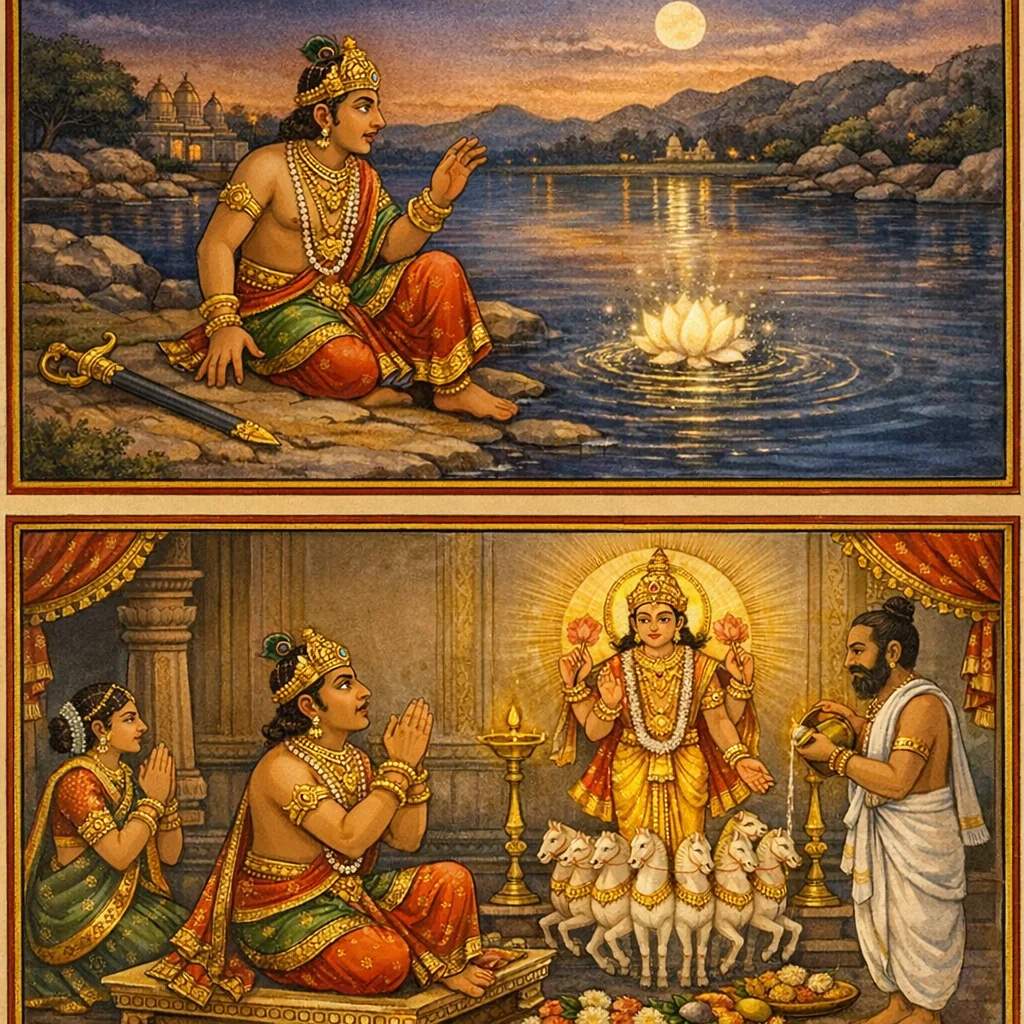
This chapter teaches the identification and merits of the “Puṣkara-traya,” the three Puṣkara waters. Sūta relates that the sage Viśvāmitra, unable to reach the distant primary Puṣkara, seeks an equally sanctified place in the auspicious month of Kārttika under Kṛttikā-yoga. A celestial voice gives the diagnostic signs: lotuses facing upward mark Jyeṣṭha-Puṣkara, sideways-facing mark Madhyama, and downward-facing mark Kaniṣṭha. It then prescribes time-bound observances—bathing in the three waters at morning, midday, and sunset—and proclaims the powerful purificatory efficacy of Puṣkara’s water and its darśana. A test narrative follows: King Bṛhadbala, while hunting, enters the water and seizes a miraculous lotus appearing at the conjunction; a cosmic sound arises, the lotus vanishes, and the king is struck with leprosy, explained as the result of touching a sacred object while in an uच्छिष्ट, ritually unfit state. Viśvāmitra prescribes the remedy through worship of Sūrya: the king installs a solar image and performs disciplined devotion, especially on Sundays; within a year he is cured, and at death attains the solar abode. The phalaśruti concludes that Kārttika bathing at Puṣkara leads to Brahmaloka; darśana of the installed Sūrya image grants health or desired aims; vṛṣotsarga at Puṣkara yields great sacrificial merit; and reciting or hearing this chapter brings fulfillment and exaltation.
Shlokas
Verse 1
। सूत उवाच । तत्रैवास्ति द्विजश्रेष्ठाः सुपुण्यं पुष्करत्रयम् । यत्र पूर्वं तपस्तप्तमानर्ताधिपभूभुजा
Sūta said: O best of the twice-born, there itself is the exceedingly meritorious triad of Puṣkara pools, where formerly the king of Ānarta performed austerities (tapas).
Verse 2
यस्तत्र कार्तिके मासि कृत्तिकास्थे निशाकरे । मध्याह्ने कुरुते स्नानं स गच्छति परां गतिम्
Whoever there, in the month of Kārttika, when the moon abides in Kṛttikā, bathes at midday—he attains the supreme state.
Verse 3
ऋषय ऊचुः । कथं तत्र समायातं सुपुण्यं पुष्करत्रयम् । कस्मिन्स्थाने च विज्ञेयं कैश्चिह्नैर्वद सूतज
The sages said: “How did that exceedingly holy triad of Puṣkara pools come to be there? In what place is it to be known, and by what signs? Tell us, O son of Sūta.”
Verse 4
सूत उवाच । अहं वः कीर्तयिष्यामि यैश्चिह्नैः पुष्करत्रयम् । प्राग्दृष्टं मुनिना तत्र विश्वामित्रेण धीमता
Sūta said: “I shall proclaim to you the signs by which the triad of Puṣkara pools may be known. Long ago, it was seen there by the wise sage Viśvāmitra.”
Verse 5
पुरा निवसतस्तस्य विश्वामित्रस्य सन्मुनेः । संप्राप्ता कार्तिकी पुण्या कृत्तिकायोगसंयुता
Once, while that noble sage Viśvāmitra was dwelling there, the holy Kārttikī occasion arrived, endowed with the auspicious conjunction of Kṛttikā.
Verse 6
सर्वतीर्थमयं क्षेत्रं तद्विज्ञाय तपोनिधिः । ततश्च चिन्तयामास स्वचित्ते गाधिनन्दनः
Knowing that this sacred region was pervaded by the essence of all tīrthas, the treasure-house of austerity—Gādhi’s son—then reflected within his own heart.
Verse 7
अद्येयं कार्तिकी पुण्या कृत्तिकायोगसंयुता । यस्यां स्नाने नरैः श्रेयः प्राप्यते पुष्करोदके । आद्यं तु पुष्करं दूरे न गन्तुं शक्यतेऽधुना
Today is the holy Kārttikī, joined with the Kṛttikā conjunction; by bathing in Puṣkara’s waters on this day, people gain spiritual good and merit. But the original Puṣkara is far away, and it is not possible to go there now.
Verse 8
तस्मादत्र स्थितं यच्च तस्मिन्स्नानं करोम्यहम् । स एवं निश्चयं कृत्वा श्रद्धापूतेन चेतसा
Therefore, I shall bathe in that which is present here. Having thus formed this resolve, he did so with a mind purified by faith.
Verse 9
ततश्चान्वेषयामास पुष्कराणि समंततः । बहुत्वात्तत्र तीर्थानां निश्चयं नान्वपद्यत
Then he began to search everywhere for the Puṣkaras; but because the holy bathing-places there were so many, he could not arrive at a definite decision.
Verse 10
दृष्ट्वादृष्ट्वा जलस्थानं स्नानं चक्रे ततः परम् । स तदा श्रममापन्नो भ्रममाण इतस्ततः
Seeing one water-spot after another, he kept performing baths again and again. Then, wandering here and there, he became overcome with fatigue.
Verse 12
वृक्षमूलं समाश्रित्य निविष्टश्च क्षितौ ततः । तुष्टावाथ शुचिर्भूत्वा श्रद्धया च त्रिपुष्करम् । मध्यमाद्योजनं स्वर्गः कनिष्ठादर्ध योजनम् । ज्येष्ठकुण्डात्पुनः ख्यातो हस्तप्रायः शुभात्मभिः
Then, taking shelter at the root of a tree, he sat down upon the ground. Becoming pure, he praised the Threefold Puṣkara with faith. From the Middle Puṣkara the path to heaven is said to be a yojana; from the Lesser, half a yojana; and from the Elder Pool it is famed among the virtuous as being only about a hand’s span away.
Verse 13
पावयंति हि तीर्थानि स्नानदानादसंशयम् । पुष्करालोकनादेव नरः पापात्प्रमु च्यते
Indeed, the tīrthas purify without doubt through sacred bathing and charitable giving; yet merely by beholding Puṣkara itself, a person is released from sin.
Verse 14
पुष्करारण्यमाश्रित्य शाकमूलफलैरपि । एकस्मिन्भोजिते विप्रे कोटिर्भवति भोजिता
Taking refuge in the forest of Puṣkara, even if one feeds a brāhmaṇa with mere vegetables, roots, and fruits—when a single brāhmaṇa is fed there, it is as though a crore have been fed.
Verse 15
पुष्करे दुष्करं स्नानं पुष्करे दुष्करं तपः । पुष्करे दुष्करो वासः सर्वं पुष्करदुष्करम्
In Puṣkara, bathing is arduous; in Puṣkara, austerity is arduous; in Puṣkara, even dwelling is arduous—everything at Puṣkara is difficult (and therefore highly meritorious).
Verse 16
कार्तिक्यां कृत्तिकायोगे पुष्करे स्नाति यो नरः । स क्षणान्मुच्यते पापादाजन्ममरणोद्भवात्
Whoever bathes at Puṣkara in the month of Kārttika when the Kṛttikā conjunction occurs—he is freed in an instant from sins accumulated through the cycle of birth and death.
Verse 17
ज्येष्ठे प्रातश्च मध्याह्ने मध्यमे स्नाति यो नरः । कनिष्ठेऽस्तमिते भानौ सकृत्स्वर्गमवाप्नुयात्
If a person bathes in the Elder Puṣkara in the morning, in the Middle Puṣkara at midday, and in the Lesser Puṣkara when the sun has set, he attains heaven even by doing so once.
Verse 18
तावत्तिष्ठति देहेषु पातकं सर्वदेहिनाम् । यावन्न पौष्करैस्तोयैः स्नानं वै कुर्वते नराः
Sin remains within the bodies of all embodied beings so long as people do not truly bathe in the waters of Puṣkara.
Verse 19
दिवाकरकरैः स्पृष्टं तमो यद्वत्प्रणश्यति । पुष्करोदकसंस्पर्शाच्छीघ्रं गच्छति पातकम्
Just as darkness perishes when touched by the sun’s rays, so sin swiftly departs through contact with the waters of Puṣkara.
Verse 20
ब्रह्महत्यादिकं पापं कृत्वापि पुरुषो भुवि । कार्तिक्यां पुष्करे स्नात्वा निर्दोषत्वं प्रपद्यते
Even a man on earth who has committed sins such as brahmin-slaying attains blamelessness by bathing at Puṣkara in the month of Kārttika.
Verse 21
किं दानैः किं व्रतैर्होमैः किं यज्ञैर्वहुविस्तरैः । कार्तिक्यां पुष्करे स्नानैः सर्वेषां लभ्यते फलम्
What need is there of gifts, vows, fire-offerings, or elaborate sacrifices? By bathing at Puṣkara in Kārttika, the fruits of them all are obtained.
Verse 22
यद्येषा भारती सत्या मया सम्यमुदीरिता । तन्मे स्याद्दर्शनं शीघ्रं सद्यः पुष्करसंभवम्
If these words of mine, spoken with restraint, are true—then may I swiftly receive a vision (darśana) of that which is born of Puṣkara, even this very day.
Verse 23
एवं तस्य ब्रुवाणस्य विश्वामित्रस्य धीमतः । अशरीराऽभवद्वाणी गगनाद्द्विजसत्तमाः
As the wise Viśvāmitra spoke thus, an unbodied voice arose from the sky—O best of the twice-born.
Verse 24
विश्वामित्र मुनिश्रेष्ठ सदा मे गगने स्थितिः । मुक्त्वैकां कार्तिकीं चैव कृत्तिकायोगसंयुताम्
‘O Viśvāmitra, best of sages, my abode is always in the heavens—except for that single Kārttikī occasion, joined with the Kṛttikā constellation.’
Verse 25
तदत्र दिवसे वासो मम भूमितले ध्रुवम् । अस्मिन्नेव वने पुण्ये तत्त्वं स्नानं समाचर
‘Therefore, on that day my dwelling on the earth is certain. In this very sacred forest, perform the proper bath in accordance with the true rite.’
Verse 26
विश्वामित्र उवाच । सर्वेषामेव तीर्थानां श्रूयते च समाश्रयः । तत्कथं वेद्मि तीर्थेश त्वामत्रैव व्यवस्थितम्
Viśvāmitra said: ‘It is heard that you are the common refuge of all tīrthas. Then how may I know you, O Lord of Tīrthas, as being established right here?’
Verse 27
तदोत्थिता पुनर्वाणी तारा गगनगोचरा । विश्वामित्रं मुनिश्रेष्ठं हर्षयंती द्विजोत्तमाः
Then again the voice arose—star-like, moving in the sky—delighting Viśvāmitra, best of sages, O foremost of the twice-born.
Verse 28
नातिदूरे वनादस्मादत्र संति जलाशयाः । तेषामेकतमे पद्मं विद्यतेऽधोमुखं स्थितम्
Not far from this forest lie several bodies of water. In one of them stands a lotus, its face turned downward.
Verse 29
ऊर्ध्ववक्त्रं द्वितीये च तिर्यग्वक्त्रं तृतीयके । तत्रोर्ध्वास्यैः सरोजैश्च विज्ञेयं ज्येष्ठपुष्करम्
In the second pool the lotus faces upward, and in the third it turns sideways. There, by the upward-facing lotuses, one should recognize Jyeṣṭha Puṣkara, the Elder.
Verse 30
पार्श्ववक्त्रैर्द्विजश्रेष्ठ मध्यमं परिकीर्तितम् । अधोवक्त्रैस्तथा ज्ञेयं कनिष्ठं पुष्करं क्षितौ
O best of the twice-born, the Puṣkara marked by side-facing lotuses is proclaimed to be Madhyama Puṣkara, the Middle. And that which is marked by downward-facing lotuses should be known on earth as Kaniṣṭha Puṣkara, the Lesser.
Verse 31
एतैश्चिह्नैर्मुनिश्रेष्ठ ज्ञात्वा स्नानं समाचर । तच्छ्रुत्वा स मुनिस्तूर्णं समुत्थाय ययौ ततः
O best of sages, having recognized the tīrtha by these signs, perform the sacred bath. Hearing this, that sage rose at once and hastened to that place.
Verse 32
तादृशैः कमलैस्तत्र संस्थितास्ते जलाशयाः । तान्दृष्ट्वा श्रद्धयोपेतः कृत्वा स्नानं यथाक्रमम्
There, those pools were adorned with lotuses of just that kind. Seeing them, filled with faith, he performed the ritual bathing in due sequence.
Verse 33
ततश्च विधिना सम्यक्चकारपितृतर्पणम्
Thereafter, in full accordance with the rite, he duly performed the pitṛ-tarpaṇa—libations offered to bring satisfaction to the ancestors.
Verse 34
ततः शाकैश्च मूलैश्च नीवारैः फलसंयुतैः । चकार विधिना श्राद्धं तत्रैव द्विजसत्तमाः
Then, using leafy greens, roots, wild rice (nīvāra), and fruits, the foremost among the twice-born performed the Śrāddha there itself, according to the prescribed rite.
Verse 35
तत्र तस्यैव तीरस्थो वीक्षांचक्रे समाहितः । कार्तिक्यां कृत्तिकायोगे चिह्नदर्शनलालसः
There, standing upon that very bank, he kept watch with a concentrated mind—eager to behold the sacred sign when, in the month of Kārttika, the Kṛttikā conjunction arrived.
Verse 36
ब्राह्मणा ऊचुः । कीदृशं जायते चिह्नं कार्तिक्यां ज्येष्ठपुष्करे । संप्राप्ते कृत्तिकायोगे सर्वं तत्र वदाशु नः
The Brahmins said: “What kind of sacred sign arises at Jyeṣṭha Puṣkara in the month of Kārttika? When the Kṛttikā conjunction arrives, tell us quickly all that takes place there.”
Verse 37
सूत उवाच । कार्तिक्यां कृत्तिकायोगे यदा गच्छति चंद्रमाः । तदा निष्क्रामति श्रेष्ठं कमलं जलमध्यतः
Sūta said: “In Kārttika, at the Kṛttikā conjunction, when the Moon enters that configuration, then a most excellent lotus emerges from the midst of the water.”
Verse 38
तन्मध्येंऽगुष्ठमात्रस्तु पुरुषो दृश्यते जनैः । सुस्नातैः श्रद्धयोपेतैस्ततस्तीर्थफलं लभेत्
In its very center, people behold a sacred Puruṣa, no larger than a thumb. Therefore, those who have bathed well and are endowed with faith obtain the full fruit of that holy tīrtha.
Verse 39
एतस्मात्कारणात्स्नात्वा विश्वामित्रो महामुनिः । तच्चिह्नं वीक्षयामास महद्यत्नं समाश्रितः
For this very reason, the great sage Viśvāmitra—having bathed—strove with great effort to behold that sacred sign.
Verse 40
तस्यैवं वीक्षमाणस्य विश्वामित्रस्य धीमतः । आनर्ताधिपतिस्तत्र प्राप्तो राजा बृहद्बलः
As the wise Viśvāmitra was thus gazing, there arrived King Bṛhadbala, the ruler of Ānarta.
Verse 41
अत्यंतं मृगयाश्रांतो हत्वा मृगगणान्बहून् । ऋक्षांश्चैव वराहांश्च सारंगानथ संबरान्
Utterly wearied by the hunt—having slain many herds of deer, and also bears, boars, sāraṅga antelopes, and śambara deer—(the king went on).
Verse 42
सिंहान्व्याघ्रान्वृकांश्चैव हिंसानारण्यचारिणः । तथान्यानपि मध्याह्ने तेन मार्गेण संगतः
Along that route at midday he encountered lions, tigers, and wolves—fierce beasts that roam the wilderness—and other such creatures as well.
Verse 43
अथापश्यद्द्रुमोपांते विश्वामित्रं मुनीश्वरम् । उपविष्टं कृतस्नानं वीक्षमाणं जलाशयम्
Then, at the foot of a tree, he beheld Viśvāmitra—the lord among sages—seated after his sacred bath, gazing upon the holy water-reservoir.
Verse 44
ततस्तं प्रणिपत्योच्चैरवतीर्य तुरंगमात् । श्रमार्त्तः सलिले तस्मिन्प्रविवेश नृपोत्तमः
Then, bowing low to him and dismounting from his horse, the best of kings—overcome by weariness—entered that water.
Verse 45
एतस्मिन्नंतरे तोयात्कमलं तद्विनिर्गतम् । सहस्रपत्रसंजुष्टं द्वादशार्कसमप्रभम्
Just then, from that water a lotus arose—adorned with a thousand petals, radiant like twelve suns.
Verse 46
तद्दृष्ट्वा स महीपालः पद्ममत्यद्भुतं महत् । जग्राह कौतुकाविष्टः स्वयं सव्येन पाणिना
Seeing that vast and utterly wondrous lotus, the king—seized with curiosity—himself took it with his left hand.
Verse 47
स्पृष्टमात्रे ततस्तस्मिन्कमले द्विजसत्तमाः । उत्थितः सुमहाञ्छब्दो विश्वं येन प्रपूरितम्
O best of the twice-born, the moment that lotus was merely touched, a tremendous sound arose, filling the whole world.
Verse 48
तं शब्दं स महीपालः श्रुत्वा मूर्छामुपाविशत् । पतितश्च जले तस्मिन्पद्मं चादर्शनं गतम्
Hearing that sound, King Mahīpāla fell into a swoon; and as he collapsed into that water, the lotus vanished from sight.
Verse 49
ततः कृच्छ्रेण महता कर्षितः सलिलाद्बहिः । सेवकैर्दुःखशोकार्त्तैर्हाहेति प्रतिजल्पकैः
Then, with great difficulty, he was dragged out from the water by his attendants—distressed with grief and anguish—crying out, “Alas! Alas!”
Verse 50
ततस्तीरं समासाद्य कृच्छ्रात्प्राप्याथ चेतनाम् । यावद्वीक्षयति स्वांगं तावत्कुष्ठं समागतम्
Then, reaching the bank with difficulty, he gradually regained consciousness. But as soon as he looked upon his own limbs, leprosy had already come upon him.
Verse 51
ततो विषादमापन्नो दृष्ट्वा तादृङ्निजं वपुः । शीर्णघ्राणांघ्रिहस्तं च घर्घरस्वरसंयुतम्
Seeing his own body become like that, he fell into despair—his nose, feet, and hands wasted away, and his voice turned harsh and rasping.
Verse 52
अथ गत्वा मुनेः पार्श्वे विश्वामित्रस्य भूमिपः । उवाच वचनं दीनं बाष्पगद्गदया गिरा
Then the king went to the side of the sage Viśvāmitra and spoke pitiable words, his speech choked and trembling with tears.
Verse 53
भगवन्पश्य मे जातं यादृशं वपुरेव हि । अकस्मादेव मग्नस्य सलिलेऽत्र विगर्हितम्
O Blessed one, look—see what my very body has become! For I, who merely plunged into this water without warning, have suddenly become disfigured and condemned.
Verse 54
तत्किं पानीयदोषो वा किं वा भूमेर्मुनी श्वर । येनेदृक्सहसा यातं विकृतिं मे शरीरकम्
Is this due to some fault in the drinking water, or a defect in the very ground, O lord among sages—by which my body has so suddenly fallen into such distortion?
Verse 55
विश्वामित्र उवाच । सावित्रं पद्ममेवैतद्यत्स्पृष्टं भूपते त्वया । उच्छिष्टेन रविर्मध्ये स्वयं यस्य व्यवस्थितः
Viśvāmitra said: “O king, what you touched was indeed the Sāvitra lotus. Within it abides the Sun himself at midday; yet you touched it while in a state of impurity (after eating),”
Verse 56
यदा स्यात्कृत्तिकायोगः कार्तिके मासि पार्थिव । शशांकस्य तदा चैतज्जायते पौष्करे जले
“O king, when the Kṛttikā conjunction occurs in the month of Kārtika, at the time connected with the Moon, this (Sāvitra lotus) arises in the waters of Puṣkara.”
Verse 57
तदिदं पुष्करं ज्येष्ठं भवान्यत्र श्रमातुरः । प्रविष्टः कार्तिकी चाद्य कृत्तिकायोगसंयुता
“This is Puṣkara the foremost; and you, wearied by exertion, entered here. Today is Kārtikī, and it is joined with the Kṛttikā conjunction.”
Verse 58
एतद्वीक्ष्य नरो ह्यत्र स्नानं कुर्याज्जलाशये । श्रद्धया परया युक्तः स गच्छति परां गतिम्
Having beheld this, a man should bathe here in the reservoir. Endowed with supreme faith, he attains the highest state.
Verse 59
उच्छिष्टेन त्वया राजन्हरणाय हि केवलम् । एतत्सरोरुहं स्पृष्टं तेनेदृक्संस्थितं फलम्
O king, you touched this lotus while in a state of impurity, and only with the intent to take it away. Therefore such a result has come to pass.
Verse 60
बृहद्बल उवाच । कथं मे स्यान्मुनिश्रेष्ठ कुष्ठव्याधिपरिक्षयः । तपसा नियमेनापि व्रतेनापि कृतेन वै
Bṛhadbala said: “O best of sages, how may my leprosy and disease be brought to complete destruction—whether by austerity, by disciplines, or by a duly performed vow?”
Verse 61
विश्वामित्र उवाच । आराधय सहस्रांशुमस्मिन्क्षेत्रे महीपते । ततः प्राप्स्यसि संसिद्धिं कुष्ठनाशसमुद्भवाम्
Viśvāmitra said: “O king, worship Sahasrāṃśu (the thousand-rayed Sun) in this sacred field; then you will attain the sure accomplishment that arises as the destruction of leprosy.”
Verse 62
तच्छ्रुत्वा स मुनेर्वाक्यं भूमिपालो बृहद्बलः । तत्क्षणात्स्थापयामास सूर्यस्य प्रतिमां तदा
Having heard the sage’s words, King Bṛhadbala at that very moment established an image of Sūrya.
Verse 63
अर्चयामास विधिवत्पुष्पधूपानुलेपनैः । श्रद्धया परया युक्तो रविवारे विशेषतः
He worshipped the Lord Sun in due rite, with flowers, incense, and fragrant anointing—endowed with supreme faith, especially on Sundays.
Verse 64
उपवासपरो भूत्वा रक्तचन्दनसंयुतैः । पूजयन्रक्तपुष्पैश्च श्रद्धया परया युतः
Observing a fast, and using red sandal paste, he worshipped with red flowers as well—steadfastly endowed with supreme faith.
Verse 65
ततः संवत्सरस्यांते स बभूव महीपतिः । कुष्ठ व्याधि विनिर्मुक्तो द्वादशार्कसमप्रभः
Then, at the end of a year, that king was freed from leprosy and disease, shining with a radiance equal to twelve suns.
Verse 66
ततः स्वं राज्यमासाद्य भुक्त्वा भोगाननेकशः । देहांते दिननाथस्य संप्राप्तो मंदिरं तथा
Thereafter, regaining his own kingdom and enjoying many royal pleasures, at the end of his life he attained the abode—the temple-world—of Dinnanātha, the Lord Sun.
Verse 67
सूत उवाच । एवं तत्र द्विजश्रेष्ठा विश्वामित्रेण धीमता । प्रकटं सर्वलोकस्य विहितं पुष्करत्रयम्
Sūta said: “Thus, O best of Brahmins, there—through the wise Viśvāmitra—Puṣkara-traya, the three Puṣkaras, was made manifest and established for all the worlds to know.”
Verse 68
यस्तत्र कार्तिके मासे कार्त्तिक्यां कृत्तिकासु च । प्रकरोति नरः स्नानं ब्रह्मलोकं स गच्छति
Whoever, in that place, bathes in the month of Kārttika—on the Kārttikī full-moon and under the Kṛttikā lunar mansion—goes to Brahmaloka.
Verse 69
तथा यो भास्करं पश्येद्बृहद्वलप्रतिष्ठितम् । वत्सरं रविवारेण यावत्कृत्वा क्षणं नरः । स मुच्यते नरो रोगैर्यदि स्याद्रोगसंयुतः
Likewise, whoever beholds Bhāskara (the Sun) as installed by Bṛhadbala—doing so on Sundays for a year, even for a moment—is freed from diseases, if he is afflicted.
Verse 70
नीरोगो वा नरः सद्यो लभते मनसेप्सितम् । निष्कामो मोक्षमाप्नोति प्रसादात्तीक्ष्णदीधितेः
By the grace of the Sharp-rayed Lord (Tīkṣṇadīdhiti) of this tīrtha, a man becomes free from disease and swiftly gains what his heart desires; and the desireless attains liberation (mokṣa).
Verse 71
कार्त्तिक्यां कृत्तिकायोगे वृषोत्सर्गं करोति यः । पुष्करेषु सुपुण्येषु सोऽश्वमेधफलं लभेत्
Whoever, in the month of Kārttika when the Kṛttikā conjunction prevails, performs vṛṣotsarga (the rite of releasing a bull) at the supremely meritorious Puṣkaras, obtains the fruit of the Aśvamedha sacrifice.
Verse 72
एष्टव्या बहवः पुत्रा यद्येकोपि गयां व्रजेत् । यजेत वाऽश्वमेधेन नीलं वा वृषमुत्सृजेत्
Many sons are to be desired—for if even one of them should go to Gayā; or if one should perform the Aśvamedha sacrifice; or if one should release a blue-hued bull as vṛṣotsarga.
Verse 73
एकतः सर्वतीर्थानि सर्वदानानि चैकतः । एकतस्तु वृषोत्सर्गः कार्तिक्यां पुष्करेषु च
On one side are all sacred tīrthas and, on one side, all acts of giving; yet on the other side stands a single rite—vṛṣotsarga, the releasing of a bull—when performed at Puṣkara in the month of Kārttika.
Verse 74
यश्चैतच्छुणुयान्नित्यं पठेद्वा श्रद्धयान्वितः । संप्राप्य सर्वकामान्वै ब्रह्मलोके महीयते
Whoever hears this daily, or recites it with faith, attains all desired aims and is honored in the world of Brahmā.