Adhyaya 26
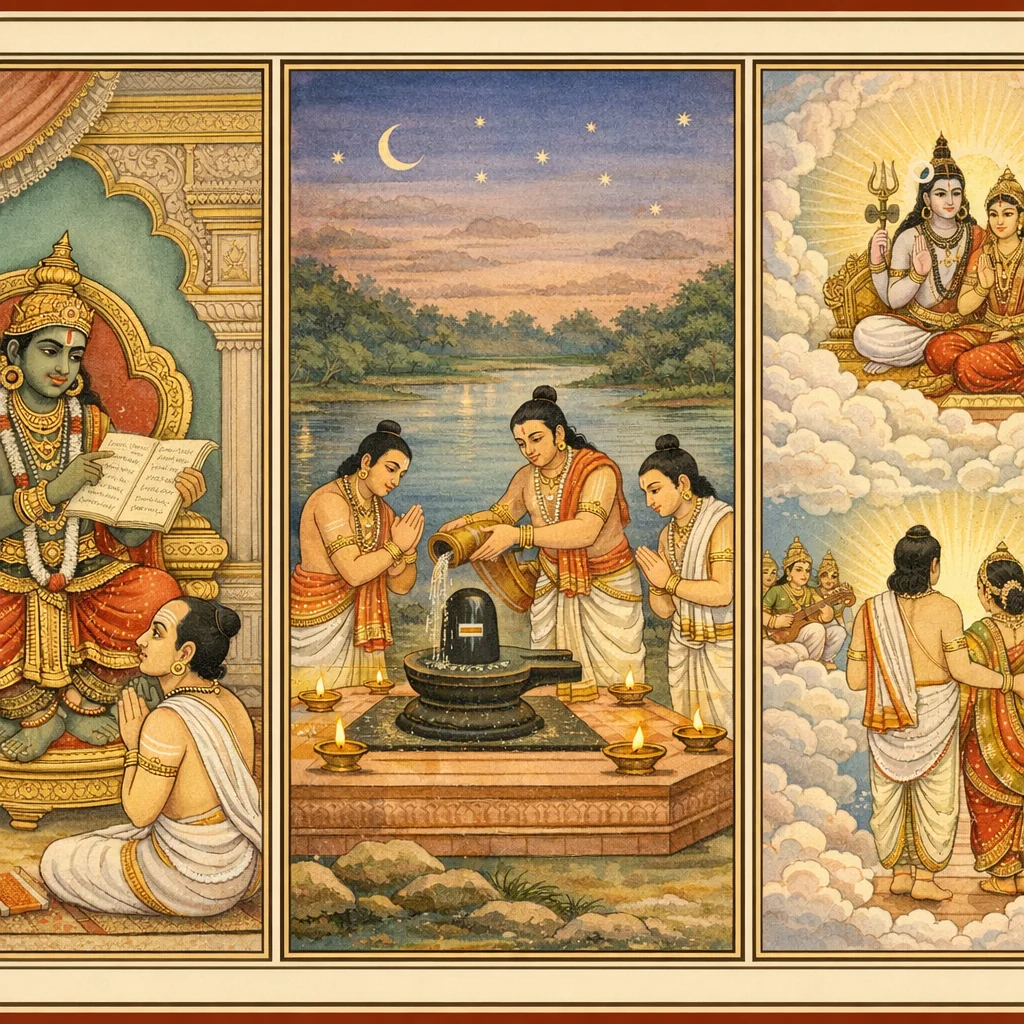
The chapter begins with Sūta’s narration and shifts to a south–north boundary setting. In Mathurā on the Yamunā, two eminent Brahmins named Gokarṇa appear; through an administrative order of Dharma-rāja Yama, a messenger mistakenly brings the wrong, long-lived Brahmin, prompting Yama’s correction and a discussion on impartial justice and the working of karmic results. A poverty-stricken Brahmin who longs for death questions Yama about fairness and the mechanics of consequence. At the Brahmin’s request, Yama sets out a taxonomy of hells: a prioritized list of twenty-one, including Vaitaraṇī, each linked with characteristic sins such as theft, betrayal, false testimony, and harming others. The teaching then turns from punitive geography to prescriptive dharma—guidance for pilgrimage, worship of deities and honoring guests, charity of food, water, and shelter, self-restraint, study, and public-benefit works like wells, tanks, and shrines as protective disciplines. Finally Yama reveals a “confidential” salvific instruction: devotion to Śiva in the Hāṭakeśvara kṣetra of the Ānarta region, even for a short time, is said to neutralize grave demerit and raise one to Śiva’s realm. The two Gokarṇas worship, install a liṅga at the boundary, perform tapas, and ascend to heaven; a night-vigil on the fourteenth lunar day is praised for granting fruits from progeny and wealth to mokṣa. The phalāśruti concludes that residence, farming, bathing, and even the death of animals within the kṣetra are spiritually beneficial, while those who act against the norm repeatedly fall from auspicious states.
Shlokas
Verse 1
। सूत उवाच । यत्पूर्वापरसीमान्तं तन्मया संप्रकीर्तितम् । दक्षिणोत्तरसंभूतं तद्वो वक्ष्यामि सांप्रतम्
Sūta said: “The eastern and western boundaries have been duly described by me. Now I shall tell you, as it stands, the extent and delineation toward the south and the north.”
Verse 2
अस्ति भूभितले ख्याता मधुराख्या महापुरी । नानाविप्रसमाकीर्णा यमुनातटसंश्रया
On the face of the earth there is a renowned great city called Madhurā, thronged with many brāhmaṇas and resting on the bank of the Yamunā.
Verse 3
तस्यामासीद्द्विजश्रेष्ठो गोकर्ण इति विश्रुतः । वेदाध्ययनसंपन्नः सर्वशास्त्रविचक्षणः
In that city lived an excellent brāhmaṇa, famed by the name Gokarṇa—accomplished in Vedic study and discerning in all the śāstras.
Verse 4
अथापरोऽस्ति तन्नामा तत्र विप्रो वयोऽन्वितः । सोऽपि च ब्राह्मणः श्रेष्ठः सर्वविद्यासु पारगः
Now, there was another brāhmaṇa there, bearing the same name, advanced in years; he too was an excellent brāhmaṇa, well-versed in every branch of knowledge.
Verse 5
कस्यचित्त्वथकालस्य यमः प्राह स्वकिंकरम् । ऊर्ध्वकेशं सुरक्ताक्षं कृष्णदन्तं भयानकम्
At a certain time, Yama spoke to his own servant—one with hair standing upright, eyes intensely red, teeth blackened, and a fearsome form.
Verse 6
अद्य गच्छ द्रुतं दूत मथुराख्यां महापुरीम् । आनयस्व द्विजश्रेष्ठं तस्यां गोकर्णसंज्ञकम्
“Go quickly today, O messenger, to the great city called Mathurā, and bring here the best of the Brahmins there, named Gokarṇa.”
Verse 7
तस्यायुषः क्षयो जातो मध्याह्नेऽद्यतने दिने । त्याज्योऽन्योऽस्ति च तत्रैव चिरायुस्तादृशो द्विजः
“His span of life has come to its end at midday on this very day. But there is another similar Brahmin there, long-lived—he must be left aside.”
Verse 8
सूत उवाच । अथ दूतो द्रुतं गत्वा तां पुरीं यमशासनात् । विभ्रमादानयामास गोकर्णं च चिरायुषम्
Sūta said: Then the messenger, going swiftly to that city by Yama’s command, brought back by mistake Gokarṇa, the long-lived one.
Verse 9
ततः कोपपरीतात्मा यमः प्रोवाच किंकरम् । दीर्घायुरेष आनीतो धिक्पाप किमिदं कृतम्
Then Yama, his mind overtaken by anger, said to the servant: “This one is long-lived—shame on you, O sinner! What is this that you have done?”
Verse 10
तस्मात्प्रापय तत्रैव यावदस्य च बन्धुभिः । नो गात्रं दह्यते शोकात्सुसमिद्धेन वह्निना
Therefore, send him back there at once—before his relatives, burning with grief, cremate his body in a well-kindled fire.
Verse 11
ब्राह्मण उवाच । नाहं तत्र गमिष्यामि दिष्ट्या प्राप्तोस्मि तेंऽतिकम् । वांछमानः सदा मृत्युं दारिद्र्येण कदर्थितः
The Brahmin said: “I will not go back there. By good fortune I have reached your presence. Crushed by poverty, I have always longed for death.”
Verse 12
यम उवाच । निमिषेणापि नो मर्त्यमानयामि महीतलात् । आयुःशेषेण विप्रेन्द्र पूर्णेनाथ त्यजामि न
Yama said: “I do not bring a mortal away from the surface of the earth even for a single instant. O best of brāhmaṇas, I do not cause anyone to depart until the remainder of his allotted lifespan has been completely fulfilled.”
Verse 13
तत एव हि मे नाम धर्मराज इति स्मृतम् । समत्वात्सर्वजंतूनां पक्षपातविवर्जनात्
“For that very reason I am remembered by the name Dharmarāja: because I am equal toward all beings and free from partiality.”
Verse 14
तस्माद्गच्छ गृहं विप्र यावद्गात्रं न दह्यते । बंधुभिस्तव शोकार्तैर्नाधुना तत्र ते स्थितिः
“Therefore, O brāhmaṇa, go to your home while your body has not yet been burned. Your relatives are afflicted with grief; this is not the time for you to remain there.”
Verse 15
प्रार्थयस्व मनोऽभीष्टं वरं ब्राह्मणसत्तम । न वृथा दर्शनं मे स्यात्कथंचिदपि देहिनाम्
Ask for the boon your heart desires, O best of brāhmaṇas. Let my appearance never be fruitless for embodied beings, in any circumstance.
Verse 16
ब्राह्मण उवाच । अवश्यं यदि गंतव्यं मया देव गृहं पुनः । तन्ममाचक्ष्व पृच्छामि वरश्चैष भवेन्मम
The brāhmaṇa said: “If I must surely return again to my home, O Lord, then tell me—this is what I ask. Let this itself be my boon.”
Verse 17
एते ये नरका रौद्राः सेविताः पापकर्मभिः । दृश्यंते वद कः केन कर्मणा सेव्यते जनैः
“These dreadful hells, brought about by sinful deeds, are seen here. Tell me: who is made to experience which hell, and by what action?”
Verse 18
यम उवाच । असंख्या नरका विप्र यथा प्राणिगणाः क्षितौ । कृत्स्नशः कथितुं शक्या नैववर्षशतैरपि
Yama said: “The hells are countless, O brāhmaṇa, just as living beings upon the earth are countless. They cannot be fully described even in hundreds of years.”
Verse 19
कीर्तयिष्यामि तेषां ते प्राधान्येन द्विजोत्तम । एकविंशतिसंख्या ये पापिलोककृते कृताः
“I shall recount to you, O best of the twice-born, the principal ones among them—twenty-one in number—established for the world of sinners.”
Verse 20
आद्योऽयं रौरवो नाम नरको द्विजसत्तम । प्रतप्ततैलकुंभेषु पच्यंते यत्र जंतवः
The first is the hell called Raurava, O best of brāhmaṇas. There, beings are cooked in great cauldrons filled with searing, blazing oil.
Verse 21
हा मातस्तात पुत्रेति प्रकुर्वंति सुदारुणम् । परपाकरताः क्षुद्राः परद्रव्या पहारकाः
Crying, “O mother! O father! O son!”, they wail in most dreadful misery—those petty-minded ones who delight in harming others and who steal the wealth of others.
Verse 22
द्वितीय एष विप्रेंद्र महारौरवसंज्ञितः । कृतघ्नैः सेव्यते नित्यं तथा च गुरुतल्पगैः
O best of brāhmaṇas, this is the second hell, known as Mahāraurava. It is ever the abode of the ungrateful, and likewise of those who violate their guru’s bed.
Verse 23
रोरूयमाणैर्दाहार्तैः पच्यमानै र्हविर्भुजा । खंडशः क्रियमाणैश्च तीक्ष्णशस्त्रैरनेकधा
There they wail aloud, tormented by burning, being ‘cooked’ by the devourer of offerings—fire (Agni); and they are cut into pieces in many ways by sharp weapons.
Verse 24
तृतीयोंऽधतमोनाम नरकः सुभयावहः । अत्र ये पुरुषा यांति तांश्च वक्ष्यामि सुद्विज
The third hell is called Andhatamas, exceedingly dreadful. O good brāhmaṇa, I shall tell you which men go there.
Verse 26
चतुर्थोऽयं प्रतप्ताख्यो नरकः संप्रकीर्तितः । अत्र ते यातनां भुक्त्वा तथा शुद्धा भवंति च
This fourth hell is proclaimed as Pratāpta, “the Scorched.” After enduring torment there, they too are purified, for that karma is exhausted.
Verse 27
यैः कृता सततं निंदा गुरुदेवतपस्वि नाम् । तेषामुत्पाट्यते जिह्वा जाताजाताऽत्र भूरिशः
Those who constantly slandered gurus, deities, and ascetics—here their tongues are torn out, again and again, many times over.
Verse 28
एषोऽन्यः पंचमो नाम सुप्रसिद्धो विदारकः । मित्रद्रोहरताश्चात्र च्छिद्यंते करपत्रकैः
This other realm is the fifth hell, famed as Vidāraka, “the Rending.” Here, those devoted to betraying friends are cut apart by “hand-leaf” blades.
Verse 29
दुष्टेन चक्षुषा दृष्टाः परदारा नराधमैः । सुलोहास्याः खगास्तेषां हरंत्यत्र विलोचने
Vile men who cast a wicked gaze upon another’s wife—here, birds with iron beaks seize and tear away their eyes.
Verse 30
प्राणांतिकं पुरा दत्तं यैर्दुःखं प्राणिनां नरैः । अपराधं विना तेऽत्र पच्यंते वालुकोत्करैः
Those men who once inflicted life-threatening suffering upon living beings without any offense on their part—here they are “cooked” upon heaps of burning hot sand.
Verse 31
बीभत्सुरिति विख्यातः सप्तमो नरकाधमः । मूत्रामेध्य समाकीर्णः समंतादतिगर्हितः
The seventh, the most vile of hells, is renowned as Bībhatsu. It is filled with urine and filth, utterly loathsome on every side.
Verse 32
राजगामि च पैशुन्यं यैः कृतं सुदुरात्मभिः । अमेध्यपूर्णवक्त्रास्ते धार्यंतेऽत्र नराधमाः
Those utterly wicked men who practiced tale-bearing that reaches the king—court-informing slander—are kept here, those low persons, with mouths filled with filth.
Verse 33
कुत्सितोनाम विख्यातो द्विजायं चाष्टमोऽधमः । श्लेष्ममूत्राभिसंपूर्णैस्तथा गन्धैश्च कुत्सितैः
O best of Brāhmaṇas, the eighth vile hell is renowned as Kutsita. It is filled with phlegm and urine, and it reeks with foul, degrading stench.
Verse 34
गुरुदेवातिथिभ्यश्च स्वभृत्येभ्यो विशेषतः । अदत्त्वा भोजनं यैस्तु कृतं तेऽत्र व्यवस्थिताः
Those who, without giving food to their guru, to the gods, to guests, and especially to their own dependents and servants, ate for themselves, are stationed here to suffer.
Verse 35
एष दुर्गमनामा च नवमो द्विजसत्तम । तीक्ष्णकंटकसंकीर्णः सर्पवृश्चिकसंकुलः
O best of Brāhmaṇas, this ninth one is called Durgama. It is strewn with sharp thorns and swarming with snakes and scorpions.
Verse 36
एकसार्थप्रयाताय क्षुत्क्षामायावसीदते । अदत्त्वा भोजनं यैश्च कृतं तेऽत्र व्यवस्थिताः
Those who failed to give food to a traveler journeying with a caravan, weakened and collapsing from hunger, are made to remain here (in this hell).
Verse 37
दशमोऽयं सुविख्यातो नरको नामदुः सहः । तप्तलोहमयैः स्तंभैः समंतात्परिवारितः
This tenth hell is well known by the name Duḥsaha. It is enclosed on all sides by pillars made of red-hot iron.
Verse 38
ये पापाः परदारेषु रक्ता मिष्टामिषेषु वा । तप्तलोहमयान्स्तंभांस्तेऽत्रालिंगंति मानवाः
The sinful who are addicted to others’ wives, or who are attached to sweet delicacies and meat, here are forced to embrace pillars of red-hot iron.
Verse 39
एकादशोऽपरश्चायमाकर्षाख्यः प्रकीर्तितः । नरको विप्रशार्दूल तप्तसंदंशसंकुलः
O tiger among Brāhmaṇas, this other—the eleventh—hell is proclaimed as Ākarṣa. It is crowded with red-hot tongs and pincers.
Verse 40
स्त्रीविप्रगुरुदेवानां वित्तं चाश्नंति ये नराः । संदंशैरपि कृष्यंते तत्र तप्तैः समंततः
Those men who consume or seize the wealth of women, Brāhmaṇas, gurus, or the gods are dragged there on every side with red-hot tongs.
Verse 41
संदंशो द्वादशश्चायं तथाऽभक्ष्यप्रभक्षकाः । लोहदंतमुखैर्गृधैर्भक्ष्यंतेऽत्र नराधमाः
This twelfth hell is Saṃdaṃśa. Here, those base men who eat what should not be eaten are devoured by vultures whose beaks and teeth are of iron.
Verse 42
एष त्रयोदशोनाम सुविख्यातो नियंत्रकः । समंतात्कृमिभिर्व्याप्तस्तथा च दृढबन्धनैः
This thirteenth hell is well known as Niyaṃtraka. It is pervaded on every side by worms, and also by tight, unyielding bonds.
Verse 43
न्यासापहारकाः पापास्तत्र बद्धाश्च बंधनैः । कृमिवृश्चिक कीटाद्यैर्भक्ष्यते द्विजसत्तम
O best of the twice-born, those sinners who steal what has been entrusted are bound there in fetters, and are devoured by worms, scorpions, and other stinging insects.
Verse 44
तथा चतुर्दशोनाम नरकोऽधोमुखः स्थितः । नरकाणां समस्तानामेष रौद्रतमाकृतिः
Likewise, the fourteenth is the hell called ‘Adhomukha’ (Face-Down), where one is kept inverted. Among all the hells, this one is of the most terrifying form.
Verse 45
अत्र चाधोमुखा बद्धा वृक्षशाखावलंबिताः । पच्यंते वह्निनाऽधस्ताद्ब्रह्मघ्ना ये च मानवाः
Here, kept face-down and bound, hanging from the branches of trees, those humans who are slayers of a brāhmaṇa are cooked by fire from below.
Verse 46
यूकामत्कुणदंशाद्यैः संकीर्णोऽयं द्विजोत्तम । नरको भीषणो नाम ख्यातः पञ्चदशो महान्
O best of the twice-born, this region teems with lice, bedbugs, gnats, and the like. This great hell is famed as the fifteenth, bearing the name “Bhīṣaṇa” (Terrifying).
Verse 47
कूटसाक्ष्यरतानां च तथैवानृतवादिनाम् । अत्राश्रयो मया दत्तस्तथान्येषां कुकर्मिणाम्
Here I have assigned a place of confinement for those devoted to false testimony and for habitual liars—indeed, for other evil-doers as well.
Verse 49
एष षोडश उद्दिष्टो नरको नाम क्षुद्रदः । युधार्तैर्मानवैर्व्याप्तः समंताद्द्विजसत्तम
O best of the twice-born, this is declared as the sixteenth hell, called “Kṣudrada”. It is filled on every side with men tormented by battle.
Verse 50
तथा सप्तदशश्चायं क्षाराख्यो नरकः स्मृतः । सुक्षारेण समाकीर्णः सर्वप्राणिभयावहः
Likewise, this is remembered as the seventeenth hell, called “Kṣāra” (Caustic Alkali). It is strewn with sharp, burning alkali and brings terror to all embodied beings.
Verse 51
व्रतभंगकरा ये च ये च पाषण्डिनो नराः । तेऽत्रागत्य शितैः शस्त्रैः पिष्यंते पापकृत्तमाः
Those who break sacred vows (vrata), and those men who follow heretical, dharma-destroying paths—coming here, those worst of sinners are crushed by sharp weapons.
Verse 52
एष चाष्टादशो नाम कथितश्च निदाघकः । ज्वलितांगारसंकीर्णो दुःसेव्यः सर्वदेहिनाम्
This is declared the eighteenth, named “Nidāghaka” (Scorching Heat). It is strewn with blazing embers and is unbearable for all embodied beings.
Verse 53
दूषयंति च ये शास्त्रं काव्यं विप्रं च कन्यकाम् । अंगारांतः स्थितातेऽत्र ध्रियंते मानवा द्विज
O twice-born, those who defile sacred teaching, refined poetry, a brāhmaṇa, and a maiden—those men are held here, set within burning embers.
Verse 54
एकोनविंशतिश्चायं प्रख्यातः कूटशाल्मलिः । सुतीक्ष्णकंटकाकीर्णः समंताद्द्विजसत्तम ।ा
O best of the twice-born, this is the nineteenth, famed as Kūṭaśālmali—filled on all sides with exceedingly sharp thorns.
Verse 56
एष विंशतिमो नाम नरको द्विजसत्तम । असिपत्रवनाख्यश्च कष्टसेव्यो दुरात्मभिः
O best of the twice-born, this is the twentieth hell, called Asipatravana—an ordeal hard to endure, fit only for the wicked to experience.
Verse 57
अत्र यांति नरा विप्र पररंध्रनिरीक्षकाः । कूटकर्मरता ये च शास्त्रविक्रयकारकाः
O Brāhmaṇa, here come those who spy on others’ faults, who delight in deceitful acts, and those who make a trade of sacred scriptures.
Verse 58
एकविंशतिमा चैषा नाम्ना वैतरणी नदी । सर्वैरेव नरैर्गम्या धर्मपापानुयायिभिः
This is the twenty-first: the river named Vaitaraṇī, which all people must approach, whether they have followed dharma or pursued sin.
Verse 59
मृत्युकाले समुत्पन्ने धेनुं यच्छंति ये नराः । तस्या लांगूलमाश्रित्य तारयंति सुखेन च
When the time of death has arrived, those who give a milch-cow—taking hold of that cow’s tail—are carried across with ease.
Verse 60
अदत्त्वा गां च ये मर्त्या म्रियंते द्विजसत्तम । तीर्त्वा हस्तादिभिर्दुर्गा त इमां संतरंति च
O best of the twice-born, those mortals who die without having given a cow cross this difficult river by their own hands and the like—struggling to make it across.
Verse 61
एतत्ते सर्वमाख्यातं यत्पृष्टोऽस्मि द्विजोत्तम । विस्तरेण तव प्रीत्या स्वरूपं नरकोद्भवम्
O best of the twice-born, I have told you everything you asked; out of affection for you, I have described in detail the nature of these hell-born torments.
Verse 62
तस्माद्गच्छ गृहं शीघ्रं यावद्गात्रं न दह्यते । बन्धुभिस्तव शोकार्तैर्गृहीत्वा वांछितं धनम्
Therefore go quickly to your home, before your body is burned; your grief-stricken relatives will take up the wealth you desire.
Verse 63
ब्राह्मण उवाच । यदि देव मया सम्यग्गंतव्यं निजमंदिरम् । तद्ब्रूहि कर्मणा येन नरकं याति नो नरः
The Brāhmaṇa said: “If, O Lord, I am truly to return properly to my own dwelling, then tell me—by what conduct does a man not go to hell?”
Verse 64
यम उवाच । तीर्थयात्रापरो नित्यं देवतातिथिपूजकः । ब्रह्मण्यश्च शरण्यश्च न याति नरकं नरः
Yama said: “One who is ever devoted to pilgrimage to the tīrthas, who worships the deities and honors guests, who is devoted to Brahman and the Brāhmaṇas and is a refuge to others—such a man does not go to hell.”
Verse 65
परोपकारसंयुक्तो नित्यं जपपरायणः । स्वाध्यायनिरतश्चैव न याति नरकं द्विज
O Brāhmaṇa, one who is devoted to helping others, steadfast in daily japa, and continually engaged in svādhyāya (sacred study) does not go to hell.
Verse 66
वापीकूपतडागानि देवतायतनानि च । यः करोति नरो नित्यं नरकं न स पश्यति
One who regularly builds wells, stepwells, and ponds, and also constructs temples for the deities—such a person does not behold hell.
Verse 67
हेमंते वह्निदो यः स्यात्तथा ग्रीष्मे जलप्रदः । वर्षास्वाश्रयदो यश्च नरकं न स पश्यति
One who gives fire (warmth) in winter, offers water in the heat of summer, and provides shelter during the rains—such a person does not see hell.
Verse 68
व्रतोपवाससंयुक्तः शांतात्मा विजितेंद्रियः । ब्रह्मचारी सदा ध्यानी नरकं याति नो नरः
One devoted to vows and fasting, serene in mind, master of the senses, abiding in brahmacarya and ever meditative—such a person does not go to hell.
Verse 69
अन्नप्रदो नरो यः स्याद्विशेषेण तिलप्रदः । अहिंसानिरतश्चैव नरकं न स पश्यति
One who gives food—especially one who gives sesame in charity—and who is devoted to ahiṃsā, does not see hell.
Verse 70
वेदाध्ययनसंपन्नः शास्त्रासक्तः सुमृष्टवाक् । धर्माख्यानपरो नित्यं नरकं न स पश्यति
One accomplished in Vedic study, devoted to the śāstras, refined in speech, and constantly engaged in narrating and teaching dharma—such a person does not see hell.
Verse 71
ब्राह्मण उवाच । एतन्मूर्खोऽपि जानाति शुभकर्मकरः पुमान् । न याति नरकं स्वर्गे तथा पापक्रियारतः
The Brāhmaṇa said: Even a fool understands this—one who performs auspicious deeds does not go to hell but to heaven; likewise, one intent on sinful acts meets the opposite.
Verse 72
तस्मादशुभकर्मापि कर्मणा येन पातकम् । स्वल्पेनापि निहन्त्याशु याति स्वर्गं नरस्ततः
Therefore, even one stained by inauspicious deeds—if by some act he quickly destroys sin, even with a small effort—then that person goes to heaven.
Verse 73
तन्मेब्रूहि सुरश्रेष्ठ व्रतं नियममेव वा । तीर्थं वा जपहोमं वा सर्वलोकसुखावहम्
Tell me, O best among the gods, of a sacred vow or a discipline—or of a holy tīrtha, or of japa and homa—that brings well-being and happiness to all the worlds.
Verse 74
यम उवाच । अत्र ते सुमहद्गुह्यं कीर्तयिष्ये द्विजोत्तध । गोपनीयं प्रयत्नेन वचनान्मम सर्वदा
Yama said: Here I shall proclaim to you, O best of the twice-born, a very great secret. Guard my words with care, and always keep this teaching protected.
Verse 75
महापातकयुक्तोऽपि पुरुषो येन कर्मणा । अनुष्ठितेन नो याति नरकं क्लेशकारकम्
Even a man burdened with the gravest sins—by performing that prescribed act—does not go to the torment-bringing hell.
Verse 76
आनर्तविषये रम्यं सर्वतीर्थमयं शुभम् । हाटकेश्वरजं क्षेत्रं महापातकनाशनम्
In the delightful land of Ānarta there is an auspicious sacred region born of Hāṭakeśvara, imbued with the power of all tīrthas, a destroyer even of great sins.
Verse 77
तत्रैकमपि मासार्धं यो भक्त्या पूजयेद्धरम् । स सर्वपापयुक्तोऽपि शिवलोके महीयते
Whoever, in that place, worships the Lord with devotion even for half a month—though laden with every sin—becomes honored in Śiva’s world.
Verse 78
तस्मात्तत्र द्रुतं गत्वा त्वमाराधय शंकरम् । येन गच्छसि निर्वाणं दशभिः पुरुषैः सह
Therefore, go there swiftly and worship Śaṅkara; by this you shall attain liberation, together with ten men.
Verse 79
सूत उवाच । उपदेशं समाकर्ण्य स यदा प्रस्थितो गृहम् । धर्मराजस्य संहष्टो मधुरां नगरीं प्रति
Sūta said: Having heard the instruction, when he set out for home, by Dharmarāja’s command he was sent toward the city of Madhurā.
Verse 80
तावद्द्वितीयं गो कर्णं दूत आदाय संगतः । दर्शयामास धृत्वाग्रे धर्मराजस्य सत्वरम्
Just then, the messenger arrived with the second Gokarṇa and swiftly presented him before Dharmarāja.
Verse 81
ततः प्रोवाच तं दूतं धर्मराजः प्रहर्षितः । गोकर्णं पुरतो दृष्ट्वा द्वितीयं प्रस्थितं गृहम्
Then Dharmarāja, delighted to see the second Gokarṇa standing before him, spoke to that messenger who had set out.
Verse 82
यस्मात्कालात्ययं कृत्वाऽनीतोऽयं ब्राह्मणस्त्वया । तस्मादेनमपि क्षिप्रं द्वितीयेन समं त्यज
Since you brought this brāhmaṇa only after letting the proper time lapse, therefore release him too at once, making him equal to the second.
Verse 83
ततस्तौ तत्क्षणान्मुक्तौ गोकर्णौ ब्राह्मणौ समम् । स्वंस्वं कलेवरं प्राप्य सहसाथ समन्वितौ
Then, in that very moment, both brāhmaṇas named Gokarṇa were released together; each regained his own body and was at once restored, whole and complete.
Verse 84
ततः स कथयामास गोकर्णः प्रथमो द्विजः । यमोपदेशसंजुष्टो द्वितीयाय सविस्तरम्
Then the first brāhmaṇa, Gokarṇa—enriched by Yama’s instruction—explained everything in detail to the second.
Verse 85
ततो गृहं परित्यज्य गोकर्णौ द्वावपि स्थितौ । देवतायतनैर्व्याप्तं क्षेत्रं दृष्ट्वाऽखिलं ततः
Then, abandoning their home, the two known as Gokarṇa stayed there. Beholding that entire sacred region, pervaded with shrines of the gods, they understood its sanctity.
Verse 86
लिंगे संस्थापिते ताभ्यां सीमांते दक्षिणोत्तरे । हाटकेश्वरजं क्षेत्रं संप्राप्य तपसि द्रुतम्
After the two had installed a liṅga at the boundary, at the southern and northern limit, they reached the sacred region connected with Hāṭakeśvara and swiftly engaged in austerity.
Verse 87
ततः शिवं समाराध्य तपः कृत्वा यथोचितम् । सशरीरौ दिवं प्राप्तौ तत्प्रभावाद्विजोत्तमाः
Thereafter, having duly worshipped Śiva and performed austerities as prescribed, those excellent twice-born attained heaven with their very bodies—by the power of that sacred region and worship.
Verse 88
ताभ्यां मार्गचतुर्दश्यां कृष्णायां जागरः कृतः । यः करोति नरो भक्त्या स गच्छति शिवालयम्
On the fourteenth day of the dark fortnight in Mārgaśīrṣa, they kept a night-vigil. Whoever performs such a vigil with devotion goes to Śiva’s abode.
Verse 89
अपुत्रो लभते पुत्रान्धनार्थी धनमाप्नुयात् । निष्कामस्तु पुनर्मोक्षं नरो याति न संशयः
The childless obtains sons; the seeker of wealth gains wealth. But the desireless person attains liberation (mokṣa)—of this there is no doubt.
Verse 90
सूत उवाच । एतद्वः सर्वमाख्यातं सीमांतं द्विजसत्तमाः । क्षेत्रस्यास्य प्रमाणं च विस्तरेण चतुर्दिशम्
Sūta said: “O best of the twice-born, I have fully told you the boundary-limits, and also, in detail, the extent of this sacred region in all four directions.”
Verse 91
अत्रांतरे नरा ये च निवसंति द्विजोत्तमाः । कृषिकर्मोद्यताश्चापि यांति ते परमां गतिम् । किं पुनर्नियतात्मानः शांता दांता जितेंद्रियाः
O best of the twice-born, even those who dwell within this region—though intent only on their farming work—attain the highest state. How much more so those who are self-controlled, peaceful, disciplined, and masters of their senses!
Verse 92
अपि कीटपतंगा ये पशवः पक्षिणो मृगाः । तस्मिन्क्षेत्रे मृता यांति स्वर्गलोकं न संशयः
Even insects and moths, cattle, birds, and wild animals—if they die in that sacred region—go to the heavenly world, without doubt.
Verse 93
किं पुनर्ये नरास्तत्र कृत्वा प्रायोपवेशनम् । संन्यस्ताः श्रद्धयोपेता हृदयस्थे जनार्दने
How much more blessed are those who, there, undertake prāyopaveśana (fasting unto death), having renounced all, endowed with faith, with Janārdana abiding in their hearts.
Verse 94
तस्मात्सर्व प्रयत्नेन तत्क्षेत्रं सेव्यमेव हि । विशेषेण कलौ प्राप्ते युगे पापसमावृते
Therefore, with every effort, that sacred region should indeed be visited and served—especially now that the age of Kali has arrived, an era enveloped in sin.
Verse 95
नास्तिका भिन्नमर्यादा ये च विप्रस्य घातकाः । ते सर्वेऽत्र नरा नित्यमारुहंति पतंति च
Unbelievers, those who transgress the bounds of dharma, and those who harm a Brāhmaṇa—such people, in this very place, continually rise and fall, suffering repeated downfall.
Verse 96
वापीकूपतडागेषु यत्रयत्र जलं द्विजाः । तत्रतत्र नरः स्नातः सर्वपापैः प्रमुच्यते
O twice-born ones, wherever there is water—whether in stepwells, wells, or ponds—whoever bathes there is released from all sins.
Verse 97
किं य्रज्ञैः किं वृथा दानैः क व्रतैः किं जपैरपि । वरं तत्र कृतो वासः क्षेत्रे स्वर्गमभीप्सुभिः
What need is there of sacrifices? What use are charities done in vain? What of vows, and even recitations? Better is residence there in that sacred field for those who desire heaven.
Verse 98
एतत्पवित्रमायुष्यं मांगल्यं पापनाशनम् । हाटकेश्वरजक्षेत्रमाहात्म्यं शृण्वतां सदा
This account is purifying, life-prolonging, auspicious, and a destroyer of sin—for those who ever listen to the greatness of Hāṭakeśvara’s sacred kṣetra.