Adhyaya 151
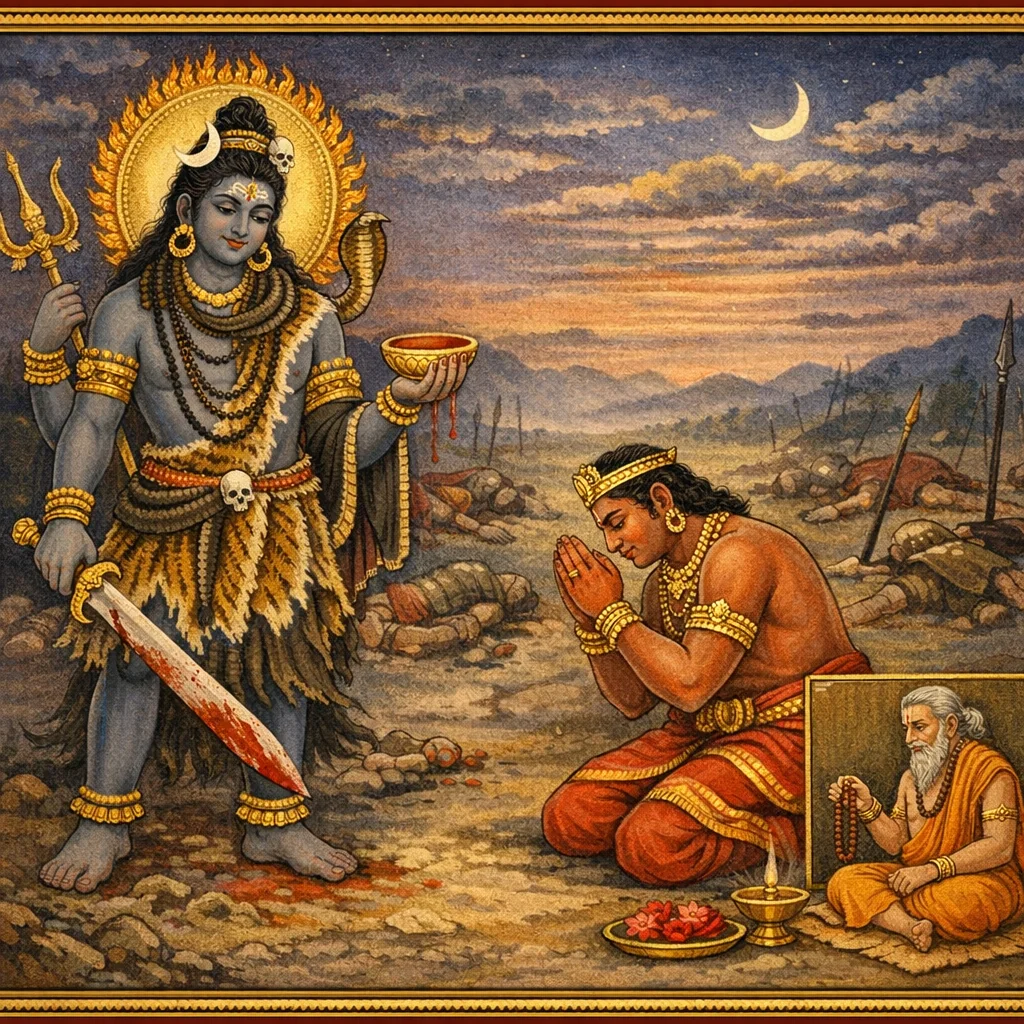
This chapter unfolds a twofold theological narrative. Andhaka, swollen with newly gained power, sends a messenger to Kailāsa with a coercive demand toward Śiva. Śiva dispatches foremost gaṇas—Vīrabhadra, Mahākāla, Nandin and others—yet they are first driven back, and Śiva himself enters the battle. When ordinary weapons fail to decide the contest, the fight turns to close combat; Andhaka briefly overpowers Śiva, but Śiva regains his divine mastery, subdues him with celestial force, and impales him upon the tip of the trident. From that trident-point Andhaka offers a long hymn of praise (stuti), shifting from foe to repentant devotee. Śiva does not grant him death; instead he purifies Andhaka of the asuric disposition and admits him to gaṇa-status. Andhaka then seeks a saving ordinance: whoever installs and worships Śiva in that very iconic form—Śiva as Bhairava with Andhaka’s body pierced upon the trident—shall attain liberation; Śiva assents. The second part turns to a royal exemplum. King Suratha, deprived of his kingdom, approaches Vasiṣṭha and is directed to Hāṭakeśvara-kṣetra, praised as bestowing siddhi. There Suratha installs Mahādeva in Bhairava form with the Andhaka-on-trident iconography and performs worship with the Nārasiṃha-mantra, red offerings, and strict purity. Upon completing the prescribed mantra count, Bhairava grants his boon: restoration of the kingdom, along with a general promise of accomplishment for all worshippers who follow the same rite. Thus the chapter binds mythic transformation, icon-installation, mantra-upāsanā, and the ethics of purity into a single place-centered religious program.
Shlokas
Verse 1
सूत उवाच । अन्धकोऽपि परां विद्यां ज्ञात्वा शुक्रार्जितां तदा । केलीश्वर्याः प्रसादं च भक्तिजं बलवृद्धिदम्
Sūta said: Then Andhaka too, having learned the supreme occult knowledge obtained through Śukra, and having received the grace of Kelīśvarī—born of devotion and granting increase of strength—(became empowered).
Verse 2
अवध्यतामात्मनश्च पितामहवरोद्भवम् । महेश्वरं समुद्दिश्य कोपं चक्रे ततः परम्
Thereafter, having (come to believe in) his own invincibility—arising from the boon of the Grandfather (Brahmā)—he directed his wrath toward Maheśvara, and then became exceedingly enraged.
Verse 3
दूतं च प्रेषयामास कैलासं पर्वतं प्रति । गच्छ दूत हरं ब्रूहि मम वाक्येन सांप्रतम्
He sent a messenger toward Mount Kailāsa, saying: “Go, messenger—now tell Hara (Śiva) these words of mine.”
Verse 4
शक्रमेनं परित्यज्य सुखं तिष्ठात्र पर्वते । नो चेद्द्रुतं समागत्य सकैलासं सभार्यकम्
“Abandon this Indra (Śakra) and dwell here happily upon the mountain. Otherwise, quickly come—together with Kailāsa and along with your consort.”
Verse 5
सगणं च रणे हत्वा सुखी स्थास्यामि नंदने । त्वामहं नाशयिष्यामि सत्येनात्मानमालभे
“And having slain you along with your gaṇas in battle, I shall dwell happily in Nandana. I will destroy you—by this truth I pledge my very self.”
Verse 6
एवमुक्तः स दैत्येन दूतो गत्वा द्रुतं ततः । प्रोवाच शंकरं वाक्यैः परुषैः स विशेषतः
Thus instructed by the demon, the messenger went swiftly and then spoke to Śaṅkara, conveying those words—harsh, and especially insolent.
Verse 7
ततः कोपपरीतात्मा भगवान्वृषभध्वजः । गणान्संप्रेषयामास वधार्थं तस्य दुर्मतेः
Then the Blessed Lord, the Bull-bannered One (Śiva), his mind encompassed by righteous wrath, dispatched his gaṇas to slay that evil-minded one.
Verse 8
वीरभद्रं महाकालं नंदिं हस्तिमुखं तथा । अघोरं घोरनादं च घोरघंटं महाबलम्
He summoned Vīrabhadra, Mahākāla, Nandin, and Hastimukha, as well as Aghora, Ghoranāda, and the mighty Ghoraghaṇṭa—powerful attendants of Śiva fit for dreadful battle.
Verse 9
एतेषामनुगाश्चान्ये कोटिरेका पृथक्पृथक् । सर्वान्संप्रेषयामास वधार्थं तस्य दुर्मतेः
And besides these, other followers—each in separate companies numbering a crore—were dispatched, all sent forth for the destruction of that wicked-minded one.
Verse 10
अथ संप्रेषितास्तेन गणास्ते विकृताननाः । हर्षेण महताविष्टा गर्जमाना यथा घनाः
Then those gaṇas, grotesque-faced and dispatched by him, surged forward—filled with great exhilaration—roaring like thunderclouds.
Verse 11
धृतायुधा गताः सर्वे युद्धार्थं यत्र सा पुरी । शक्रस्यासादिता तेन दानवेन बलीयसा
All of them, bearing weapons, went to that city for battle—the very city that had been assailed by that mighty Dānava, the foe of Śakra (Indra).
Verse 12
अथ प्राप्तान्गणान्दृष्ट्वा दानवास्ते धृतायुधाः । निश्चक्रमुर्वै सहसा युद्धार्थमतिगर्विताः
Seeing the gaṇas arrive, those armed Dānavas—swollen with pride—suddenly rushed out for battle.
Verse 13
ततः समभवद्युद्धं गणानां दानवैः सह । परस्परं महारौद्रं मृत्युं कृत्वा निवर्तनम्
Then a battle arose between the gaṇas and the Dānavas—terrible on both sides—where each made death the price of turning back.
Verse 14
ततो हरगणाः सर्वे दानवैस्तै रणाजिरे । जिता जग्मुर्दिशो भीता हरवीक्षणतत्पराः
Then all the gaṇas of Hara (Śiva), defeated by those Dānavas on the battlefield, fled in fear to every quarter, intent on beholding Hara and finding refuge.
Verse 15
हरोऽपि तान्गणान्भग्नान्दृष्ट्वा कोपाद्विनिर्ययौ । हरं दृष्ट्वा ततो दैत्या दुद्द्रुवुस्ते दिशो दश
Hara (Śiva) too, seeing his gaṇas broken, came forth in wrath; and upon beholding Hara, the Daityas fled in panic to all ten directions.
Verse 16
अन्धकोऽपि हरं दृष्ट्वा युद्धार्थं संमुखो ययौ । ततो युद्धं समभवदंधकस्य हरेण तु । वृत्रवासवयोः पूर्वं यथा युद्धमभून्महत्
Andhaka too, seeing Hara, advanced straight toward him for battle. Then a great war arose between Andhaka and Hara—like the mighty combat that once took place between Vṛtra and Vāsava (Indra).
Verse 17
चक्रनालीकनाराचैस्तोमरैः खड्गमुद्गरैः । एवं न शक्यते हंतुं दानवो विविधायुधैः
With discus, arrows, iron darts, swords, and maces—though struck by many kinds of weapons—the Dānava could not be slain in this manner.
Verse 18
अस्त्रयुद्धं परित्यज्य बाहु युद्धमुपागतौ । करं करेण संगृह्य मुष्टिप्रहरणौ तदा
Abandoning the combat with weapons, the two closed in for hand-to-hand fighting. Grasping hand with hand, they then struck one another with their fists.
Verse 19
दानवेनाथ देवेशो बंधेनाक्रम्य पीडितः । निष्पंदभावमापन्नस्ततो मूर्च्छामुपागतः
Then the Lord of the gods was pressed and tormented by the Dānava, who overpowered him with a binding. Becoming motionless, he thereupon fell into a swoon.
Verse 20
मूर्छागतं तु तज्ज्ञात्वा ह्यन्धको निर्ययौ गृहात् । तावत्स्थाणुः क्षणाल्लब्ध्वा चेतनामात्तकार्मुकः
Knowing that he had fallen into a swoon, Andhaka came out from his dwelling. Meanwhile, Sthāṇu regained consciousness in a moment and took up his bow.
Verse 21
आयसीं लकुटीं गृह्य प्रभुर्भारसहसि काम् । दानवेन्द्रं ततः प्राप्य ताडयामास मूर्धनि
Taking up a mighty, heavy iron club, the Lord reached the king of the Dānavas and struck him upon the head.
Verse 22
सोऽपि खड्गेन देवेशं ताडयामास वेगतः । अथ देवोऽपि सस्मार कौबेरास्त्रं महाहवे
He too swiftly struck the Lord of the gods with a sword. Then, in that great battle, the God invoked the Kaubera weapon.
Verse 23
अस्त्रेण तेन हृदये ताडयामास दानवम् । ततः स ताडितस्तेन रुधिरोद्गारमुद्वमन्
With that weapon he struck the Dānava in the heart. Struck by it, the demon vomited forth a gush of blood.
Verse 24
पतितोऽधोमुखो भूत्वा ततः शूलेन भेदितः । शूलाग्रसंस्थितः पापश्चक्रवद्भ्रमते ततः
Falling face-down, he was then pierced by the trident. Fixed upon the trident’s point, that sinner thereafter whirled around like a wheel.
Verse 25
अन्धकोऽपि तदात्मानं तथावस्थमवेक्ष्य च । ततो वाग्भिः सुपुष्टाभिरस्तौद्देवं महेश्वरम्
Andhaka too, seeing himself in that condition, then praised the God Maheśvara with well-composed and powerful words.
Verse 26
अन्धक उवाच । नमस्ते जगतां धात्रे शर्वाय त्रिगुणात्मने । वृषभासनसंस्थाय शशांककृतभूषण
Andhaka said: Salutations to You, the Sustainer of the worlds—Śarva, whose being pervades the three guṇas; enthroned upon the bull Vṛṣabha, and wearing the moon as an ornament.
Verse 27
नमः खट्वांगहस्ताय नमः शूलधराय च । नमो डमरुकोदण्डकपालानलधारिणे
Salutations to the One who holds the khaṭvāṅga; salutations to the bearer of the trident; salutations to Him who bears the ḍamaru, the staff, the skull, and the fire.
Verse 28
स्मरदेहविनाशाय मूर्त्यष्टकमयात्मने । नमः स्वरूपदेहाय ह्यरूपबहुरू पिणे
Salutations to the One who annihilated the body of Smara (Kāma), whose very Self is the eightfold embodiment of the cosmic forms; salutations to Him whose body is pure essential reality—yet who, being formless, appears in countless forms.
Verse 29
उत्तमांगविनाशाय विरिंचेः सृष्टिकारिणे । स्मशानवासिने नित्यं नमो भैरवरूपिणे
Everlasting salutations to the Lord in the form of Bhairava—destroyer of the “highest head” (the summit of pride), the cause behind the creation of Viriñci (Brahmā), and the eternal dweller in cremation grounds.
Verse 30
सर्वगः सर्वकर्ता च त्वं हर्ता नान्य एव हि । त्वं भूमिस्त्वं रजश्चैव त्वं ज्योतिस्त्वं तमस्तथा
You are all-pervading; You are the maker of all; You alone are the withdrawer—none other. You are the earth; You are rajas; You are light; and You are also darkness.
Verse 31
त्वं वपुः सर्वभूतानां जीवभूतो महेश्वर । अस्तौदेवं दानवेन्द्रो देवशूलाग्र संस्थितः
O Maheśvara, you are the body of all beings, present as their very life. Thus the lord of the Dānavas praised the God while fixed upon the tip of the divine trident.
Verse 32
सूत उवाच । एवं तस्य स्तुतिं श्रुत्वा परितुष्टो महेश्वरः । ततः प्रोवाच तं हर्षाच्छूलाग्रस्थं दनूत्तमम्
Sūta said: Hearing his hymn of praise in this manner, Maheśvara was fully pleased. Then, with joy, he addressed that excellent Danu-descendant who stood upon the trident’s tip.
Verse 33
श्रीभगवानुवाच । नेदं वीरव्रतं दैत्य यच्छत्रुकरपीडनात् । प्रोच्यन्ते सामवाक्यानि विशेषाद्दैत्यजन्मना
The Blessed Lord said: “O Daitya, this is not the vow of a hero—to speak conciliatory words merely because the enemy’s hand oppresses you—especially when you are born of the Daityas.”
Verse 34
अन्धक उवाच । निर्विण्णोऽस्मि सुरश्रेष्ठ त्रिशूलाऽग्रं समाश्रितः । तस्मात्सूदय मां येन द्रुतं स्यान्मे व्यथाक्षयः
Andhaka said: “O best of gods, I am utterly weary, clinging to the trident’s tip. Therefore slay me, by which my torment may quickly come to an end.”
Verse 35
श्रीभगवानुवाच । न तेऽस्ति मरणं दैत्य कथंचिच्चिंतितं मया । तेनेत्थं विधृतं व्योम्नि भित्त्वा शूलेन वक्षसि
The Blessed Lord said: “O Daitya, death is not ordained for you—so has it been resolved by me. Therefore you have been held aloft in the sky, your chest pierced by the trident.”
Verse 36
तस्मात्त्वं गणतां गच्छ सांप्रतं पापवर्जितः । त्यक्त्वा दानवजं भावं श्रद्धया परया युतः
Therefore, go now to the status of one of My Gaṇas, freed from sin—having abandoned the demonic disposition and endowed with supreme faith.
Verse 37
अन्धक उवाच । गतो मे दानवो भावः सांप्रतं तव किंकरः । भविष्यामि न सन्देहः सत्येनात्मानमालभे
Andhaka said: “My demonic nature has now departed; at present I am Your servant. I shall become so without doubt—I pledge myself by truth.”
Verse 38
शंकर उवाच । परितुष्टोऽस्मि ते वत्स ब्रूहि यत्तेऽभिवांछितम् । प्रार्थयस्व प्रयच्छामि यद्यपि स्यात्सुदुर्लभम्
Śaṅkara said: “I am pleased with you, dear one. Tell Me what you truly desire. Ask—I shall grant it, even if it be exceedingly difficult to obtain.”
Verse 39
अन्धक उवाच । अनेनैव तु रूपेण शृलाग्रस्थितमत्तनुम् । यो मर्त्योर्च्चां प्रकृत्वा ते स्थापयिष्यति भूतले
Andhaka said: “In this very form—Your body set upon the tip of the trident—whatever mortal fashions Your image for worship and establishes it upon the earth…”
Verse 40
तस्य मोक्षस्त्वया देयो मद्वाक्यात्सुरसत्तम । तथेत्युक्त्वा महेशस्तं शूलाग्रात्प्रमुमोच ह । अस्थिशेषं कृशांगं च चामुण्डासदृशं द्विजाः
“Grant liberation to him, O best among the gods—on my word.” Thus addressed, Maheśa replied, “So be it,” and released him from the tip of the trident. O twice-born, he was left as mere bone and a gaunt frame, resembling a Cāmuṇḍā-like figure.
Verse 41
ततः स गणतां प्राप्तो गीतं चक्रे मनोहरम् । पुरतो देवदेवस्य पार्वत्याश्च विशेषतः
Then he attained the rank of a Gaṇa and sang a delightful hymn before the God of gods—especially in the presence of Pārvatī.
Verse 42
भृंगवद्रटनं यस्मात्तस्य श्रोत्रसुखा वहम् । भृंगीरिटि इति प्रोक्तस्ततः स त्रिपुरारिणा
Because his sound was like the humming of a bee—pleasant to the ears—Tripurāri (Śiva) therefore called him “Bhṛṅgīriṭi”.
Verse 43
एवं स गणतां प्राप्तो देवदेवस्य शूलिनः । विश्वास्यः सर्वकृत्येषु तत्परं समपद्यत
Thus, having attained Gaṇa-hood of the trident-bearing God of gods, he became trusted in every duty and devoted wholly to that service.
Verse 44
ततःप्रभृति लोकेऽत्र देवदेवो महेश्वरः । तादृशेनैव रूपेण स्थाप्यते भूतले जनैः
From that time onward in this world, the God of gods—Maheśvara—has been installed by people upon the earth in that very same form.
Verse 45
प्राप्यतेऽत्र परा सिद्धिस्तत्प्रसादादलौ किकी । कस्यचित्त्वथ कालस्य राज्याद्भ्रष्टो महीपतिः
Here, through his grace, the supreme attainment is gained—even in the Kali age. Then, after some time, a king fell away from his kingdom.
Verse 46
सुरथाख्यः प्रसिद्धोऽत्र सूर्यवंशसमुद्भवः । ततो वसिष्ठमासाद्य स चात्मीयं पुरो हितम् । प्रोवाच प्रणतो भूत्वा बाष्पव्याकुललोचनः
There was a renowned king named Suratha, born of the Solar dynasty. Then he approached Vasiṣṭha, his own family priest, and, bowing down with eyes troubled by tears, he spoke.
Verse 47
त्वया नाथेन मे ब्रह्मन्संस्थितेनाऽपि शत्रुभिः । बलाच्च यद्धृतं राज्यं मन्द भाग्यस्य सांप्रतम्
“O Brahman, though you stand as my protector, my enemies have seized my kingdom by force. Such is my wretched fortune at present.”
Verse 48
तस्मात्कुरु प्रसादं मे येन मे राज्यसंस्थितिः । भूयोऽपि त्वत्प्रसादेन नान्या मे विद्यते गतिः
“Therefore, show me your grace, by which my kingship may be firmly established. Again and again, by your favor alone—there is no other refuge or course for me.”
Verse 49
वसिष्ठ उवाच । यद्येवं ते महाराज मद्वाक्यात्सत्वरं व्रज । हाटकेश्वरजं क्षेत्रं सर्वसिद्धिप्रदायकम्
Vasiṣṭha said: “If this is so, O great king, then at my word go quickly to the sacred region of Hāṭakeśvara, the bestower of every accomplishment.”
Verse 50
तत्र भैरवरूपेण स्थापयित्वा महेश्वरम् । भुजोद्यतोग्रशूलाग्रविद्धान्धककलेवरम्
“There, install Maheśvara in the form of Bhairava—his arm raised, with the tip of a fierce trident piercing the body of Andhaka, the asura.”
Verse 51
नारसिंहेन मंत्रेण ततः पूजय तं नृप । रक्तपुष्पैस्तथा धूपै रक्तैश्चैवानुलेपनैः
Then, O king, worship Him with the Nārasiṃha mantra—offering red flowers, red incense, and red unguents for anointing.
Verse 52
ततः सद्वीर्य मासाद्य तेजोवीर्यसमन्वितः । हनिष्यस्यखिलाञ्छत्रूंस्तत्प्रसादादसंशयम्
Then, attaining true valor and endowed with splendor and strength, you will surely destroy all enemies—without doubt—through His grace.
Verse 53
परं शौचसमेतेन संपूज्यो भगवांस्त्वया । अन्यथा प्राप्स्यसे विघ्नान्सत्यमेतन्मयोदितम्
But the Blessed Lord must be worshiped by you with utmost purity; otherwise you will meet with obstacles—this is truly what I declare.
Verse 54
अथ तस्य वचः श्रुत्वा स राजा सत्वरं ययौ । तत्र क्षेत्रे ततो देवं स्थापयामास भैरवम्
Hearing his words, the king went quickly; and in that sacred region he then installed the deity Bhairava.
Verse 55
ततः संपूजयामास नारसिंहेन भक्तितः । मन्त्रेण प्रयतो भूत्वा ब्रह्मचर्यपरायणः
Then, with devotion, he duly worshiped (Bhairava) with the Nārasiṃha mantra—becoming disciplined and intent upon brahmacarya.
Verse 56
ततो दशसहस्रांते तस्य मंत्रस्य संख्यया । भैरवस्तुष्टिमापन्नः प्रोवा च तदनन्तरम्
Then, when the count of that mantra was completed—ten thousand in all—Bhairava was pleased and spoke immediately thereafter.
Verse 57
श्रीभैरव उवाच । परितुष्टोऽस्मि ते राजन्मंत्रेणानेन पूजितः । तस्मात्प्रार्थय यच्चेष्टं येन सर्वं ददाम्यहम्
Śrī Bhairava said: “I am fully pleased with you, O king, for you have worshiped me with this mantra. Therefore ask for whatever you desire, and by that I shall grant you everything.”
Verse 58
सुरथ उवाच । शत्रुभिर्मे हृतं राज्यं त्वत्प्रसादात्सुरेश्वर । तन्मे भवतु भूयोऽपि शत्रुभिः परिवर्ज्जितम्
Suratha said: “O Lord of the gods, my kingdom was taken away by enemies. By your grace, may that very kingdom come to me again—this time free from the harassment of foes.”
Verse 59
अन्योऽपि यः पुमानित्थं त्वामिहागत्य पूजयेत् । अनेनैव तु मंत्रेण तस्य सिद्धिस्त्वया विभो
“And any other person too, who comes here and worships you in this same manner—by this very mantra—will attain success through you, O Lord.”
Verse 60
देया देव सहस्रांते यथा मम सुरेश्वर । तथेति तं प्रतिज्ञाय गतश्चादर्शनं हरः
“O Lord of the gods, O Deva, grant it to me at the end of a thousand (days/years) as promised.” Saying, “So be it,” Hara pledged to him and then disappeared from sight.
Verse 61
सुरथोऽपि निजं राज्यं प्राप हत्वा रणे रिपून्
Suratha too regained his own kingdom, having slain his enemies in battle.