Adhyaya 11
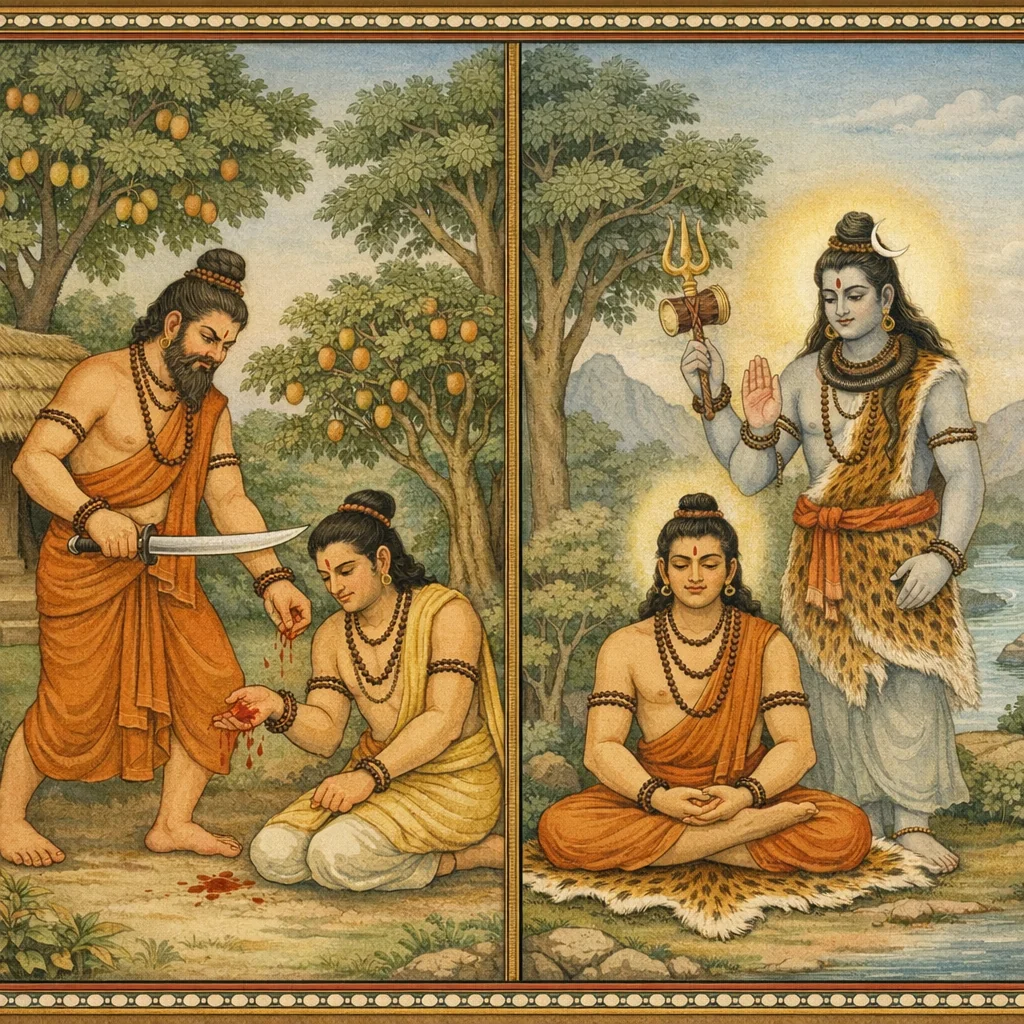
The ṛṣis ask Sūta how King Camatkāra was freed from leprosy, who the Brahmins were that guided him, and where Śaṅkhatīrtha lies with its power. Sūta relates that the king wandered through many pilgrimage sites, seeking medicines and mantras, yet found no cure. Living austerely in a highly meritorious region, he met Brahmin pilgrims and begged for a means—human or divine—to end his affliction. The Brahmins point to nearby Śaṅkhatīrtha as a universal destroyer of disease, especially potent when one bathes there while fasting in the month of Caitra, on the lunar fourteenth night (caturdaśī) with the moon in Citrā. They recount the tīrtha’s origin: the ascetic brothers Likhita and Śaṅkha; Śaṅkha takes fruit from Likhita’s empty āśrama and accepts the blame, and Likhita, in anger, severs his hand. Śaṅkha performs severe tapas; Śiva appears, restores his hands, and establishes a tīrtha in Śaṅkha’s name, promising renewal and purification to bathers and the satisfaction of ancestors through śrāddha on that appointed night. Following this instruction, the Brahmins lead Camatkāra to bathe at the proper time; he is cured and becomes radiant. In gratitude and renunciation he offers his kingdom and wealth, but the Brahmins ask instead for a protected settlement (with walls and moat) for learned householders devoted to study and ritual. The king builds and endows a well-planned town, distributes valuables to qualified Brahmins according to śāstric procedure, and then moves toward deeper detachment and an ascetic orientation.
Shlokas
Verse 1
। ऋषय ऊचुः । चमत्कारः कथं राजा मुक्तः कुष्ठेन सूतज । कथं तेन तपस्तप्तं कियत्कालं च भूभुजा
The sages said: “O son of Sūta, how was the king freed from leprosy—what wondrous marvel was this? How did that ruler perform tapas (austerity), and for how long?”
Verse 2
कतमे ब्राह्मणास्ते वै शंखतीर्थं प्रदर्शितम् । यैस्तस्य रोगमुक्त्यर्थं दुःखितस्य महात्मनः
“And which brāhmaṇas were they who showed him Śaṅkhatīrtha—those who, to free that sorrowing great-souled one from disease, revealed it to him?”
Verse 3
कतमं शंखतीर्थं तत्कस्मिन्स्थाने व्यवस्थितम् । किंप्रभावं च निःशेषं सर्वं विस्तरतो वद
“What is that sacred ford called Śaṅkhatīrtha, and in what place is it established? What is its power? Tell everything fully, in detail, without remainder.”
Verse 4
सूत उवाच । अहं वः कीर्तयिष्यामि कथामेतां मनोहराम् । सर्वपापहरां विप्राश्चमत्कारनृपोद्भवाम्
Sūta said: “O brāhmaṇas, I shall recount to you this delightful tale—one that removes all sins—arising from the wondrous king, Cāmatkāra.”
Verse 5
स भ्रांतः सर्वतीर्थानि प्रभासाद्यानि कृत्स्नशः । तपस्वी नियताहारो भिक्षान्नकृतभोजनः
He wandered through all the tīrthas, beginning with Prabhāsa, in their entirety; living as an ascetic, restrained in diet, sustaining himself on food obtained by alms (bhikṣā).
Verse 6
पृच्छमानो भिषग्मुख्यानौषधानि मुहुर्मुहुः । मंत्रान्मंत्रविदश्चैव रोगनाशाय नित्यतः
Again and again he questioned the foremost physicians about medicines, and likewise asked the knowers of mantras for sacred chants—ever seeking the destruction of his disease.
Verse 7
न लेभे किंचिदिष्टं वा स मंत्रं भेषजं च वा । तीर्थं वा नृपशार्दूलो येन स्याद्व्याधिसंक्षयः
That tiger among kings found nothing desirable—no mantra, no medicine, nor even a tīrtha—by which his illness might be brought to an end.
Verse 9
निवासमकरोत्तस्मिन्क्षेत्रे पुण्यतमे चिरम् । शीर्णपर्णफलाहारो भूमौ शेते सदा निशि । अन्य स्याऽन्यस्य वृक्षस्य मदाहंकारवर्जितः
He made his dwelling for a long time in that most holy region. Living on fallen leaves and fruits, he always slept on the ground at night, moving from one tree to another, free from pride and ego.
Verse 10
ततः कतिपयाहस्य भ्रममाणो महीपतिः । सोऽपश्यद्ब्राह्मणश्रेष्ठांस्तीर्थयात्राश्रयान्बहून्
Then, after wandering for some days, the king saw many excellent brāhmaṇas—pilgrims who had taken refuge in a tīrtha-journey.
Verse 11
इति श्रीस्कांदे महापुराणएकाशीतिसाहस्र्यां संहितायां षष्ठे नागरखण्डे हाटकेश्वरक्षेत्रमाहात्म्ये शंखतीर्थोत्पत्तिमाहात्म्यवर्णने चमत्कारभूपतिना व्राह्मणेभ्यो नगरदानवर्णनंनामैकादशोऽध्यायः
Thus ends the Eleventh Chapter, called “The Description of the Gift of a City by King Cāmatkāra to the Brāhmaṇas,” within the account of the greatness of Hāṭakeśvara-kṣetra, in the Sixth Nāgara-khaṇḍa of the Śrī Skanda Mahāpurāṇa (the Saṃhitā of eighty-one thousand verses), in the section describing the origin and greatness of Śaṅkhatīrtha.
Verse 13
अस्ति कश्चिदुपायोऽत्र दैवो वा मानुषोऽपि वा । भेषजं वाऽथ मंत्रो वा येन कुष्ठं प्रशाम्यति
Is there any remedy here—divine or even human—whether a medicine or a mantra, by which this leprosy may be pacified?
Verse 15
अथवा वित्थ नो यूयं त्यक्ष्यामीह कलेवरम् । प्रविश्याग्निं जलं वाऽपि भक्षयित्वाऽथ वा विषम्
Or if you know of no remedy, I shall abandon this body here—entering fire, or water, or else by consuming poison.
Verse 16
तस्य तद्वचनं श्रुत्वा सर्वे ते द्विजसत्तमाः । प्रोचुः कृपासमाविष्टास्ततस्तं पृथिवीश्वरम्
Hearing his words, all those foremost of twice-born sages—moved with compassion—then addressed that lord of the earth.
Verse 17
अस्ति पार्थिवशार्दूल स्थानादस्माददूरतः । शंखतीर्थमिति ख्यातं सर्वरोगक्षयावहम्
O tiger among kings, not far from this place there is a sacred ford renowned as Śaṅkhatīrtha, which brings about the destruction of all diseases.
Verse 18
ये नरा व्याधिना ग्रस्ताः काणाश्चांधास्तथा जडाः । हीनांगाश्चाऽधिकांगाश्च कुरूपा विकृताननाः
Men afflicted by disease—one-eyed, blind, and dull-witted—those with missing limbs or extra limbs, and those ill-formed with distorted faces—
Verse 19
तेऽपि चैत्रस्य कृष्णादौ स्नातास्तत्राकृताशनाः । भवंति नीरुजः सद्यश्चित्रासंस्थे निशाकरे
Even they, bathing there at the beginning of the dark fortnight of Caitra and fasting without food, become at once free from illness—when the moon is in Citrā.
Verse 20
अस्माभिः शतशो दृष्टा द्वादशार्कसमप्रभाः । कामदेवसमाकारास्तेजोवीर्यसमायुताः
We have seen, by the hundreds, people radiant like twelve suns—beautiful in form like Kāma-deva—endowed with splendor and vigor.
Verse 21
राजोवाच । शंखतीर्थं कथं ज्ञेयं मया ब्राह्मणसत्तमाः । कथं चैव समुत्पन्नं वदध्वं मम विस्तरात्
The king said: “O best of Brahmins, how may Śaṅkhatīrtha be recognized by me? And how did it arise? Tell me in detail.”
Verse 22
ब्राह्मणा ऊत्रुः । आसीत्पूर्वं मुनिश्रेष्ठो लिखिताख्यो महीतले । शांडिल्यस्य मुनेः पुत्रस्तपोवीर्यसमन्वितः
The Brahmins replied: “Formerly, upon the earth, there lived an excellent sage named Likhita, the son of the sage Śāṇḍilya, possessed of the power born of austerity.”
Verse 23
अथ तस्यानुजो जज्ञे शंखाख्यो धर्मशास्त्रवित् । कन्दमूलफलाहारः सदैव तपसि स्थितः
Then his younger brother was born, named Śaṅkha—knower of the Dharma-śāstras—living on roots, tubers, and fruits, ever established in austerity.
Verse 24
कस्यचित्त्वथ कालस्य लिखितस्याऽश्रमं ययौ । शंखः स्वादुफलार्थाय पीडितोतिबुभुक्षया
At a certain time, Śaṅkha went to Likhita’s hermitage in search of sweet fruits, tormented by intense hunger.
Verse 25
स शून्यमाश्रमं प्राप्य लिखितस्य महात्मनः । आत्मीयानीति मन्वानः फलानि जगृहे ततः
Reaching the hermitage of the great-souled Likhita and finding it empty, he thought, “They are as good as my own,” and then took the fruits.
Verse 26
भक्षयामास भूरीणि पक्वानि मधुराणि च । एतस्मिन्नन्तरे प्राप्तो लिखितः शिष्यसंयुतः
He ate many ripe and sweet fruits. Just then, Likhita arrived there, accompanied by his disciple.
Verse 27
स गृहीतफलं दृष्ट्वा शंखं प्रोवाच कोपतः
Seeing that the fruit had been taken, he angrily addressed Śaṅkha.
Verse 28
अदत्तानि मया पाप फलानि हृतवानसि । कस्मात्त्वं चौर्यरूपेण नानुबन्धमवेक्षसे
“O sinner! You have taken fruits that were not given by me. Why do you, in the form of a thief, not consider the consequences that follow?”
Verse 29
शंख उवाच । सत्यमेतद्द्विजश्रेष्ठ यत्त्वया परिकीर्तितम् । फलानि प्रगृहीतानि विजनेऽत्र तवाश्रमे
Śaṅkha said: “True indeed, O best of the twice-born, is what you have declared. In this lonely place, here in your hermitage, I did take those fruits.”
Verse 30
तस्मात्कुरु यथार्हं मे निग्रहं चौर्यसंभवम् । इह लोकः परश्चैव येन मे स्यात्सुखावहः
“Therefore, impose upon me the fitting discipline born of this theft, so that both this world and the next may become auspicious and conducive to my well-being.”
Verse 31
ततः स हस्तमादाय हस्ते शंखस्य तत्क्षणात् । चकर्त कोपमाविष्टो वार्यमाणोऽपि तापसैः
Then, seizing Śaṅkha’s hand, he at once cut it off—overcome by anger—even though the ascetics tried to restrain him.
Verse 32
छिन्नहस्तोऽपि शंखस्तु तपश्चक्रे सुदारुणम् । विशेषेण समासाद्य स्वाश्रमे भूय एव तु
Even with his hand severed, Śaṅkha performed exceedingly austere penance; returning again to his own hermitage, he pursued it with special intensity.
Verse 33
ततस्तुष्टो महादेवस्तस्य कालेन केन चित् । प्रोवाच दर्शनं गत्वा तं च शंखमुनीश्वरम्
In time, Mahādeva became pleased with him. Approaching and granting him His vision (darśana), He spoke to that lordly sage, Śaṅkha.
Verse 34
महेश्वर उवाच । भोभो मुने महासत्त्व दुष्करं कृतवानसि । वरं गृहाण मत्तस्त्वं मनसा समभीप्सितम्
Maheśvara said: “O sage, great-souled one, you have accomplished what is difficult. Accept from Me a boon—whatever your mind truly desires.”
Verse 35
शंख उवाच । यदि तुष्टोसि मे देव वरं चेद्यच्छसि प्रभो । स्यातां मे तादृशौ हस्तौ भूयोऽपि सुरसत्तम
Śaṅkha said: “If You are pleased with me, O Lord, and if You will grant a boon, then may I again have hands just like those I had before, O best among the gods.”
Verse 36
तथेदं मम नामांकं तीर्थं स्यात्सुरसत्तम । विख्यातं सर्वलोकेषु सर्वपापहरं नृणाम्
“So shall this sacred ford bear my very name, O best among the gods. It will become renowned in all the worlds, and for human beings it will remove every sin.”
Verse 37
हीनांगो वाधिकांगो वा व्याधिना ग्रस्त एव च । अत्र स्नानं करोत्याशु स भूयः स्यात्पुनर्नवः
“Whether one is maimed, or has an extra limb, or is indeed afflicted by disease—if he bathes here, he quickly becomes renewed again, as if restored to wholeness.”
Verse 38
भगवानुवाच । एतत्तीर्थं तु विख्यातं तव नाम्ना भविष्यति । अद्यप्रभृति विप्रेन्द्र देहिनां पापनाशनम्
The Blessed Lord said: “This tīrtha shall indeed become renowned by your name. From this very day onward, O best of brāhmaṇas, it will destroy the sins of embodied beings.”
Verse 39
हीनांगो वाधिकांगो वा योऽत्र स्नानं करिष्यति । चैत्रे शुक्ले निराहारश्चित्रासंस्थे निशाकरे । सुवर्णांगः स तेजस्वी भविष्यति न संशयः
Whether maimed or possessing an extra limb, whoever bathes here—in the bright fortnight of Caitra, fasting, when the Moon is in Citrā—will become golden-limbed and radiant, without doubt.
Verse 40
सकामो यदि विप्रेंद्र ध्यायमानः सुरूपताम् । निष्कामो वा परं स्थानं गमि ष्यति शिवात्मकम्
O chief of brāhmaṇas, if a person performs this with desire, meditating on beauty, he gains a comely form; but if desireless, he will go to the supreme abode that is of the nature of Śiva.
Verse 41
अत्र श्राद्धे कृते ब्रह्मंश्चतुर्दश्यां निशाकरे । चित्रास्थिते प्रयास्यंति पितरस्तृप्तिमुत्तमाम्
O brāhmaṇa, when śrāddha is performed here on the fourteenth lunar day, when the Moon is in Citrā, the Pitṛs attain the highest satisfaction.
Verse 42
अद्यैव विप्रशार्दूल चैत्रशुक्लांत उत्तमः । अपराह्णे निशानाथश्चित्रायोगं प्रयास्यति
Indeed today itself, O tiger among brāhmaṇas, at the excellent close of the bright fortnight of Caitra, in the afternoon the Lord of the night (the Moon) will enter the Citrā conjunction.
Verse 43
तत्रोपवासयुक्तस्य सम्यक्स्नातस्य तत्क्षणात् । स्यातां हस्तौ सुरूपाढ्यौ यथा पूर्वं तथा हि तौ
There, for one who is observing a fast and has bathed properly, at that very moment the two hands become endowed with fine form—just as they were before, so indeed they are restored.
Verse 44
एवमुक्त्वा स भगवांस्ततश्चादर्शनं गतः । शंखोऽपि कुतपे काले तत्र स्नानमथाकरोत्
Having spoken thus, the Blessed Lord then vanished from sight. Thereafter Śaṅkha too, at the proper kutapa time, performed the sacred bath at that place.
Verse 45
ततश्च तत्क्षणाज्जातौ हस्तौ तस्य यथा पुरा । रक्तोत्पलनिभौ कांतौ मत्स्यचिह्नेन चिह्नितौ
And then, at that very instant, his two hands returned just as before—radiant and lovely like red lotuses, and marked with the sign of a fish.
Verse 46
ब्राह्मणा ऊचुः । एवं तद्धरणीपृष्ठे तीर्थं जातं नृपोत्तम । प्रभावाद्देवदेवस्य चंद्रांकस्य शुभावहम्
The brāhmaṇas said: “Thus, O best of kings, upon the surface of the earth a tīrtha has arisen—auspicious and beneficent—through the divine power of the God of gods, Candrāṅka.”
Verse 47
तस्मात्त्वमपि राजेंद्र तत्र स्नानं समाचर । चैत्रे शुक्लचतुर्दश्यां चित्रासंस्थे निशाकरे
Therefore, O lord of kings, you too should perform the sacred bath there—on the bright fourteenth day of Caitra, when the Moon is situated in Citrā.
Verse 48
भविष्यसि न संदेहः सर्वरोगविवर्जितः । वयं ते दर्शयिष्यामः प्राप्ते काले यथोदिते
You will become free from all diseases—of this there is no doubt. When the proper time arrives, as stated, we shall lead you and show you the rite and the place.
Verse 49
सूत उवाच । ततः कतिपयाहेन चैत्रकृष्णादिरागतः । चित्रासंस्थे निशानाथे संप्राप्ता च चतुर्दशी
Sūta said: “After some days had passed, the dark fortnight of Caitra arrived; and when the Moon was in Citrā, the fourteenth lunar day also came.”
Verse 50
ततस्ते ब्राह्मणा भूपं समादाय च तत्क्षणात् । शंखतीर्थं समुद्दिश्य गतास्तस्य हितैषिणः
Then those brāhmaṇas, seeking the king’s welfare, took the ruler with them at once and set out, aiming for Śaṅkha-tīrtha.
Verse 51
ततः स मनसि ध्यात्वा कुष्ठव्याधिपरिक्षयम् । स्नानं चक्रे यथान्यायं श्रद्धया परया युतः
Then he, mentally contemplating the complete destruction of his leprosy, performed the bath according to proper rule—endowed with supreme faith.
Verse 52
ततः कुष्ठविनिर्मुक्तो द्वादशार्कसमप्रभः । निष्क्रांतः सलिलात्तस्माद्धर्षेण महतान्वितः
Then, freed from leprosy, radiant like twelve suns, he emerged from that water filled with immense joy.
Verse 53
ततः प्रणम्य तान्सर्वान्ब्राह्मणान्वेदपारगान् । कृतांजलिपुटो भूत्वा वाक्यमेतदुवाच ह
Then, bowing to all those brāhmaṇas—masters of the Vedas—he joined his palms in reverence and spoke these words.
Verse 54
प्रसादेन हि युष्माकं मुक्तोऽहं ब्राह्मणोत्तमाः । कुष्ठव्याधेर्महाकालं गर्हितोस्म्येव देहिनाम्
By your gracious favor, O best of brāhmaṇas, I have been freed from leprosy—a dreadful affliction, long endured, and despised among embodied beings.
Verse 55
तस्मान्नाहं करिष्यामि राज्यं ब्राह्मणसत्तमाः । तीर्थेऽत्रैवाधुना नित्यं चरिष्यामि महत्तपः
Therefore, O most excellent brāhmaṇas, I shall no longer pursue kingship. Here at this very tīrtha, from now on, I will continually practice great austerity.
Verse 56
एतद्राज्यं च देशं च हस्त्यश्वादि तथापरम् । यत्किंचिद्विद्यते मह्यं तद्गृह्णंतु द्विजोत्तमाः
This kingdom and this land, along with elephants, horses, and whatever else belongs to me—let the foremost of the twice-born accept all of it.
Verse 57
ममैवानुग्रहार्थाय दयां कृत्वा बृहत्तराम् । दीनस्य भक्तियुक्तस्य विरक्तस्य विशेषतः
For my sake—so that I may receive grace—please extend even greater compassion, especially toward one who is afflicted, devoted, and detached.
Verse 58
ब्राह्मणा ऊचुः । न वयं रक्षितुं शक्ता राज्यं पार्थिवसत्तम । तत्किं तेन गृहीतेन येन स्याद्राज्यविप्लवः
The brāhmaṇas said: “O best of kings, we are not capable of protecting a kingdom. What use is it for us to accept that which would bring upheaval to the realm?”
Verse 59
जामदग्न्येन रामेण पुरा दत्ता वसुन्धरा । त्रिःसप्त क्षत्रियैर्हीनां कृत्वास्माकं नृपोत्तम
O best of kings, long ago Rāma Jāmadagnya (Paraśurāma) bestowed the earth upon us, after making it bereft of kṣatriyas—thrice seven times.
Verse 60
सा भूयोपि हृताऽस्माकं क्षत्रियैर्बलवत्तरैः । तिरस्कृत्य द्विजान्सर्वांल्लीलयापि मुहुर्मुहुः
Yet again it was taken from us by stronger kṣatriyas, who repeatedly—even playfully—insulted all the twice-born.
Verse 61
राजोवाच । अहं वः प्रकरिष्यामि रक्षां ब्राह्मणसत्तमाः । तपस्थितोऽपि कार्येऽत्र न भीः कार्या कथंचन
The king said: “O best of brāhmaṇas, I will arrange protection for you. Even if I am devoted to austerity, in this matter you should not fear in any way.”
Verse 62
ब्राह्मणा ऊचुः । अवश्यं यदि ते श्रद्धा विद्यते दानसंभवा । क्षेत्रेऽत्रापि महापुण्ये कृत्वा देहि पुरोत्तमम्
The brāhmaṇas said: “If you truly possess faith that ripens into charity, then in this exceedingly meritorious sacred region, build and grant us an excellent settlement (pura).”
Verse 63
सर्वेषां ब्राह्मणेंद्राणां प्राकारपरिखान्वितम् । सुखेन येन तिष्ठामः स्नात्वा तीर्थैः पृथग्विधैः । गृहस्थधर्मिणः सर्वे स्वाध्यायनिरता सदा
“A settlement for all the foremost brāhmaṇas—furnished with ramparts and moats—so that we may dwell in comfort after bathing at the various tīrthas. All of us will live by the householder’s dharma and remain ever devoted to svādhyāya, the study and recitation of the Veda.”
Verse 64
सूत उवाच । तच्छ्रुत्वा स महीपालस्तथेत्युक्त्वा प्रहर्षितः । नगरं कल्पयामास स्थाने तत्र महत्तमम्
Sūta said: “Hearing this, the king, rejoicing, replied, ‘So be it!’ and had a mighty city founded there, in that very place.”
Verse 65
प्राकारेण सुतुंगेन परिखाद्येन सर्वतः । आयामव्यासतश्चैव क्रोशमात्रं मनोहरम्
“It was encircled on every side by a lofty wall, moats and the like, and measured a krośa in both length and breadth—a city most charming.”
Verse 66
त्रिकचत्वरसंशुद्धं शोभितं सर्वतो ध्वजैः । प्रासादैः प्रोन्नतैः कान्तैः समंतात्सुधया वृतैः
“At the three- and four-way crossroads it was made pure; on every side it was adorned with banners, and all around it was ringed with lofty, lovely mansions coated in shining lime.”
Verse 67
मत्तवारणकोपेतैर्बहुभिर्भूभिरेव च । संपूर्णं सत्यकामाद्यैः साधुलोकप्रशंसितैः
“It was filled with many kings, attended by rutting elephants, and complete with rulers such as Satyakāma and others—praised by the community of the righteous.”
Verse 68
ततो गृहाणि सर्वाणि पूरयित्वा स भूमिपः । सुवर्णमणिमुक्तादिपदार्थैरपरैरपि
“Then that king filled all the houses with gold, jewels, pearls, and many other precious goods.”
Verse 69
ब्राह्मणेभ्यः कुलीनेभ्यो वेदविद्भ्यो विशेषतः । श्रोत्रियेभ्यश्च दांतेभ्यः स तु श्रद्धासमन्वितः
Endowed with faith, he gave especially to Brāhmaṇas—noble in lineage and learned in the Vedas—and also to śrotriyas and men of self-restraint.
Verse 70
यथाज्येष्ठं यथाश्रेष्ठं प्रक्षाल्य चरणौ ततः । शास्त्रोक्तेन विधानेन प्रददौ द्विजसत्तमाः
Then, in proper order—by seniority and excellence—having washed their feet, he bestowed gifts upon the foremost among the twice-born, following the procedure taught in the scriptures.
Verse 97
ततश्च पार्थिवश्रेष्ठो वैराग्यं परमं गतः । एकाकी यतचित्तात्मा सर्वसत्त्वविराजिते
Thereafter the foremost of kings attained supreme dispassion; dwelling alone, with mind and self restrained, he remained in a place radiant with all living beings.