Adhyaya 104
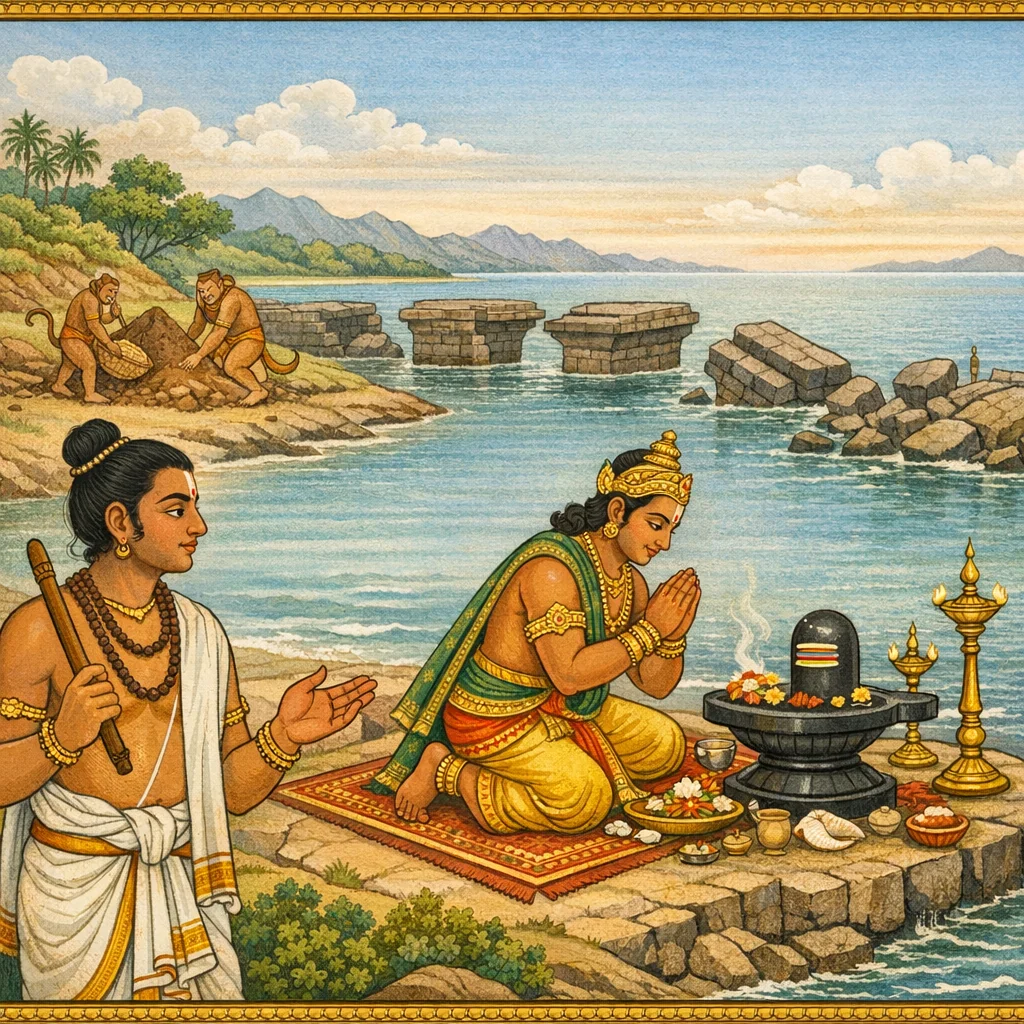
Chapter 104 of the Nāgara Khaṇḍa unfolds a governance-and-pilgrimage case within tīrtha discourse. The ṛṣis ask Sūta about the greatness and consequences of liṅgas installed by rākṣasas with devotion. Sūta recounts a crisis: powerful rākṣasas from Laṅkā repeatedly raid the western part of the Hāṭakeśvaraja field, devouring travelers and residents and spreading terror. Refugees report to King Kuśa in Ayodhyā that four-faced liṅgas set up with rākṣasa-mantras have become a recurring magnet for violent incursions; even accidental worship of them is said to bring immediate ruin. Kuśa mobilizes, is reproached by brāhmaṇas for negligence, accepts responsibility, and sends a stern message to Vibhīṣaṇa. A messenger reaches the Setu region and learns that onward passage is blocked because the bridge is broken; local testimony instead highlights Vibhīṣaṇa’s strict devotional regimen. He worships three manifestations of Rāmeśvara through the day—at dawn at the gateway shrine, at midday on a Setu fragment amid the waters, and at night—showing him as a disciplined bhakta rather than merely a political figure. Vibhīṣaṇa arrives, praises Śiva in a theologically dense hymn (Śiva as all-deities and immanent in all beings, like fire in wood and ghee in curd), performs an elaborate pūjā with flowers, ornaments, and music, and then hears Kuśa’s accusations. He admits the harm occurred unknowingly, interrogates and curses the offending rākṣasas into a degraded, hungry state, and promises restraint. A practical dilemma follows: the messenger urges uprooting the dangerous rākṣasa-installed liṅgas, but Vibhīṣaṇa cites his vow before Rāma and the rule that a liṅga—whether sound or damaged—should not be moved. The chapter resolves pragmatically through Kuśa’s directive: instead of “moving” the liṅgas, the sites are filled and covered with earth, neutralizing their harmful function while honoring the taboo against displacement. Kuśa also frames an ethical consequence-system for the cursed beings (linked to failures in śrāddha and improper giving/consumption), sends an apology to Vibhīṣaṇa for harsh speech, and reaffirms trust. The narrative closes with gifts, reconciliation, and the re-stabilization of sacred space through regulated worship and royal responsibility.
Shlokas
Verse 1
ऋषय ऊचुः । राक्षसैस्तत्र लिंगानि यानि भक्त्या समन्वितैः । स्थापितानि च माहात्म्यं तेषां सूत प्रकीर्तय
The sages said: O Sūta, proclaim the greatness of those liṅgas which, in that place, were established by the Rākṣasas endowed with devotion.
Verse 2
सूत उवाच । तेषां पूजाकृते रौद्रा राक्षसा बलवत्तराः । लंकापुर्याः समायांति सदैव शतशः पुरा
Sūta said: For the worship of those liṅgas, in ancient times fierce and exceedingly powerful Rākṣasas would come continually in hundreds from the city of Laṅkā.
Verse 3
आगच्छन्तो व्रजन्तस्ते मार्गे क्षेत्रे च तत्र च । भक्षयन्ति जनौघांश्च बालवृद्धाञ्जनानपि
As they came and went—on the roads and even within that sacred precinct—they devoured crowds of people, sparing neither children nor the elderly.
Verse 4
ततस्ते मानवाः सर्वे प्रद्रवंतः समंततः । इतश्चेतश्च धावन्ति प्राणरक्षणतत्पराः
Then all those people fled in every direction, running here and there, intent only on saving their lives.
Verse 5
तथान्ये बहवो गत्वा ह्ययोध्याख्यां महापुरीम् । रामपुत्रं नृपश्रेष्ठं कुशं प्रोचुः सुदुःखिताः
Likewise, many others went to the great city called Ayodhyā and, in deep distress, informed Kuśa—the best of kings, the son of Rāma.
Verse 6
तव पित्रा समं प्राप्ताः पूर्वं ये राक्षसा नृप । हाटकेश्वरजे क्षेत्रे विभीषणपुरःसराः
O king, those Rākṣasas who formerly came along with your father—led by Vibhīṣaṇa—have reached the sacred field of Hāṭakeśvara.
Verse 7
संस्थापितानि लिंगानि चतुर्वक्त्राणि तत्र वै । राक्षसेंद्रैः स्वमन्त्रैस्तैस्तस्य क्षेत्रस्य पश्चिमे
There, in the western quarter of that sacred region, the Rākṣasa-lords installed four-faced liṅgas, employing their own mantras.
Verse 8
तेनैव चानुषंगेण समागच्छंति नित्यशः । तस्मिन्क्षेत्रे प्रकुर्वंति तथा लोकस्य भक्षणम्
And by that very connection they keep returning day after day; and within that sacred region they carry out the devouring of the people.
Verse 9
यदि वा तानि लिंगानि कश्चित्संपूजयेन्नरः । सद्यो विनाशमायाति सोऽप्यनर्थो महानभूत्
And if any person were to worship those liṅgas, he would meet destruction at once; thus that too became a great calamity.
Verse 10
तस्माद्यदि न रक्षा नः करिष्यसि महीपते । तच्छनैर्यास्यते लोकः सर्वोऽयं संक्षयं ध्रुवम्
Therefore, O lord of the earth, if you do not protect us, then little by little this entire populace will surely go to ruin.
Verse 11
तच्च क्षेत्रं विशेषेण यत्रागच्छंति ते सदा । राक्षसाः क्रूरकर्माणो महामांसस्य लोलुपाः
And that particular tract of the sacred region—where they always come—is plagued by Rākṣasas of cruel deeds, greedy for great quantities of flesh.
Verse 12
तच्छ्रुत्वा स नृपस्तूर्णं स्वामात्यानां न्यवेदयत् । राज्यभारं ततस्तत्र बलेन सहितो ययौ
Hearing this, the king swiftly informed his ministers, entrusted them with the burden of governance, and then set out for that place accompanied by an army.
Verse 13
अथ प्राप्तं कुशं दृष्ट्वा हतशेषा द्विजोत्तमाः । प्रोचुस्तं भर्त्सयित्वा तु वचनैः परुषाक्षरैः
Then, seeing Kuśa arrive, the foremost brāhmaṇas—left with only a remnant after the slaughter—addressed him, rebuking him with harsh words.
Verse 14
किमेवं क्रियते राज्यं यथा त्वं क्षत्रियाधमः । करोषि यत्र विध्वंसं राक्षसै र्नीयते जनः
What sort of kingship is this, in which you—lowest among kṣatriyas—allow such ruin to be wrought, where people are being carried off by rākṣasas?
Verse 15
नूनं जातो न रामेण भवान्रावणसंभवः । येनोपेक्षसि सर्वान्नो राक्षसैः परिपीडितान्
Surely you are not born of Rāma, but are sprung from Rāvaṇa—since you neglect all of us who are being oppressed by rākṣasas.
Verse 16
सत्यमेतत्पुरा प्रोक्तं नीतिशास्त्रविचक्षणैः । यस्य वर्णस्य यो राजा स वर्णः सुखमेधते
This is indeed true, as the wise in the science of polity taught long ago: whichever varṇa has a king devoted to it, that varṇa prospers in happiness.
Verse 17
तस्मात्त्वं राक्षसोद्भूतो राक्षसैर्द्विजसत्तमान् । उपेक्षसे ततः सर्वान्भक्ष्यमाणांस्तथापरान्
Therefore you must be rākṣasa-born, for you ignore the best of the twice-born as they are made prey by rākṣasas, and likewise all the others who are being devoured.
Verse 18
आर्तानां यत्र लोकानां दोषैः पार्थिवसंभवैः । पतंत्यश्रूणि भूपृष्ठे तत्र राजा स दोषभाक्
Where the tears of afflicted people fall upon the earth because of faults arising from the king, there that king becomes the bearer of that sin.
Verse 19
कुश उवाच । प्रसादः क्रियतां विप्रा न मया ज्ञातमीदृशम् । राक्षसेभ्यः समुत्पन्नो ब्राह्मणानां पराभवः
Kuśa said: “Be gracious, O vipras; I did not know of such a thing—that from rākṣasas there has arisen the humiliation of the brāhmaṇas.”
Verse 20
अद्यप्रभृति यः कश्चिद्विनाशं नीयते क्वचित् । ब्राह्मणो वाऽथवाऽन्योऽपि तद्भवेन्मम पातकम्
From today onward, if anyone anywhere is led to destruction—whether a brāhmaṇa or anyone else—may that become my sin.
Verse 21
एवमुक्त्वा ततस्तूर्णं प्रेषयामास राघवः । विभीषणाय संक्रुद्धो दूतं भयविवर्जितम्
Having spoken thus, Rāghava at once dispatched a messenger—fearless and unshaken—angrily, to Vibhīṣaṇa.
Verse 22
गच्छ दूत द्रुतं गत्वा त्वया वाच्यो विभीषणः । रामोचितस्त्वया स्नेहो मया सह कृतो महान्
Go, messenger—go swiftly. Vibhīṣaṇa must be told by you: ‘A great friendship, worthy of Rāma, has been formed by you with me.’
Verse 23
यद्राक्षसगणैः सार्धं मम भूमिं समंततः । त्वं क्लेशयसि दुर्बुद्धे मां विश्वास्य सुभाषितैः
Yet, together with bands of rākṣasas, you afflict my land on every side, O evil-minded one—having won my trust with fair-sounding words.
Verse 24
मम पित्रा कृतेयं ते प्रतिष्ठा राक्षसाधम । तेन नो हन्मि ते भ्राता यथा तातेन शातितः
O vilest of rākṣasas! This very eminence of yours was established by my father. Therefore I shall now slay your brother, just as my father once subdued your own sire.
Verse 25
विषवृक्षोऽपि यो वृद्धिं स्वयमेव प्रणीयते । कथं संछिद्यते सोऽत्र स्वयमेव मनीषिभिः
Even a poison-tree that grows by its own momentum—how is it to be cut down here, by the wise, if it keeps advancing of itself?
Verse 26
तस्मादद्य दिनादूर्ध्वं यदि कश्चिन्निशाचरः । समुद्रस्योत्तरं पारं कथंचिदागमिष्यति
Therefore, from this very day onward, if any night-roamer (rākṣasa) should somehow reach the northern shore beyond the ocean…
Verse 27
तदहं सत्वरं प्राप्य लंकां तव पुरीमिमाम् । ससैन्यो ध्वंसयिष्यामि तथा सर्वान्निशाचरान्
Then I shall swiftly reach Laṅkā—this city of yours—and with my army I shall destroy it, and likewise all the night-roamers.
Verse 28
त्वां च बद्ध्वा दृढैः पाशैर्निगडैश्च सुसंयतम् । कारासंस्थं करिष्यामि सद्य एव न संशयः
And you too—binding you with strong nooses and fetters, tightly restrained—I shall cast you into prison this very day; of this there is no doubt.
Verse 29
एवमुक्तस्ततो दूतो गत्वा सेतुं द्रुतं ततः । दृष्ट्वा रामेश्वरं देवं यावदग्रे व्यव स्थितः
Thus addressed, the messenger hurried to Setu. Then, beholding the divine Rāmeśvara, he remained standing there before it.
Verse 30
तावत्पृष्टो जनैः कैश्चित्कस्त्वं वत्स इहागतः । केन कार्येण नो ब्रूहि नात्र गच्छंति मानवाः
Then some people questioned him: “Who are you, dear boy, who have come here? Tell us—on what business? For men do not go onward from here.”
Verse 31
दूत उवाच । अहं कुशेन भूपेन विभीषणगृहं प्रति । प्रेषितः कार्यमुद्दिश्य तत्र यास्याम्यहं कथम्
The messenger said: “I have been dispatched by King Kuśa, with a task in mind, toward the house of Vibhīṣaṇa. How, then, am I to go there?”
Verse 32
जना ऊचुः । नातः परं नरः कश्चिद्गन्तुं शक्तः कथंचन । भग्नः सेतुर्यतो मध्ये रामेणाक्लिष्टकर्मणा
The people said: “No man can go beyond this point by any means, for the Setu-bridge has been broken in the middle by Rāma, whose deeds know no weariness.”
Verse 33
तस्मादत्रैव ते कार्यं सिद्धिं दूत प्रयास्यति । विभीषणकृतं सर्वं दर्शनात्तस्य रक्षसः
“Therefore, right here your mission will attain success, O messenger. All that Vibhīṣaṇa has arranged will be fulfilled merely by beholding that rākṣasa (Vibhīṣaṇa).”
Verse 34
सर्वदा राक्षसेन्द्रोऽसौ शुभं रामेश्वरत्रयम् । त्रिकालं पूजयत्येव नियमं समुपाश्रितः
That lord of the Rākṣasas ever reveres the auspicious triad of the Rāmeśvara-liṅgas; taking refuge in sacred discipline, he worships them unfailingly at the three daily times.
Verse 35
लंकाद्वारे स्थितो यो वै सेतुखण्डे महेश्वरः । प्रभाते कुरुते तस्य स्वयं पूजां विभीषणः
To the Maheśvara who stands at the gateway of Laṅkā in the Setu region, Vibhīṣaṇa himself offers worship at dawn.
Verse 36
जलमध्यगतं यच्च सेतुखंडं द्वितीयकम् । तत्र रामेश्वरो यश्च मध्याह्ने तं प्रपूजयेत्
And the second Setu-shrine, set amid the waters—there abides Rāmeśvara; He should be worshiped at midday with special reverence.
Verse 37
एनं देव निशीथे च सर्वदागत्य भक्तितः । संपूजयेन्न सन्देहः सत्यमेतत्प्रकीर्तितम्
To this very Lord, even at the hour of midnight, one should always draw near with devotion and worship in full—without doubt; this is proclaimed as truth.
Verse 38
तस्मात्तिष्ठ त्वमव्यग्रः स्थानेऽत्रैव समाहितः । यावदागमनं तस्य राक्षसस्य महात्मनः
Therefore remain here, untroubled, calm and composed in this very place, until the arrival of that great-souled Rākṣasa.
Verse 39
तेनैव सहितः पश्चात्स्वेच्छया तस्य मन्दिरम् । प्रयास्यसि गृहं वापि स्वकीयं तद्विसर्जितः
Afterward, accompanied by him, you may go as you wish—either to his temple or, once dismissed by him, to your own home.
Verse 40
अथ तेषां तदाकर्ण्य स दूतो हर्षसंयुतः । बाढमित्येव चोक्त्वाथ तत्र चैव व्यवस्थितः
Hearing their words, the messenger, filled with joy, replied, “So be it,” and then remained stationed right there.
Verse 41
अथ प्राप्ते निशार्धे स राक्षसैः परिवारितः । विभीषणः समायातस्तस्मिन्नायतने शुभे
Then, when the middle of the night had come, Vibhīṣaṇa arrived at that auspicious sanctuary, surrounded by Rākṣasas.
Verse 42
विमानवरमारूढः स्तूयमानः समन्ततः । राक्षसैर्बंदिरूपैस्तैर्गीयमानस्तथा परैः
Mounted upon an excellent vimāna, he was praised on every side—sung of by Rākṣasas who served as bards, and by others as well.
Verse 43
उत्तीर्य च विमानाग्र्यात्कृत्वाऽथ त्रिः प्रदक्षिणाम् । रामेश्वरं प्रणम्योच्चैः स्तोत्रमेतच्चकार सः
Descending from the foremost vimāna, he then performed three circumambulations; bowing to Rāmeśvara, he recited aloud this hymn of praise.
Verse 44
नमस्ते देवदेवेश भक्तानामभयप्रद । सर्वतः पाणिपादं ते सर्वतोक्षिशिरोमुखम्
Salutations to you, Lord of lords, bestower of fearlessness upon devotees. Your hands and feet are everywhere; everywhere are your eyes, heads, and faces.
Verse 45
त्वं यज्ञस्त्वं वषट्कारस्त्वं चंद्रस्त्वं प्रभाकरः । त्वं विष्णुस्त्वं चतुर्वक्त्रः शक्रस्त्वं परमेश्वरः
You are the sacrifice; you are the vaṣaṭ-cry. You are the Moon; you are the Sun. You are Viṣṇu; you are the four-faced Brahmā; you are Śakra (Indra); you are the Supreme Lord.
Verse 47
यथा काष्ठगतो वह्निः संस्थितोऽपि न लक्ष्यते । मूढैः सर्वत्रसंस्थोपि तथा त्वं नैव लक्ष्यसे
Just as fire hidden within wood, though present, is not perceived—so too, though you abide everywhere, you are not recognized by the deluded.
Verse 48
यथा दधिगतं सर्पिर्निगूढत्वेन संस्थितम् । चराचरेषु भूतेषु तथा त्वं देव संस्थितः
As ghee lies concealed within curd, so You, O God, abide hidden within all beings—both moving and unmoving.
Verse 49
यथा जलं धरापृष्ठात्खनन्नाप्नोति मानवः । तथा त्वां पूजयन्नित्यं मोक्षमाप्नोत्यसंशयम्
As a person obtains water by digging into the earth, so one who worships You daily attains liberation—without doubt.
Verse 50
तावच्च दुर्लभः स्वर्गस्तावच्छूराश्च शत्रवः । यावदेव न सन्तोषं त्वं करोषि शरीरिणाम्
So long is heaven hard to attain, and so long do fierce enemies persist—so long as You do not bestow contentment upon embodied beings.
Verse 51
तावल्लक्ष्मीश्चला नॄणां तावद्रोगाः पृथग्विधाः । न यावद्देवदेव त्वं सन्तोषं संप्रयास्यसि
Fortune remains fickle for people, and diseases of many kinds persist—until, O God of gods, You bestow contentment.
Verse 52
तावत्पुत्रोद्भवं दुःखं तथा प्रियसमु द्भवम् । यावत्त्वं देव नायासि सन्तोषं देहिनामिह
So long do sorrows arise from children, and likewise from what is dear—until You, O God, bring contentment to embodied beings here.
Verse 53
एवं स्तुत्वा ततो लिंगं स्नापयित्वा यथाविधि । गन्धानुलेपनैदिव्यैर्मर्दयामास वै ततः
Thus having praised Him, he bathed the liṅga according to the prescribed rite; thereafter he anointed and gently rubbed it with divine fragrances and sacred unguents.
Verse 54
पारिजातकपुष्पैश्च तथा सन्तानसम्भवैः । कल्पपादपसंभूतैस्तथा मन्दारजैरपि
With pārijāta flowers, with blossoms born of the santāna tree, with flowers sprung from wish-fulfilling trees, and also with mandāra flowers, he offered worship.
Verse 55
पूजां चक्रे सुविस्तीर्णा श्रद्धया परया युतः । दिव्यैराभरणैर्भूष्य दिव्यवस्त्रैस्ततः परम्
Endowed with supreme faith, he performed an elaborate and expansive worship, adorning (the Deity) with celestial ornaments and thereafter also with divine garments.
Verse 56
स च गीतं स्वयं चक्रे तालमादाय पाणिना । मूर्छातालकृतं रम्यं सप्तस्वरविराजितम्
He himself then composed and sang a song, keeping rhythm with his hand—beautifully arranged in melodic modes and rhythmic patterns, shining with the splendor of the seven notes.
Verse 57
तानयुक्त्या समोपेतं ग्रामै रागैः स्वलंकृतम् । एवं कृत्वा स शुश्रूषा तस्य देवस्य भक्तितः
Enriched with fitting tonal nuances and adorned with musical scales and rāgas, he thus rendered service to that Deity, moved by devotion.
Verse 58
यावत्संप्रस्थितो भूयो लंकां प्रति विभीषणः । तावद्दूतोऽग्रतः स्थित्वा कुशवाक्यमुवाच ह
As Vibhīṣaṇa set out once more toward Laṅkā, a messenger stood before him and conveyed Kuśa’s words.
Verse 59
विशेषतस्तु तेनोक्तं यत्तस्य पुरतः पुरा । अतिकोपाभिभूतेन प्ररक्तनयनेन च
In particular, he reported what had earlier been spoken in his very presence—by one overcome with fierce anger, eyes reddened with rage.
Verse 60
तच्छ्रुत्वाथ प्रणम्योच्चैर्दूतं प्राह विभीषणः । कृतांजलिपुटो भूत्वा विनयावनतः स्थितः
Hearing this, Vibhīṣaṇa bowed and spoke reverently to the messenger; with hands joined in añjali, he stood in humble deference.
Verse 61
यद्येवं विहितं राज्ये रामपुत्रस्य राक्षसैः । तन्नूनं तन्मया सर्वं विहितं दूतसत्तम
“If such deeds have been done in the kingdom of Rāma’s son by the rākṣasas, then surely all of it has been done by me, O best of messengers,” said Vibhīṣaṇa.
Verse 62
तस्मान्महाप्रसादो मे कृतस्तेन महात्मना । कुशेन प्रेषितो यस्त्वं मम मूर्खस्य संनिधौ
“Therefore the great-souled Kuśa has shown me great favor—since you have been sent by Kuśa into the presence of me, a fool.”
Verse 63
एवमुक्त्वा स तान्सर्वाञ्छोधयामास राक्षसान् । ये गत्वा भूतले मर्त्यान्ध्वंसयंति सदैव हि
Having spoken thus, he set about correcting and disciplining all those rākṣasas who, going down to the earth, continually oppress and destroy mortals.
Verse 64
ततस्तत्रैव चानीय तस्य दूतस्य संनिधौ । प्रत्येकं तानुवाचेदं कोपादश्रूणि चोत्सृजन्
Then, bringing them right there into the presence of that messenger, he addressed them one by one—speaking in anger, and shedding tears as well.
Verse 65
यैः कृतो जनविध्वंसो राक्षसैः सुदुरात्मभिः । राज्ये कुशस्य संप्राप्तैः प्रभोर्मम महात्मनः
“By those utterly wicked rākṣasas—who, having entered the kingdom of Kuśa, my noble and great lord—brought about the destruction of the people…”
Verse 66
ते सर्वे व्यंतरा रौद्राः प्रभवंतु सुदुःखिताः । लंकाद्वारगता नित्यं क्षुत्पिपासानिपीडिताः
“May all of them become fierce, restless spirits (vyaṃtaras), miserable indeed—ever stationed at Laṅkā’s gate, constantly tormented by hunger and thirst.”
Verse 67
सर्वभोगपरित्यक्ताः शीतातपसहि ष्णवः । श्लेष्ममूत्रकृताहारा निन्द्याः सर्वजनस्य च
“Deprived of all enjoyments, enduring cold and heat, feeding on phlegm and urine—let them be despised by all people.”
Verse 68
एवं दत्त्वाथ तेषां स शापं राक्षससत्तमः । ततः प्राह च तं दूतं पुनरेव कृतां जलिः
Thus, having pronounced that curse upon them, the foremost of the rākṣasas addressed the messenger once more, his hands joined in reverent salutation.
Verse 69
अद्यप्रभृति नो कश्चिद्राक्षसः संप्रयास्यति । तस्माद्वाच्यो रघुश्रेष्ठो मद्वाक्यात्स कुशस्त्वया । क्षम्यतामपराधो मे यदज्ञाना दयंकृतः
From this day forth, no rākṣasa shall attack again. Therefore, by my word, convey to Kuśa—the finest of Raghu’s line: “Forgive my offense, for in ignorance I caused harm.”
Verse 70
राक्षसैर्दुष्टजातीयैर्महामांसस्यलोलुपैः । कृतश्च निग्रहस्तेषां प्रत्यक्षं तव दूत यः
Those rākṣasas—vile by nature, greedy for great heaps of flesh—have been restrained; and that restraint, O messenger, is plain to you before your very eyes.
Verse 71
यदन्यदपि कृत्यं स्याद्दैवं वा मानुषं च वा । मम भृत्यस्य तत्सर्वं कथनीयमशंकितम्
And if there is any other duty to be done—whether divine or human—tell it all to my servant, without the least hesitation.
Verse 72
दूत उवाच । यानि तत्र च लिंगानि राक्षसैर्निर्मितानि च । तानि गत्वा स्वयं शीघ्रं त्वमुत्पाटय राक्षस
The messenger said: “As for the liṅgas fashioned there by the rākṣasas, go there yourself at once and uproot them, O rākṣasa.”
Verse 73
एतदेव परं कृत्यं सर्वलोकसुखावहम् । स्थापितानि च यान्येव मंत्रै राक्षससंभवैः
This alone is the supreme duty, bringing welfare to all worlds: to deal with those liṅgas that were installed by mantras arising from rākṣasa origin.
Verse 74
संपूजितानि रक्षोभिश्चतुर्वक्त्राणि राक्षस । अजानन्मानवः कश्चिद्यदि पूजां समाचरेत्
O rākṣasa, those four-faced forms/liṅgas have already been fully worshipped by the demon hosts; if some human, not knowing their true nature, were to perform worship…
Verse 75
तत्क्षणान्नाशमायाति एतद्दृष्टं मया स्वयम् । एतस्मात्कारणाद्वच्मि त्वामहं राक्षसाधिप । तैः स्थितैर्भूतले लिंगैः स्थिताः सर्वे निशाचराः
In that very instant one meets destruction—this I have witnessed myself. For this reason I speak to you, O lord of the rākṣasas: by those liṅgas established upon the earth, all the night-roaming beings have been bound and made to remain here.
Verse 76
विभीषण उवाच । मया पूर्वं प्रतिज्ञातं रामस्य पुरतः किल । रामेश्वरमतिक्रम्य न गतव्यं धरातले
Vibhīṣaṇa said: Formerly, indeed, I made a vow in Rāma’s very presence: “Having reached Rāmeśvara, one should not go beyond it upon the earth.”
Verse 77
अन्यच्च कारणं दूत प्रोक्तमत्र मनीषिभिः । दुःस्थितं सुस्थितं वापि शिवलिंगं न चालयेत्
And there is another reason, O messenger, spoken here by the wise: whether a Śiva-liṅga is ill-placed or well-placed, one should not move it.
Verse 78
तत्कथं तत्र गत्वाऽथ लिंगभेदं करोम्यहम् । स्वयं माहेश्वरो भूत्वा प्रतिज्ञाय च वै स्वयम्
How then, after going there, could I commit the sin of breaking the liṅga—when I myself have become a devotee of Maheśvara, and I myself have uttered my vow?
Verse 79
तस्मात्प्रसादनीयस्ते मद्वाक्यात्स नराधिपः । यद्युक्तं मया प्रोक्तं तत्त्वं कुरु विनिग्रहम्
Therefore, by my words, you should conciliate that king. And if what I have spoken is fitting, then act according to its truth—exercise restraint.
Verse 80
एवमुक्त्वाथ तं दूतं रत्नैः सागरसंभवैः । प्रभूतैर्भूषयित्वाऽथ विससर्ज नृपं प्रति
Having spoken thus, he adorned that messenger with abundant jewels born of the ocean, and dispatched him toward the king.
Verse 81
अथ ते राक्षसास्तेन शप्ताः प्रोचुः सुदुःखिताः । कुरु शापस्य मोक्षं नः सर्वेषां राक्षसेश्वर
Then those Rākṣasas, cursed by him and greatly distressed, said: “O lord of the Rākṣasas, grant release to us all from this curse.”
Verse 82
विभीषण उवाच । नाहं करोमि भूयोऽपि युष्माकं राक्षसाधमाः अनुग्रहं प्रशप्तानां वंचकानां विशेषतः
Vibhīṣaṇa said: “I will not again show you favor, O vilest of Rākṣasas—especially those who are under a curse, and most of all deceivers.”
Verse 83
तस्मात्सोऽपि रघुश्रेष्ठः प्रसादं वः करिष्यति । मम वाक्याद संदिग्धं कालः कश्चित्प्रतीक्ष्यताम्
Therefore that best of the Raghus, too, will grant you favor. By my word it is certain—wait for some time.
Verse 84
एवमुक्त्वाऽथ रक्षेन्द्रः प्रेषयामास सत्वरम् । दूतं कुशमहीपस्य मानुषं देवपूजकम्
Having spoken thus, the lord of the Rākṣasas quickly sent a messenger to King Kuśa—a human devotee and worshipper of the gods.
Verse 85
गत्वा ब्रूहि कुशं भूपं सत्वरं वचनान्मम । एतेषां मत्प्रशप्तानां राक्षसानां दुरात्मनाम् । अनुग्रहं कुरु विभो दीनानां भोजनाय वै
“Go quickly and convey my message to King Kuśa. These wicked rākṣasas, cursed by me, beg for relief—O mighty one, show them compassion, for they are wretched and seek food.”
Verse 86
एवमुक्तस्ततस्तेन इतो दूतेन संयुतः । कुशस्तेन विनिर्यातः सत्वरं द्विजसत्तमाः
So addressed by that messenger, King Kuśa then set out at once, accompanied by that messenger—O best of brāhmaṇas.
Verse 87
ततो गत्वा द्रुतं दूतः कुशं प्रोवाच सादरम् । प्रणिपत्य यथा न्यायं विनयावनतः स्थितः
Then the messenger hurriedly approached and respectfully addressed Kuśa; bowing as is proper, he stood with humility and deference.
Verse 88
विभीषणो मया दृष्टो देवे रामेश्वरे विभो । पूजार्थं तत्र चायातो राक्षसैर्बहुभिर्वृतः
O mighty one, I saw Vibhīṣaṇa at the divine Rāmeśvara. He had come there for worship, surrounded by many rākṣasas.
Verse 89
प्रोक्तो मया भवद्वाक्यमशेषं रघुनन्दन । श्रुतं तेनापि तत्सर्वं विनयावनतेन च
O delight of the Raghu line, I conveyed your entire message; and he too heard it all, bowing in humility.
Verse 90
अजानतः प्रभो तस्य राक्षसैः सुदुरात्मभिः । प्रजैवं पीडिता भूमौ महामांसस्य लोलुपैः
O lord, without his knowledge the people on earth were oppressed by those very wicked rākṣasas, greedy for great quantities of flesh.
Verse 91
तच्छ्रुत्वा मन्मुखात्तेन सर्वेषां निग्रहः कृतः । यैः कृतं कदनं भूमौ तव पार्थिव सत्तम । कृतास्ते व्यन्तरा सर्वे पापाहारविहारिणः
Hearing it from my own mouth, he restrained them all. Those who had wrought slaughter upon the earth—O best of kings—were all made into vyantaras, beings who roam living on sinful fare.
Verse 92
भविष्यथ तथा यूयं क्षुत्पिपासानिपीडिताः । तैः सर्वैः प्रार्थितः सोऽपि भूयोभूयः प्रणम्य तम्
“So shall you become—afflicted by hunger and thirst.” Thus they all pleaded with him, and he too, bowing to him again and again, made supplication.
Verse 93
शप्ताः सर्वे वयं तावत्प्रसादं कुरु तद्विभो । ते तेनाथ ततः प्रोक्ता नाहं वो राक्षसाधमाः
“We have all been cursed; therefore, O mighty one, grant us your grace!” Then he said to them: “Not I am the one to grant this to you, O vilest of rākṣasas.”
Verse 94
अनुग्रहं करिष्यामि न दास्यामि च भोजनम् । कुशादेशान्मया सर्वे यूयं पापसमन्विताः
“I will show you a measure of favor, but I will not give you food. By King Kuśa’s command, all of you—laden with sin—must remain so.”
Verse 95
निगृहीताः स युष्माकं प्रसादं प्रकरिष्यति । तदर्थं प्रेषितो दूतस्त्वत्सकाशं महीपते
“Having been restrained, he will seek your gracious favor. For that very purpose, O king, a messenger has been sent to your presence.”
Verse 96
रक्षसा तेन यद्युक्तमखिलं तत्त्वमाचर । किं वा ते बहुनोक्तेन नास्ति भक्तस्तथा विधः । भक्तिशक्तिसमोपेतो यथा ते स विभीषणः
“If what is enjoined by that rākṣasa is fitting, then follow the whole truth of it. What is the use of saying much? There is no devotee of that kind—endowed with the power of bhakti—like your Vibhīṣaṇa.”
Verse 97
अद्यप्रभृति नो भूमौ विचरिष्यंति राक्षसाः । तस्य वाक्यादसंदेहं त्वं राजन्सुख भाग्भव
“From today onward, rākṣasas will not roam upon our land. By his word, without doubt, O king, become a sharer in happiness—live in peace.”
Verse 98
लिंगानां च कृते राजन्विज्ञप्तं तेन रक्षसा । न मया चात्र राजेंद्र आगन्तव्यं कथंचन । रामदेवस्य वाक्येन जंबुद्वीपे न मे गतिः
“Concerning the liṅgas, O king, that rākṣasa has made a petition. Yet, O lord of kings, I must not come here in any manner; by the command of Lord Rāma, I have no passage—no movement—within Jambūdvīpa.”
Verse 99
अत्र स्थितस्य यत्कृत्यं दैवं वा मानुषं च वा । तवादेशं करिष्यामि यद्यपि स्यात्सुदुष्करम्
“Whatever duty is to be done while staying here—whether divine or human—I shall carry out your command, even if it be exceedingly difficult.”
Verse 100
तस्मात्तेन महाराज रामेश्वरप्रपूजकः । मनुष्यः प्रेषितो दूतो यस्तं पश्य महीपते
“Therefore, O great king, he has sent a human messenger—one devoted to the worship of Rāmeśvara. Behold him, O lord of the earth.”
Verse 101
अथ तस्य समादेशाड्ढौकनीयैः पृथग्विधैः । सहितः स समायातो दूतो रक्षेंद्रनोदितः
“Then, by his command, the messenger arrived, accompanied by various gifts fit for presentation—dispatched by the lord of the rākṣasas.”
Verse 102
धात्रीफलप्रमाणानां तेन प्रस्थास्त्रयोदश । मौक्तिकानां समानीताः कृते तस्य महीपतेः
“For the sake of that king, he brought thirteen prasthas of pearls, each pearl the size of a dhātrī-fruit (āmalaka).”}]}
Verse 103
वैडूर्याणां मरकतानां मणीनां च द्विजोत्तमाः । जात्यानां षोडश द्रोणाः समानीताः सुनिर्मलाः
O best of brāhmaṇas, sixteen droṇas of flawless, genuine gems—vaiḍūrya (cat’s-eye), marakata (emerald), and other jewels—were brought, all exceedingly pure.
Verse 104
अग्निशौचानि वस्त्राणि तथा देवमयानि च । असंख्यातानि वै हेम जात्यं संख्याविवर्जितम्
Garments purified by fire, and garments of divine make as well, were provided in countless number; and truly, pure gold was offered in measure beyond all reckoning.
Verse 105
तत्सर्वं दर्शयित्वाथ कुशाय सुमहात्मने । कृत्वा प्रदक्षिणं पश्चात्प्रणाममकरोद्द्विजाः
Having shown all of that to the great-souled Kuśa, the twice-born brāhmaṇa then circumambulated him in pradakṣiṇā and thereafter bowed down in reverence.
Verse 106
एष पार्थिवशार्दूल राक्षसेन्द्रो विभीषणः । प्रणामं कुरुते भक्त्या मन्मुखेनेदमब्रवीत्
“O tiger among kings, this is Vibhīṣaṇa, lord of the Rākṣasas. With devotion he offers pranāma.” Having spoken thus through my mouth, he then said the following.
Verse 107
प्रसादात्ते पितुः क्षेमं मम राज्ये मही पते । एष तिष्ठाम्यहं नित्यं पूजयंस्ते पितुर्हरम्
“O lord of the earth, by the grace of your father there is well-being in my kingdom. Here I remain always, continually worshipping your father—Hara (Śiva).”
Verse 108
मम राजन्नविज्ञातैर्यदि तैः सुदुरात्मभिः । महीतले कृतं किंचिद्विरुद्धं क्षम्यतां मम
O king, if those wicked ones—acting without my knowledge—have done anything improper upon the earth, may it be forgiven for my sake.
Verse 109
एते ये राक्षसाः शप्तास्तवार्थाय मया प्रभो । एतेषां प्रेतरूपाणां त्वमाहारं प्रकीर्तय
O lord, these Rākṣasas were cursed by me for your sake. For these beings now in a preta-like state, declare what their sustenance—the offering of food—shall be.
Verse 110
कुश उवाच । ममादेशात्समागत्य तेऽत्र लिंगानि कृत्स्नशः । पूरयंतु प्रयत्नेन पांसुभिः सर्वतोदिशम्
Kuśa said: “By my command, let them come here and, with effort, completely fill all these liṅgas with sand from every direction.”
Verse 111
ततस्तु भोजनं तेषां यद्भविष्यति भूतले । तद्वक्ष्यामि स्थिरो भूत्वा शृणु देवप्रपूजक
Then, as for what food they shall obtain upon the earth, I will declare it. Be steady and listen, O devoted worshipper of the gods.
Verse 112
तुलागते सदादित्ये तैरागत्य धरातले । विहर्तव्यं प्रयत्नेन यावद्वृश्चिकदर्शनम्
When the Sun has entered Tulā (Libra), they should come down to the earth and roam with effort until the appearance of Vṛścika (Scorpio).
Verse 113
तत्र यैर्न कृतं श्राद्धं प्रेतपक्षे नराधमैः । कन्यास्थे वा रवौ यावन्न तुलांतगतिर्भवेत्
In that season, the lowest among men who do not perform śrāddha during the fortnight of the departed (Pretapakṣa)—or while the Sun abides in Kanyā (Virgo)—remain so until the Sun reaches the end of Tulā (Libra).
Verse 114
ज्वररूपैस्तदंगस्थैर्भक्ष्यमन्नं पृथग्विधम् । ममादेशादसंदिग्धं मासमेकं निशाचरैः
Assuming the form of fevers and dwelling in their limbs, the night-roaming beings will, by my command and without doubt, consume many kinds of food for one month.
Verse 115
विधिहीनं च यैर्दत्तं भुक्तं च विधिवर्जितम् । श्राद्धं वा मानुषैः सेव्या ज्वररूपैश्च ते सदा
Those who give without proper rite, who eat in a manner devoid of rule, or who partake of Śrāddha improperly—such people are ever attended by afflictions taking the form of fevers.
Verse 116
एवं वाच्यास्त्वया सर्वे प्रेतास्ते मद्वचोऽखिलम् । तस्मादागत्य कुर्वंतु कार्तिके मासि मद्वचः
Thus you must address all those pretas, conveying my entire message. Therefore, let them come and, in the month of Kārtika, carry out my command.
Verse 117
तथा दूत त्वया वाच्यो मम वाक्याद्विभीषणः । प्रमादाद्यन्मया प्रोक्तं परुषं वचनं तव
And, O messenger, speak to Vibhīṣaṇa too on my behalf: the harsh words I spoke to you were uttered only through inadvertence.
Verse 118
जानाम्यहं महाभाग न तेऽस्ति विकृतिः क्वचित् । परिक्लिष्टं जनं दृष्ट्वा मयैतद्व्याहृतं वचः
I know, O noble one, that there is no fault in you at all. Seeing the people distressed, I spoke these words.
Verse 119
राक्षसेन्द्रे स्थिते भूमौ त्वयि जानाम्यहं सदा । तिष्ठते जनको मह्यं रामः शस्त्रभृतां वरः
So long as you, the lord of the rākṣasas, stand established upon the earth, I know always that Rāma—best of weapon-bearers—remains as a fatherly protector to me.
Verse 120
एवमुक्त्वा ततो दूतं पूजया मास राघवः । वस्त्रैर्बहुविधै रत्नैर्नद्युत्थैश्च पृथग्विधैः
Having spoken thus, Rāghava then honored the messenger with worship—bestowing many kinds of garments and various jewels, including those obtained from rivers.
Verse 121
विभीषणकृते पश्चात्प्रेषयामास राघवः । ढौकनीयान्यनेकानि यानि संति च तत्र वै
Afterwards, for Vibhīṣaṇa’s sake, Rāghava sent many suitable gifts—whatever offerings were indeed available there.
Verse 122
सूत उवाच । एवं स सुखसंयुक्तान्कृत्वा सर्वान्द्विजोत्तमान् । एतत्सर्वं ददौ पश्चात्तेभ्यो मुक्तादिकं नृपः
Sūta said: Thus, having gladdened all the best of brāhmaṇas, the king afterwards gave them all this—pearls and other valuables.
Verse 123
ढौकनीयं तथाऽयातं तल्लंकायाः पृथग्विधम् । शासनानि तथान्यानि गजाश्वसहितानि च
And diverse gifts also arrived from Laṅkā, of many distinct kinds; likewise other royal grants and endowments came too, together with elephants and horses.
Verse 124
पत्तनानि विचित्राणि ग्रामाणि नगराणि च । यच्चान्यद्वांछितं येन तद्दत्तं तेन तस्य वै
He granted splendid ports, villages, and cities; and whatever else anyone desired, that indeed he gave to that very person.
Verse 125
ततः कुशेश्वरं देवं विधाय च लवेश्वरम् । स्वां तनुं च महाभागौ भ्रातरौ तौ रघूत्तमौ
Thereafter, those two most fortunate brothers—noble scions of Raghu’s line—established the deity Kuśeśvara and also Laveśvara, as though consecrating there their very own embodied presence.
Verse 126
निवेद्य ब्राह्मणेन्द्राणां कृत्वा वृत्तिं यथोचिताम् । अयोध्यां नगरीं तूर्णं कृतकृत्यौ विनिर्गतौ
After presenting due offerings to the foremost of brāhmaṇas and arranging their proper maintenance as fitting, the two—having fulfilled their purpose—departed swiftly for the city of Ayodhyā.
Verse 495
यथा तिलगतं तैलं गूढं तिष्ठति सर्वदा । तथा त्वं सर्व लोकेषु गूढस्तिष्ठसि शंकर
Just as oil remains ever hidden within the sesame seed, so too, O Śaṅkara, do You abide—hidden yet present—throughout all worlds.
Read Skanda Purana in the Vedapath app
Scan the QR code to open this directly in the app, with audio, word-by-word meanings, and more.