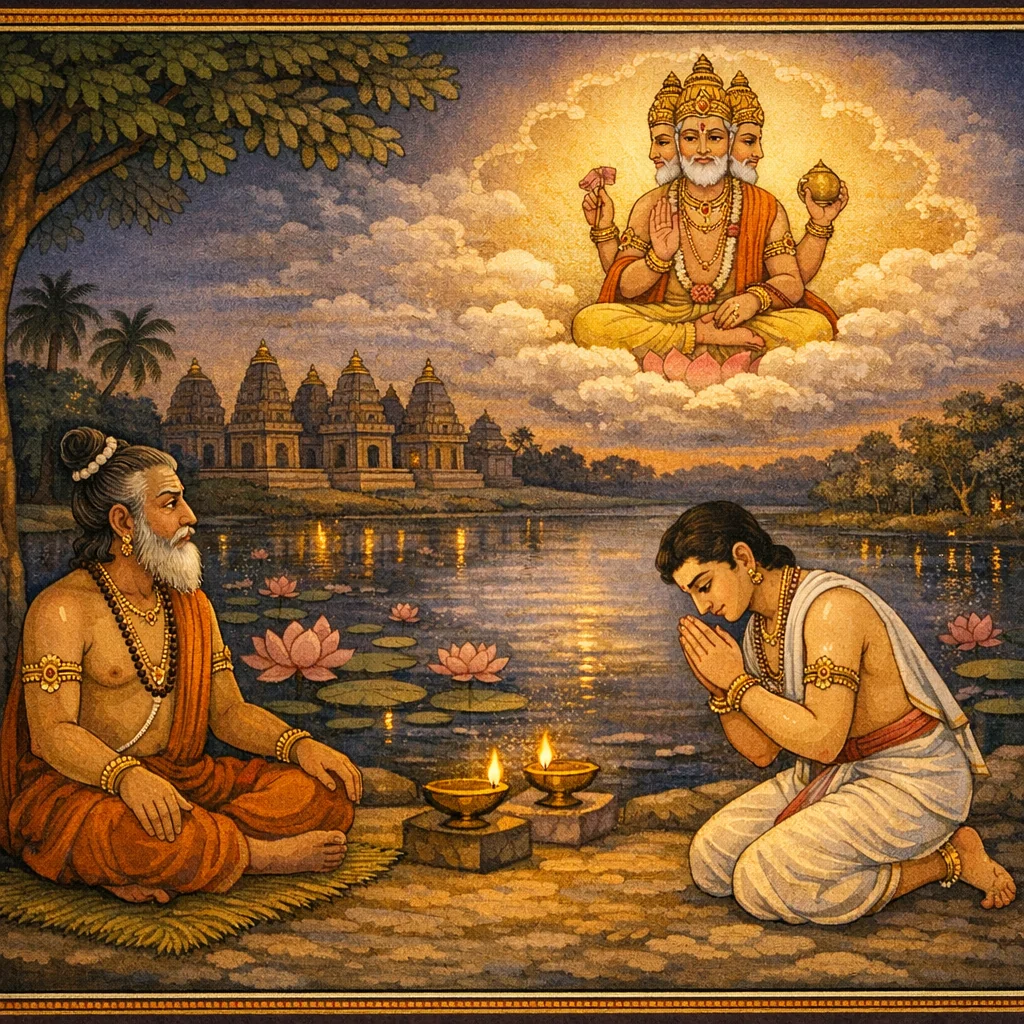
Adhyaya 103
Chapter 103 is framed as a question-led catalogue of sacred establishments and their ritual-ethical benefits within a defined kṣetra. The ṛṣis ask Sūta for fuller details of liṅgas set up by vānara and rākṣasa agents, and Sūta maps the holy space by direction: Sugrīva, after bathing at Bālamaṇḍanaka, installs a Mukha-liṅga; other vānara groups establish further Mukha-liṅgas; rākṣasas place four-faced liṅgas to the west; and to the east Rāma founds a five-prāsāda complex praised as sin-destroying. In the south, near Ānarttīya-taḍāga, a purifying kūpikā is described with explicit timing rules: śrāddha in Dakṣiṇāyana yields Aśvamedha-like merit and elevates ancestors, while Kārttika lamp-offering prevents descent into named hells and removes afflictions such as blindness across births. Prompted again, Sūta proclaims the immeasurable glory of Ānarttīya-taḍāga and shifts to Rāma’s meeting with Agastya. Agastya recounts a nocturnal vision of a celestial aeronaut—once King Śveta of Ānarta—who on Dīpotsava nights repeatedly consumes his own decayed body from the pond and then briefly regains sight, a living allegory of karmic consequence. The king confesses failures of non-giving (especially food), predatory seizure of gems, and neglect of protection; Brahmā explains that these bring hunger and blindness even in higher realms. Agastya prescribes an ethical-ritual remedy: offering the jeweled neck-ornament as anna-niṣkraya (food-compensation), instituting devotional Kārttika ratna-dīpa offerings to Dāmodara, worship of Yama/Dharma-rāja, and gifts of sesame and black gram with brāhmaṇa-tarpaṇa. Freed from hunger and granted purified sight, the king attains Brahma-loka by the tīrtha’s power; the chapter concludes that all who bathe and offer lamps there in Kārttika are released from sins and honored in Brahma-loka, at Ānarttīya-taḍāga with its associated Viṣṇu-kūpikā.
Shlokas
Verse 1
। ऋषय ऊचुः । आश्चर्यं सूतपुत्रैतद्यत्त्वया परिकीर्तितम् । यत्स्थापितानि लिंगानि राक्षसैरपि वानरैः
The sages said: O son of Sūta, wondrous indeed is what you have proclaimed—that liṅgas were established even by Rākṣasas and by Vānaras.
Verse 2
तस्माद्विस्तरतो ब्रूहि यत्रयत्र यथायथा । तैः स्थापितानि लिंगानि येषु स्थानेषु सूतज
Therefore, O son of Sūta, tell us in full detail—where and in what manner those liṅgas were installed, and in which places.
Verse 3
सूत उवाच । सुग्रीवः संभ्रमित्वाथ क्षेत्रं सर्वमशेषतः । बालमंडनकं प्राप्य तत्र स्नात्वा समाहितः
Sūta said: Then Sugrīva, moving about the entire sacred region without leaving anything unvisited, reached Bālamaṇḍanaka; bathing there, he became composed and focused.
Verse 4
मुखलिंगं ततस्तत्र स्थापयामास शूलिनः । तथान्यैर्वानरैः सर्वैमुखलिंगानि शूलिनः । स्वसंज्ञार्थं द्विजश्रेष्ठाः स्थापितानि यथेच्छया
Then, in that place, a Mukha-liṅga of the Trident-bearing Lord (Śiva) was installed. Likewise, all the other Vānaras installed Mukha-liṅgas of Śūlin—O best of the twice-born—according to their wish, to commemorate their own distinctive names.
Verse 5
यस्तेषां मुखलिंगानां करोति घृतकंबलम् । मकरस्थेन सूर्येण शिवलोकं स गच्छति
Whoever makes a “ghee-cloak” (a covering or anointment with clarified butter) for those Mukha-liṅgas—when the Sun is in Makara (Capricorn)—goes to Śiva’s world.
Verse 6
ततः पश्चिमदिग्भागे तस्य क्षेत्रस्य राक्षसैः । संस्थापितानि लिङ्गानि चतुर्वक्त्राणि च द्विजाः
Then, in the western quarter of that sacred region, the Rākṣasas installed four-faced liṅgas, O twice-born.
Verse 7
रामेण पूर्वदिग्भागे प्रासादानां च पंचकम् । स्थापितं भक्तियुक्तेन सर्वपातकनाशनम्
In the eastern quarter, Rāma, filled with devotion, established five shrines (prāsādas) that destroy all sins.
Verse 8
तथादक्षिणदिग्भागे कूपिका तेन निर्मिता । आनर्त्तीयतडागस्य समीपे पापनाशनी
Likewise, in the southern quarter he made a small well (kūpikā) near the Ānarttīya pond, a place that destroys sin.
Verse 9
यस्तस्यां कुरुते श्राद्धं संप्राप्ते दक्षिणायने । सोऽश्वमेधफलं प्राप्य पितृलोके महीयते
Whoever performs śrāddha there when the sun’s southern course (dakṣiṇāyana) has begun attains the fruit of an Aśvamedha sacrifice and is honored in Pitṛloka, the world of the ancestors.
Verse 10
यस्तत्र दीपकं दद्यात्कार्तिके मासि च द्विजाः । न स पश्यति रौद्रांस्तान्नरकानेकविंशतिम् । न चांधो जायते क्वापि यत्रयत्र प्रजायते
O twice-born ones, whoever offers a lamp there in the month of Kārttika will not behold those dreadful twenty-one hells; and wherever he is born again, he is never born blind.
Verse 11
ऋषय ऊचुः । आनर्त्तीयतडागं तत्केन तत्र विनिर्मितम् । किंप्रभावं च कार्त्स्न्येन सूतपुत्र प्रकीर्तय
The sages said: “That Ānarttīya pond—by whom was it constructed there? And what, in full, is its power and glory? O son of Sūta, proclaim it completely.”
Verse 12
सूत उवाच । आनर्त्तीयतडागस्य महिमा द्विजसत्तमाः । एकवक्त्रेण नो शक्यो वक्तुं वर्षशतैरपि
Sūta said: “O best of the twice-born, the greatness of the Ānartīya pond cannot be fully spoken by a single mouth—even in hundreds of years.”
Verse 13
आश्विनस्य सिते पक्षे चतुर्दश्यां समाहितः । स्नात्वा देवान्पितॄंश्चैव तर्पयेद्विधिपूर्वकम्
On the fourteenth day (caturdaśī) of the bright fortnight of Āśvina, being composed in mind, one should bathe and then, according to proper rule, offer tarpaṇa—libations—to the gods and to the ancestors.
Verse 14
ततो दीपोत्सवदिने श्राद्धं कृत्वा समाहितः । दामोदरं यमं पूज्य दीपं दद्यात्स्वभक्तितः
Then, on the day of Dīpotsava, the festival of lamps, having performed śrāddha with a steady mind, one should worship Dāmodara and Yama, and offer a lamp with personal devotion.
Verse 15
संपूज्यो धर्मराजस्तु गन्धपुष्पानुलेपनैः । माषास्तिलाश्च दातव्या गोविंदः प्रीयतामिति
Dharma-rāja (Yama) should be duly worshipped with perfumes, flowers, and unguents; and one should give black gram and sesame, saying, “May Govinda be pleased.”
Verse 16
तिलमाषप्रदानेन द्विजानां तर्पणेन च । यमेन सहितो देवः प्रीयते पुरुषोत्तमः
By giving sesame and black gram, and by offering tarpaṇa to the twice-born, the Supreme Person (Puruṣottama) is pleased—together with Yama.
Verse 17
य एवं कुरुते विप्रास्तीर्थ आनर्त संज्ञिते । सोऽश्वमेधफलं प्राप्यब्रह्मलोके महीयते
O brāhmaṇas, whoever performs these acts in the tīrtha called Ānarta attains the fruit of an Aśvamedha sacrifice and is honored in Brahmaloka.
Verse 18
यस्मिन्दिने समायातो रामस्तत्र प्रहर्षितः । तस्मिन्द्विजोत्तमैः सर्वैः प्रोक्तः सोऽभ्येत्य सादरम्
On the day when Rāma arrived there, delighted, he was addressed by all the foremost brāhmaṇas; and he approached them with respect.
Verse 19
अत्रागस्त्यो मुनिश्रेष्ठस्तिष्ठते रघुनंदन । तं गत्वा पश्य विप्रेन्द्र मित्रावरुणसंभवम्
“Here the foremost of sages, Agastya, abides, O delight of the Raghu line. Go to him and behold that best of brāhmaṇas—born of Mitra and Varuṇa.”
Verse 20
अथ तेषां वचः श्रुत्वा रामो राजीवलोचनः । वानरै राक्षसैः सार्धं प्रहृष्टः सत्वरं ययौ
Then, having heard their words, Rāma of lotus-like eyes—delighted—quickly set out together with the Vānara hosts and the Rākṣasas.
Verse 21
अष्टांगप्रणिपातेन तं प्रणम्य रघूत्तमः । परिष्यक्तो दृढं तेन सानन्देन महात्मना
Raghūttama (Rāma), having bowed to him with the eight-limbed prostration, was firmly embraced by that great-souled sage, who was filled with joy.
Verse 22
नातिदूरे ततस्तस्य विनयेन समन्वितः । उपविष्टो धरापृष्ठे कृतांजलिपुटः स्थितः
Then, not far from him, endowed with humility, he sat upon the earth and remained with hands joined in reverence (añjali).
Verse 23
ततः पृष्टस्तु मुनिना कथयामास विस्तरात् । वृत्तांतं सर्वमात्मीयं स्वर्गस्य गमनं प्रति
Then, questioned by the sage, he narrated in detail his entire personal account—concerning his going toward heaven (svarga).
Verse 24
यथा सीता परित्यक्ता यथा सौमित्रिणा कृतः । परित्यागः स्वकीयस्य संत्यक्तेन महात्मना
He told how Sītā was renounced, and how Saumitrī (Lakṣmaṇa) carried out the renunciation of his own beloved—he, the great soul commanded to abandon.
Verse 25
तथा सुग्रीवमासाद्य तथैव च विभीषणम् । संभाष्य चागमस्त्वत्र ततः पुष्पकसंस्थितिः
Likewise, having met Sugrīva—and also Vibhīṣaṇa—and having spoken with them, he then arrived here; and thereafter came the taking of seat in the Puṣpaka (aerial chariot).
Verse 26
ततोऽगस्त्यः कथाश्चित्राश्चक्रे तस्य पुरस्तदा । राजर्षीणां पुराणानां दृष्टांतैर्बहुभिर्मुनिः
Then the sage Agastya recounted wondrous stories before him, illustrating them with many examples from ancient accounts of royal seers (rājarsis).
Verse 27
ततः कथावसाने च चलचित्तं रघूत्तमम् । विलोक्य प्रददौ तस्मै रत्नाभरणमुत्तमम्
And when the narration had ended, seeing that Raghūttama’s mind still wavered, he bestowed upon him an excellent jewel-ornament.
Verse 28
यन्न देवेषु यक्षेषु सिद्धविद्याधरेषु च । नागेषु राक्षसेन्द्रेषु मानुषेषु च का कथा
That ornament is not found even among the gods, Yakṣas, Siddhas and Vidyādharas—nor among Nāgas or the lords of Rākṣasas; how much less among human beings!
Verse 29
यस्येन्द्रायुधसंघाश्च निष्क्रामंति सहस्रशः । रात्रौ तमिस्रपक्षेऽपि लक्ष्यतेऽर्कोपमत्विषः
From it, thousands upon thousands of rainbow-like flashes stream forth; even on a moonless, pitch-dark night, it is seen shining with a radiance like the sun.
Verse 30
तद्रामस्तु गृहीत्वाऽथ विस्मयोत्फुल्ललोचनः । पप्रच्छ कौतुकाविष्टः कुतस्त्वेतन्मुने तव
Then Rāma, taking it in his hand, his eyes widened in amazement, asked—filled with wonder—“O sage, from where has this come to you?”
Verse 31
अत्यद्भुतकरं रत्नैर्निर्मितं तिमिरापहम् । कण्ठाभरणमाख्याहि नेदमस्ति जगत्त्रये
“Tell me about this neck-ornament—crafted from jewels, wondrous indeed, and a remover of darkness; nothing like it exists in the three worlds.”
Verse 32
अगस्तिरुवाच । यत्पश्यसि रघुश्रेष्ठ तडागमिदमुत्तमम् । ममाश्रमसमीपस्थं तद्देवदेवनिर्मितम्
Agastya said: “O best of the Raghus, this excellent pond that you behold, lying near my hermitage, was fashioned by the Lord of the gods.”
Verse 33
तस्य तीरे मया दृष्टं यदाश्चर्यमनुत्तमम् । तत्तेऽहं संप्रवक्ष्यामि शृणुष्व रघु नन्दन
“On its bank I witnessed an unsurpassed marvel. That I shall now recount to you—listen, O joy of the Raghu line.”
Verse 34
कदाचिद्राघवश्रेष्ठ निशीथेऽहं समुत्थितः । पश्यामि व्योममार्गेण प्रद्योतं भास्करोपमम्
“Once, O best of the Rāghavas, rising at midnight, I saw a brilliant light moving along the path of the sky, radiant like the sun.”
Verse 35
यावत्तावद्विमानं तदप्सरोगणराजितम् । तस्य मध्यगतश्चैकः पुरुषस्तरुणस्तथा । अन्धस्तत्र समारूढः स्तूयते किन्नरैर्नृपः
“In a moment there appeared a celestial chariot, a vimāna adorned with hosts of Apsarases. In its center stood a single youthful man; and upon it rode a blind king, praised in song by the Kinnaras.”
Verse 36
रत्नाभरणमेतच्च बिभ्रत्कण्ठे सुनिर्मलम् । द्वादशार्कप्रतीकाशं कामदेव इवापरः
“Wearing that spotless jeweled ornament upon his neck, shining like twelve suns, he looked like another Kāma-deva.”
Verse 37
अथोत्तीर्य विमानाग्र्यात्स्कंधलग्नो रघूद्वह । एकस्य देवदूतस्य सलिलांतमुपागतः
Then, descending from that foremost celestial chariot and clinging to the shoulder of a certain divine messenger, he came to the edge of the water, O best of the Raghus.
Verse 38
ततश्च सलिलात्तस्मादाकृष्य च कलेवरम् । मृतकस्य ततो दंतैर्भक्षयामास सत्वरम्
Then, pulling a corpse up from that water, he quickly began to devour the dead body with his teeth.
Verse 39
यथायथा महामांसं स भक्षयति राघव । तथातथा पुनः कायं तद्रूपं तत्प्रजायते
O Rāghava, in whatever manner he eats that great flesh, in that very manner his body again takes form—becoming of the same kind and shape.
Verse 40
ततस्तृप्तिं चिरात्प्राप्य शुचिर्भूत्वा प्रहर्षितः । निष्कम्य सलिलाद्यावद्विमानमधिरोहति
Then, after gaining satisfaction at length, becoming purified and delighted, he came out from the water and, at once, mounted a celestial chariot.
Verse 41
तावन्मया द्रुतं गत्वा स पृष्टः कौतुकान्नृपः । सेव्यमानोऽपि गन्धर्वैः समंताद्बुद्धितत्परैः
Just then I hurriedly went and, out of curiosity, questioned that king—though he was being attended on all sides by Gandharvas, intent and attentive.
Verse 42
भोभो वैमानिकश्रेष्ठ मुहूर्तं प्रतिपालय । अगस्तिर्नाम विप्रोऽहं मित्रावरुणसंभवः
“Ho there, best among the riders of the vimāna—wait for a moment. I am the brāhmaṇa named Agastya, born of Mitra and Varuṇa.”
Verse 43
तच्छ्रुत्वा सम्मुखो भूत्वा प्रणाममकरोत्ततः । तैश्च वैमानिकैः सार्धं सर्वैस्तैः किन्नरादिभिः
“Hearing that, he turned to face him and at once made obeisance—together with those vimāna-dwellers and all those Kinnaras and the rest.”
Verse 44
सोऽयं राजा मया पृष्टः कृतानतिः पुरः स्थितः । कस्त्वमीदृग्वपुः श्रीमान्विमानवरमाश्रितः । सेव्यमानोऽप्सरोभिश्च गन्धर्वैः किन्नरैस्तथा
“That king, having bowed, stood before me. I asked: ‘Who are you—so radiant, possessed of such a form, seated in an excellent vimāna, attended by Apsarases, Gandharvas, and Kinnaras as well?’”
Verse 45
अत्राऽगत्य तडागांते महामांसप्रभक्षणम् । कृतवानसि वैकल्यं कस्मात्ते दृष्टिसंभवम्
“Having come here, at the edge of this pond, you ate that great flesh. Why did you commit such a fault—and from what cause did your present condition come about?”
Verse 46
वैमानिक उवाच । साधु साधु मुनिश्रेष्ठ यत्त्वं प्राप्तो ममान्तिकम् । अवश्यं सानुकूलो मे विधिर्यत्त्वं समागतः
“The Vimāna-dweller said: ‘Excellent, excellent, O best of sages, that you have come near me. Surely fate has turned favorable to me, since you have arrived.’”
Verse 47
साधूनां दर्शनं पुण्यं तीर्थभूता हि साधवः । कालेन फलते तीर्थं सद्यः साधुसमागमः
The very sight of the holy is meritorious, for the holy themselves are living tīrthas. A tīrtha yields fruit in time, but meeting a saint bears fruit immediately.
Verse 48
तस्मात्सर्वं तवाख्यानं कथयामि महामुने । येन मे गर्हितं भोज्यं विभवश्च तथेदृशः
Therefore, O great sage, I shall tell you the whole account—how my food became blameworthy, and how such extraordinary splendor came to me.
Verse 49
अहमासं पुरा राजा श्वेतोनाम महामुने । आनर्ताधिपतिः पापः सर्वलोकनिपीडकः
O great sage, I was once a king named Śveta—ruler of Ānarta—sinful in conduct, a tormentor who oppressed all people.
Verse 50
न किंचित्प्राङ्मया दत्तं न हुतं जातवेदसि । न च रक्षा कृता लोके न त्राताः शरणागताः
In earlier times I gave no charity at all, I offered no oblations into Agni; I did not protect anyone in the world, nor did I save those who came seeking refuge.
Verse 51
दृष्ट्वादृष्ट्वा मया रत्नं यत्किंचिद्धरणीतले । तद्वै बलाद्धृतं सर्वं सर्वेषामिह देहिनाम्
Whatever treasure I saw—indeed anything at all upon the earth—I seized it by force, taking everything that belonged to living beings here.
Verse 52
ततः कालेन दीर्घेण जराग्रस्तस्य मे बलात् । हृतं राज्यं स्वपुत्रेण मां निर्वास्य विगर्हितम्
Then, after a long time, when old age had overpowered my strength, my own son seized the kingdom by force and drove me out, disgraced and condemned.
Verse 53
ततोऽहं जरया ग्रस्तो वैराग्यं परमं गतः । समायातोऽत्र विप्रेंद्र भ्रममाण इतस्ततः
Then, afflicted by old age, I attained the highest renunciation; wandering here and there, O best of brāhmaṇas, I finally arrived at this place.
Verse 54
ततः क्षुत्क्षामकण्ठोऽहं स्नात्वाऽत्र सलिले शुभे । मृतश्च संनिविष्टोहं क्षुधया परिपीडितः
Then, with my throat parched by hunger, I bathed here in this auspicious water; tormented by hunger, I died and fell down there.
Verse 55
प्राविश्याऽत्र जले पुण्ये पंचत्वं समुपागतः । ततश्च तत्क्षणादेव विमानं समुपस्थितम्
Entering this holy water, I met my end and became one with the five elements; and at that very moment a celestial chariot (vimāna) appeared.
Verse 56
मामन्येन शरीरेण समादाय च किंकराः । तत्रारोप्य ततः प्राप्ता ब्रह्मणः सदनं प्रति
Then the divine attendants took me up in another body, placed me upon the vimāna, and carried me onward to the abode of Brahmā.
Verse 57
दिव्यमाल्यावरधरंदिव्यगन्धानुलेपनम् । दिव्याभरणसंजुष्टं स्तूयमानं च किन्नरैः
Adorned with heavenly garlands and fine garments, anointed with divine fragrance, and wearing celestial ornaments, I was praised by the Kinnaras.
Verse 58
ततो ब्रह्मसभामध्ये ह्यहं तैर्देवकिंकरैः । तादृग्रूपो विचक्षुश्च धारितो ब्रह्मणः पुरः
Then, in the midst of Brahmā’s assembly, those divine attendants brought me—endowed with such a form and radiant sight—into the presence of Brahmā himself.
Verse 59
सर्वैः सभागतैर्दृष्टा विस्मितास्यैः परस्परम् । अन्यैश्च निन्दमानैश्च धिक्छब्दस्य प्रजल्पकैः
All who had come to the assembly looked on, exchanging glances with faces full of astonishment; while others, censuring, kept muttering reproachful words of “shame!”
Verse 60
किंकरा ऊचुः । एष देवश्चतुर्वक्त्रः सभेयं तस्य सम्भवा । सर्वैर्देवगणैर्जुष्टा प्रणामः क्रियतामिति
The attendants said: “This is the four-faced god, Brahmā. This assembly has arisen from him and is graced by all the hosts of gods. Therefore, make obeisance.”
Verse 61
ततोऽहं प्रणिपत्योच्चैस्तं देवं देवसंयुतम् । उपविष्टः सभामध्ये व्रीडयाऽवनतः स्थितः
Then I bowed down deeply before that god, surrounded by the gods; and, seated in the midst of the assembly, I remained with my head lowered in shame.
Verse 62
यथायथा कथास्तत्र प्रजायन्ते सभातले । देवद्विजनरेन्द्राणां धर्माख्यानानि कुंभज
O Kumbhaja, as diverse discussions arose there upon the floor of the assembly, so were recounted sacred narratives of dharma concerning gods, Brahmins, and kings.
Verse 63
तथातथा ममातीव क्षुद्वृद्धिं संप्रगच्छति । जाने किं भक्षयाम्याशु दृषदः काष्ठमेव वा
Just so, my hunger kept increasing greatly. I wondered, “What shall I quickly eat—stones, or even wood?”
Verse 64
ततो मया प्रणम्योच्चैर्विज्ञप्तः प्रपितामहः । प्राणिपत्य मुनिश्रेष्ठ लज्जां त्यक्त्वा सुदूरतः
Then, having bowed in deep reverence, I addressed the Great Grandsire (Brahmā). O best of sages, after prostrating, I cast aside my shame and spoke openly.
Verse 65
क्षुधा मां बाधते अतीव सांप्रतं प्रपितामह । तथा पश्यामि नो किंचित्तादृग्भोज्यं प्रयच्छ मे
“O Great Grandsire, hunger afflicts me intensely right now. I see nothing at all fit to be eaten—grant me such food.”
Verse 66
क्षुत्पिपासादयो दोषा न विद्यंतेऽत्र ते किल । स्वर्गे स्थितस्य यच्चैतत्तत्किमेवंविधं मम
“They say that faults such as hunger and thirst do not exist here. If I am dwelling in heaven, why then is my condition like this?”
Verse 67
पितामह उवाच । त्वया नान्नं क्वचिद्दत्तं कस्यचित्पृथिवीतले । तेनात्रापि बुभुक्षा ते वृद्धिं गच्छति दुर्मते
The Grandsire said: “You never gave food to anyone anywhere upon the earth. Therefore, even here your hunger increases—O misguided one.”
Verse 68
तथा हृतानि रत्नानि यानि दृष्टिगतानि ते । चक्षुर्हीनस्ततो जातो मम लोके गतोऽपि च
“Likewise, the jewels that came within your sight—you stole them. Therefore you became deprived of eyesight, even though you have come to my world.”
Verse 69
यस्त्वं पातकयुक्तोऽपि संप्राप्तो मम मंदिरम् । तद्वक्ष्याम्यखिलं तेऽहं शृणुष्वैकमनाः स्थितः
Even though you are burdened with sin, you have come to my temple. Therefore I shall tell you everything in full—listen, standing here with a one-pointed mind.
Verse 70
यस्मिञ्जले त्वया मुक्ताः प्राणाः पापा त्मनापिच । श्वेतद्वीपपतिस्तत्र कलिकालभयातुरः
In the very water where you—though sinful—gave up your life-breath, the lord of Śvetadvīpa is there, distressed by fear of the Kali age.
Verse 71
ततोऽस्य स्पर्शनात्सद्यो विमुक्तः सर्वपातकैः । अन्नादानात्परा पीडा जायते क्षुत्समु द्भवा
Thereafter, by merely touching it, one is instantly freed from all sins. But when the dharma of giving food is violated, a severe affliction arises—suffering born of hunger (as its consequence).
Verse 72
तथा रत्नापहारेण सञ्जाता चांधता तव । नैवान्यत्कारणं किंचित्सत्यमेतन्मयोदितम्
Likewise, through the theft of jewels your blindness has arisen. There is no other cause at all—this is the truth I have spoken.
Verse 73
ततो मया विधिः प्रोक्तः पुनरेव द्विजोत्तम । एषोऽपि ब्रह्मलोकस्ते नरकादतिरिच्यते । तस्मात्तत्रैव मां देव प्रेषयस्व किमत्र वै
Then, O best of twice-born, I again declared the prescribed procedure. Even this Brahma-world of yours surpasses hell. Therefore, O Lord, send me there alone—what is the point of my staying here?
Verse 74
ब्रह्मोवाच । तस्मात्तत्रैव गच्छ त्वं प्रेषि तोऽसि किमत्र वै । नरके तव वासो न श्वेतद्वीपसमुद्भवम्
Brahmā said: Therefore go there alone—you have been dispatched; what is your business here? For you there is no dwelling in hell—(you are) one who has arisen from Śvetadvīpa.
Verse 75
माहात्म्यं नाशमायाति शास्त्रं स्यात्सत्यवर्जितम् । तस्मात्त्वं नित्यमारूढो विमा ने त्रैवसुन्दरे
The Māhātmya would be destroyed, and the scripture would become bereft of truth. Therefore remain always mounted upon the celestial chariot named Traivasundara.
Verse 76
गत्वा जलाशये तस्मिन्यत्र प्राणाः समुज्झिताः । तमेव निजदेहं च भक्षयस्व यथेच्छया
Go to that lake where the life-breaths were abandoned; and there, devour that very body of yours as you wish.
Verse 77
तद्भविष्यति मद्वाक्या दक्षयं जलमध्यगम् । तावत्कालं च दृष्टिस्ते भोज्यकाले भविष्यति
That shall happen by my word: you will remain inexhaustible within the water. And for that duration, your sight will return only at the time of eating.
Verse 78
ततोऽहं तस्य वाक्येन दीपोत्सवदिने सदा । निशीथेऽत्र समा गत्य भक्षयामि निजां तनुम्
Then, by his command, on the day of the Festival of Lamps, at midnight, I always come here and devour my own body.
Verse 79
ततस्तृप्तिं प्रगच्छामि यावद्दैवं दिनं स्थितम् । मानुषं च तथा वर्षमीदृग्रूपो व्यवस्थितः
Then I attain contentment for as long as a divine day endures—and likewise for a full human year—such is the measure of my state.
Verse 80
नास्त्यसाध्यं मुनिश्रेष्ठ तव किंचिज्जगत्त्रये । येनैकं चुलुकं कृत्वा निपीतः पयसांनिधिः
O best of sages, nothing is impossible for you in the three worlds—for you once made but a single handful and drank the ocean dry.
Verse 81
तस्मान्मुने दयां कृत्वा ममोपरि महत्तराम् । अकृत्या द्रक्ष मामस्मात्सर्वलोकविगर्हितात्
Therefore, O sage, show me even greater compassion and protect me from this wrongdoing—condemned by all the worlds.
Verse 82
तथा दृष्टिप्रदानं मे कुरुष्व मुनिसत्तम । निर्विण्णोऽस्म्यंधभावेन नान्या त्वत्तोऽस्ति मे गतिः
Grant me sight, O best of sages. I am worn out by blindness; apart from you, I have no refuge.
Verse 83
तस्य तद्वचनं श्रुत्वा कृपया मम मानसम् । द्रवीभूतं तदा वाक्यमवोचं तं रघूत्तम
Hearing his words, my heart melted with compassion; then I spoke these words to that noble one, the best of the Raghu line.
Verse 84
त्वमन्ननिष्क्रयं देहि कण्ठस्थमिह भूषणम् । येन नाशं प्रयात्येषा बुभुक्षा जठरोद्भवा
Give, as the price for food, the ornament you wear upon your neck; by it this hunger—born of the belly—will come to an end.
Verse 85
तथाऽद्यप्रभृति प्राज्ञ रत्नदीपान्सुनिर्मलान् । अत्रैव सरसस्तीरे देहि दामोदराय च
And from today onward, O wise one, offer spotless lamps of jewels right here on the bank of this lake—also unto Dāmodara.
Verse 86
द्धस येन संजायते दृष्टिः शाश्वती तव निर्मला । मम वाक्यादसंदिग्धं सत्येनात्मानमालभे
By this, your everlasting, stainless sight will arise. Of my word there is no doubt—by truth I stake my very self.
Verse 87
राजोवाच । ममोपरि दयां कृत्वा त्वमेव मुनिसत्तम । गृहाण रत्नसंभूतं कण्ठाभरणमुत्तमम्
The King said: “Show compassion to me, O best of sages. Please accept this finest neck-ornament, fashioned from jewels.”
Verse 90
ततो दयाभिभूतेन मया तस्य प्रतिग्रहः । निःस्पृहेणापि संचीर्णो मुनिना रण्यवासिना । ततः प्रक्षाल्य मे पादौ यावत्तेनान्ननिष्क्रये । विभूषणमिदं दत्तं सद्भक्त्या भावितात्मने । ततस्तस्य प्रणष्टा सा बुभुक्षा तत्क्षणान्नृप । संजाता परमा तृप्तिर्देवपीयूषसंभवा
“Then, overcome by compassion, I accepted his gift—though I was a desireless sage dwelling in the forest. After he had washed my feet, he offered this ornament as the price for food, with sincere devotion and a purified heart. At that very moment, O king, his hunger vanished, and supreme satisfaction arose, as though born of the nectar of the gods.”
Verse 91
तस्य नष्टं मृतं कायं तच्च जीर्णं पुरोद्भवम् । यदासीदक्षयं नित्यं तस्मिंस्तोये व्यवस्थितम्
His body—lost, as it were dead, and worn out from former existence—was set aside; but that which in him was imperishable and eternal remained established in that sacred water.
Verse 92
ततः संस्थापितस्तेन तस्मिन्स्थाने सुभक्तितः । दामोदरो रघुश्रेष्ठ कृत्वा प्रासादमुत्तमम्
Then, O best of the Raghus, with excellent devotion he established Dāmodara in that very place, having built a splendid temple.
Verse 93
तस्याग्रे श्रद्धया युक्तो दीपं दयाद्यथायथा । तथातथा भवेद्दृष्टिस्तस्य नित्यं सुनिर्मलाम्
As one, endowed with faith, offers a lamp before Him again and again, so—accordingly—does one’s vision become ever pure and clear.
Verse 94
ततो मासात्समासाद्य दिव्यचक्षुर्महीपतिः । स बभूव नृपश्रेष्ठः स्पृहणीयतमः सताम्
Then, when a month had passed, that king attained divine sight; he became the foremost of rulers, most worthy of the virtuous’ admiration.
Verse 95
ततः प्रोवाच मां हृष्टः प्रणिपत्य कृतांजलिः । हर्षगद्गदया वाचा प्रस्थितस्त्रिदिवं प्रति
Then, delighted, he addressed me; bowing down with joined palms, and with a voice choked with joy, he set out toward heaven.
Verse 96
त्वत्प्रसादात्प्रणष्टा मे बुभुक्षाऽतिसुदारुणा । तथा दृष्टिश्च संजाता दिव्या ब्राह्मणसत्तम
By your grace my terrible, overpowering hunger has vanished; and likewise, O best of brāhmaṇas, divine vision has arisen in me.
Verse 97
अनुज्ञां देहि मे तस्माद्येन गच्छामि सांप्रतम् । ब्रह्मलोकं मुनिश्रेष्ठ तीर्थस्यास्य प्रभावतः
Therefore grant me permission, O best of sages, so that I may now depart to Brahmaloka, by the very power of this tīrtha.
Verse 98
ततो मया विनिर्मुक्तः प्रणिपत्य मुहुर्मुहुः । स जगाम प्रहृष्टात्मा ब्रह्मलोकं सनातनम्
Then, released by me, after bowing again and again, he went forth with a joyful heart to the eternal Brahmaloka.
Verse 99
एवं मे भूषणमिदं जातं हस्तगतं पुरा । तव योग्यमिदं ज्ञात्वा तुभ्यं तेन निवेदितम्
Thus this ornament came into my hands long ago; knowing it to be worthy of you, he presented it to you as an offering.
Verse 100
ततः प्रभृति राजेंद्र समागत्यात्र मानवाः । रत्नदीपान्प्रदायोच्चैः स्नात्वाऽत्र सलिले शुभे । कार्तिके मासि निर्यांति देहांते त्रिदिवालयम्
From that time onward, O king, people come here; reverently offering jeweled lamps and bathing in this auspicious water, they depart at life’s end—especially in the month of Kārtika—to the heavenly abode.
Verse 101
ये पुनः प्राणसंत्यागं प्रकुर्वंति समाहिताः । पापात्मानोऽपि ते यांति ब्रह्मलोकं रघूत्तम
And those who, with a collected mind, relinquish their life there—even if they have been sinful—attain Brahmaloka, O Raghūttama (Rāma).
Verse 102
ततो दृष्ट्वा सहस्राक्षः प्रभावं तज्जलोद्भवम् । पांसुभिः पूरयामास समंताद्भयसंकुलम्
Then Sahasrākṣa (Indra), seeing the extraordinary potency arising from that water, seized with fear, filled it in on all sides with dust.
Verse 103
तदद्य दिवसः प्राप्तो दीपोत्सवसमुद्भवः । सुपुण्योऽत्र ममादेशात्त्वं कुरुष्व सुकूपिकाम्
That day has now arrived—the auspicious occasion from which the festival of lamps arose. Therefore, by my command, establish here a fine little well (kūpikā), highly meritorious in this place.
Verse 107
तत्र स्नात्वा पितॄंस्तर्प्य रत्नदीपं प्रदाय च । समस्तं कार्तिकं यावदयोध्यां प्रस्थितास्ततः
Having bathed there, having satisfied the Pitṛs with tarpaṇa-offerings, and having presented a jewel-lamp, they then set out for Ayodhyā, observing the whole month of Kārtika.
Verse 108
ततो विभीषणं मुक्त्वा हनूमंतं च वानरम् । ब्रह्मलोकं गताः सर्वे तत्तीर्थस्य प्रभावतः
Then, leaving Vibhīṣaṇa and the monkey Hanūmān behind, all the others went to Brahmaloka—by the power of that tīrtha.
Verse 109
सूत उवाच । अद्यापि दीपदानं यः कुरुते तत्र सादरम् । संप्राप्ते कार्तिके मासि स्नात्वा तत्र जले शुभे । स सर्वपातकैर्मुक्तो ब्रह्मलोके महीयते
Sūta said: Even today, whoever reverently offers a lamp there—having bathed in that auspicious water when the month of Kārtika has arrived—is freed from all sins and is honored in Brahmaloka.
Verse 110
एवं तत्र समुत्पन्नं तत्तडागं शुभावहम् । आनर्त्तीयं तथा विष्णुकूपिका सा च शोभना
Thus there arose that auspicious, welfare-bringing pond; it is known as Ānarttīya, and that beautiful well is called Viṣṇukūpikā.