Adhyaya 9
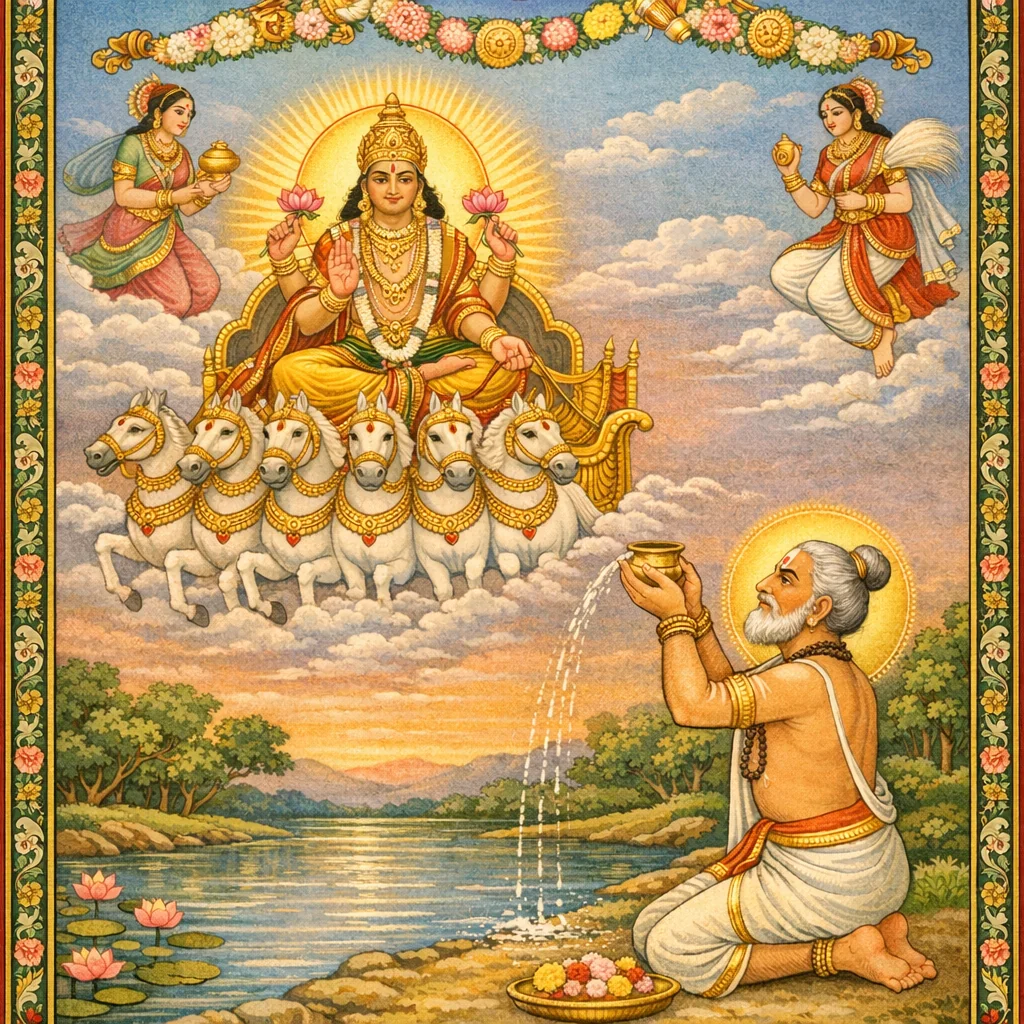
Adhyāya 9 opens as a didactic dialogue: Śivaśarmā asks about extraordinarily beautiful, richly adorned celestial women. The Gaṇa explain that they are apsaras-like beings, skilled in music, dance, refined speech, and the arts, and they describe the causes for dwelling in Apsaroloka—ritual observances, occasional lapses in continence under the force of fate, and desire-oriented vows that ripen into divine enjoyments. The chapter then names various apsaras, depicts their heavenly ornaments, and points to merit-making acts connected with solar transitions (saṅkramaṇa), bhogadāna (gifts of enjoyments), and mantra-framed offerings. In its second movement the text exalts Sūrya, and especially the Gayatrī mantra, asserting a hierarchy of knowledge that culminates in Gayatrī as the supreme mantra. Tri-kāla discipline and exact sandhyā timing are stressed as obligatory according to kāla-śāstra. Practical rites are given: offering arghya with a clean copper vessel, water, flowers, kuśa/dūrvā, and akṣata, with mantra-salutations at sunrise and sunset. Many epithets of the Sun (nāma-stuti) are recited, promising health and prosperity and, after death, ascent to Sūryaloka; the chapter closes with the merit of listening (śravaṇa-phala) and Agastya’s approval of its ethical and purificatory power.
Shlokas
Verse 1
शिवशर्मोवाच । का इमा रूपलावण्य सौभाग्यनिधयः स्त्रियः । दिव्यालंकारधारिण्यो दिव्यभोगसमन्विताः
Śivaśarmā said: “Who are these women—treasures of beauty, charm, and good fortune—adorned with divine ornaments and endowed with heavenly enjoyments?”
Verse 2
गणावूचतुः । एता वारविलासिन्यो यज्ञभाजां प्रियंकराः । गीतज्ञा नृत्यकुशला वाद्यविद्या विचक्षणाः
The two attendants (gaṇas) said: “These are courtesans of the city—delighters of those who have earned sacrificial merit; skilled in song, adept in dance, and discerning in the arts of instrumental music.”
Verse 3
कामकेलिकलाभिज्ञा द्यूतविद्याविशारदाः । रसज्ञा भाववेदिन्यश्चतुराश्चोचितोक्तिषु
They are versed in the arts of amorous play, accomplished in the science of gaming, connoisseurs of rasa (aesthetic delight), sensitive to emotions, and clever in fitting, graceful speech.
Verse 4
नानादेश विशेषज्ञा नानाभाषा सुकोविदाः । संकेतोदंतनिपुणा नैकास्वैरचरा मुदा
They are experts in the distinctive ways of many lands, highly proficient in many languages, skilled in secret signs and subtle hints, and—joyfully—move about freely in many ways.
Verse 5
लीलानर्मसुसाभिज्ञाः सुप्रलापेषु पंडिताः । यूनां मनांसि सततं स्वैर्हावै रमयंत्यमूः
Skilled in playful arts and amorous jesting, and learned in refined conversation, these Apsarās continually delight the minds of young men by their own graceful gestures and coquetry.
Verse 6
निर्मथ्यमानात्क्षीरोदात्पूर्वमप्सरसस्त्वमूः । निःसृतास्त्रिजगज्जेतुर्मोहनास्त्रमनोभुवः
When the Ocean of Milk was first being churned, these Apsarās emerged. They are the delusive weapon of Manobhū (Kāma), the conqueror of the three worlds.
Verse 7
उर्वशी मेनका रंभा चंद्रलेखा तिलोत्तमा । वपुष्मतीकांतिमती लीलावत्युत्पलावती
Urvaśī, Menakā, Rambhā, Candralekhā, Tilottamā—Vapuṣmatī, Kāntimatī, Līlāvatī, and Utpalāvatī as well—(these are among the Apsarās).
Verse 8
अलंबुषा गुणवती स्थूलकेशी कलावती । कलानिधिर्गुणनिधिः कर्पूरतिलकोर्वरा
Alambuṣā, Guṇavatī, Sthūlakeśī, Kalāvatī; Kalānidhi, Guṇanidhi, and Karpūratilakā, and Orvarā—(these too are among the Apsarās).
Verse 9
अनंगलतिका चापि तथा मदनमोहिनी । चकोराक्षी चंद्रकला तथा मुनिमनोहरा
Anaṅgalatikā also, and likewise Madanamohinī; Cakorākṣī, Candrakalā, and also Munimanoharā—these are numbered among the Apsarās.
Verse 10
ग्रावद्रावा तपोद्वेष्टी चारुनासा सुकर्णिका । दारुसंजीविनी सुश्रीः क्रतुशुल्का शुभानना
Grāvadrāvā, Tapodveṣṭī, Cārunāsā, Sukarṇikā; Dārusaṃjīvinī, Suśrī, Kratuśulkā, and Śubhānanā—these too are among the Apsarās.
Verse 11
तपःशुल्का तीर्थशुल्का दानशुल्का हिमावती । पंचाश्वमेधिका चैव राजसूयार्थिनी तथा
Tapaḥśulkā, Tīrthaśulkā, Dānaśulkā, Himāvatī; and also Paṃcāśvamedhikā, and likewise Rājasūyārthinī—these are among the Apsarās.
Verse 12
अष्टाग्निहोमिका तद्वद्वाजपेयशतोद्भवा । इत्याद्यप्सरसां श्रेष्ठं सहस्रं षष्टिसंमितम्
Aṣṭāgnihomikā, and likewise Vājapeyaśatodbhavā—thus and so forth. The foremost among the Apsarās are, in all, one thousand and sixty.
Verse 13
एतस्मिन्नप्सरोलोके वसंत्यन्या अपिस्त्रियः । सदा स्खलितलावण्याः सदास्खलितयौवनाः
In this realm of the Apsarās dwell many other women as well—ever overflowing with beauty, ever brimming with youth.
Verse 14
दिव्यांबरा दिव्यमाल्या दिव्यगंधानुलेपनाः । दिव्यभोगैः सुसंपन्नाः स्वेच्छाविधृतविग्रहाः
Clad in divine raiment, adorned with celestial garlands, and anointed with heavenly perfumes, they are richly endowed with supernal delights, assuming forms at will.
Verse 15
कृत्वा मासोपवासानि स्खलंति ब्रह्मचर्यतः । सकृदेव द्विकृत्वो वा त्रिःकृत्वो दैवयोगतः
Even after observing month-long fasts, they may yet slip from the vow of brahmacarya—once, twice, or even thrice—through the force of fate (daiva).
Verse 16
ता इमा दिव्यभोगिन्यो रूपलावण्यसंपदः । निवसंत्यप्सरोलोके सर्वकामसमन्विताः
These women, enjoying celestial pleasures and endowed with beauty and charm, dwell in the realm of the Apsarases, furnished with every desired delight.
Verse 17
कृत्वा व्रतानि सांगानि कामिकानि विधानतः । भवंति स्वैरचारिण्यो देवभोग्या इहागताः
Having duly performed, according to ordinance, the desire-fulfilling vows together with all their proper ancillaries, they become here women who move at will, fit to partake in divine pleasures.
Verse 18
पतिव्रतधृता नार्यो बलेन बलिना धृताः । भर्तबुद्ध्यारमंतेतं कदाचित्ता इमा द्विज
These women—steadfast in pativratā, the vow of wifely fidelity—are held fast by a mighty force; and, O twice-born (dvija), at times they delight in him, regarding him as their husband.
Verse 19
भर्तरि प्रोषिते याश्च ब्रह्मचर्यव्रताः सदा । विप्लवं ते सकृद्दैवात्ता एता वामलोचनाः
And those whose husbands were away, ever steadfast in the vow of continence (brahmacarya), by the decree of fate suffered a single lapse; thus they became these fair‑eyed women.
Verse 20
कुसुमानि सुगंधीनि सुवासं चंदनं तथा । सुगौरं चापि कर्पूरं सुसूक्ष्माण्यंबराणि च
Fragrant flowers, choice perfumes, and sandalwood; bright‑white camphor as well, and garments of the finest delicacy—(these are to be arranged as offerings).
Verse 21
पर्णानि ऋजुताराणि जीर्णानि कठिनानि च । साग्राणि स्वर्णवर्णानि स्थूलनीलशिराणि च
Leaves—straight and firm; aged and hard; with pointed tips; golden‑hued; and also bearing thick blue veins—(such are the ones described and selected).
Verse 22
सुवासोपस्कराढ्यानि नागवल्ल्या द्विजोत्तम । शय्याविचित्राभरणा रतिशालोचितानि च
Abounding in fine garments and luxurious articles, together with the betel creeper, O best of the twice‑born; adorned with splendid beds and ornaments, and with things befitting the chambers of delight.
Verse 23
बहुकौतुकवस्तूनि समर्च्यद्विजदंपती । भोगदानमिदं काम्यं प्रतिसंक्रमणं रवेः
After duly honoring the Brahmin couple with many delightful articles, this desired “gift of enjoyments” is to be performed at Ravi’s saṃkramaṇa—the Sun’s sacred transit.
Verse 24
किंवा प्रतिव्यतीपातमेकसंवत्सरावधि । कोदादिति च मंत्रेण या दद्याद्वरवर्णिनी
Or else, for a full year—on each occasion of prativyatīpāta—the noble, beautiful woman who gives in charity while uttering the mantra “kodāditi” attains the merit that has been declared.
Verse 25
कामरूपधरो देवः प्रीयतामिति वादिनी । सा श्रेष्ठाऽप्सरसां मध्ये वसेत्कल्पमिहांगना
Saying, “May the god who assumes forms at will be pleased,” that woman—foremost among the Apsarases—dwelt there for a full kalpa.
Verse 26
कन्यारूपधराकाचिद्याभुक्ता केनचित्क्वचित् । देवरूपेण तं कालमारभ्य ब्रह्मचारिणी
A certain woman, taking the form of a maiden, was once enjoyed by someone somewhere; from that time onward—since it occurred in a divine form—she lived as a brahmacāriṇī, vowed to celibacy.
Verse 27
तदेव वृत्तं ध्यायंती निधनं याति कालतः । दिव्यरूपधरा सेह जायते दिव्य भोगभाक्
Meditating on that very occurrence, in due course she met her end; and then, bearing a divine form, she was born here, partaking of celestial enjoyments.
Verse 28
निदानमप्सरोलोकस्येतिशृण्वन्द्विजाग्रणीः । सौरं लोकमथ प्राप्य क्षणेन स विमानगः
Hearing thus the cause of attaining the world of the Apsarases, O best of the twice-born, he—riding in a celestial vimāna—reached the Solar world in an instant.
Verse 29
यथा कदंबकुसुमं किंजल्कैः सर्वतोवृतम् । देदीप्यमानं हि तथा समंताद्भानुभानुभिः
Just as a kadamba blossom, encircled on every side by its pollen-filaments, shines forth, so too it blazed all around with rays upon rays of light.
Verse 30
दूराद्रविं स विज्ञाय धृततामरसद्वयम् । नवभिर्योजनानां च सहस्रैः संमितेन ह
Recognizing the Sun from afar, he held a pair of lotuses; and the Sun’s orb, they say, was measured at nine thousand yojanas.
Verse 31
विचित्रेणैकचक्रेण सप्तसप्तियुतेन च । अनूरुणाधिष्ठितेन पुरतोधृतरश्मिना
With a wondrous chariot of a single wheel, yoked with seven horses; with Anūruṇa as the charioteer, and with rays held out before—
Verse 32
अप्सरोमुनिगंधर्व सर्पग्रामणि नैरृतैः । स्यंदनेनातिजविना प्रणनाम कृतांजलिः
Surrounded by Apsarases, sages (munis), Gandharvas, serpent-lords, and Nairṛtas, he—upon a very swift chariot—bowed down with joined palms.
Verse 33
तस्य प्रणामंदेवोपि भ्रूभंगेनानुमन्य च । अतिदूरं नभोवर्त्म व्यतिचक्राम सक्षणात्
Even the god acknowledged his salutation with a mere movement of the brow; and in an instant he traversed the far-reaching path of the sky.
Verse 34
प्रक्रांते द्युमणौ दूरं शिवशर्मातिशर्मवान् । प्रोवाच भगवद्भक्तौ कथं लभ्यं रवेः पदम्
When the Radiant One had gone far ahead, Śivaśarman—filled with great joy—asked: “Through devotion (bhakti) to the Lord, how may the station of the Sun be attained?”
Verse 35
एतदिच्छाम्यहं श्रोतुमाचक्षाथां ममाग्रतः । सतां साप्तपदी मैत्री तन्मे मैत्र्या प्रणोदितौ
“I wish to hear this—tell it to me plainly, here before me. Among the virtuous, friendship is sealed by the ‘seven steps’; therefore, urged on by friendship, speak it to me.”
Verse 36
गणावूचतुः । शृणु द्विज महाप्राज्ञ त्वय्यकथ्यं न किंचन । सत्संगादेव साधूनां सत्कथा संप्रवर्तते
The Gaṇas said: “Listen, O most wise Brāhmaṇa—there is nothing that ought not be spoken to you. Indeed, from the company of the holy alone does sacred discourse arise and proceed.”
Verse 37
नियंता सर्वभूतानां य एकःकारणं परम् । अनामा गोत्ररहितो रूपादि परिवर्जितः
“He is the one Supreme Cause and the ruler of all beings—nameless, without lineage, and beyond form and all such attributes.”
Verse 38
आविर्भाव तिरोभावौ यद्भूनर्तनवर्तिनौ । स एव वक्ति सततं सर्वात्मा वेदपूरुषः
“In Him, manifestation and withdrawal move within the dance of beings—He alone speaks unceasingly as the Inner Self of all, the Person (Puruṣa) of the Veda.”
Verse 39
योसावादित्यपुरुषः सोसावहमिति स्फुटम् । अंधतमः प्रविशंति ये चैवान्यमुपासते
That Purusha in the Sun—He indeed is the “I”: this is plain. Those who worship anything else enter into blinding darkness.
Verse 40
निश्चितार्थां श्रुतिमिमां ब्राह्मणासो द्विजोत्तम । तमेकमुपतिष्ठंते निश्चित्येति पुनःपुनः
O best of the twice-born, the Brāhmaṇas, having ascertained the settled meaning of this śruti, worship that One alone—after discerning it again and again.
Verse 41
उपलभ्य च सावित्रीं नोपतिष्ठेत यः पराम् । काले त्रिकालं सप्ताहात्स पतेन्नात्र संशयः
Having obtained the supreme Sāvitrī (Gāyatrī), whoever does not perform its worship at the proper times—three times a day—falls within seven days; of this there is no doubt.
Verse 42
तावत्प्रातर्जपंस्तिष्ठेद्यावदर्धोदयो रवेः । आसनस्थो जपेन्मौनी प्रत्यगातारकोदयात्
In the morning, one should remain engaged in japa until the sun is half-risen. Seated on a proper seat, silent, one should continue japa until the rising of the morning star is past.
Verse 43
सादित्यां मध्यमां संध्यां जपेदादित्यसंमुखः । काललोपो न कर्तव्यस्ततः कालं प्रतीक्षयेत्
At the midday sandhyā, one should recite facing the Sun. One must not omit the proper time; therefore one should wait for the correct time and perform it.
Verse 44
काले फलंत्योषधयः काले पुष्पंति पादपाः । वर्षंति तोयदाः काले तस्मात्कालं न लंघयेत्
In due season herbs bear fruit; in due season trees blossom; in due season rain-clouds pour forth—therefore one should not transgress the appointed time.
Verse 45
मंदेहदेहनाशार्थमुदयास्तमये रविः । समीहते द्विजोत्सृष्टं मंत्रतोयांजलित्रयम्
At sunrise and at sunset, the Sun strives to destroy the bodies of the Mandehas; therefore he longs for the three handfuls of water, sanctified by mantra, offered by a twice-born man.
Verse 46
गायत्रीमंत्रतोयाढ्यं दत्तं येनांजलित्रयम् । काले सवित्रे किं न स्यात्तेन दत्तं जगत्त्रयम्
Whoever, at the proper time, offers to Savitṛ three handfuls of water enriched with the Gāyatrī-mantra—what would not be achieved by him? It is as though he has given the three worlds in gift.
Verse 47
किं किं न सविता सूते काले सम्यगुपासितः । आयुरारोग्यमैश्वर्यं वसूनि सपशूनि च
What is it that Savitṛ does not bestow when properly worshipped at the proper time? He grants long life, health, prosperity, wealth, and even cattle.
Verse 48
मित्रपुत्र कलत्राणि क्षेत्राणि विविधानि च । भोगानष्टविधांश्चापि स्वर्गं चाप्यपवर्गकम्
He grants friends, sons, and spouses; many kinds of lands; the eightfold enjoyments as well—along with heaven, and even final liberation.
Verse 49
अष्टादश सुविद्यासु मीमांसातिगरीयसी । ततोपि तर्कशास्त्राणि पुराणं तेभ्य एव च
Among the eighteen noble disciplines, Mīmāṃsā is most weighty; higher still are the treatises of reasoning, and higher than even those is the Purāṇa.
Verse 50
ततोपि धर्मशास्त्राणि तेभ्यो गुर्वी श्रुतिर्द्विज । ततोप्युपनिषच्छ्रेष्ठा गायत्री च ततोधिका
Higher even than those are the Dharmaśāstras; weightier than them, O twice-born, is Śruti. Higher still are the Upaniṣads—and superior even to them is Gāyatrī.
Verse 51
दुर्लभा सर्वमंत्रेषु गायत्री प्रणवान्विता । न गायत्र्याधिकं किंचित्त्रयीषु परिगीयते
Among all mantras, the Gāyatrī—joined with the Praṇava—is rare indeed. In the three Vedas nothing whatsoever is sung as superior to Gāyatrī.
Verse 52
न गायत्री समो मंत्रो न काशी सदृशी पुरी । न विश्वेश समं लिंगं सत्यंसत्यं पुनःपुनः
No mantra equals Gāyatrī; no city resembles Kāśī; no liṅga is equal to Viśveśa—this is truth, truth again and again.
Verse 53
गायत्री वेदजननी गायत्री ब्राह्मणप्रसूः । गातारं त्रायते यस्माद्गायत्री तेन गीयते
Gāyatrī is the mother of the Vedas; Gāyatrī gives birth to brāhmaṇas. Because she protects (trāyate) the singer/reciter (gātā), she is therefore called ‘Gāyatrī’.
Verse 54
वाच्यवाचकसंबंधो गायत्र्याः सवितुर्द्वयोः । वाच्योसौ सविता साक्षाद्गायत्रीवाचिकापरा
Between Gāyatrī and Savitṛ there is the relation of the denoted and the denoting. Savitṛ himself is directly what is denoted; Gāyatrī is the supreme denoting utterance.
Verse 55
प्रभावेणैव गायत्र्याः क्षत्रियः कौशिको वशी । राजर्षित्वं परित्यज्य ब्रह्मर्षिपदमीयिवान्
By the sheer power of Gāyatrī, the self-mastered Kauśika—though a Kṣatriya—abandoned the status of rājārṣi and attained the rank of Brahmarṣi.
Verse 56
सामर्थ्यं प्राप चात्युच्चैरन्यद्भुवनसर्जने । किं किं न दद्याद्गायत्री सम्यगेवमुपासिता
He attained exceedingly great capability—even to create other worlds. What, indeed, would Gāyatrī not bestow when worshipped properly in this way?
Verse 57
न ब्राह्मणो वेदपाठान्न शास्त्रपठनादपि । देव्यास्त्रिकालमभ्यासाद्बाह्मणः स्याद्धि नान्यथा
One does not become a true Brāhmaṇa merely by reciting the Vedas or by studying the śāstras. Rather, by the thrice-daily practice of the Goddess (Gāyatrī), one becomes a Brāhmaṇa—indeed, not otherwise.
Verse 58
गायत्र्येव परं विष्णुर्गायत्र्येव परःशिवः । गायत्र्येव परोब्रह्मा गायत्र्येव त्रयी ततः
Gāyatrī alone is the Supreme Viṣṇu; Gāyatrī alone is the Supreme Śiva. Gāyatrī alone is the supreme Brahmā; therefore Gāyatrī alone is the very Triad and the threefold Veda.
Verse 59
देवत्रयं स भगवानंशुमाली दिवाकरः । सर्वेषां महसां राशिः कालकालप्रवर्तकः
That blessed Sun—garlanded with rays, maker of day—is itself the triad of gods. He is the treasury of all splendors and the regulator of time and its cycles.
Verse 60
अर्कमुद्दिश्य सततमस्मल्लोकनिवासिनः । श्रुतिं ह्युदाहरंतीमां सारासारविवेकिनः
With the Sun in view, the discerning—able to distinguish the essential from the non-essential—continually cite this Vedic utterance among the people of our world.
Verse 61
एषो ह देवः प्रदिशोनु सर्वाः पूर्वो ह जातः स उ गर्भे अंतः । स एव जातः स जनिष्यमाणः प्रत्यङ्जानास्तिष्ठति सर्वतोमुखः
This very Deva pervades all directions; first-born, he is also within the womb. He alone is born, and he is the one yet to be born; facing inward, he stands with faces on all sides.
Verse 62
सदैवमुपतिष्ठेरन्सौरसूक्तैरतंद्रिताः । ये नमंत्यत्र ते विप्रा विप्रा भास्करसन्निभाः
Let them always, without negligence, attend upon the Sun with the Saurasūktas. Those Brāhmaṇas who bow here become Brāhmaṇas radiant like Bhāskara, the Sun.
Verse 63
पुष्यार्केप्यथ हस्तार्के मूलार्केप्यथवा द्विज । उत्तरार्केऽथ यत्कार्यं तत्फलत्येव नान्यथा
O twice-born, whether on a Puṣya-Sun day, a Hasta-Sun day, a Mūla-Sun day, or an Uttara-Sun day—whatever rite is undertaken then surely bears fruit, and not otherwise.
Verse 64
पौषे मास्यर्कदिवसे यः स्नात्वा भास्करोदये । दानहोमंजपंकुर्यादर्चामर्कस्य सुव्रत
O keeper of an excellent vow: in the month of Pauṣa, on the Sun’s sacred day, having bathed at Bhāskara’s sunrise, whoever performs charity, fire-offering (homa), and japa, and worships the Sun, attains the promised merit.
Verse 65
श्रद्धावानेकभक्तश्च कामक्रोधविवर्जितः । सहाप्सरोभिर्द्युतिमान्स वसेदत्र भोगवान्
One who is faithful, devoted in single-minded worship, and free from desire and anger dwells here in radiant splendor, enjoying divine felicities together with the apsarās.
Verse 66
अयने विषुवे चापि षडशीतिमुखेषु वा । विष्णुपद्यां च ये दद्युर्महादानानि सुव्रताः
Those disciplined votaries who give great gifts at the solstices, at the equinoxes, at the opening of the eighty-six sacred junctures, and also on Viṣṇupadī are praised as keepers of noble vows.
Verse 67
तिलाञ्जुह्वति साज्यांश्च ब्राह्मणान्भोजयंति च । पितॄनुद्दिश्य च श्राद्धं ये कुर्वंति विपश्चितः
The wise who offer sesame into the fire with ghee, who feed brāhmaṇas, and who perform śrāddha directed to the ancestors—such acts are upheld as dharma rich in merit.
Verse 68
महापूजां च ये कुर्युर्महामंत्राञ्जपंति च । तेऽत्र वैकर्तने लोके विकर्तनसमप्रभा
Those who perform grand worship (pūjā) and who recite great mantras—here, in the radiant world of Vaikartana, they shine with a splendor equal to Vikartana, the Sun.
Verse 69
न दरिद्रा न च दुःखार्ता न व्याधि परिपीडिताः । संक्रमेष्वर्कभक्ता ये न विरूपा न दुर्भगाः
Those who, at the time of saṅkrānti, are devoted to Arka (the Sun) are not poor, not afflicted by sorrow, not tormented by disease; they are neither ugly nor unfortunate.
Verse 70
संक्रमेषु न यैर्दत्तं न स्नातं तीर्थवारिषु । विशेषहोमो न कृतः कपिलाज्याप्लुतैस्तिलैः
Those who, at saṅkrānti, neither give in charity, nor bathe in the waters of a tīrtha, nor perform the special fire-offering with sesame steeped in the ghee of a tawny cow—
Verse 71
ते दृश्यंते प्रतिद्वारं विहीन नयनाननाः । देहिदेहीति जल्पंतो देहिनः सपटच्चराः
They are seen at every doorway, bereft of eyes and face, babbling, “Give, give!”—embodied beings moving about in rags and tatters.
Verse 72
समं कृष्णलकेनापि यो दद्यात्कांचनं कृती । सूर्यग्रहे कुरुक्षेत्रे स वसेदत्र पुण्यभाक्
Even if only equal to the measure of a single black seed, the capable person who gives gold at Kurukṣetra during a solar eclipse dwells here, sharing in great merit.
Verse 73
सर्वं गंगासमं तोयं सर्वे ब्रह्मसमा द्विजाः । सर्वं देयं स्वर्णसमं राहुग्रस्ते दिवाकरे
When the day-maker (the Sun) is seized by Rāhu, all water becomes equal to the Gaṅgā, all brāhmaṇas equal to Brahmā, and every gift becomes equal to giving gold.
Verse 74
दत्तं जप्तं हुतं स्नातं यत्किंचित्सदनुष्ठितम् । भानूपरागे श्राद्धादि तद्धेतुर्ब्रध्न संनिधे
Whatever is duly performed—dāna (charity), japa (mantra-recitation), homa (oblations), ritual bathing, and rites such as śrāddha—when done during a solar eclipse, becomes supremely efficacious in the presence of Bradhna, the Sun.
Verse 75
रविवारे संक्रमश्चेदुपरागोऽथवाभवेत् । तदा यदर्जितं पुण्यं तदिहाक्षयमाप्यते
If Ravi’s day (Sunday) coincides with a saṃkrānti (solar transit) or an eclipse, then whatever puṇya is gained at that time becomes imperishable, here in this very life.
Verse 76
भानुवारो यदा षष्ठ्यां सप्तम्यामथ जायते । तदा यत्सुकृतं कर्म कृतं तदिह भुज्यते
When Sunday falls on the sixth or seventh lunar day (ṣaṣṭhī or saptamī), the good deed performed then bears fruit to be enjoyed here itself.
Verse 77
हंसो भानुः सहस्रांशुस्तपनस्तापनो रवि । विकर्तनो विवस्वांश्च विश्वकर्मा विभावसुः
Haṃsa, Bhānu, Sahasrāṃśu, Tapana, Tāpana, Ravi; Vikartana, Vivasvān, Viśvakarmā, and Vibhāvasu—these are names of Sūrya.
Verse 78
विश्वरूपो विश्वकर्ता मार्तंडो मिहिरोंऽशुमान् । आदित्यश्चोष्णगुः सूर्योऽर्यमा ब्रध्नो दिवाकरः
Viśvarūpa, Viśvakartā, Mārtaṇḍa, Mihira, Aṃśumān; Āditya, Uṣṇagu, Sūrya, Aryamā, Bradhna, and Divākara—these are names of the Sun.
Verse 79
द्वादशात्मा सप्तहयो भास्करो हस्करः खगः । सुरः प्रभाकरः श्रीमांल्लोकचक्षुर्ग्रहेश्वरः
Dvādaśātmā, Saptahaya, Bhāskara, Haskara, Khaga; Sura, Prabhākara, Śrīmān, Lokacakṣus, and Graheśvara—these are the sacred names of the Sun.
Verse 80
त्रिलोकेशो लोकसाक्षीतमोरिः शाश्वतः शुचिः । गभस्तिहस्तस्तीव्रांशुस्तरणिः सुमहोरणिः
Trilokeśa, Lokasākṣin, Tamori, Śāśvata, Śuci; Gabhastihasta, Tīvrāṃśu, Taraṇi, and Sumahoraṇi—these are the sacred names of the Sun.
Verse 81
द्युमणिर्हरिदश्वोर्को भानुमान्भयनाशनः । छन्दोश्वो वेदवेद्यश्च भास्वान्पूषा वृषाकपिः
Dyumaṇi, Haridaśva, Arka, Bhānumān, Bhayanāśana; Chandōśva, Vedavedya, Bhāsvān, Pūṣā, and Vṛṣākapi—these are the sacred names of the Sun.
Verse 82
एकचक्ररथो मित्रो मंदेहारिस्तमिस्रहा । दैत्यहा पापहर्ता च धर्मोधर्म प्रकाशकः
Ekacakraratha, Mitra, slayer of the Mandehas, destroyer of darkness; killer of the daityas, remover of sin, and revealer of dharma and adharma—these are the names of the Sun.
Verse 83
हेलिकश्चित्रभानुश्च कलिघ्नस्तार्क्ष्यवाहनः । दिक्पतिः पद्मिनीनाथः कुशेशयकरो हरिः
Helika, Citrabhānu, destroyer of Kali, he whose vehicle is Tārkṣya; lord of the directions, lord of the lotus-groves, maker of the kuśeśaya-lotus, Hari—these are the names of the Sun.
Verse 84
घर्मरश्मिर्दुर्निरीक्ष्यश्चंडांशुः कश्यपात्मजः । एभिः सप्ततिसंख्याकैः पुण्यैः सूर्यस्य नामभिः
Gharmaraśmi, Durnirīkṣya, Caṇḍāṃśu, and Kaśyapātmaja—by these meritorious Names of Sūrya, seventy in number, he is praised.
Verse 85
प्रणवादि चतुर्थ्यंतैर्नमस्कार समन्वितैः । प्रत्येकमुच्चरन्नाम दृष्ट्वादृष्ट्वा दिवाकरम्
Beginning with Oṁ and ending with the dative (—āya), joined with reverent obeisance, one should utter each Name in turn—gazing again and again upon the Sun, the Day-maker.
Verse 86
विगृह्य पाणियुग्मेन ताम्रपात्रं सुनिर्मलम् । जानुभ्यामवनिं गत्वा परिपूर्य जलेन च
Taking up with both hands a very clean copper vessel, and going down upon the ground with the knees, one should fill it completely with water.
Verse 87
करवीरादि कुसुमै रक्तचंदनमिश्रितैः । दूर्वांकुरैरक्षतैश्च निक्षिप्तैः पात्रमध्यतः
With flowers such as karavīra (oleander), mixed with red sandalwood, and with dūrvā shoots and unbroken grains of rice placed in the middle of the vessel—
Verse 88
दद्यादर्घ्यमनर्घ्याय सवित्रे ध्यानपूर्वकम् । उपमौलि समानीय तत्पात्रं नान्यदृङ्मनाः
One should offer arghya—priceless—to Savitṛ, after meditating; raising that vessel up to the crown of the head, with gaze and mind fixed on nothing else.
Verse 89
प्रतिमंत्रं नमस्कुर्यादुदयास्तमये रविम् । अनया नामसप्तत्या महामंत्ररहस्यया
With each mantra, one should bow to Ravi at sunrise and at sunset—through this set of seventy Names, the secret of the great mantra is revealed.
Verse 90
एवं कुर्वन्नरो जातु न दरिद्रो न दुःखभाक् । व्याधिभिर्मुच्यते घोरैरपिजन्मांतरार्जितैः
One who acts thus is never poor, nor a bearer of sorrow; he is freed from dreadful diseases, even those acquired from previous births.
Verse 91
विनौषधैर्विना वैद्यैर्विनापथ्यपरिग्रहैः । कालेन निधनं प्राप्तः सूर्यलोके महीयते
Without medicines, without physicians, and without adopting dietary regimens, when he reaches death in due time, he is honored in the world of the Sun.
Verse 92
इत्येकदेशः कथितो भानुलोकस्य सत्तम । महातेजोनिधेरस्य कोविशेषमवैत्यहो
Thus, O best of the virtuous, only a small portion of the Sun’s realm has been described. Who indeed can fully comprehend the greatness of this treasury of immense radiance?
Verse 93
स्वकर्णविषयीकुर्वन्नितिपुण्यकथामिमाम् । क्षणादालोकयांचक्रे महेंद्रस्य महापुरीम्
Having thus taken this meritorious account into his own hearing, in a moment he beheld the great city of Mahendra (Indra).
Verse 94
अगस्तिरुवाच । श्रुत्वा सौरीं कथमेतामप्सरोलोकसंयुताम् । न दरिद्रो भवेत्क्वापि नाधर्मेषु प्रवर्तते
Agastya said: Having heard this sacred Saurī narrative, joined to the realm of the Apsarases, one is never poor anywhere, and one does not turn toward unrighteous deeds (adharma).
Verse 95
ब्राह्मणैः सततं श्राव्यमिदमाख्यानमुत्तमम् । वेदपाठेन यत्पुण्यं तत्पुण्यफलदायकम्
This excellent sacred account should always be recited and heard by brāhmaṇas. It bestows the very fruit of merit that arises from Vedic recitation.
Verse 96
ब्राह्मणाः क्षत्रिया वैश्याः शृण्वंतोऽध्यायमुत्तमम् । पातकानि विसृज्येह गतिं यास्यंत्यनुत्तमाम्
Brāhmaṇas, kṣatriyas, and vaiśyas who listen to this excellent chapter cast off their sins here itself and attain an unsurpassed spiritual destiny.