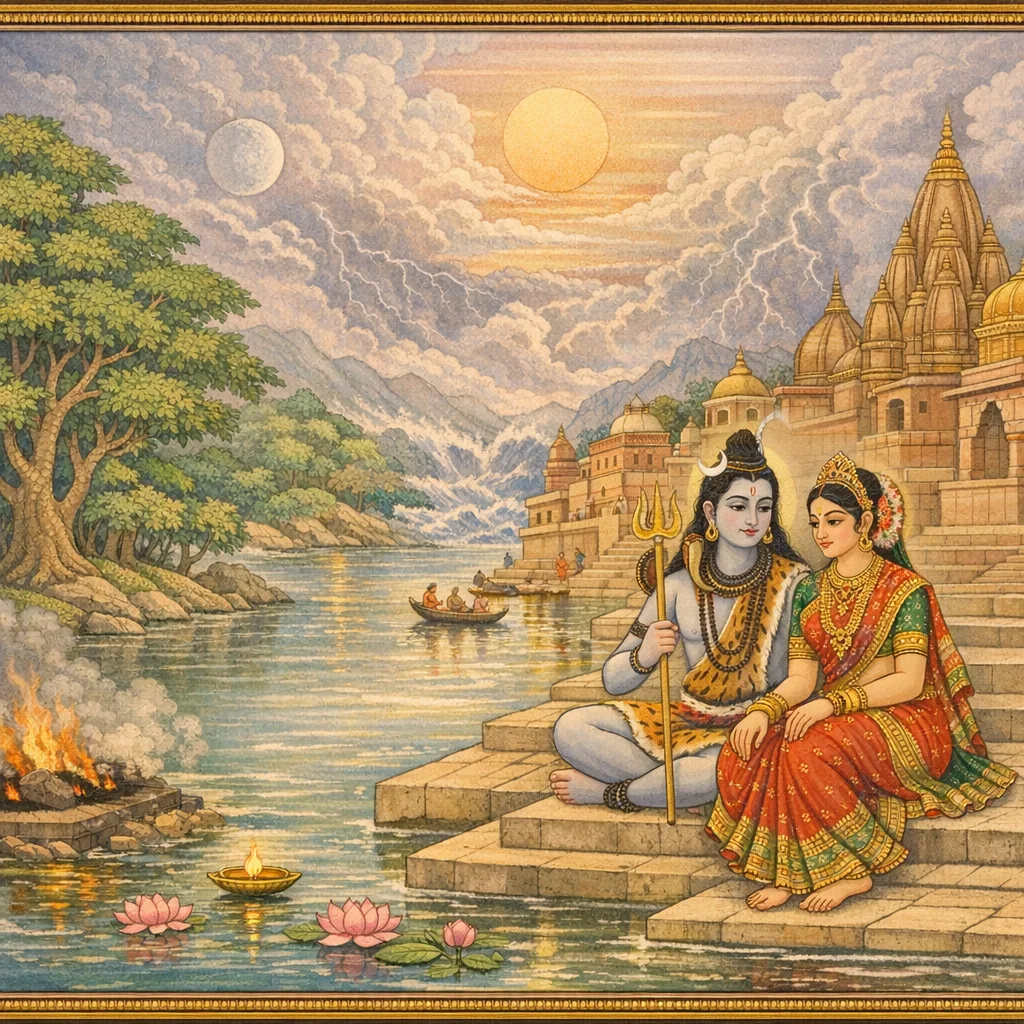
Adhyaya 26
Agastya asks Skanda about the first appearance of Avimukta on earth, its rise in fame as a mokṣa‑bestowing kṣetra, the origin of Maṇikarṇikā, and the derivations of the names Kāśī/Vārāṇasī/Rudrāvāsa/Ānandakānana/Mahāśmaśāna. Skanda replies by recounting an earlier divine disclosure: at the time of mahāpralaya there is an undifferentiated state, and then creative agency arises through Śiva‑Śakti categories, expressed in terms such as prakṛti, māyā, and buddhi‑tattva. Avimukta is described as a five‑krośa expanse that Śiva and Śakti never abandon, even at dissolution; hence it is called “Avimukta,” the un-abandoned. The narrative then turns to Ānandavana, where Viṣṇu appears, performs intense tapas, excavates the sacred pond Cakrapuṣkariṇī, and receives Śiva’s favor. Maṇikarṇikā is explained through a mythic incident: Śiva’s jeweled ear‑ornament (maṇi‑kuṇḍala) falls due to a movement, making that tīrtha renowned by this name. The chapter also lists ritual and ethical acts in Kāśī and proclaims their fruits exceptionally potent—so much so that even minimal contact, and even merely uttering the city’s name, extends merit—affirming Kāśī’s supremacy through comparative statements of phala.
Shlokas
Verse 1
अगस्तिरुवाच । प्रसन्नोसि यदि स्कंद मयि प्रीतिरनुत्तमा । तत्समाचक्ष्व भगवंश्चिरं यन्मे हृदिस्थितम्
Agastya said: If you are pleased with me, O Skanda, and if your love for me is unsurpassed, then tell me, O Blessed One, that which has long remained within my heart.
Verse 2
अविमुक्तमिदं क्षेत्रं कदारभ्य भुवस्तले । परां प्रथितिमापन्नं मोक्षदं चाभवत्कथम्
From what time onward, upon the surface of the earth, did this sacred field called Avimukta attain supreme renown—and how did it become a bestower of liberation?
Verse 3
कथमेषा त्रिलोकीड्या गीयते मणिकर्णिका । तत्रासीत्किं पुरास्वामिन्यदा नामरनिम्नगा
How is this Maṇikarṇikā praised as renowned throughout the three worlds? And what was there in ancient times, O Lord—when that river was first known by name?
Verse 4
वाराणसीति काशीति रुद्रावास इति प्रभो । अवाप नामधेयानि कथमेतानि सा पुरी । आनंदकाननं रम्यमविमुक्तमनंतरम्
O Lord, how did that city obtain these names—‘Vārāṇasī’, ‘Kāśī’, and ‘Rudrāvāsa’? And how is it also spoken of as the delightful Ānandakānana and, furthermore, as Avimukta?
Verse 5
महाश्मशान इति च कथं ख्यातं शिखिध्वज । एतदिच्छाम्यहं श्रोतुं संदेहं मेऽपनोदय
And how did it become famed as ‘Mahāśmaśāna’, O Śikhidhvaja? I wish to hear this—remove my doubt.
Verse 6
स्कंद उवाच । प्रश्नभारोयमतुलस्त्वया यः समुदाहृतः । कुंभयोनेऽमुमेवार्थमप्राक्षीदंबिका हरम्
Skanda said: The weight of the questions you have uttered is truly incomparable, O Kumbhayoni. This very matter Ambikā once asked of Hara.
Verse 7
यथा च देवदेवेन सर्वज्ञेन निवेदितम् । जगन्मातुः पुरस्ताच्च तथैव कथयामि ते
Just as the Lord of gods, the all-knowing One, explained it in the presence of the Mother of the universe—so too shall I relate it to you.
Verse 8
महाप्रलय काले च नष्टे स्थावरजंगमे । आसीत्तमोमयं सर्वमनर्कग्रहतारकम्
And at the time of the great dissolution, when the immovable and the moving creation had perished, everything became nothing but darkness—without sun, planets, or stars.
Verse 9
अचंद्रमनहोरात्रमनग्न्यनिलभूतलम् । अप्रधानं वियच्छून्यमन्यतेजोविवर्धितम्
There was no moon, no day or night; no fire, wind, or earth—no manifest primal substance; the sky was empty, and only an undifferentiated radiance prevailed.
Verse 10
द्रष्टृत्वादि विहीनं च शब्दस्पर्शसमुज्झितम् । व्यपेतगंधरूपं च रसत्यक्तमदिङ्मुखम्
It was devoid even of the condition of ‘seerhood’ and the like; bereft of sound and touch; with smell and form departed; with taste abandoned—without any direction or orientation.
Verse 11
इत्थं सत्यंधतमसि सूचीभेद्ये निरंतरे । तत्सद्ब्रह्मेति यच्छ्रुत्या सदैकं प्रतिपाद्यते
Thus, in that dense darkness—continuous and impenetrable, as though pierceable only by a needle—Śruti proclaims the one enduring Reality: “That is Being; that is Brahman.”
Verse 12
अमनोगोचरोवाचां विषयं न कथंचन । अनामरूपवर्णं च न स्थूलं न च यत्कृशम्
It is beyond the reach of mind and never truly an object of speech. It has no name, no form, no color—neither gross nor subtle.
Verse 13
अह्रस्वदीर्घमलघुगुरुत्वपरिवर्जितम् । न यत्रोपचयः कश्चित्तथा चापचयोपि च
It is free from shortness and length, from lightness and heaviness. In it there is neither increase nor decrease.
Verse 14
अभिधत्ते स चकितं यदस्तीति श्रुतिः पुनः । सत्यं ज्ञानमनंतं च यदानंदं परं महः
Even the Śruti, as if in wonder, declares only this: “It exists.” That supreme radiance is truth, knowledge, endlessness—and bliss.
Verse 15
अप्रमेयमनाधारमविकारमनाकृति । निर्गुणं योगिगम्यं च सर्वव्याप्येककारणम्
It is immeasurable, without support, unchanging and formless; beyond the guṇas, attainable by yogins—all-pervading, the single cause of all.
Verse 16
निर्विकल्पं निरारंभं निर्मायं निरुपद्रवम् । यस्येत्थं संविकल्प्यंते संज्ञाः संज्ञोदितस्य वै
It is without conceptual division, without any originating undertaking, without illusion, and free from disturbance. Yet for That—beyond all naming—such designations are imaginatively applied.
Verse 17
तस्यैकलस्य चरतो द्वितीयेच्छा भवत्किल । अमूर्तेन स्वमूर्तिश्च तेनाकल्पि स्वलीलया
For that One, moving alone, there arose—so it is said—the wish for a “second.” Thus, by Its own līlā, the Form was fashioned by the Formless.
Verse 18
सर्वैश्वर्यगुणोपेता सर्वज्ञानमयी शुभा । सर्वगा सर्वरूपा च सर्वदृक्सर्वकारिणी
Endowed with every lordly power and virtue, made of all knowledge, auspicious—she pervades all, assumes all forms, sees all, and accomplishes all.
Verse 19
सर्वैकवंद्या सर्वाद्या सर्वदा सर्वसंकृतिः । परिकल्प्येति तां मूर्तिमीश्वरीं शुद्धरूपिणीम्
She is the one revered by all, the primordial source, ever-present, the universal ordering power. Thus they conceive that pure-formed Sovereign Goddess as a manifest form.
Verse 20
अंतर्दधे पराख्यं यद्ब्रह्मसर्वंगमव्ययम्
Then that imperishable Brahman—called “the Supreme,” all-pervading—became concealed, unmanifest.
Verse 21
अमूर्तं यत्पराख्यं वै तस्य मूर्तिरहं प्रिये । अर्वाचीनपराचीना ईश्वरं मां जगुर्बुधाः
“Beloved, of that formless Reality known as the Supreme, I am its manifest form. As both the near and the far, the wise proclaim me as Īśvara.”
Verse 22
ततस्तदैकलेनापि स्वैरं विहरतामया । स्वविग्रहात्स्वयं सृष्टा स्वशरीरानपायिनी
Then, even when I wandered freely there alone, She—self-manifest from my own divine form—appeared of Herself, never departing from Her own body, ever self-subsistent and inseparable.
Verse 23
प्रधानं प्रकृतिं त्वां च मायां गुणवतीं पराम् । बुद्धि तत्त्वस्य जननीमाहुर्विकृतिवर्जिताम्
They call You Pradhāna, Prakṛti, and the supreme Māyā endowed with the guṇas; they also declare You to be the mother of the principle of intellect (buddhi-tattva), untouched by any distortion.
Verse 24
युगपच्च त्वया शक्त्या साकं कालस्वरूपिणा । मयाऽद्य पुरुषेणैतत्क्षेत्रं चापि विनिर्मितम्
Together with You, O Śakti, and with the One whose very nature is Time, I—today as Puruṣa—have fashioned this sacred field (kṣetra) as well.
Verse 25
सा शक्तिः प्रकृतिः प्रोक्ता स पुमानीश्वरः परः । ताभ्यां च रममाणाभ्यां तस्मिन्क्षेत्रे घटोद्भव
That Power is spoken of as Prakṛti; that Male Principle is the supreme Lord. And while those two delight together in that sacred field, O Pot-born one (Agastya)…
Verse 26
परमानंदरूपाभ्यां परमानंदरूपिणी । पंचक्रोशपरीमाणे स्वपादतलनिर्मिते
She whose very form is supreme bliss, together with the Two whose forms are supreme bliss, abides within the five-krośa measure—this sacred kṣetra fashioned by the sole of Her own foot.
Verse 27
मुने प्रलयकालेपि न तत्क्षेत्रं कदाचन । विमुक्तं हि शिवाभ्यां यदविमुक्तं ततो विदुः
O sage, even at the time of pralaya that sacred field is never abandoned; for it is not ‘forsaken’ by Śiva and Śivā—therefore the wise know it as Avimukta, the Never-Forsaken.
Verse 28
न यदा भूमिवलयं न यदाऽपां समुद्भवः । तदा विहर्तुमीशेन क्षेत्रमेतद्विनि र्मितम्
When there was no encircling earth and when the waters had not yet arisen, then—so that the Lord might sport—this sacred kṣetra was fashioned.
Verse 29
इदं रहस्यं क्षेत्रस्य वेद कोपि न कुंभज । नास्तिकाय न वक्तव्यं कदाचिच्चर्मचक्षुषे
O Kumbhaja, scarcely anyone knows this secret of the kṣetra. It should never be told to a nāstika, nor to one who sees only with the ‘skin-eye’, mere outward vision.
Verse 30
श्रद्धालवे विनीताय त्रिकालज्ञानचक्षुषे । शिवभक्ताय शांताय वक्तव्यं च मुमुक्षवे
But it should be taught to the faithful and disciplined; to one whose vision is illumined by knowledge of the three times; to a devotee of Śiva, peaceful in nature, and longing for liberation (mokṣa).
Verse 31
अविमुक्तं तदरभ्य क्षेत्रमेतदुदीर्यते । पर्यंक भूतं शिवयोर्निरंतरसुखास्पदम्
From that very point this sacred region is proclaimed as “Avimukta”—the couch of Śiva and Śivā, the abode of unbroken bliss.
Verse 32
अभावः कल्प्यते मूढैर्यदा च शिवयोस्तयोः । क्षेत्रस्यास्य तदाभावः कल्प्यो निर्वाणकारिणः
When the deluded imagine any “absence” of Śiva and His Śakti here, they must likewise imagine the absence of this sacred Kṣetra—whose very nature is to bestow nirvāṇa.
Verse 33
अनाराध्य महेशानमनवाप्य च काशिकाम् । योगाद्युपायविज्ञोपि न निर्वाणमवाप्नुयात्
Without worshipping Maheśa, and without attaining Kāśikā (Kāśī) itself, even one skilled in yoga and other means does not obtain final liberation.
Verse 34
अस्यानंदवनं नाम पुरा कारि पिनाकिना । क्षेत्रस्यानंदहेतुत्वादविमुक्तमंनतरम्
Long ago Pinākin (Śiva) made this place known as Ānandavana. And because this Kṣetra is a direct cause of bliss, it is immediately renowned as Avimukta, the Never-Forsaken.
Verse 35
आनंदकंदबीजानामंकुराणि यतस्ततः । ज्ञेयानि सर्वलिंगानि तस्मिन्नानंदकानने
In that Forest of Bliss, all the Liṅgas are to be understood as sprouts arising everywhere from the seed-tubers of divine bliss.
Verse 36
अविमुक्तमिति ख्यातमासीदित्थं घटोद्भव । तथा चाख्याम्यथ मुने यथासीन्मणिकर्णिका
Thus it became renowned as “Avimukta,” O Ghaṭodbhava (Agastya). And now, O sage, I shall also tell how Maṇikarṇikā came to be.
Verse 37
प्रागानंदवने तत्र शिवयो रममाणयोः । इच्छेत्यभूत्कलशज सृज्यः कोप्यपरः किल
Formerly, in Ānandavana, while Śiva and (Śakti) delighted there, a mere intention arose—O Kalaśaja (Agastya)—that “something else should be brought forth.”
Verse 38
यस्मिन्न्यस्ते महाभारे आवां स्वः स्वैरचारिणौ । निर्वाणश्राणनं कुर्वः केवलं काशिशायिनाम्
When that great burden was set aside, we two moved freely in our own heaven, granting the gift of liberation only to those who dwell in Kāśī.
Verse 39
स एव सर्वं कुरुते स एव परिपाति च । स एव संवृणोत्यंते सर्वैश्वर्यनिधिः स च
He alone accomplishes everything; He alone protects. And in the end, He alone gathers all back—He is the very treasury of all lordly powers.
Verse 40
चेतःसमुद्रमाकुंच्य चिंताकल्लोलदोलितम् । सत्त्वरत्नं तमोग्राहं रजोविद्रुमवल्लितम्
Restrain the ocean of the mind, tossed by the waves of anxiety—where sattva is like a gem, tamas like a crocodile, and rajas like coral that entangles.
Verse 41
यस्य प्रसादात्तिष्ठावः सुखमानंदकानने । परिक्षिप्त मनोवृत्तौ क्व हि चिंतातुरे सुखम्
By whose grace we abide happily in the Forest of Bliss. For when the mind’s movements are scattered, what happiness can there be for one afflicted by worry?
Verse 42
संप्रधार्येति स विभुः सर्वतश्चित्स्वरूपया । तया सह जगद्धात्र्या जगद्धाताऽथ धूर्जटिः
Having thus resolved, that all-pervading Lord—Dhūrjaṭi (Śiva), the sustainer of the worlds—together with the World-Mother, whose nature is pure Consciousness in every way, proceeded to act for the ordering of creation.
Verse 43
सव्ये व्यापारयांचक्रे दृशमंगे सुधामुचम् । ततः पुमानाविरासीदेकस्त्रैलोक्यसुंदरः
On his left side he set in motion a glance that poured forth nectar; from that there appeared a single Person, beautiful to the three worlds.
Verse 44
शांतः सत्त्वगुणोद्रिक्तो गांभीर्य जितसागरः । तथा च क्षमया युक्तो मुनेऽलब्धोपमोऽभवत्
He was tranquil, rich in the quality of sattva; in depth he surpassed the ocean; and endowed with forbearance—O sage—he became incomparable.
Verse 45
इंद्रनीलद्युतिःश्रीमान्पुंडरीकोत्तमेक्षणः । सुवर्णाकृति सुच्छाय दुकूलयुगलावृतः
Splendid with the radiance of indranīla sapphire, blessed with fortune, lotus-eyed; golden in form and radiant in complexion, he was clad in a pair of fine garments.
Verse 46
लसत्प्रचंडदोर्दंड युगलद्वयराजितः । उल्लसत्परमामोदनाभीह्रदकुशेशयः
Adorned with two pairs of shining, mighty arms; and with a navel like a lake, within which a lotus gleamed with supreme fragrance and delight.
Verse 47
एकः सर्वगुणावासस्त्वेकः सर्वकलानिधिः । एकः सर्वोत्तमो यस्मात्ततो यः पुरुषोत्तमः
He alone is the abode of all virtues; he alone is the treasury of all arts and powers. Because he is the one supreme above all, therefore he is called Puruṣottama, the Highest Person.
Verse 48
ततो महांतं तं वीक्ष्य महामहिमभूषणम् । महादेव उवाचेदं महाविष्णुर्भवाच्युत
Then, beholding that great One adorned with immense majesty, Mahādeva said: “Become Mahāviṣṇu, O Acyuta!”
Verse 49
तव निःश्वसितं वेदास्तेभ्यः सर्वमवैष्यसि । वेददृष्टेन मार्गेण कुरु सर्वं यथोचितम्
“The Vedas are your very exhalation; from them you shall know everything. Do all things as is fitting, following the path shown by the Veda.”
Verse 50
इत्युक्त्वा तं महेशानो बुद्धितत्त्वस्वरूपिणम् । शिवया सहितो रुद्रो विवेशानंदकाननम्
Having thus addressed him—who embodied the very principle of intellect (buddhi-tattva)—Maheśāna, Rudra, together with Śivā, entered the Grove of Bliss.
Verse 51
ततः स भगवान्विष्णुर्मौलावाज्ञां निधाय च । क्षणं ध्यानपरो भूत्वा तपस्येव मनो दधौ
Then the Lord Viṣṇu, reverently placing the command upon his head, became intent on meditation for a moment and set his mind as though engaged in austerity.
Verse 52
खनित्वा तत्र चक्रेण रम्यां पुष्करिणीं हरिः । निजांगस्वेदसंदोह सलिलैस्तामपूरयत्
There, Hari dug out a beautiful sacred tank with his discus; and with the streams of sweat that poured forth from his own body, he filled it with water.
Verse 53
समाः सहस्रं पंचाशत्तप उग्रं चचार सः । चक्रपुष्कीरणी तीरे तत्र स्थाणुसमाकृतिः
For one thousand and fifty years he performed fierce austerity there, on the bank of Cakra-puṣkariṇī—standing motionless, like a pillar.
Verse 54
ततः स भगवानीशो मृडान्या सहितो मृडः । दृष्ट्वा ज्वलंतं तपसा निश्चलं मीलितेक्षणम्
Then the Blessed Lord Īśa—Śiva the Gracious—together with Mṛḍānī, beheld him blazing with austerity, unmoving, his eyes closed in absorption.
Verse 55
तमुवाच हृषीकेशं मौलिमांदोलयन्मुहुः । अहो महत्त्वं तपसस्त्वहो धैर्यं च चेतसः
He spoke to Hṛṣīkeśa, repeatedly nodding his head: “Ah, how great is austerity! Ah, how great the steadfast courage of the mind!”
Verse 56
अहो अनिंधनो वह्निर्ज्वलत्येष निरंतरम् । अलं तप्त्वा महाविष्णो वरं वरय सत्तम
“Marvel! A fire without fuel burns here unceasingly. Enough of austerity, O Mahāviṣṇu—choose a boon, O best of beings.”
Verse 57
मृडस्याम्रोडितमिदं प्रत्यभिज्ञाय भाषितम् । उन्मीलित दृगंभोजः समुत्तस्थौ चतुर्भुजः
Recognizing these words spoken by Mṛḍa (Śiva), the four-armed Lord opened his lotus-like eyes and rose up.
Verse 58
श्रीविष्णुरुवाच । यदि प्रसन्नो देवेश देवदेव महेश्वर । भवान्या सहितं त्वां तु द्रष्टुमिच्छामि सर्वदा
Śrī Viṣṇu said: “If you are pleased, O Lord of the gods, O God of gods, Mahādeva—then I desire to behold you always, together with Bhavānī.”
Verse 59
सर्वकर्मसु सर्वत्र त्वामेव शशिशेखर । पुरश्चरं तं पश्यामि यथा तन्मे वरस्तथा
“In every action and everywhere, O Śaśiśekhara, may I behold only you, ever going before me—let that be my boon.”
Verse 60
त्वदीय चरणांभोज मकरंदमधूत्सुकः । मच्चेतो भ्रमरो भ्रांतिं विहायास्तु सुनिश्चलः
“Eager for the honeyed nectar of the pollen of your lotus-feet, may the bee of my mind abandon all wandering and become perfectly steady.”
Verse 61
श्रीशिव उवाच । एवमस्तु हृषीकेश यत्त्वयोक्तं जनार्दन । अन्यं वरं प्रयच्छामि तमाकर्णय सुव्रत
Śrī Śiva said: “So be it, O Hṛṣīkeśa; so shall it be as you have spoken, O Janārdana. I grant you yet another boon; hear it, O noble in vow.”
Verse 62
त्वदीयस्यास्य तपसो महोपचय दर्शनात् । यन्मयांदोलितो मौलिरहिश्रवणभूषणः
Seeing the vast accumulation of merit born of your austerity, I was moved; and my head—adorned with serpents as ear-ornaments—began to sway.
Verse 63
तदांदोलनतः कर्णात्पपात मणिकर्णिका । मणिभिः खचिता रम्या ततोऽस्तु मणिकर्णिका
From that swaying, the Māṇikarṇikā fell from the ear—lovely and studded with gems; therefore let it be known as Māṇikarṇikā.
Verse 64
चक्रपुष्करिणी तीर्थं पुराख्यातमिदं शुभम् । त्वया चक्रेण खननाच्छंखचक्रगदाधर
This auspicious tīrtha has been famed since ancient times as Cakrapuṣkariṇī, for you excavated it with your discus—O bearer of conch, discus, and mace.
Verse 65
मम कर्णात्पपातेयं यदा च मणिकर्णिका । तदाप्रभृति लोकेऽत्र ख्यातास्तु मणिकर्णिका
When this Māṇikarṇikā fell from my ear, from that time onward it became renowned in this world as Māṇikarṇikā.
Verse 66
श्रीविष्णुरुवाच । मुक्ताकुंडलपातेन तवाद्रितनयाप्रिय । तीर्थानां परमं तीर्थं मुक्तिक्षेत्रमिहास्तु वै
Śrī Viṣṇu said: By the falling of your pearl ear-ring, O beloved of the Daughter of the Mountain, let this indeed become the supreme of tīrthas—here, a field of liberation.
Verse 67
काशतेऽत्र यतो ज्योतिस्तदनाख्येयमीश्वरः । अतो नामापरं चास्तु काशीति प्रथितं विभो
Because an inexpressible divine Light shines here, O Lord, therefore let another name be established—famed as ‘Kāśī’.
Verse 68
अन्यं वरं वरे देव देयः सोप्यविचारितम् । स ते परोपकारार्थं जगद्रक्षामणे शिव
Grant another boon as well, O best of gods, without hesitation—one meant for the welfare of others, O Śiva, protector of the world.
Verse 69
आब्रह्मस्तंबपर्यंतं यत्किंचिज्जंतुसंज्ञितम् । चतुर्षु भूतग्रामेषु काश्यां तन्मुक्तिमाप्स्यतु
From Brahmā down to a blade of grass—whatever is called a living being, among the four classes of creatures—shall attain liberation in Kāśī.
Verse 70
अस्मिंस्तीर्थवरे शंभो मणिश्रव णभूषणे । संध्यां स्नानं जपं होमं वेदाध्ययनमुत्तमम् । तर्पण पिंडदानं च देवतानां च पूजनम्
In this excellent tīrtha, O Śambhu—at (the place called) Maṇiśravaṇa-bhūṣaṇa—perform the sandhyā rites, bathing, japa, homa, excellent Vedic study, tarpaṇa, offering of piṇḍas, and worship of the deities.
Verse 71
गोभूतिलहिरण्याश्वदीपान्नांबरभूषणम् । कन्यादानं प्रयत्नेन सप्ततंतूननेकशः
Give in charity cows, land, sesame, gold, horses, lamps, food, garments, and ornaments; and with earnest effort perform kanyādāna (the gifting of a maiden), and many other gifts as well—such as cloths woven of seven threads in diverse forms.
Verse 72
व्रतोत्सर्गं वृषोत्सर्गं लिंगादि स्थापनं तथा । करोति यो महाप्राज्ञो ज्ञात्वायुःक्षणगत्वरम्
Knowing that life hastens away in a single moment, the truly wise perform sacred acts here—such as the concluding offering of a vow, the gifting of a bull (vṛṣotsarga), and the installation (sthāpanā) of a Śiva-liṅga and related holy emblems.
Verse 73
विपत्तिं विपुलां चापि संपत्तिमतिभंगुराम् । अक्षया मुक्तिरेकास्तु विपाकस्तस्य कर्मणः
Even if vast calamity befalls, or even if prosperity appears—though exceedingly fragile—the sole enduring fruit of such sacred action is imperishable liberation (mokṣa).
Verse 74
अन्यच्चापि शुभं कर्म यदत्र श्रद्धयायुतम् । विनात्मघातमीशान त्यक्त्वा प्रायोपवेशनम्
And any other auspicious deed performed here with faith—without self-harm, O Īśāna—after abandoning prāyopaveśana, the fasting unto death, becomes spiritually fruitful.
Verse 75
नैःश्रेयस्याः श्रियो हेतुस्तदस्तु जगदीश्वर । नानुशोचति नाख्याति कृत्वा कालांतरेपि यत्
O Lord of the world, let that be the cause of the supreme good and true prosperity: the deed which, even after a long time, one neither regrets nor feels compelled to proclaim with pride.
Verse 76
तदिहाक्षयतामेतु तस्येश त्वदनुग्रहात् । तव प्रसादात्तस्येश सर्वमक्षयमस्तु तत्
Therefore, may that (merit) become imperishable here, O Lord, by Your favor. By Your graciousness, O Lord, may all of it indeed be undecaying.
Verse 77
यदस्ति यद्भविष्यच्च यद्भूतं च सदाशिव । तस्मादेतच्च सर्वस्मात्क्षेत्रमस्तु शुभोदयम्
O Sadāśiva—whatever exists, whatever will be, and whatever has been—therefore, may this sacred field surpass all and become the source of auspicious arising.
Verse 78
यथा सदाशिव त्वत्तो न किंचिदधिकं शिवम् । तथानंदवनादस्मात्किंचिन्मास्त्वधिकं क्वचित्
Just as, O Sadāśiva, nothing whatsoever is higher than You, O Śiva—so too, may nothing anywhere be higher than this Ānandavana.
Verse 79
विना सांख्येन योगेन विना स्वात्मावलोकनम् । विना व्रत तपो दानैः श्रेयोऽस्तु प्राणिनामिह
Here (in this sacred place), may living beings attain the highest good even without Sāṅkhya, without Yoga, without inward self-contemplation, and without vows, austerities, or gifts.
Verse 80
शशका मशका कीटाः पतं गास्तुरगोरगाः । पंचक्रोश्यां मृताः काश्यां संतु निर्वाणदीक्षिताः
May even rabbits, mosquitoes, insects, birds, horses, and serpents—if they die in Kāśī within the Pañcakrośī circuit—be as though initiated into nirvāṇa.
Verse 81
नामापि गृह्णतां काश्याः सदैवास्त्वेनसः क्षयः
For those who even merely utter or remember the name of Kāśī, may there always be the destruction of sin.
Verse 82
सदा कृतयुगं चास्तु सदाचास्तूत्तरायणम् । सदा महोदयश्चास्तु काश्यां निवसतां सताम्
For the virtuous who dwell in Kāśī, may it ever be as the Kṛta Yuga; may it ever be the auspicious Uttarāyaṇa; and may there ever be the great mahodaya for them.
Verse 83
यानि कानि पवित्राणि श्रुत्युक्तानि सदाशिव । तेभ्योऽधिकतरं चास्तु क्षेत्रमेतत्त्रिलोचन
O Sadāśiva, whatever purifying things are proclaimed in the Vedas—may this sacred kṣetra be even more purifying than all of them, O Three-eyed Lord.
Verse 84
चतुर्णामपि वेदानां पुण्यमध्ययनाच्च यत् । तत्पुण्यं जायतां काश्यां गायत्रीलक्ष जाप्यतः
Whatever merit arises from studying all four Vedas—may that very merit arise in Kāśī from the japa of a hundred thousand repetitions of the Gāyatrī.
Verse 85
अष्टांगयोगाभ्यासेन यत्पुण्यमपि जायतेः । तत्पुण्यं साधिकं भूयाच्छ्रद्धाकाशीनिषेवणात्
Whatever merit is gained through the practice of eight-limbed yoga—may that merit become even greater through devoted service and dwelling in Kāśī with faith.
Verse 86
कृच्छ्रचांद्रायणाद्यैश्च यच्छ्रेयः समुपार्ज्यते । तदेकेनोपवासेन भवत्वानंदकानने
Whatever spiritual good is earned by arduous vows such as Kṛcchra and Cāndrāyaṇa—may that be attained here in Ānandavana by a single fast.
Verse 87
अन्यत्र यत्तपस्तप्त्वा श्रेयः स्याच्छरदां शतम् । तदस्तु काश्यां वर्षेण भूमिशय्या व्रतेन हि
That spiritual good which elsewhere is gained by performing austerity for a hundred autumns—may it be gained in Kāśī within a year, by the vow of sleeping on the ground.
Verse 88
आजन्म मौनव्रततो यदन्यत्रफलं स्मृतम् । तदस्तु काश्यां पक्षाहः सत्यवाक्परिभाषणात्
The fruit that is said to come elsewhere from a lifelong vow of silence—may that be attained in Kāśī in a fortnight, by speaking only truthful words.
Verse 89
अन्यत्र दत्त्वा सर्वस्वं सुकृतं यत्समीरितम् । सहस्रभोजनात्काश्यां तद्भूयादयुताधिकम्
The merit that is spoken of elsewhere as arising from giving away one’s entire wealth—may that become far greater in Kāśī through feeding a thousand (people), increasing by ten thousand more.
Verse 90
मुक्तिक्षेत्राणि सर्वाणि यत्संसेव्योदितं फलम् । पंचरात्रात्तदत्रास्तु निषेव्य मणिकर्णिकाम्
The fruit that is declared from resorting to all the fields of liberation—may that be obtained here within five nights, by devoutly resorting to Maṇikarṇikā.
Verse 91
प्रयागस्नानपुण्येन यत्पुण्यं स्याच्छिवप्रदम् । काशीदर्शनमात्रेण तत्पुण्यं श्रद्धयास्त्विह
The merit born of bathing at Prayāga, which bestows Śiva’s grace—may that very merit be gained here, with faith, by the mere sight of Kāśī.
Verse 92
यत्पुण्यमश्वमेधेन यत्पुण्यं राजसूयतः । काश्यां तत्पुण्यमाप्नोतु त्रिरात्रशयनाद्यमी
The merit gained from an Aśvamedha sacrifice and the merit gained from a Rājasūya—those very merits are obtained in Kāśī by this disciplined one through the observance of sleeping there for three nights.
Verse 93
तुलापुरुषदानेन यत्पुण्यं सम्यगाप्यते । काशीदर्शनमात्रेण तत्पुण्यं श्रद्धयास्तु वै
The merit rightly obtained by the Tulāpuruṣa gift (weighing a person and donating an equal amount) is indeed attained by the mere sight of Kāśī, when beheld with faith.
Verse 94
इति विष्णोर्वरं श्रुत्वा देवदेवो जगत्पतिः । उवाच च प्रसन्नात्मा तथाऽस्तु मधुसूदन
Hearing thus the boon spoken by Viṣṇu, the God of gods, the Lord of the world, with a pleased heart, said: “So be it, O Madhusūdana.”
Verse 95
श्रीमहादेव उवाच । शृणु विष्णो महाबाहो जगतः प्रभवाप्यय । विधेहि सृष्टिं विविधां यथावत्त्वं श्रुतीरिताम्
Śrī Mahādeva said: “Listen, O Viṣṇu, mighty-armed one, source and dissolution of the worlds. Arrange the manifold creation properly, as declared in the Vedas.”
Verse 96
पितेव सर्वभूतानां धर्मतः पालको भव । विध्वंसनीया विविधा धर्मध्वंसविधायिनः
Be, like a father, the protector of all beings through dharma; and destroy the many kinds of those who bring about the ruin of dharma.
Verse 97
धर्मेतरपथस्थानामुपसंहृतये हरे । हेतुमात्रं भवान्यस्मात्स्वकर्मनिहता हि ते
O Hari, for the withdrawal (destruction) of those who stand on paths other than dharma, you are only the instrumental cause; for they are truly struck down by their own deeds.
Verse 98
यथा परिणतं सस्यं पतेत्प्रसवबंधनात् । ते परीणतपाप्मानः पतिष्यंति तथा स्वयम्
Just as ripened grain falls away from the bond of its ear, so too those whose sins have come to fruition will fall of themselves.
Verse 99
ये च त्वामवमन्यंते दर्पिताः स्वतपोबलैः । तेषां चैवोपसंहृत्यै प्रभविष्याम्यहं हरे
And those who despise you, puffed up by the power of their own austerities—for the destruction of them as well, I shall manifest, O Hari.
Verse 100
उपपातकिनो ये च महापातकिनश्च ये । तेपि काशीं समासाद्य भविष्यंति गतैनसः
Even those guilty of minor sins, and those guilty of great sins—having reached Kāśī, they too become freed from sin.
Verse 110
विष्णोऽविमुक्ते संवासः कर्मनिर्मूलनक्षमः । द्वित्राणां हि पवित्राणां निर्वाणा येह जायते
O Viṣṇu, dwelling in Avimukta is able to uproot karma. Indeed, for the pure, liberation arises here within two or three days and nights.
Verse 120
अश्रद्धयापि यः स्नातो मणिकर्ण्यां विधानतः । सोपि पुण्यमवाप्नोति स्वर्गप्राप्तिकरं परम्
Even one who bathes at Maṇikarṇikā according to the proper rite, though lacking faith, still attains merit—supreme merit that becomes a direct cause for reaching heaven.
Verse 130
योसौ विश्वेश्वरो देवः काशीपुर्यामुमे स्थितः । लिंगरूपधरः साक्षान्मम श्रेयास्पदं हि तत्
That very Lord Viśveśvara who abides in the city of Kāśī, O Umā—manifest directly in the form of the Liṅga—indeed, that is my very seat and source of highest welfare.
Verse 140
बहूपसर्गो योगोयं कृच्छ्रसाध्यं तपो हि यत् । योगाद्भ्रष्टस्तपोभ्रष्टो गर्भक्लेशसहःपुनः
This discipline of yoga is beset with many obstacles; austerity too is achieved only with hardship. One who falls away from yoga, or falls away from tapas, must again endure the pains of the womb—rebirth.
Verse 150
व्यास उवाच । अगस्त्यस्य पुरः सूत कथयित्वा कथामिमाम् । सर्वपापप्रशमनीं पुनः स्कंद उवाच ह
Vyāsa said: O Sūta, after narrating this story in the presence of Agastya—a tale that pacifies all sins—Skanda spoke again.