Adhyaya 23
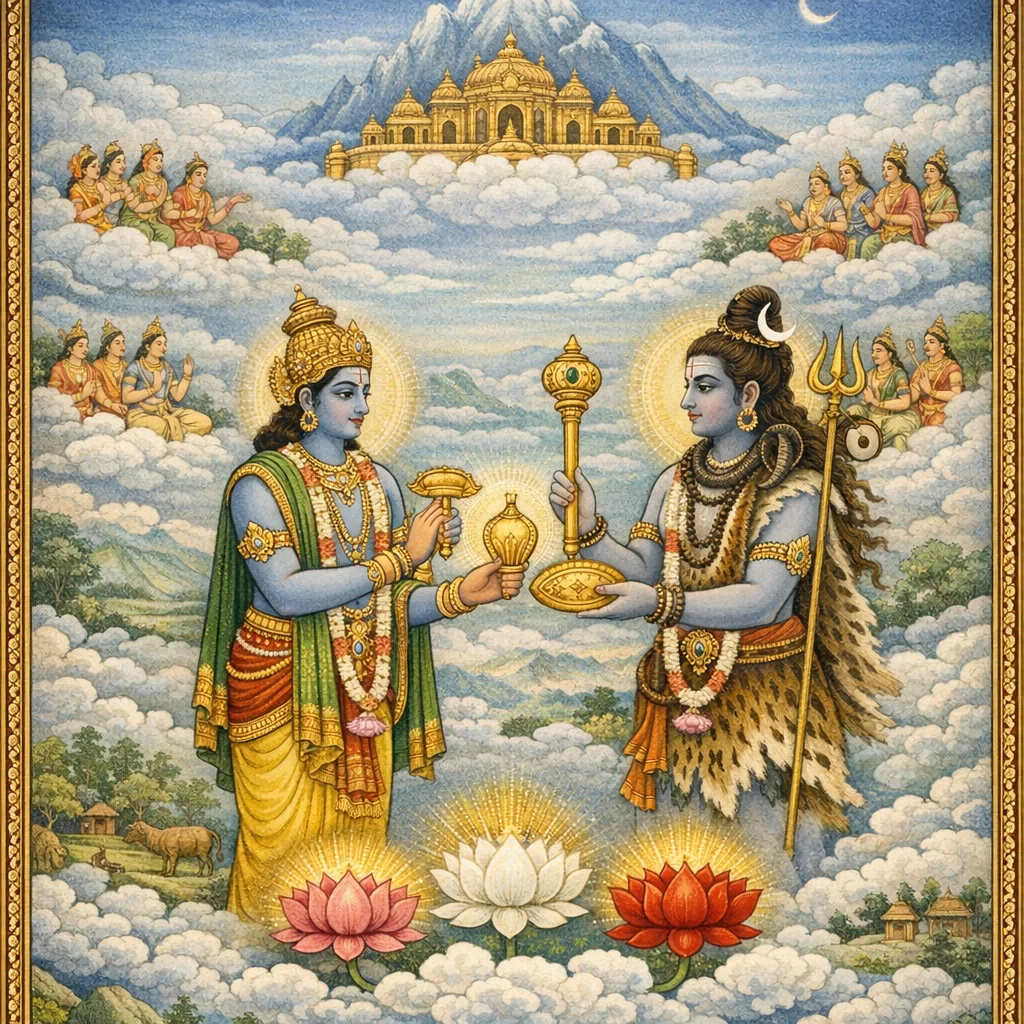
Adhyāya 23 opens with the brāhmaṇa Śivaśarman questioning Brahmā in Satyaloka. Brahmā accepts the inquiry and refers it to Viṣṇu’s attendants (gaṇas), praising their all-round knowledge. As they set out for Vaikuṇṭha, Śivaśarman questions them further; they list the seven mokṣa-bestowing cities (saptapurī)—Ayodhyā, Mathurā, Māyāpurī (Haridvāra), Kāśī, Kāñcī, Avantī, and Dvāravatī—and explain why liberation is established in a special way in Kāśī. The attendants then give a graded cosmography of the lokas, from Bhūrloka upward through Bhuvar, Svar, Mahas, Jana, Tapas, and Satya, placing Vaikuṇṭha above Satya and Kailāsa beyond that, thus situating Kāśī’s salvific claim within a tiered universe. The chapter turns to theology: Śiva is proclaimed the supreme self-willed ruler, the ineffable Brahman beyond speech and mind, yet also manifest in worshipful form. The central doctrine is affirmed—har-hari-aikya: Śiva and Viṣṇu are truly non-different. It culminates in a royal consecration scene where Śiva ritually empowers Viṣṇu with sovereignty and the three powers (icchā, kriyā, jñāna), assigns governance functions, and grants māyā, portraying cosmic rule as divinely delegated. A phalaśruti-style passage recommends recitation in auspicious rites (festivals, weddings, consecrations, house-entry, grants of authority), promising welfare—progeny, wealth, freedom from illness and bondage—and the pacification of inauspiciousness.
Shlokas
Verse 1
शिवशर्मोवाच । सत्यलोकेश्वर विधे सर्वेषां प्रपितामह । किंचिद्विज्ञप्तुकामोस्मि न भयाद्वक्तुमुत्सहे
Śivaśarman said: O Vidhātṛ (Brahmā), Lord of Satyaloka, great-grandsire of all beings—there is something I wish to submit; yet, out of fear, I do not dare to speak.
Verse 2
ब्रह्मोवाच । यत्त्वं प्रष्टुमना विप्र ज्ञातं ते तन्मनोगतम् । पिपृच्छिषुस्त्वं निर्वाणं गणौ तत्कथयिष्यतः
Brahmā said: O brāhmaṇa, whatever you intend to ask—I already know what is in your mind. Ask, then, about nirvāṇa (final release); these two attendants will explain it to you.
Verse 3
नेतयोर्विष्णुगणयोरगोचरमिहास्ति हि । सर्वमेतौ विजानीतो यत्किंचिद्ब्रह्मगो लके
Indeed, in this realm there is nothing beyond the range of these two attendants of Viṣṇu. Whatever exists anywhere in the world that moves within Brahmā’s sphere, they know it all.
Verse 4
इत्युक्त्वा सत्कृतास्ते वै ब्रह्मणा भगवद्गणाः । प्रणम्य लोककर्तारं तेऽपि हृष्टाः प्रतस्थिरे
Having spoken thus, those divine attendants were duly honored by Brahmā. Bowing to the Creator of the worlds, they too, delighted, set forth.
Verse 5
पुनः स्वयानमारुह्य वैकुंठमभितो ययुः । गच्छतापि पुनस्तत्र द्विजेनापृच्छितौ गणौ
Mounting their celestial conveyance once more, they proceeded toward Vaikuṇṭha. As they journeyed on, the brāhmaṇa again questioned the two attendants.
Verse 6
शिवशर्मोवाच । कियद्दूरे वयं प्राप्ता गंतव्यं च कियत्पुनः । पृच्छाम्यन्यच्च वां भद्रौ ब्रूतं प्रीत्या तदप्यहो
Śivaśarman said: How far have we come, and how far yet remains to be traveled? I ask you something else as well, O noble ones—tell that too, kindly and with affection.
Verse 7
कांच्यवंती द्वारवती काश्ययोध्या च पंचमी । मायापुरी च मथुरा पुर्यः सप्त विमुक्तिदाः
Kāñcī, Dvāravatī, Kāśī, and Ayodhyā as the fifth; Māyāpurī (Haridvāra) and Mathurā—these are the seven cities that bestow liberation.
Verse 8
विहाय षट्पुरीश्चान्याः काश्यामेवप्रतिष्ठिता । मुक्तिर्विश्वसृजा तत्किं मम मुक्तिर्न संप्रति
Setting aside the other six cities, liberation stands established in Kāśī alone—so ordained by the Creator of the universe. If so, why is my own liberation not attained even now?
Verse 9
इति सर्वं मम पुरः प्रसादाद्वक्तुमर्हतम् । इति तद्वाक्यमाकर्ण्य गणावूचतुरादरात्
“Therefore, out of compassion, you should declare all this before me.” Hearing these words, the two attendants replied with respectful attention.
Verse 10
गणावूचतुः । यथार्थं कथयावस्ते यत्पृष्टं भवतानघ । विष्णुप्रसादाज्जानीवो भूतंभाविभवत्तथा
The two attendants said: O sinless one, we shall tell you truthfully what you have asked. By Viṣṇu’s grace we know what has been, what will be, and what is as it is.
Verse 11
विप्रावभासते यावत्किरणैः पुष्पवंतयोः । तावतीभूः समुद्दिष्टा ससमुद्राद्रि कानना
O brāhmaṇa, as far as the radiance of the Sun’s rays extends upon the blossoming world, so far is the Earth said to spread—together with its oceans, islands, mountains, and forests.
Verse 12
वियच्च तावदुपरि विस्तारपरिमंडलम् । योजनानां च नियुते भूमेर्भानुर्व्यवस्थितः
And above that earthly extent lies the expanse of the sky as a broad circular vault; and the Sun (Bhānu) is stationed at a distance of ten thousand yojanas from the Earth.
Verse 13
भानोः सकाशादुपरि लक्षे लक्ष्यः क्षपाकरः । नक्षत्रधं डलं सोमाल्लक्षयोजनमुच्छ्रितम्
Above the Sun, at a distance of one lakh (100,000 yojanas), the Moon—maker of night—is seen; and above the Moon, the sphere of the stars rises by one lakh yojanas.
Verse 14
उडुमंडलतः सौम्य उपरिष्टाद्द्विलक्षतः । द्विलक्षे तु बुधाच्छुक्रः शुक्राद्भौमो द्विलक्षके
Above the sphere of stars, O gentle one, at two lakhs (200,000 yojanas) is Mercury (Saumya). At a further two lakhs beyond Mercury is Venus; and at two lakhs beyond Venus is Mars.
Verse 15
माहेयादुपरिष्टाच्च सुरेज्यो नियुतद्वये । द्विलक्षयोजनोत्सेधः सौरिर्देवपुरोहितात्
Above Maṅgala (Mars), at a distance of twenty thousand yojanas, stands Bṛhaspati (Surejya). And above the priest of the gods, Śani (Sauri) is raised by two lakh yojanas.
Verse 16
दशायुतसमुच्छ्रायं सौरेः सप्तर्षिमंडलम् । सप्तर्षिभ्यः सहस्राणां शतादूर्ध्वं ध्रुवस्थितः
Above Śani (Sauri), the sphere of the Seven Ṛṣis stands at a height of ten thousand yojanas; and a hundred thousand yojanas above the Seven Ṛṣis is Dhruva, fixed in place.
Verse 17
पादगम्यं हि यत्किंचिद्वस्त्वस्ति धरणीतले । तद्भूर्लोक इति ख्यातः साब्धिद्वीपाद्रिकाननम्
Whatever exists upon the surface of the Earth and is reachable by foot—this is known as Bhūrloka: the world comprising oceans, islands, mountains, and forests.
Verse 18
भूर्लोकाच्च भुवर्लोको ब्रध्नावधिरुदाहृतः । आदित्यादाध्रुवं विप्र स्वर्लोक इति गीयते
Above Bhūrloka, Bhuvarloka is said to extend up to the region of Bradhna. And, O brāhmaṇa, from the Sun up to Dhruva is sung of as Svargaloka (Svarloka).
Verse 19
महर्लोकः क्षितेरूर्ध्वमेककोटिप्रमाणतः । कोटिद्वये तु संख्यातो जनो भूर्लोकतो जनैः
Maharloka lies above the Earth, measured as one koṭi. And Janaloka is reckoned by those who know these measures as two koṭis above Bhūrloka.
Verse 20
चतुष्कोटिप्रमाणस्तु तपोलोकोऽस्ति भूतलात् । उपरिष्टात्क्षितेरष्टौ कोटयः सत्यमीरितम्
Tapoloka exists above the earthly plane, measured as four koṭis. Higher still above the Earth by eight koṭis is Satyaloka—so it is declared.
Verse 21
सत्यादुपरि वैकुंठो योजनानां प्रमाणतः । भूर्लोकात्परिसंख्यातः कोटिषोडशसंमितः
Above Satyaloka lies Vaikuṇṭha, measured in yojanas; its distance from Bhūrloka is reckoned as sixteen koṭis (of yojanas).
Verse 22
यत्रास्ते श्रीपतिः साक्षात्सर्वेषामभयप्रदः । ततस्तु षोडशगुणः कैलासोऽस्ति शिवालयः
There indeed dwells Śrīpati (Viṣṇu) in person, the giver of fearlessness to all. Beyond that, sixteen times higher, is Kailāsa—the abode of Śiva.
Verse 23
पार्वत्या सहितः शंभुर्गजास्य स्कंद नंदिभिः । यत्र तिष्ठति विश्वेशः सकलः स परः स्मूतः
There Śambhu stands together with Pārvatī, with Gajāsya (Gaṇeśa), Skanda, and Nandin. Where Viśveśa abides in fullness, that state is declared the Supreme.
Verse 24
तस्य देवस्य खेलोऽयं स्वलीला मूर्तिधारिणः । स विश्वेश इति ख्यात स्तस्याज्ञाकृदिदं जगत्
This universe is but the sportive play of that God, who assumes form by his own free delight. He is famed as Viśveśa, and this world acts in accordance with his command.
Verse 25
सर्वेषां शासकश्चासौ तस्य शास्ता न चापरः । स्वयं सृजति भूतानि स्वयं पाति तथात्ति च
He alone is the ruler of all; there is no other governor above him. He himself creates beings, he himself protects them, and he himself also withdraws (consumes) them.
Verse 26
सर्वज्ञ एकः स प्रोक्तः स्वेच्छाधीन विचेष्टितः । तस्य प्रवतर्कः कोपि नहि नैव निवर्तकः
He is declared the one omniscient Lord, whose activity depends solely on his own will. None can question him, and none can restrain or turn him back.
Verse 27
अमूर्तं यत्परं ब्रह्म समूर्तं श्रुतिचोदितम् । सर्वव्यापि सदा नित्यं सत्यं द्वैतविवर्जितम्
That Supreme Brahman which is formless is also taught by the Vedas as assuming form. It is all-pervading, ever and eternal—real, and free from duality.
Verse 28
सर्वेभ्यः कारणेभ्यश्च परात्परतरं परम् । आनंदं ब्रह्मणो रूपं श्रुतयो यत्प्रचक्षते
Beyond all causes, and even beyond what is called ‘beyond,’ is the Supreme. The Vedas proclaim that bliss (ānanda) is the very nature (form) of Brahman.
Verse 29
संविदं तेन यं वेदा विष्णुर्वेद न वै विधिः । यतो वाचो निवर्तंते ह्यप्राप्य मनसा सह
That consciousness by which the Vedas are known—Viṣṇu knows it, but not even Vidhi (Brahmā). From it, words return, unable to reach it, along with the mind.
Verse 30
स्वयंवेद्यः परं ज्योतिः सर्वस्य हृदि संस्थितः । योगिगम्यस्त्वनाख्येयो यः प्रमाणैकगोचरः
Self-revealed is the Supreme Light, abiding in the heart of all. It is attainable by yogins, yet beyond description—known only through direct and valid realization.
Verse 31
नानारूपोप्यरूपो यः सर्वगोपि न गोचरः । अनंतोप्यंतक वपुः सर्ववित्कर्मवर्जितः
He who, though appearing in many forms, is in truth formless; though all-pervading, is not grasped by the senses; though infinite, assumes the form of the Ender; all-knowing, yet untouched by action—such is the Lord.
Verse 32
तस्येदमैश्वरं रूपं खंडचंद्रावतंसकम् । तमालश्यामलगलं स्फुरद्भालविलोचनम्
This is His sovereign, lordly form: adorned with the crescent moon as an ornament; with a throat dark as the tamāla tree; and with the radiant eye upon His forehead flashing forth.
Verse 33
लसद्वामार्धनारीकं कृतशेषशुभांगदम् । गंगातरंगसत्संग सदाधौतजटातटम्
With His left half resplendent as the Lady (Ardhanārī); with every remaining part adorned with auspicious ornaments; and with the banks of His matted locks ever washed by the holy companionship of Gaṅgā’s waves.
Verse 34
स्मरांगरजःपुंज पूजितावयवोज्ज्वलम् । विचित्रगात्रविधृतमहाव्यालविभूषणम्
His limbs shine as though worshipped with heaps of the ash of Smara’s body; and His wondrous frame bears great serpents as ornaments.
Verse 35
महोक्षस्यंदनगमं विरुताजगवायुधम् । गजाजिनोत्तरासंगं दशार्धवदनं शुभम्
He moves with the great bull as His chariot; He bears the mighty bow as His weapon; He is clad in an elephant-hide upper garment; and His auspicious countenance shines with eighteen aspects.
Verse 36
उत्त्रासित महामृत्यु महाबलगणावृतम् । शरणार्थिकृतत्राणं नत निर्वाणकारणम् । मनोरथपथातीतं वरदानपरायणम्
He terrifies even Great Death; He is surrounded by hosts of immense power. He grants protection to those who seek refuge; for the bowed devotee, He becomes the very cause of nirvāṇa. Beyond the pathways of worldly wishing, He is wholly devoted to the granting of boons.
Verse 37
तस्य तत्त्वस्वरूपस्य रूपातीतस्य भो द्विज । परावरे रुद्ररूपे सर्वेव्याप्यावतिष्ठत
O brāhmaṇa, He whose very nature is the Reality-principle, who transcends all form—abiding as Rudra in both the higher and the lower realms, He pervades all and stands established everywhere.
Verse 38
निराकारोपि साकारः शिव एव हि कारणम । मुक्तये भुक्तये वापि न शिवान्मोक्षदो परः
Though formless, He is also with form—Śiva alone is the true cause. Whether for liberation or for worldly enjoyment, there is none higher than Śiva as the giver of mokṣa.
Verse 39
यथा तेनाखिलं ह्येतत्पार्वतीपतिसात्कृतम । इदं चराचरं सर्वं दृश्यादृश्यमरूपिणा
In this manner, all of this—indeed the entire cosmos—has been made His own by the Lord of Pārvatī: all that is moving and unmoving, all that is seen and unseen, by the Formless One.
Verse 40
तथा मृडानीकांतेन विष्णुसादखिलंजगत । विधाय क्रीड्यते विप्र नित्यं स्वच्छंद लीलया
So too, O brāhmaṇa, by the beloved of Mṛḍānī (Pārvatī) the entire universe is brought under the power of Viṣṇu; having thus set it in order, He plays eternally in His free, self-willed līlā.
Verse 41
यथाशिवस्तथा विष्णुर्यथाविष्णुस्तथा शिवः । अंतरं शिवविष्ण्वोश्च मनागपि न विद्यते
As Śiva is, so is Viṣṇu; and as Viṣṇu is, so is Śiva. Between Śiva and Viṣṇu there is not even the slightest difference.
Verse 42
आहूय पूर्वं ब्रह्मादीन्समस्तान्देवतागणान् । विद्याधरोरगादींश्च सिद्धगंधर्वचारणान्
First, having summoned Brahmā and the rest—indeed all the hosts of gods—he also called the Vidyādharas, Nāgas, Siddhas, Gandharvas, and Cāraṇas.
Verse 43
निजसिंहासनसमं कृत्वा सिंहासनं शुभम् । उपवेश्य हरिं तत्र च्छत्रं कृत्वा मनोहरम्
Having prepared an auspicious throne equal to his own royal seat, he seated Hari upon it, and set there a delightful ceremonial canopy (royal umbrella).
Verse 44
श्लक्ष्णं कोटिशलाकं च विश्वकर्मविनिर्मितम् । पांडुरं रत्नदंडं च स्थूलमुक्तावलंबितम्
Smooth and fitted with countless ribs, crafted by Viśvakarman; shining white, with a jeweled staff, and hung with large pearls.
Verse 45
कलशेन विचित्रेण ह्युपरिष्टाद्विराजितम् । सहस्रयोजनायामं सर्वरत्नमयं शुभम्
It shone aloft, crowned with a wondrous kalaśa. Auspicious and vast as though a thousand yojanas in span, it was fashioned wholly of every kind of jewel.
Verse 46
पट्टसूत्रमयैरम्यैश्चामरैश्च परिष्कृतम् । राजाभिषेकयोग्यैश्च द्रव्यैः सर्वौषधादिभिः
It was adorned with lovely cāmaras—yak-tail fans of fine silk threads—and furnished with substances worthy of a royal abhiṣeka, together with all manner of medicinal herbs and the like.
Verse 47
प्रत्यक्षतीर्थपाथोभिः पंचकुंभैर्मनोहरैः । सिद्धार्थाक्षतदूर्वाभिर्मंत्रैः स्वयमुपस्थितैः
There were five delightful water-pots filled with water from manifest tīrthas, along with mustard seeds, unbroken rice (akṣata), and dūrvā grass—together with mantras as though present of themselves—by which the rite was arrayed.
Verse 48
देवानां च तथर्षीणां सिद्धानां फणिनामपि । आनीय मंगलकराः कन्याः षोडशषोडश
And auspicious maidens were brought from among the gods, the ṛṣis, the Siddhas, and even the serpent-lords—sixteen and sixteen, in groups.
Verse 49
वीणामृदंगाब्जभेरी मरु डिंडिमझर्झरैः । आनकैः कांस्यतालाद्यै र्वाद्यैर्ललितगायनैः
With vīṇās, mṛdaṅgas, lotus-like drums, bherīs, marus, ḍiṇḍimas, and jharjharas; with ānakas, bronze tālas and the like—musical instruments resounded, accompanied by graceful singing.
Verse 50
ब्रह्मघोषमहारावैरापूरितनभोंगणे । शुभे तिथौ शुभे लग्ने ताराचंद्रबलान्विते
As the vault of the sky was filled with the mighty roar of Vedic acclamations, it was carried out on an auspicious tithi, at an auspicious moment, endowed with the strength of favorable stars and the moon.
Verse 51
आबद्धमुकुटं रम्यं कृतकौतुकमंगलम् । मृडानीकृतशृंगारं सुश्रिया सुश्रियायुतम्
He appeared with a lovely crown firmly fastened, adorned with auspicious festive emblems; his ornamentation was arranged by Mṛḍānī (Pārvatī), and he shone, joined with splendid fortune and grace.
Verse 52
अभिषिच्य महेशेन स्वयं ब्रह्मांडमंडपे । दत्तं समस्तमैश्वर्यं यन्निजं नान्यगामि च
In the pavilion of the cosmic assembly, Maheśa himself consecrated him by abhiṣeka and bestowed the entirety of sovereignty—his own innate lordship—never to pass to another.
Verse 53
ततस्तुष्टाव देवेशः प्रमथैः सह शार्ङ्गिणम् । ब्रह्माणं लोककर्तारमुवाच च वचस्त्विदम्
Then the Lord of the gods, along with his Pramathas, praised Śārṅgiṇ (Viṣṇu); and he spoke these words to Brahmā, the creator of the worlds.
Verse 54
मम वंद्यस्त्वयं विष्णुः प्रणमत्वममुं हरिम् । इत्युक्त्वाथ स्वयं रुद्रो ननाम गरुडध्वजम्
“This Viṣṇu is venerable even to me—bow to that Hari.” Having said so, Rudra himself bowed to the Lord whose banner bears Garuḍa.
Verse 55
ततो गणेश्वरैः सर्वैंर्ब्रह्मणा च मरुद्गणैः । योगिभिः सनकाद्यैश्च सिद्धैर्देवर्षिभिस्तथा
Then, together with all the lords of Śiva’s hosts, and with Brahmā and the companies of the Maruts, the yogins, Sanaka and the other sages, the Siddhas, and likewise the divine seers—
Verse 56
विद्याधरैः सगंधर्वैर्यक्षरक्षोप्सरोगणैः । गुह्यकैश्चारणैर्भूतैः शेष वासुकि तक्षकैः
—by the Vidyādharas with the Gandharvas, by hosts of Yakṣas, Rākṣasas, and Apsarases; by the Guhyakas, the Cāraṇas, and the Bhūtas; and by Śeṣa, Vāsuki, and Takṣaka—
Verse 57
पतत्रिभिः किंनरैश्च सर्वैः स्थावरजंगमैः । ततो जयजयेत्युक्त्वा नमोस्त्विति नमोस्त्विति
—by birds and Kiṃnaras, and by all beings, the moving and the unmoving. Then, crying “Victory, victory!”, they repeatedly exclaimed, “Homage to you! Homage to you!”
Verse 58
ततोहरिर्महेशेन संसदि द्युसदां तदा । एतैर्महारवै रम्यैश्चानर्चि परमार्चिषा
Then, in the assembly of the celestial dwellers, Hari was worshipped by Maheśa, with these delightful, thunderous acclamations, and with supreme radiance.
Verse 59
त्वं कर्ता सर्वभूतानां पाता हर्ता त्वमेव च । त्वमेव जगतां पूज्यस्त्वमेव जगदीश्वरः
You are the creator of all beings; you alone are their protector and their withdrawer. You alone are worthy of worship for the worlds; you alone are the Lord of the universe.
Verse 60
दाता धर्मार्थकामानां शास्ता दुर्नयकारिणाम् । अजेयस्त्वं च संग्रामे ममापि हि भविष्यसि
You are the giver of dharma, artha, and kāma; you are the chastiser of those who follow wicked conduct. Unconquerable in battle, you shall indeed be for me as well my protector and support.
Verse 61
इच्छाशक्तिः क्रियाशक्तिर्ज्ञानशक्तिस्तथोत्तमा । शक्तित्रयमिदं विष्णो गृहाण प्रापितं मया
The power of will, the power of action, and the supreme power of knowledge—this triad of śakti, O Viṣṇu, accept, for it has been brought forth and offered by me.
Verse 62
त्वद्द्वेष्टारो हरे नूनं मया शास्याः प्रयत्नतः । त्वद्भक्तानां मया विष्णो देयं निर्वाणमुत्तमम्
Those who hate You, O Hari, I shall surely chastise with all effort; but to Your devotees, O Viṣṇu, I shall grant the highest liberation, the supreme nirvāṇa.
Verse 63
मायां चापि गृहाणेमां दुष्प्रणोद्यां सुरासुरैः । यया संमोहितं विश्वमकिंचिज्ज्ञं भविष्यति
Accept this Māyā as well—hard to cast off even by gods and asuras—by which the whole world, deluded, becomes as though knowing nothing at all.
Verse 64
वामबाहुर्मदीयस्त्वं दक्षिणोसौ पितामहः । अस्यापि हि विधेः पाता जनितापि भविष्यसि
You are my left arm, and that Pitāmaha (Brahmā) is the right. Indeed, you shall become also the protector—and, in a sense, the progenitor—of this Ordainer (Brahmā).
Verse 65
वैकुंठैश्वर्यमासाद्य हरेरित्थं हरः स्वयम् । कैलासे प्रमथैः सार्धं स्वैरं क्रीडत्युमापतिः
Thus, having attained the lordly glory of Hari’s Vaikuṇṭha, Hara himself—Umāpati—sports freely on Kailāsa together with the Pramathas.
Verse 66
तदा प्रभृति देवोसौ शार्ङ्गधन्वा गदाधरः । त्रैलोक्यमखिलं शास्ति दानवांतकरो हरिः
From that time onward, that God—Hari, bearer of the Śārṅga bow and the mace—rules the entire three worlds, the destroyer of the Dānavas.
Verse 67
इति ते कथिता विप्र लोकानां च परिस्थितिः । इदानीं कथयिष्यावस्तवनिर्वाण कारणम्
Thus, O Brāhmaṇa, I have explained to you the condition of the worlds. Now I shall tell you the cause of your liberation.
Verse 68
इदं तु परमाख्यानं शृणुयाद्यः समाहितः । स्वर्लोकमभिगम्याथ काश्यां निर्वाणमाप्नुयात्
But whoever, with a collected mind, listens to this supreme sacred account—having reached Svarga thereafter, he attains liberation in Kāśī.
Verse 69
यज्ञोत्सवे विवाहे च मंगलेष्वखिलेष्वपि । राज्याभिषेक समये देवस्थापनकर्मणि
At a sacrificial festival, at a wedding, and indeed at all auspicious occasions; at the time of royal consecration, and in the rite of installing a deity…
Verse 70
सर्वाधिकारदानेषु नववेश्मप्रवेशने । पठितव्यं प्रयत्नेन तत्कार्य परिसिद्धये
At every granting of authority, and at the entering of a new house, it should be recited with earnest effort, for the complete success of that undertaking.
Verse 71
अपुत्रो लभते पुत्रमधनो धनवान्भवेत् । व्याधितो मुच्यते रोगाद्बद्धो मुच्येत बंधनात्
The childless gains a son; the poor becomes wealthy. The sick is freed from disease, and the bound one is released from bondage.
Verse 72
जप्यमेतत्प्रयत्नेन सततं मंगलार्थिना । अमंगलानां शमनं हरनारायणप्रियम
One who seeks auspiciousness should constantly chant this with earnest effort as japa. It pacifies misfortunes and is beloved of Hara (Śiva) and Nārāyaṇa (Viṣṇu).