Adhyaya 11
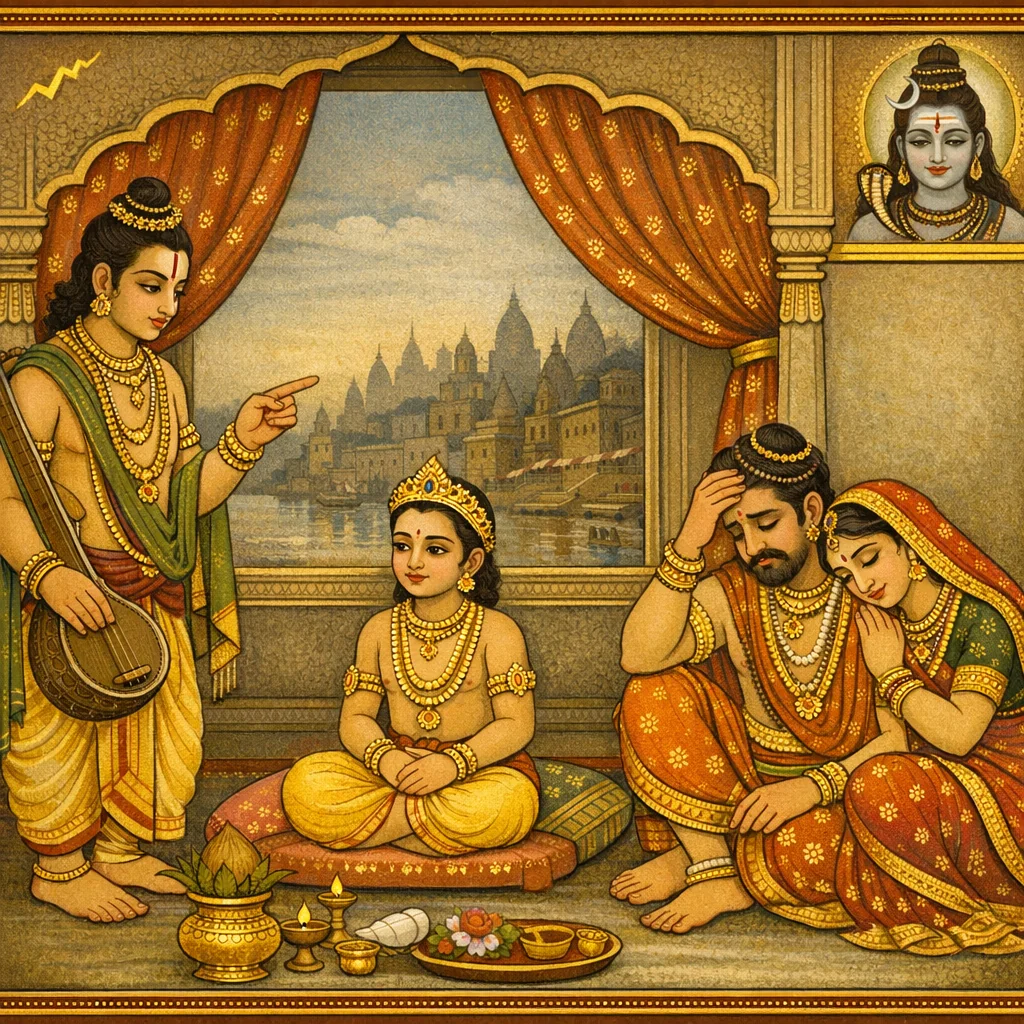
Agastya relates a Kāśī-centered theological discourse, beginning with the household life of Viśvānara and Śuciṣmatī. The chapter sets forth the classical saṃskāras in order—garbhādhāna, puṃsavana, sīmanta, the birth festivities, and the formal naming rite—culminating in the child being named “Gṛhapati,” supported by a Vedic-style mantra citation. A grand gathering of sages and divine beings is portrayed as attending the birth festival, affirming the child’s auspicious standing within a sacral public order. The teaching then turns to household dharma: it extols progeny as vital to the gṛhastha-āśrama, offers a typology of sons, and frames lineage continuity as a dharmic concern. Nārada arrives, instructs filial obedience as an ethical rule, and conducts a detailed examination of bodily and palm-marks (lakṣaṇa-parīkṣā), reading signs of sovereignty and fortune while warning that fate may invert qualities. A prophecy of danger around the twelfth year—linked with lightning/fire—brings parental grief; the child consoles them and vows to propitiate Mṛtyuñjaya (Śiva) to overcome the threat, re-centering the narrative on devotion, protection, and Kāśī’s Śaiva horizon of salvation.
Shlokas
Verse 1
अगस्तिरुवाच । शृणु सुश्रोणि सुभगे वैश्वानरसमुद्भवम् । पुण्यशीलसुशीलाभ्यां यथोक्तं शिवशर्मणे
Agastya said: Listen, O fair-hipped, auspicious one, to this account born of Vaiśvānara, the sacred fire. It was related to Śivaśarman by the virtuous pair Puṇyaśīla and Suśīlā, just as it happened.
Verse 2
अथ कालेन तद्योषिदंतर्वत्नी बभूव ह । विधिवद्विहिते तेन गर्भाधानाख्य कर्मणि
Then, in due course, that woman became pregnant, after he had duly performed the rite called Garbhādhāna according to rule.
Verse 3
ततः पुंसवनं तेन स्पंदनात्प्राग्विपश्चिता । गृह्योक्तविधिना सम्यक्कृतं पुंस्त्वविवृद्धये
Thereafter, before the fetus first stirred, the wise one had the Puṃsavana rite duly performed according to the procedure taught in the Gṛhya texts, for the strengthening of male progeny.
Verse 4
सीमन्तोथाष्टमे मासि गर्भरूपसमृद्धिकृत् । सुखप्रसव सिद्ध्यै च तेनाकारि क्रियाविदा
Then, in the eighth month, the rite called Sīmanta was performed by those skilled in sacred observances, so that the form of the fetus might flourish and an easy, successful delivery be ensured.
Verse 5
अथातः सत्सुतारासु ताराधिप वराननः । केंद्रे गुरौ शुभे लग्ने सुग्रहेष्वयुगेषु च
Thereafter, when auspicious lunar asterisms prevailed, and the Moon—lord of the stars, fair-faced—stood with Jupiter (Guru) in a favorable angular position, with an auspicious ascendant and benefic planets in the odd divisions, the time became supremely propitious.
Verse 6
अरिष्टं दीपयन्दीप्त्या सर्वारिष्टविनाशकृत् । तनयो नाम तस्यां तु शुचिष्मत्यां बभूव ह
Shining with a radiance that dispelled all inauspiciousness, a son was indeed born to her—Śuciṣmatī—whose very brilliance destroyed every evil omen.
Verse 7
सद्यः समस्तसुखदो भूर्भुवःस्वर्निवासिनाम् । गंधवाहागन्धवाहादिग्वधूमुखवासनाः
At once he became a bestower of complete joy upon the dwellers of Bhūḥ, Bhuvaḥ, and Svaḥ; and fragrant breezes arose, like perfumes from the faces of the maidens of the directions, bearing sweet scents on every side.
Verse 8
इष्टगन्धप्रसूनौघैर्ववर्षुस्ते घनाघनाः । देवदुन्दुभयो नेदुः प्रसेदुः सर्वतोदिशः
Those dense clouds poured down torrents of flowers of beloved fragrance; the divine kettledrums of the Devas resounded, and all the directions on every side became serene and gracious.
Verse 9
परितः सरितः स्वच्छा भूतानां मानसैः सह
All around, the rivers became clear—and with them, the minds of beings too grew clear and tranquil.
Verse 10
सत्त्वाः सत्त्वसमायुक्ता वसुधासीच्छुभा तदा । कल्याणी सर्वतो वाणी प्राणिनः प्रीणयंत्यभूत्
Creatures became filled with goodness; the earth itself turned auspicious then; and from every side arose благой and pleasing speech, delighting all living beings.
Verse 11
तिलोत्तमोर्वशीरंभा प्रभा विद्युत्प्रभा शुभा । सुमंगला शुभालापा सुशीलाड्या वरांगनाः
Tilottamā, Urvaśī, Rambhā, Prabhā, Vidyutprabhā, Śubhā, Sumaṅgalā, Śubhālāpā, and Suśīlā—noble celestial maidens rich in grace—appeared in celebration.
Verse 12
क्वणत्कंकण पात्राणि कृत्वा करतलं मुदा । मुक्तमुक्ताफलाढ्यानि यक्षकर्दमवंति च
With joy they brought their palms together, their bangles and vessels ringing; and they bore offerings rich with pearls and clusters of pearl-gems, along with Yakṣa-kardama, treasures of the Yakṣas.
Verse 13
वज्रवैदूर्य दीपानि हरिद्रा लेपनानि च । गारुत्मतैकरूपाणि शंखशुक्तिदधीनि च
There were lamps of diamond and vaidūrya (cat’s-eye), and anointments of turmeric; articles of a single Garuḍa-like sheen, and also conches, oyster-shells, and curd, set forth as auspicious offerings.
Verse 14
पद्मरागप्रवालाख्यरत्नकुंकुमवंति च । गोमेदपुष्परागेंद्र नीलसन्माल्यभांजि च
They were adorned with auspicious substances—vermilion and powders made from gems such as padmarāga (ruby) and pravāla (coral)—bearing also gomeda, puṣparāga (topaz), sapphire-blue ornaments (nīla), and splendid garlands.
Verse 15
विद्याधर्यश्च किन्नर्यस्तथाऽमर्यः सहस्रशः । चामर व्यग्रहस्ताग्र मंगलद्रव्यपाणयः
Thousands of Vidyādharī women, Kinnarī women, and divine maidens arrived—some busily holding yak-tail fans (cāmara), others carrying auspicious ceremonial articles in their hands.
Verse 16
गंधर्वोरगयक्षाणां सुवासिन्यः शुभस्वराः । गायंत्यो ललितं गीतं तत्राजग्मुरनेकशः
Many well-adorned women of the Gandharvas, Nāgas, and Yakṣas—sweet-voiced and auspicious in tone—came there singing graceful songs.
Verse 17
मरीचिरत्रि पुलहः पुलस्त्यः क्रतुरंगिराः । वसिष्ठः कश्यपश्चाहं विभांडो मांडवीसुतः
Present were Marīci, Atri, Pulaha, Pulastya, Kratu, and Aṅgiras; Vasiṣṭha and Kaśyapa—and I myself—together with Vibhāṇḍa, the son of Māṇḍavī: all were there.
Verse 18
लोमशो लोमचरणो भरद्वाजोथ गौतमः । भृगुस्तु गालवो गर्गो जातूकर्ण्यः पराशरः
There assembled Lomaśa and Lomacaraṇa, Bharadvāja and Gautama; Bhṛgu, Gālava, Garga, Jātūkarṇya, and Parāśara as well—thus all those sages gathered there.
Verse 19
तत्र स्नात्वा विधानेन दृष्ट्वा विश्वेश्वरं विभुम् । त्रैलोक्यप्राणिसंत्राणकारिणं प्रणनाम ह
Having bathed there according to due observance, and having beheld Viśveśvara, the all-pervading Lord, protector of beings in the three worlds, he bowed down in reverent homage.
Verse 20
जमदग्निश्च संवर्तो मतंगो भरतोंशुमान् । व्यासः कात्यायनः कुत्सः शौनकः सुश्रुतः शुकः
Jamadagni and Saṃvarta were there, Mataṅga and Bharata the radiant; Vyāsa, Kātyāyana, Kutsa, Śaunaka, Suśruta, and Śuka—these sages too were present.
Verse 21
ऋष्यशृंगोथ दुर्वासा रुचिर्नारदतुंबुरू । उत्तंको वामदेवश्च च्यवनोसितदेवलौ
Ṛṣyaśṛṅga came, then Durvāsas, Ruci, Nārada and Tumburu; Uttaṅka and Vāmadeva, and Cyavana, Asita, and Devala—each of them arrived there.
Verse 22
शालंकायनहारी तौ विश्वामित्रोथभार्गवः । मृकंडः सह पुत्रेण दाल्भ्य उद्दालकस्तथा
There were Śālaṃkāyana and Hārī, Viśvāmitra and Bhārgava; Mṛkaṇḍa together with his son, and Dālbhya and Uddālaka as well—thus all assembled there.
Verse 23
धौम्योपमन्युवत्साद्या मुनयो मुनिकन्यकाः । तच्छांत्यर्थं समाजग्मुर्धन्यं विश्वानराश्रमम्
Sages such as Dhaumya, Upamanyu, and Vatsa, together with maidens of ascetic lineages, assembled for that pacification and blessing and came to the blessed hermitage of Viśvānara.
Verse 24
ब्रह्मा बृहस्पतियुतो देवो गरुडवाहनः । नंदि भृंगि समायुक्तो गौर्या सह वृषध्वजः
Brahmā arrived accompanied by Bṛhaspati; the god who rides Garuḍa came as well. And the Bull-bannered Lord (Śiva), together with Gaurī, attended—along with Nandin and Bhṛṅgin—at that great sacred occasion.
Verse 25
महेंद्रमुख्या गीर्वाणा नागाः पातालवासिनः । रत्नान्यादाय बहुशः ससरित्का महाब्धयः
The gods led by Mahendra (Indra) came; the Nāgas who dwell in Pātāla came as well. The great oceans too arrived with their rivers, repeatedly bearing many kinds of jewels as offerings.
Verse 26
स्थावरा जंगमं रूपं धृत्वा याताः सहस्रशः । महामहोत्सवे तस्मिन्बभूवाकालकौमुदी
Countless beings that are ordinarily immobile assumed moving forms and came in their thousands. In that great, great festival, an unseasonal moonlit radiance seemed to arise.
Verse 27
जातकर्म स्वयं चक्रे तस्य देवः पितामहः । श्रुतिं विचार्य तद्रूपां नाम्ना गृहपतिस्त्वयम्
For him, the divine Grandfather (Brahmā) himself performed the birth-rites. Reflecting upon the Śruti suited to that form, he declared: “You shall be named Gṛhapati.”
Verse 28
इति नाम ददौ तस्मै देयमेकादशेहनि । नामकर्मविधानेन तदर्थं श्रुतिमुच्चरन्
Thus he bestowed that name upon him, to be given on the eleventh day. Following the procedure of the naming-rite, he recited the Śruti that declares its meaning.
Verse 29
अयमग्निर्गृहपतिर्गार्हपत्यः प्रजाया वसुवित्तमः । अग्ने गृहपतेभिद्युम्नमभि सह आयच्छस्व
“This Agni is the Gṛhapati—the Gārhapatya fire—bestower of wealth and prosperity for one’s lineage. O Agni, O Lord of the house, together bring and confer radiant splendor upon us.”
Verse 30
अग्ने गृहपते स्थित्या परामपि निदर्शयन् । चतुर्निगममंत्रोक्तैराशीर्भिरभिनंद्य च
O Agni, O Gṛhapati—by your steadfast order you reveal even the highest state. And he honored him with blessings spoken through mantras of the four Vedas.
Verse 31
कृत्वा बालोचितां रक्षां हरेण हरिणा सह । निर्ययौ हंसमारुह्य सर्वेषां प्रपितामहः
Having performed the protections proper for an infant, the Prāpitāmaha (the Great-Grandfather of all, Brahmā) departed—together with Hari (Viṣṇu) and Hara (Śiva)—mounting his swan.
Verse 32
अहोरूपमहो तेजस्त्वहो सर्वांगलक्षणम् । अहो शुचिष्मतीभाग्यमाविरासीत्स्वयं हरः
“Ah, what beauty! Ah, what splendor! Ah, what perfect auspicious marks upon every limb! Ah, the pure and radiant fortune—Hara (Śiva) himself has appeared in person!”
Verse 33
अथवा किमिदं चित्रं शर्वभक्तजनेष्वहो । आविर्भवेत्स्वयं रुद्रो यतोरुद्रास्तदर्चकाः
Or what wonder is this, indeed, among the devotees of Śarva? Rudra himself appears in person—for those who worship him are, by their devotion, as it were Rudras.
Verse 34
इति स्तुवंतस्त्वन्योन्यं जग्मुः सर्वे यथागतम् । विश्वानरं समापृच्छ्य संप्रहृष्टतनूरुहाः
Thus, praising one another, they all departed as they had come; after taking leave of Viśvānara, their bodies thrilled, hairs standing on end with joy.
Verse 35
अतः पुत्रं समीहंते गृहस्थाश्रमवासिनः । पुत्रेण लोकाञ्जयति श्रुतिरेषा सनातनी
Therefore those who abide in the householder āśrama desire a son; for by a son one conquers the worlds—this is the eternal teaching of the Śruti.
Verse 36
अपुत्रस्य गृहं शून्यमपुत्रस्यार्जनं वृथा । अपुत्रस्यान्वयश्छिन्नो नापवित्रं ह्यपुत्रतः
For one without a son, the home is said to be empty; for one without a son, acquisition is in vain. For one without a son, the lineage is cut off—indeed, there is no purifier like a son.
Verse 37
न पुत्रात्परमो लाभो न पुत्रात्परमं सुखम् । न पुत्रात्परमं मित्रं परत्रेह च कुत्रचित्
There is no gain higher than a son, no happiness higher than a son; there is no friend higher than a son—neither in this world nor in the world beyond, anywhere.
Verse 38
औरसः क्षेत्रजः क्रीतो दत्तः प्राप्तः सुतासुतः । आपत्सुरक्षितश्चान्यः पुत्राः सप्तात्र कीर्तिताः
Here the sons are declared to be of seven kinds: the legitimate (born of one’s own wife), the kṣetraja, the purchased, the given (adopted), the obtained, the son of a daughter, and another—one protected in times of calamity.
Verse 39
एषामन्यतमः कार्यो गृहस्थेन विपश्चिता । पूर्वपूर्वः सुतः श्रेयान्हीनःस्यादुत्तरोत्तरः
Of these, a discerning householder should establish one as his son. Each type mentioned earlier is superior; each later-mentioned type is progressively inferior.
Verse 40
गणावूचतुः । निष्क्रमोथ चतुर्थेऽस्य मासि पित्राकृतो गृहात् । अन्नप्राशनमब्दार्धे चूडाब्दे चार्थवत्कृता
The Gaṇas said: “Then, in his fourth month, the father performed the rite of taking the child out from the house. At half a year he performed the first feeding of solid food, and in the year of the tonsure he duly carried out the cūḍā-rite with proper gifts.”
Verse 41
कर्णवेधं ततः कृत्वा श्रवणर्क्षे सकर्मवित् । ब्रह्मतेजोभिवृद्ध्यर्थं पंचमेऽब्दे व्रतं ददौ
Then, being skilled in rites, he performed the ear-piercing ceremony under the Śravaṇa constellation, and in the fifth year he bestowed a vow for the increase of brahmanical radiance (spiritual lustre).
Verse 42
उपाकर्म ततः कृत्वा वेदानध्यापयत्सुधीः । त्र्यब्दं वेदान्सविधिनाऽध्यैष्ट सांगपदक्रमान्
Thereafter, having performed the upākarma, the wise one began the study of the Vedas. For three years he studied the Vedas according to rule—together with their auxiliaries, word-by-word recitation, and sequential recitation.
Verse 43
विद्याजातं समस्तं च साक्षिमात्राद्गुरोर्मुखात् । विनयादिगुणानाविष्कुर्वञ्जग्राह शक्तिमान्
All the learning that was to be gained he received straight from the guru’s mouth, as though by mere witnessing; and, being capable, he absorbed it while displaying virtues such as humility.
Verse 44
ततोथ नवमे वर्षे पित्रोः शुश्रूषणे रतम् । वैश्वानरं गृहपतिं दृष्ट्वा कामचरो मुनिः
Then, in the ninth year, seeing the child Gṛhapati Vaiśvānara wholly devoted to serving his parents, the sage—free to roam at will—came upon him.
Verse 45
विश्वानरोटजं प्राप्य देवर्षिर्नारदः सुधीः । पप्रच्छ कुशलं तत्र गृहीतार्घासनः क्रमात्
Reaching Vaiśvānara’s hermitage, the wise divine sage Nārada—having been duly honored with arghya and a seat—then asked about his welfare in proper order.
Verse 46
नारद उवाच । विश्वानर महाभाग शुचिष्मति शुभव्रते । कुरुते युवयोर्वाक्यमयं गृहपतिः शिशुः
Nārada said: “O fortunate Vaiśvānara, pure-minded one of auspicious vows—this child Gṛhapati indeed carries out your words (commands).”
Verse 47
नान्यत्तीर्थं न वा देवो न गुरुर्न च सत्किया । विहाय पित्रोर्वचनं नान्यो धर्मः सुतस्य हि
For a son there is no other tīrtha, no other deity, no other guru, and no other meritorious observance apart from faithfully following the word of his parents; indeed, there is no higher dharma for him.
Verse 48
न पित्रोरधिकं किंचित्त्रिलोक्यां तनयस्य हि । गर्भधारणपोषाभ्यां पितुर्माता गरीयसी
For a son, in all the three worlds there is nothing greater than his parents; and by bearing him in the womb and nourishing him, the mother is even more venerable than the father.
Verse 49
अंभोभिरभिषिच्यस्वं जननीचरणच्युतैः । प्राप्नुयात्स्वर्धुनीशुद्ध कबंधाधिकशुद्धताम्
If one bathes oneself with the water that has flowed from one’s mother’s feet, one attains—O pure one, like the Gaṅgā—a purity surpassing even the famed purity won by sacred means.
Verse 50
संन्यस्ताखिलकर्मापि पितुर्वंद्यो हिमस्करी । सर्ववंद्येन यतिना प्रसूर्वंद्या प्रयत्नतः
Even if she has renounced all actions, a mother remains worthy of the father’s reverence; and with special effort she is to be revered even by an ascetic—honored by all—for she is the very source of his birth.
Verse 51
इदमेव तपोत्युग्रमिदमेवपरं व्रतम् । अयमेव परो धर्मो यत्पित्रोः परितोषणम्
This alone is the fierce austerity; this alone is the supreme vow; this alone is the highest dharma—namely, the complete satisfaction of one’s parents.
Verse 52
मन्येमान्यो नाधमस्य तथान्यस्य यथा युवाम् । सुखाकारैर्विनीतस्य शिशोर्गृहपतेरहम्
I deem none more worthy, and none inferior, as you two truly are exemplary; for by kindly ways you have gently trained this child, Gṛhapati.
Verse 53
वैश्वानरसमभ्येहि ममोत्संगे निषीद भो । लक्षणानि परीक्षेहं पाणिं दर्शय दक्षिणम्
“O Vaiśvānara, come near and sit upon my lap. I shall examine your auspicious marks—show me your right hand.”
Verse 54
इत्युक्तो मुनिना बालः पित्रोराज्ञामवाप्य सः । प्रणम्य नारदं श्रीमान्भक्त्याप्रह्व उपाविशत्
Thus instructed by the sage, the noble boy obtained his parents’ permission. Then, bowing to Nārada with devotion and humility, he sat down.
Verse 55
ततो दृष्ट्वास्य सर्वांगं तालुजिह्वाद्विजानपि । आनीय कुंकुमारक्तं सूत्रं च त्रिगुणीकृतम्
Then, after examining all his limbs—even his palate, tongue, and teeth—the sage brought a thread dyed red with saffron, and made it threefold.
Verse 56
स्मृत्वा शिवौ गणाध्यक्षमूर्ध्वीभूतमुदङ्मुखम् । मुनिः परिममौ बालमापादतलमस्तकम्
Remembering Śiva—lord of the gaṇas—the sage, with the boy standing upright and facing north, measured him from the soles of his feet up to the crown of his head.
Verse 57
तिर्यगूर्ध्वं समो माने योष्टोत्तरशतांगुलः । स भवेत्पृथिवीपालो बालोऽयं ते यथा द्विज
If, in measure, he is proportionate both in breadth and height, and exceeds a hundred aṅgulas by a span, then this boy of yours, O brāhmaṇa, will become a protector of the earth—a king.
Verse 58
पंचसूक्ष्मः पंचदीर्घः सप्तरक्तः षडुन्नतः । त्रिपृथुर्लघुगंभीरो द्वात्रिंशल्लक्षणस्त्विति
He has five subtle features, five long features, seven reddish features, and six raised features; three broad features, and a gentle depth of form—thus indeed he bears the thirty-two auspicious marks.
Verse 59
पंचदीर्घाणि शस्यानि यथादीर्घायुषोस्य वै । भुजौ नेत्रे हनुर्जानु नासाऽस्य तनयस्य ते
For long life, five long features are indeed praised in him: the arms, the eyes, the jaw, the knees, and the nose of this son of yours.
Verse 60
ग्रीवाजंघा मेहनैश्च त्रिभिर्ह्रस्वोयमीडितः । स्वरेण सत्त्वनाभिभ्यां त्रिगंभीरः शिशुः शुभः
He is praised as having three short features—neck, shanks, and generative organ. And by three deep qualities—voice, vitality, and navel—this auspicious child is ‘threefold deep’.
Verse 61
त्वक्केशांगुलिदशनाः पर्वाण्यंगुलिजान्यपि । तथास्य पंचसूक्ष्माणि दिक्पालपदभाग्यथा
His skin, hair, fingers, teeth, and even the joints of his fingers are fine and delicate; thus he has the five ‘subtle’ features, befitting the fortune of one who attains the station of a guardian of the directions.
Verse 62
वक्षः कुक्ष्यलकं स्कंध करं वक्त्रं षडुन्नतम् । तथाऽत्र दृश्यते बाले महदैश्वर्यभाग्यथा
His chest, abdomen, curls of hair, shoulders, hands, and face are six raised features; thus, in this boy, signs are seen that befit a share in great sovereignty and prosperity.
Verse 63
पाण्योस्तले च नेत्रांते तालुजिह्वाधरौष्ठकम् । सप्तारुणं च सनखमस्मिन्राज्यसुखप्रदम्
The palms of his hands, the corners of his eyes, his palate and tongue, and his lower lip—together with the nails—are seven parts suffused with a ruddy hue; in him they bestow the comforts and happiness of kingship.
Verse 64
ललाटकटिवक्षोभिस्त्रिविस्तीर्णो यथाह्यसौ । सर्वतेजोतिरैश्वर्यं तथा प्राप्स्यति नान्यथा
If one is well-proportioned and broad in three places—forehead, waist, and chest—then he surely attains sovereign prosperity and radiant splendor in every way; it cannot be otherwise.
Verse 65
कमठीपृष्ठकठिनावकर्मकरणौ करौ । राज्यहेतू शिशोरस्य पादौ चाध्वनि कोमलौ
If a child’s hands are firm and hard like a tortoise’s back—fit for work—then they become causes for kingship; and if his feet are tender for travel, he is destined to move forth on great paths.
Verse 66
अच्छिन्ना तर्जनीं व्याप्य तथा रेखास्य दृश्यते । कनिष्ठा पृष्ठनिर्याता दीर्घायुष्यं यथार्पयेत्
If an unbroken line is seen extending across his index finger, and if the little finger’s line runs out toward the back, it is said to bestow long life upon him.
Verse 67
पादौ सुमांसलौ रक्तौ समौ सूक्ष्मौ सुशौभनौ । समगुल्फौ स्वेदहीनौ स्निग्धावैश्वर्यसूचकौ
Feet that are well-fleshed, reddish, even, fine-textured, and beautiful—having balanced ankles, free from excessive perspiration, and naturally smooth—are signs indicating prosperity and lordly fortune.
Verse 68
स्वल्पाभिः कररेखाभिरारक्ताभिः सदासुखी । लिंगेन कृशह्रस्वेन राजराजो भविष्यति
With few, slightly reddish lines upon the palms, he remains ever joyful; and with a lean and short liṅga, he becomes a king among kings.
Verse 69
उत्कंटासनगुल्फास्फिग्नाभिरस्यापि वर्तुला । दक्षिणावर्तमरुणं महदैश्वर्यसूचिका
Even his buttocks, thighs, ankles, and navel are rounded; and a reddish, right-turning auspicious mark indicates great sovereignty and abundant prosperity.
Verse 70
धारैका मूत्रयत्यस्मिन्दक्षिणावर्तिनी यदि । गंधश्च मीनमधुनोर्यदि वीर्ये तदा नृपः
If his urination issues in a single steady stream and is right-turning in auspicious fashion, and if his semen bears the fragrance of fish and honey, then he becomes a king.
Verse 71
विस्तीर्णौ मांसलौ स्निग्धौ स्फिचावस्य सुखोचितौ । वामावर्तौ सुप्रलंबौ दोषौ दिग्रक्षणोचितौ
If his buttocks are broad, fleshy, and smooth—befitting comfort—and if his testicles are left-turning and well-hanging, then he is fit to guard the quarters, worthy of royal protection and command.
Verse 72
श्रीवत्सवज्रचक्राब्ज मत्स्यकोदंडदंडभृत् । तथास्य करगा रेखा यथा स्यात्त्रिदिवस्पतिः
If the lines upon his hands bear marks like the Śrīvatsa, the vajra, the cakra, the lotus, the fish, the bow, and the staff, then he becomes like the Lord of the three worlds.
Verse 73
द्वात्रिंशद्दशनश्चायं करकंबु शिरोधरः । कौंचदुंदुभिहंसाभ्र स्वरः सर्वेश्वराधिकः
He has thirty-two teeth; his hands are like conches; his head and neck are well formed; and his voice—like a heron, the dundubhi drum, a swan, and a cloud—is supreme, fit for lordship over all.
Verse 74
मधुपिंगलनेत्रोऽसौ नैनं श्रीस्त्यजति क्वचित् । पंचरेखललाटस्तु तथा सिंहोदरः शुभः
His eyes are honey-golden; Lakṣmī—prosperity—never abandons him. His forehead bears five distinct lines, and his belly is like a lion’s: wholly auspicious.
Verse 75
ऊर्ध्वरेखांकितपदो निःश्वसन्पद्मगंधवान् । अच्छिद्रपाणिः सुनखो महालक्षणवानयम्
His feet are marked with upward lines; even his breath bears the fragrance of the lotus. His hands are unblemished, his nails are fine, and he is endowed with great auspicious marks.
Verse 76
किंतु सर्वगुणोपेतं सर्वलक्षणलक्षितम् । संपूर्णनिर्मलकलं पातयेद्विधुवद्विधिः
Yet even one endowed with every virtue and marked by every auspicious sign—complete and spotless in every part—may be struck down by adverse destiny, as the moon is brought low by its ordained course.
Verse 77
तस्मात्सर्वप्रयत्नेन रक्षणीयस्त्वसौ शिशुः । गुणोपि दोषतां याति वक्रीभूते विधातरि
Therefore, with every possible effort, that child must be protected. For even a virtue turns into a fault when the Ordainer—fate—becomes adverse.
Verse 78
शंकेऽस्य द्वादशेवर्षे प्रत्यूहो विद्युदग्नितः । इत्युक्त्वा नारदो धीमान्स जगाम यथागतम्
“I suspect that in his twelfth year there will be an obstruction arising from lightning and fire.” Having said this, the wise Nārada departed, as he had come.
Verse 79
विश्वानरः सपत्नीकस्तच्छ्रुत्वा नारदेरितम् । तदैव मन्यमानोभूद्वज्रपातं सुदारुणम्
Viśvānara, together with his wife, hearing what Nārada had spoken, immediately imagined a terribly dreadful thunderbolt-strike.
Verse 80
हाहतोस्मीति वचसा हृदयं समताडयत् । मूर्च्छामवाप महतीं पुत्रशोकसमाकुलः
Crying, “Alas, I am ruined!”, he struck his own heart with his words, and—overwhelmed by sorrow for his son—fell into a great faint.
Verse 81
शुचिष्मत्यपि दुःखार्ता रुरोदातीव दुःसहम् । आर्तस्वरेण हारावैरत्यंत व्याकुलेद्रिया
Even Śuciṣmatī, tormented by grief, wept unbearably. With a distressed voice, her senses utterly shaken, she cried out again and again.
Verse 82
हाशिशो हागुणनिधे हा पितुर्वाक्यकारक । हा कुतो मंदभाग्याया जठरे मे समागतः
“Alas, my child! Alas, treasure-house of virtues! Alas, you who fulfilled your father’s words! Alas—how did you ever come into the womb of me, so ill-fated?”
Verse 83
त्वदेकपुत्रां हापुत्रकोऽत्र मां त्रायते पुरा । त्वदृते त्वद्गुणोर्म्याढ्ये पतितां शोकसागरे
“Alas, my son—who will protect me here, I who have you as my only child? Without you, O one rich in waves of virtues, I have fallen into an ocean of grief.”
Verse 84
हा बाल हा विमल हा कमलायताक्ष हा लोकलोचनचकोर कुरंगलक्ष्मन् । हा तात तात नयनाब्ज मयूखमालिन्हा मातुरुत्सवसहस्रसुखैकहेतो
“Alas, child—alas, pure one; alas, lotus-eyed one; O delight of the world’s gaze, O graceful fawn! Alas, dear son, dear son—O you whose lotus-eyes are garlanded with rays of light—O sole cause of a mother’s thousand festival-joys!”
Verse 85
हा पूर्णचंद्रमुख हा सुनखांगुलीक हा चाटुकारवचनामृतवीचिपूर । दुःखैः कियद्भिरहहां गमयात्वमाप्तः किं किं कृतं गृहपते न मया त्वदाप्त्यै
“Alas, full-moon-faced one! Alas, with lovely fingers and nails! Alas, whose sweet, endearing words are like waves of nectar! By how many sorrows—ah!—have you been taken away? O lord of my home, what have I not done to attain you and keep you with me?”
Verse 86
नोप्तो बलिर्न बत कासु च देवता सुतीर्थानि कानि न मयाध्युषितानि वत्स । के के मया न नियमौषधमंत्रयंत्राः संसाधितास्तव कृते सुकृतैकलभ्य
“Surely no offering was left unmade, and to what deities did I not appeal? What sacred fords did I not dwell at, my child? What vows, remedies, mantras, and ritual devices did I not undertake for your sake—O one gained only by accumulated merit!”
Verse 87
संसारसागरतरे हर दुःखभारं सारं मुखेंदुमभिदर्शय सौख्यसिंधो । पुन्नामतीव्रनरकार्णव वाडवाग्नेस्संजीवयस्व पितरं निजवाक्सुधोक्षैः
“O ferry across the ocean of worldly existence—remove the burden of sorrow! O ocean of bliss, reveal again the moon of your face, the very essence of life. O submarine fire in the fierce hell-ocean called ‘Punnāma’, revive your father by showers of your own nectar-like speech!”
Verse 88
किंदेवता अहह जन्ममहोत्सवेऽस्य ज्ञात्वेति भाविमिलिता युगपत्समस्ताः । एकस्थ सर्वगुण शील कलाकलाप सौंदर्यलक्षणपरीक्षणपूर्णहर्षाः
“What deity is this?”—thinking thus, all beings gathered at once at his great birth-festival, filled with joy as they beheld in this one child the complete presence of every virtue, character, arts, beauty, and auspicious marks.
Verse 89
शंभो महेश करुणाकर शूलपाणे मृत्युंजयस्त्वमिति वेदविदो वदंति । त्वद्दत्त बालतनये यदि कालकालः स्यादेवमत्र वद कस्य भवेन्न पातः
O Śambhu, Maheśa, ocean of compassion, bearer of the trident—those who know the Veda declare that you are the Conqueror of Death. If, for the child-son granted by you, Death itself has become his death, then tell me: who in this world would not fall into ruin?
Verse 90
हा हंतहंतभवता भव तापहारी कस्माद्विधेऽत्र विदधे बहुभिः प्रयत्नैः । बालो विशालगुणसिंधुमगाधमध्यं सद्रत्नसारमखिलं सविधं विधाय
Alas! Alas! O Creator, remover of worldly torment—why did you fashion him here with such great effort: a child who was an immense ocean of virtues, whose depths were unfathomable, the very essence of all fine jewels—perfect in every way?
Verse 91
हा कालबालकवती किमुतेन राज्ञी त्वत्कालतां न हृतवान्नसुताननेंदुः । बालेति कोमलमृणाल लतांगलीलं दंभोलिनिष्ठुरकठोरकुठारदंष्ट्रः
Alas—made childless by Time! And what of this queen—has not the moon of her son’s face stolen away her very life? “A child!”—yet that tender play of a body like soft lotus-stalk and creeping vine has been struck by Time, whose fangs are like a cruel thunderbolt, a hard axe, a ruthless blade.
Verse 92
इत्थं विलप्य बहुशो नयनांबुधारासंपातजात तटिनी शतमुत्तरंगम् । सा तोकशोकजनितानल तापतप्ता प्रोच्छ्वस्यदीर्घविपुलोष्णमहो शुशोष
Lamenting thus again and again, she poured down streams of tears that became like hundreds of rivers with swelling waves. Scorched by the heat of the fire born of grief for her child, she heaved long, heavy, burning sighs—and, alas, withered away.
Verse 93
आकर्ण्य तत्करुणवत्परिदेवितानि तानि द्रुमा व्रततयः कुसुमाश्रुपातैः । प्रायो रुदंति पततां विरुतार्तरावैरालोल्यमौलिमसकृत्पवनच्छलेन
Hearing those compassion-laden lamentations, the trees—like ascetics steadfast in their vows—seemed to weep in showers of blossoms as tears. For the most part they cried with the anguished calls of falling birds, their crowns swaying again and again as though on the pretext of the wind.
Verse 94
रुण्णं तया किल तथा बहुमुक्तकंठमार्तस्वरैः प्रतिरवच्छलतो यथोच्चैः । तद्दुःखतोनुरुरुदुर्गिरिकंदरास्याः सर्वा दिशः स्थगितपत्रिमृगागमा हि
She wept with such intensity that her throat choked again and again, crying out in anguished tones so loud that the echoes rebounded repeatedly. From the force of that sorrow, even the mouths of the mountain caves seemed to wail, and all directions were filled and muffled as birds and beasts fell silent.
Verse 95
श्रुत्वार्तनादमिति विश्वनरोपि मोहं हित्वोत्थितः किमिति किंत्विति किंकिमेतत् । उच्चैर्वदन्गृहपतिः क्व समे बहिस्थः प्राणोंतरात्मनिलयः सकलेंद्रियेशः
Hearing that cry of distress, Viśvanara too cast off his stupor and sprang up, exclaiming, “What is it? Why is this? What has happened?” The lord of the house spoke aloud: “Where is he—outside, on level ground—he who is life itself, dwelling as the inner Ātman, ruler of all the senses?”
Verse 96
अगस्त्य उवाच । ततो दृष्ट्वा स पितरौ बहुशोकसमावृतौ । स्मित्वोवाच ततो मातस्त्रासस्त्वीदृक्कुतो हि वाम्
Agastya said: Then, seeing his parents overwhelmed by great sorrow, he smiled and said, “Mother, why do you both have such fear?”
Verse 97
न मांकृत वपुस्त्राणं भवच्चरणरेणुभिः । कालः कलयितुं शक्तो वराकी चंचलाल्पिका
Do not make my body a “thing to be protected” with the dust of your feet. Time cannot measure me—time, that pitiable, fickle, little force.
Verse 98
प्रतिज्ञां शृणुतं तातौ यदि वां तनयो ह्यहम् । करिष्येहं तथा तेन विद्युन्मत्तस्त्रसिष्यति
Hear my vow, dear parents. If I am truly your son, I shall act so that even he who rages like lightning will be made to tremble.
Verse 99
मृत्युंजयं समाराध्य सर्वज्ञं सर्वदं सताम् । कालकालं महाकालं कालकूटविषादिनम्
By duly worshipping Mṛtyuñjaya—omniscient, the giver of all boons to the righteous—Kālakāla, Mahākāla, the devourer even of the Kālakūṭa poison.
Verse 100
इति श्रुत्वा वचस्तस्य जरितौ द्विजदंपती । अकालामृतवर्षौघ शांततापौ तदोचतुः
Hearing his words, the aged Brahmin couple—whose burning distress was stilled as though by an untimely flood of nectar-rain—then spoke.
Verse 110
अंधकं यस्त्रिशूलाग्रप्रोतं वर्षायुतं पुरा । त्रैलोक्यैश्वर्यसंमूढं शोषयामास भानुना
He who once impaled Andhaka upon the tip of his trident for ten thousand years, and dried up—by the heat of his radiance—him who was deluded by lordship over the three worlds—
Verse 120
आलोक्यालोक्य तल्लिंगं तुतोष हृदये बहु । परमानंदकंदाख्यं स्फुटमेतन्न संशयः
Gazing again and again at that Liṅga, he felt great delight within his heart. Clearly, without doubt, this is the one called ‘Paramānanda-kanda’—the very root-bulb of supreme bliss.
Verse 130
विश्वेषां विश्वबीजानां कर्माख्यानां लयो यतः । अस्मिन्निर्वाणदे लिंगे विश्वलिंगमिदं ततः
Because in this Liṅga—bestower of nirvāṇa—the dissolution of all cosmic seeds and all karmic histories takes place, it is therefore called the “Viśva-liṅga,” the Liṅga of the universe.
Verse 140
उवाच मधुरं धीरः कीरवन्मधुराक्षरम् । मघवन्वृत्रशत्रो त्वां जाने कुलिशपाणिनम्
The steadfast one spoke sweetly, with syllables as melodious as a parrot’s call: “O Maghavan, slayer of Vṛtra—I recognize you as Indra, the bearer of the vajra, the thunderbolt.”
Verse 150
परिज्ञाय महादेवं गुरुवाक्यत आगमात् । हर्ष बाष्पाकुलः सन्न कठो रोमांचकंचुकः
Having recognized Mahādeva through the teacher’s words and the authority of the sacred āgamas, he was overwhelmed with tears of joy; his body stiffened in rapture, as though clothed in horripilation.
Verse 160
ततः काशीं पुनः प्राप्य कल्पांते मोक्षमाप्नुयात् । वीरेश्वरस्य पूर्वेण गंगायाः पश्चिमे तटे
Thereafter, returning again to Kāśī, one attains mokṣa at the end of the kalpa—at the place east of Vīreśvara, on the western bank of the Gaṅgā.
Verse 163
गणावूचतुः । इत्थमग्निस्वरूपं ते शिवशर्मन्प्रवर्णितम् । किमन्यच्छ्रोतुकामोसि कथयावस्तदीरय
The Gaṇas said: “Thus has your fiery nature been described, O Śivaśarman. What else do you wish to hear? Tell us—state it clearly.”