Adhyaya 1
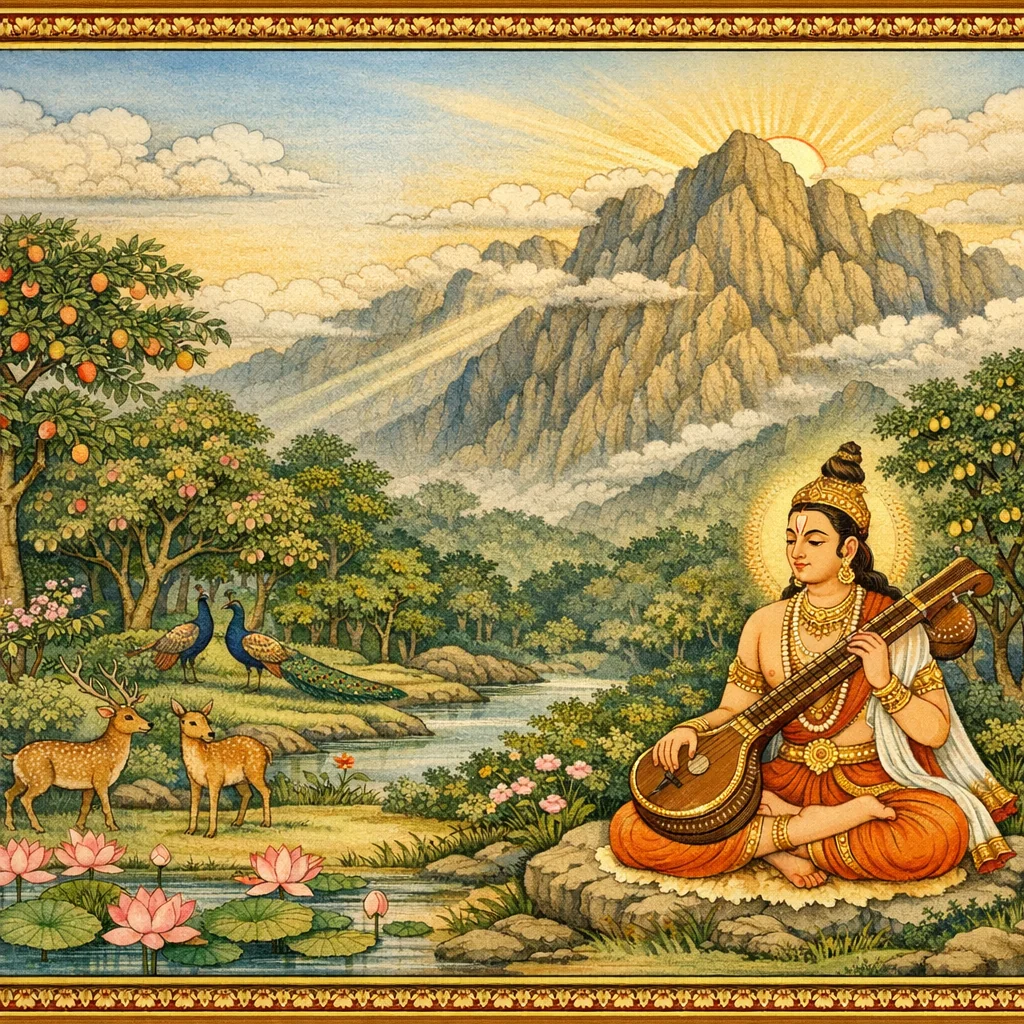
The chapter begins with invocatory verses—reverence to Gaṇeśa and exalted praise of Kāśī as a city that purifies sin and is linked with liberation—set within a purāṇic transmission frame (Vyāsa as speaker, Sūta as public narrator). Nārada then appears: after bathing in the Narmadā and worshipping Oṃkāra, he journeys on and beholds the Vindhya mountain, portrayed through an extended poetic catalogue of forests, fruits, flowers, and creatures, as a living sacred ecology. Vindhya welcomes him with arghya and attendant hospitality, rejoicing, yet reveals a pride-born anxiety about rank among mountains, especially Meru’s preeminence. Nārada reflects that true greatness is not gained through association with pride, but his reply only inflames Vindhya’s self-regard. After Nārada departs, Vindhya sinks into distress, condemning the torment of worry and describing “cintā-jvara” (the fever of anxiety) as corrosive to body and spirit. Seeking relief, he turns for refuge to Viśveśa, resolves not to delay, and—driven by rivalry—begins to grow until he obstructs the sun’s path, as the chapter closes with proverbial ethical counsel on conflict, restraint, and the social consequences of displaying power.
Shlokas
Verse 1
श्रीगणेशाय नमः । तं मन्महे महेशानं महेशानप्रियार्भकम् । गणेशानं करिगणेशानाननमनामयम्
Homage to Śrī Gaṇeśa. We contemplate that Lord of the Gaṇas, the beloved child of Maheśāna—Gaṇeśa, whose face is like the lord of elephants, the remover of affliction.
Verse 2
भूमिष्ठापि न यात्रभूस्त्रिदिवतोप्युच्चैरधःस्थापि या या बद्धा भुवि मुक्तिदास्युरमृतं यस्यां मृता जंतवः । या नित्यं त्रिजगत्पवित्रतटिनी तीरे सुरैः सेव्यते सा काशी त्रिपुरारिराजनगरी पायादपायाज्जगत्
Though situated on earth, she is no mere earthly place; though higher even than heaven, she is set here below, within reach. Bound in worldly life, beings there become givers of liberation; creatures who die there attain immortality. Ever served by the gods on the bank of the river that purifies the three worlds, may that Kāśī—the royal city of Tripurāri (Śiva)—protect the world from calamity.
Verse 3
नमस्तस्मै महेशाय यस्य संध्यात्त्रयच्छलात् । यातायातं प्रकुर्वंति त्रिजगत्पतयोऽनिशम्
Salutations to that Maheśa, by the pretext of whose three twilight rites the lords of the three worlds ceaselessly come and go to attend upon him.
Verse 4
अष्टादशपुराणानां कर्त्ता सत्यवतीसुतः । सूताग्रे कथयामास कथां पापापनोदिनीम्
Satyavatī’s son (Vyāsa), the composer of the eighteen Purāṇas, narrated—before the Sūta—this account that removes sin.
Verse 5
श्रीव्यास उवाच । कदाचिन्नारदः श्रीमान्स्नात्वा श्रीनर्मदांभसि । श्रीमदोंकारमभ्यर्च्य सर्वदं सर्वदेहिनाम्
Śrī Vyāsa said: Once, the illustrious Nārada bathed in the holy waters of the Narmadā, and worshipped the revered Oṃkāra—bestower of all boons upon all embodied beings.
Verse 6
व्रजन्विलोकयांचक्रे पुरोविंध्यं धराधरम् । संसारतापसंहारि रेवावारिपरिष्कृतम्
As he journeyed on, he beheld before him the Vindhya mountain, the earth-supporting range—made splendid by the waters of the Revā (Narmadā) and famed for quelling the burning of worldly existence.
Verse 7
द्वैरूप्येणापि कुर्वंतं स्थावरेण चरेण च । साभिख्येन यथार्थाख्यामुच्चैर्वसु मतीमिमाम्
He saw this rich land made as though in a twofold form—by the immovable and the movable—and, true to its famed name, it shone resplendent as ‘Vasumatī’, the wealthy earth.
Verse 8
रसालयं रसालैस्तैरशोकैः शोकहारिणाम् । तालैस्तमालेर्हिंतालैः सालैः सर्वत्रशालितम्
It was a mango-grove, filled with mango trees and aśoka trees that dispel sorrow; everywhere it was adorned with palms, tamāla, hiṃtāla, and śāla trees.
Verse 9
खपुरैः खपुराकारं श्रीफलं श्रीफलैः किल । गुरुश्रियंत्वगुरुभिः कपिपिंगं कपित्थकैः
With khapura fruits, the place seemed, as it were, “khapura-shaped”; śrīphala trees bore śrīphala in plenty; aguru lent it a weighty splendor, and kapittha fruits made it tawny, like a monkey’s hue.
Verse 10
वनश्रियः कुचाकारैर्लकुचैश्च मनोहरम् । सुधाफलसमारंभि रंभाभिः परिभासितम्
Delightful with the forest’s beauty—adorned with lakuca fruits shaped like rounded breasts—and radiant on every side with plantain groves, rich in nectar-like fruits.
Verse 11
सुरंगैश्चापि नारंगैरंगमंडपवच्छियः । वानीरैश्चापि जंबीरैर्बीजपूरैः प्रपूरितम्
Filled with citron, oranges, and other fragrant fruits—like a splendid stage-pavilion for beauty—and further crowded with vānīra, jambīra (citrus), and bījapūra trees in abundance.
Verse 12
अनिलालोल कंकोल वल्लीहल्ली सकायितम् । लवलीलवलीलाभिर्लास्यलीलालयं किल
Stirred by the wind, the kaṅkola creepers and winding vines seemed to sway and embrace; with lavalī and playful tendrils it appeared, indeed, like an abode of dancing grace.
Verse 13
मंदांदोलितकर्पूर कदलीदल संज्ञया । विश्रमाय श्रमापन्नानाहूयंतमिवाध्वगान्
With camphor-like coolness gently wafting from banana leaves, it seemed to call weary travelers, as if inviting them to rest from their fatigue.
Verse 14
पुन्नागमिव पुन्नागपल्लवैःकरपल्लवैः । कलयंतमिवाऽलोलैर्मल्लिकास्तबकस्तनम्
As though the punnāga tree, with tender shoots like hands, were gently touching—without wavering—the jasmine’s clustered breasts of bloom.
Verse 15
विदीर्णदाडिमैः स्वांतं दर्शयंतं तु रागवत् । माधवीं धवरूपेण श्लिष्यंतमिव कानने
With split pomegranates it seemed to reveal its own inner heart, flushed with red; and in the grove it appeared as though the mādhavī creeper were embraced in the form of the dhava tree.
Verse 16
उदुंबरैरंबरगैरनंतफलमालितैः । ब्रह्मांडकोटीर्बिभ्रंतमनंतमिव सर्वतः
With udumbara and aṃbaraga trees garlanded with endless fruits, it appeared on every side like the Infinite itself, bearing countless crores of universes.
Verse 17
पनसैर्वनासाभैः शुकनासैः पलाशकैः । पलाशनाद्विरहिणां पत्रत्यक्तैरिवावृतम्
Covered with jackfruit trees, with vanāsa-like growths, and with palāśa trees, it looked as though wrapped in leaf-garments cast off by lovers parted from their beloved.
Verse 18
कदंबवादिनो नीपान्दृष्ट्वा कंटकितैरिव । समंततो भ्राजमानं कदंबककदंबकैः
Seeing the nīpa (kadamba) trees, as though thrilled into gooseflesh, it shone on every side, resplendent with cluster upon cluster of kadamba blossoms.
Verse 19
नमेरुभिश्च मेरूच्चशिखरैरिव राजितम् । राजादनैश्च मदनैः सदनैरिव कामिनाम्
Adorned with lofty peaks like Meru and its towering summits; and with rājādana and madana trees, it seemed like the pleasure-houses of lovers.
Verse 20
तटेतटेपटुवटैरुच्चैःपटकुटी वृतम् । कुटजस्तबकैर्भांतमधिष्ठितबकैरिव
Along every riverbank it was encircled by lofty, sturdy banyan trees, as if the shoreline wore a ring of leafy huts; it shone with clusters of kuṭaja blossoms, like a white heron-roost made radiant by birds perched upon it.
Verse 21
करमर्दैः करीरैश्च करजैश्चकरंबकैः । सहस्रकरवद्भांतमर्थिप्रत्युद्गतैः करैः
Adorned with karamarda, karīra, karaja and karaṃbaka trees, it appeared like one with a thousand hands—hands extended as if to welcome supplicants approaching for refuge and blessing.
Verse 22
नीराजितमिवोद्दीपैराजचंपककोरकैः । सपुष्पशाल्मलीभिश्च जितपद्माकरश्रियम्
It seemed as though worshipped with bright lamps—the blazing buds of royal campaka—while flowering śālmalī trees made it surpass the splendor of lotus-lakes.
Verse 23
क्वचिच्चलदलैरुच्चैः क्वचित्कांचनकेतकैः । कृतमालैर्न क्तमालैः शोभमानं क्वचित्क्वचित्
Here and there it was beautified by tall trees with trembling leaves; elsewhere by golden ketaka; in places it shone with kṛtamāla and with fragrant naktamāla—splendor appearing in every direction.
Verse 24
कर्कंधु बंधुजीवैश्च पुत्रजीवैर्विराजितम् । सतिंदुकेंगुदीभिश्च करुणैःकरुणालयम्
It shone with karkaṃdhu, bandhu-jīva, and putra-jīva plants, and with tiṃduka and iṅgudī as well—truly a “home of compassion,” softened and sanctified by such gentle abundance.
Verse 25
गलन्मधू ककुसुमैर्धरारूपधरंहरम् । स्वहस्तमुक्तमुक्ताभिरर्चयंतमिवानिशम्
With kaku flowers dripping honey, it seemed as though the Earth—taking visible form—unceasingly worshipped Hara, offering pearls released from her own hand.
Verse 26
सर्जार्जुनांजनैर्बीजैर्व्यजनैर्वीज्यमानवत् । नारिकेलैः सखर्जूरैर्धृतच्छत्रमिवांबरे
With sārja, arjuna, and añjana trees and their seeds, it looked as if fanned by whisks; with coconut palms and date trees, it appeared as though parasols were held aloft in the sky above.
Verse 27
अमंदैः पिचुमंदैश्च मंदारैः कोविदारकैः । पाटलातिंतिणीघोंटाशाखोटैः करहाटकैः
It was filled with amaṃda and picumaṃda, with mandāra and kovidāra; with pāṭalā, tiṃtiṇī, ghoṃṭā, śākhoṭa, and karahāṭaka—an abundance of trees making the holy ground richly auspicious.
Verse 28
उद्दंडैश्चापि शेहुंडैरेरंडैर्गुडपुष्पकैः । बकुलैस्तिलकैश्चैव तिलकांकितमस्तकम्
With uddaṃḍa plants, śehuṃḍa, eraṇḍa (castor), and guḍapuṣpaka, and with bakula and tilaka trees as well—it was as though the land’s “forehead” bore an auspicious tilaka, a mark of consecration.
Verse 29
अक्षैः प्लक्षैः शल्लकीभिर्देवदारुहरिद्रुमैः । सदाफलसदापुष्प वृक्षवल्लीविराजितम्
Adorned with akṣa, plakṣa, and śallakī trees, with deodar and other noble woods; resplendent with creepers and trees ever bearing fruit and ever blooming—thus the sacred region stood in perpetual auspiciousness.
Verse 30
एलालवंग मरिचकुलुं जनवनावृतम् । जंब्वाम्रातकभल्लातशेलुश्रीपर्णिवर्णितम्
It was enfolded by groves of ela (cardamom), lavanga (clove), marica (pepper), and jujube; and richly adorned with jambū, wild mango (āmrātaka), marking-nut trees (bhallātaka), śelu, and śrīparṇī—thus proclaiming the abundance of that sacred woodland.
Verse 31
शाकशंखवनैरम्यं चदनैरक्तचंदनैः । हरीतकीकर्णिकार धात्रीवनविभूषणम्
Charming with groves of śāka and śaṅkha trees, and beautified by sandalwood and red sandal; it was further ornamented by forests of harītakī, karṇikāra, and dhātrī—like a sacred realm dressed in auspicious splendor.
Verse 32
द्राक्षावल्लीनागवल्लीकणावल्लीशतावृतम् । मल्लिकायूथिकाकुंदम दयंती सुगंधिनम्
It was covered with vines of grapes, betel (nāgavallī), and hundreds of fragrant creepers; and it was sweetly perfumed with jasmine (mallikā), yūthikā, and kunda blossoms, along with dayantī—filling the sacred tract with an enchanting fragrance.
Verse 33
भ्रमद्भ्रमरमालाभिर्मालतीभिरलंकृतम् । अलिच्छलागतंकृष्णं गोपीरंतुमनेकशः
Adorned with mālatī garlands amid swarms of whirling bees, it seemed—as if by the pretext of bees—to draw Kṛṣṇa there again and again for the delight of the gopīs.
Verse 34
नानामृगगणाकीर्णं नानापक्षिविनादितम् । नानासरित्सरः स्रोतः पल्वलैः परितो वृतम्
It swarmed with herds of many kinds of wild beasts and resounded with the calls of countless birds; on every side it was encircled by diverse rivers, lakes, streams, and lotus-pools.
Verse 35
तुच्छश्रियः स्वर्गभूमीः परिहायागतैरिव । नानासुरनिकायैश्च विष्वग्भोगेच्छयोषितम्
As though deeming even the splendors of heaven trifling and departing from those celestial realms, hosts of various devas seemed to dwell there, drawn from every side by the desire to partake of its blessed enjoyments.
Verse 36
उत्सृजंतमिवार्घ्यं वै पत्रपुष्पैरितस्ततः । केकिकेकारवैर्दूरात्कुर्वंतं स्वागतं किल
From here and there, with leaves and flowers, it seemed as though arghya—an offering of welcome—was being poured forth; and from afar, with peacocks’ ‘keki-keka’ cries, it was as if a greeting were being proclaimed.
Verse 37
अथ सूर्यशताभासं नभसि द्योतितांबरम् । नारदं दृष्टवाञ्छैलो दूरात्प्रत्युज्जगाम तम्
Then the mountain, beholding Nārada—radiant like a hundred suns and illumining the sky—came forth from afar to welcome him.
Verse 38
ब्रह्मसूनुवपुस्तेजो दूरीकृतदरीतमाः । तमागच्छंतमालोक्य मानसं तम उज्जहौ
The radiance of that son of Brahmā drove away the darkness from the mountain-caves; and seeing him draw near, the mountain cast off even the darkness of its own mind.
Verse 39
ब्रह्मतेजःसमुद्भूत साध्वसः साधुस त्क्रियः । कठिनोपि परित्यज्य धत्ते मृदुलतां किल
Through awe born of brahma-tejas and the noble duty of honoring the sādhu, even what is hard, casting off its hardness, truly takes on gentleness.
Verse 40
दृष्ट्वा मृदुलतां तस्य द्वैरूप्येपि स नारदः । मुमुदे सुतरां संतः प्रश्रयग्राह्यमानसाः
Seeing his gentleness—though he bore a twofold nature—Nārada rejoiced greatly; for the hearts of the truly good are won over by humility and reverent conduct.
Verse 41
गृहानायांतमालोक्य गुरुंवाऽगुरुमेव वा । योऽगुरुर्नम्रतां धत्ते स गुरुर्न गुरुर्गुरुः
Whether one beholds a guru or even one who is not a guru arriving at the house—whoever, though ‘not a guru,’ adopts humility, he becomes the true guru; the arrogant ‘guru’ is no guru at all.
Verse 42
तं प्रत्युच्चैः शिराःसोपि विनम्रतरकंधरः । शैलस्त्विलामिलन्मौलिः प्रणनाम महामुनिम्
He too raised his head toward him, yet with his neck bent in deeper humility; and the mountain—its peak seeming to brush the sky—bowed down to the great sage.
Verse 43
तमुत्थाप्य कराग्राभ्यामाशीर्भिरभिनंद्य च । तदुद्दिष्टासनं भेजे मनसोपि समुच्छ्रितम्
Raising him up with his hands and greeting him with blessings, he took the seat that was offered—uplifted in mind as well by the honor shown.
Verse 44
स दध्नामधुनाज्येन नीरार्द्राक्षतदूर्व या । तिलैः कुशैः प्रसूनैस्तमष्टांगार्घ्यैरपूजयत्
He worshipped him with the eightfold arghya—curd, honey, ghee, water, moist rice-grains and dūrvā grass—together with sesame, kuśa grass, and flowers.
Verse 45
गृहीतार्घ्यंकिल श्रांतं पादसंवाहनादिभिः । गतश्रममथालोक्य बभाषे ऽवनतो गिरिः
After he had accepted the arghya, the weary one was refreshed by services such as the massaging of his feet. Seeing his fatigue gone, the mountain—bowed in reverence—spoke.
Verse 46
अद्य सद्यः परिहृतं त्वदंघ्रिरजसारजः । त्वदंगसंगिमहसा सहसाऽप्यांतरंतमः
Today, at once, the dust of my inner defilement has been swept away by the dust of your feet; and by the radiance that clings to your very person, the darkness within has been suddenly dispelled.
Verse 47
सफलर्धिरहं चाद्य सुदिवाद्यच मे मुने । प्राक्कृतैः सुकृतैरद्य फलितं मे चिरार्जितैः
Today my prosperity has borne fruit, and this day is truly auspicious for me, O sage; for the merits I performed long ago, gathered over time, have ripened into their fruit today.
Verse 48
धराधरत्वं कुलिषुमान्यं मेऽद्य भविष्यति । इति श्रुत्वा तदा किंचिदुच्छुस्य स्थितवान्मुनिः
“My very state of being a mountain—hard as a thunderbolt—will today become worthy and meaningful.” Hearing this, the sage paused for a moment, breathed out softly, and remained still.
Verse 49
पुनरूचे कुलिवरः संभ्रमाप न्नमानसः । उच्छ्वासकारणं ब्रह्मन्ब्रूहि सर्वार्थकोविद
Then the best of mountains spoke again, his mind filled with awe: “O Brahman, knower of all meanings—tell me the reason for your sigh.”
Verse 50
अदृष्टं तव नोदृष्टं यदिष्टंविष्टपत्रये । अनुक्रोशोत्र मयिचेदुच्यतां प्रणतोस्म्यहम्
Nothing about you is unseen; nothing about you remains unknown. If, moved by compassion, you wish to convey something here to one like me, then speak it; I bow to you.
Verse 51
त्वदागमनजानन्दसंदोहैर्मे दुरारवः । अलं न वक्तुमसकृत्तथाप्येकं वदाम्यहम्
From the surging joy born of your arrival, my voice is hard to steady. I could speak again and again without end—yet even so, I will say one thing.
Verse 52
धराधरणसामर्थ्यं मेर्वादौ पूर्वपूरुषैः । वर्ण्यते समुदायात्तदहमेको दधे धराम्
The power of bearing the earth is praised, from Meru onward, by the men of old as a collective glory—yet I alone bear the earth.
Verse 53
गौरीगुरुत्वाद्धिमवानादिपत्याच्च भूभृताम् । संबंधित्वात्पशुपतेः स एको मान्यभृत्सताम्
Himavān alone is held in honor among the mountains—because he is the revered father of Gaurī, because he is the foremost among earth-bearers, and because he is related to Paśupati (Śiva).
Verse 54
नमेरुः स्वर्णपूर्णत्वाद्रत्नसानुतयाथवा । सुरसद्मतयावापि क्वापि मान्यो मतो मम
I do not esteem Meru merely because he is filled with gold, nor because his slopes are jeweled, nor even because he is the dwelling-place of the Devas.
Verse 55
परं शतं न किंशैला इलाकलनकेलयः । इह संति सतां मान्या मान्यास्ते तु स्वभूमिषु
There are not merely a hundred mountains with many kinds of names and distinctions. Here many are honored by the good, yet each is honored chiefly within its own land.
Verse 56
मन्देहदेहसंदेहादुदयैकदयाश्रितः । निषधो नौषधिधरोऽप्यस्तोप्यस्तमितप्रभः
Niṣadha, though bearing mighty healing herbs, has his radiance diminished—shadowed by the bodies of the Mandehas and dependent only on the mercy of the rising sun.
Verse 57
नीलश्च नीलीनिलयो मन्दरो मन्दलोचनः । सर्पालयः समलयो रायं नावैति रैवतः
Nīla is but the abode of Nīlī; Mandara is famed for gentle beauty; Raivata is a dwelling of serpents and a place of mingling—yet none of them truly attains sovereign eminence.
Verse 58
हेमकूटत्रिकूटाद्याः कूटोत्तरपदास्तुते । किष्किंधक्रौंचसह्याद्या भारसह्या न ते भुवः
O praised one, Hemakūṭa, Trikūṭa, and the other peaks famed for their lofty summits—Kiṣkindhā, Krauñca, Sahya and the rest—are not able to bear the burden as you do.
Verse 59
इति विंध्यवचः श्रुत्वा नारदोऽचिन्तयद्धृदि । अखर्वगर्वसंसर्गो न महत्त्वाय कल्पते
Hearing these words of Vindhya, Nārada reflected in his heart: “Association with unbending pride never leads to true greatness.”
Verse 60
श्रीशैलमुख्याः किंशैलानेह संत्यमलश्रियः । येषां शिखरमात्रादि दर्शनं मुक्तये सताम्
Beginning with Śrīśaila, what other mountains are there here, radiant with stainless glory—those whose very peak alone, once seen, becomes a cause of liberation for the virtuous?
Verse 61
अद्यास्य बलमालोक्यमिति ध्यात्वाब्रवीन्मुनिः । सत्यमुक्तं हि भवता गि रिसारंविवृण्वता
Reflecting, “Today I shall observe his power,” the sage spoke: “Indeed, what you have said is true, as you unfold the very essence of mountains.”
Verse 62
परं शैलेषु शैलेंद्रो मेरुस्त्वामवमन्यते । मया निःश्वसितं चैतत्त्वयि चापि निवेदितम्
But among mountains, the king of peaks—Meru—despises you. This, as it were, is my very sigh, and I lay it before you as well.
Verse 63
अथवा मद्विधानां हि केयं चिंता महात्मनाम् । स्वस्त्यस्तु तुभ्यमित्युक्त्वा ययौ स व्योमवर्त्मनि
Or else, what concern is this for great souls such as I? Saying, “May auspiciousness be yours,” he departed upon the path of the sky.
Verse 64
गते मुनौ निनिंदस्वमतीवोद्विग्नमानसः । चिन्तामवाप महतीं विंध्यो र्वंध्यमनोरथः
When the sage had departed, Vindhya—his mind exceedingly agitated—fell into self-reproach and was seized by a great anxiety, his desires left barren.
Verse 65
विंध्य उवाच । धिग्जीवितंशास्त्रकलोज्झितस्य धिग्जीवितं चोद्यमवर्जितस्य । धिग्जीवितं ज्ञातिपराजितस्य धिग्जीवितं व्यथर्मनोरथस्य
Vindhya said: “Fie upon the life of one who has fallen away from the arts of sacred learning; fie upon the life of one who is deprived of noble enterprise; fie upon the life of one defeated by his own kin; fie upon the life of one whose aims are wounded and frustrated.”
Verse 66
कथं भुनक्ति स दिवा कथं रात्रौ स्वपित्यहो । रहः शर्म कथं तस्य यस्याभिभवनं रिपोः
How does such a one eat by day, and how indeed does he sleep at night? How can there be peace for him in secret, when he has been overpowered by an enemy?
Verse 67
अहोदवाग्निदवथुस्तथामां न स बाधते । बाधते तु यथा चित्ते चिन्तासंतापसंततिः
Alas, even a forest-fire’s burning fever would not afflict me so; rather, what afflicts me is the unbroken stream of anxiety and inner torment within my mind.
Verse 68
युक्तमुक्तं पुराविद्भिश्चिन्तामूर्तिः सुदारुणा । न भेषजैर्लंघनैर्वा न चान्यैरुपशाम्यति
Truly have the wise of old spoken: anxiety is a most dreadful embodied force; it is not calmed by medicines, nor by fasting, nor by other means.
Verse 69
चिन्ताज्वरो मनुष्याणां क्षुधांनिद्रांबलं हरेत् । रूपमुत्साहबुद्धिं श्री जीवितं च न संशयः
The fever of anxiety in human beings steals hunger, sleep, and strength; it also takes away beauty, enthusiasm, intelligence, prosperity—and even life itself, without doubt.
Verse 70
ज्वरो व्यतीते षडहे जीर्णज्वर इहोच्यते । असौ चिन्ताज्वरस्तीव्रः प्रत्यहं नवतां व्रजेत्
When a fever persists beyond six days, it is called a chronic fever. But this fierce “fever of anxiety” grows newer and more intense with each passing day.
Verse 71
धन्यो धन्वतरिर्नात्र चरकश्चरतीह न । नासत्यावपिनाऽ सत्यावत्र चिन्ताज्वरे किल
Blessed is Dhanvantari—yet even he is of no help here; nor does Caraka roam here. Not even the Aśvin twins can truly set things right in this fever of anxiety, indeed.
Verse 72
किं करोमि क्व गच्छामि कथं मेरुं जयाम्यहम् । उत्प्लुत्य तस्य शिरसि पतामि न पताम्यतः
“What shall I do? Where shall I go? How can I conquer Meru? If I leap up and fall upon its summit—will I fall, or will I not?”
Verse 73
शक्रं कोपयता पूर्वमस्मद्गोत्रेण केनचित् । पक्षहीनः कृतो यत्र धिगपक्षस्यचेष्टितम्
“Long ago, someone of our own lineage angered Śakra (Indra), and there—because of that—he was made wingless. Fie upon the efforts of one who is without wings!”
Verse 74
अथवा स कथं मेरुस्तथोच्चैः स्पर्द्धते मया । भूमेर्भारभृतःप्रायो भवंति भ्रांति भूमयः
Or else, how could lofty Meru contend with me at such a height? Those who bear the burden of the earth are, for the most part, causes of confusion and delusion.
Verse 75
अलीकवाक्त्वमथवा संभाव्यं नारदे कथम् । ब्रह्मचारिणि वेदज्ञे सत्यलोकनिवासिनि
How could false speech even be suspected of you, O Nārada—of you who are a brahmacārin, a knower of the Vedas, and a dweller in Satyaloka?
Verse 76
युक्तायुक्तविचारोथ मादृशेनोपयुज्यते । पराक्रमेष्वशक्तानां विचारं गाहते मनः
And so, deliberation on what is proper or improper is what a person like me resorts to; for those unable to act with heroic effort, the mind plunges into endless reasoning.
Verse 77
अथवा चिन्तनैरेतैः किंव्यर्थैर्विश्वकारकम् । विश्वेशं शरणं यायां समे बुद्धिं प्रदास्यति
Or else—what is the use of these pointless worries? Let me go for refuge to Viśveśa, the maker of the universe; he will grant me right understanding.
Verse 78
अनाथनाथः सर्वेषां विश्वनाथो हि गीयते । क्षणं मनसि संचित्य भवेदित्थमसंशयम्
For he is sung as Viśvanātha—the lord of all, the protector of the unprotected. If one gathers this truth in the mind even for a moment, it becomes so—without doubt.
Verse 79
एतदेव करिष्यामि नेष्टं कालविलंबनम् । विचक्षणैरुपेक्ष्यौ न वर्द्धमानौ परामयौ
This alone shall I do; delay is not desirable. The wise do not overlook afflictions as they grow, for they become great calamities.
Verse 80
मेरुं प्रदक्षिणीकुर्यान्नित्यमेव दिवाकरः । सग्रहर्क्षगणो नूनं मन्यमानो बलाधिकम्
Surely the Sun, accompanied by the hosts of planets and constellations, daily circumambulates Mount Meru, deeming Meru superior in power.
Verse 81
इति निश्चित्य विन्ध्याद्रिर्ववृधे स मृधेक्षणः । अनंतगगनस्यांतं कुर्वद्भिः शिखरैरिव
Having decided thus, Vindhya mountain—grim in outlook—began to grow, as though its peaks were bringing an end to the boundless sky.
Verse 82
कैश्चित्सार्द्धं विरोधो न कर्तव्यः केनचित्क्वचित् । कर्तव्यश्चेत्प्रयत्नेन यथा नोपहसेज्जनः
With certain persons one should never enter into conflict—by anyone, anywhere. And if conflict must be undertaken, it should be done with utmost care, so that people do not mock one.
Verse 83
निरुध्य ब्राध्नमध्वानं कृतकृत्य इवाद्रिराट् । स्वस्थोऽभवद्भवाधीना प्राणिनां हि भविष्यता
Having blocked the Sun’s path, the king of mountains felt as though his task were accomplished and became self-satisfied—though indeed the fate of living beings depends upon the Lord, Bhava.
Verse 84
यमद्ययमकर्तासौ दक्षिणं प्रक्रमिष्यति । सकुलीनः स च श्रीमान्समहान्महितः स च
He—who today shall become the restrainer of Yama—will set forth toward the South; noble-born is he, prosperous and blessed, great and honoured as well.
Verse 85
यावत्स्वश क्तिं शक्तोपि न दर्शयति कर्हिचित् । तावत्स लंघ्यः सर्वेषां ज्वलनो दारुगो यथा
So long as a capable one does not display his own power at the proper time, so long is he disregarded by all—like fire concealed within wood.
Verse 86
इति चिंतामहाभारं त्यक्त्वा तस्थौ स्थिरोद्यमः । आकांक्षमाणस्तरणे रुदयं ब्राह्मणो यथा
Thus, casting off the great burden of anxiety, he stood firm in resolve—like a brāhmaṇa who longs in his heart for the Sun’s crossing, that he may proceed on his way.