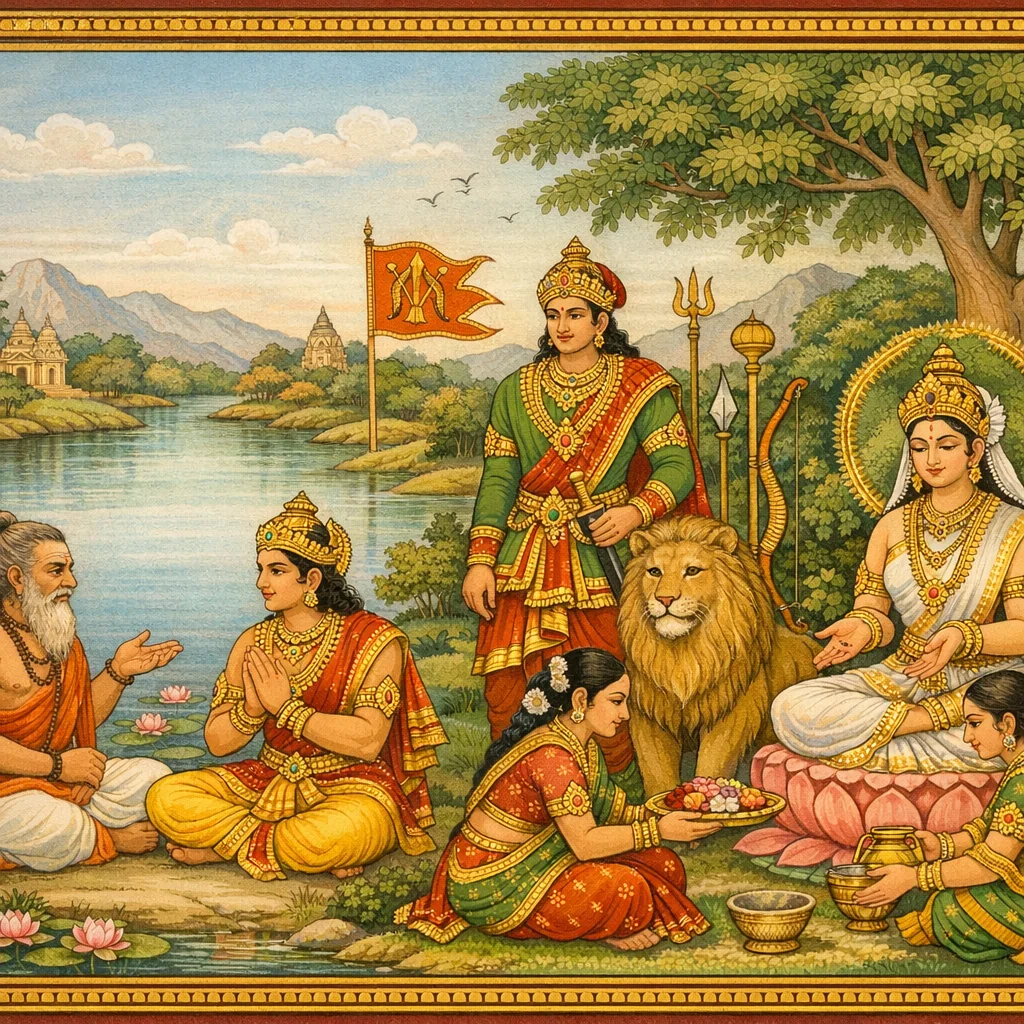
Adhyaya 16
This chapter unfolds through layered narration: Sūta introduces Vāmadeva’s account of a vast divine assembly on Mount Mandara, where Rudra appears as an awe-inspiring cosmic Lord, surrounded by innumerable Rudra hosts and many kinds of beings. Sanatkumāra approaches to ask for dharmas that lead to liberation and requests a practice that is easy to perform yet yields great results. Rudra proclaims Tripuṇḍra-dhāraṇa—wearing the three lines of sacred ash—as an eminent, Śruti-aligned secret for all beings. The chapter then details the rite: bhāsma made from burnt cow-dung is consecrated with the five Brahma-mantras (Sadyōjāta, etc.) and other mantras; it is applied to the head, forehead, arms, and shoulders; and the three lines are defined by their span and finger-method. A doctrinal scheme assigns to each line sets of nine correspondences (a/u/ma, fires, worlds/guṇas/Vedic portions, powers, savanas, and presiding deities), culminating in Mahādeva/Maheśvara/Śiva. The phalaśruti extols its fruits: purification from major and minor sins, exaltation of the bearer even if socially marginal, equivalence to bathing in all tīrthas, and efficacy as though many mantras were recited. It uplifts one’s lineage, grants celestial enjoyments, and finally bestows Śiva-loka and sāyujya without rebirth. The narrative closes with Rudra’s disappearance, Vāmadeva’s exhortation, and an exemplum in which a brahmarākṣasa is transformed by receiving and applying bhāsma/Tripuṇḍra and ascends to auspicious worlds; hearing, reciting, or teaching this māhātmya is itself declared salvific.
Shlokas
Verse 1
। सूत उवाच । शृणुध्वं मुनयः श्रेष्ठा वामदेवस्य भाषितम्
Sūta said: O best of sages, listen to the words spoken by Vāmadeva.
Verse 2
वामदेव उवाच । पुरा मंदरशैलेंद्रे नानाधातुविचित्रिते । नानासत्वसमाकीर्णे नानाद्रुमलताकुले
Vāmadeva said: Long ago, upon Mount Mandara—the king of mountains—adorned with many kinds of minerals, thronged with diverse beings, and filled with varied trees and creepers,
Verse 3
कालाग्निरुद्रो भगवान्कदाचिद्विश्ववंदितः । समाससाद भूतेशः स्वेच्छया परमेश्वरः
At a certain time, the Blessed Kālāgnirudra—revered by the whole world—came there of his own will: the Supreme Lord, the Master of beings.
Verse 4
समंतात्समुपातिष्ठन्रुद्राणां शतकोटयः । तेषां मध्ये समासीनो देवदेवस्त्रिलोचनः
From all sides there stood forth hundreds of crores of Rudras. In their midst sat the God of gods, the Three-eyed Lord.
Verse 5
तत्रागच्छत्सुरश्रष्ठो देवैः सह पुरंदरः । तथाग्निर्वरुणो वायुर्यमो वैवस्वतस्तथा
There came the foremost of gods—Purandara (Indra)—together with the deities. Likewise came Agni, Varuṇa, Vāyu, and Yama Vaivasvata.
Verse 6
गंधर्वाश्चित्रसेनाद्याः खेचराः पन्नगादयः । विद्याधराः किंपुरुषाः सिद्धाः साध्याश्च गुह्यकाः
Gandharvas led by Citrasena, sky-roamers, serpent beings and others; Vidyādharas, Kiṃpuruṣas, Siddhas, Sādhyas, and Guhyakas also assembled.
Verse 7
ब्रह्मर्षयो वसिष्ठाद्या नारदाद्याः सुरर्षयः । पितरश्च महात्मानो दक्षाद्याश्च प्रजेश्वराः
Brahmarṣis beginning with Vasiṣṭha, and divine seers beginning with Nārada; the great-souled Pitṛs, and the lords of creation beginning with Dakṣa—all were present.
Verse 8
उर्वश्याद्याश्चाप्सरसश्चंडिकाद्याश्च मातरः । आदित्या वसवो दस्रौ विश्वेदेवा महौजसः
There were Urvaśī and the other Apsarases; Caṇḍikā and the other Divine Mothers; the Ādityas, the Vasus, the twin Aśvins, and the mighty Viśvedevas—radiant with great power.
Verse 9
अथान्ये भूतपतयो लोकसंहरणे क्षमाः । महाकालश्च नंदी च तथा वै शंखपालकौ
Then there were other lords of spirits, capable even of bringing about the dissolution of worlds—Mahākāla, Nandī, and also the two named Śaṅkha and Pālaka.
Verse 10
वीरभद्रो महातेजाः शंकुकर्णो महाबलः । घंटाकर्णश्च दुर्धर्षो मणिभद्रो वृकोदरः
Vīrabhadra, blazing with great splendor; Śaṅkukarṇa, of immense strength; and Ghaṇṭākarṇa, hard to resist—along with Maṇibhadra and Vṛkodara—were present.
Verse 11
कुंडोदरश्च विकटास्तथा कुभोदरो बली । मंदोदरः कर्णधारः केतुर्भृंगीरिटिस्तथा
Kuṇḍodara and Vikaṭa, and the mighty Kubhodara; also Mandodara, Karṇadhāra, Ketu, and Bhṛṅgīriṭi as well.
Verse 12
भूतनाथास्तथान्ये च महाकाया महौजसः । कृष्णवर्णास्तथा श्वेताः केचिन्मंडूकसप्रभाः
And other lords of spirits too—of massive forms and great energy—some dark in hue, some white, and some shining with a frog-like luster.
Verse 13
हरिता धूसरा धूम्राः कर्बुरा पीतलोहिताः । चित्रवर्णा विचित्रांगाश्चित्रलीला मदोत्कटाः
Some were green, some ashen, some smoky; some mottled, some yellow-red. Variegated in hue and wondrous in limb, they performed strange displays, fierce with intoxicated ardor.
Verse 14
नानायुधोद्यतकरा नानावाहनभूषणाः । केचिद्व्याघ्रमुखाः केचित्सूकरास्या मृगा ननाः
With hands raised, bearing many kinds of weapons, and adorned with diverse mounts and ornaments—some had tiger faces, some boar faces, and others the forms of various beasts.
Verse 15
केचिच्च नक्रवदनाः सारमेयमुखाः परे । सृगालवदनाश्चान्य उष्ट्राभवदनाः परे
Some had crocodile faces; others had dog faces. Some were jackal-faced, and others bore camel-like faces.
Verse 16
केचिच्छरभभेरुंडसिंहाश्वोष्ट्रबकाननाः । एकवक्त्रा द्विवक्त्राश्च त्रिमुखाश्चैव निर्मुखाः
Some had the faces of Śarabha, Bheruṇḍa, lion, horse, camel, or crane. Some were one-faced, some two-faced, some three-faced—and some even faceless.
Verse 17
एकहस्तास्त्रिहस्ताश्च पंचहस्तास्त्वहस्तकाः । अपादा बहुपादाश्च बहुकर्णैककर्णकाः
Some were one-armed, some three-armed, some five-armed, and some armless. Some were without feet, some had many feet, and some had many ears—or only a single ear.
Verse 18
एकनेत्राश्चतुर्नेत्रा दीर्घाः केचन वामनाः । समंतात्परिवार्येशं भूतनाथमुपासते
Some were one-eyed, some four-eyed; some were tall, and some dwarfish. Encircling the Lord on every side, they worshipped Īśa, Bhūtanātha, the Master of all beings.
Verse 19
अथागच्छन्महातेजा मुनीनां प्रवरः सुधीः । सनत्कुमारो धर्मात्मा तं द्रष्टुं जगदीश्वरम्
Then the radiant and wise Sanatkumāra—foremost among sages, righteous in spirit—came there to behold Jagadīśvara, the Lord of the world.
Verse 20
तं देवदेवं विश्वेशं सूर्यकोटिसमप्रभम् । महाप्रलयसंक्षुब्धसप्तार्णवघनस्वनम्
He beheld that God of gods, Viśveśa, Lord of the universe, radiant like ten million suns—resounding like the deep roar of the seven oceans churned in the great dissolution.
Verse 21
संवर्त्ताग्निसमाटोपं जटामंडलशोभितम् । अक्षीणभालनयनं ज्वालाम्लानमुखत्विषम्
He appeared like the blazing fire of saṃvarta, the cosmic dissolution, adorned with a circle of matted locks; the eye upon his brow unwearied, and his face luminous with flame-like brilliance.
Verse 22
प्रदीप्तचूडामणिना शशिखंडेन शोभितम् । तक्षकं वामकर्णेन दक्षिणेन च वासुकिम्
He was splendid with a blazing crest-jewel and adorned with the crescent moon; Takṣaka was at his left ear and Vāsuki at his right.
Verse 23
बिभ्राणं कुंडलयुगं नीलरत्नमहाहनुम् । नीलग्रीवं महाबाहुं नागहारविराजितम्
He wore a pair of earrings; his mighty cheeks were like great blue gems. Blue-throated and great-armed, he shone, adorned with a garland of serpents.
Verse 24
फणिराजपरिभ्राजत्कंक णांगदमुद्रिकम् । अनंतगुणसाहस्रमणिरंजितमेखलम्
His bracelets, armlets, and rings shone with the splendor of serpent-kings; and his girdle was tinted with gems—countless in qualities, by the thousand.
Verse 25
व्याघ्रचर्मपरीधानं घंटादर्पणभूषितम् । कर्कोटकमहापद्मधृतराष्ट्रधनंजयैः
Clad in a tiger-skin and adorned with bells and mirror-like ornaments, he was attended by the nāgas Karkoṭaka, Mahāpadma, Dhṛtarāṣṭra, and Dhanañjaya.
Verse 26
कूजन्नूपुरसंघुष्टपादपद्मविराजितम् । प्रासतोमरखट्वाङ्गशूलटंकधनुर्धरम्
His lotus-feet were made splendid by the jingling of anklets; he bore spear and javelin, the khaṭvāṅga, trident, axe, and bow.
Verse 27
अप्रधृष्यमनिर्देश्यमचिंत्याकारमीश्वरम् । रत्नसिंहासनारूढं प्रण नाम महामुनिः
That Lord—invincible, indescribable, of inconceivable form—seated upon a jeweled throne: the great sage bowed down to him in reverence.
Verse 28
तं भक्तिभारोच्छ्वसितांतरात्मा संस्तूय वाग्भिः श्रुतिसंमिताभिः । कृतांजलिः प्रश्रयनम्रकंधरः पप्रच्छ धर्मानखिलाञ्छु भप्रदान्
His inmost self, heaving under the weight of devotion, he praised Him with words consonant with the Vedas; then, with palms joined and his neck bowed in humility, he asked of all the forms of dharma that bestow auspicious good.
Verse 29
यान्यानपृच्छत मुनिस्तांस्तान्धर्मानशेषतः । प्रोवाच भगवान्रुद्रो भूयो मुनिरपृच्छत
Whatever dharmas the sage asked about, the Blessed Rudra expounded them all without remainder; and again the sage continued to inquire further.
Verse 30
सनत्कुमार उवाच । श्रुतास्ते भगवन्धर्मास्त्वन्मुखान्मुक्तिहेतवः । यैर्मुक्तपापा मनुजास्तरिष्यंति भवार्णवम्
Sanatkumāra said: “O Lord, I have heard from your own mouth those dharmas—causes of liberation—by which human beings, freed from sins, will cross the ocean of worldly becoming.”
Verse 31
अथापरं विभो धर्ममल्पायासं महाफलम् । ब्रूहि कारुण्यतो मह्यं सद्यो मुक्तिप्रदं नृणाम्
“Now, O All-powerful One, out of compassion tell me another dharma—requiring little effort yet yielding great fruit—that grants immediate liberation to people.”
Verse 32
अभ्यासबहुला धर्माः शास्त्रदृष्टाः सहस्रशः । सम्यक्संसेविताः कालात्सिद्धिं यच्छंति वा न वा
“There are thousands of dharmas taught in the śāstras that require abundant repeated practice; even when rightly undertaken, in time they may grant attainment—or they may not.”
Verse 33
अतो लोकहितं गुह्यं भुक्तिमुक्त्योश्च साधनम् । धर्मं विज्ञातुमिच्छामि त्वत्प्रसादान्महेश्वर
Therefore, O Maheśvara, by your grace I desire to know that secret Dharma which brings welfare to the world and is a means to both worldly enjoyment (bhukti) and liberation (mokṣa).
Verse 34
श्रीरुद्र उवाच । सर्वेषामपि धर्माणामुत्तमं श्रुतिचोदितम् । रहस्यं सर्वजंतूनां यत्त्रिपुंड्रस्य धारणम्
Śrī Rudra said: “Among all Dharmas, the supreme—enjoined by the Vedas—is this secret for all beings: the wearing of the Tripuṇḍra.”
Verse 35
सनत्कुमार उवाच । त्रिपुंड्रस्य विधिं ब्रूहि भगवञ्जगतां पते । तत्त्वतो ज्ञातुमिच्छामि त्वत्प्रसादान्महेश्वर
Sanatkumāra said: “O Lord, Master of the worlds, teach me the proper procedure for the Tripuṇḍra. By your grace, O Maheśvara, I wish to know it in its true principles.”
Verse 36
कति स्थानानि किं द्रव्यं का शक्तिः का च देवता । किं प्रमाणं च कः कर्त्ता के मंत्रास्तस्य किं फलम्
How many places (on the body) are there? What is the substance? What is its power, and which deity is to be contemplated? What is the measure, who is qualified to perform it, what mantras belong to it, and what is its fruit?
Verse 37
एतत्सर्वमशेषेण त्रिपुंड्रस्य च लक्षणम् । ब्रूहि मे जगतां नाथ लोकानुग्रहकाम्यया
Explain to me, without leaving anything out, all of this—the full characteristics of the Tripuṇḍra, O Lord of the worlds—so that, desiring the welfare of people, I may bring them grace.
Verse 38
श्रीरुद्र उवाच । आग्नेयमुच्यते भस्म दग्धगोमयसंभवम् । तदेव द्रव्यमित्युक्तं त्रिपुंड्रस्य महामुने
Śrī Rudra said: “Ash is called ‘of the fire,’ for it arises from burnt cow-dung. O great sage, that alone is declared the proper substance for applying the sacred Tripuṇḍra.”
Verse 39
सद्योजातादिभिर्ब्रह्ममयैर्मंत्रैश्च पंचभिः । परिगृह्याग्निरित्यादिमंत्रैर्भस्माभिमंत्रयेत्
With the five Brahman-filled mantras beginning with Sadyōjāta, one should take up the ash and consecrate it by reciting mantras beginning with “Agni…”.
Verse 40
मानस्तोकेति संमृंज्य शिरो लिंपेच्च त्र्यंबकम् । त्रियायुषादिभिर्मंत्रैर्ललाटे च भुजद्वये । स्कंधे च लेपयेद्भस्म सजलं मंत्रभावितम्
Reciting “Mānas toke…”, one should rub and anoint the head; and with the mantra “Tryambakam…”, and with mantras beginning “Triyāyuṣa…”, one should apply the mantra-empowered ash, moistened with water, on the forehead, on both arms, and on the shoulders.
Verse 41
तिस्रो रेखा भवंत्येषु स्थानेषु मुनिपुंगव । भ्रुवोर्मध्यं समारभ्य यावदंतो भ्रुवोर्भवेत्
O foremost of sages, in these places there are three lines: beginning from the middle between the eyebrows and extending up to the ends of the eyebrows.
Verse 42
मध्यमानामिकांगुल्योर्मध्ये तु प्रतिलोमतः । अंगुष्ठेन कृता रेखा त्रिपुंड्रस्याभिधीयते
That line which is made with the thumb—drawn in reverse direction—between the middle finger and the ring finger is spoken of as the proper Tripuṇḍra line.
Verse 43
तिसृणामपि रेखाणां प्रत्येकं नव देवताः । अकारो गार्हपत्यश्च ऋग्भूर्लोको रजस्तथा
For each of the three lines there are nine presiding divinities: the syllable “A”, the Gārhapatya fire, the Ṛgveda, the Bhūrloka, and rajas, the quality of active impulse.
Verse 44
आत्मा चैव क्रियाशक्तिः प्रातः सवनमेव च । महादेवस्तु रेखायाः प्रथमायास्तु देवता
There also belong the Self (Ātman), the power of action, and the morning Soma-pressing; and Mahādeva is the presiding deity of the first line.
Verse 45
उकारो दक्षिणाग्निश्च नभः सत्त्वं यजुस्तथा । मध्यंदिनं च सवनमिच्छाशक्त्यंतरात्मकौ
“U” (ukāra), the Dakṣiṇāgni fire, the mid-space (nabhas), sattva, and the Yajurveda; and the midday savana—these are of the nature of the inner power of will (icchā-śakti).
Verse 46
महेश्वरश्च रेखाया द्वितीयायाश्च देवता । मकाराहवनीयौ च परमात्मा तमो दिवः
Maheśvara is the presiding deity of the second line; and to it pertain “M” (makāra), the Āhavanīya fire, the Supreme Self (Paramātman), tamas, and the heavenly realm (divaḥ).
Verse 47
ज्ञानशक्तिः सामवेदस्तृतीयसवनं तथा । शिवश्चेति तृतीयाया रेखायाश्चाधिदेवता
The power of knowledge, the Sāmaveda, and the third savana likewise; and Śiva is the presiding deity of the third line.
Verse 48
एता नित्यं नमस्कृत्य त्रिपुंड्रं धारयेत्सुधीः । महेश्वरव्रतमिदं सर्ववेदेषु कीर्तितम्
Having reverently saluted these sacred observances each day, the wise should wear the Tripuṇḍra. This is the vow of Maheśvara (Śiva), proclaimed in all the Vedas.
Verse 49
मुक्तिकामैर्नरैः सेव्यं पुनस्तेषां न संभवः । त्रिपुंड्रं कुरुते यस्तु भस्मना विधिपूर्वकम्
This should be practiced by those who long for liberation; for them there is no further rebirth. And whoever, following the prescribed method, properly forms the Tripuṇḍra with sacred ash—(attains that state).
Verse 50
ब्रह्मचारी गृहस्थो वा वनस्थो यतिरेव वा । महापातकसंघातैर्मुच्यते चोपपातकैः
Whether one is a brahmacārin, a householder, a forest-dweller, or a renunciant ascetic, one is freed from heaps of great sins, and also from subsidiary transgressions.
Verse 51
तथान्यैः क्षत्रविट्शूद्रस्त्रीगोहत्या दिपातकैः । वीरहत्याश्वहत्याभ्यां मुच्यते नात्र संशयः
Likewise, one is released from other sins—such as killing a Kṣatriya, a Vaiśya, a Śūdra, a woman, or a cow—and from killing a hero or a horse; of this there is no doubt.
Verse 52
अमंत्रेणापि यः कुर्यादज्ञात्वा महिमोन्नतिम् । त्रिपुंड्रं भालपटले मुच्यते सर्वपातकैः
Even without mantra, if someone applies the Tripuṇḍra upon the forehead without knowing its exalted greatness, he is freed from all sins.
Verse 53
परद्रव्यापहरणं परदाराभिमर्शनम् । परनिंदा परक्षेत्रहरणं परपीडनम्
Stealing another’s property; violating another’s spouse; slandering others; seizing another’s land; and harming others.
Verse 54
सस्यारामादिहरणं गृहदाहादिकर्म च । असत्यवादं पैशुन्यं पारुष्यं वेदविक्र यः । कूटसाक्ष्यं व्रतत्यागः कैतवं नीचसेवनम्
Stealing crops, gardens, and the like; acts such as burning houses; false speech; malicious tale-bearing; harshness; selling the Veda; false testimony; abandoning vows; deceit; and consorting with the base.
Verse 55
गोभूहिरण्यमहिषी तिलकंबलवाससाम् । अन्नधान्यजलादीनां नीचेभ्यश्च परिग्रहः
Accepting improper gifts—cows, land, gold, buffaloes, sesame, blankets, garments; and food, grain, water, and the like—especially from unworthy persons.
Verse 56
दासी वेश्याभुजंगेषु वृषलीषु नटीषु च । रजस्वलासु कन्यासु विधवासु च संगमः
Sexual intercourse with a maidservant, a prostitute, a woman of outcaste associations, a low-born woman, an actress; and with a menstruating woman, an unmarried girl, or a widow.
Verse 57
मांसचर्मरसादीनां लवणस्य च विक्रयः । एवमादीन्य संख्यानि पापानि विविधानि च
The selling of meat, hides, intoxicating liquids and the like, and of salt; and thus, countless other sins of many kinds.
Verse 58
सद्य एव विनश्यंति त्रिपुंड्रस्य च धारणात् । शिवद्रव्यापहरणं शिवनिंदा च कुत्रचित्
By the mere wearing of the Tripuṇḍra, such sins are destroyed at once—such as the theft of Śiva’s property and, in some cases, even contempt spoken against Śiva.
Verse 59
निंदा च शिवभक्तानां प्रायश्चितैर्न शुद्ध्यति । रुद्राक्षा यस्य गात्रेषु ललाटे च त्रिपुंड्रकम्
Slandering Śiva’s devotees is not purified even by expiatory rites. But one who bears Rudrākṣa upon the body and the Tripuṇḍra upon the forehead is declared highly sanctified.
Verse 60
स चांडालोऽपि संपूज्यः सर्ववर्णोत्तमो भवेत् । यानि तीर्थानि लोकेऽस्मिन्गंगायाः सरितश्च याः
Even if he be a Caṇḍāla, he becomes worthy of honor and is regarded as the best among all social orders. Whatever sacred fords exist in this world, and whatever rivers belong to the Gaṅgā—
Verse 61
स्नातो भवति सर्वत्र ललाटे यस्त्रिपुंड्रधृक् । सप्तकोटिमहामंत्राः पंचाक्षरपुरःसराः
Wherever he may be, the one who bears the Tripuṇḍra upon his forehead is considered as one who has bathed in holy waters everywhere. The great mantras—seven crores of them—led by the Pañcākṣarī,
Verse 62
तथान्ये कोटिशो मंत्राः शैवाः कैवल्यहेतवः । ते सर्वे येन जप्ताः स्युर्यो बिभर्ति त्रिपुंड्रकम्
So too, countless other Śaiva mantras that are causes of liberation—by the one who wears the Tripuṇḍra, all of those are considered as though they have been recited.
Verse 63
सहस्रं पूर्वजातानां सहस्रं च जनिष्यताम् । स्ववंशजानां मर्त्यानामुद्धरेद्यस्त्रिपुंड्रधृक्
The bearer of the Tripuṇḍra uplifts and delivers a thousand forebears and a thousand yet to be born—mortals of his own lineage.
Verse 64
इह भुक्त्वाखिलान्भोगान्दीर्घायुर्व्याधिवर्जितः । जीवितांते च मरणं सुखनैवं प्रपद्यते
Here in this world he enjoys every comfort, becomes long-lived and free from illness; and at life’s end he attains a peaceful, auspicious death.
Verse 65
अष्टैश्वर्यगुणोपेतं प्राप्य दिव्यं वपुः शुभम् । दिव्यं विमानमारुह्य दिव्यस्त्रीशतसेवितः
Endowed with the qualities of the eight divine powers, he attains a radiant, auspicious celestial body, mounts a heavenly vimāna, and is attended by hundreds of divine maidens.
Verse 66
विद्याधराणां सिद्धानां गंधर्वाणां महौजसाम् । इंद्रादिलोकपालानां लोकेषु च यथाक्रमम्
In due order he moves through the worlds of the Vidyādharas, the Siddhas, the mighty Gandharvas, and the Lokapālas beginning with Indra.
Verse 67
भुक्त्वा भोगान्सुविपुलान्प्रजेशानां पुरेषु च । ब्रह्मणः पदमासाद्य तत्र कल्पशतं रमेत्
Having enjoyed vast delights in the cities of the Prajeśas, he attains the realm of Brahmā and rejoices there for a hundred kalpas.
Verse 68
विष्णोर्लोके च रमते यावद्ब्रह्मशतत्रयम्
He delights in Viṣṇu’s world for as long as three hundred Brahmā-years.
Verse 69
शिवलोकं ततः प्राप्य रमते कालमक्षयम् । शिवसायुज्यमाप्नोति न स भूयोऽभिजायते
Then, attaining Śiva’s realm, he abides in imperishable time. He reaches union with Śiva, and is not born again.
Verse 70
सर्वोपनिषदां सारं समालोच्य मुहुर्मुहुः । इदमेव हि निर्णीतं परं श्रेयस्त्रिपुंड्रकम्
Having reflected again and again on the essence of all the Upaniṣads, this alone has been concluded: the Tripuṇḍra is the highest good.
Verse 71
एतत्त्रिपुंड्रमाहात्म्यं समासात्कथितं मया । रहस्यं सर्वभूतानां गोपनीयमिदं त्वया
Thus I have briefly told you the greatness of the Tripuṇḍra. This is a secret for all beings; it should be safeguarded by you.
Verse 72
इत्युक्त्वा भगवान्रुद्रस्तत्रैवांतरधीयत । सनत्कुमारोऽपि मुनिर्जगाम ब्रह्मणः पदम्
Having spoken thus, the Blessed Rudra vanished there itself. And the sage Sanatkumāra too went to the abode of Brahmā.
Verse 73
तवापि भस्मसंपर्कात्संजाता विमला मतिः । त्वमपि श्रद्धया पुण्यं धारयस्व त्रिपुंड्रकम्
Even in you, through contact with the sacred ash, a purified understanding has arisen. You too, with faith, should bear the holy Tripuṇḍra.
Verse 74
सूत उवाच । इत्युक्त्वा वामदेवस्तु शिवयोगी महातपाः । अभिमंत्र्य ददौ भस्म घोराय ब्रह्मरक्षसे
Sūta said: Having spoken thus, Vāmadeva—the great ascetic, a yogin devoted to Śiva—consecrated the ash with mantra and gave it to Ghora, the Brahma-rākṣasa.
Verse 75
तेनासौ भालपटले चक्रे तिर्य क्त्रिपुंड्रकम् । ब्रह्मराक्षसतां सद्यो जहौ तस्यानुभावतः
With that ash, he drew the horizontal Tripuṇḍra upon his forehead. By its power, he instantly cast off his state of being a Brahma-rākṣasa.
Verse 76
स बभौ सूर्यसंकाशस्तेजोमण्डलमंडितः । दिव्यावयरूपैश्च दिव्यमाल्यांबरो ज्ज्वलः
He shone like the sun, adorned with a circle of radiance—resplendent with divine ornaments and forms, and glowing in heavenly garlands and garments.
Verse 77
भक्त्या प्रदक्षिणीकृत्य तं गुरुं शिवयोगिनम् । दिव्यं विमानमारुह्य पुण्यलोकाञ्जगाम सः
Having reverently circumambulated that guru—the Śiva-yogin—with devotion, he mounted a celestial vimāna and went to the meritorious worlds.
Verse 78
वामदेवो महायोगी दत्त्वा तस्मै परां गतिम् । चचार लोके मूढात्मा साक्षादिव शिवः स्वयम्
Vāmadeva, the great yogin, having bestowed upon him the supreme state, then moved about the world—though appearing as a simple-minded soul—like Śiva Himself manifest in person.
Verse 79
य एतद्भस्ममाहात्म्यं त्रिपुंड्रं शृणुयान्नरः । श्रावयेद्वा पठेद्वापि स हि याति परां गतिम्
Any person who listens to this greatness of the sacred ash and the Tripuṇḍra—and even one who has it recited to others or reads it—indeed attains the supreme state.
Verse 80
कथयति शिवकीर्तिं संसृतेर्मुक्तिहेतुं प्रणमति शिवयोगिध्येयमीशांघ्रिपद्मम् । रचयति शिवभक्तोद्भासि भाले त्रिपुंड्रं न पुनरिह जनन्या गर्भवासं भजेत्सः
One who proclaims Śiva’s fame as a cause of liberation from saṃsāra, who bows to the Lord’s lotus-feet contemplated by Śiva-yogins, and who inscribes upon the forehead the Tripuṇḍra shining with devotion to Śiva—such a person will not again undergo dwelling in a mother’s womb in this world.