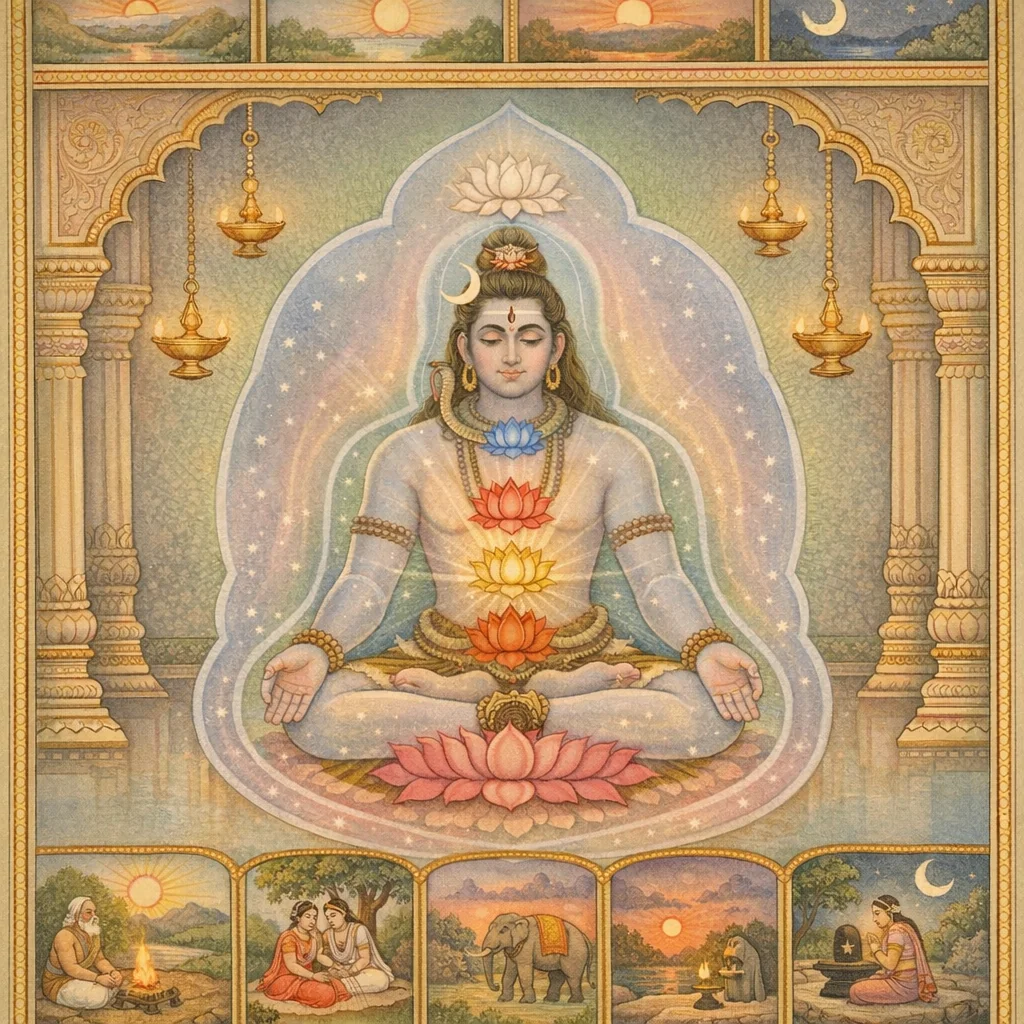
Adhyaya 12
This chapter sets forth a technical Śaiva kavaca (protective armour), spoken by Ṛṣabha. It opens with a ritual and inner discipline: salutation to Mahādeva, sitting in a purified place, steadying the posture, restraining the senses, and sustained contemplation of imperishable Śiva. The practitioner then visualizes Mahādeva within the heart-lotus and establishes protection through ṣaḍakṣara-nyāsa and the donning of the kavaca. A structured protective litany assigns Śiva’s forms to the elements and surroundings, to the directions through the five-faced Śiva—Tatpuruṣa, Aghora, Sadyojāta, Vāmadeva, and Īśāna—to the body from head to feet, and to the divisions of day and night. A long mantra-like invocation culminates in requests for complete safeguarding and the removal of afflictions and dangers, ending with a phalaśruti that regular recitation or wearing dispels obstacles, eases suffering, and supports longevity and auspiciousness. The frame then shifts as Sūta reports Ṛṣabha empowering a prince with consecrated ash, a conch, and a sword, describing their effects on strength, morale, and deterrence of foes, and concluding with an assurance of victory and stable kingship.
Shlokas
Verse 1
ऋषभ उवाच । नमस्कृत्य महादेवं विश्वव्यापिनमीश्वरम् । वक्ष्ये शिवमयं वर्म सर्वरक्षाकरं नृणाम्
Ṛṣabha said: Having bowed to Mahādeva, the all-pervading Lord, I shall declare the Śiva-formed armor (varma), which brings complete protection to human beings.
Verse 2
शुचौ देशे समासीनो यथावत्कल्पितासनः । जितेंद्रियो जितप्राणश्चिंतयेच्छिवमव्ययम्
Seated in a clean place, on a properly arranged seat, with senses mastered and breath disciplined, one should contemplate Śiva, the imperishable.
Verse 3
हृत्पुंडरीकांतरसन्निविष्टं स्वतेजसा व्याप्तनभोवकाशम् । अतींद्रियं सूक्ष्ममनंतमाद्यं ध्यायेत्परानंदमयं महेशम्
Let one meditate on Maheśa, seated within the heart-lotus; by His own radiance He pervades the vastness of sky and space—beyond the senses, subtle, infinite, the primordial Lord—whose very nature is supreme bliss.
Verse 4
ध्यानावधूताखिलकर्मबंधश्चिरं चिदानंदनिमग्नचेताः । षडक्षरन्याससमाहितात्मा शैवेन कुर्या त्कवचेन रक्षाम्
With all bonds of karma shaken off by meditation, the mind long immersed in consciousness and bliss, and the self gathered through the nyāsa of the six-syllabled mantra, one should secure protection by the Śaiva kavaca, the protective armour of Śiva.
Verse 5
मां पातु देवोऽखिलदेवतात्मा संसारकूपे पतितं गभीरे । तन्नाम दिव्यं वरमंत्रमूलं धुनोतु मे सर्वमघं हृदिस्थम्
May that Deva—whose very essence is all the gods—protect me, fallen into the deep well of saṃsāra. May His divine Name, the excellent root of mantra, shake off all sin that abides within my heart.
Verse 6
सर्वत्र मां रक्षतु विश्वमूर्त्तिर्ज्योतिर्मयानंदघनश्चिदात्मा । अणोरणीयानुरुशक्तिरेकः स ईश्वरः पातु भयादशेषात्
May the Lord—whose form is the universe, whose essence is light, a dense mass of bliss, the very Self of consciousness—protect me everywhere. May that one Īśvara, subtler than the subtlest and of boundless power, save me from every fear without remainder.
Verse 7
यो भूस्वरूपेण बिभर्ति विश्वं पायात्स भूमेर्गिरिशोऽष्टमूर्तिः । योऽपां स्वरूपेण नृणां करोति संजीनं सोऽवतु मां जलेभ्यः
May Girīśa, the eight-formed Lord, protect me through His form as Earth—He who upholds the universe as the very ground. And may He, who becomes the form of Waters and brings life to beings, safeguard me from dangers arising from water.
Verse 8
कल्पावसाने भुवनानि दग्ध्वा सर्वाणि यो नृत्यति भूरिलीलः । स कालरुद्रोऽवतु मां दवाग्नेर्वात्यादिभीतेरखिलाच्च तापात्
At the end of the kalpa, having burned all the worlds, He dances in mighty divine play. May Kālarudra protect me from forest-fire, from terrors such as violent winds, and from every burning affliction.
Verse 9
प्रदीप्तविद्युत्कनकावभासो विद्यावराभीतिकुठारपाणिः । चतुर्मुखस्तत्पुरुषस्त्रिनेत्रः प्राच्यां स्थितं रक्षतु मामजस्रम्
May Tatpuruṣa—four-faced, three-eyed, radiant like blazing lightning and gold, bearing the emblems of knowledge, boon, fearlessness, and an axe—ever protect me, abiding in the eastern quarter.
Verse 10
कुठारवेदांकुशपाशशूलकपालढक्काक्षगुणान्दधानः । चतुर्मुखो नीलरुचिस्त्रिनेत्रः पायादघोरो दिशि दक्षिणस्याम्
May Aghora—four-faced, three-eyed, dark-blue in radiance—protect me in the southern quarter, bearing the axe, the Veda, the goad, the noose, the trident, the skull, the ḍhakkā drum, the rosary, and the bowstring.
Verse 11
कुंदेन्दुशंखस्फटिकावभासो वेदाक्षमालावरदाभयांकः । त्र्यक्षश्चतुर्वक्त्र उरुप्रभावः सद्योधिजातोवतु मां प्रतीच्याम्
May Sadyojāta—four-faced, three-eyed, of vast splendor, shining like jasmine, the moon, conch, and crystal, bearing the Veda and rosary, and marked with boon and fearlessness—protect me in the western quarter.
Verse 12
वराक्षमालाभयटंकहस्तः सरोजकिंजल्कसमानवर्णः । त्रिलोचनश्चारुचतुर्मुखो मां पायादुदीच्यां दिशि वामदेवः
May Vāmadeva—beautifully four-faced and three-eyed, whose hands bear boon, rosary, fearlessness, and a small bell, and whose complexion is like the pollen of a lotus—protect me in the northern quarter.
Verse 13
वेदाभयेष्टांकुशटंकपाशकपालढक्काक्षकशूलपाणिः । सितद्युतिः पंचमुखोऽवतान्मामीशान ऊर्द्ध्वं परमप्रकाशः
May Īśāna—supremely radiant above, white in splendor, five-faced, and bearing the Vedas, the gesture of fearlessness, the boon, the goad, the axe, the noose, the skull, the ḍhakkā drum, the rosary, and the trident—protect me.
Verse 14
मूर्धानमव्यान्मम चंद्रमौ लिर्भालं ममाव्यादथ भालनेत्रः । नेत्रे ममाव्याद्भगनेत्रहारी नासां सदा रक्षतु विश्वनाथः
May the Moon-crested Lord protect my head; may the One with the forehead-eye protect my brow; may the remover of Bhaga’s eye protect my eyes; and may Viśvanātha ever guard my nose.
Verse 15
पायाच्छ्रुती मे श्रुतिगीतकीर्तिः कपोलमव्या त्सततं कपाली । वक्त्रं सदा रक्षतु पंचवक्त्रो जिह्वां सदा रक्षतु वेदजिह्वः
May the One whose glory is sung by the Vedas protect my ears; may Kapālī ever protect my cheeks; may the Five-faced Lord always guard my mouth; and may the One whose tongue is the Veda ever protect my tongue.
Verse 16
कंठं गिरीशोऽवतु नीलकंठः पाणिद्वयं पातु पिनाकपाणिः । दोर्मूलमव्यान्मम धर्मबाहुर्वक्षःस्थलं दक्षमखांतकोऽव्यात्
May Girīśa, the Blue-throated, protect my throat; may Pinākapāṇi protect both my hands; may Dharmabāhu protect the roots of my arms; and may the destroyer of Dakṣa’s sacrifice protect my chest.
Verse 17
ममोदरं पातु गिरींद्रधन्वा मध्यं ममाव्यान्मदनान्तकारी । हेरंबतातो मम पातु नाभिं पायात्कटी धूर्जटिरीश्वरो मे
May the Lord who wields the mountain-bow protect my belly; may the slayer of Kāma protect my waist; may the father of Heramba protect my navel; and may Dhūrjaṭi, my Lord, protect my hips.
Verse 18
ऊरुद्वयं पातु कुबेरमित्रो जानुद्वयं मे जगदीश्वरोऽव्यात् । जंघायुगं पुंगवकेतुरव्यात्पादौ ममाव्या त्सुरवंद्यपादः
May Kubera’s Friend protect my two thighs; may the Lord of the worlds guard my knees. May Puṅgavaketu protect my pair of shanks; and may He whose feet are worshiped by the gods protect my feet.
Verse 19
महेश्वरः पातु दिनादियामे मां मध्ययामेऽवतु वामदेवः । त्रियंबकः पातु तृतीययामे वृषध्वजः पातु दिनांत्ययामे
May Maheśvara protect me in the first watch of the day; may Vāmadeva guard me at midday. May Tryambaka protect me in the third watch; and may Vṛṣadhvaja protect me in the day’s final watch.
Verse 20
पायान्निशादौ शशिशेखरो मां गंगाधरो रक्षतु मां निशीथे । गौरीपतिः पातु निशावसाने मृत्युंजयो रक्षतु सर्वकालम्
May Śaśiśekhara protect me at the night’s beginning; may Gaṅgādhara guard me at midnight. May Gaurīpati protect me as the night ends; and may Mṛtyuṃjaya protect me at all times.
Verse 21
अंतःस्थितं रक्षतु शंकरो मां स्थाणुः सदा पातु बहिःस्थितं माम् । तदंतरे पातु पतिः पशूनां सदा शिवो रक्षतु मां समंतात्
May Śaṅkara protect me from within; may Sthāṇu ever protect me from without. Between these, may Paśupati protect me; and may Śiva always guard me on every side.
Verse 22
तिष्ठंतमव्या द्भुवनैकनाथः पायाद्व्रजंतं प्रमथाधिनाथः । वेदांतवेद्योऽवतु मान्निषण्णं मामव्ययः पातु शिवः शयानम्
May the sole Lord of the worlds protect me while I stand; may the Lord of the Pramathas guard me while I go. May the One known through Vedānta protect me while I sit; and may the imperishable Śiva protect me while I lie down.
Verse 23
मार्गेषु मां रक्षतु नीलकंठः शैलादिदुर्गेषु पुरत्रयारिः । अरण्यवासादिमहाप्रवासे पायान्मृगव्याध उदारशक्तिः
May Nīlakaṇṭha protect me upon the roads; may the Foe of Tripura guard me in perilous places such as mountains and forts. And in great journeys—dwelling in forests and other long sojourns—may the noble and mighty Mṛgavyādha, Śiva, keep me safe.
Verse 24
कल्पांतकाटोपपटुप्रकोपः स्फुटाट्टहासोच्चलितांडकोशः । घोरारिसेनार्णवदुर्निवारमहाभयाद्रक्षतु वीरभद्रः
May Vīrabhadra protect us from the great, irresistible terror—he whose fierce wrath is sharp and overwhelming like the cataclysm at the end of an aeon; whose resounding, bursting laughter makes the cosmic shells tremble; and who is invincible, even against the dreadful ocean-like host of enemies.
Verse 25
पत्त्यश्वमातंगघटावरूथसहस्रलक्षायुतकोटिभीषणम् । अक्षौहिणीनां शतमाततायिनां छिंद्या न्मूढो घोरकुठारधारया
Even if a hundred akṣauhiṇīs of murderous aggressors—terrifying with countless thousands, lakhs, ayutas, and crores of infantry, horses, elephants, chariots, and armoured forces—were to advance, a deluded man should cut them down with the sharp edge of a dreadful axe.
Verse 26
निहंतु दस्यून्प्रलयानलार्चिर्ज्वलत्त्रिशूलं त्रिपुरांतकस्य । शार्दूलसिंहर्क्षवृकादिहिंस्रान्संत्रासयत्वीशधनुःपिनाकम्
May Tripurāntaka’s blazing trident—like the flame of the fire of dissolution—destroy the bandits; and may Pināka, the Lord’s bow, terrify the fierce beasts such as tigers, lions, bears, wolves, and the rest.
Verse 27
दुःस्वप्नदुःशकुनदुर्गतिदौर्मनस्यदुर्भिक्षदुर्व्यसनदुःसहदुर्यशांसि । उत्पाततापविषभीतिमसद्ग्रहार्तिव्याधींश्च नाशयतु मे जगतामधीशः
May the Lord of the worlds destroy for me: evil dreams, inauspicious omens, misfortune, depression of mind, famine, calamities, unbearable hardships, and ill repute; and also portents, burning afflictions, fear of poison, torment from wicked planetary influences (grahas), and diseases.
Verse 28
ओंनमो भगवते सदाशिवाय सकलतत्त्वात्मकाय सकलतत्त्वविहाराय सकललोकैककर्त्रे सकललौकैकभर्त्रे सकललोकैकहर्त्रे सकललोकैकगुरवे सकललोकैकसाक्षिणे सकलनिगमगुह्याय सकलवरप्रदाय सकलदुरितार्तिभंजनाय सकलजगदभयंकराय सकललोकैकशंकराय शशांकशेखराय शाश्व तनिजाभासाय निर्गुणाय निरुपमाय नीरूपाय निराभासाय निरामयाय निष्प्रपंचाय निष्कलंकाय निर्द्वंद्वाय निःसंगाय निर्मलाय निर्गमाय नित्यरूपविभवाय निरुपमविभवाय निराधाराय नित्यशुद्धबुद्धपरिपूर्णसच्चिदानंदाद्वयाय परमशांतप्रकाशतेजोरूपाय जयजय महारुद्र महारौद्र भद्रावतार दुःखदावदारण महाभैरव कालभैरव कल्पान्तभैरव कपालमालाधर खट्वांगखड्गचर्मपाशांकुशडमरुशूलचापबाणगदाशक्तिभिं डिपालतोमरमुसलमुद्गरपट्टिशपरशुपरिघभुशुंडीशतघ्नीचक्राद्यायुधभीषणकरसहस्र मुखदंष्ट्राकराल विकटाट्टहासविस्फारितब्रह्मामण्डल नागेंद्र कुण्डल नागेंद्रहार नागेंद्रवलय नागेंद्रचर्मधर मृत्युंजय त्र्यंबक त्रिपुरांतक विरूपाक्ष विश्वेश्वर विश्वरूप वृषभवाहन विषभूषण विश्वतोमुख सर्वतो रक्षरक्ष मां ज्वलज्वल महामृत्युभयमपमृत्युभयं नाशयनाशय रोगभयमुत्सादयोत्सादय विषसर्पभयं शमयशमय चोरभयं मारयमारय मम शत्रूनुच्चा टयोच्चाटय शूलेन विदारयविदारय कुठारेण भिंधिभिंधि खड्गेन छिंधिछिंधि खट्वांगेन विपोथयविपोथय मुसलेन निष्पेषयनिष्पेषय बाणैः संताडय संताडय रक्षांसि भीषयभीषय भूतानि विद्रावयविद्रावय कूष्मांडवेतालमारीगणब्रह्मराक्षसान्संत्रासयसंत्रासय ममाभयं कुरुकुरु वित्रस्तं मामाश्वास याश्वासय नरकभयान्मामुद्धारयोद्धारय संजीवयसंजीवय क्षुत्तृड्भ्यां मामाप्याययाप्यायय दुःखातुरं मामानन्दयानंदय शिवकवचेन मामाच्छादया च्छादय त्र्यंबक सदाशिव नमस्तेनमस्तेनमस्ते । ऋषभ उवाच । इत्येतत्कवचं शैवं वरदं व्याहृतं मया । सर्वबाधाप्रशमनं रहस्यं सर्व देहिनाम्
Om—salutations to the Blessed Sadāśiva: the embodiment of all principles, the sole creator, sustainer, and withdrawer of all worlds; the one Guru and Witness. Victory, victory—O Mahārudra, Mahābhairava; bearer of the skull-garland; terrible with innumerable weapons. O Lord riding the bull, protect, protect me on every side. Blaze, blaze; destroy the fear of death and disease; strike down my enemies and drive away evil spirits. Cover me with the Śiva-kavaca. Ṛṣabha said: “Thus has this Śaiva protective hymn, bestowing boons, been uttered by me—a secret for all embodied beings, quelling every affliction.”
Verse 29
यः सदा धारयेन्मर्त्यः शैवं कवचमुत्तमम् । न तस्य जायते क्वापि भयं शम्भोरनुग्रहात्
Any mortal who continually bears this supreme Śaiva protective hymn (kavaca) never encounters fear anywhere—by the gracious favor of Śambhu.
Verse 30
क्षीणायुर्मृत्युमापन्नो महारोगहतोऽपि वा । सद्यः सुखमवाप्नोति दीर्घमायुश्च विंदति
Even one whose lifespan is waning—who has fallen into the grasp of death, or is struck by a grievous disease—immediately attains well-being and finds long life.
Verse 31
सर्वदारिद्र्यशमनं सौमंगल्यविवर्धनम् । यो धत्ते कवचं शैवं स देवैरपि पूज्यते
He who wears the Śaiva protective amulet (kavaca)—which pacifies every form of poverty and increases auspicious fortune—becomes worthy of honor even by the gods themselves.
Verse 32
महापातकसंघातैर्मुच्यते चोपपातकैः । देहांते शिवमाप्नोति शिववर्मानुभावतः
By the power of the Śiva-varma, one is released from heaps of the great sins as well as the minor transgressions; and at the end of the body’s life, one attains Śiva.
Verse 33
त्वमपि श्रद्धया वत्स शैवं कवच मुत्तमम् । धारयस्व मया दत्तं सद्यः श्रेयो ह्यवाप्स्यसि
You too, dear child, with faith, wear this supreme Śaiva protective armor that I have bestowed; at once you shall attain auspicious welfare and spiritual good.
Verse 34
सूत उवाच । इत्युक्त्वा ऋषभो योगी तस्मै पार्थिवसूनवे । ददौ शंखं महारावं खड्गं चारिनिषूदनम्
Sūta said: Having spoken thus, the yogī Ṛṣabha gave to the king’s son a loud-roaring conch and a sword that destroys enemies in battle.
Verse 35
पुनश्च भस्म संमंत्र्य तदंगं सर्वतोऽस्पृशत् । गजानां षट्सहस्रस्य द्विगुणं च बलं ददौ
Then again, having empowered the sacred ash with mantra, he touched his body all over; and he granted him strength equal to twice that of six thousand elephants.
Verse 36
भस्मप्रभावात्संप्राप्य बलैश्वर्यधृतिस्मृतीः । स राजपुत्रः शुशुभे शरदर्क इव श्रिया
By the power of that sacred ash, obtaining strength, sovereignty, steadfastness, and memory, the prince shone with splendor like the autumn sun.
Verse 37
तमाह प्रांजलिं भूयः स योगी राजनंदनम् । एष खड्गो मया दत्तस्तपोमंत्रानुभावतः
Again the yogī spoke to the king’s son, who stood with joined palms: “This sword has been given by me through the power of austerity and mantra.”
Verse 38
शितधारमिमं खड्गं यस्मै दर्शयसि स्फुटम् । स सद्यो म्रियते शत्रुः साक्षान्मृत्युरपि स्वयम्
Whomever you clearly show this sharp-edged sword to, that enemy dies at once—even Death itself, manifest in person.
Verse 39
अस्य शंखस्य निह्रादं ये शृण्वंति तवाहिताः । ते मूर्च्छिताः पतिष्यंति न्यस्तशस्त्रा विचेतना
Those who are hostile to you, upon hearing the reverberation of this conch, will faint and fall down—dropping their weapons, senseless.
Verse 40
खड्गशंखाविमौ दिव्यौ परसैन्यविनाशिनौ । आत्मसैन्यस्वपक्षाणां शौर्यतेजोविवर्धनौ
This divine sword and conch destroy the enemy’s army, and they increase the valor and brilliance of one’s own forces and allies.
Verse 41
एतयोश्च प्रभावेन शैवेन कवचेन च । द्विषट्सहस्रनागानां बलेन महतापि च
By the power of these two, and by the Śaiva protective armor as well, and also by the great strength of twice six thousand elephants,
Verse 42
भस्मधारणसामर्थ्याच्छत्रुसैन्यं विजेष्यसि । प्राप्य सिंहासनं पैत्र्यं गोप्तासि पृथिवीमिमाम्
By the potency gained from wearing the sacred ash, you will conquer the enemy host; attaining your ancestral throne, you will protect this earth.
Verse 43
इति भद्रायुषं सम्यगनुशास्य समातृकम् । ताभ्यां संपूजितः सोऽथ योगी स्वैरगतिर्ययौ
Thus, having properly instructed Bhadrāyuṣa together with his mother, the yogin—honoured and worshipped by them both—then departed freely, moving wherever he willed.