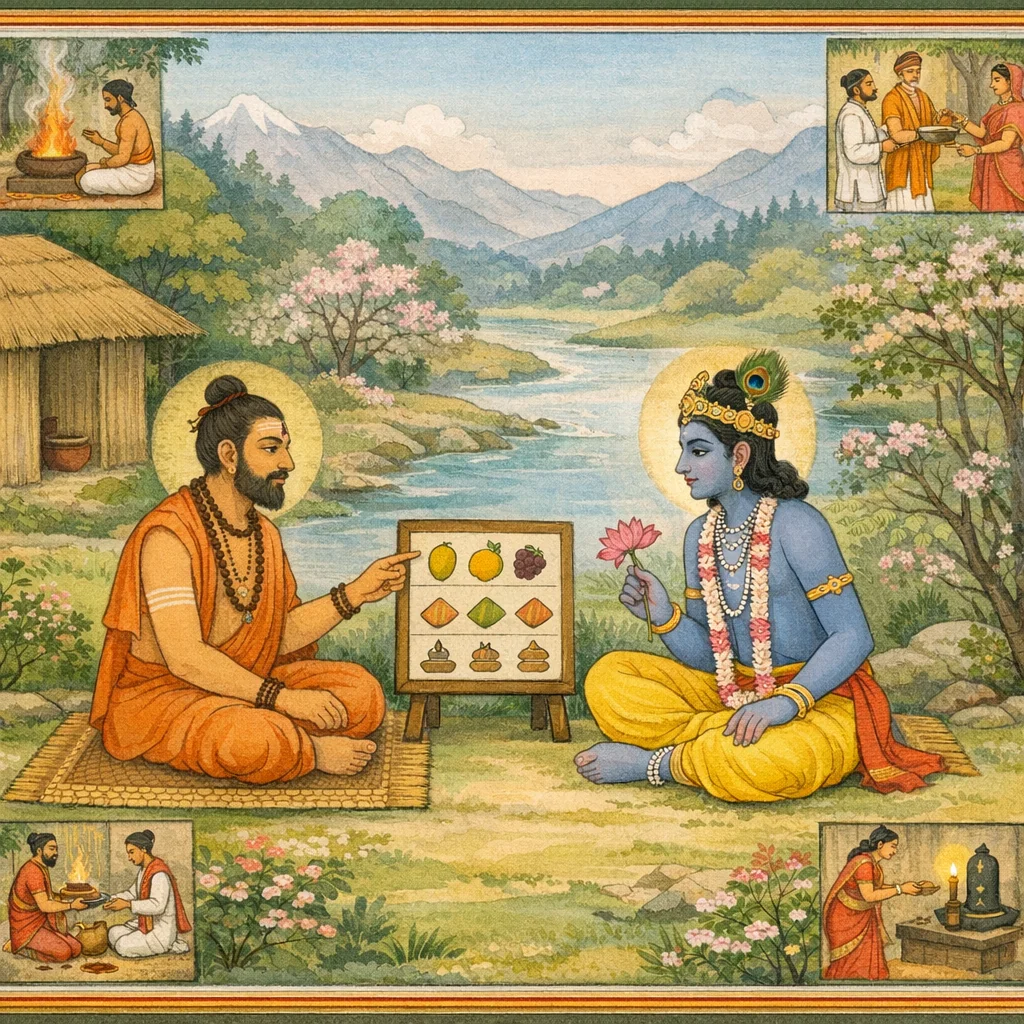
काम्यकर्मविभागः — Taxonomy of Kāmya (Desire-Motivated) Śaiva Rites
Adhyāya 29 begins with Śrī Kṛṣṇa asking Upamanyu whether qualified practitioners of Śiva-dharma (śivadharmādhikāriṇaḥ) have kāmya-karmas, beyond the nitya and naimittika duties already taught. Upamanyu replies by classifying fruits as aihika (this-worldly), āmūṣmika (other-worldly), and combined, and by outlining modes of practice: kriyā-maya (ritual action), tapaḥ-maya (austerity), japa–dhyāna-maya (mantra-repetition and meditation), and sarva-maya (integrative), with kriyā further arranged in sequences such as homa, dāna, and arcana. He stresses that ritual action yields full results chiefly for those endowed with śakti (competence/empowerment), since śakti is Śiva’s ājñā—His command and authorization as Paramātman; therefore, one who bears Śiva’s authorization should undertake kāmya rites. He then introduces rites that bestow fruits both here and hereafter, performed by Śaivas and Māheśvaras in an inner/outer order. He clarifies that “Śiva” and “Maheśvara” are ultimately non-different, and thus Śaiva and Māheśvara are not essentially divided: Śaivas rely on Śiva and are devoted to jñāna-yajña (knowledge-sacrifice), while Māheśvaras are devoted to karma-yajña (action-sacrifice). Hence Śaivas emphasize the inward and Māheśvaras the outward, though the rite’s procedure is the same in principle, differing only in emphasis (antar/bahiḥ).
Shlokas
Verse 1
श्रीकृष्ण उवाच । भगवंस्त्वन्मुखादेव श्रुतं श्रुतिसमं मया । स्वाश्रितानां शिवप्रोक्तं नित्यनैमित्तिकं तथा
Śrī Kṛṣṇa said: “O revered one, I have heard from your own mouth a teaching equal in authority to the Veda—what Śiva has ordained for those who take refuge in Him: the daily observances and the occasional, duty-bound rites as well.”
Verse 2
इदानीं श्रोतुमिच्छामि शिवधर्माधिकारिणाम् । काम्यमप्यस्ति चेत्कर्म वक्तुमर्हसि साम्प्रतम्
Now I wish to hear about those who are qualified for the dharma of Śiva. If there are also desire-motivated rites (kāmya-karmas) prescribed for them, please explain them at this very time.
Verse 3
उपमन्युरुवाच । अस्त्यैहिकफलं किञ्चिदामुष्मिकफलं तथा । ऐहिकामुष्मिकञ्चापि तच्च पञ्चविधं पुनः
Upamanyu said: “There is a fruit that is worldly, belonging to this life, and likewise a fruit that is otherworldly. There is also a fruit that is both worldly and otherworldly; and that, again, is of five kinds.”
Verse 4
किंचित्क्रियामयं कर्म किंचित्कर्म तपो मयम् । जपध्यानमयं किंचित्किंचित्सर्वमयं तथा
Some karma is predominantly ritual action; some karma is chiefly austerity. Some is made of japa and meditation; and some, likewise, is all-inclusive—embracing every mode of spiritual discipline.
Verse 5
क्रियामयं तथा भिन्नं होमदानार्चनक्रमात् । सर्वशक्तिमतामेव नान्येषां सफलं भवेत्
Action-based worship—distinguished as the ordered practices of homa (fire oblation), dāna (charitable giving), and arcana (ritual adoration)—bears fruit only for those endowed with full spiritual power; for others it does not become truly fruitful.
Verse 6
शक्तिश्चाज्ञा मदेशस्य शिवस्य परमात्मनः । तस्मात्काम्यानि कर्माणि कुर्यादाज्ञाधरोद्विजः
Power (Śakti) and command (ājñā) are My very ordinance—I, Śiva, the Supreme Self. Therefore, O twice-born, one who upholds that divine command should perform the desired (kāmya) rites in accordance with it.
Verse 7
अथ वक्ष्यामि काम्यं हि चेहामुत्र फलप्रदम् । शैवैर्माहेश्वरैश्चैव कार्यमंतर्बहिः क्रमात्
Now I shall explain the desire-fulfilling discipline that bestows results both here and hereafter. It is to be practiced by Śaivas and Māheśvaras, in due order, inwardly and outwardly.
Verse 8
शिवो महेश्वरश्चेति नात्यंतमिह भिद्यते । यथा तथा न भिद्यंते शैवा माहेश्वरा अपि
Here, the appellations “Śiva” and “Maheśvara” are not truly different in essence. In the same way, the Śaivas and the Māheśvaras also are not to be regarded as distinct.
Verse 9
शिवाश्रिता हि ते शैवा ज्ञानयज्ञरता नराः । माहेश्वरास्समाख्याता कर्मयज्ञरता भुवि
Those Śaivas who have taken refuge in Śiva and are devoted to the sacrifice of spiritual knowledge (jñāna-yajña) are truly blessed. In this world, those who are devoted to the sacrifice of action and ritual duty (karma-yajña) are known as the Māheśvaras.
Verse 10
तस्मादाभ्यन्तरे कुर्युः शैवा माहेश्वरा वहिः । न तु प्रयोगो भिद्येत वक्ष्यमाणस्य कर्मणः
Therefore, they should be Śaiva within, and outwardly Māheśvara; but the prescribed procedure of the rite that is about to be taught should not be altered or broken.
Verse 11
परीक्ष्य भूमिं विधिवद्गंधवर्णरसादिभिः । मनोभिलषिते तत्र वितानविततांबरे
Having duly examined the ground—by its fragrance, colour, taste, and the like—one should, in a place pleasing to the mind, spread a canopy and arrange a broad covering overhead for the rite.
Verse 12
सुप्रलिप्ते महीपृष्ठे दर्पणोदरसंनिभे । प्राचीमुत्पादयेत्पूर्वं शास्त्रदृष्टेन वर्त्मना
On a well-smeared, evenly prepared earthen surface—smooth like the inside of a mirror—one should first establish the eastern direction, following the method laid down in the scriptures.
Verse 13
एकहस्तं द्विहस्तं वा मण्डलं परिकल्पयेत् । आलिखेद्विमलं पद्ममष्टपत्रं सकर्णिकम्
One should design a ritual maṇḍala of one hand-span or two hand-spans, and within it draw a spotless lotus with eight petals and a central pericarp.
Verse 14
रत्नहेमादिभिश्चूर्णैर्यथासंभवसंभृतैः । पञ्चावरणसंयुक्तं बहुशोभासमन्वितम्
Using powders of jewels, gold, and the like—gathered according to one’s means—one should prepare it furnished with five coverings (āvaraṇas), richly endowed with splendor.
Verse 15
दलेषु सिद्धयः कल्प्याः केसरेषु सशक्तिकाः । रुद्रा वामादयस्त्वष्टौ पूर्वादिदलतः क्रमात्
One should envisage the siddhis, the spiritual perfections, in the petals, and in the filaments the Śaktis, the divine Powers, together with them. The eight Rudras—beginning with Vāma—are to be contemplated in due order, starting from the eastern petal and proceeding onwards.
Verse 16
कर्णिकायां च वैराग्यं बीजेषु नव शक्तयः । स्कन्दे शिवात्मको धर्मो नाले ज्ञानं शिवाश्रयम्
In the pericarp is dispassion; in the seed-syllables are the nine powers. In the stalk is dharma whose very essence is Śiva, and in the channel is knowledge that rests in Śiva alone.
Verse 17
कर्णिकोपरि चाग्नेयं मंडलं सौरमैन्दवम् । शिवविद्यात्मतत्त्वाख्यं तत्त्वत्रयमतः परम्
Above the pericarp is the Agni-maṇḍala, together with the solar and lunar spheres. Beyond these is the triad of principles—known as the tattva of Śiva, the tattva of Vidyā, and the tattva of Ātman—transcendent to the lower levels.
Verse 18
सर्वासनोपरि सुखं विचित्रकुसुमान्वितम् । पञ्चावरणसंयुक्तं पूजयेदंबया सह
Upon the best of all seats, comfortable and adorned with variegated flowers, one should worship (Śiva) together with the Divine Mother (Ambā), arranging the rite with the fivefold enclosures (pañcāvaraṇa).
Verse 19
शुद्धस्फटिकसंकाशं प्रसन्नं शीतलद्युतिम् । विद्युद्वलयसंकाशजटामुकुटभूषितम्
He appeared like flawless crystal—serene, clear, and radiant with a cool, soothing splendour—adorned with a matted-hair crown whose brilliance resembled a ring of lightning.
Verse 20
शार्दूलचर्मवसनं किञ्चित्स्मितमुखांबुजम् । रक्तपद्मदलप्रख्यपादपाणितलाधरम्
He wore a tiger-skin as his garment; his lotus-like face bore a gentle smile. His feet, the palms of his hands, and his lips shone with the hue of red lotus petals.
Verse 21
सर्वलक्षणसंपन्नं सर्वाभरणभूषितम् । दिव्यायुधवरैर्युक्तं दिव्यगंधानुलेपनम्
He was endowed with every auspicious mark and adorned with all ornaments; equipped with excellent divine weapons, and anointed with heavenly, fragrant unguents.
Verse 22
पञ्चवक्त्रं दशभुजं चन्द्रखण्डशिखामणिम् । अस्य पूर्वमुखं सौम्यं बालार्कसदृशप्रभम्
He is five-faced and ten-armed, crowned with the crest-jewel marked by the crescent moon. Of Him, the eastern face is gentle and auspicious, shining with a radiance like the newly risen sun.
Verse 23
त्रिलोचनारविंदाढ्यं कृतबालेंदुशेखरम् । दक्षिणं नीलजीमूतसमानरुचिरप्रभम्
On the southern side of that sacred form, he beheld the Lord whose three eyes were like lotuses, who bore the tender crescent moon as His crest-jewel, and whose beautiful radiance was like that of a dark-blue rain cloud—auspicious and compassionate, fit for contemplation by the bound soul seeking the grace of Pati (Śiva).
Verse 24
भ्रुकुटीकुटिलं घोरं रक्तवृत्तेक्षणत्रयम् । दंष्ट्राकरालं दुर्धर्षं स्फुरिताधरपल्लवम्
Terrible to behold, with brows knotted in a fierce frown; bearing three round, blood-red eyes; with dreadful protruding fangs, invincible and unassailable—his lip-buds quivered and throbbed with surging power.
Verse 25
उत्तरं विद्रुमप्रख्यं नीलालकविभूषितम् । सविलासं त्रिनयनं चन्द्राभरणशेखरम्
His northern aspect shone like red coral, adorned with dark-blue curling locks; playful and graceful, three-eyed, with the crescent moon set as the crest-ornament upon His head.
Verse 26
पश्चिमं पूर्णचन्द्राभं लोचनत्रितयोज्ज्वलम् । चन्द्ररेखाधरं सौम्यं मंदस्मितमनोहरम्
Facing the west, He shines like the full moon, radiant with His three resplendent eyes. Bearing the crescent-moon mark, gentle and auspicious, He captivates the heart with a soft, enchanting smile.
Verse 27
पञ्चमं स्फटिकप्रख्यमिंदुरेखासमुज्ज्वलम् । अतीव सौम्यमुत्फुल्ललोचनत्रितयोज्ज्वलम्
The fifth form shone with crystal-like radiance, brilliantly adorned with the crescent-moon mark. Exceedingly gentle and auspicious in aspect, it gleamed with the splendor of three wide-open eyes.
Verse 28
दक्षिणे शूलपरशुवज्रखड्गानलोज्ज्वलम् । सव्ये च नागनाराचघण्टापाशांकुशोज्ज्वलम्
In His right hands He shone with the trident, the axe, the vajra, the sword, and blazing fire; and in His left hands He shone with the serpent, the iron arrow, the bell, the noose, and the goad.
Verse 29
निवृत्त्याजानुसंबद्धमानाभेश्च प्रतिष्ठया । आकंठं विद्यया तद्वदाललाटं तु शांतया
From the knees up to the navel, one should apply the sacred ash in the spirit of withdrawal from worldly pursuits (nivṛtti). From the navel upward, one should apply it with steadfastness (pratiṣṭhā); up to the throat with spiritual knowledge (vidyā); and likewise upon the forehead with serene peace (śānti).
Verse 30
तदूर्ध्वं शांत्यतीताख्यकलया परया तथा । पञ्चाध्वव्यापिनं साक्षात्कलापञ्चकविग्रहम्
Beyond that, by the supreme and transcendent potency called “Śāntyatītā,” one realizes directly the Lord who pervades the fivefold paths of manifestation—He whose very form is the fivefold set of divine kalās (powers).
Verse 31
ईशानमुकुटं देवं पुरुषाख्यं पुरातनम् । अघोरहृदयं तद्वद्वामगुह्यं महेश्वरम्
He is Maheśvara: His diadem is Īśāna—ancient and primeval, known as Puruṣa. Likewise, His heart is Aghora; and His hidden, left-side mystery is Vāma.
Verse 32
सद्यपादं च तन्मूर्तिमष्टत्रिंशत्कलामयम् । मातृकामयमीशानं पञ्चब्रह्ममयं तथा
He is also called Sadyapāda; that Form of His is made of thirty-eight kalās (divine powers). He is Īśāna, pervaded by the Mātṛkās (sacred matrices of sound), and likewise constituted as the Pañcabrahman—the fivefold faces/realities of Śiva.
Verse 33
ओंकाराख्यमयं चैव हंसशक्त्या समन्वितम् । तथेच्छात्मिकया शक्त्या समारूढांकमंडलम्
He is of the very nature called Oṁ, conjoined with the Haṁsa-Śakti; likewise, mounted upon the power of Will (icchā-śakti), He bears the radiant maṇḍala upon His lap.
Verse 34
ज्ञानाख्यया दक्षिणतो वामतश्च क्रियाख्यया । तत्त्वत्रयमयं साक्षाद्विद्यामूर्तिं सदाशिवम्
On His right is the Power called Knowledge (Jñāna-Śakti), and on His left the Power called Action (Kriyā-Śakti). He is directly Sadāśiva—whose form is pure Vidyā—embodying the triad of principles: Pati, Paśu, and Pāśa.
Verse 35
मूर्तिमूलेन संकल्प्य सकलीकृत्य च क्रमात् । संपूज्य च यथान्यायमर्घान्तं मूलविद्यया
Having mentally invoked (Śiva) through the root of the sacred form, and then, step by step, making that visualization complete, one should worship Him in the proper prescribed manner—up to and including the offering of arghya—by means of the root mantra (mūla-vidyā).
Verse 36
मूर्तिमन्तं शिवं साक्षाच्छक्त्या परमया सह । तत्रावाह्य महादेवं सदसद्व्यक्तिवर्जितम्
There, invoking Lord Śiva—truly present in embodied form—together with His supreme Śakti, one should worship Mahādeva, who transcends the manifest and the unmanifest, and is beyond all limited modes of individualization.
Verse 37
पञ्चोपकरणं कृत्वा पूजयेत्परमेश्वरम् । ब्रह्मभिश्च षडङ्गैश्च ततो मातृकया सह
Having arranged the five ritual requisites (pañcopakaraṇa), one should worship Parameśvara. Then, with the Brahma-mantras and the six auxiliaries (ṣaḍaṅga), and thereafter together with the Mātṛkā—the matrix of sacred letters—the worship should be performed.
Verse 38
प्रणवेन शिवेनैव शक्तियुक्तेन च क्रमात् । शांतेन वा तथान्यैश्च वेदमन्त्रैश्च कृत्स्नशः
One should perform the rite in proper sequence by means of the Praṇava (Oṁ) and also by the mantra “Śiva,” joined with Śakti; or else by the Śānti-mantra, and likewise by the other Vedic mantras in their entirety.
Verse 39
पूजयेत्परमं देवं केवलेन शिवेन वा । पाद्यादिमुखवासांतं कृत्वा प्रस्थापनं विना
One should worship the Supreme Lord—either the Absolute Deity Himself or Śiva alone—offering the services from water for the feet (pādya) up to the mouth-perfume (mukhavāsa), yet without performing the concluding dismissal (visarjana) of the deity.
Verse 40
पञ्चावरणपूजां तु ह्यारभेत यथाक्रमम्
Then one should begin the worship of the five enclosures (pañcāvaraṇa-pūjā) in the properly prescribed sequence.
Frequently Asked Questions
No standalone mythic episode dominates the sampled passage; the chapter is framed as a didactic dialogue where Kṛṣṇa questions Upamanyu about kāmya rites within Śiva-dharma.
The chapter correlates ritual efficacy with śakti understood as Śiva’s ājñā (authorization), implying that correct empowerment/qualification is the hidden condition behind successful kāmya practice.
Śiva and Maheśvara are treated as non-different at the level of ultimate reality; the ‘Śaiva’ and ‘Māheśvara’ identities are presented as functional emphases (inner jñāna-yajña vs. outer karma-yajña) rather than separate manifestations.
Read Shiva Purana in the Vedapath app
Scan the QR code to open this directly in the app, with audio, word-by-word meanings, and more.