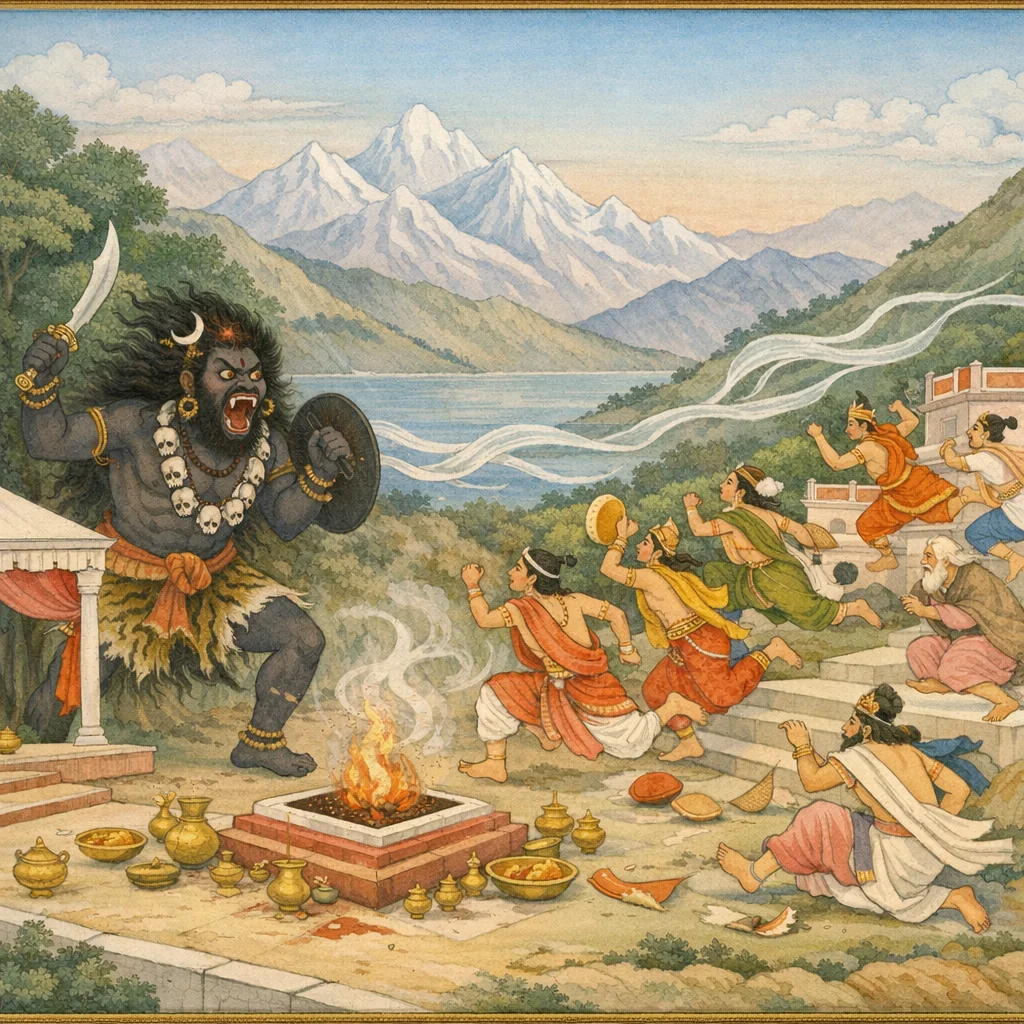
दक्षयज्ञदर्शनम् — The Vision of Dakṣa’s Great Sacrifice (and the Onset of Vīrabhadra’s Terror)
Adhyāya 20 begins with Vāyu describing the devas’ splendid mahāsatra led by Viṣṇu: the altar is strewn with darbha, the sacred fires blaze, golden ritual vessels gleam, and skilled ṛṣis perform the Veda-ordained rites in proper sequence, amid apsaras, celestial women, veṇu/vīṇā music, and resonant Vedic chanting. Suddenly Vīrabhadra bursts into this holy order and, on seeing Dakṣa’s adhvara, releases a thunder-like lion-roar. The gaṇa-host magnifies it into a sky-filling tumult that overwhelms the assembly; devas flee in terror, their garments and ornaments in disarray, imagining Meru has broken or the earth is tearing apart. The sound is likened to a lion’s roar that frightens elephants in a dense forest; some even die of fear. Cosmic instability follows—mountains split, the earth trembles, winds whirl, and the ocean churns—signaling the collapse of ritual complacency before Śiva’s corrective power and the imminent disruption of Dakṣa’s sacrifice.
Shlokas
Verse 1
वायुरुवाच । ततो विष्णुप्रधानानां सुराणाममितौजसाम् । ददर्श च महत्सत्रं चित्रध्वजपरिच्छदम्
Vāyu said: Then he beheld the mighty gods—foremost among them being Viṣṇu—of immeasurable splendor; and he also saw a great sacrificial session, adorned with many-colored banners and festive insignia.
Verse 2
सुदर्भऋतुसंस्तीर्णं सुसमिद्धहुताशनम् । कांचनैर्यज्ञभांडैश्च भ्राजिष्णुभिरलंकृतम्
The sacrificial ground was finely strewn with excellent darbha grass, and the sacred fire blazed bright with proper kindling. It was adorned with shining golden vessels of the yajña, resplendent in ritual splendor.
Verse 3
ऋषिभिर्यज्ञपटुभिर्यथावत्कर्मकर्तृभिः । विधिना वेददृष्टेन स्वनुष्ठितबहुक्रमम्
It was performed by sages skilled in sacrifice—true executors of the rites—duly and in proper order, according to the procedure taught by the Vedas, with many prescribed steps carefully observed.
Verse 4
देवांगनासहस्राढ्यमप्सरोगणसेवितम् । वेणुवीणारवैर्जुष्टं वेदघोषैश्च बृंहितम्
It was richly filled with thousands of celestial maidens and attended by hosts of Apsarās; it resounded with the music of flutes and vīṇās, and was made majestic by the reverberating chants of the Vedas.
Verse 5
दृष्ट्वा दक्षाध्वरे वीरो वीरभद्रः प्रतापवान् । सिंहनादं तदा चक्रे गंभीरो जलदो यथा
Beholding Dakṣa’s sacrificial rite, the mighty and valorous Vīrabhadra—radiant with power—then let out a lion-like roar, deep and resounding like a thundercloud.
Verse 6
ततः किलकिलाशब्द आकाशं पूरयन्निव । गणेश्वरैः कृतो जज्ञे महान्न्यक्कृतसागरः
Then a great clamour—cries of “kilakilā”—arose, as though filling the whole sky. It was raised by the Gaṇeśvaras, and it surged mightily like an agitated ocean.
Verse 7
तेन शब्देन महताः ग्रस्ता सर्वेदिवौकसः । दुद्रुवुः परितो भीताः स्रस्तवस्त्रविभूषणाः
Overwhelmed by that mighty sound, all the celestial beings were seized with fear; terrified, they fled in every direction, their garments and ornaments slipping loose in panic.
Verse 8
किंस्विद्भग्नो महामेरुः किंस्वित्संदीर्यते मही । किमिदं किमिदं वेति जजल्पुस्त्रिदशा भृशम्
“Has the great Meru been shattered? Is the earth being torn apart?”—thus the gods, overwhelmed, kept exclaiming again and again, “What is this—what is this?”
Verse 9
मृगेन्द्राणां यथा नादं गजेंद्रा गहने वने । श्रुत्वा तथाविधं केचित्तत्यजुर्जीवितं भयात्
Just as lordly elephants in a dense forest, on hearing the roar of the king of beasts, are struck with terror—so too, hearing such a dreadful sound, some gave up their very lives out of fear.
Verse 10
पर्वताश्च व्यशीर्यंत चकम्पे च वसुंधरा । मरुतश्च व्यघूर्णंत चुक्षुभे मकरालयः
The mountains began to crumble, and the earth itself trembled. The winds whirled in confusion, and the ocean—abode of the makaras—became violently agitated.
Verse 11
अग्नयो नैव दीप्यंते न च दीप्यति भास्करः । ग्रहाश्च न प्रकाशंते नक्षत्राणि च तारकाः
Fires do not blaze, nor does the Sun shine; the planets give no light, and neither do the constellations and stars—for in that condition all luminosity is withdrawn.
Verse 12
एतस्मिन्नेव काले तु यज्ञवाटं तदुज्ज्वलम् । संप्राप भगवान्भद्रो भद्रैश्च सह भद्रया
At that very time, the venerable Bhadra reached the radiant sacrificial arena, accompanied by the auspicious ones, together with Bhadrā.
Verse 13
तं दृष्ट्वा भीतभीतो ऽपि दक्षो दृढ इव स्थितः । क्रुद्धवद्वचनं प्राह को भवान् किमिहेच्छसि
Seeing him, Daksha—though trembling with fear—stood as if resolute, and, speaking as one enraged, said: “Who are you? What do you seek here?”
Verse 14
तस्य तद्वचनं श्रुत्वा दक्षस्य च दुरात्मनः । वीरभद्रो महातेजा मेघसंभीरनिस्स्वनः
Hearing those words of wicked-souled Dakṣa, Vīrabhadra—of immense splendor—let forth a deep, thunderous roar, like thunder rolling within a dense cloud.
Verse 15
स्मयन्निव तमालोक्य दक्षं देवाश्च ऋत्विजः । अर्थगर्भमसंभ्रान्तमवोचदुचितं वचः
Seeing Dakṣa, the gods and the officiating priests—almost as if smiling—spoke to him with calm composure words fit for the moment, unagitated yet laden with inner meaning.
Verse 16
वीरभद्र उवाच । वयं ह्यनुचराः सर्वे शर्वस्यामिततेजसः । भागाभिलिप्सया प्राप्ता भागो नस्संप्रदीयताम्
Vīrabhadra said: “We are all attendants of Śarva (Lord Śiva) of immeasurable splendor. We have come desiring our rightful share; therefore, let our share be duly granted to us.”
Verse 17
अथ चेदध्वरे ऽस्माकं न भागः परिकल्पितः । कथ्यतां कारणं तत्र युध्यतां वा मयामरैः
If, in this sacrifice, no share has been allotted to us, then let the reason be declared there; otherwise, let there be battle—let the gods fight with me.
Verse 18
इत्युक्तास्ते गणेंद्रेण देवा दक्षपुरोगमाः । ऊचुर्मन्त्राः प्रमाणं नो न वयं प्रभवस्त्विति
Thus addressed by Gaṇeśa, the gods—led by Dakṣa—replied: “For us, the mantras are the authority; we ourselves are not competent to decide beyond them.”
Verse 19
मन्त्रा ऊचुस्सुरा यूयं मोहोपहतचेतसः । येन प्रथमभागार्हं न यजध्वं महेश्वरम्
The Mantras said: “O Devas, your minds are struck by delusion, for you do not worship Maheśvara—He who is worthy of the first share in every sacrifice.”
Verse 20
मंत्रोक्ता अपि ते देवाः सर्वे संमूढचेतसः । भद्राय न ददुर्भागं तत्प्रहाणमभीप्सवः
Even though they were addressed with proper mantras, those gods—bewildered in mind—did not allot any share to Bhadrā, for they desired her abandonment and exclusion.
Verse 21
यदा तथ्यं च पथ्यं च स्ववाक्यं तद्वृथा ऽभवत् । तदा ततो ययुर्मंदा ब्रह्मलोकं सनातनम्
When their own words—though truthful and wholesome—became fruitless, then those weary ones departed from there and went to the eternal realm of Brahmā (Brahmaloka).
Verse 22
अथोवाच गणाध्यक्षो देवान्विष्णुपुरोगमान् । मन्त्राः प्रमाणं न कृता युष्माभिर्बलगर्वितैः
Then the leader of Śiva’s gaṇas spoke to the gods, with Viṣṇu at their head: “You, swollen with pride in your strength, have not honoured the mantras as the true authority, nor made them the rightful measure of your conduct.”
Verse 23
यस्मादस्मिन्मखे देवैरित्थं वयमसत्कृताः । तस्माद्वो जीवितैस्सार्धमपनेष्यामि गर्वितम्
Since, at this sacrifice, the gods have thus dishonoured me, therefore, O proud ones, I shall take away your very lives.
Verse 24
इत्युक्त्वा भगवान् क्रुद्धो व्यदहन्नेत्रवह्निना । यक्षवाटं महाकूटं यथातिस्रः पुरो हरः
Having spoken thus, the Blessed Lord, inflamed with wrath, burned it with the fire from His eye—consuming Yakṣavāṭa and the great peak Mahākūṭa—just as Hara once destroyed the three cities (Tripura).
Verse 25
ततो गणेश्वरास्सर्वे पर्वतोदग्रविग्रहाः । यूपानुत्पाट्य होत्ःणां कंठेष्वाबध्य रज्जुभिः
Then all those Gaṇeśvaras—whose bodies were massive like towering mountains—uprooted the sacrificial posts and, binding the officiating priests by ropes around their necks, seized them.
Verse 26
यज्ञपात्राणि चित्राणि भित्त्वा संचूर्ण्य वारिणि । गृहीत्वा चैव यज्ञांगं गंगास्रोतसि चिक्षिपुः
They broke the ornate vessels of the sacrifice, crushed them into the water, and, taking the sacrificial implements as well, hurled them into the current of the Gaṅgā.
Verse 27
तत्र दिव्यान्नपानानां राशयः पर्वतोपमाः । क्षीरनद्यो ऽमृतस्रावाः सुस्निग्धदधिकर्दमाः
There, heaps of celestial foods and drinks stood like mountains. Rivers of milk flowed, streaming amṛta, with richly smooth curd (dadhi) forming their soft, unctuous banks and mire.
Verse 28
उच्चावचानि मांसानि भक्ष्याणि सुरभीणि च । रसवन्ति च पानानि लेह्यचोष्याणि तानि वै
“There were meats of many kinds, fragrant foods to be eaten, and flavorful drinks—along with things to be licked and sucked, indeed.”
Verse 29
वीरास्तद्भुजते वक्त्रैर्विलुंपंति क्षिपंति च । वज्रैश्चक्रैर्महाशूलैश्शक्तिभिः पाशपट्टिशैः
Those heroic warriors seize them and devour them with their mouths; they rend them apart and hurl them away—striking with vajras, discus-weapons, great tridents, śakti-spears, pāśa-nooses, and battle-axes.
Verse 30
मुसलैरसिभिष्टंकैर्भिधिपालैः परश्वधैः । उद्धतांस्त्रिदशान्सर्वांल्लोकपालपुरस्सरान्
With clubs, swords, axes, and battle-hatchets, they struck down all the raging gods—led on by the Lokapālas, guardians of the worlds—who had risen up in pride and fury.
Verse 31
बिभिदुर्बलिनो वीरा वीरभद्रांगसंभवाः । छिंधि भिंधि क्षिप क्षिप्रं मार्यतां दार्यतामिति
Then those mighty heroes—born from the very limbs of Vīrabhadra—charged and struck, shouting, “Cut! Pierce! Hurl him away—quickly! Let him be slain! Let him be torn apart!”
Verse 32
हरस्व प्रहरस्वेति पाटयोत्पाटयेति च । संरंभप्रभवाः क्रूराश्शब्दाः श्रवणशंकवः
“Seize him! Strike him!”—and also, “Tear him! Rip him out!” Such harsh cries, born of furious agitation, became like spikes piercing the ears.
Verse 33
यत्रतत्र गणेशानां जज्ञिरे समरोचिताः । विवृत्तनयनाः केचिद्दष्टदंष्ट्रोष्ठतालवः
Here and there, hosts of Gaṇeśas sprang forth—fully fit for battle. Some had rolling, widened eyes; some bore bared teeth, with fangs, lips, and palates contorted in fierce wrath.
Verse 34
आश्रमस्थान्समाकृष्य मारयन्ति तपोधनात् । स्रुवानपहरन्तश्च क्षिपन्तोग्निं जलेषु च
Dragging the hermitages from their very places, they kill the ascetics—those rich in austerity. They even steal the sacrificial ladles and hurl the sacred fire into the waters.
Verse 35
कलशानपि भिन्दंतश्छिंदंतो मणिवेदिकाः । गायंतश्च नदन्तश्च हसन्तश्च मुहुर्मुहुः
They even smashed the water-pots and broke the gem-studded platforms; singing aloud, shouting, and laughing again and again—carried away by their tumultuous excitement.
Verse 36
रक्तासवं पिबन्तश्च ननृतुर्गणपुंगवाः । निर्मथ्य सेंद्रानमरान् गणेन्द्रान्वृषेन्द्रनागेन्द्रमृगेन्द्रसाराः
Drinking the red fermented liquor, the foremost of Śiva’s gaṇas danced. Having churned and shaken even the deathless gods—together with Indra—they, the mighty leaders of the hosts, moved like lords among bulls, elephants, and lions—swift and overpowering.
Verse 37
चक्रुर्बहून्यप्रतिमभावाः सहर्षरोमाणि विचेष्टितानि । नन्दंति केचित्प्रहरन्ति केचिद्धावन्ति केचित्प्रलपन्ति केचित्
Overwhelmed by incomparable emotions, with their hair standing on end in rapture, they performed many spontaneous acts—some rejoiced, some struck about, some ran here and there, and some spoke incoherently.
Verse 38
नृत्यन्ति केचिद्विहसन्ति केचिद्वल्गन्ति केचित्प्रमथा बलेन । केचिज्जिघृक्षंति घनान्स तोयान्केचिद्ग्रहीतुं रविमुत्पतंति
Some of the Pramathas danced; some laughed aloud; some leapt about with force. Some tried to seize the clouds and their waters, and some even sprang up as though to grasp the Sun.
Verse 39
केचित्प्रसर्तुं पवनेन सार्धमिच्छंति भीमाः प्रमथा वियत्स्थाः । आक्षिप्य केचिच्च वरायुधानि महा भुजंगानिव वैनतेयाः
Some of the terrible Pramathas, stationed in the sky, wished to rush forth along with the wind. Others, seizing their excellent weapons, darted about like Garuḍas swooping upon mighty serpents.
Verse 40
भ्रमंति देवानपि विद्रवंतः खमंडले पर्वतकूटकल्पाः । उत्पाट्य चोत्पाट्यगृहाणि केचित्सजालवातायनवेदिकानि
Rushing about and driving even the gods into flight, they moved through the vault of the sky like mountain-peaks. Tearing up and flinging away, some of them uprooted houses—complete with their latticed windows and raised platforms.
Verse 41
विक्षिप्य विक्षिप्य जलस्य मध्ये कालांबुदाभाः प्रमथा निनेदुः । उद्वर्तितद्वारकपाटकुड्यं विध्वस्तशालावलभीगवाक्षम्
Hurling it again and again into the midst of the water, the Pramathas—dark as thunderclouds—roared aloud. The building’s doorways, shutters, and walls were wrenched and overturned; its halls, rafters, and windows were shattered and laid waste.
Verse 42
अहो बताभज्यत यज्ञवाटमनाथवद्वाक्यमिवायथार्थम् । हा नाथ तातेति पितुः सुतेति भ्रतर्ममाम्बेति च मातुलेति
Alas! The sacrificial arena has been shattered, and the words once spoken have proved futile, like the speech of one without refuge. “O Lord!”, “O Father!”, “O son of my father!”, “O brother!”, “O Mother!”, and “O maternal uncle!”—thus they cried out in distress.
Verse 43
उत्पाट्यमानेषु गृहेषु नार्यो ह्यानाथशब्दान्बहुशः प्रचक्रुः
As the houses were being torn apart, the women again and again raised the cry: “We are helpless—without protection!”
Frequently Asked Questions
It depicts the scene at Dakṣa’s great sacrifice (adhvara/mahāsatra) and the initial shock of Vīrabhadra’s arrival, whose roar and the gaṇas’ tumult throw the devas into panic.
The roar functions as a sign of Śiva-śakti interrupting a ritually correct yet theologically misaligned yajña, revealing that cosmic order is not sustained by externals alone but by rightful alignment with Śiva.
Vīrabhadra and Śiva’s gaṇas are foregrounded, with their sound and presence producing macrocosmic effects—earthquake, wind-turbulence, and ocean-churning—mirroring the collapse of the sacrificial assembly’s security.
Read Shiva Purana in the Vedapath app
Scan the QR code to open this directly in the app, with audio, word-by-word meanings, and more.