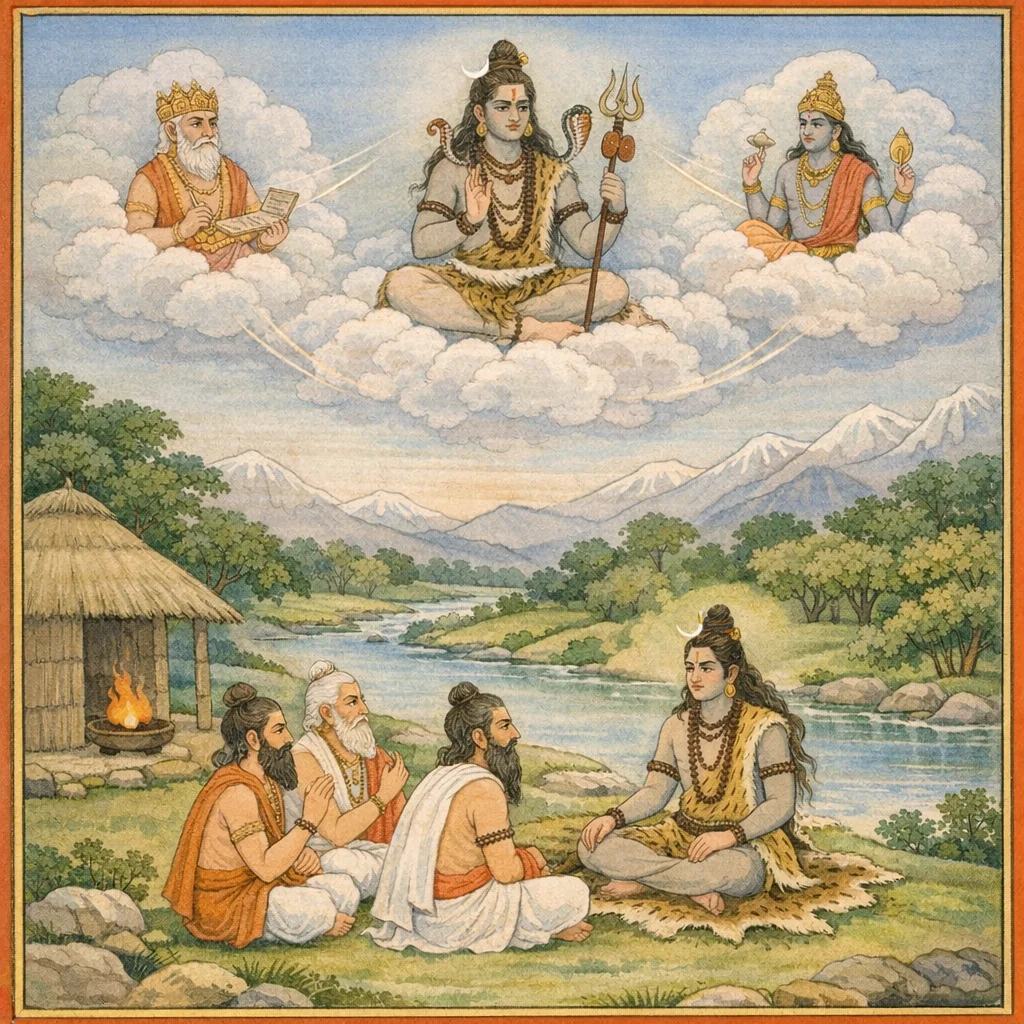
रुद्रस्य परमात्मत्वे ब्रह्मपुत्रत्वादिसंशयप्रश्नः — Questions on Rudra’s Supremacy and His ‘Sonship’ to Brahmā
Adhyāya 13 begins with the ṛṣis affirming the earlier teaching that creation issues from the supreme Bhava (Śiva), and then raising a doctrinal tension. Rudra—praised as Virūpākṣa, Śūladhara, Nīlalohita, Kapardī—is celebrated as the cosmic dissolver who, at the yuga’s end, destroys even Brahmā and Viṣṇu. Yet the sages have also heard that Brahmā, Viṣṇu, and Rudra arise from one another, mutually manifesting from each other’s aṅga, and they ask how such reciprocal emergence can be possible, especially in terms of guṇa–pradhāna modalities. The chapter thus sets a formal pūrvapakṣa: if Rudra is primordial (ādideva, purātana) and the Lord who grants yoga-kṣema, how can he be spoken of as attaining putratva (sonship) of Brahmā, whose birth is unmanifest? The ṛṣis request a precise tattva-explanation, aligned with Brahmā’s own instruction to the munis, to clarify the metaphysical causality behind Purāṇic genealogy.
Shlokas
Verse 1
ऋषय ऊचुः । भवता कथिता सृष्टिर्भवस्य परमात्मनः । चतुर्मुखमुखात्तस्य संशयो नः प्रजायते
The sages said: “You have explained to us the creation that proceeds from Bhava—the Supreme Self. Since it has come from the mouth of the four-faced (Brahmā), no doubt arises in us regarding it.”
Verse 2
देवश्रेष्ठो विरूपाक्षो दीप्तश्शूलधरो हरः । कालात्मा भगवान् रुद्रः कपर्दी नीललोहितः
He is the foremost among the gods—Virūpākṣa of wondrous vision; Hara who bears the blazing trident; Rudra, the Blessed Bhagavān whose very essence is Time; Kapardī, the matted-haired ascetic; the One of blue-and-red hue.
Verse 3
सब्रह्मकमिमं लोकं सविष्णुमपि पावकम् । यः संहरति संक्रुद्धो युगांते समुपस्थिते
At the end of the age, when the hour of dissolution arrives, He—wrathful in His cosmic act of reabsorption—withdraws this entire world, along with Brahmā, along with Viṣṇu, and even Pāvaka (Agni) as well.
Verse 4
यस्य ब्रह्मा च विष्णुश्च प्रणामं कुरुतो भयात् । लोकसंकोचकस्यास्य यस्य तौ वशवर्तिनौ
Out of awe, Brahmā and Viṣṇu bow to Him. He is the One who can contract and withdraw the worlds, and even those two deities remain under His governance.
Verse 5
यो ऽयं देवः स्वकादंगाद्ब्रह्मविष्णू पुरासृजत् । स एव हि तयोर्नित्यं योगक्षेमकरः प्रभुः
This very Deva who, in ancient times, brought forth Brahmā and Viṣṇu from His own body—He alone is the Sovereign Lord who eternally ordains their yoga and kṣema, granting attainment and safeguarding their cosmic functions.
Verse 6
स कथं भगवान् रुद्र आदिदेवः पुरातनः । पुत्रत्वमगमच्छंभुर्ब्रह्मणो ऽव्यक्तजन्मनः
How, then, did the Blessed Lord Rudra—Śambhu, the primeval and original God—come to assume the status of a son of Brahmā, whose own birth is unmanifest and inscrutable?
Verse 7
प्रजापतिश्च विष्णुश्च रुद्रस्यैतौ परस्परम् । सृष्टौ परस्परस्यांगादिति प्रागपि शुश्रुम
We have also heard earlier that Prajāpati (Brahmā) and Viṣṇu—these two, in relation to Rudra—came forth in creation from one another’s limbs, mutually dependent in the manifested order.
Verse 8
कथं पुनरशेषाणां भूतानां हेतुभूतयोः । गुणप्रधानभावेन प्रादुर्भावः परस्परात्
How, again, do all beings—without remainder—arise mutually from the two causal principles, through the relationship in which the guṇas and Pradhāna (primordial Nature) become predominant over one another?
Verse 9
नापृष्टं भवता किंचिन्नाश्रुतं च कथंचन । भगवच्छिष्यभूतेन भवता सकलं स्मृतम्
You have left nothing unasked, and nothing has remained unheard in any way. Since you are truly a disciple of the Blessed Lord, you have remembered everything in full.
Verse 10
तत्त्वं वद यथा ब्रह्मा मुनीनामवदद्विभुः । वयं श्रद्धालवस्तात श्रोतुमीश्वरसद्यशः
O revered one, speak the true principle just as the all-pervading Brahmā taught it to the sages. We are full of faith, dear sir, and we wish to hear at once the glorious account of the Lord (Īśvara).
Verse 11
वायुरुवाच । स्थाने पृष्टमिदं विप्रा भवद्भिः प्रश्नकोविदैः । इदमेव पुरा पृष्टो मम प्राह पितामहः
Vāyu said: “O brāhmaṇas, skilled in the art of inquiry, you have asked this question in the proper manner. This very matter was once asked of me before, and my grandsire (Brahmā) explained it to me.”
Verse 12
तदहं सम्प्रवक्ष्यामि यथा रुद्रसमुद्भवः । यथा च पुनरुत्पत्तिर्ब्रह्मविष्ण्वोः परस्परम्
Therefore I shall now explain how Rudra came into manifestation, and also how Brahmā and Viṣṇu arise again, each in relation to the other.
Verse 13
त्रयस्ते कारणात्मानो जतास्साक्षान्महेश्वरात् । चराचरस्य विश्वस्य सर्गस्थित्यंतहेतवः
From Mahādeva Himself arose three causal principles. Directly manifested from Maheśvara, they became the causes of the universe—of all moving and unmoving beings—through creation, preservation, and dissolution.
Verse 14
परमैश्वर्यसंयुक्ताः परमेश्वरभाविताः । तच्छक्त्याधिष्ठिता नित्यं तत्कार्यकरणक्षमाः
Endowed with supreme lordly power and permeated by the presence of Parameśvara, they are ever sustained by His Śakti and fully capable of accomplishing His works.
Verse 15
पित्रा नियमिताः पूर्वं त्रयोपि त्रिषु कर्मसु । ब्रह्मा सर्गे हरिस्त्राणे रुद्रः संहरणे तथा
Formerly, the Father appointed the three for the three cosmic functions: Brahmā for creation, Hari (Viṣṇu) for protection, and Rudra likewise for dissolution.
Verse 16
तथाप्यन्योन्यमात्सर्यादन्योन्यातिशयाशिनः । तपसा तोषयित्वा स्वं पितरं परमेश्वरम्
Yet, through mutual jealousy and the urge to outdo one another, they strove for superiority; and by austerity (tapas) they satisfied their own Father—the Supreme Lord, Parameśvara.
Verse 17
लब्ध्वा सर्वात्मना तस्य प्रसादात्परमेष्ठिनः । ब्रह्मनारायणौ पूर्वं रुद्रः कल्पान्तरे ऽसृजत्
Having wholly obtained the grace of the Supreme Lord (Parameṣṭhin), Rudra, in a former age at the close of a kalpa, brought forth Brahmā and Nārāyaṇa.
Verse 18
कल्पान्तरे पुनर्ब्रह्मा रुद्रविष्णू जगन्मयः । विष्णुश्च भगवान्रुद्रं ब्रह्माणमसृजत्पुनः
At the close of a cosmic cycle, Brahmā appears again, and Rudra and Viṣṇu—pervading the universe—carry forward the divine functions. And Lord Viṣṇu again brought forth Rudra and manifested Brahmā anew.
Verse 19
नारायणं पुनर्ब्रह्मा ब्रह्माणमसृजत्पुनः । एवं कल्पेषु कल्पेषु ब्रह्मविष्णुमहेश्वराः
Again and again, Brahmā brings forth Nārāyaṇa, and again Nārāyaṇa brings forth Brahmā. Thus, in cycle after cycle of creation, the triad—Brahmā, Viṣṇu, and Maheśvara—manifests repeatedly according to the cosmic order.
Verse 20
परस्परेण जायंते परस्परहितैषिणः । तत्तत्कल्पान्तवृत्तान्तमधिकृत्य महर्षिभिः
They arise in mutual succession, ever seeking one another’s welfare. Thus, the great sages, taking up the accounts of the endings of various aeons (kalpas), have expounded these narratives.
Verse 21
प्रभावः कथ्यते तेषां परस्परसमुद्भवात् । शृणु तेषां कथां चित्रां पुण्यां पापप्रमोचिनीम्
Their power and efficacy are explained as arising from their mutual interdependence. Listen now to their wondrous account—holy in nature and a remover of sins.
Verse 22
कल्पे तत्पुरुषे वृत्तां ब्रह्मणः परमेष्ठिनः । पुरा नारायणो नाम कल्पे वै मेघवाहने
In the Tatpuruṣa Kalpa, the ancient account of Brahmā—Parameṣṭhin, the Supreme Creator—is recounted. Indeed, in the Meghavāhana Kalpa, in former times there was one known as Nārāyaṇa.
Verse 23
दिव्यं वर्षसहस्रं तु मेघो भूत्वावहद्धराम् । तस्य भावं समालक्ष्य विष्णोर्विश्वजगद्गुरुः
For a divine thousand years he became a cloud and rained upon the earth. Perceiving that intent and state, the all-knowing preceptor of the universe understood it as pertaining to Viṣṇu.
Verse 24
सर्वस्सर्वात्मभावेन प्रददौ शक्तिमव्ययाम् । शक्तिं लब्ध्वा तु सर्वात्मा शिवात्सर्वेश्वरात्तदा
Then the all-pervading Lord, abiding as the Self of all, bestowed imperishable Power (Śakti). Having received that Power from Śiva—the Lord of all—He, the indwelling Self of all beings, became empowered.
Verse 25
ससर्ज भगावन् विष्णुर्विश्वं विश्वसृजा सह । विष्णोस्तद्वैभवं दृष्ट्वा सृष्टस्तेन पितामहः
The blessed Lord Viṣṇu, together with the cosmic principle of creation, manifested the universe. Beholding that majesty of Viṣṇu, Pitāmaha (Brahmā) was brought forth by Him.
Verse 26
आवयोरधिकश्चास्ति स रुद्रो नात्र संशयः । तस्य देवाधिदेवस्य प्रसादात्परमेष्ठिनः
Between the two of us, the One who is truly superior is Rudra—of this there is no doubt. By the grace of that God of gods, the Supreme Lord, this truth is known and firmly established.
Verse 27
स्रष्टा त्वं भगवानाद्यः पालकः परमार्थतः । अहं च तपसाराध्य रुद्रं त्रिदशनायकम्
O Primordial Lord, You alone are truly the Creator and the Sustainer. And I, by austerity, worship Rudra—the leader of the gods.
Verse 28
त्वया सह जगत्सर्वं स्रक्ष्याम्यत्र न संशयः । एवं विष्णुमुपालभ्य भगवानब्जसम्भवः
“Together with you I shall bring forth this entire universe—of this there is no doubt.” Having thus addressed Viṣṇu, the Blessed One, the Lotus-born (Brahmā), spoke.
Verse 29
एवं विज्ञापयामास तपसा प्राप्य शंकरम् । भगवन् देवदेवेश विश्वेश्वर महेश्वर
Having thus approached Śaṅkara through austerity, he made his supplication: “O Blessed Lord—God of gods, Lord of the universe, Mahādeva.”
Verse 30
तव वामांगजो विष्णुर्दक्षिणांगभवो ह्यहम् । मया सह जगत्सर्वं तथाप्यसृजदच्युतः
“Viṣṇu is born from Your left side, and I indeed arise from Your right side. And yet, together with me, Acyuta (Viṣṇu) brought forth the entire universe.”
Verse 31
स मत्सरादुपालब्धस्त्वदाश्रयबलान्मया । मद्भावान्नाधिकस्तेति भावस्त्वयि महेश्वरे
Out of jealousy I reproached him, relying on the strength of being under Your shelter. Yet, because his inner disposition was wholly devoted to me, he held the conviction: “None is higher than You, O Maheśvara.”
Verse 32
त्वत्त एव समुत्पत्तिरावयोस्सदृशी यतः । तस्य भक्त्या यथापूर्वं प्रसादं कृतवानसि
For our origin is indeed from You alone, and thus it is alike in both of us. Therefore, just as before, by his devotion you have bestowed your gracious favor upon him.
Verse 33
तथा ममापि तत्सर्वं दातुमर्हसि शंकर । इति विज्ञापितस्तेन भगवान् भगनेत्रहा
“So too, O Śaṅkara, you should grant all of that to me as well.” Thus petitioned by him, the Blessed Lord—He who once destroyed Bhaga’s eye—(heard his request).
Verse 34
न्यायेन वै ददौ सर्वं तस्यापि स घृणानिधिः । लब्ध्वैवमीश्वरादेव ब्रह्मा सर्वात्मतां क्षणात्
Acting in accordance with dharma, that ocean of compassion (the Lord) granted him everything. Thus, by receiving this grace from Īśvara alone, Brahmā instantly attained the state of being the Self of all.
Verse 35
त्वरमाणोथ संगम्य ददर्श पुरुषोत्तमम् । क्षीरार्णवालये शुभ्रे विमाने सूर्यसंनिभे
Hastening, he approached and beheld the Supreme Person, seated in a radiant, auspicious celestial chariot—sun-like in splendor—within the bright abode of the Ocean of Milk.
Verse 36
हेमरत्नान्विते दिव्ये मनसा तेन निर्मिते । अनंतभोगशय्यायां शयानं पंकजेक्षणम्
Upon a divine couch adorned with gold and jewels—fashioned by him through the power of mind—he beheld the Lotus‑eyed Lord reclining on the serpent Ananta’s many‑coiled bed.
Verse 37
चतुर्भुजमुदारांगं सर्वाभरणभूषितम् । शंखचक्रधरं सौम्यं चन्द्रबिंबसमाननम्
He was four-armed, noble-limbed, and adorned with every ornament—bearing the conch and discus, gentle in presence, with a face resembling the orb of the moon.
Verse 38
श्रीवत्सवक्षसं देवं प्रसन्नमधुरस्मितम् । धरामृदुकरांभोजस्पर्शरक्तपदांबुजम्
They beheld the radiant Lord, whose chest bore the mark of Śrīvatsa, whose face was serene with a gentle, sweet smile, and whose lotus-feet were tinged red from the tender touch of the Earth’s soft, lotus-like hands.
Verse 39
क्षीरार्णवामृतमिव शयानं योगनिद्रया । तमसा कालरुद्राख्यं रजसा कनकांडजम्
He lay in yogic sleep, like nectar resting in the Ocean of Milk. Through tamas he was known as Kālarudra, and through rajas as the golden Egg-born (Hiraṇyagarbha).
Verse 40
सत्त्वेन सर्वगं विष्णुं निर्गुणत्वे महेश्वरम् । तं दृष्ट्वा पुरुषं ब्रह्मा प्रगल्भमिदमब्रवीत्
Perceiving Viṣṇu as the all-pervading principle through the mode of sattva, and recognizing Maheśvara as transcending all qualities in His nirguṇa nature, Brahmā—having beheld that supreme Person—boldly spoke these words.
Verse 41
ग्रसामि त्वामहं विष्णो त्वमात्मानं यथा पुरा । तस्य तद्वचनं श्रुत्वा प्रतिबुद्ध्य पितामहम्
“O Viṣṇu, I shall swallow you—just as you once swallowed your own self before.” Hearing those words, Pitāmaha (Brahmā) was awakened to the truth.
Verse 42
उदैक्षत महाबाहुस्स्मितमीषच्चकार च । तस्मिन्नवसरे विष्णुर्ग्रस्तस्तेन महात्मना
The mighty-armed One looked on and formed a faint smile. At that very moment, Viṣṇu was seized and overpowered by that great-souled Being.
Verse 43
सृष्टश्च ब्रह्मणा सद्यो भ्रुवोर्मध्यादयत्नतः । तस्मिन्नवसरे साक्षाद्भगवानिन्दुभूषणः
Brahmā at once created (him) effortlessly from the space between his eyebrows. At that very moment, the Lord Himself—Śiva, adorned with the moon—manifested directly.
Verse 44
शक्तिं तयोरपि द्रष्टुमरूपो रूपमास्थितः । प्रसादमतुलं कर्तुं पुरा दत्तवरस्तयोः
To enable them both to behold His divine Power, the Formless Lord assumed a form. Wishing to bestow incomparable grace, He—who had formerly granted boons to them—manifested thus.
Verse 45
आगच्छत्तत्र यत्रेमौ ब्रह्मनारायणौ स्थितौ । अथ तुष्टुवतुर्देवं प्रीतौ भीतौ च कौतुकात्
He came to the place where Brahmā and Nārāyaṇa were standing. Then, moved by wonder—at once delighted and awed—they offered hymns of praise to that Deva, the Lord.
Verse 46
प्रणेमतुश्च बहुशो बहुमानेन दूरतः । भवोपि भगवानेतावनुगृह्य पिनाकधृक्
From afar they bowed again and again with deep reverence. Then Lord Bhava—Shiva, the Bearer of the Pināka bow—out of grace bestowed His favor upon them.
Verse 47
सादरं पश्यतोरेव तयोरंतरधीयत
Even as the two gazed with reverent attention, He vanished from their sight.
Frequently Asked Questions
The sages challenge the compatibility of Rudra’s primordial supremacy (ādideva, yuga-end dissolver) with statements that he became Brahmā’s son and that Brahmā, Viṣṇu, and Rudra arise from one another.
The chapter signals that Purāṇic genealogy must be read through causal categories—guṇa and pradhāna—so that “birth” and “sonship” can denote functional manifestation within cosmic process rather than ontological dependence.
Rudra is invoked as Virūpākṣa, Śūladhara, Hara, Kālātmā, Kapardī, and Nīlalohita—emphasizing his fiery, time-associated power of dissolution and lordship over other cosmic authorities.
Read Shiva Purana in the Vedapath app
Scan the QR code to open this directly in the app, with audio, word-by-word meanings, and more.