Sarga 81
एकाशीति तमः सर्गः — Bharata’s Grief, Courtly Summons, and the Assembly Hall
अयोध्याकाण्ड
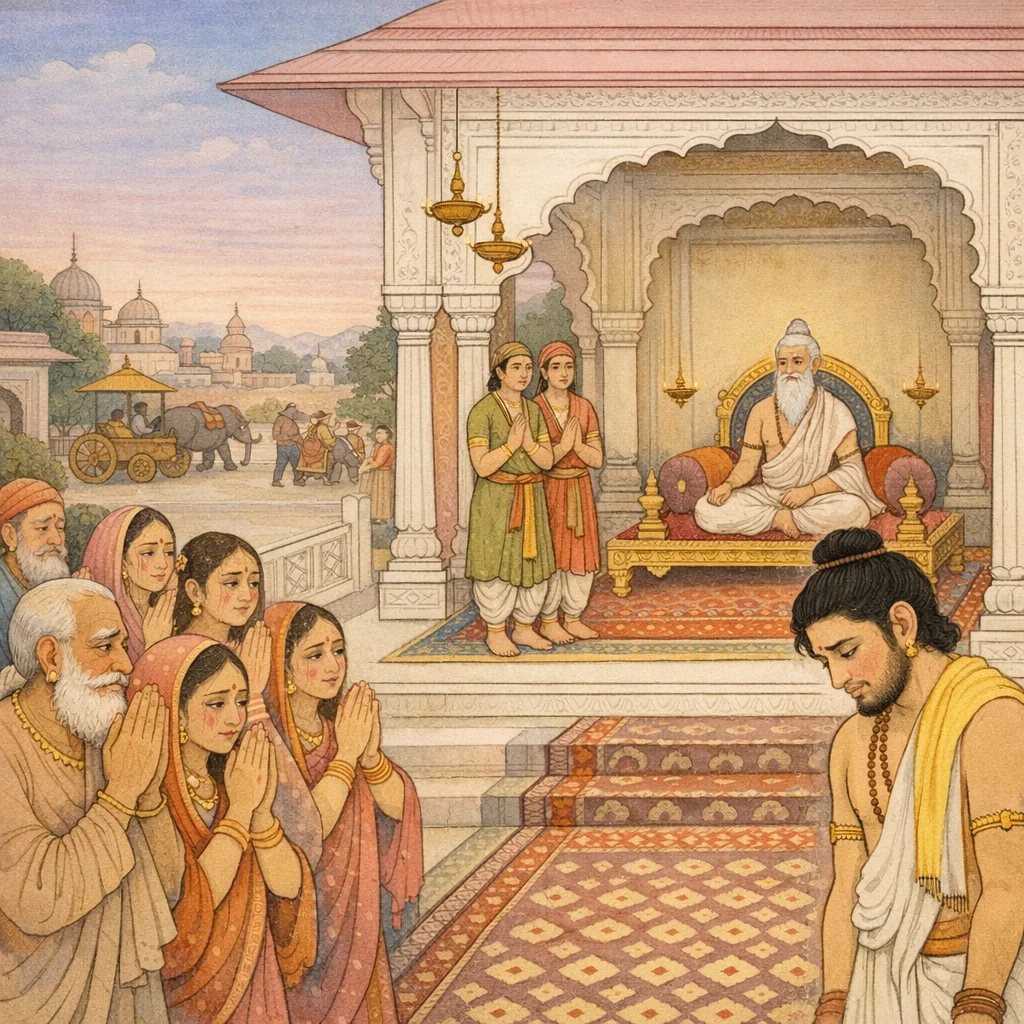
In the late-night period called nāndīmukhī, deemed auspicious in its beginning, professional bards (sūtamāgadhāḥ) and the watchmen’s instruments raise a ceremonial sound—drums struck with golden sticks and many conches—to honor Bharata. Yet the public acclamation only deepens his grief: he rejects any hint of kingship, stops the music, and tells Śatrughna that he is not the king. He blames the city’s suffering on Kaikeyī’s deed and laments that the realm now reels like a rudderless boat, since Rāma, protector of all, has been exiled. Overcome by sorrow, Bharata collapses, and the women of the inner chambers cry out together. At the same time, Vasiṣṭha, knower of royal law (rajadharma), enters Daśaratha’s assembly hall—a gem-inlaid, golden sabhā likened to Indra’s Sudharmā. Seated upon a golden throne with soft coverings, he orders messengers to urgently summon the varṇa groups, ministers, commanders, royal attendants, and also Bharata, Śatrughna, Yudhājit, Sumantra, and other well-wishers. As they arrive by chariots, horses, and elephants, a great tumult rises; when Bharata approaches, the subjects greet him as they once greeted Daśaratha, and the hall shines as if the king were present again—binding legitimacy, memory, and public consent into a single image.
Shlokas
Verse 1
ततो नान्दीमुखीं रात्रिं भरतं सूतमागधाः।तुष्टुवुर्वाग्विशेषज्ञास्स्तवैर्मङ्गलसंहितैः।।।।
Then, in the auspicious closing watch of the night, bards and panegyrists skilled in refined speech delighted Bharata with hymns filled with auspiciousness.
Verse 2
सुवर्णकोणाभिहतः प्राणदद्यामदुन्दुभिः।दध्मुश्शङ्खांश्च शतशो नादांश्चोच्चावचस्वरान्।।।।
The night-watch drums, struck with golden-tipped beaters, resounded; and conches by the hundreds were blown, sending forth calls in many rising and falling tones.
Verse 3
स तूर्यघोष स्सुमहान्दिवमापूरयन्निव।भरतं शोकसन्तप्तं भूयश्शोकैररन्ध्रयत्।।।।
That mighty blare of instruments, as though filling the very sky, overwhelmed Bharata—already scorched by grief—with still more sorrow.
Verse 4
ततः प्रबुद्धो भरतस्तं घोषं सन्निवर्त्य च।नाहं राजेति चाप्युक्त्वा शत्रुघ्नमिदमब्रवीत्।।।।
Then Bharata awoke, had that clamor stopped, and declaring, “I am not the king,” spoke these words to Śatrughna.
Verse 5
पश्य शत्रुघ्न कैकेय्या लोकस्यापकृतं महत्।विसृज्य मयि दुःखानि राजा दशरथो गतः।।।।
“See, Śatrughna, what great harm Kaikeyī has done to the people. King Daśaratha has departed, leaving the burden of suffering upon me.”
Verse 6
तस्यैषा धर्मराजस्य धर्ममूला महात्मनः।परिभ्रमति राज्य श्रीर्नौरिवाकर्णिका जले।।।।
For that great-souled king, whose rule is rooted in dharma, the kingdom’s fortune—grounded in righteousness—now reels about like a boat upon the waters without a helmsman.
Verse 7
यो हि न स्सुमहान्नाथस्सोऽपि प्रव्राजितो वनम्।अनया धर्ममुत्सृज्य मात्रा मे राघवस्स्वयम्।।।।
“Rāghava—great protector of us all—has himself been driven into the forest by my mother, who cast aside dharma.”
Verse 8
इत्येवं भरतं प्रेक्ष्य विलपन्तं विचेतनम्।कृपणं रुरुदुस्सर्वास्सस्वरं योषित स्तदा।। ।।
Seeing Bharata lamenting thus and fallen senseless, all the women then cried out together, wailing piteously.
Verse 9
तथा तस्मिन्विलपति वसिष्ठो राजधर्मवित्।सभामिक्ष्वाकुनाथस्य प्रविवेश महायशाः।।।।
While he thus lamented, the illustrious Vasiṣṭha—knower of royal dharma—entered the assembly hall of the Ikṣvāku lord, Daśaratha.
Verse 10
शातकुम्भमयीं रम्यां मणिरत्नसमाकुलाम्।सुधर्मामिव धर्मात्मा सगणः प्रत्यपद्यत।।।।
The righteous Vasiṣṭha, accompanied by his followers, entered the lovely hall wrought of gold and crowded with gems, like Indra’s Sudharmā assembly.
Verse 11
स काञ्चनमयं पीठं सुखास्तरणसंवृतम्।अध्यास्त सर्ववेदज्ञो दूताननुशशास च।।।।
He, the knower of all the Vedas, sat upon a golden seat covered with a comfortable spread, and instructed the messengers.
Verse 12
ब्राह्मणान् क्षत्रियान्वैश्यनमात्यान्गणवल्लभान्।क्षिप्रमानयताऽव्यग्राः कृत्यमात्ययिकं हि नः।।।।
“Bring at once—without agitation—brahmins, kṣatriyas, vaiśyas, ministers, and commanders; for an urgent duty awaits us.”
Verse 13
सराजभृत्यं शत्रुघ्नं भरतं च यशस्विनम्।युधाजितं सुमन्त्रं च ये च तत्र हिता जनाः।।।।
“Also bring Śatrughna with the royal attendants, the illustrious Bharata, Yudhājit, Sumantra, and all those people there who are loyal well-wishers.”
Verse 14
ततो हलहलाशब्दस्सुमहान्समपद्यत।रथैरश्वैर्गजैश्चापि जनानामुपगच्छताम्।।।।
Then a very great uproar arose as people came arriving—by chariots, on horses, and also on elephants.
Verse 15
ततो भरतमायान्तं शतक्रतुमिवामराः।प्रत्यनन्दन्प्रकृतयो यथा दशरथं तथा।।।।
Then, as Bharata approached, the ministers and subjects greeted him just as they used to greet Daśaratha—like the gods greeting Śatakratu (Indra).
Verse 16
ह्रद इव तिमिनागसंवृतः स्तिमितजलो मणिशङ्खशर्करः।दशरथसुतशोभिता सभा सदशरथेव बभौ यथा पुरा।।।।
The assembly hall, graced by Daśaratha’s son, shone as it once had—like a lake of still waters, strewn with gems, shells, and pebbles and filled with mighty creatures; it seemed as though Daśaratha himself were present again.
Frequently Asked Questions
Bharata confronts the implied transfer of sovereignty signaled by ceremonial praise and instruments; he explicitly refuses—“I am not the king”—treating acceptance as ethically illegitimate while Rāma is exiled and Daśaratha has died.
The chapter contrasts external legitimation (public acclamation, ritual honor) with inner dharma: rightful rule depends on moral order and counsel (राजधर्म), not mere opportunity; grief becomes a moral testimony rather than a claim to power.
The royal सभा of Ayodhyā is foregrounded, poetically compared to Indra’s Sudharmā; cultural markers include the nāndīmukhī night, bards (सूतमागधाः), conches and night-watch drums, and the court’s protocol of summoning varṇa groups, ministers, and commanders.