Sarga 113
पादुकाप्रदानं भरतस्य निवृत्तिश्च (The Sandals Bestowed; Bharata’s Return Toward Ayodhya)
अयोध्याकाण्ड
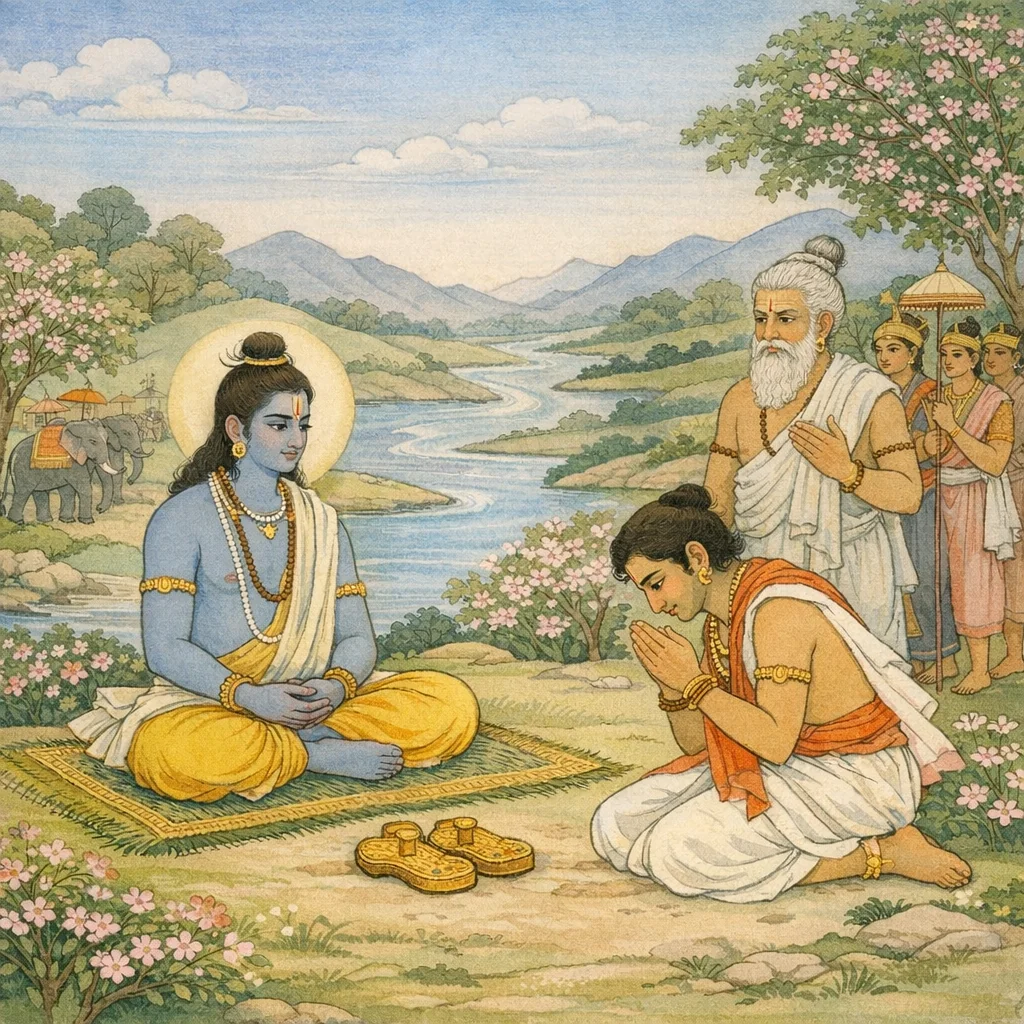
This sarga completes the movement from negotiation to symbolic governance. Bharata, with Śatrughna and the ministers, departs bearing Rāma’s pādukā as a ceremonial proxy of rightful sovereignty. The sandals are framed as a juridico-ritual emblem: Vasiṣṭha urges Rāma to bestow the gold-adorned pādukā for Ayodhyā’s “yogakṣema” (security and welfare), and Rāma, facing east in formal posture, grants them explicitly “for the sake of ruling.” Bharata proclaims fidelity to Daśaratha’s fourteen-year vow, reaffirming the exile terms as binding constitutional speech. Bharadvāja praises Bharata’s innate nobility, seeing virtue as naturally settled in him, and declares that Daśaratha lives on through such a dharmic son. The narrative then turns to the return journey and its mood: the army wheels back with vehicles, horses, and elephants; the crossings of the Yamunā and Gaṅgā are noted; and Śṛṅgiberapura is entered. At last Ayodhyā is seen as bereft—silent, cheerless, and diminished—prompting Bharata’s grief-laden address to the charioteer.
Shlokas
Verse 1
तत श्शिरसि कृत्वा तु पादुके भरतस्तदा।आरुरोह रथं हृष्टः शत्रुघ्नेन समन्वितः।।।।
Then Bharata, placing the sandals upon his head, joyfully mounted the chariot, accompanied by Śatrughna.
Verse 2
वसिष्ठो वामदेवश्च जाबालिश्च दृढव्रतः।अग्रतः प्रययु स्सर्वे मन्त्रिणो मन्त्रपूजिताः।।।।
Vasiṣṭha, Vāmadeva, and Jābāli—steadfast in their vows—together with all the ministers honored for their counsel, proceeded at the front.
Verse 3
मन्दाकिनीं नदीं रम्यां प्राङ्मुखास्ते ययुस्तदा।प्रदक्षिणं च कुर्वाणाश्चित्रकूटं महागिरिम्।।।।
Then, facing east, they went on toward the lovely river Mandākinī, while performing pradakṣiṇā—reverent circumambulation—of the great mountain Citrakūṭa.
Verse 4
पश्यन्धातुसहस्राणि रम्याणि विविधानि च।प्रययौ तस्य पार्श्वेन ससैन्यो भरतस्तदा।।।।
Beholding countless beautiful and varied minerals, Bharata, accompanied by his army, proceeded then along the mountain’s side.
Verse 5
अदूराच्चित्रकूटस्य ददर्श भरतस्तदा।आश्रमं यत्र स मुनिर्भरद्वाजः कृतालयः।।।।
Not far from Citrakūṭa, Bharata then saw the hermitage (āśrama) where the sage Bharadvāja had made his dwelling.
Verse 6
स तमाश्रममागम्य भरद्वाजस्य बुद्धिमान्।अवतीर्य रथात्पादौ ववन्दे भरतस्तदा।।।।
Reaching that hermitage, the wise Bharata descended from his chariot and bowed at Bharadvāja’s feet.
Verse 7
ततो हृष्टो भरद्वाजो भरतं वाक्यमब्रवीत्।अपि कृत्यं कृतं तात रामेण च समागतम्।।।।
Then Bharadvāja, delighted, spoke to Bharata: “My child, has the duty for which you came been fulfilled? And have you met with Rāma?”
Verse 8
एवमुक्त स्स तु ततो भरद्वाजेन धीमता।प्रत्युवाच भरद्वाजं भरतो धर्मवत्सलः।।।।
Thus addressed by the wise Bharadvāja, Bharata—devoted to righteousness—then replied to Bharadvāja.
Verse 9
स याच्यमानो गुरुणा मया च दृढविक्रमः।राघवः परमप्रीतो वसिष्ठं वाक्यमब्रवीत्।।।।
Though entreated by his preceptor and by me, Rāghava—firm in resolve—yet greatly pleased, spoke these words to Vasiṣṭha.
Verse 10
पितुः प्रतिज्ञां तामेव पालयिष्यामि तत्त्वतः।चतुर्दश हि वर्षाणि या प्रतिज्ञा पितुर्मम।।।।
Truly, I shall uphold that very pledge of my father in full truth—the promise of fourteen years.
Verse 11
एवमुक्तो महाप्राज्ञो वसिष्ठः प्रत्युवाच ह।वाक्यज्ञो वाक्यकुशलं राघवं वचनं महत्।।।।
Thus addressed, the great and wise sage Vasiṣṭha—skilled and discerning in speech—replied to Rāghava (Rāma) with weighty words.
Verse 12
एते प्रयच्छ संहृष्टः पादुके हेमभूषिते।अयोध्यायां महाप्राज्ञ योगक्षेमकरे तव।।।।
O supremely sagacious one, gladly bestow these two sandals adorned with gold, that in your stead they may secure Ayodhyā’s welfare and safety.
Verse 13
एवमुक्तो वसिष्ठेन राघवः प्राङ्मुखः स्थितः।पादुके ह्यधिरुह्यैते मम राज्याय वै ददौ।।।।
Thus addressed by Vasiṣṭha, Rāghava stood facing east; having placed his feet upon those sandals, he bestowed them upon me for the governance of the kingdom.
Verse 14
निवृत्तोऽहमनुज्ञातो रामेण सुमहात्मना।अयोध्यामेव गच्छामि गृहीत्वा पादुके शुभे।।।।
Permitted by the great-souled Rāma, I now turn back; taking these auspicious sandals, I go to Ayodhyā.
Verse 15
एतच्छ्रुत्वा शुभं वाक्यं भरतस्य महात्मनः।भरद्वाजश्शुभतरं मुनिर्वाक्यमुवाच तम्।।।।
Hearing these auspicious words of the great-souled Bharata, the sage Bharadvāja spoke to him words even more auspicious.
Verse 16
नैतच्चित्रं नरव्याघ्र शीलवृत्तवतां वर।यदार्यं त्वयि तिष्ठेत्तु निम्ने सृष्टमिवोदकम्।।।।
This is no wonder, O tiger among men, foremost among those of noble conduct: that what is noble should dwell in you—like water poured, naturally flowing downward.
Verse 17
अमृत स्समहाबाहुः पिता दशरथस्तव।यस्य त्वमीदृश: पुत्रो धर्मज्ञो धर्मवत्सलः।।।।
That mighty-armed father of yours, Daśaratha, is not truly dead—since he has a son like you, one who knows dharma and is devoted to dharma.
Verse 18
तमृषिं तु महात्मानमुक्तवाक्यं कृताञ्जलिः।आमन्त्रयितुमारेभे चरणावुपगृह्य च।।।।
Then, with palms joined, he approached that great sage who had thus spoken; clasping his feet, he began to take leave.
Verse 19
ततः प्रदक्षिणं कृत्वा भरद्वाजं पुनः पुनः।भरतस्तु ययौ श्रीमानयोध्यां सह मन्त्रिभिः।।।।
Then, having circumambulated Bharadvāja again and again in reverence, the illustrious Bharata set out for Ayodhyā together with his ministers.
Verse 20
यानैश्च शकटैश्चैव हयैर्नागैश्च सा चमूः।पुनर्निवृत्ता विस्तीर्णा भरतस्यानुयायिनी।। ।।
That vast host, following Bharata with carriages, carts, horses, and elephants, turned back once more toward Ayodhyā.
Verse 21
ततस्ते यमुनां दिव्यां नदीं तीर्त्वोर्मिमालिनीम्।ददृशुस्तां पुन स्सर्वे गङ्गां शुभजलां नदीम्।।।।
Thereafter, having crossed the divine Yamunā wreathed in waves, they all beheld once again the river Gaṅgā, whose waters are auspicious.
Verse 22
तां रम्यजलसंपूर्णां सन्तीर्य सहबान्धवःशृङ्गिबेरपुरं रम्यं प्रविवेश ससैनिकः।शृङ्गिबेरपुराद्भूय स्त्वयोध्यां सन्ददर्श ह।।।।
Crossing the Gaṅgā, full of delightful waters, Bharata—together with his kinsmen and army—entered the lovely city of Śṛṅgiberapura; and from Śṛṅgiberapura, he again came to behold Ayodhyā.
Verse 23
अयोध्यां च ततो दृष्ट्वा पित्रा भ्रात्रा विवर्जिताम्।भरतो दुःख सन्तप्त स्सारथिं चेदमब्रवीत्।।।।
Then, seeing Ayodhyā deserted of his father and his brothers, Bharata, burning with grief, spoke these words to the charioteer.
Verse 24
सारथे पश्य विध्वस्ता साऽयोध्या न प्रकाशते।निराकारा निरानन्दा दीना प्रतिहतस्वरा।।।।
Charioteer, look—Ayodhyā is shattered and no longer shines: it seems without form, without joy, wretched, and with its voices stilled.
Frequently Asked Questions
The pivotal action is the transfer of regnal authority without personal appropriation: Bharata accepts Rāma’s pādukā as the emblem of rule while reaffirming that the kingdom’s legitimacy remains with the exiled heir, thereby resolving a succession dilemma through renunciation and symbolic governance.
Speech as binding moral law is central: Bharata insists on honoring Daśaratha’s promise “in truth,” and the sages frame virtue as self-evident conduct rather than rhetoric—dharma resides naturally in a disciplined character, sustaining both family continuity and public order.
The return route marks a cultural geography of north Indian sacred space—Chitrakūṭa and the Mandākinī, crossings of Yamunā and Gaṅgā, entry into Śṛṅgiberapura—culminating in Ayodhyā, whose altered soundscape and mood function as a civic index of royal absence.