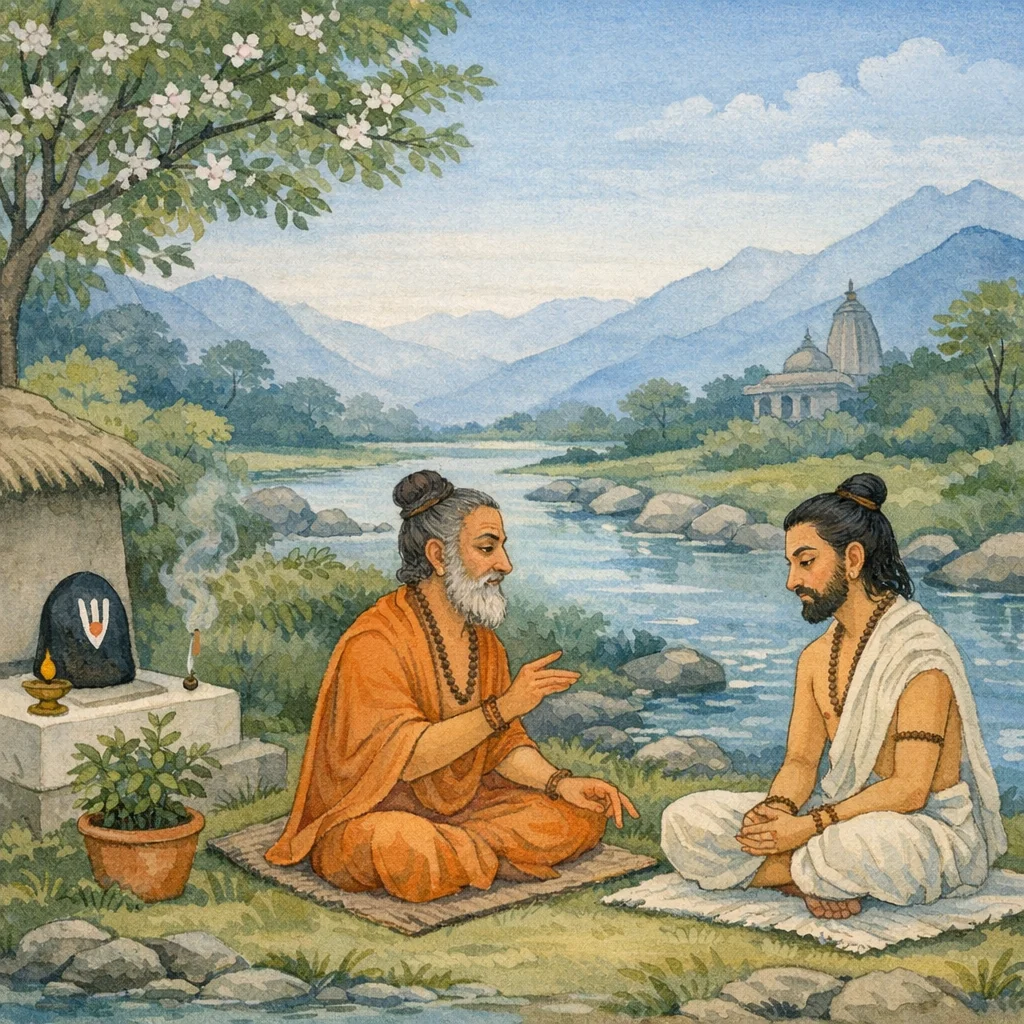
Adhyaya 42
The Birth of Tāraka and the Prelude to the Deva–Asura War (Topic-based Title)
Bhīṣma asks Pulastya for a concise account of Śiva’s greatness and the origin of Guha, and the narration opens upon Diti’s line. Vajrāṅga is foretold and born with vajra-like limbs; in his first surge of power he even captures Indra. Brahmā and Kaśyapa intervene, whereupon Vajrāṅga releases Indra and is instructed to pursue tapas. Brahmā grants him Varāṅgī as wife, and the pair undertake long austerities. Indra tries to break Varāṅgī’s resolve through terrifying forms, yet her vow remains unshaken. Brahmā bestows boons, and Varāṅgī asks for a son—Tāraka—whose birth makes the cosmos tremble. Tāraka becomes lord of the asuras, performs tapas, and gains a conditional death-boon: only a seven-day-old child may slay him. He musters vast forces and defeats the devas; Indra consults Bṛhaspati on the fourfold policy, but war still erupts and the Lokapālas are bound, setting the stage for Kārttikeya’s destined intervention.
Shlokas
Verse 1
भीष्म उवाच । श्रुतः पद्मोद्भवो ब्रह्मन्विस्तरेण त्वयेरितः । समासाद्भवमाहात्म्यमुत्पत्तिं च गुहस्य च
Bhīṣma said: “O Brahmin, I have heard from you in detail of Brahmā, born from the lotus. Now, in brief, tell me the greatness of Bhava (Śiva), and also the origin of Guha (Kārttikeya).”
Verse 2
श्रोतुमिच्छामि ते ब्रह्मन्यथाभूतः कृतं च यत् । तारकश्च कथं भूतो दानवो बलवत्तरः
O Brahmin, I wish to hear from you exactly what happened and what was done—and how Tāraka came to be, that mighty and powerful Dānava.
Verse 3
कार्त्तिकेयेन स ब्रह्मन्कथं ध्वस्तो महासुरः । कथं रुद्रेण मुनयः प्रेषिता मंदरं गिरिम्
O Brahman, how was that great demon destroyed by Kārttikeya? And how were the sages sent by Rudra to Mount Mandara?
Verse 4
कथं लब्धा उमा तत्र रुद्रेण परमेष्ठिना । एतदाख्याहि मे सर्वं यथाभूतं महामुने
How was Umā obtained there by Rudra, the Supreme Lord? Tell me all of this exactly as it happened, O great sage.
Verse 5
पुलस्त्य उवाच । कश्यपेन पुरा प्रोक्ता दितिर्दैत्यारणिः शुभा । वज्रसारमयैश्चांगैः पुत्रो देवि भविष्यति
Pulastya said: “Formerly, Kaśyapa declared that Diti—an auspicious mother of the Daityas—will bear a son, O goddess, whose limbs are made of the essence of vajra, of adamantine hardness.”
Verse 6
वज्रांगो नाम पुत्रस्तु भविता धर्मवत्सलः । सा च लब्धवरा देवी सुषुवे वज्रदुश्छिदम्
A son named Vajrāṅga would be born, devoted to dharma. And that Goddess, having obtained a boon, gave birth to Vajraduśchida—unbreakable, like the vajra.
Verse 7
स जातमात्र एवाभूत्सर्वशास्त्रार्थपारगः । उवाच मातरं भक्त्या मातः किं करवाण्यहम्
No sooner was he born than he became fully versed in the meaning of all the śāstras. With devotion he said to his mother, “Mother, what shall I do?”
Verse 8
तस्योवाच ततो हृष्टा दितिर्दैत्याधिपस्य तु । बहवो मे हताः पुत्राः सहस्राक्षेण पुत्रक
Then Diti, delighted, spoke to the lord of the Daityas: “Many of my sons have been slain by Sahasrākṣa (Indra), my child.”
Verse 9
तेषामपचितिं कर्तुं गच्छ शक्रवधाय तु । बाढमित्येव तां चोक्त्वा जगाम त्रिदिवं बलात्
“Go and make amends for them—yes, go for the slaying of Śakra (Indra).” Saying to her, “So be it,” he departed with force for Tridiva (heaven).
Verse 10
बध्वा ततः सहस्राक्षं पाशेनामोघवर्चसा । मातुरंतिकमागच्छद्व्याधः क्षुद्रमृगं यथा
Then, having bound Sahasrākṣa with a noose of unfailing power, he came near to his mother—like a hunter bringing in a small animal caught in the chase.
Verse 11
एतस्मिन्नंतरे ब्रह्मा कश्यपश्च महातपाः । आगतौ तत्र यत्रास्तां मातापुत्रावभीतकौ
Meanwhile, Brahmā and the great ascetic Kaśyapa arrived at the very place where the fearless mother and son were staying.
Verse 12
दृष्ट्वा तु तावुवाचेदं ब्रह्मा कश्यप एव च । मुंचैनं पुत्र देवेंद्रं किमनेन प्रयोजनम्
Seeing them, Brahmā spoke these words—and Kaśyapa as well: “Release him, my son, O Indra; what purpose is served by this?”
Verse 13
अवमानो वधः प्रोक्तः पुत्र संभावितस्य तु । अस्मद्वाक्येन यो मुक्तस्त्वद्धस्तान्मृत एव सः
For one who is honoured as a son, dishonour is declared to be the same as death. Even if someone is released by my word, if he has fallen into your hands, he is as good as dead.
Verse 14
परस्य गौरवान्मुक्तः शत्रूणां शत्रुराहवे । सजीवन्नेव हि मृतो दिवसे दिवसे पुनः
Freed from dependence on another’s favor, he becomes an enemy to enemies in battle; yet, though still alive, he is as good as dead—dying again and again with each passing day.
Verse 15
एतच्छ्रुत्वा तु वज्रांगः प्रणतो वाक्यमब्रवीत् । न मे कृत्यमनेनास्ति मातुराज्ञा कृता हि मे
Hearing this, Vajrāṅga bowed down and spoke: “I have no business with this matter, for I have already carried out my mother’s command.”
Verse 16
त्वं सुरासुरनाथो वै मान्यश्च प्रपितामहः । करिष्ये त्वद्वचो देव एष मुक्तः शतक्रतुः
You are indeed the lord of gods and asuras, and venerable, O great-grandfather. O Deva, I shall do as you command—this Śatakratu (Indra) is released.
Verse 17
तपसेमेरतिर्देवनिर्विघ्नंतच्चमेभवेत् । त्वत्प्रसादेन भगवन्नित्युक्त्वा विरराम ह
“O God, may my devotion to tapas remain steadfast and free from obstacles; and may this be fulfilled for me by your grace, O Blessed One.” Having spoken thus, he fell silent.
Verse 18
तस्मिंस्तूष्णीं स्थिते दैत्ये प्रोवाचेदं पितामहः । ब्रह्मोवाच । तपस्त्वं कुरु मापन्नः सोस्मच्छासनसंस्थितः
When the Daitya stood silent, the Grandfather (Brahmā) spoke: “O Daitya, practice tapas; do not despair. Remain established under my command.”
Verse 19
अनया चित्तशुद्ध्या हि पर्याप्तं जन्मनः फलम् । इत्युक्त्वा पद्मजः कन्यां ससर्जायतलोचनाम्
“Indeed, through this purification of mind, the fruit of one’s birth is fully attained.” Having said this, the Lotus-born (Brahmā) created a maiden with long, wide eyes.
Verse 20
तामस्मै प्रददौ देवः पत्न्यर्थे पद्मसंभवः । वरांगीति च नामास्याः कृत्वा यातः पितापहः
The Padma-born (Brahmā) gave her to him as a wife; and, having bestowed on her the name “Varāṅgī,” the Father—destroyer of sin—departed.
Verse 21
वज्रांगोपि तया सार्द्धं जगाम तपसे वनम् । ऊर्द्ध्वबाहुस्स दैत्येंद्रो चरद्वर्षसहस्रकम्
Vajrāṅga too, together with her, went to the forest to perform tapas. That lord of the Daityas, with arms raised aloft, practiced penance for a thousand years.
Verse 22
कालं कमलपत्राक्षः शुद्धबुद्धिर्महातपाः । तावच्चाधोमुखः कालं तावत्पंचाग्निमध्यगः
For a long time, that lotus‑eyed great ascetic—pure in understanding—remained with his face turned downward; and for that same length of time he stayed amid the five fires.
Verse 23
निराहारो घोरतपास्तपोराशिरजायत । ततः सोंतर्जले चक्रे वासं वर्षसहस्रकम्
Living without food, he became as it were a heap of fierce austerity; thereafter he made his dwelling within the waters for a thousand years.
Verse 24
जलांतरं प्रविष्टस्य तस्य पत्नी महाव्रता । तस्यैव तीरे सरसः स्थिताऽसौ मौनमाश्रिता
When he had entered the depths of the water, his wife—steadfast in her great vow—remained on the bank of that very lake, abiding in silence.
Verse 25
निराहारं तपो घोरं प्रविवेश महाद्युतिः । तस्यां तपसि वर्तंत्यामिंद्रश्चक्रे विभीषिकाम्
The radiant one undertook a severe austerity without food; and while she remained engaged in that penance, Indra created a terror to obstruct her.
Verse 26
गत्वा तु मर्कटाकारस्तदाश्रमपदं महत् । ब्रसीं चकर्ष बलवान्गंधाद्यर्चाकरंडकम्
Then, assuming the form of a monkey, he went to that great hermitage-site; and the powerful one dragged away the basket of worship-materials containing perfumes and the like.
Verse 27
ततस्तु सिंहरूपेण भीषयामास भामिनीम् । ततो भुजंगरूपेणाप्यदशच्चरणद्वयम्
Then, taking the form of a lion, he terrified the fair lady; and then, taking the form of a serpent, he bit both of her feet.
Verse 28
तपोबलवशात्सा तु नवध्यत्वं जगाम ह । भीषिकाभिरनेकाभिः क्लेशयन्पाकशासनः
But by the power of her austerities, she indeed became invulnerable; and Pākaśāsana (Indra), tormenting her, afflicted her with many terrors.
Verse 29
विरराम यदा नैव वज्रांगमहिषी तदा । शैलस्यदुष्टतां मत्वा शापं दातुं समुद्यता
When the wife of Vajrāṅga did not desist, then—considering the mountain’s wickedness—she rose, ready to pronounce a curse.
Verse 30
तां शापाभिमुखीं दृष्ट्वा शैलः पुरुषविग्रहः । उवाच तां वरारोहां वरांगीं भीतलोचनः
Seeing her facing the impending curse, Śaila—embodied in human form—spoke to that noble lady of graceful gait and beautiful limbs, his eyes filled with fear.
Verse 31
शैल उवाच । नाहं महाव्रते दुष्टः सेव्योहं सर्वदेहिनाम् । विप्रियं ते करोत्येष रुषितः पाकशासनः
Śaila said: “O great-vowed one, I am not wicked; I am worthy of reverence by all embodied beings. It is this Pākaśāsana (Indra), enraged, who is doing what is displeasing to you.”
Verse 32
एतस्मिन्नंतरे जातः कालो वर्षसहस्रकः । तस्मिन्ज्ञात्वा तु भगवान्काले कमलसंभवः
In the meantime, a period of a thousand years elapsed. Realizing that this time had passed, the Blessed One—born of the lotus—then acted accordingly.
Verse 33
तुष्टः प्रोवाच वज्रांगं तदागत्य जलाशयम् । ब्रह्मोवाच । ददामि सर्वकामं त उत्तिष्ठ दितिनंदन
Pleased, he spoke to Vajrāṅga when he had come to the waterside. Brahmā said: “I grant you the fulfillment of all desires—arise, O son of Diti.”
Verse 34
एवमुक्तस्तदोत्थाय स दैत्येंद्रस्तपोनिधिः । उवाच प्रांजलिर्वाक्यं सर्वलोकपितामहम्
Thus addressed, the lord of the Daityas—an ocean of austerity—rose up and, with folded hands, spoke these words to the Grandsire of all the worlds (Brahmā).
Verse 35
वज्रांग उवाच । आसुरो मास्तु मे भावः संतु लोका ममाक्षयाः । तपस्यभिरतिर्मेऽस्तु शरीरस्यास्य वर्तनम्
Vajrāṅga said: “Let there be no demonic disposition in me. Let my worlds be imperishable. Let me delight in austerity (tapas), and let this body continue to endure.”
Verse 36
एवमस्त्विति तं देवो जगाम स्वकमालयम् । वज्रांगोपि समाप्ते तु तपसि स्थिरसंयमः
“So be it,” said the god, and departed to his own abode. And Vajrāṅga too—his austerities completed—remained steadfast, firm in self-restraint.
Verse 37
संगंतुमिच्छन्स्वां भार्यां न ददर्शाश्रमे स्वके । क्षुधाविष्टः स शैलस्य गहनं प्रविवेश ह
Wishing to meet his own wife, he did not see her in his hermitage. Afflicted by hunger, he then entered the deep forested region of the mountain.
Verse 38
आदातुं फलमूलानि स च तस्मिन्व्यलोकयत् । रुदन्तीं स्वां प्रियां दीनां तरुप्रच्छादिताननाम्
As he went to gather fruits and roots, he then saw there his own beloved—wretched and weeping—her face hidden behind the trees.
Verse 39
तां विलोक्य ततो दैत्यः प्रोवाच परिसांत्वयन् । वज्रांग उवाच । केन तेऽपकृतं भद्रे यमलोकं यियासुना
Seeing her, the Daitya then spoke, seeking to console her. Vajrāṅga said: “Fair lady, who has wronged you, that you wish to go to Yama’s world?”
Verse 40
कं वा कामं प्रयच्छामि शीघ्रं प्रब्रूहि मानिनि । वरांग्युवाच । त्रासितास्म्यपविद्धास्मि ताडिता पीडितास्मि च
“Which desire shall I grant you? Speak quickly, O proud lady.” The fair-limbed woman said: “I have been terrified, cast aside, struck, and tormented as well.”
Verse 41
रौद्रेण देवराजेन नष्टनाथेव भूरिशः । दुःखस्यांतमपश्यंती प्राणांस्त्यक्तुं व्यवस्थिता
Tormented by the fierce king of the Devas, she became as one bereft of a protector; seeing no end to her sorrow, she resolved to relinquish her life-breath.
Verse 42
पुत्रं मे तारकं देहि तस्माद्दुःखमहार्णवात् । एवमुक्तस्तु दैत्येंद्रः कोपव्याकुललोचनः
“Grant me a son—Tāraka—so that I may be delivered from that vast ocean of sorrow.” Thus addressed, the lord of the Daityas, his eyes trembling with anger, (replied).
Verse 43
शक्तोपि देवराजस्य प्रतिकर्तुं महासुरः । तप एव पुनश्चर्तुं व्यवस्यत महाबलः
Though the great Asura was able to retaliate against the king of the Devas, the mighty one resolved instead to undertake austerities (tapas) once again.
Verse 44
ज्ञात्वा तस्य तु संकल्पं ब्रह्मा क्रूरतरं पुनः । आजगाम त्वरायुक्तो यत्रासौ दितिनंदनः
Knowing his intention, Brahmā—becoming even more stern—hurriedly went to the place where that son of Diti was.
Verse 45
ब्रह्मोवाच । किमर्थं पुत्र भूयस्त्वं कर्तुं नियममुद्यतः । तदहं ते पुनर्दद्मि कांक्षितं पुत्रमोजसा
Brahmā said: “For what reason, my son, are you again preparing to undertake a sacred observance? Therefore, by my power, I shall grant you once more the son you desire.”
Verse 46
वज्रांग उवाच । उत्थितेन मया दृष्टा समाधानात्त्वदाज्ञया । त्रासितेंद्रेण मामाह सा वरांगी सुतार्थिनी
Vajrāṅga said: “When I rose, I beheld her—by your command, after emerging from my meditative absorption. That fair-limbed lady, yearning for a son, spoke to me, for Indra had frightened her.”
Verse 47
पुत्रं मे तारकं देहि तुष्टो मे त्वं पितामह । ब्रह्मोवाच । अलं ते तपसा वीर मा क्लेशे दुस्तरे विश
“Grant me a son named Tāraka; you are pleased with me, O Grandfather (Brahmā).” Brahmā said: “Enough of your austerities, O hero; do not enter into hardship that is difficult to bear.”
Verse 48
पुत्रस्तु तारको नाम भविष्यति महाबलः । देवसीमंतिनीनां तु धम्मिल्लक विमोक्षकः
And a son named Tāraka will be born—mighty in strength—who will be the liberator of the braided hair-knots (dhammillaka) of the divine women.
Verse 49
इत्युक्तो दैत्यनाथस्तु प्रणम्य प्रपितामहम् । गत्वा तां नंदयामास महिषीं कर्शितांतराम्
Thus addressed, the lord of the Daityas bowed to his great-grandfather; then he went and delighted that queen, whose inward heart had been worn down by distress.
Verse 50
तौ दंपती कृतार्थौ तु जग्मतुः स्वाश्रमं तदा । आहितं तु तदा गर्भं वरांगी वरवर्णिनी
Then that husband and wife, their purpose fulfilled, went to their own hermitage. And at that time the fair-limbed, beautiful-complexioned lady conceived a child.
Verse 51
पूर्णं वर्षसहस्रं तु दधारोदर एव हि । ततो वर्षसहस्रांते वरांगी सा प्रसूयत
Indeed, she bore the child in her womb for a full thousand years; then, at the end of that thousand years, the fair-limbed woman gave birth.
Verse 52
जायमाने तु दैत्ये तु तस्मिन्लोकभयंकरे । चचाल सर्वा पृथिवी प्रोद्भूताश्च महार्णवाः
But as that Daitya—terrifying to the worlds—was being born, the entire earth shook, and the great oceans surged up in upheaval.
Verse 53
चेलुर्धराधराश्चापि ववुर्वाताश्च भीषणाः । जेपुर्जप्यं मुनिवरा नेदुर्व्यालमृगा अपि
Even the mountains shook, and dreadful winds began to blow. The best of sages continued their sacred recitation, while even serpents and wild beasts let out cries.
Verse 54
जहौ कांतिश्चंद्रसूर्यौ नीहारच्छादिता दिशः । जाते महासुरे तस्मिन्सर्वे चापि महासुराः
The moon and the sun lost their radiance, and the directions were veiled in mist. When that great Asura was born, all the mighty Asuras too assembled.
Verse 55
आजग्मुर्हर्षितास्तत्र तथा चासुरयोषितः । जगुर्हर्षसमाविष्टा ननृतुश्चाप्सरोगणाः
There, the delighted wives of the Asuras also arrived. Filled with joy, they sang, and the hosts of Apsarases danced as well.
Verse 56
ततो महोत्सवे जाते दानवानां महाद्युते । विषण्णमनसो देवाः सहेंद्रा अभवंस्तदा
Then, when that great festival of the Dānavas took place, O greatly radiant one, the gods—together with Indra—became downcast at heart.
Verse 57
वरांगी तु सुतं दृष्ट्वा हर्षेणापूरिता तदा । बहुमेने च दैत्येंद्रो विजातं तं तदा तया
Then Varāṅgī, seeing her son, was filled with joy. And the lord of the Daityas highly esteemed that child, who had been borne by her.
Verse 58
जातमात्रस्तु दैत्येंद्रस्तारकश्चोग्रविक्रमः । अभिषिक्तो सुरैर्मुख्यैः कुजंभमहिषादिभिः
As soon as he was born, Tāraka—the lord of the Daityas, of fierce prowess—was consecrated as king by the foremost, such as Kujambha, Mahiṣa, and others.
Verse 59
सर्वासुरमहाराज्ये पृथिवीतुलनक्षमे । स तु प्राप्तमहाराज्यस्तारको नृपसत्तम
In the vast imperial dominion of all the Asuras—mighty enough to rival the earth itself—Tāraka, O best of kings, had indeed obtained a great sovereignty.
Verse 60
उवाच दानवश्रेष्ठो युक्तियुक्तमिदं वचः । तारक उवाच । शृणुध्वमसुराः सर्वे वाक्यं मम महाबलाः
The foremost of the Dānavas spoke these well-reasoned words. Tāraka said: “Listen, all you Asuras—hear my words, O mighty ones.”
Verse 61
वंशक्षयकरा देवाः सर्वेषामेव दानवाः । अस्माकं जातिधर्मेण विरूढं वैरमक्षयम्
The Devas are the destroyers of our line—of all the Dānavas indeed. By the very law of our kind, an undying enmity has grown between us.
Verse 62
वयं तपश्चरिष्यामः सुराणां निग्रहाय तु । स्वबाहुबलमाश्रित्य सर्व एव न संशयः
“We shall undertake austerities (tapas) in order to subdue the gods; relying on the strength of our own arms, all of us will do so—there is no doubt.”
Verse 63
तच्छ्रुत्वा संमतं कृत्वा पारियात्रं ययौ गिरिं । निराहारः पंचतपाः पत्रभुग्वारिभोजनः
Hearing that and giving his assent, he went to the Pāriyātra mountain. Practising severe austerities, he remained fasting—living on leaves and taking only water as sustenance.
Verse 64
शतंशतं समानां तु तपांस्येतान्यथाकरोत् । एवं तु कर्शिते देहे तपोराशित्वमागते
For hundreds upon hundreds of years, he performed these austerities as prescribed. And when his body had become emaciated thus, he attained the state of being a vast treasury of tapas—ascetic power.
Verse 65
ब्रह्मागत्याह दैत्येंद्रं वरं वरय सुव्रत । स वव्रे सर्वभूतेभ्यो न मे मृत्युर्भवेदिति
Brahmā came and said to the lord of the Daityas, “O you of noble vow, choose a boon.” He chose this: “May death not come to me from any being.”
Verse 66
तमुवाच ततो ब्रह्मा देहिनां मरणं ध्रुवम् । यतस्ततोपि वरय मृत्युं यस्मान्न शंकसे
Then Brahmā said to him: “For embodied beings, death is certain. Therefore, choose a death as a boon, since you do not fear it.”
Verse 67
ततः संचिंत्य दैत्येंद्रः शिशोर्वै सप्तवासरात् । वव्रे महासुरो मृत्युं मोहितो ह्यवलेपतः
Then, after reflecting, the lord of the Daityas—bewildered by arrogance—chose death at the hands of the child after seven days.
Verse 68
जगामोमित्युदाहृत्य ब्रह्मा दैत्यो निजं गृहम् । अथाह मंत्रिणस्तूर्णं बलं मे संप्रयुज्यताम्
Uttering “Om, I shall depart,” the Daitya named Brahmā went to his own home. Then he said to his ministers, “Quickly, let my forces be mobilized.”
Verse 69
यदि वो मत्प्रियं कार्यं निग्राह्याः सुरसत्तमाः । निगृहीतेषु मे प्रीतिर्जायते चातुलाऽसुराः
If you wish to do what is pleasing to me, O best of the Devas, then the Asuras must be restrained; when they are subdued, an incomparable joy arises in me.
Verse 70
तारकस्य वचः श्रुत्वा ग्रसनो नाम दानवः । सेनानीर्दैत्यराजस्य सज्जं चक्रे बलं च तत्
Hearing Tāraka’s words, the demon named Grasana—commander of the Daitya king—made that army ready for action.
Verse 71
आहत्य भेरीं गंभीरां दैत्यानाहूय सत्वरः । दशकोटीश्वरा दैत्या दैत्यानां चंडविक्रमाः
Having struck the deep-resounding war-drum, he swiftly summoned the Daityas—mighty lords over ten crores—Daityas of fierce valor among the Daityas.
Verse 72
तेषामग्रेसरो जंभः कुजंभोनंतरोऽसुरः । महिषः कुंजरो मेघः कालनेमिर्निमिस्तथा
Among them, the foremost was Jambha; next came the asura Kujambha. There were also Mahiṣa, Kuñjara, Megha, Kālanemi, and Nimi as well.
Verse 73
मंथनो जंभकः शुम्भो दैत्येंद्रा दशनायकाः । अन्ये च शतशस्तत्र पृथिवीतुलनक्षमाः
There were Manthana, Jambhaka, and Śumbha—Daitya-lords, ten commanders in all; and hundreds of others there as well, able in strength to match the very earth.
Verse 74
गरुडानां सहस्रेण चक्राष्टकविभूषितः । सकूबरपरीवारश्चतुर्योजनविस्तृतः
Adorned with eight circular discs and accompanied by a thousand Garuḍas, together with the attendant Kūbaras, it extends over an expanse of four yojanas.
Verse 75
स्यंदनस्तारकस्यासीत्व्याघ्रसिंहखरार्वभिः । युक्ता रथास्तु ग्रसन जंभकौ जंभकुंभिनां
Tāraka’s chariot was harnessed with tigers, lions, donkeys, and camels; and for the demons Jambha and Kumbha there were chariots yoked with mounts named Grasana and Jambhaka.
Verse 76
मेघस्य द्वीपिभिर्युक्तः कूष्मांडैः कालनेमिनः । पर्वताभश्चतुर्दंष्ट्रो निमेश्चैव महागजः
Megha was attended by leopards; Kālanemi by the Kūṣmāṇḍas. Caturdaṃṣṭra was mountain-like in form, and Nimeśa was indeed a mighty elephant.
Verse 77
शतहस्ततुरंगस्थो मंथनो नाम दैत्यराट् । जंभकस्तूष्ट्रमारूढो गिरींद्राभं महाबलः
The Daitya-king named Manthana was mounted upon a swift and strong horse; and Jambhaka—of great might, resembling the lord of mountains—was mounted upon a camel.
Verse 78
शुंभो मेषं समारूढोऽन्येप्येवं चित्रवाहनाः । प्रचंडाश्चित्रवर्माणः कुंडलोष्णीषभूषिताः
Śumbha mounted a ram; and others too, in the same way, rode upon wondrous mounts. They were fierce, clad in variegated armor, and adorned with earrings and turbans.
Verse 79
तद्बलं दैत्यसिंहस्य भीमरूपं व्यजायत । प्रमत्तमत्तमातंगतुरंगरथसंकुलम्
Then the army of that lion among the Daityas came forth in a fearsome form—thronged with frenzied, intoxicated elephants, horses, and chariots.
Verse 80
प्रतस्थेऽमरयुद्धाय बहुपत्तिपताकिकम् । एतस्मिन्नंतरे वायुर्देवदूतोऽसुरालये
He set out for battle against the Immortals (Amaras), with an army marked by many troops and banners. Meanwhile, Vāyu, the Devas’ messenger, arrived at the abode of the Asuras.
Verse 81
दृष्ट्वा तद्दानवबलं जगामेंद्रस्य शंसितुं । स गत्वा तु सभां दिव्यां महेंद्रस्य महात्मनः
Seeing that host of Dānavas, he went to report it to Indra. Having gone, he entered the divine assembly hall of great-souled Mahendra (Indra).
Verse 82
शशंस मध्ये देवानां तत्कार्यं समुपस्थितम् । तच्छ्रुत्वा देवराजस्तु निमीलितविलोचनः
In the midst of the gods he reported that the required task had now presented itself. Hearing this, the king of the gods kept his eyes closed.
Verse 83
बृहस्पतिमुवाचेदं वाक्यं काले महाभुजः । इंद्र उवाच । संप्राप्नोति विमर्दोयं देवानां दानवैः सह
At the proper time, the mighty-armed Indra spoke these words to Bṛhaspati: “O Bṛhaspati, this clash between the gods and the Dānavas is now at hand.”
Verse 84
कार्यं किमत्र तद्ब्रूहि नीत्युपायोपबृंहितम् । एतच्छ्रुत्वा तु वचनं महेंद्रस्य गिरां पतिः
“What is the task at hand here? Tell me—supported by proper policy and practical means.” Hearing these words of Mahendra (Indra), the Lord of Speech (Bṛhaspati) …
Verse 85
इत्युवाच महाभागो बृहस्पतिरुदारधीः । बृहस्पतिरुवाच । सामपूर्वा श्रुता नीतिश्चतुरंगापताकिनी
Thus spoke the noble Bṛhaspati, of lofty intellect. Bṛhaspati said: “This policy of statecraft, preceded by conciliation (sāma), has been learned—arrayed like a fourfold army and bearing its banner.”
Verse 86
जिगीषतां सुरश्रेष्ठ स्थितिरेषा सनातनी । सामभेदस्तथा दानं दंडश्चांगचतुष्टयम्
O best of the gods, this is the eternal policy for those who seek to conquer: conciliation and division, as well as gifts and punishment—these are the four constituent means.
Verse 87
न सांत्वगोचरे लुब्धानभेद्यास्त्वेकधर्मिणः । न दानमत्त्र संसिद्ध्यै प्रसह्यैवापहारिणाम्
The greedy are not amenable to conciliation; those fixed in a single (selfish) course are hard to turn. Here, gifts too do not succeed with those who seize by force—robbers who take outright.
Verse 88
एकोभ्युपायो दंडोऽत्र भवतां यदि रोचते । एवमुक्तः सहस्राक्ष एवमेतदुवाच ह
“There is only one course here—punishment—if it pleases you.” Thus addressed, Sahasrākṣa (Indra) indeed spoke these words.
Verse 89
कर्त्तव्यतां च संचिंत्य प्रोवाचामरसंसदि । इंद्र उवाच । अवधानेन मे वाचं शृणुध्वं नाकवासिनः
Having reflected on what ought to be done, he spoke in the assembly of the gods. Indra said: “O dwellers of heaven, listen attentively to my words.”
Verse 90
भवंतो यज्ञभोक्तारो दिव्यात्मानो हि सान्वयाः । स्वे महिम्नि स्थिता नित्यं जगतः पालने रताः
You are indeed the enjoyers of the sacrifices—divine-souled beings, endowed with your proper lineages. Abiding eternally in your own majesty, you are ever engaged in the protection and governance of the world.
Verse 91
क्रियतां समरोद्योगः सैन्यं संयोज्यतां मम । आह्रियंतां च शस्त्राणि पूज्यंतां शस्त्रदेवताः
Let the preparations for battle be made; let my army be assembled. Let the weapons be brought forth, and let the deities presiding over weapons be worshipped.
Verse 92
वाहनानि विमानानि योजयद्ध्वं ममेश्वराः । यमं सेनापतिं कृत्वा शीघ्रमेव दिवौकसः
“O divine lords, harness my vehicles and aerial chariots. Appoint Yama as the commander of the army, and quickly set forth, O dwellers of heaven.”
Verse 93
इत्युक्तास्समनह्यंत देवानां ये प्रधानतः । वाजिनामयुतेनाजौ हेमघंटा परिष्कृतम्
Thus addressed, the foremost among the gods prepared themselves; on the battlefield the host was arrayed with ten thousand horses, adorned with golden bells.
Verse 94
नानाश्चर्यगुणोपेतं संप्राप्तं देवदानवैः । रथं मातलिना युक्तं देवराजस्य दुर्जयम्
Endowed with many wondrous excellences, there arrived—brought by the gods and the Dānavas—Indra’s chariot, harnessed by Mātali, invincible and impossible to overcome.
Verse 95
यमो महिषमास्थाय सेनाग्रे समवर्त्तत । चंडकिंकरवृंदेन सर्वतः परिवारितः
Yama, mounting a buffalo, took his position at the front of the army, surrounded on all sides by a host of fierce attendants.
Verse 96
कल्पकालोद्गतज्वाला पूरितोम्बरगोचरः । हुताशनस्त्वजारूढः शक्तिहस्तो व्यवस्थितः
Blazing with flames that rise at the end of a kalpa and filling the whole expanse of the sky, Hutāśana, the Fire, stood poised—mounted on a goat and holding a spear in his hand.
Verse 97
पवनोऽङकुशहस्तश्च विस्तारित महाजवः । भुजगेंद्रसमारूढो जलेशो भगवान्स्वयम्
Pavana, holding the goad (aṅkuśa) in his hand and endowed with vast, great speed, mounted upon the king of serpents—was himself the blessed Lord of the waters, Jaleśa.
Verse 98
नरयुक्ते रथे देवो राक्षसेशो वियच्चरः । तीक्ष्णखड्गयुतो भीमः समरे समवस्थितः
The lord of the Rākṣasas—mighty, roaming through the sky—stood ready for battle on a chariot drawn by men, terrifying, and armed with a sharp sword.
Verse 99
महासिंहरथे देवो धनाध्यक्षो गदायुधः । चंद्रादित्यावश्विनौ च चतुरंगबलान्विताः
The god, the lord of wealth, bearing a mace, was on a great lion-chariot; and the Moon and the Sun, along with the Aśvins, were also present, accompanied by the fourfold army.
Verse 100
सेनान्यो देवराजस्य दुर्जया भुवनत्रये । कोटयस्तास्त्रयस्त्रिंशद्देवदेवनिकायिनाम्
The commanders of Indra, king of the gods, were unconquerable in the three worlds; their hosts, belonging to the various groups of deities, amounted to thirty-three crores.
Verse 101
हिमाचलाभे सितचारुचामरे सुवर्णपद्मामलसुंदरस्रजि । कृताभिरामो ज्वलकुंकुमांकुरे कपोललीलालिकदंबसंकुले
He shone in splendor—fair as the Himālaya—holding a lovely white yak-tail fan; adorned with a pure and beautiful garland of golden lotuses; his cheeks marked with glowing saffron, while swarms of bees, playfully drawn by the fragrance, surrounded him.
Verse 102
स्थितस्तदैरावणनाम कुंजरे महामनाश्चित्रविभूषणांबरः । विशालवज्रः सुवितानभूषितः प्रकीर्णकेयूरभुजंगमंडलः
Then he stood upon the elephant named Airāvaṇa—noble in mind, clad in garments adorned with wondrous ornaments—bearing a vast vajra; splendidly shaded by a canopy, and encircled by scattered armlets and serpent-like adornments.
Verse 103
सहस्रदृग्वंदितपादपल्लवस्त्रिविष्टपे शोभत पाकशासनः । तुरंग मातंग कुलौघसंकुला सितातपत्त्रद्ध्वजशालिनी च
In Triviṣṭapa, Pākaśāsana (Indra) shone forth—his lotus-bud feet revered by the Thousand-Eyed. Around him surged great hosts of horses and elephants, and the scene was graced with white parasols and banners.
Verse 104
बभूव सा दुर्जयपत्तिसंतता विभाति नानायुधयोधदुस्तरा । ततोश्विनौ च मरुतः ससाध्याः सपुरंदराः
Then there arose an invincible succession of armies, resplendent and hard to overcome, filled with warriors bearing weapons of many kinds. After that appeared the Aśvin twins and the Maruts, along with the Sādhyas and Purandara (Indra), the breaker of forts.
Verse 105
यक्षराक्षसगंधर्वा दिव्य नानास्त्रपाणयः । जघ्नुर्दैत्येश्वरं सर्वे संभूय तु महाबलाः
The Yakṣas, Rākṣasas, and Gandharvas—bearing various divine weapons—joined together; and all those mighty ones, united, slew the lord of the Daityas.
Verse 106
न चैवास्त्राण्यसज्जंत गात्रे वज्राचलोपमे । अथो रथादवप्लुत्य तारको दानवाधिपः
And the weapons could not at all find purchase upon his body, which was like a mountain of adamant. Then Tāraka, lord of the Dānavas, leapt down from his chariot.
Verse 107
जघान कोटिशो देवान्करपार्ष्णिभिरेव च । हतशेषाणि सैन्यानि देवानां विप्र दुद्रुवुः
He struck down the gods by the crores, using only the heels of his hands; and, O Brāhmaṇa, the remaining troops of the gods—those left after the slaughter—fled in rout.
Verse 108
दिशो भीतानि संत्यज्य रणोपकरणानि च । दृष्ट्वा तान्विद्रुतान्देवांस्तारको वाक्यमब्रवीत्
Seeing the gods fleeing in fear in all directions, having cast aside their weapons of war, Tāraka spoke these words.
Verse 109
मा वधिष्ठ सुरान्दैत्या वज्रांगाय च मंदिरे । शीघ्रमानीय दर्श्यंतां बद्धान्पश्यत्वयं सुरान्
“Do not kill the gods, O Daityas, in the temple of Vajrāṅga. Bring them quickly and show them—let Vajrāṅga see these gods bound.”
Verse 110
लोकपालांस्ततो दैत्यो बद्ध्वा चेंद्रमुखान्रणे । सरुद्रान्सुदृढैः पाशैः पशुपालः पशूनिव
Then the Daitya bound the Lokapālas—Indra and the others—on the battlefield; and with exceedingly strong nooses he even bound the Rudras, like a cattle-herd tying up animals.
Verse 111
स भूयो रथमास्थाय जगाम स्वकमालयं । सिद्धगंधर्वसंघुष्टं विपुलाचलमस्तकम्
Then, mounting his chariot once again, he went to his own abode—upon the broad mountain’s summit, resounding with the voices of Siddhas and Gandharvas.