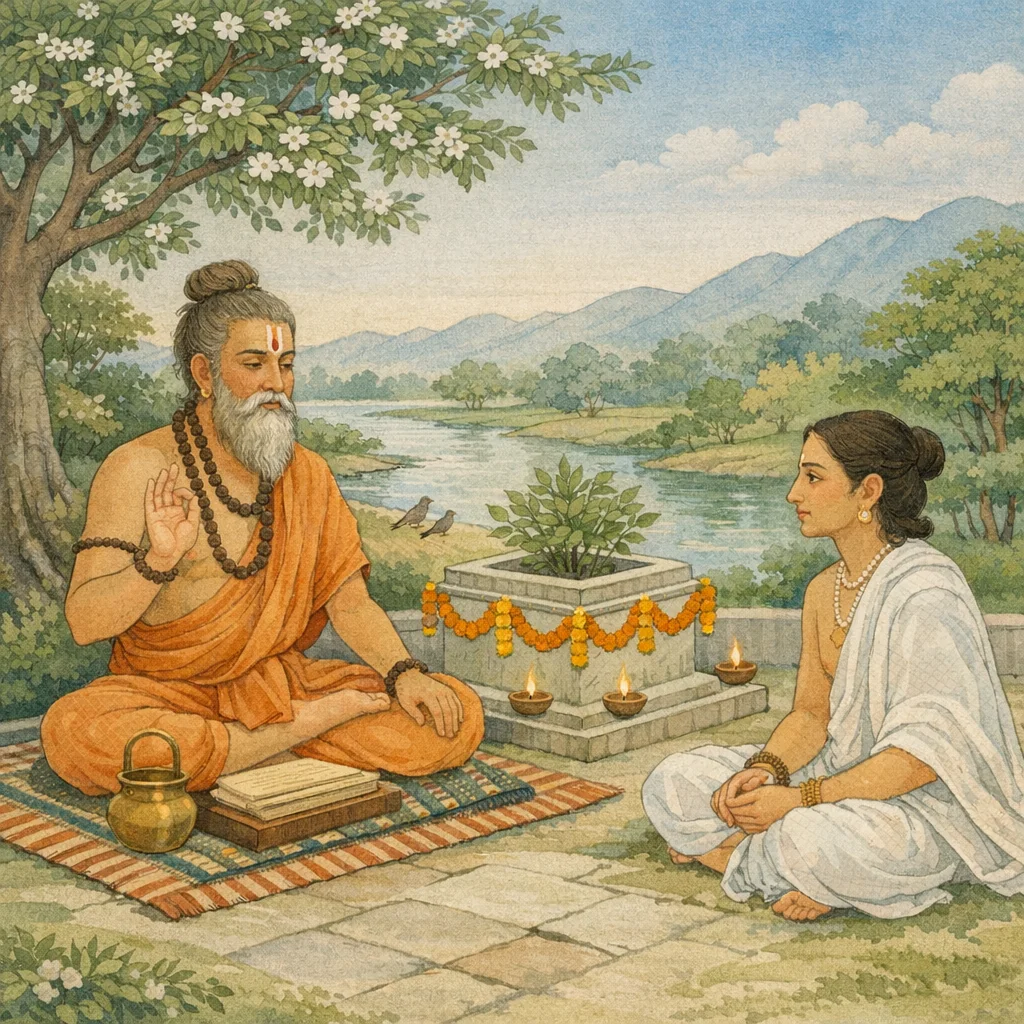
Adhyaya 22
Agastya Arghya Rite and the Gaurī & Sārasvata Vows (with Origin Narratives and Merit Statements)
PP.1.22 opens by naming the seven divine worlds and turns to questions of sovereignty, beauty, longevity, and health. Pulastya recounts a mythic crisis: the Dānavas hide in the ocean; Indra commands Agni and Vāyu to dry it up, but they refuse to cause mass harm and are cursed into embodied birth. This leads into the jar-birth traditions of Vasiṣṭha and Agastya through Mitra and Varuṇa; later Agastya drinks the ocean and removes the threat to the gods. The chapter then becomes strongly ritual: it prescribes offering Agastya-arghya at dawn with white substances and gifts, granting graded fruits up to attaining the seven worlds and Viṣṇu’s abode. Next comes Devī-centered worship on Ananta-tṛtīyā, with nyāsa-like salutations, lotus-maṇḍala installations of goddesses, monthly flower observances, and strict honoring of the guru. It further teaches the Rasakalyāṇinī vow (Māgha tṛtīyā) with monthly abstentions and donations, and concludes with the Sārasvata vow for sweet speech, intellect, popularity, and long life, culminating in Brahmaloka merit.
Shlokas
Verse 1
भीष्म उवाच । भूर्लोकोथ भुवर्लोकः स्वर्लोकोथ महर्जनः । तपः सत्यं च सप्तैते देवलोकाः प्रकीर्त्तिताः
Bhīṣma said: Bhūrloka, then Bhuvarloka, Svargaloka, and Maharloka; and also Tapoloka and Satyaloka—these seven are proclaimed as the divine worlds.
Verse 2
पर्यायेण तु सर्वेषामाधिपत्यं कथं भवेत् । इहलोके शुभं रूपमायुरारोग्यमेव च
But how can sovereignty come to all, in turn? And how may one attain in this world a beautiful form, long life, and indeed good health as well?
Verse 3
लक्ष्मीश्च विपुला ब्रह्मन्कथं स्यात्सुरपूजित । पुलस्त्य उवाच । पुरा हुताशनः सार्द्धं मारुतेन महीतले
“O Brahman, revered and worshipped by the gods, how can Lakṣmī become abundant?” Pulastya said: “Formerly, Agni, together with Vāyu, was upon the surface of the earth…”
Verse 4
आदिष्टः पुरुहूतेन विनाशाय सुरद्विषाम् । निर्दग्धेषु ततस्तेन दानवेषु सहस्रशः
Commanded by Puruhūta (Indra) to bring about the destruction of the enemies of the gods, he then burned thousands upon thousands of Dānavas to ashes.
Verse 5
तारकः कमलाक्षश्च कालदंष्ट्रः परावसुः । विरोचनस्तु संह्रादः प्रयातास्ते तदा वसन्
Tāraka, Kamalākṣa, Kāladaṁṣṭra, Parāvasu, and also Virocana and Saṁhrāda—those beings then set out, dwelling there at that time.
Verse 6
अंतःसमुद्रमाविश्य सन्निवेशमकुर्वत । अशक्ता इति तेप्यग्निमारुताभ्यामुपेक्षिताः
Entering the heart of the ocean, they made their settlement there; yet, deemed powerless, they too were disregarded by Fire and Wind.
Verse 7
ततः प्रभृति वै देवान्मानुषान्स भुजंगमान् । संपीड्य च मुनीन्सर्वान्प्रविशंति पुनर्जलम्
From that time onward, they indeed harass the gods, human beings, and the serpents; and, having oppressed all the sages as well, they again enter the waters.
Verse 8
एवं युगसहस्राणि ते वीराः सप्त पंच च । जलदुर्गबलाद्राजन्पीडयंति जगत्त्रयम्
Thus, for thousands of yugas, those twelve heroes—supported by their watery fortress and armed might—have been afflicting the three worlds, O king.
Verse 9
ततः पुनरथो वह्निमारुतावमराधिपः । आदिदेशाचिरादंबु निधिरेष विशोष्यताम्
Then the lord of the gods again commanded Fire and Wind: “Quickly, let this ocean be dried up.”
Verse 10
यस्मादस्मद्द्विषां चैष शरणं वरुणालयः । तस्माद्भवद्भ्यामद्यैव शोषमेष प्रणीयताम्
Since this abode of Varuṇa has become a refuge for our enemies as well, therefore, you two must bring it to dryness this very day.
Verse 11
तावूचतुस्ततः शक्रं मयशम्बरसूदनम् । अधर्म एष देवेंद्र सागरस्य विनाशनम्
Then those two spoke to Śakra (Indra), the slayer of Māyā and Śambara: “O Lord of the gods, this is adharma—this destruction of the ocean.”
Verse 12
यस्माज्जीवनिकायस्य महतः संक्षयो भवेत् । तस्मादुपायमन्यं तु समाश्रय पुरंदर
Since by that course there would be great destruction of living beings, therefore adopt another means, O Purandara (Indra).
Verse 13
यस्य योजनमात्रेपि जीवकोटि शतानि च । निवसंति सुरश्रेष्ठ स कथं नाशमर्हति
O best of the gods, in whose mere yojana-wide domain hundreds of crores of living beings dwell—how could such a one be fit to perish?
Verse 14
एवमुक्तः सुरेंद्रस्तु क्रोधसंरक्तलोचनः । उवाचेदं वचो रोषादमरावग्निमारुतौ
Thus addressed, Indra—his eyes reddened with anger—spoke these words in wrath to Amarāva, Agni, and Māruta.
Verse 15
न धर्माधर्मसंयोगं प्राप्नुवंत्यमराः क्वचित् । भवंतौ तु विशेषेण महात्मानौ च तिष्ठतः
The immortals do not, at any time, come into contact with the conjunction of dharma and adharma. But you two, in particular, stand established as great-souled beings.
Verse 16
ममाज्ञा न कृता यस्मान्मारुतेन समं त्वया । मुंनिव्रतपरो भूत्वा परिगृह्य कलेवरम्
Since you did not carry out my command, setting yourself on a par with the Wind, therefore adopt the discipline of a sage and take up a bodily form.
Verse 17
धर्मार्थशास्त्ररहितां योनिं प्रति विभावसो । तस्मादेकेन वपुषा मुनिरूपेण मानुषे
Therefore Vibhāvasu (Agni) approached a human womb devoid of the teachings of dharma and artha; and so, with a single form, he entered the human realm in the guise of a sage.
Verse 18
मारुतेन समं लोके तव जन्म भविष्यति । यदा तु मानुषत्वेपि त्वया गंडूषशोषितः
In the world, your birth will occur in connection with the Wind-god, Māruta. And when, even in human existence, you have dried him up by a single mouthful of water…
Verse 19
भविष्यत्युदधिर्वह्ने तदा देवत्वमाप्स्यसि । इतींद्रशापात्पतितौ तत्क्षणात्तौ महीतले
“In the future you will become the ocean, O Fire; then you will attain divinity.” Thus, by Indra’s curse, the two of them fell at that very moment onto the surface of the earth.
Verse 20
अवाप्तवंतौ देहे च कुंभाज्जन्म ततोभवत् । मित्रावरुणयोर्वीर्याद्वसिष्ठश्चात्मजोभवत्
Thereafter they obtained embodied form, and from a jar a birth occurred. From the potency of Mitra and Varuṇa, Vasiṣṭha too was born as their son.
Verse 21
ततोगस्त्य उग्रतपा बभूव मुनिसत्तमः । अस्माद्भ्रातुः स वै भ्राता वसिष्ठस्यानुजो मुनिः
Then Agastya, the foremost of sages, endowed with fierce austerity, came into being. From this brother, indeed, was born that ṛṣi—the younger brother of Vasiṣṭha.
Verse 22
भीष्म उवाच । कथं च मित्रावरुणौ पितरावस्य तौ स्मृतौ । जन्म कुंभादगस्त्यस्य यथाभूत्तद्वदाधुना
Bhīṣma said: How are Mitra and Varuṇa remembered as his two fathers? And how did Agastya’s birth from a pot come about? Tell me now exactly as it happened.
Verse 23
पुलस्त्य उवाच । पुरा पुराणपुरुषः कदाचिद्गंधमादने । भूत्वा धर्मसुतो विष्णुश्चचार विपुलं तपः
Pulastya said: Long ago, the Primeval Person once came to Gandhamādana; having become Dharma’s son, Viṣṇu practiced extensive austerities.
Verse 24
तपसा चास्य भीतेन विघ्नार्थे प्रेषितावुभौ । शक्रेण माधवानंगावप्सरोगणसंयुतौ
And Indra (Śakra), frightened by his austerities, dispatched both Mādhava and Anaṅga—accompanied by hosts of apsarases—to create obstacles for him.
Verse 25
यदा च गीतवाद्येन भावहावादिना हरिः । न काममाधवाभ्यां च मोहं नेतुमशक्यत
And when Hari, through song and instrumental music, together with expressive moods and graceful gestures, still could not be made to fall into delusion by Kāma and Mādhava,
Verse 26
तदा काममधुस्त्रीणां विषादमभजद्गणः । संक्षोभायत तस्तेषामूरुदेशान्नराग्रजः
Then that company sank into despondency because of the women, sweet as love’s nectar; and the foremost among men grew agitated, stirred especially by their broad thighs.
Verse 27
नारीमुत्पादयामास त्रैलोक्यस्यापि मोहिनीम् । संमोहितास्तया देवास्तौ तु चैव सुरावुभौ
He brought forth a woman—an enchantress who could delude even the three worlds. Bewitched by her, the gods, and those two celestial beings as well, became utterly infatuated.
Verse 28
अप्सराणां समक्षं हि देवानामब्रवीद्धरिः । उर्वशीति च नाम्नेयं लोके ख्यातिं गमिष्यति
In the very presence of the Apsarās and the gods, Hari declared: “This one shall be named Urvaśī, and she will attain fame in the world.”
Verse 29
ततः कामयमानेन मित्रेणाहूयतोर्वशी । प्रोक्ता मां रमयस्वेति बाढमित्यब्रवीच्च सा
Then Urvaśī was summoned by that friend, overcome with desire. He said, “Please delight me,” and she replied, “So be it.”
Verse 30
गच्छंती तु ततः सूर्यलोकमिंदीवरेक्षणा । वरुणेन वृता पश्चाद्वचनं तमभाषत
Then the lotus-eyed lady proceeded from there to the world of the Sun; and afterward, surrounded by Varuṇa, she spoke these words to him.
Verse 31
मित्रेणाहं वृता पूर्वं मम सूर्यः पतिः प्रभो । उवाच वरुणश्चित्तं मयि संन्यस्य गम्यताम्
Formerly I was chosen by Mitra; my husband is the Sun, the Lord. Varuṇa said: “Entrust your heart (your resolve) to me and depart.”
Verse 32
गतायां बाढमित्युक्त्वा मित्रः शापमदादथ । अद्यैव मानुषे लोके गच्छ सोमसुतात्मजम्
When she had gone, Mitra said, “So be it,” and then pronounced a curse: “This very day, go to the human world—(go and become) the son of Soma.”
Verse 33
भजस्वेति यतो मिथ्या धर्म एष त्वया कृतः । जलकुंभे ततो वीर्यं मित्रेण वरुणेन च
“Because you proclaimed, ‘Worship (me),’ this ‘dharma’ you established is false. Therefore, your semen was placed into a water-pot by Mitra and Varuṇa.”
Verse 34
प्रक्षिप्तमथ संजातौ द्वावेव मुनिसत्तमौ । निमिर्नाम नृपः स्त्रीभिः पुरा द्यूतमदीव्यत
Then, from what was cast in, there arose two excellent sages. In former times, a king named Nimi used to gamble at dice with women.
Verse 35
तदंतरेभ्याजगाम वसिष्ठो ब्रह्मसंभवः । तस्य पूजामकुर्वाणं शशाप स मुनिर्नृपम्
In the meantime, Vasiṣṭha—born of Brahmā—arrived. Seeing that the king did not offer him due worship, the sage pronounced a curse upon him.
Verse 36
विदेहस्त्वं भवस्वेति शप्तस्तेनाप्यसौ मुनिः । अन्योन्यशापादुभयोर्विशरीरे तु तेजसी
“Become bodiless (videha),” he said; thus that sage too was cursed by him. And through their mutual curses, the spiritual powers of both became disembodied.
Verse 37
जग्मतुश्शापनाशाय ब्रह्माणं जगतः पतिम् । अथ ब्रह्मसमादेशाल्लोचनेष्ववसन्निमिः
To have the curse removed, the two went to Brahmā, the Lord of the world. Then, by Brahmā’s command, Nimi sank down into the eyes.
Verse 38
निमेषाः स्युश्चलोकानां तद्विश्रामाय पार्थिव । वसिष्ठोप्यभवत्तस्मिञ्जलकुंभे च पूर्ववत्
“O king, the worlds have their moments of rest in the form of blinks. And Vasiṣṭha too came to be there again in that water-pot, just as before.”
Verse 39
ततो जातश्चतुर्बाहुः साक्षसूत्रकमंडलुः । अगस्त्य इति शांतात्मा बभूव ऋषिसत्तमः
Then there was born a four-armed one, bearing the sacred thread and a water-pot (kamaṇḍalu); calm-souled, he became the foremost of sages, known as Agastya.
Verse 40
मलयस्यैकदेशे तु वैखानस विधानतः । सभार्यः संवृतो विप्रैस्तपश्चक्रे सुदुष्करम्
In a certain region of the Malaya mountains, following the Vaikhānasa prescriptions, he—together with his wife and surrounded by Brahmin sages—performed extremely arduous austerities (tapas).
Verse 41
ततः कालेन महता तारकादिनिपीडितम् । जगद्वीक्ष्यसकोपेन पीतवान्वरुणालयम्
Then, after a long time, seeing the world oppressed by Tāraka and the others, he—filled with wrath—drank up Varuṇa’s abode, the ocean.
Verse 42
ततोस्य वरदास्सर्वे बभूवुः शंकरादयः । ब्रह्माविष्णुश्च भगवान्वरदानाय जग्मतुः
Then all of them—Śaṅkara and the others—became bestowers of boons for him; and the Blessed Brahmā and Viṣṇu also went forth to grant boons.
Verse 43
वरं वृणीश्व भद्रं ते यश्चाभीष्टोत्र वै मुने । अगस्त्य उवाच । यावद्ब्रह्मसहस्राणां पंचविंशतिकोटयः
“Choose a boon; may auspiciousness be yours—whatever you desire here, O sage.” Agastya said: “As long as twenty-five crores of thousands of Brahmās …”
Verse 44
वैमानिको भविष्यामि दक्षिणांबरवर्त्मनि । मद्विमानोदयात्कुर्याद्यः कश्चित्पूजनं मम
I shall become a celestial voyager on the path of the southern sky. Whoever worships me at the rising/appearance of my vimāna shall attain that fruit.
Verse 45
स सप्तलोकाधिपतिः पर्यायेण भविष्यति । यस्त्वाश्रमं पुष्करे तु मन्नाम्ना परिकीर्तयेत्
In due course, he will become the lord of the seven worlds—whoever, at Puṣkara, proclaims or establishes the hermitage (āśrama) in my name.
Verse 46
स चैव पुण्यतां यातु वर एष वृतो मया । श्राद्धं येऽत्र करिष्यंति पिंडपूर्वं तु भक्तितः
And may this indeed become meritorious—this boon have I chosen: that those who perform śrāddha here, first offering the piṇḍa and doing so with devotion, shall obtain the intended spiritual benefit.
Verse 47
तेषां पितृगणास्सर्वे मया सह दिवि स्थिताः । एतत्कालं वसिष्यंति एष एव वरो मम
All those hosts of Pitṛs abide in heaven together with me. They shall dwell there for this very span of time—this alone is my boon.
Verse 48
एवमस्त्विति तेप्युक्त्वा जग्मुर्देवा यथागतम् । तस्मादर्घः प्रदातव्यो ह्यगस्त्याय सदा बुधैः
Saying, “So be it,” those gods too departed, returning as they had come. Therefore, the wise should always offer argha—a respectful water-offering—to Agastya.
Verse 49
भीष्म उवाच । कथमर्घप्रदानं च कर्तव्यं तस्य वै मुनेः । विधानं यदगस्त्यस्य पूजने तद्वदस्व मे
Bhīṣma said: “O sage, how indeed should the offering of arghya be performed for that muni? Tell me the proper procedure prescribed for the worship of Agastya.”
Verse 50
पुलस्त्य उवाच । प्रत्यूष समये विद्वान्कुर्यादस्योदये निशि । स्नानं शुक्लतिलैस्तद्वच्छुक्लमाल्यांबरो गृही
Pulastya said: At the time of dawn, the wise should bathe when it rises in the night; and having bathed with white sesame, the householder should likewise wear white garlands and white garments.
Verse 51
स्थापयेदव्रणं कुंभं माल्यवस्त्रविभूषितम् । पंचरत्नसमायुक्तं घृतपात्रेणसंयुतम्
One should set up an unblemished water-pot, adorned with garlands and cloth, furnished with the five gems, and accompanied by a vessel of ghee.
Verse 52
अंगुष्ठमात्रं पुरुषं तथैव सुवर्णमध्यायतबाहुदंडम् । चतुर्भुजं कुंभमुखे निधाय धान्यानि सप्ताचलसंयुतानि
Likewise, fashion a Person the measure of a thumb, with a golden middle and elongated arms; place that four-armed figure at the mouth of a pot, together with grains accompanied by the seven mountains.
Verse 53
सकांस्यपात्राक्षतशुक्लयुक्तं मंत्रेण दद्याद्द्विजपुंगवाय । उत्क्षिप्य कुंभोपरिदीर्घबाहुमनन्यचेता यमदिङ्मुखस्थम्
With a mantra, one should give to an excellent brāhmaṇa a bronze vessel containing unhusked rice and white offerings. Then, raising one’s long arms above the pot and fixing the mind without distraction, one should face the direction of Yama, the southern quarter.
Verse 54
श्वेतां च दद्याद्यदिशक्तिरस्ति रौप्यैः खुरैर्हेममुखीं सवत्सां । धेनुं नरः क्षीरवतीं प्रणम्य स्रग्वस्त्रघंटाभराणां द्विजाय
If he has the means, a man should give a white cow together with her calf, having silver hooves and a golden face, rich in milk; having bowed in reverence, he should donate that cow, adorned with garlands, cloth, and a bell, to a brāhmaṇa.
Verse 55
आसप्तरात्रादुदये नृपास्य दातव्यमेतत्सकलं नरेण । यावत्समास्सप्तदशाथ वा स्युरथोर्द्ध्वमप्यत्र वदंति केचित्
From sunrise up to seven nights, a man should give all of this to the king. This obligation continues for as long as seventeen years—or, some say, even beyond that.
Verse 56
काशपुष्पप्रतीकाश अग्निमारुतसंभव । मित्रावरुणयोः पुत्र कुंभयोने नमोस्तु ते
Obeisance to you, radiant like the blossoms of kāśa grass—born of fire and wind; son of Mitra and Varuṇa, O Agastya, born from a jar.
Verse 57
प्रत्यब्दं च फलत्यागमेवं कुर्वन्नसीदति । होमं कृत्वा ततः पश्चाद्वर्तयेन्मानवः फलम्
And each year, by thus renouncing the fruit (of one’s acts), a person does not fall into suffering. Having performed the fire-offering (homa), thereafter the man should partake of the fruit (i.e., enjoy what is permitted).
Verse 58
अनेनविधिना यस्तु पुमानर्घं निवेदयेत् अर्घ्य । इमं लोकमवाप्नोति रूपारोग्यफलप्रदम्
A man who, in this prescribed manner, offers the arghya obtains in this very world the fruit of beauty and freedom from disease.
Verse 59
द्वितीयेन भुवर्लोकं स्वर्लोकं च ततः परम् । सप्तैव लोकानाप्नोति सप्तार्घान्यः प्रयच्छति
By offering the second arghya, one attains the Bhuvar-loka and the Svarga-loka and what lies beyond; indeed, whoever offers seven arghyas reaches all the seven worlds.
Verse 60
इति पठति शृणोति यो हि सम्यक्चरितमगस्त्यसमर्चनं च पश्येत् । मतिमपि च ददाति सोपि विष्णोर्भवनगतः परिपूज्यतेमरौघैः
Whoever duly recites this, listens to it, or properly beholds the account of Agastya’s worship—even one who merely gives assent and understanding—he too reaches the abode of Viṣṇu and is duly honored there by hosts of gods.
Verse 61
भीष्म उवाच । सौभाग्यारोग्यफलदममित्रक्षयकारकम् । भुक्तिमुक्तिप्रदं यच्च तन्मे ब्रूहि महामते
Bhīṣma said: O great sage, tell me that which grants the fruits of good fortune and health, brings about the destruction of enemies, and bestows both worldly enjoyment and liberation (mokṣa).
Verse 62
पुलस्त्य उवाच । यदुमाया पुरा देव उवाचांधकसूदनः । कथासु संप्रवृत्तासु धर्म्यासु ललितासु च
Pulastya said: Formerly, the Lord—Andhakasūdana, the slayer of Andhaka—spoke to Yadumāyā, when their conversations had begun, righteous in theme and graceful in style.
Verse 63
तदिदानीं प्रवक्ष्यामि भुक्तिमुक्तिफलप्रदम् । गौर्युवाच । दत्तः शापो हि सावित्र्या मह्यं लक्ष्म्यै सुरेश्वर
“Now I shall explain that which bestows the fruits of worldly enjoyment and liberation.” Gaurī said: “O Lord of the gods, Savitrī has indeed pronounced a curse—upon me and upon Lakṣmī.”
Verse 64
यथा लक्ष्मीप्रधानत्वमहं यामि तथा वद । शंकर उवाच । शुणुष्वावहिता देवि तथैवान्यत्स्वयंकृतम्
“Tell me how I may attain preeminence in Lakṣmī (fortune and prosperity).” Śaṅkara said: “Listen attentively, O goddess; I shall likewise relate what was done by my own agency.”
Verse 65
नराणामथ नारीणामाराधनमनुत्तमम् । नभस्ये वाथ वैशाखे पुण्ये मार्गशिरस्यथ
For men and for women, the unsurpassed form of worship is to be performed in the month of Nabhasya (Bhādrapada), or else in Vaiśākha, and also in the sacred month of Mārgaśīrṣa.
Verse 66
शुक्लपक्षे तृतीयायां स्नातः स गौरसर्षपैः । गोरोचनं सगोमूत्रं गोदुग्धं च घृतं तथा
On the third tithi of the bright fortnight, having bathed with yellow mustard seeds, he should also prepare gorocanā, together with cow’s urine, cow’s milk, and ghee.
Verse 67
दधिचंदनसंमिश्रं ललाटे तिलकं न्यसेत् । सौभाग्यारोग्यकृद्यस्मात्सदा च ललिताप्रियम्
One should place upon the forehead a tilaka made by mixing curd and sandalwood; for it bestows good fortune and health, and is ever dear to Lalitā, the Goddess.
Verse 68
प्रतिपक्षं तृतीयायां पुमान्वापि सुवासिनी । धारयेद्रक्तवस्त्राणि कुसुमानि सितानि च
On the third tithi of the dark fortnight, whether a man or a married woman, one should wear red garments and also bear white flowers.
Verse 69
विधवा शुक्लवस्त्रं वै त्वेकमेव हि धारयेत् । कुमारी शुक्ल सूक्ष्मे च परिदध्यात्तु वाससी
A widow should indeed wear only a single white garment. A maiden, however, should wear two garments—white and of fine, delicate cloth.
Verse 70
देवीं च पंचगव्येन ततः क्षीरेण केवलं । स्नापयेन्मधुना तद्वत्पुष्पगंधोदकेन तु
One should bathe the Goddess first with pañcagavya (the five products of the cow), then with pure milk alone; likewise, one should bathe her with honey and with water made fragrant with flowers.
Verse 71
पूजयेच्छुक्लपुष्पैस्तु फलैर्नानाविधैरपि । धान्यलाजादिलवणगुडक्षीरघृतान्वितैः
One should perform worship with white flowers and with fruits of many kinds, accompanied by grains, parched rice and the like, salt, jaggery, milk, and ghee.
Verse 72
शुक्लाक्षततिलैरर्चा कार्या देवि सदा त्वया । पादयोरर्चनं कुर्यात्प्रतिपक्षं वरानने
O Goddess, you should always perform worship using white unbroken rice and sesame seeds. O fair-faced one, worship at the feet should be performed every fortnight.
Verse 73
वरदायै नमः पादौ तथा गुल्फौ श्रियै नमः । अशोकायै नमो जंघे पार्वत्यै जानुनी तथा
Salutations to Varadā in the feet, and likewise salutations to Śrī in the ankles. Salutations to Aśokā in the shanks, and likewise to Pārvatī in the knees.
Verse 74
ऊरू मांगल्यकारिण्यै वामदेव्यै तथा कटिम् । पद्मोदरायै जठरं नमः कंठे श्रियै नमः
Salutations to the thighs as bestowers of auspiciousness; to the waist as Vāmadevī; to the belly as Padmodarā. Salutations to the throat as Śrī, prosperity and splendor.
Verse 75
करौ सौभाग्यदायिन्यै बाहू च सुमुखश्रियै । मुखं दर्पविनाशिन्यै स्मरदायै स्मितं पुनः
He offered her hands as bestowers of good fortune; her arms as enhancers of the beauty of her lovely face; her face as the destroyer of pride; and again, her smile as the awakener of love.
Verse 76
गौर्यै नमस्तथानासामुत्पलायै च लोचने । तुष्ट्यै ललाटमलकं कात्यायन्यै नमः शिरः
Salutations to Gaurī as the nose; to Utpalā as the two eyes; to Tuṣṭi as the forehead and the hair-lock; and salutations to Kātyāyanī as the head.
Verse 77
नमो गोर्य्यै नमः पुष्ट्यै नमः कांत्यै नमः श्रियै । रंभायै ललितायै च वामदेव्यै नमो नमः
Salutations to Gaurī; salutations to Puṣṭi; salutations to Kānti; salutations to Śrī. Salutations to Rambhā and to Lalitā; salutations again and again to Vāmadevī.
Verse 78
एवं संपूज्य विधिवदग्रतः पद्ममालिखेत् । पत्रैः षोडशभिर्युक्तं क्रमेणैव सकर्णिकम्
Thus, having duly worshipped according to the prescribed rite, one should draw a lotus in front of the worship-place, furnished in order with sixteen petals and with its central pericarp.
Verse 79
पूर्वेण विन्यसेद्गौरीमपर्णां च ततः परम् । भवानीं दक्षिणे तद्वद्रुद्राणीं च ततः परम्
On the eastern side, one should install Gaurī, and then Aparṇā. Likewise on the southern side, one should install Bhavānī, and then Rudrāṇī.
Verse 80
विन्यसेत्पश्चिमे भागे सौम्यां मदनवासिनीम् । वायव्ये पाटलामुग्रामुत्तरेण तथा उमाम्
One should place Saumyā and Madanavāsinī in the western quarter; in the north-west, Pāṭalā and Ugrā; and likewise, to the north, Umā.
Verse 81
साध्यां पथ्यां तथा सौम्यां मंगलां कुमदां सतीम् । भद्रां च मध्ये संस्थाप्य ललितां कर्णिकोपरि
Placing Sādhyā, Pathyā, Saumyā, Maṅgalā, Kumadā, Satī, and also Bhadrā in the center, he established Lalitā upon the lotus’s pericarp, the central seed-cup.
Verse 82
कुसुमैरक्षताद्भिर्वा नमस्कारेण विन्यसेत् । गीतमंगलघोषं च कारयित्वा सुवासिनीम्
One should arrange the rite with flowers and unbroken grains of rice (akṣata), or else by reverent obeisance; and, having a blessed married woman perform auspicious songs and proclamations, one should proceed.
Verse 83
पूजयेद्रक्तवासोभी रक्तमाल्यानुलेपनैः । सिंदूरं स्नानचूर्णं च तासां शिरसि पातयेत्
One should worship them with red garments, with red garlands and red unguents; and one should place vermilion (sindūra) and bathing-powder upon their heads.
Verse 84
सिंदूरं कुंकुमं स्नानमतीवेष्टं यतस्ततः । तथोपदेष्टारमपि पूजयेद्यत्नतो गुरुम्
With vermilion (sindūra), saffron-powder (kuṅkuma), ritual bathing, and abundant offerings of cloth and other items from every side, one should also diligently worship the Guru—the instructor who imparts the teaching.
Verse 85
न पूज्यते गुरुर्यत्र सर्वास्तत्राफलाः क्रियाः । जप्यैश्च पूजयेद्गौरीमुत्पलैरसितैः सदा
Where the Guru is not honored, all actions performed there become fruitless. Therefore one should always worship Gaurī with japa (repetition of sacred mantra) and with dark-blue lotus flowers.
Verse 86
बंधुजीवैः प्रिये पूज्या कार्तिके मासि यत्नतः । जातीपुष्पैर्मार्गशिरे पौषे पीतैः कुरंटकैः
O beloved, in the month of Kārtika she should be worshipped diligently with bandhujīva flowers; in Mārgaśīrṣa with jāti (jasmine) blossoms; and in Pauṣa with yellow kuraṇṭaka flowers.
Verse 87
कुंदैः कुमुदपुष्पैश्च देवीं माघेपि पूजयेत् । सिंदुवारेण जात्या वा फाल्गुनेप्यर्चयेन्नरः
In the month of Māgha one should worship the Goddess with kunda and kumuda flowers; and in Phālguna, one should likewise offer worship with sinduvāra (vitex) or with jāti (jasmine).
Verse 88
चैत्रे तु मल्लिकाशोकैर्वैशाखे गंधपाटलैः । ज्येष्ठे कमलमंदारैराषाढे च जलांबुजैः
In the month of Caitra one should worship with mallikā (jasmine) and aśoka flowers; in Vaiśākha with fragrant pāṭala blossoms; in Jyeṣṭha with lotuses and mandāra flowers; and in Āṣāḍha with water-born lotuses.
Verse 89
मंदारैरथ मालत्या श्रावणे पूजयेत्सदा । गोमूत्रं गोमयं क्षीरं दधिसर्पिः कुशोदकम्
In the month of Śrāvaṇa, one should always perform worship with mandāra and mālatī flowers, offering as sacred substances cow’s urine, cow-dung, milk, curd (dahi), ghee, and water sanctified with kuśa grass.
Verse 90
बिल्वपत्रार्ककुसुमांबुज गोशृंगवारि च । पंचगव्यं च बिल्वं च प्राशयेत्क्रमशः सदा
One should always administer, in due order, bilva leaves, arka flowers, lotus, water poured from a cow’s horn, pañcagavya, and bilva (fruit or preparation) to be consumed.
Verse 91
एतद्भाद्रपदादौ तु प्राशनं समुदाहृतम् । प्रतिपक्षं च मिथुनं तृतीयायां वरानने
This prescribed rite of first eating (prāśana) is declared to be performed at the beginning of Bhādrapada. And, O fair-faced one, in the opposite fortnight it is to be done for a couple on the third lunar day (tṛtīyā).
Verse 92
भोजयित्वार्चयेद्भक्त्या वस्त्रमाल्यानुलेपनैः । पुंसः पीतांबरे दद्यात्स्त्रियाः कौशेयवाससी
After feeding them, one should worship them with devotion by offering garments, garlands, and unguents. To men one should give yellow garments, and to women silk clothing.
Verse 93
निष्पाव जीरलवणमिक्षुदंड गुडान्वितम् । स्त्रियै दद्यात्फलं पुंसः सुवर्णोत्पलसंयुतम्
One should give a woman a gift consisting of niṣpāva (beans), cumin, salt, sugarcane-stalk, and jaggery. For a man, one should give fruit accompanied by a golden lotus.
Verse 94
यथा न देवि देवस्त्वां संपरित्यज्य गच्छति । तथा मामुद्धराशेष दुःखसंसारसागरात्
O Goddess, just as the Lord does not abandon you and go away, so too rescue me completely from the ocean of worldly existence, filled with sorrow.
Verse 95
कुमुदा विमला नंदा भवानी वसुधा शिवा । ललिता कमला गौरी सती रम्भाथ पार्वती
“(She is called) Kumudā, Vimalā, Nandā, Bhavānī, Vasudhā, Śivā; Lalitā, Kamalā, Gaurī, Satī, Rambhā, and Pārvatī.”
Verse 96
नभस्यादिषु मासेषु प्रीयतामित्युदीरयेत् । व्रतांते शयनं दद्यात्सुवर्णकमलान्वितम्
During the months beginning with Nabhas (Bhādrapada), one should utter, “May the Lord be pleased.” At the conclusion of the vow, one should donate a couch or bed adorned with golden lotuses.
Verse 97
मिथुनानि चतुर्विशद्द्वादशाथ समर्चयेत् । अष्टावष्टाथवा भूयश्चतुर्मासेथ वार्चयेत्
One should duly worship the paired divine forms—either twenty-four or twelve; or again eight—or else worship them during the four-month season of Cāturmāsya.
Verse 98
पूर्वं दत्वाथ गुरवे पश्चादन्यान्समर्चयेत् । उक्तानन्ततृतीयैषा सदानंतफलप्रदा
Having first offered the gift to one’s guru, one should thereafter honor the others. This is declared to be the observance of Ananta-tṛtīyā, ever bestowing endless rewards.
Verse 99
सर्वपापहरा देवी सौभाग्यारोग्यवर्धिनी । न चैनं वित्तशाठ्येन कदाचिदपि लंघयेत्
The Goddess removes all sins and increases good fortune and health. Therefore one should never, at any time, violate this observance through deceit concerning wealth.
Verse 100
नरो वा यदि वा नारी सोपवासव्रतं चरेत् । गर्भिणी सूतिका नक्तं कुमारी वाथ रोगिणी
Whether a man or a woman, one should observe the vow accompanied by fasting. A pregnant woman, a woman who has recently given birth, a maiden, or one who is ill should instead observe it by eating only at night.
Verse 101
यदाऽशुद्धा तदान्येन कारयेत्प्रयता स्वयम् । इमामनंतफलदां यस्तृतीयां समाचरेत्
If at that time she is impure, then—remaining disciplined—she should have it performed through another. Whoever duly observes this third vow, which bestows endless fruits, attains its reward.
Verse 102
कल्पकोटिशतं साग्रं शिवलोके महीयते । वित्तहीनोपि कुर्वीत यावद्वर्षमुपोषणम्
For a hundred crores of kalpas and more, one is honored in Śiva’s realm. Even one without wealth should undertake fasting for as long as a year.
Verse 103
पुष्पमंत्रविधाने सोपि तत्फलमाप्नुयात् । नारी वा कुरुते या तु आत्मनः शुभमिच्छती
Even he would obtain the same fruit through the prescribed rite of the flower-mantra. Likewise, any woman who performs it, desiring her own welfare, attains that benefit.
Verse 104
जन्मपौरुषमाप्नोति गौर्यनुग्रहकारितम् । इति पठति शृणोति वा य इत्थं गिरितनयाव्रतमिंद्रलोकसंस्थः
He attains nobility of birth and true manly excellence, brought about by the grace of Gaurī. Thus, whoever recites this or even hears it—this vow of the Daughter of the Mountain—comes to dwell in Indra’s world.
Verse 105
मतिमपि च ददाति योपि देवैरमरवधूजनकिन्नरैः स पूज्यः । अन्यामपि प्रवक्ष्यामि तृतीयां पापनाशिनीम्
Even one who offers wise counsel is worthy of worship by the gods, the celestial maidens, and the Kinnaras. Now I shall also describe another—the third—practice that destroys sin.
Verse 106
रसकल्याणिनीमेतां पुराकल्पभवा विदुः । माघेमासि तु संप्राप्य तृतीयां शुक्लपक्षतः
They know this observance, called Rasakalyāṇinī, to be most ancient, born of a former aeon. It is to be undertaken in the month of Māgha, on the third lunar day of the bright fortnight (śukla-pakṣa).
Verse 107
प्रातर्गंधेन पयसा तिलैः स्नानं समाचरेत् । स्नापयेन्मधुना देवीं तथैवेक्षुरसेन तु
In the morning one should duly perform a bath with fragrant substances, milk, and sesame. One should also bathe the Goddess with honey, and likewise with sugarcane juice.
Verse 108
गंधोदकेन च पुनः पूजनं कुंकुमेन तु । दक्षिणांगानि संपूज्य ततो वामानि पूजयेत्
And again one should perform worship with fragrant water and with kunkuma (saffron). Having duly worshiped the limbs on the right side, then one should worship those on the left.
Verse 109
ललितायै पदं देव्यै वामगुल्फौ ततोर्चयेत् । जंघे जानु तथा शांत्यै तथैवोरुं श्रियै नमः
One should worship the Goddess’s feet for Lalitā; then her left ankles. (Next,) worship her shanks and knees for Śānti (Peace); and likewise bow to her thighs for Śrī (Prosperity).
Verse 110
मदालसायै च कटिममलायै तथोदरम् । स्तनौ मदनवासिन्यै कुमुदायै च कंधराम्
To Madālasā he offered the waist; to Amalā, the belly; to Madanavāsinī, the breasts; and to Kumudā, the neck.
Verse 111
भुजं भुजाग्रं माधव्यै कमलायै सुखस्मिते । भ्रूललाटं च रुद्राण्यै शंकरायै तथालकं
He assigned the arm and forearm to Mādhavī and Kamalā (Lakṣmī), the gentle smile to Sukhasmitā, the eyebrows and forehead to Rudrāṇī (Pārvatī), and likewise the hair-locks to Śaṅkarā.
Verse 112
मदनायै ललाटं तु मोहनायै पुनर्भ्रुवौ । नेत्रे चंद्रार्धधारिण्यै तुष्ट्यै च वदनं पुनः
He assigned the forehead to Madanā; the eyebrows again to Mohanā; the eyes to the goddess who bears the half-moon; and once more the face to Tuṣṭi.
Verse 113
उत्कंठिन्यै नमः कंठममृतायै नमस्तनुम् । रंभायै च महाबाहू विशोकायै नमः करौ
Salutations to Utkaṃṭhinī—may my throat be offered. Salutations to Amṛtā—may my body be offered. And to Rambhā—may my two mighty arms be offered. Salutations to Viśokā—may my two hands be offered.
Verse 114
हृदयं मन्मथाह्वायै पाटलायै तथोदरं । कटिं सुरतवासिन्यै तथोरू पंकजश्रियै
The heart is offered to Manmathāhvā; the belly likewise to Pāṭalā; the waist to Suratavāsinī; and the thighs to Paṅkajaśrī.
Verse 115
जानुजंघे नमो गौर्यै गुल्फौ शांत्यै तथार्चयेत् । धराधरायै पादौ तु विश्वकायै नमः शिरः
One should worship the knees and shanks with obeisance to Gaurī; likewise the ankles with obeisance to Śānti. The feet should be revered as Dharādharā, and the head bowed in salutation to Viśvakāyā.
Verse 116
नमो भवान्यै कामिन्यै वासुदेव्यै जगच्छ्रियै । आनंददायै नंदायै सुभद्रायै नमोनमः
Salutations to Bhavānī; to the Beloved; to Vāsudevī, the splendor of the world; to the Giver of bliss; to Nandā; to Subhadrā—again and again, salutations.
Verse 117
एवं संपूज्य विधिवद्द्विजदांपत्यमर्चयेत् । भोजयित्त्वा तथान्नेन मधुरेण विमत्सरः
Thus, having duly honored them, one should worship the Brahmin couple according to proper rite; and, free from envy, should feed them with sweet food as well.
Verse 118
समोदकं वारिकुंभं शुक्लांबरयुगद्वयं । दत्त्वा सुवर्णकमलं गंधमाल्यैरथार्चयेत्
Having offered a water-pot filled with water, a pair of white garments, and a golden lotus, one should then worship with fragrances and garlands.
Verse 119
प्रीयतामत्र कुमुदा गृह्णीयाल्लवणव्रतम् । अनेन विधिना देवीं मासिमासि सदार्चयेत्
Here, let the goddess Kumudā be pleased; one should undertake the vow concerning salt. By this very procedure, one should worship the Goddess unfailingly, month after month.
Verse 120
लवणं वर्जयेन्माघे फाल्गुने च गुडं पुनः । नवनीतं तथा चैत्रे वर्ज्यं मधु च माधवे
In the month of Māgha one should avoid salt; in Phālguna, jaggery. Likewise in Caitra, butter should be avoided; and in Mādhava (Vaiśākha), honey should be avoided.
Verse 121
पानीयं ज्येष्ठमासे तु तथाषाढे च जीरकं । श्रावणे वर्जयेत्क्षीरं दधि भाद्रपदे तथा
In the month of Jyeṣṭha one should drink plentiful water; in Āṣāḍha, take cumin. In Śrāvaṇa one should avoid milk, and likewise in Bhādrapada, curd.
Verse 122
घृतमाश्वयुजे तद्वदूर्जे वर्ज्यं च माक्षिकं । धान्याकं मार्गशीर्षे तु पौषे वर्ज्या च शर्करा
In the month of Āśvayuja, ghee should be avoided; likewise, in Ūrja (Kārttika), honey should be avoided. In Mārgaśīrṣa, dhānyāka—a preparation of grains—should be avoided; and in Pauṣa, sugar should be avoided.
Verse 123
व्रतांते करकं पूर्णमेतेषां मासिमासि च । दद्याद्विकालवेलायां भक्ष्यपात्रेण संयुतं
At the conclusion of the vow—and also month after month in these observances—one should, at the proper ritual time, give a full water-pot (karaka) together with a vessel containing food offerings.
Verse 124
लड्डुकास्सेवकाश्चैव संयावमथ पूरिका । नारिका घृतपूर्णाश्च पिष्टपूर्णा च नंदिकी
Laddus and sevakas, as well as saṃyāva and pūrikā; nārikā sweets, ghee-filled pastries, flour-filled cakes, and also nandikī—(these are the offerings prepared).
Verse 125
क्षीरशाकं च दध्यन्नं पिंडशाकं तथैव च । माघादौ क्रमशो दद्यादेतानि करकोपरि
Starting in the month of Māgha, one should offer in due order: greens cooked with milk, rice mixed with curd, and likewise a ball-shaped vegetable preparation—placing these offerings upon the small pot (karaka).
Verse 126
कुमुदा माधवी रंभा सुभद्रा च शिवा जया । ललिता कमलानंगा मंगला रति लालसा
Kumudā, Mādhavī, Rambhā, Subhadrā, and also Śivā and Jayā; likewise Lalitā, Kamalā, Anaṅgā, Maṅgalā, Rati, and Lālasā.
Verse 127
क्रमान्माघादिमासेषु प्रीयतामिति कीर्तयेत् । सर्वत्र पंचगव्यं च प्राशनं समुदाहृतं
In due order, during the months beginning with Māgha, one should recite, “May the Lord be pleased.” In every case, the consuming of pañcagavya is also prescribed.
Verse 128
उपवासी भवेन्नित्यमशक्तौ नक्तमिष्यते । कुर्यादेवमिदं नारी रसकल्याणिनी व्रतं
She should observe a fast every day; if unable, a night-meal (taking food only at night) is permitted. Thus should a woman perform this vow called Rasakalyāṇinī.
Verse 129
पुनर्माघे च संप्राप्ते शर्करा कलशोपरि । कृत्वा तु कांचनीं गौरीं पंचरत्नसमन्वितां
And when the month of Māgha arrives again, upon a pot filled with sugar, one should fashion a golden image of Gaurī, adorned with the five precious gems.
Verse 130
स्वकीयांगुष्ठमात्रं च साक्षसूत्रकमंडलुं । चतुर्भुजामिंदुयुतां सितनेत्रपटावृतां
She appeared no larger than one’s own thumb, bearing a rosary and a water-pot; four-armed, moon-bright, and with her fair eyes veiled by a cloth.
Verse 131
तद्वद्गोमिथुनं चैव सुवर्णस्य सितांबरं । सवस्त्रं भाजनं दद्याद्भवानी प्रीयतामिति
Likewise, one should offer a pair of cows and a white garment adorned with gold; and donate a vessel together with cloth, saying: “May Bhavānī be pleased.”
Verse 132
अनेनविधिना यस्तु रसकल्याणिनीव्रतं । कुर्याच्च सर्वपापेभ्यस्तत्क्षणादेव मुच्यते
Whoever performs the Rasakalyāṇinī vow in this prescribed manner is freed from all sins at that very moment.
Verse 133
भवानां च सहस्रं तु न दुःखी जायते क्वचित् । अग्निष्टोमसहस्रेण यत्फलं तदवाप्नुयात्
Even a thousand among you will never become sorrowful at any time; one would obtain the very same merit that is gained by performing a thousand Agniṣṭoma sacrifices.
Verse 134
नारी वा कुरुते या तु कुमारी वा वरानने । विधवा च वराकी वा सापि तत्फलभागिनी
O fair-faced one, whether a woman performs it, or a maiden, or even a widowed and unfortunate woman—she too becomes a sharer in that very fruit (merit).
Verse 135
सौभाग्यारोग्यसंपन्ना गौरीलोके महीयते । इति पठति य इत्थं यः शृणोति प्रसंगात् । सकलकलुषमुक्तः पार्वतीलोकमेति
Endowed with good fortune and health, one is honored in Gaurī’s realm. Whoever recites this thus, and whoever hears it even incidentally, is freed from all impurity and attains the world of Pārvatī.
Verse 136
मतिमपि च विधत्ते यो नराणां प्रियार्थं । विबुधपतिजनानां लोकगः स्यादमोघः । तथैवान्यां प्रवक्ष्यामि तृतीयां पापनाशिनीम्
And whoever also grants wise counsel to people for what is dear to them—such a one, moving among the worlds of the followers of the Lord of the gods, becomes unfailing in merit. Even so, I shall now speak of another—the third (practice/teaching)—the destroyer of sins.
Verse 137
नाम्ना च लोकविख्यातामग्र्यानंदकरीमिमां । यदा शुक्लतृतीयायामषाढर्क्षं भवेत्क्वचित्
And this observance, renowned in the world by name and supremely joy-bestowing—whenever, on the bright fortnight’s third lunar day, the Āṣāḍhā asterism occurs at some time—then it is to be observed.
Verse 138
ब्रह्मर्क्षं वाथ च मघा हस्तो मूलमथापि वा । दर्भगंधोदकैः स्नानं तदा सम्यक्समाचरेत्
When (the Moon is in) Brahmārkṣa, or Maghā, or Hasta, or even Mūla, one should then properly perform a bath using water scented with darbha grass.
Verse 139
शुक्लमाल्यांबरधरः शुक्लगंधानुलेपनः । भवानीमर्चयेद्भक्त्या शुक्लपुष्पैः सुगंधिभिः
Wearing white garlands and white garments, and anointed with white-scented unguents, one should worship Bhavānī with devotion using fragrant white flowers.
Verse 140
महादेवं च सकलमुपविष्टं महासने । वासुदेव्यै नमः पादौ शंकरायै नमो हरेः
And (she saw) Mahādeva—complete in all his glory—seated upon a great throne. (She offered reverence:) “Homage to Vāsudevī; homage to the feet; homage to Śaṅkarā; homage to Hari.”
Verse 141
जंघेशोकविनाशिन्यै मानदायै नमः प्रभोः । रंभायै पूजयेदूरू शिवाय च पिनाकिने
Let him worship the thighs as Rambhā, and also offer worship to Śiva, wielder of the Pināka bow; and let him bow to the Lord as Mānadā, the destroyer of the thighs’ sorrow.
Verse 142
आनंदिन्यै कटिं देव्याः शूलिनश्शूलपाणये । माधव्यै च तथा नाभिमथ शंभोर्भवाय वै
To Ānandini he assigned the Goddess’s waist; to the Trident-bearer (Śiva), the trident in his hand; and likewise to Mādhavī he assigned the navel—indeed, to Bhava, to Śambhu, Śiva.
Verse 143
स्तनौ चानंदकारिण्यै शंकरस्येंदुधारिणे । उत्कंठिन्यै नमः कंठं नीलकंठाय वै हरेः
Salutations to the bliss-giving breasts, and to Śaṅkara who bears the moon; salutations to the yearning one; and salutations to the throat—to Nīlakaṇṭha, indeed the Lord Hara.
Verse 144
करावुत्पलधारिण्यै रुद्राय जगतः प्रभो । बाहू च परिरंभिण्यै नृत्यप्रीताय वै हरेः
O Rudra, Lord of the universe—salutations to her who bears lotuses in her hands, whose arms lovingly embrace, and to Him who delights in the dancing of Hari.
Verse 145
देव्या मुखं विलासिन्यै वृषभाय पुनर्विभोः । स्मितं च स्मरणीयायै विश्ववक्त्राय वै विभोः
The Goddess’s face was given to the playful one; and again, O Lord, the bull was given to the mighty one. Her memorable smile was given to the one worthy of remembrance; and indeed, O Lord, the face of the universe was given to the all-pervading Lord.
Verse 146
नेत्रे मंदारवासिन्यै विश्वधाम्ने त्रिशूलिनः । भ्रुवौ नृत्यप्रियायै च शंभोर्वै पाशशूलिने
The eyes were offered to the Lady dwelling in Mandāra, and to the Trident-bearing Lord, the abode of the universe. The eyebrows were offered to the Dance-loving One—indeed to Śambhu, bearer of the noose and the spear.
Verse 147
देव्या ललाटमिंद्राण्यै वृषवाहाय वै विभोः । स्वाहायै मकुटं देव्या विभो गंगाधराय वै
The Goddess’s forehead-mark (tilaka) was given to Indrāṇī; and the mighty Lord who rides the bull received it as well. The Goddess’s crown was given to Svāhā; and likewise to the mighty Gaṅgādhara, bearer of the Gaṅgā.
Verse 148
विश्वकायौ विश्वभुजौ विश्वपादमुखौ शिवौ । प्रसन्नवरदौ वंदे पार्वतीपरमेश्वरौ
I bow to Pārvatī and Parameśvara—auspicious Śiva—whose bodies are the universe, whose arms are the universe, whose feet and faces are the universe, and who, being gracious, bestow boons.
Verse 149
एवं संपूज्य विधिवदग्रतः शिवयोः पुनः । पद्मोत्पलानि रजसा नानावर्णेन कारयेत्
Thus, having worshipped properly, again in front of Śiva and (Pārvatī), one should fashion lotus and utpala (water-lily) offerings using colored powders of various hues.
Verse 150
शंखचक्रे सकटके स्वस्तिकं शुभकारकम् । यावंतः पांसवस्तत्र रजसः पतिता भुवि
On the cart marked with the conch (śaṅkha) and discus (cakra) is the auspicious, beneficent svastika. As many grains of dust as have fallen there upon the earth—
Verse 151
तावद्वर्षसहस्राणि शिवलोके महीयते । चत्वारि घृतपात्राणि सहिरण्यानि शक्तितः
For so many thousands of years, one is honored in Śiva’s world. One should give four vessels of ghee, together with gold, according to one’s capacity.
Verse 152
दत्वा द्विजाय करकमुदकेन समन्वितम् । प्रतिपक्षं चतुर्मासं यावदेतान्निवेदयेत्
Having given a brāhmaṇa a water-pot filled with water, one should continue to offer these prescribed offerings every fortnight throughout the entire four-month season, as enjoined.
Verse 153
ततस्तु चतुरो मासान्पूर्ववत्करकोपरि । चत्वारि घृतपात्राणि तिलपात्राण्यंनंतरं
Then, for four months, as before, upon the ritual vessel placed above the water-pot, one should set four bowls of ghee, and thereafter also the bowls of sesame.
Verse 154
गंधोदकं पुष्पवारि चंदनं कुङ्कुमोदकं । अपक्वं दधिदुग्धं च गोशृंगोदकमेव च
Scented water, flower-water, sandalwater, and saffron-water; also fresh (uncooked) curd and milk, and likewise water taken from a cow’s horn—these are to be used.
Verse 155
अब्दोदकं तथा वारिकुष्ठचूर्णान्वितं पुनः । उशीरसलिलं चैव यवचूर्णोदकं पुनः
Also use rainwater, and again water infused with fragrant substances: water mixed with kuṣṭha-powder; likewise water scented with uśīra; and again water mixed with barley-flour.
Verse 156
तिलोदकं च संप्राश्यस्वपेन्मार्गशिरादिषु । मासेषु पक्षद्वितयं प्राशनं समुदाहृतम्
Having partaken of water mixed with sesame (tilodaka), one should sleep during the months beginning with Mārgaśīrṣa; in those months, its intake is prescribed for two fortnights.
Verse 157
सर्वत्रशुक्लपुष्पाणिप्रशस्तानिसदार्चने । दानकाले च सर्वत्र मंत्रमेतमुदीरयेत्
Everywhere, white flowers are praised for regular worship; and at the time of giving gifts as well, one should everywhere recite this mantra.
Verse 158
गौरी मे प्रीयतां नित्यमघनाशाय मंगला । सौभाग्यायास्तु ललिता भवानी सर्वसिद्धये
May Gaurī ever be pleased with me; may Maṅgalā, the Auspicious One, destroy my sins. May Lalitā grant me good fortune; may Bhavānī bestow all attainments.
Verse 159
संवत्सरांते लवणं गुडकुंकुमसंयुतम् । चंदनेनयुतं कुंभं सहस्वर्णांबुजेन च
At the end of the year, one should offer salt combined with jaggery and saffron; and a water-pot prepared with sandalwood, together also with a golden lotus.
Verse 160
उमायाः प्रीतये हैमं तद्विदिक्षुफलैर्युतम् । सास्तरावरणां शय्यां सविश्रामां निवेदयेत्
To please Umā, one should offer a golden couch, furnished with fruits and sugarcane from that region, complete with bedding and coverings, and arranged as a place of restful repose.
Verse 161
सपत्नीकाय विप्राय गौरी मे प्रीयतामिति । आत्मानंदकरीं नाम प्राप्नुयात्संपदं नरः
A man who offers a gift to a Brahmin together with his wife, saying, “May Gaurī be pleased with me,” attains a prosperity called Ātmānandakarī—the bestower of inner bliss.
Verse 162
आयुरानंदसंपन्नो न क्वचिच्छोकमाप्नुयात् । नारी वा कुरुते या तु कुमारी विधवा तथा
Endowed with long life and happiness, one never falls into sorrow. This holds for any woman who performs it as well—whether she is an unmarried maiden or a widow.
Verse 163
सापि तत्फलमाप्नोति देव्यनुग्रहलालिता । प्रतिपक्षमुपोष्यैवं मंत्रार्चनविधानतः
She too attains that very fruit, cherished by the Goddess’s grace—by fasting on the fortnightly observances and worshiping the mantra according to the prescribed rite.
Verse 164
रुद्राणां लोकमाप्नोति पुनरावृत्तिदुर्लभम् । इमां यः शृणुयान्नित्यं श्रावयेद्वापि भक्तितः
Whoever regularly listens to this account, or devoutly causes it to be recited, attains the world of the Rudras—a realm from which return to rebirth is hard to come by.
Verse 165
शक्रलोकं स गत्वा तु पूज्यते कल्पसंस्थितः । शंकर उवाच । एवंविधा भवति चेन्नारी व्रतपरायणा
Having gone to Śakra’s world (Indra’s heaven), he is honored there for an entire kalpa. Śaṅkara said: if a woman is of such a kind—steadfast and devoted to her vows—then such is the fruit.
Verse 166
सावित्री तु वराकी सा तस्याः शापस्तु कीदृशः । न काचिद्गणना चास्ति यतस्त्रैलोक्यसुंदरी
But Sāvitrī—poor woman—what kind of curse did she utter? It cannot be measured, for she is the very beauty of the three worlds.
Verse 167
सा पूर्वस्यापि वन्द्या च लक्ष्मीर्विष्णुप्रतिग्रहात् । मया पूर्वं तवार्थाय दक्षयज्ञस्तु नाशितः
She is venerable even in the former age, for Lakṣmī became so by being accepted by Viṣṇu. Earlier, for your sake, I truly destroyed Dakṣa’s sacrifice.
Verse 168
लक्ष्म्यर्थं विष्णुना चापि वारिधिर्मथितः पुरा । आज्ञाकरौ भवत्योश्च मा कुरुष्व भयं क्वचित्
Formerly, even the Ocean was churned by Viṣṇu for the sake of Lakṣmī. You two shall be obedient to His command—do not ever be afraid.
Verse 169
सावित्र्या मानना कार्या कुपितायाः प्रसादनम् । मया च विष्णुना चैव ब्रह्मणा मानमीप्सुना
Sāvitrī must be shown due honor, and when she is angry she should be appeased—by me, by Viṣṇu as well, and by Brahmā, who seeks honor.
Verse 170
गमिष्ये ब्रह्मसदनं त्वं च तिष्ठ वरानने । एवमुक्त्वा गतो रुद्रो गौरी तत्र व्यवस्थिता
“I shall go to Brahmā’s abode; you remain here, O lovely-faced one.” Having said this, Rudra departed, and Gaurī stayed there.
Verse 171
कृतं युगं समग्रं च यज्ञे तस्मिन्हुताशनः । वहंस्तु हव्यं देवानां प्रीणयानो जगत्त्रयम्
In that sacrifice, Hutaśana (Agni) bore the oblations to the gods, gladdening the three worlds; and the Kṛta Yuga, in its fullness, prevailed.
Verse 172
भोजनं द्विजमुख्येषु भोगान्विद्याधरे गणे । कामावाप्तिं मनुष्येषु सर्वमेव ददौ प्रभुः
The Lord granted food to the foremost of the twice-born; pleasures to the hosts of Vidyādharas; and to human beings the fulfillment of desires—indeed, He bestowed everything.
Verse 173
रुद्रेणोक्तस्तदा विष्णुर्धर्मांस्ते त्वं प्रकीर्त्तय । गौरीधर्मान्सरस्वत्या व्रतं यत्परिकीर्तितम्
Then Viṣṇu, addressed by Rudra, said: “Proclaim those dharmas—namely, the rites of Gaurī and the vow of Sarasvatī that has been described.”
Verse 174
इत्येवमुक्ते रुद्रेण विष्णुः प्रोवाच सादरम् । नाहं धर्मं ख्यापयिष्ये स्वकीयं शंकराधुना
When Rudra had spoken thus, Viṣṇu replied with respect: “Now, O Śaṅkara, I shall not proclaim my own dharma.”
Verse 175
भवानाख्यातु माहात्म्यं मदीयं सुरसत्तम । त्वया वै कथितं पूर्वं कृते वै पापसंक्षयः
O best among the gods, please recount my sacred greatness. Indeed, you had told it earlier; and by doing so, the destruction of sins is surely brought about.
Verse 176
भविष्यति न संदेहो भवान्पूतो भविष्यति । भीष्म उवाच । मधुरा गीर्भवेत्केन व्रतेन मुनिसत्तम
“It shall come to pass—there is no doubt: you will be purified.” Bhīṣma said: “O best of sages, by what vow does one’s speech become sweet?”
Verse 177
तथैव जनसौभाग्यं मतिर्विद्यासु कौशलम् । अभेदश्चापि दांपत्ये संगो बंधुजनेन च
Likewise, one gains the goodwill of people, a keen intellect, skill in learning, harmony in married life, and close association with one’s relatives.
Verse 178
आयुश्च विपुलं पुंसां तन्मे कथय सत्तम । पुलस्त्य उवाच । सम्यक्पृष्टं त्वया राजन्शृणु सारस्वतं व्रतम्
“Tell me, O best of the virtuous, the means by which men attain a long span of life.” Pulastya said: “You have asked well, O king. Listen to the Sārasvata vow.”
Verse 179
यस्य संकीर्तनादेव देवी तुष्येत्सरस्वती । यावद्भक्तः स्तवं कुर्यादेतद्व्रतमनुत्तमम्
By the very act of devotional chanting, the Goddess Sarasvatī is pleased; so long as the devotee continues to recite the hymn, this vow is regarded as unsurpassed.
Verse 180
प्राग्वासरादौ संपूज्य दिव्यं स्तवं समारभेत् । अथवा रविवारेण ग्रहताराबलेन च
Having first performed worship at the beginning of the day, one should commence the divine hymn; or else one may do so on a Sunday, in accordance with the auspicious strength of the planets and stars.
Verse 181
पायसं भोजयेद्विप्रान्कुर्याद्ब्राह्मणवाचनम् । शुक्लवस्त्राणि दत्त्वा च सहिरण्यानि शक्तितः
One should feed the Brahmins with pāyasa (sweet rice), have the Brahmins recite the sacred texts, and, according to one’s capacity, give them white garments together with gold.
Verse 182
गायत्रीं पूजयेद्भक्त्या शुक्लमाल्यानुलेपनैः । यथा न देवि भगवान्ब्रह्मा लोकपितामहः
One should worship Gāyatrī with devotion, offering white garlands and white unguents—just as, O Goddess, the Blessed Brahmā, grandsire and father of the worlds, does.
Verse 183
त्वां परित्यज्य तिष्ठेच्च तथा भव वरप्रदा । वेदशास्त्राणि धर्माणि नृत्यगीतादिकं च यत्
If, abandoning you, one still remains steadfast, then become a bestower of boons. The Vedas, the śāstras, the duties of dharma, and whatever pertains to dance, song, and the like—may all these be granted and fulfilled.
Verse 184
न विहीनं त्वया देवि तथा मे संतु सिद्धयः । लक्ष्मीर्मेधा धरा पुष्टिर्गौरी तुष्टिर्जया मतिः
O Goddess, may I never be without you; and may my attainments be complete—grant me prosperity, intelligence, steadfast support, nourishment, auspicious grace, contentment, victory, and right understanding.
Verse 185
एताभिः पाहि चाष्टाभिमूर्तिभिर्मां सरस्वति । एवं संपूज्य गायत्रीं वीणाकमलधारिणीम्
O Sarasvatī, protect me through these eight forms of yours. Thus, having duly worshipped Gāyatrī—she who bears the vīṇā and the lotus—(one should proceed accordingly).
Verse 186
शुक्लपुष्पाक्षतैर्भक्त्या सकमंडलु पुस्तकाम् । मौनव्रतेन भुंजीत सायंप्रातश्च धर्मवित्
A knower of dharma should, with devotion, offer white flowers and unbroken rice (akṣata), together with a water-pot (kamandalu) and a sacred scripture; and, observing a vow of silence, he should take his meal both in the evening and in the morning.
Verse 187
पंचम्यां प्रतिपक्षं च गां च विप्राय शोभनाम् । तथैव तंडुलप्रस्थं घृतपात्रेण संयुतम्
On the fifth lunar day (Pañcamī), one should also give to a worthy brāhmaṇa a fine cow, and likewise a prastha-measure of rice together with a vessel of ghee.
Verse 188
क्षीरं दद्याद्धिरण्यं च गायत्री प्रीयतामिति । संध्यायां च तथा मौनमेतत्कुर्वन्समाचरेत्
One should offer milk and also gold, praying, “May Gāyatrī be pleased.” And at the time of sandhyā (twilight worship) one should also observe silence; practicing these, one should duly follow the prescribed conduct.
Verse 189
न रात्र्यां भोजनं कुर्याद्यावन्मासास्त्रयोदश । समाप्ते तु व्रते दद्याद्भोजनं शुक्लतंडुलैः
For thirteen months one should not eat at night. When the vow is completed, one should offer a meal prepared with white rice.
Verse 190
दिव्यां वितानं घंटां च सितनेत्रपटान्विताम् । चंदनं वस्त्रयुग्मं च दध्यन्नं सुरसं पुनः
A splendid canopy and a bell, adorned with a white cloth-screen; sandalwood, a pair of garments, and again curd-rice of excellent taste.
Verse 191
अथोपदेष्टारमपि भक्त्या संपूजयेद्गुरुम् । वित्तशाठ्येनरहितो वस्त्रमाल्यानुलेपनैः
Then, with devotion, one should duly honor even the guru who gives instruction—free from deceit regarding one’s wealth—by offering garments, garlands, and fragrant unguents.
Verse 192
अनेन विधिना यस्तु कुर्यात्सारस्वतं व्रतम् । सौभाग्यमतियुक्तस्तु सूक्ष्मकंठश्च जायते
Whoever performs the Sārasvata vow according to this procedure becomes endowed with good fortune and keen intelligence, and is born with a refined, pleasant voice.
Verse 193
सरस्वत्याः प्रसादेन ब्रह्मलोके महीयते । नारी वा कुरुते या तु सापि तत्फलभागिनी
By the grace of Sarasvatī, one is honored in Brahmaloka. And if a woman performs it, she too becomes a sharer in that very fruit (merit).
Verse 194
ब्रह्मलोके वसेद्राजन्यावत्कल्पायुत त्रयम् । सारस्वतं व्रतं यस्तु शृणुयादपि वा पठेत्
O King, whoever listens to—or even recites—the account of the Sārasvata vow will dwell in Brahmā’s world for three myriads of kalpas.