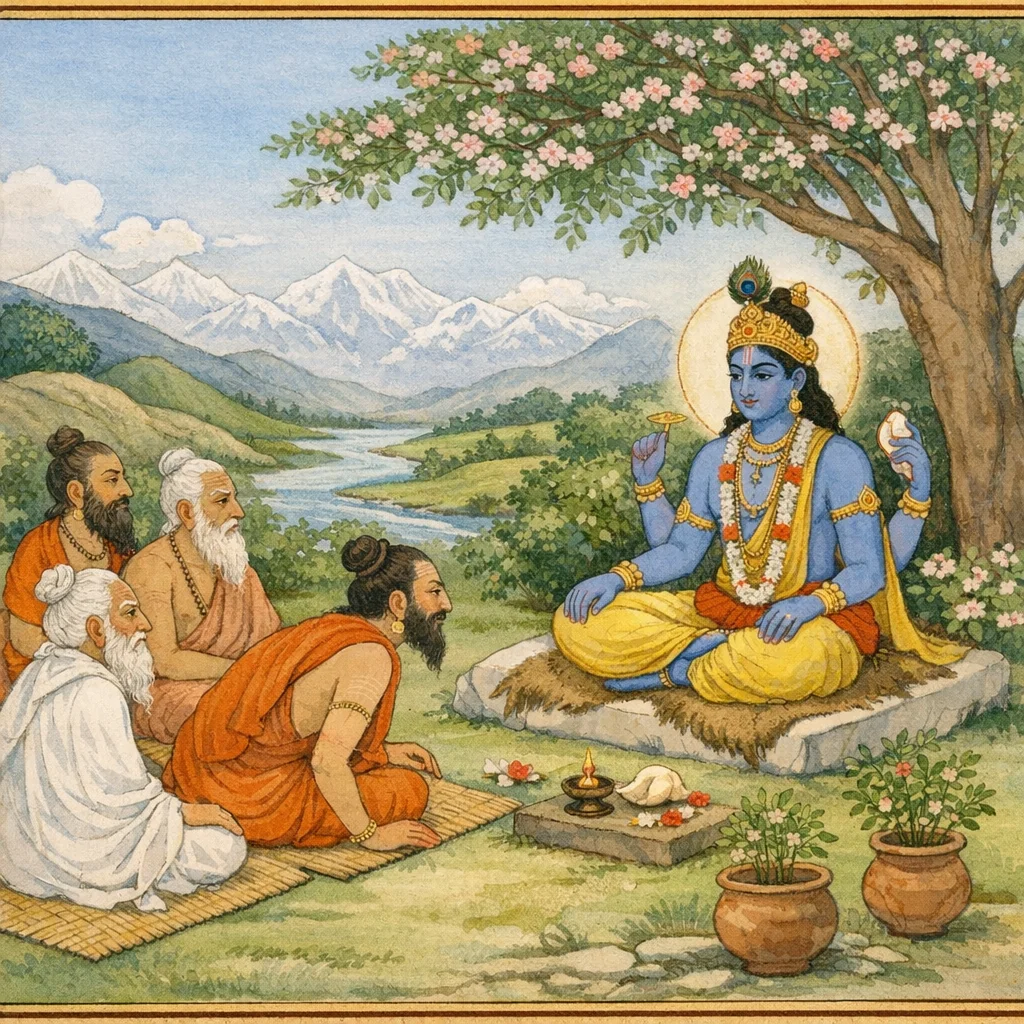
Adhyaya 18
Brahmā’s Puṣkara Sacrifice and the Manifestation of Sarasvatī (with Tīrtha-Merit Teachings)
PP.1.18 begins with Bhīṣma’s amazement at Gāyatrī’s consecration, and Pulastya recounts Brahmā’s primordial Puṣkara yajña in the Kṛta-yuga. A vast divine gathering—sages, Ādityas, Rudras, Vasus, Maruts, Nāgas, Gandharvas, and Apsarases—is catalogued, establishing Puṣkara as a cosmic theatre of sacrifice. The narration then turns to tīrtha-teachings: Sarasvatī’s fivefold, five-stream manifestation at Puṣkara (Suprabhā and other names), and the merits of bathing, dāna, and śrāddha—especially at Jyeṣṭha-Puṣkara/Jyeṣṭhakuṇḍa—along with rules for pradakṣiṇā and offerings. Interwoven are the Maṅkaṇaka episode, where Mahādeva/Rudra blesses austerity, and the mythic mission in which Sarasvatī, as Brahmā’s daughter, bears the Vaḍavāgni to the western ocean in dialogue with Gaṅgā. The chapter also plants the seed of the embedded tale “Nandā,” moving toward an ethical teaching on vows, truth, and maternal devotion.
Shlokas
Verse 1
भीष्मौवाच । अत्यद्भुतमिदं ब्रह्मन्श्रुतवानस्मि तत्त्वतः । अभिषेकं तु गायत्र्याः सदस्यत्र तथा कृतम्
Bhīṣma said: “O Brahmin, I have heard this truly as it is, in its very essence. It is exceedingly wondrous: that here, in this very assembly, the abhiṣeka—the consecratory rite—of Gāyatrī was indeed performed.”
Verse 2
विरोधं चैव सावित्र्या शापदानं तथा कृतम् । विष्णुना च यथा देवी सर्वस्थानेषु कीर्तिता
And likewise the account is told of her conflict with Sāvitrī and of how the curse was pronounced; and also how the Goddess was praised by Viṣṇu in all places.
Verse 3
गायत्री चापि रुद्रेण स्तुता च वरवर्णिनी । तं श्रुत्वा प्रतिमात्मानं विस्तरेण पितामहम्
And Gāyatrī—she of excellent complexion—was also praised by Rudra. Hearing that, the Grandfather (Brahmā), whose very self is the archetypal form, spoke at length.
Verse 4
प्रहृष्टानि च रोमाणि प्रशांतं च मनो मम । श्रुत्वा मे परमा प्रीतिः कौतूहलमथैव हि
My hairs stand on end, and my mind is serene. Hearing this, I am filled with supreme joy—and indeed, great curiosity as well.
Verse 5
नारायणस्तु भगवान्कृत्वा तां परमां च वै । ब्रह्मपत्न्याः स्तुतिं भक्त्या न्यस्यतां पर्वतोपरि
Then the Blessed Lord Nārāyaṇa, having indeed composed that supreme hymn, reverently placed the praise of Brahmā’s consort upon the mountaintop with devotion.
Verse 6
उवाच वचनं विष्णुस्तुष्टिपुष्टिप्रदायकम् । श्रीमति ह्रीमती चैव या च देवीश्वरी तथा
Viṣṇu spoke words that bestow satisfaction and nourishment, addressing Śrīmatī, Hrīmatī, and also she who is likewise the sovereign Goddess.
Verse 7
एतदेव श्रुतं ब्रह्मंस्तव वक्त्राद्विनिःसृतम् । उत्तरं तत्र यद्भूतं यच्च तस्मिन्स्थले कृतम्
“This indeed I have heard, O Brahmā, as it issued from your own mouth. Now tell me what further happened there, and what was done in that place.”
Verse 8
आनुपूर्व्या च तत्सर्वं भगवान्वक्तुमर्हति । श्रुतेन मे देहशुद्धिर्भविष्यति न संशयः
May the Blessed Lord please explain all of that in due order; by hearing it, my body will be purified—of this there is no doubt.
Verse 9
पुलस्त्य उवाच । यजतः पुष्करे तस्य देवस्य परमेष्ठिनः । शृणुराजन्निदं चित्रं पूर्वमेव यथाकृतम्
Pulastya said: “O king, hear this wondrous account—how it was accomplished in former times—when that god Parameṣṭhin (Brahmā) was performing sacrifice at Puṣkara.”
Verse 10
आदौ कृतयुगे तस्मिन्यजमाने पितामहे । मरीचिरंगिराश्चैव पुलस्त्यः पुलहः क्रतुः
In the beginning, in that Kṛta Yuga, when the Grandsire (Brahmā) was performing the sacrifice, Marīci and Aṅgiras were present, as well as Pulastya, Pulaha, and Kratu.
Verse 11
दक्षः प्रजापतिश्चैव नमस्कारं प्रचक्रिरे । विद्योतमानाः पुरुषाः सर्वाभरणभूषिताः
Dakṣa and the Prajāpati likewise offered their reverential salutations. The men, radiant and shining, were adorned with every kind of ornament.
Verse 12
उपनृत्यंति देवेशं विष्णुमप्सरसां गणाः । ततो गंधर्वतूर्यैस्तु प्रतिनंद्य विहायसि
Hosts of Apsarases dance before Viṣṇu, the Lord of the gods; then, in the sky, they acclaim him, accompanied by the musical instruments of the Gandharvas.
Verse 13
बहुभिः सह गंधर्वैः प्रगायति च तुंबरुः । महाश्रुतिश्चित्रसेन ऊर्णायुरनघस्तथा
Along with many Gandharvas, Tumburu sings forth; and present as well are Mahāśruti, Citraseṇa, Ūrṇāyu, and the sinless Anagha.
Verse 14
गोमायुस्सूर्यवर्चाश्च सोमवर्चाश्च कौरव । युगपच्च तृणायुश्च नंदिश्चित्ररथस्तथा
O Kaurava, there were also Gomāyu, Sūryavarcā, and Somavarcā; likewise Yugapat, Tṛṇāyu, Nandi, and also Citraratha.
Verse 15
त्रयोदशः शालिशिराः पर्जन्यश्च चतुर्दशः । कलिः पंचदशश्चात्र तारकश्चात्र षोडशः
Here, the thirteenth is Śāliśira; the fourteenth is Parjanya; the fifteenth here is Kali; and the sixteenth here is Tāraka.
Verse 16
हाहाहूहूश्च गंधर्वो हंसश्चैव महाद्युतिः । इत्येते देवगंधर्वा उपगायंति ते विभुम्
The Gandharva Hāhāhūhū, and Haṁsa as well—of great splendor—thus these divine Gandharvas sing in praise of that Supreme Lord.
Verse 17
तथैवाप्सरसो दिव्या उपनृत्यंति तं विभुं । धातार्यमा च सविता वरुणोंशो भगस्तथा
Likewise, the divine Apsarases danced in attendance upon that mighty Lord; and Dhātā, Aryamā, Savitṛ, Varuṇa, Aṃśa, and Bhaga also honored him.
Verse 18
इंद्रो विवस्वान्पूषा च त्वष्टा पर्जन्य एव च । इत्येते द्वादशादित्या ज्वलंतो दीप्ततेजसः
Indra, Vivasvān (the Sun), Pūṣan, Tvāṣṭṛ, and Parjanya as well—these are among the twelve Ādityas, blazing with radiant splendor.
Verse 19
चक्रुरस्मिन्सुरेशाश्च नमस्कारं पितामहे । मृगव्याधश्च शर्वश्च निरृतिश्च महायशाः
Thereupon the lords of the gods offered their obeisance to Pitāmaha (Brahmā). And Mṛgavyādha, Śarva, and the illustrious Nirṛti also paid homage.
Verse 20
अजैकपादहिर्बुध्न्यः पिनाकी चापराजितः । भवो विश्वेश्वरश्चैव कपर्दी च विशांपते
O lord of the people, he is Ajaikapād and Ahirbudhnya; the wielder of Pināka; the unconquered; Bhava; Viśveśvara, Lord of all; and Kapardī as well.
Verse 21
स्थाणुर्भगश्च भगवान्रुद्रास्तत्रावतस्थिरे । अश्विनौ वसवश्चाष्टौ मरुतश्च महाबलाः
There, Sthāṇu, Bhaga, and the venerable Rudras took their positions. The two Aśvins, the eight Vasus, and the mighty Maruts also stood present.
Verse 22
विश्वेदेवाश्च साध्याश्च तस्मै प्रांजलयः स्थिताः । शेषाद्यास्तु महानागा वासुकिप्रमुखाहयः
The Viśvedevas and the Sādhyas stood before him with hands folded in reverence; and the great Nāgas too—beginning with Śeṣa—along with the serpents headed by Vāsuki.
Verse 23
काश्यपः कंबलश्चापि तक्षकश्च महाबलः । एते नागा महात्मानस्तस्मै प्रांजलयः स्थिताः
Kāśyapa, Kambala, and Takṣaka of great strength—these noble Nāgas stood before him with hands joined in reverence.
Verse 24
तार्क्ष्यश्चारिष्टनेमिश्च गरुडश्च महाबलः । वारुणिश्चैवारुणिश्च वैनतेया व्यवस्थिताः
Tārkṣya, Ariṣṭanemi, and Garuḍa the mighty, and also Vāruṇi and Aruṇi—these Vainateyas stood stationed, poised in readiness.
Verse 25
नारायणश्च भगवान्स्वयमागत्य लोकवान् । प्राह लोकगुरुं श्रीमान्सहसर्वैर्महर्षिभिः
Then Nārāyaṇa—the Blessed Lord—came there in person, the renowned One; and the glorious Lord addressed the Teacher of the worlds in the presence of all the great sages.
Verse 26
त्वया ततमिदं सर्वं त्वया सृष्टं जगत्पते । तस्माल्लोकेश्वरश्चासि पद्मयोने नमोस्तु ते
By you all this is pervaded; by you the universe has been created, O Lord of the world. Therefore you are indeed the Lord of the worlds. O lotus-born One, salutations to you.
Verse 27
यदत्र ते मया कार्यं कर्तव्यं च तदादिश । एवं प्रोवाच भगवान्सार्धं देवर्षिभिः प्रभुः
“Whatever task here is to be done by me for you—whatever duty is to be performed—please command it.” Thus spoke the Blessed Lord, the Master, together with the divine sages.
Verse 28
नमस्कृत्य सुरेशाय ब्रह्मणेऽव्यक्तजन्मने । स च तत्रस्थितो ब्रह्मा तेजसा भासयन्दिशः
Having bowed to the Lord of the gods—Brahmā, whose birth is unmanifest—Brahmā remained stationed there, illuminating the directions with his radiance.
Verse 29
श्रीवत्सलोमसंच्छन्नो हेमसूत्रेण राजता । सुरर्षिप्रतिमः श्रीमान्स्वयंभूर्भूतभावनः
Marked with the sacred Śrīvatsa and shining with a golden thread, he appeared like a divine ṛṣi—radiant, self-born, and the nurturer of all beings.
Verse 30
शुचिरोमा महावक्षाः सर्वतेजोमयः प्रभुः । यो गतिः पुण्यशीलानामगतिः पापकर्मणां
The Lord—pure-haired, broad-chested, and filled with all splendor—is the refuge of the virtuous; for those who commit sinful deeds, there is no refuge.
Verse 31
योगसिद्धा महात्मानो यं विदुर्लोकमुत्तमं । यस्याष्टगुणमैश्वर्यं यमाहुर्देवसत्तमम्
The great souls perfected in yoga know Him as the highest realm; He whose lordly power is eightfold is proclaimed the best among the devas.
Verse 32
यं प्राप्य शाश्वतं विप्रा नियता मोक्षकांक्षिणः । जन्मनो मरणाच्चैव मुच्यंते योगभाविताः
Having attained Him—the Eternal—O brāhmaṇas, the disciplined seekers of mokṣa, matured through yoga, are freed from both birth and death.
Verse 33
यदेतत्तप इत्याहुः सर्वाश्रमनिवासिनः । सेवंसेवं यताहारा दुश्चरं व्रतमास्थिताः
This indeed is what all who dwell in every āśrama call ‘tapas’ (austerity): living with restrained diet, serving again and again, and undertaking a difficult vow.
Verse 34
योनंत इति नागेषु प्रोच्यते सर्वयोगिभिः । सहस्रमूर्द्धा रक्ताक्षः शेषादिभिरनुत्तमैः
Among the Nāgas, all yogins proclaim him as “Yonanta”; thousand-headed and red-eyed, he is the Supreme—foremost among Śeṣa and the other exalted serpents.
Verse 35
यो यज्ञ इति विप्रेंद्रैरिज्यते स्वर्गलिप्सुभिः । नानास्थानगतिः श्रीमानेकः कविरनुत्तमः
He whom the foremost brāhmaṇas—yearning for heaven—worship as “Yajña” (the Sacrifice) is the one illustrious, unsurpassed Sage, who moves through many abodes and states of being.
Verse 36
यं देवं वेत्ति वेत्तारं यज्ञभागप्रदायिनं । वृषाग्निसूर्यचंद्राक्षं देवमाकाशविग्रहं
Whoever truly knows that God—the all-knowing Knower, the bestower of sacrificial shares—whose eyes are the Bull, Fire, the Sun, and the Moon, that deity whose very form is like the sky, all-pervading.
Verse 37
तं प्रपद्यामहे देवं भगवन्शरणार्थिनः । शरण्यं शरणं देवं सर्वदेवभवोद्भवं
Seeking refuge in the Blessed Lord, we take shelter in that God—the refuge of all—Him who is the shelter itself, and from whom the existence of all the gods arises.
Verse 38
ऋषीणां चैव स्रष्टारं लोकानां च सुरेश्वरं । प्रियार्थं चैव देवानां सर्वस्य जगतः स्थितौ
He is the creator of the sages and the lord of the worlds, the sovereign of the devas—established for the dear purpose of the devas and for the steady maintenance of the entire universe.
Verse 39
कव्यं पितॄणामुचितं सुराणां हव्यमुत्तमं । येन प्रवर्तितं सर् तं नतास्मस्सुरोत्तमं
The kavya offering proper to the Pitṛs and the supreme havya oblation for the gods—he by whom all this was set in motion: to that best of the gods we bow.
Verse 40
त्रेताग्निना तु यजता देवेन परमेष्ठिना । यथासृष्टिः कृता पूर्वं यज्ञसृष्टिस्तथा पुनः
But when the god Parameṣṭhin (Brahmā) performed sacrifice with the three sacred fires, then—just as creation had been made before—so again a creation arose through the sacrifice.
Verse 41
तथा ब्रह्माप्यनंतेन लोकानां स्थितिकारिणा । अन्वास्यमानो भगवान्वृद्धोप्यथ च बुद्धिमान्
So too Brahmā—though aged, yet wise—was attended upon by Ananta, the divine sustainer of the worlds’ stability.
Verse 42
यज्ञवाटमचिंत्यात्मा गतस्तत्र पितामहः । धनाढ्यैरृत्विजैः पूर्णं सदस्यैः परिपालितम्
Then Pitāmaha (Brahmā), whose nature is inconceivable, went to that sacrificial enclosure, filled with wealthy officiating priests (ṛtvij) and carefully maintained by the assembled members of the ritual council.
Verse 43
गृहीतचापेन तदा विष्णुना प्रभविष्णुना । दैत्यदानवराजानो राक्षसानां गणाः स्थिताः
Then, when Viṣṇu—the mighty, all-powerful one—had taken up his bow, the kings of the Daityas and Dānavas, along with the bands of Rākṣasas, stood ready for battle.
Verse 44
आत्मानमात्मना चैव चिंतयामास वै द्रुतं । चिंतयित्वा यथातत्वं यज्ञं यज्ञः सनातनः
Then the Eternal Yajña—the Lord, embodiment of sacrifice—swiftly contemplated Himself by His own Self; and, reflecting according to true reality, He conceived the yajña in its essential nature.
Verse 45
वरणं तत्र भगवान्कारयामास ऋत्विजाम् । भृग्वाद्या ऋत्विजश्चापि यज्ञकर्मविचक्षणाः
There the Lord arranged the selection of the officiating priests—Bhrigu and others—priests skilled and discerning in the rites and works of yajña.
Verse 46
चक्रुर्बह्वृचमुख्यैश्च प्रोक्तं पुण्यं यदक्षरं । शुश्रुवुस्ते मुनिश्रेष्ठा वितते तत्र कर्मणि
They performed the rite, and the foremost among the Bahvṛc priests recited the sacred, meritorious syllables; the best of sages listened as the ritual action unfolded there in full.
Verse 47
यज्ञविद्या वेदविद्या पदक्रमविदां तथा । घोषेण परमर्षीणां सा बभूव निनादिना
She became the sacred knowledge of yajña, the knowledge of the Vedas, and also the skill of those who know the word-by-word and sequential recitation—resounding with the mighty, reverberating chant of the supreme sages.
Verse 48
यज्ञसंस्तरविद्भिश्च शिक्षाविद्भिस्तथा द्विजैः । शब्दनिर्वचनार्थज्ञैः सर्वविद्याविशारदैः
—by those who know the proper arrangements of yajña, by the twice-born Brāhmaṇa scholars skilled in śikṣā (phonetics), by experts in the derivations and meanings of words, and by those proficient in every branch of learning.
Verse 49
मीमांसा हेतुवाक्यज्ञैः कृता नानाविधा मुखे । तत्र तत्र च राजेंद्र नियतान्संशितव्रतान्
O king, the debates of Mīmāṁsā—manifold in their forms—are fashioned by those skilled in reasoning and in argumentative utterance; and in many places are found disciplined men, steadfast in their vows, observing prescribed observances.
Verse 50
जपहोमपरान्मुख्यान्ददृशुस्तत्रवै द्विजान् । यज्ञभूमौ स्थितस्तस्यां ब्रह्मा लोकपितामहः
There indeed they beheld the foremost of the twice-born, the brāhmaṇas, intent upon japa and offerings into the sacred fire; and upon that sacrificial ground stood Brahmā, Pitāmaha, grandsire and father of the worlds.
Verse 51
सुरासुरगुरुः श्रीमान्सेव्यमानः सुरासुरैः । उपासते च तत्रैनं प्रजानां पतयः प्रभुं
There the illustrious Lord—teacher of both devas and asuras—served and honoured by devas and asuras alike, is worshipped; and the lords of all creatures also revere that sovereign Master.
Verse 52
दक्षो वसिष्ठः पुलहो मरीचिश्च द्विजोत्तमः । अंगिरा भृगुरत्रिश्च गौतमो नारदस्तथा
O best of the twice-born, there were Dakṣa, Vasiṣṭha, Pulaha, and Marīci; also Aṅgiras, Bhṛgu, Atri, Gautama, and likewise Nārada.
Verse 53
विद्यामानमंतरिक्षं वायुस्तेजो जलं मही । शब्दः स्पर्शश्च रूपं च रसो गंधस्तथैव च
There are knowledge and the intermediate space (ākāśa), air, fire, water, and earth; and likewise sound, touch, form, taste, and smell.
Verse 54
विकृतश्च विकारश्च यच्चान्यत्कारणं महत् । ऋग्यजुः सामाथर्वाख्या वेदाश्चत्वार एव च
The manifested form and its transformations, and whatever else is the great causal principle—so too the Vedas are four alone, known as the Ṛg, Yajus, Sāma, and Atharva.
Verse 55
शब्दः शिक्षा निरुक्तं च कल्पश्च्छंदः समन्विताः । आयुर्वेद धनुर्वेदौ मीमांसा गणितं तथा
Included are śabda (grammar), śikṣā (phonetics), nirukta (etymology), kalpa (ritual procedure), and chandas (metre); likewise Ayurveda, Dhanurveda, Mīmāṃsā, and also mathematics.
Verse 56
हस्त्यश्वज्ञानसहिता इतिहाससमन्विताः । एतैरंगैरुपांगैश्च वेदाः सर्वे विभूषिताः
Together with the knowledge of elephants and horses, and accompanied by the Itihāsas (traditional histories), all the Vedas are adorned by these limbs and subsidiary limbs.
Verse 57
उपासते महात्मानं सहोंकारं पितामहं । तपश्च क्रतवश्चैव संकल्पः प्राण एव च
They worship the great-souled Pitāmaha (Brahmā), together with the sacred syllable Oṃ; and they worship austerity (tapas), sacrificial rites (kratu), resolve (saṅkalpa), and indeed the vital breath (prāṇa) as well.
Verse 58
एते चान्ये च बहवः पितामहमुपस्थिताः । अर्थो धर्मश्च कामश्च द्वेषो हर्षश्च सर्वदा
These and many others stood in attendance upon the Grandfather (Brahmā)—wealth (artha), righteousness (dharma), desire (kāma), hatred, and joy, always present.
Verse 59
शुक्रो बृहस्पतिश्चैव संवर्तो बुध एव च । शनैश्चरश्च राहुश्च ग्रहाः सर्वे तथैव च
Likewise are Śukra (Venus) and Bṛhaspati (Jupiter), Saṃvarta and Budha (Mercury), and also Śanaiścara (Saturn) and Rāhu—indeed all the grahas, the celestial influencers, as well.
Verse 60
मरुतो विश्वकर्मा च पितरश्चापि भारत । दिवाकरश्च सोमश्च ब्रह्माणं पर्युपासते
O Bhārata, the Maruts, Viśvakarmā, and the Pitṛs, as well as the Sun and the Moon, all worship Brahmā with reverent devotion.
Verse 61
गायत्री दुर्गतरणी वाणी सप्तविधा तथा । अक्षराणि च सर्वाणि नक्षत्राणि तथैव च
Gāyatrī, she who helps one cross over hardships; Vāṇī, Speech in its sevenfold form; all the letters; and likewise all the nakṣatras, the lunar constellations.
Verse 62
भाष्याणि सर्वशास्त्राणि देहवंति विशांपते । क्षणा लवा मुहूर्ताश्च दिनं रात्रिस्तथैव च
O lord of men, there are bhāṣyas (commentaries) and all the śāstras; there are also embodied beings; and likewise the measures of time—moments, instants, muhūrtas—as well as day and night.
Verse 63
अर्द्धमासाश्च मासाश्च क्रतवः सर्व एव च । उपासते महात्मानं ब्रह्माणं दैवतैः सह
The fortnights and the months, and indeed all the kratus, the sacrificial rites, worship the great-souled Brahmā together with the gods.
Verse 64
अन्याश्च देव्यः प्रवरा ह्रीः कीर्तिर्द्युतिरेव च । प्रभा धृतिः क्षमा भूतिर्नीतिर्विद्या मतिस्तथा
And there were other most excellent goddesses as well: Hrī (Modesty), Kīrti (Fame), and Dyuti (Splendour); Prabhā (Radiance), Dhṛti (Steadfastness), Kṣamā (Forbearance), Bhūti (Prosperity); Nīti (Right Conduct), Vidyā (Knowledge), and likewise Mati (Intellect).
Verse 65
श्रुतिः स्मृतिस्तथा क्षांतिः शांतिः पुष्टिस्तथा क्रिया । सर्वाश्चाप्सरसो दिव्या नृत्यगीतविशारदाः
There were also Śruti and Smṛti, and likewise Kṣānti (Forbearance), Śānti (Peace), Puṣṭi (Nourishment), and Kriyā (Sacred Activity). And all the celestial Apsarases—divine nymphs—were skilled in dance and song.
Verse 66
उपतिष्ठंति ब्रह्माणं सर्वास्ता देवमातरः । विप्रचित्तिः शिविः शंकुरयःशंकुस्तथैव च
Then all those divine Mothers of the gods attended upon Brahmā; and there came also Vipracitti, Śivi, Śaṅku, and likewise Ayaḥśaṅku.
Verse 67
वेगवान्केतुमानुग्रः सोग्रो व्यग्रो महासुरः । परिघः पुष्करश्चैव सांबोश्वपतिरेव च
There came Vegavān, Ketumān, Ugra, Sogra, Vyagra, and the great Asura Mahāsura; Parigha, and also Puṣkara, as well as Sāmbha and Aśvapati.
Verse 68
प्रह्लादोथ बलि कुंभः संह्रादो गगनप्रियः । अनुह्रादो हरिहरौ वराहश्च कुशो रजः
Also present were Prahlāda, Bali, Kumbha, Saṃhrāda, and Gaganapriya; likewise Anuhrāda, Hari and Hara, Varāha, Kuśa, and Raja.
Verse 69
योनिभक्षो वृषपर्वा लिंगभक्षोथ वै कुरुः । निःप्रभः सप्रभः श्रीमांस्तथैव च निरूदरः
One becomes a devourer of the womb; another, a bull with knotted joints; and another, a devourer of the liṅga—thus indeed, O Kuru. One becomes lustreless, another lustrous and prosperous; and likewise another becomes without a belly.
Verse 70
एकचक्रो महाचक्रो द्विचक्रः कुलसंभवः । शरभः शलभश्चैव क्रपथः क्रापथः क्रथः
Ekacakra, Mahācakra, Dvicakra, Kulasaṃbhava; Śarabha and Śalabha; and also Krapatha, Krāpatha, and Kratha.
Verse 71
बृहद्वांतिर्महाजिह्वः शंकुकर्णो महाध्वनिः । दीर्घजिह्वोर्कनयनो मृडकायो मृडप्रियः
He is broad-waisted, great-tongued, conch-eared, and thunderous in sound; long-tongued, sun-eyed, with a gentle body, and dear to Mṛḍa (Śiva).
Verse 72
वायुर्गरिष्ठो नमुचिश्शम्बरो विज्वरो विभुः । विष्वक्सेनश्चंद्रहर्ता क्रोधवर्द्धन एव च
Vāyu, Gariṣṭha, Namuci, Śambara, Vijvara, Vibhu, Viṣvaksena, Candraharta, and also Krodhavardhana.
Verse 73
कालकः कलकांतश्च कुंडदः समरप्रियः । गरिष्ठश्च वरिष्ठश्च प्रलंबो नरकः पृथुः
Kālaka; Kalakānta; Kuṇḍada; the lover of battle; the most weighty; the most excellent; Pralamba; Naraka; and Pṛthu.
Verse 74
इंद्रतापन वातापी केतुमान्बलदर्पितः । असिलोमा सुलोमा च बाष्कलि प्रमदो मदः
Indratāpana, Vātāpī, Ketumān, Baladarpita, Asilomā, Sulomā, Bāṣkali, Pramada, and Mada—these are the names that were mentioned.
Verse 75
सृगालवदनश्चैव केशी च शरदस्तथा । एकाक्षश्चैव राहुश्च वृत्रः क्रोधविमोक्षणः
And there were also Sṛgālavadana, Keśī, and likewise Śarada; as well as Ekākṣa, Rāhu, Vṛtra, and Krodha-vimokṣaṇa.
Verse 76
एते चान्ये च बहवो दानवा बलवर्द्धनाः । ब्रह्माणं पर्युपासंत वाक्यं चेदमथोचिरे
These and many other Dānavas, grown strong in power, stood attending upon Brahmā; and then they spoke these words.
Verse 77
त्वया सृष्टाः स्म भगवंस्त्रैलोक्यं भवता हि नः । दत्तं सुरवरश्रेष्ठ देवेभ्यधिकाः कृताः
O Blessed Lord, we have been created by you; indeed, by you this threefold world has been granted to us. O best of the gods, you have made us superior even to the devas.
Verse 78
भगवन्निह किं कुर्मो यज्ञे तव पितामह । यद्धितं तद्वदास्माकं समर्थाः कार्यनिर्णये
O Lord, what should we do here in this sacrifice (yajña), O Grandfather (Pitāmaha)? Tell us what is beneficial; we are capable of carrying out the decision in this matter.
Verse 79
किमेभिस्ते वराकैश्च अदितेर्गर्भसंभवैः । दैवतैर्निहतैः सर्वैः पराभूतैश्च सर्वदा
What use are these wretched sons of yours, born from Aditi’s womb—gods who have all been slain and who are ever defeated?
Verse 80
पितामहोसि सर्वेषामस्माकं दैवतैः सह । तव यज्ञसमाप्तौ च पुनरस्मासु दैवतैः
You are the grandsire of us all, together with the gods. And when your sacrifice is concluded, then return again to us along with the deities.
Verse 81
श्रियं प्रति विरोधश्च भविष्यति न संशयः । इदानीं प्रेक्षणं कुर्मः सहिताः सर्वदानवैः
There will surely be opposition toward Śrī (Fortune and Prosperity)—of this there is no doubt. Now let us go and witness it, together with all the Dānavas.
Verse 82
पुलस्त्य उवाच । सगर्वं तु वचस्तेषां श्रुत्वा देवो जनार्दनः । शक्रेण सहितः शंभुमिदमाह महायशाः
Pulastya said: Hearing their proud words, the divine Janārdana—glorious and renowned—together with Śakra (Indra), spoke the following to Śambhu (Śiva).
Verse 83
विघ्नं प्रकर्तुं वै रुद्र आयाता दनुपुंगवाः । ब्रह्मणामंत्रिताश्चेह विघ्नार्थं प्रयतंति ते
Indeed, the foremost of the Dānavas came there to create an obstacle—summoned by Rudra; and, invited by Brahmā in this matter, they strive here for the purpose of causing hindrance.
Verse 84
अस्माभिस्तु क्षमाकार्या यावद्यज्ञः समाप्यते । समाप्ते तु क्रतावस्मिन्युद्धं कार्यं दिवौकसां
We must forbear until the sacred yajña is completed. But when this rite is concluded, the gods must enter into battle.
Verse 85
यथानिर्दानवा भूमिस्तथा कार्यं त्वया विभो । जयार्थं चेह शक्रस्य भवता च मया सह
Just as the earth has been freed of the Dānavas, so must you, O mighty one, carry out this task here—together with me—for Śakra’s victory.
Verse 86
द्विजानां परिवेष्टारो मरुतः परिकल्पिताः । दानवानां धनं यच्च गृहीत्वा तद्यजामहे
The Maruts have been appointed as attendants to serve the twice-born. And whatever wealth of the Dānavas we have seized—using that, we perform this sacrifice.
Verse 87
अत्रागतेषु विप्रेषु दुःखितेषु जनेष्विह । व्ययं तस्य करिष्यामो दासभावे निवेशिताः
When the brāhmaṇas and the distressed people come here, we—abiding in the spirit of servants—shall bear the expense for them.
Verse 88
वदंतमेवं तं विष्णुं ब्रह्मा वचनमब्रवीत् । एते दनुसुताः क्रुद्धा युष्माकं कोपनेप्सिताः
As Viṣṇu spoke thus, Brahmā addressed him: “These sons of Danu have grown wrathful, and they seek to provoke your anger.”
Verse 89
भवता च क्षमा कार्या रुद्रेण सह दैवतैः । कृते युगावसाने तु समाप्तिं चक्रतौ गते
You too should grant forgiveness, together with Rudra and the other deities, when the Kṛta Yuga reaches its end and the cycle comes to its completion.
Verse 90
मया च प्रेषिता यूयमेते च दनुपुंगवाः । संधिर्वा विग्रहो वापि सर्वैः कार्यस्तदैव हि
You have been sent forth by me, and these foremost among the Dānavas as well; therefore all of you must at once bring about either a treaty or a war.
Verse 91
पुलस्त्य उवाच । पुनस्तान्दानवान्ब्रह्मा वाक्यमाह स्वयंप्रभुः । दानवैर्न विरोधोत्र यज्ञे मम कथंचन
Pulastya said: Then the self-born Lord Brahmā again addressed those Dānavas, saying, “Let there be no conflict here with the Dānavas in my sacrifice (yajña)—under any circumstances.”
Verse 92
मैत्रभावस्थिता यूयमस्मत्कार्ये च नित्यशः । दानवा ऊचुः । सर्वमेतत्करिष्यामः शासनं ते पितामह
Abide in a spirit of friendship and be ever engaged in our work. The Dānavas said: “We shall do all this—such is your command, O Pitāmaha (Grandsire).”
Verse 93
अस्माकमनुजा देवा भयं तेषां न विद्यते । पुलस्त्य उवाच । एतच्छुत्वा तदा तेषां परितुष्टः पितामहः
“The gods are our younger brothers; therefore they have no fear.” Pulastya said: Hearing this, the Pitāmaha (Brahmā) was then pleased with them.
Verse 94
मुहूर्तं तिष्ठतां तेषामृषिकोटिरुपागता । श्रुत्वा पैतामहं यज्ञं तेषां पूजां तु केशवः
While they stayed there for a brief while, a crore of sages arrived. Hearing of that primordial sacrifice belonging to Pitāmaha (Brahmā), Keśava (Viṣṇu) also came there to receive their worship.
Verse 95
आसनानि ददौ तेषां तदा देवः पिनाकधृत् । वसिष्ठोर्घं ददौ तेषां ब्रह्मणा परिचोदितः
Then the Lord, bearer of Pināka (Śiva), offered them seats; and Vasiṣṭha, urged by Brahmā, presented them with arghya, the sacred offering of welcome.
Verse 96
गामर्घं च ततो दत्वा पृष्ट्वा कुशलमव्ययम् । निवेशं पुष्करे दत्वा स्थीयतामिति चाब्रवीत्
Then, after offering a respectful gift and inquiring about their unfailing welfare, he arranged lodging for them at Puṣkara and said, “Stay here.”
Verse 97
ततस्ते ऋषयः सर्वे जटाजिनधरास्तथा । शोभयंतः सरःश्रेष्ठं गङ्गामिव दिवौकसः
Then all those sages—wearing matted locks and garments of bark and skin—adorned that excellent lake, just as the dwellers of heaven adorn the Gaṅgā.
Verse 98
मुंडाः काषायिणश्चैके दीर्घश्मश्रुधराः परे । विरलैर्दशनैः केचिच्चिपिटाक्षास्तथा परे
Some were shaven-headed, and some wore ochre robes (kaṣāya). Others bore long beards; some had sparse teeth, and others had sunken eyes.
Verse 99
बृहत्तनूदराः केपि केकराक्षास्तथापरे । दीर्घकर्णा विकर्णाश्च कर्णैश्च त्रुटितास्तथा
Some had vast bodies and swollen bellies; others had squinting or misshapen eyes. Some had long ears, some had deformed ears, and some had ears torn or broken.
Verse 100
दीर्घफाला विफालाश्च स्नायुचर्मावगुंठिताः । निर्गतं चोदरं तेषां मुनीनां भावितात्मनां
Some bore long ploughshare-like blades, while others had none; they were wrapped in sinews and skin, and the bellies of those self-controlled munis protruded outward.
Verse 101
दृष्ट्वा तु पुष्करं तीर्थं दीप्यमानं समंततः । तीर्थलोभान्नरव्याघ्र तस्य तीरे व्यवस्थिताः
But on beholding the sacred tīrtha of Puṣkara, shining on every side, those men—O tiger among men—out of longing for holy places, took their stand upon its bank.
Verse 102
वालखिल्या महात्मानो ह्यश्मकुट्टास्तथापरे । दंतोलूखलिनश्चान्ये संप्रक्षालास्तथापरे
There are the great-souled Vālakhilyas; others are called Aśmakuṭṭas. Some are known as Dantolūkhalins, and still others as Saṃprakṣālas.
Verse 103
वायुभक्षा जलाहाराः पर्णाहारास्तथापरे । नाना नियमयुक्ताश्च तथा स्थंडिलशायिनः
Some live by ‘feeding on air’, others subsist on water, and still others eat only leaves. Some observe many disciplines and vows, and likewise some sleep upon the bare ground.
Verse 104
सरस्यस्मिन्मुखं दृष्ट्वा सुरूपास्याः क्षणादभुः । किमेतदिति चिंत्याथ निरीक्ष्य च परस्परम्
Seeing, in that lake, the face of the beautiful woman, they were instantly bewildered. Thinking, “What is this?”, they then looked at one another in astonishment.
Verse 105
अस्मिंस्तीर्थे दर्शनेन मुखस्येह सुरूपता । मुखदर्शनमित्येव नाम कृत्वा तु तापसाः
At this sacred ford, merely by beholding the face here, one’s own face becomes beautiful in this very world. Therefore the ascetics gave it the name “Mukhadarśana” (the Vision of the Face).
Verse 106
स्नाता नियमयुक्ताश्च सुरूपास्ते तदाभवन् । देवपुत्रोपमा जाता अनौपम्य गुणान्विताः
Having bathed and become established in disciplined observances, they then became beautiful in form—like the sons of the gods—endowed with incomparable virtues.
Verse 107
शोभमाना नरश्रेष्ठ स्थिताः सर्वे वनौकसः । यज्ञोपवीतमात्रेण व्यभजंस्तीर्थमंजसा
O best of men, all the forest-dwelling sages stood resplendent, and by the mere act of wearing the sacred thread they readily distinguished the sacred ford (tīrtha).
Verse 108
जुह्वतश्चाग्निहोत्राणि चक्रुश्च विविधाः क्रियाः । चिंतयंतो हि राजेंद्र तपसा दग्धकिल्बिषाः
They offered oblations in the sacred fires and performed various rites; and, O king of kings, they remained contemplative—having had their sins burnt away by austerity (tapas).
Verse 109
न यास्यामो परं तीर्थं ज्येष्ठभावेत्विदं सरः । ज्येष्ठपुष्करमित्येव नाम चक्रुर्द्विजातयः
“We shall not go to any other sacred ford; in its supreme preeminence this lake is foremost.” Thus the twice-born (brāhmaṇas) bestowed upon it the name ‘Jyeṣṭha-Puṣkara’—the Eldest and Foremost Puṣkara.
Verse 110
तत्र कुब्जान्बहून्दृष्ट्वा स्थितांस्तीर्थसमीपतः । बभूवुर्विस्मितास्तत्र जना ये च समागताः
There, seeing many hunchbacked people standing near the sacred ford (tīrtha), all the people who had gathered were filled with astonishment.
Verse 111
दत्वा दानं द्विजातिभ्यो भांडानि विविधानि च । श्रुत्वा सरस्वतीं प्राचीं स्नातुकामा द्विजागताः
Having given gifts to the twice-born, along with vessels of many kinds, and having heard of the Sarasvatī flowing eastward, the brāhmaṇas—desiring sacred bathing—came there.
Verse 112
सरस्वतीतीर्थवरा नानाद्विजगणैर्युता । बदरेंगुदकाश्मर्य प्लक्षाश्वत्थविभीतकैः
That excellent sacred ford of the Sarasvatī, frequented by multitudes of twice-born sages, is adorned with badara, iṅgudaka, kāśmarya, plakṣa, aśvattha, and vibhītaka trees.
Verse 113
पौलोमैश्च पलाशैश्च करीरैः पीलुभिस्तथा । सरस्वतीतीर्थरुहैर्धन्वनैः स्यंदनैस्तथा
And it is graced with pauloma trees and palāśa trees, with karīra shrubs and also pīlu trees; likewise with the wild growth that rises around the Sarasvatī’s sacred fords, and with arid tracts and syaṃdana trees as well.
Verse 114
कपित्थैः करवीरैश्च बिल्वैराम्लातकैस्तथा । अतिमुक्तकपंडैश्च पारिजातैश्च शोभिता
It was adorned with kapittha (wood-apple) trees, karavīra (oleander), bilva and āmlātaka trees; also with atimuktaka vines and clusters, and with pārijāta trees.
Verse 115
कदंबवनभूयिष्ठा सर्वसत्वमनोरमा । वाय्वंबुफलपर्णादैर्दंतोलूखलिकैरपि
Abounding in kadamba groves, delightful to all creatures, it was furnished even with tooth-cleaning twigs and small mortars made from things such as wind, water, fruits, and leaves.
Verse 116
तथाश्मकुट्टमुख्यैश्च वरिष्ठैर्मुनिभिर्वृता । स्वाध्यायघोषसंघुष्टा मृगयूथशताकुला
Likewise, it was surrounded by the foremost sages—chief among them Aśmakuṭṭa—and resounded with the sound of Vedic recitation, while teeming with hundreds of herds of deer.
Verse 117
अहिंसैर्धर्मपरमैस्तथा चातीव शोभिता । सुप्रभा कांचनाख्या च प्राची नंदा विशालका
Adorned with ahiṃsā (non-violence) and with Dharma held as supreme, it is exceedingly resplendent—known as Suprabhā, also called Kāñcanā; and (other regions named) Prācī, Nandā, and Viśālakā.
Verse 118
स्रोतोभिः पंचभिस्तत्र वर्तते पुष्करे नदी । पितामहस्य सदसि वर्त्तमाने महीतले
There, at Puṣkara, the river flows in five streams upon the earth’s surface, in the assembly of the Grandfather (Pitāmaha), Brahmā.
Verse 119
वितते यज्ञवाटे तु स्वागतेषु द्विजादिषु । पुण्याहघोषैर्विततैर्देवानां नियमैस्तथा
When the sacrificial enclosure was fully spread out and prepared, and the brāhmaṇas and other honored guests had been duly welcomed, while auspicious benedictory cries resounded and the prescribed observances for the devas were properly performed—
Verse 120
देवेषु चैव व्यग्रेषु तस्मिन्यज्ञविधौ तथा । तत्र चैव महाराज दीक्षिते च पितामहे
And when the devas were stirred with agitation and that sacrificial rite was proceeding, then there—O great king—Pitāmaha (Brahmā) too was undergoing dīkṣā, the sacred consecration.
Verse 121
यजतस्तस्य सत्रेण सर्वकामसमृद्धिना । मनसा चिंतिता ह्यर्था धर्मार्थकुशलास्तथा
As he performed that satra, endowed with the fulfillment of every desired aim, whatever he merely contemplated in his mind was truly obtained—together with skill and success in matters of dharma and artha.
Verse 122
उपतिष्ठंति राजेंद्र द्विजातींस्तत्र तत्र ह । जगुश्च देवगंधर्वा ननृतुश्चाप्सरोगणाः
O king of kings, the dvijas—the twice-born—were respectfully attended here and there; the divine Gandharvas sang, and hosts of Apsarases danced.
Verse 123
वादित्राणि च दिव्यानि वादयामासुरंजसा । तस्य यज्ञस्य संपत्या तुतुषुदेर्वता अपि
And effortlessly they played the divine musical instruments. By the prosperity and perfect success of that sacrifice, even the devas were filled with delight.
Verse 124
विस्मयं परमं जग्मुः किमु मानुषयोनयः । वर्तमाने तथा यज्ञे पुष्करस्थे पितामहे
They were struck with the utmost astonishment—how much more so those born of human wombs—when that sacrifice (yajña) was proceeding at Puṣkara with Pitāmaha (Brahmā) present.
Verse 125
अब्रुवन्नृषयो भीष्म तदा तुष्टास्सरस्वतीम् । सुप्रभां नाम राजेंद्र नाम्ना चैव सरस्वतीम्
Then the sages, O Bhīṣma, being pleased, addressed Sarasvatī: “O king, her name is Suprabhā, and she is also known by the name Sarasvatī.”
Verse 126
ते दृष्ट्वा मुनयः सर्वे वेगयुक्तां सरस्वतीम् । पितामहं भासयंतीं क्रतुं ते बहु मेनिरे
Seeing Sarasvatī rushing forward with great speed, illuminating Pitāmaha (Brahmā), all the sages thought that a great kratu—a mighty sacrificial rite—was about to be undertaken.
Verse 127
एवमेषा सरिच्छ्रेष्ठा पुष्करेषु सरस्वती । पितामहार्थं सम्भूता तुष्ट्यर्थं च मनीषिणाम्
Thus, in Puṣkara, Sarasvatī—foremost among rivers—came into being for the sake of Pitāmaha (Brahmā) and for the satisfaction of the wise.
Verse 128
पुण्यस्य पुण्यताकारि पंचस्रोतास्सरस्वती । सुप्रभा नाम राजेंन्द्र नाम्ना चैव सरस्वती
O king, there is Sarasvatī who embodies and bestows merit (puṇya), the river of five channels. She is known as Suprabhā, and she is also called Sarasvatī.
Verse 129
यत्र ते मुनयश्शान्ता नानास्वाध्यायवादिनः । ते समागत्य ऋषयस्सस्मरुर्वै सरस्वतीम्
There, those tranquil sages—reciters and expounders of diverse Vedic studies—assembled together, and the seers indeed remembered and invoked Sarasvatī.
Verse 130
साभिध्याता महाभागा ऋषिभिः सत्रयाजिभिः । समास्थिता दिशं पूर्वां भक्तिप्रीता महानदी
That great and fortunate river—revered and invoked by sages who perform sacrificial sessions (sattrayajñas)—took her station toward the eastern quarter, pleased by their devotion.
Verse 131
प्राची पूर्वावहा नाम्ना मुनिवंद्या सरस्वती । इदमन्यन्महाराज शृण्वाश्चर्यवरं भुवि
To the east flows Sarasvatī, known as Pūrvāvahā, revered by sages. Now, O great king, hear yet another account—most wondrous upon the earth.
Verse 132
क्षतो मंकणको विप्रः कुशाग्रेणेति नः श्रुतम् । क्षतात्किल करे तस्य राजन्शाकरसोस्रवत्
We have heard that the brāhmaṇa Maṅkaṇaka was wounded by the tip of a blade of kuśa grass. And, O King, from that wound on his hand, it is said, sugarcane juice flowed forth.
Verse 133
स वै शाकरसं दृष्ट्वा हर्षाविष्टः प्रनृत्तवान् । ततस्तस्मिन्प्रनृत्ते तु स्थावरं जंगमं च यत्
Seeing that sugarcane juice, he was seized by joy and began to dance. And as he danced thus, whatever was there—both the immobile and the mobile creation—was affected by it.
Verse 134
प्रानृत्यत जगत्सर्वं तेजसा तस्य मोहितम् । शक्रादिभिस्सुरै राजन्नृषिभिश्च तपोधनैः
All the worlds began to dance, deluded by his radiance—O King—as witnessed by the gods led by Śakra and by the ascetic sages rich in austerity.
Verse 135
विज्ञप्तस्तत्र वै ब्रह्मा नायं नृत्येत्तथा कुरु । आदिष्टो ब्रह्मणा रुद्र ऋषेरर्थे नराधिप
Thereupon Brahmā was petitioned: “This one should not dance—do it in that manner.” Thus instructed by Brahmā, Rudra (Śiva) acted for the sake of the sage, O King.
Verse 136
नायं नृत्येद्यथा भीम तथा त्वं वक्तुमर्हसि । गत्वा रुद्रो मुनिं दृष्ट्वा हर्षाविष्टमतीव हि
“This one does not dance in the terrifying manner you describe; you should not speak so.” For Rudra, having gone and seen the sage, was indeed overwhelmed with great joy.
Verse 137
भो भो विप्रर्षभ त्वं हि नृत्यसे केन हेतुना । नृत्यमानेन भवता जगत्सर्वं च नृत्यति
“O best of Brahmins, tell me—why are you dancing? For when you dance, the entire world seems to dance as well.”
Verse 138
तेनायं वारितः प्राह नृत्यन्वै मुनिसत्तमः । मुनिरुवाच । किं न पश्यसि मे देव कराच्छाकरसोस्रवत्
Checked by him, the best of sages spoke—still dancing. The sage said: “O Lord, do you not see that sugarcane-juice is flowing from my hand?”
Verse 139
तं तु दृष्ट्वाप्र नृत्तोहं हर्षेण महतावृतः । तं प्रहस्याब्रवीद्देवो मुनिं रागेण मोहितम्
But on seeing him, I bowed down, overwhelmed with great joy. Then the Lord, smiling, spoke to the sage who had been deluded by passion.
Verse 140
अहं न विस्मयं विप्र गच्छामीह प्रपश्य मां । एवमुक्तो मुनिश्रेष्ठो महादेवेन कौरव
“O brāhmaṇa, I am not departing in any mysterious way—look at me here.” Thus addressed by Mahādeva, O Kaurava, the foremost of sages was deeply affected.
Verse 141
ध्यायमानस्तदा कोयं प्रतिषिद्धोस्मि येन हि । अंगुल्यग्रेण राजेंद्र स्वांगुष्ठस्ताडितस्तथा
While I was absorbed in contemplation, who was it that restrained me? For, O king of kings, I was then struck upon my own thumb by the tip of a finger.
Verse 142
ततो भस्मक्षताद्राजन्निर्गतं हिमपांडुरं । तद्दृष्ट्वा व्रीडितश्चासौ प्राह तत्पादयोः पतन्
Then, O King, from the ashes there emerged something snow-pale. Seeing it, he became ashamed, and, falling at his feet, spoke.
Verse 143
नान्यद्देवादहं मन्ये रुद्रात्परतरं महत् । चराचरस्य जगतो गतिस्त्वमसि शूलधृत्
I deem no other deity greater than Rudra. O Trident-bearer, you are the refuge and final course of this entire world, both moving and unmoving.
Verse 144
त्वया सृष्टमिदं सर्वं वदंतीह मनीषिणः । त्वामेव सर्वं विशति पुनरेव युगक्षये
The wise declare that all this has been created by you; and at the end of the age, everything enters into you again.
Verse 145
देवैरपि न शक्यस्त्वं परिज्ञातुं मया कुतः । त्वयि सर्वे च दृश्यन्ते सुरा ब्रह्मादयोपि ये
If even the gods are unable to fully comprehend you, how could I? For within you are seen all of them—the deities, even Brahmā and the rest.
Verse 146
सर्वस्त्वमसि देवानां कर्ता कारयिता च यः । त्वत्प्रसादात्सुराः सर्वे भवंतीहाकुतोभयाः
You are everything; you are the doer and the one who causes the gods to act. By your grace, all the deities here become free from fear from any quarter.
Verse 147
एवं स्तुत्वा महादेवमृषिश्च प्रणतोब्रवीत् । भगवंस्त्वत्प्रसादेन तपो न क्षीयते त्विह
Having thus praised Mahādeva, the sage—bowing down—spoke: “O Blessed Lord, by your grace, my austerity does not diminish here.”
Verse 148
ततो देवः प्रीतमनास्तमृषिं पुनरब्रवीत् । तपस्ते वर्द्धतां विप्र मत्प्रसादात्सहस्रधा
Then the god, pleased at heart, spoke again to that sage: “O brāhmaṇa, may your austerity increase a thousandfold by my grace.”
Verse 149
प्राचीमेवेह वत्स्यामि त्वया सार्द्धमहं सदा । सरस्वती महापुण्या क्षेत्रे चास्मिन्विशेषतः
I shall dwell here in the eastern quarter, always together with you. For Sarasvatī is supremely sacred—especially in this holy region.
Verse 150
न तस्य दुर्लर्भं किंचिदिह लोके परत्र च । सरस्वत्युत्तरे तीरे यस्त्यजेदात्मनस्तनुम्
For one who gives up the body on the northern bank of the Sarasvatī, nothing is unattainable—neither in this world nor in the next.
Verse 151
प्राचीतटे जाप्यपरो न चेह म्रियते पुनः । आप्लुतो वाजिमेधस्य फलमाप्स्यति पुष्कलं
On the eastern bank, one devoted to japa does not die here again; and having bathed there, one obtains abundant merit equal to that of the Aśvamedha sacrifice.
Verse 152
नियमैश्चोपवासैश्च कर्शयन्देहमात्मनः । जलाहारो वायुभक्षः पर्णाहारश्च तापसः
By disciplines and fasts they emaciate their own bodies: the ascetic lives on water, or feeds on air, or subsists on leaves.
Verse 153
तथा स्थंडिलशायी च ये चान्ये नियमाः पृथक् । करोति यो द्विजश्रेष्ठो नियमांस्तान्व्रतानि च
Likewise, the best of the twice-born—who practices lying on the bare ground and other distinct observances—turns those observances into sacred vows as well.
Verse 154
स याति शुद्धदेहश्च ब्रह्मणः परमं पदं । तस्मिंस्तीर्थे तु यैर्दत्तं तिलमात्रं तु कांचनं
With his body purified, he attains the supreme abode of Brahmā; and at that sacred ford (tīrtha), even the gift of gold no more than a sesame-seed’s measure bestows great merit.
Verse 155
मेरुदानसमं तत्स्यात्पुरा प्राह प्रजापतिः । तस्मिंस्तीर्थे तु ये श्राद्धं करिष्यंति हि मानवाः
Prajāpati once declared that it becomes equal to the gift of Mount Meru. Therefore, those people who will perform śrāddha at that sacred ford (tīrtha)…
Verse 156
एकविंशकुलोपेताः स्वर्गं यास्यंति ते नराः । पितॄणां च शुभं तीर्थं पिंडेनैकेन तर्पिताः
Those men, with merit extending to twenty-one generations of their lineage, will go to heaven; and with a single piṇḍa-offering they satisfy the Pitṛs, for it becomes an auspicious sacred observance for the ancestors.
Verse 157
ब्रह्मलोकं गमिष्यंति स्वपुत्रेणेह तारिताः । भूयश्चान्नं न चेच्छंति मोक्षमार्गं व्रजंति ते
Delivered here by their own son, they go to Brahmaloka; and thereafter, no longer desiring food, they proceed on the path to mokṣa, liberation.
Verse 158
प्राचीनत्वं सरस्वत्या यथा भूतं शृणुष्व तत् । सरस्वती पुरा प्रोक्ता देवैः सर्वैः सवासवैः
Hear, as it truly happened, the ancient account of Sarasvatī. In former times, Sarasvatī was spoken of by all the gods, together with the Vasus.
Verse 159
तटं त्वया प्रयातव्यं प्रतीच्यां लवणोदधेः । वडवाग्निमिमं नीत्वा समुद्रे निक्षिपस्व ह
You must go to the western shore of the Salt Ocean; taking this Vaḍavā-fire with you, cast it into the sea.
Verse 160
एवं कृते सुराः सर्वे भवंति भयवर्जिताः । अन्यथा वाडवाग्निस्तु दहते स्वेन तेजसा
When this is done, all the gods become free from fear; otherwise, the submarine fire (Vāḍavāgni) burns by its own fiery power.
Verse 161
तस्माद्रक्षस्व विबुधानेतस्मादचिराद्भयात् । मातेव भव सुश्रोणि सुराणामभयप्रदा
Therefore, protect the gods from this imminent fear. O fair-hipped one, be like a mother—granting fearlessness to the Devas.
Verse 162
एवमुक्ता तु सा देवी विष्णुना प्रभविष्णुना । आह नाहं स्वतंत्रास्मि पिता मे व्रियतां स्वराट्
Thus addressed by Viṣṇu, that goddess replied: “I am not independent; let my father, the sovereign, be chosen (consulted) in this matter.”
Verse 163
तदाज्ञाकारिणी नित्यं कुमारीह धृतव्रता । पित्रादेशाद्विना नाहं पदमेकमपि क्वचित्
I am ever obedient to his command; here I remain a maiden, firm in my vow. Without my father’s permission, I do not take even a single step anywhere.
Verse 164
गच्छामि तस्मात्कोप्यन्य उपायश्चिंत्यतामहो । तदाशयं विदित्वाहुस्ते समेत्य पितामहं
“Therefore I shall depart; alas, let some other remedy be devised. Having understood his intention, they assembled and went together to Pitāmaha (Brahmā).”
Verse 165
नान्येन शक्यते नेतुं वडवाग्निः पितामह । अदृष्टदोषाम्मुक्त्वैकां कुमारीं तनयां तव
“O Pitāmaha, none other can carry away the Vaḍavāgni. Therefore, setting apart a single maiden—your daughter—free from any perceived fault, let it be accomplished through her.”
Verse 166
सरस्वतीं समानीय कृत्वांके वरवर्णिनीं । शिरस्याघ्रायसस्नेहमुवाचाथसरस्वतीम्
Having brought Sarasvatī near and seated that fair-complexioned lady upon his lap, he affectionately smelled her head and then spoke to Sarasvatī.
Verse 167
मां च देवि सुराः प्राहुः स त्वं ब्रूहि यशस्विनीम् । नीत्वा विनिक्षिपेदेनं बाडवं लवणांबुनि
“And the gods said to me, ‘O Goddess—therefore you, illustrious one, should speak to her; and, taking this mare-faced fire, cast it into the salty waters of the ocean.’”
Verse 168
पितुर्वाक्यं हि तच्छ्रुत्वा वियुक्ता कुररी यथा । पित्रा तदैव सा कन्या रुरुदे दीनमानसा
On hearing her father’s words, the maiden wept at once—like a kurarī bird separated from its mate—her heart overcome with sorrow.
Verse 169
शोभते तन्मुखं तस्याः शोकबाष्पाविलेक्षणं । सितं विकसितं तद्वत्पद्मं तोयकणोक्षितम्
Her face shone with beauty, though its features were veiled by tears of grief—like a white lotus in full bloom, sprinkled with drops of water.
Verse 170
तत्तथाविधमालोक्य पितामहपुरस्सराः । विबुधाः शोकभावस्य सर्वे वशमुपागताः
Seeing him in such a condition, the gods—led by Pitāmaha (Brahmā)—all came under the sway of sorrow.
Verse 171
संस्तभ्य हृदयं तस्याः शोकसंतापितं तदा । पितामहस्तामुवाच मा रोदीर्नास्ति ते भयम्
Then, steadying her heart that was scorched by grief, the Grandfather said to her: “Do not weep; you have nothing to fear.”
Verse 172
मान लाभश्च भविता तव देवानुभावतः । नीत्वा क्षारोदमध्ये तु क्षिपस्व ज्वलनं सुते
By the power of the gods, you will gain honor and profit. So, my child, take the fire and cast it into the midst of the Ocean of Salt.
Verse 173
एवमुक्ता तु सा बाला बाष्पाकुलितलोचना । प्रणम्य पद्मजन्मानं गच्छाम्युक्तवती तु सा
Thus addressed, the young girl—her eyes clouded with tears—bowed to the lotus-born (Brahmā) and said, “I shall go.”
Verse 174
मा भैरुक्ता पुनस्तैस्तु पित्रा चापि तथैव सा । त्यक्त्वा भयं हृष्टमनाः प्रयातुं समवस्थिता
Again they said, “Do not be afraid,” and her father said the same. Casting off fear, she—her heart made glad—stood prepared to depart.
Verse 175
तस्याः प्रयाणसमये शंखदुंदुभिनिस्वनैः । मंगलानां च निर्घोषैर्जगदापूरितं शुभैः
At the time of her departure, the world was filled with auspicious sounds—the reverberation of conches and kettle-drums, and the resounding cries of benedictions.
Verse 176
सितांबरधराधन्या सितचंदनमंडिता । शरदंबुजसच्छाय तारहारविभूषिता
Blessed, clad in white garments, adorned with white sandal paste, radiant like the autumn lotus, she is embellished with a necklace of pearls.
Verse 177
संपूर्णचंद्रवदना पद्मपत्रायतेक्षणा । शुभां कीर्तिं सुरेशस्य पूरयंती दिशो दश
With a face like the full moon and eyes like lotus petals, she spread the auspicious fame of the lord of the gods, filling all the ten directions.
Verse 178
स्वतेजसा तद्धृदयान्निःसृता भासयज्जगत् । अनुव्रजन्ती तां गंगा तयोक्ता वरवर्णिनी
Born forth from his heart by the power of his own radiance, she illuminated the world. Following her course, the river Gaṅgā accompanied her, as the fair and excellent lady was addressed by him.
Verse 179
द्रक्ष्यामि त्वां पुनरहं प्रयासि कुत्र मे सखि । एवमुक्ता तु सा गंगा प्रोवाच मधुरां गिरम्
“I shall see you again. Where are you going, my friend?” Thus addressed, the goddess Gaṅgā replied in sweet words.
Verse 180
यदैवायास्यसि प्राचीं दिशं मां पश्यसे शुभे । विबुधैस्त्वं परिवृता दर्शनं तव संश्रये
“Whenever you go toward the eastern direction and behold me, O auspicious one—surrounded by the gods—I shall grant you my vision; in that sight of you I take refuge.”
Verse 181
उदङ्मुखी तदा भूत्वा त्यज शोकं शुचिस्मिते । अहं चोदङ्मुखी पुण्या त्वं तु प्राची सरस्वति
“Then, facing north, give up your sorrow, O woman of pure smile. I too shall face north in this auspicious act; but you, Sarasvatī, should face the east.”
Verse 182
तत्र क्रतुशतं पुण्यं स्नानदानेन सुव्रते । श्राद्धदाने तथा नित्यं पितॄणां दत्तमक्षयम्
“There, O you of noble vows, bathing and giving gifts yields the merit of a hundred sacrifices; and likewise, the offering given in śrāddha to the ancestors, when done regularly, becomes imperishable.”
Verse 183
ये करिष्यंति मनुजा विमुक्तास्त्ते ऋणैस्त्रिभिः । मोक्षमार्गं गमिष्यंति विचारो नात्र विद्यते
“Those people who do this will be freed from the three debts; they will proceed on the path to liberation—there is no doubt about it.”
Verse 184
तामुवाच ततो गंगा पुनर्दर्शनमस्तु ते । गच्छ स्वमालयं भद्रे स्मर्तव्याहं त्वयानघे
Then Gaṅgā said to her: “May you behold me again. Go to your own abode, O auspicious one; remember me, O sinless one.”
Verse 185
यमुनापि तथैवं सा गायत्री च मनोरमा । सावित्र्या सहिताः सर्वाः सखीं संप्रैषयंस्तथा
Likewise, Yamunā too, and that charming Gāyatrī—together with Sāvitrī—all of them then sent their female friend as a messenger.
Verse 186
ततो विसृज्य तान्देवान्नदी भूत्वा सरस्वती । उत्तंकस्याश्रमपद उद्भूता सा मनस्विनी
Then, having sent those gods forth, Sarasvatī—becoming a river—arose at the hermitage-site of Uttanka, she of resolute mind.
Verse 187
अधस्तात्प्लक्षवृक्षस्य अवरोप्य च तां तनुम् । अवतीर्णा महाभागा देवानां पश्यतां तदा
Then, lowering that body down beneath the plakṣa tree, the greatly fortunate one descended, while the gods looked on.
Verse 188
विष्णुरूपस्तरुः सोत्र सर्वदेवैस्तु वंदितः । संसेव्यश्च द्विजैर्नित्यं फलहेतोर्महोदयः
Here, this tree is of the very form of Viṣṇu and is revered by all the gods. It should be regularly attended and honored by the twice-born, for it is a great bestower of auspicious fruits.
Verse 189
अनेकशाखाविततश्चतुर्मुख इवापरः । तत्कोटरकुटीकोटि प्रविष्टानां द्विजन्मनाम्
Spreading forth with many branches, it seemed like another four-faced Brahmā; and into its hollows and hut-like cavities had entered countless dvijas, the twice-born.
Verse 190
श्रूयंते विविधा वाचः सुराणां रक्तचेतसाम् । वनस्पतिरपुष्पोपि पुष्पितश्चोपलक्ष्यते
Various utterances are heard from the devas whose minds are inflamed; and even a tree that is ordinarily flowerless is seen to be in bloom.
Verse 191
जातीचंपकवत्पुष्पैः शाखालग्नैः शुकैः शुभैः । केतकीभिः सुरभिभिरशोभत सरिद्वरा
The excellent river shone, adorned with auspicious parrots clinging to the branches, with flowers like jasmine and campaka, and with fragrant ketakī blossoms.
Verse 192
कोकिलाभिस्स मालेव फेनकैः पुष्पितेव सा । हरेणेव यथा गंगा प्लक्षेणैव हि सा तथा
Adorned with cuckoos like a garland, and blossoming with foam-like white flowers, she appeared—just as the Gaṅgā is ever associated with Hari; so too was she indeed associated with the plakṣa tree.
Verse 194
एवमुक्तेन सा तेन प्रत्युक्ता विष्णुना तदा । न ते दाहभयं त्याज्यस्त्वयायं वह्निराट्स्वयम्
Thus addressed by him, she was then answered by Viṣṇu: “Do not cast aside your fear of being burned; for this Fire-king is himself present here because of you.”
Verse 195
पश्चिमं सागरं नेतुं वाडवज्वलनं शुभे । एवं क्रमेण गच्छंत्या तदापं प्राप्स्यते शुभे
“O auspicious one, carry the submarine fire, the Vaḍava-blaze, to the western ocean. Thus, going step by step, you shall then reach those waters, O auspicious one.”
Verse 196
ततस्तं शातकुंभस्थं कृत्वासौ वडवानलं । समर्पयत गोविंदः सरस्वत्या महोदरे
Then Govinda, having made that fire into the Vaḍavānala and placing it within a golden vessel, consigned it to the great belly—the depths—of the river Sarasvatī.
Verse 197
सा तं गृहीत्वा सुश्रोणी प्रतीच्यभिमुखी ययौ । अंतर्द्धानेन संप्राप्ता पुष्करं सा महानदी
Taking it with her, the fair-hipped lady set out facing west; and by vanishing from sight she reached Puṣkara—she, the great river.
Verse 198
मर्यादापर्वते तस्मिन्संभूता विमला सरित् । पुष्करारण्यं विपुलं सुरसिद्धनिषेवितम्
From that boundary-mountain arose the pure river Vimalā; and there lay the vast forest of Puṣkara, frequented by gods and siddhas, the perfected sages.
Verse 199
पितामहेन यत्रासीद्यज्ञसत्रं निषेवितम् । सिध्यर्थं मुनिमुख्यानामागतासौ महानदी
There, where the Grandfather (Brahmā) once conducted and honored a sacrificial session, a yajña-satra, that great river came—so that the foremost sages might attain their desired success.
Verse 200
येषु तत्र कृतो होमः कुंडेष्वासीद्विरिंचिना । तानि सर्वाणि संप्लाव्य तोयेनाप्युद्गता हि सा
There, in those fire-pits where Viriñci (Brahmā) had offered the oblation, she indeed rose up and, with water, completely flooded them all.
Verse 201
तत्र क्षेत्रे महापुण्या पुष्करे सा तथोत्थिता । तेन तत्पूरणं प्रोक्तं वायुना जगदायुषा
In that holy region—at Puṣkara—she arose, most meritorious. Therefore that Purāṇa was proclaimed by Vāyu, the breath and life of the world.