Adhyaya 15
Puṣkara Mahatmya: Brahmā’s Lotus-Tīrtha, Sacrifice, Initiation, and Kṣetra-Dharma
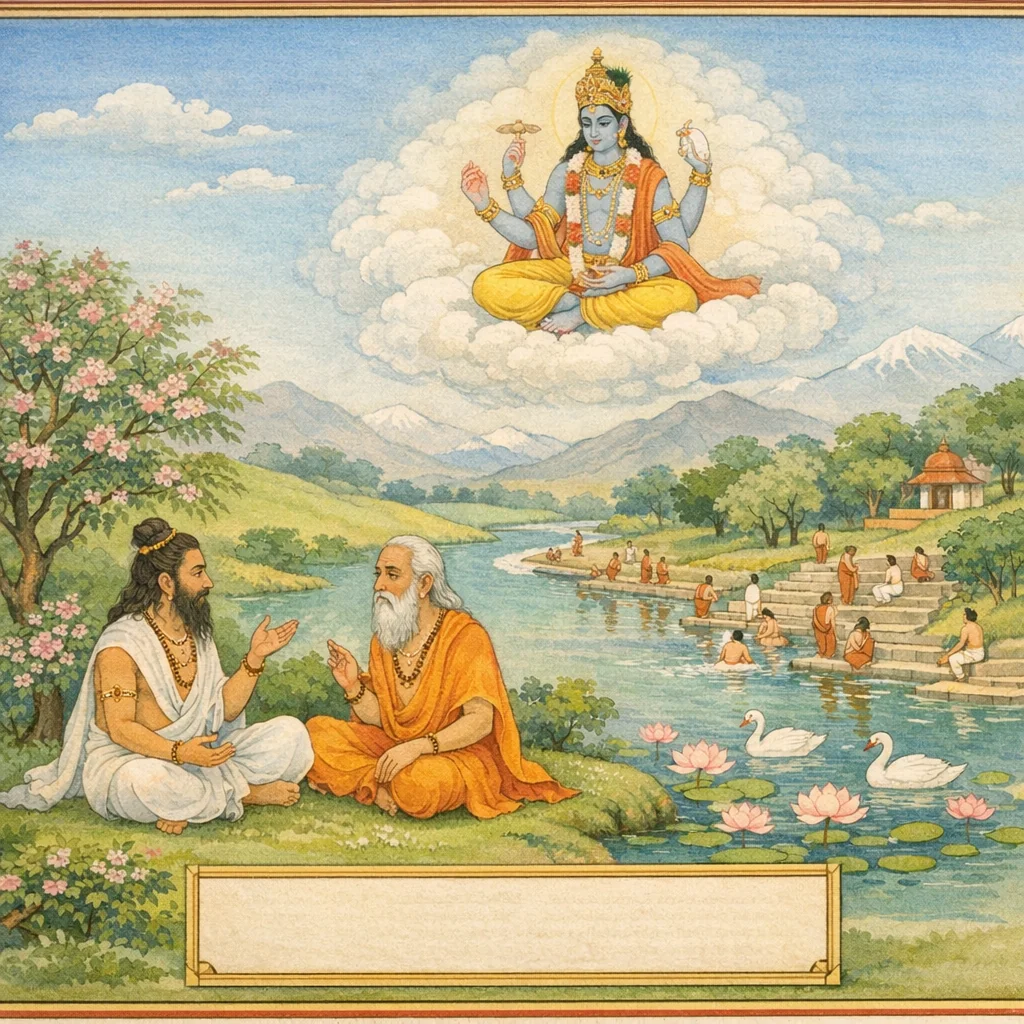
Bhīṣma asks Pulastya about the origin and ritual meaning of Brahmā’s movement toward Kāśī, and about the deeds of Viṣṇu and Śaṅkara. Pulastya recounts a mythic episode: from his celestial abode Brahmā resolves to perform yajña, and Puṣkara is established as a primordial tīrtha, bound to the lotus born from Viṣṇu’s navel. Brahmā descends into a wondrous forest, blesses the trees and forest-deities, and consecrates the land as a supreme kṣetra. When the lotus is cast upon the earth, a thunderous shock shakes the worlds; the Devas question Viṣṇu, who explains Brahmā’s act and directs them to worship. The chapter then unfolds ritual and liberation-teaching: Brāhmī dīkṣā, brāhma-snāna, sacrificial procedure, hymns of praise to Brahmā, the slaying of the asura Vajranābha, and the delineation of Puṣkara’s sub-tīrthas (Jyeṣṭha/Vaiṣṇava/Kaniṣṭha). It further sets forth extensive kṣetra-dharma—classifications of bhakti (mental, verbal, bodily; laukika/vaidika/adhyātmika), Sāṅkhya–Yoga devotion, and āśrama conduct leading to Brahmaloka and mokṣa.
Shlokas
Verse 1
भीष्म उवाच । किं कृतं ब्रह्मणा ब्रह्मन्प्रेष्य वाराणसीपुरीम् । जनार्दनेन किं कर्म शंकरेण च यन्मुने
Bhīṣma said: O Brahmin, what did Brahmā accomplish by sending (a messenger) to the city of Vārāṇasī? And what deed was performed by Janārdana (Viṣṇu) and by Śaṅkara (Śiva), O sage?
Verse 2
कथं यज्ञः कृतस्तेन कस्मिंस्तीर्थे वदस्व मे । के सदस्या ऋत्विजश्च सर्वांस्तान्प्रब्रवीहि मे
Tell me: how was that sacrifice (yajña) performed by him, and at which sacred ford (tīrtha)? Who were the attendants and the officiating priests (ṛtvijas)? Describe them all to me.
Verse 3
के देवास्तर्पितास्तेन एतन्मे कौतुकं महत् । पुलस्त्य उवाच । श्रीनिधानं पुरं मेरोः शिखरे रत्नचित्रितम्
“Which deities were satisfied by that act?” This is my great curiosity. Pulastya said: “Upon the peak of Mount Meru there is a city called Śrīnidhāna, adorned with jewels.”
Verse 4
अनेकाश्चर्यनिलयंबहुपादपसंकुलम् । विचित्रधातुभिश्चित्रं स्वच्छस्फटिकनिर्मलम्
It was an abode of many marvels, thronged with countless footed beings; variegated with many kinds of minerals, it was wondrous—clear and spotless like transparent crystal.
Verse 5
लतावितानशोभाढ्यं शिखिशब्दविनादितम् । मृगेन्द्ररववित्रस्त गजयूथसमाकुलम्
Richly adorned with the beauty of vine-canopies, it resounded with the cries of peacocks; and herds of elephants, startled by the roars of lions, thronged about in confusion.
Verse 6
निर्झरांबुप्रपातोत्थ शीकरासारशीतलम् । वाताहततरुव्रात प्रसन्नापानचित्रितम्
Cooled by the fine spray rising from the cascade of a mountain stream, and adorned with clear, delightful waters—its groves of trees stirred by the wind—that place appeared richly picturesque.
Verse 7
मृगनाभिवरामोद वासिताशेषकाननम् । लतागृहरतिश्रान्त सुप्तविद्याधराध्वगम्
Its entire forest-land was perfumed with the exquisite fragrance of musk; and the travellers among the Vidyādharas, wearied by pleasure in vine-clad bowers, lay asleep.
Verse 8
प्रगीतकिन्नरव्रात मधुरध्वनिनादितम् । तस्मिन्ननेकविन्यास शोभिताशेषभूमिकम्
It resounded with the sweet tones of bands of Kinnaras singing. In it, every level and terrace was adorned with many splendid arrangements and designs.
Verse 9
वैराजं नाम भवनं ब्रह्मणः परमेष्ठिनः । तत्र दिव्यांगनोद्गीत मधुरध्वनि नादिता
There is a mansion called Vairāja belonging to Brahmā, the Paramēṣṭhin, Supreme Lord of beings. There it resounds with sweet, melodious sounds, sung by divine maidens.
Verse 10
पारिजाततरूत्पन्न मंजरीदाममालिनी । रत्नरश्मिसमूहोत्थ बहुवर्णविचित्रिता
A garland of flower-clusters born from the Pārijāta tree, strung as a chain of blossoms—made radiant by streams of jeweled rays, and adorned with a wondrous variety of colors.
Verse 11
विन्यस्तस्तंभकोटिस्तु निर्मलादर्शशोभिता । अप्सरोनृत्यविन्यास विलासोल्लासलासिता
It was adorned with rows of well-ordered pillars and beautified by spotless, mirror-like surfaces; enlivened by the graceful formations of the apsarās’ dance, it shone with playful elegance and joyous brilliance.
Verse 12
बह्वातोद्यसमुत्पन्नसमूहस्वननादिता । लयतालयुतानेक गीतवादित्र शोभिता
It resounded with the blended tones arising from many instruments, and was adorned with manifold songs and instrumental performances, all upheld by laya and tāla—rhythm and measured beat.
Verse 13
सभा कांतिमती नाम देवानां शर्मदायिका । ऋषिसंघसमायुक्ता मुनिवृंदनिषेविता
There was an assembly-hall named Kāntimatī, bestowing comfort and well-being upon the devas—attended by gatherings of ṛṣis and frequented by multitudes of sages.
Verse 14
द्विजातिसामशब्देन नादिताऽऽनंददायिनी । तस्यां निविष्टो देवेशस्संध्यासक्तः पितामहः
Resounding with the Sāman-chants of the twice-born, it bestowed bliss. There, seated within it, Pitāmaha—the Lord of the devas—remained absorbed in the Sandhyā rites.
Verse 15
ध्यायति स्म परं देवं येनेदं निर्मितं जगत् । ध्यायतो बुद्धिरुत्पन्ना कथं यज्ञं करोम्यहम्
He meditated upon the Supreme God by whom this universe was fashioned. As he meditated, a thought arose within him: “How shall I perform a yajña, a sacred sacrifice?”
Verse 16
कस्मिन्स्थाने मया यज्ञः कार्यः कुत्र धरातले । काशीप्रयागस्तुंगा च नैमिषं शृंखलं तथा
“In what place—where upon the earth’s surface—should I perform the yajña? Should it be at Kāśī, at Prayāga, at Tuṅgā, or at Naimiṣa, and likewise at Śṛṅkhala?”
Verse 17
कांची भद्रा देविका च कुरुक्षेत्रं सरस्वती । प्रभासादीनि तीर्थानि पृथिव्यामिह मध्यतः
Kāñcī, Bhadrā, and Devikā; Kurukṣetra and the Sarasvatī; and the tīrthas beginning with Prabhāsa—these sacred places are situated here in the earth’s middle region.
Verse 18
क्षेत्राणि पुण्यतीर्थानि संति यानीह सर्वशः । मदादेशाच्च रुद्रेण कृतान्यन्यानि भूतले
All the sacred kṣetras and holy tīrthas that exist here everywhere—others too upon the earth were established by Rudra, acting under my command.
Verse 19
यथाहं सर्वदेवेषु आदिदेवो व्यवस्थितः । तथा चैकं परं तीर्थमादिभूतं करोम्यहम्
As I am established among all the gods as the Ādideva, the primeval deity, so too do I create one supreme tīrtha, primordial in its very nature.
Verse 20
अहं यत्र समुत्पन्नः पद्मं तद्विष्णुनाभिजम् । पुष्करं प्रोच्यते तीर्थमृषिभिर्वेदपाठकैः
The place where I arose—the lotus that sprang from Viṣṇu’s navel—is declared by the ṛṣis who recite the Vedas to be the sacred tīrtha called Puṣkara.
Verse 21
एवं चिंतयतस्तस्य ब्रह्मणस्तु प्रजापतेः । मतिरेषा समुत्पन्ना व्रजाम्येष धरातले
As Prajāpati Brahmā pondered thus, this resolve arose in him: “I shall now go to the surface of the earth.”
Verse 22
प्राक्स्थानं स समासाद्य प्रविष्टस्तद्वनोत्तमम् । नानाद्रुमलताकीर्णं नानापुष्पोपशोभितम्
Having reached the eastern region, he entered that excellent forest—filled with many kinds of trees and creepers, and beautified by a multitude of flowers.
Verse 23
नानापक्षिरवाकीर्णं नानामृगगणाकुलम् । द्रुमपुष्पभरामोदैर्वासयद्यत्सुरासुरान्
It was filled with the cries of many kinds of birds and thronged with herds of diverse beasts; and by the fragrance of flowers laden on the trees it perfumed both the gods and the demons.
Verse 24
बुद्धिपूर्वमिव न्यस्तैः पुष्पैर्भूषितभूतलम् । नानागंधरसैः पक्वापक्वैश्च षडृतूद्भवैः
The surface of the earth appeared adorned with flowers, as if they had been arranged with deliberate care; and it was filled with produce of the six seasons—some ripe, some unripe—of many fragrances and flavors.
Verse 25
फलैः सुवर्णरूपाढ्यैर्घ्राणदृष्टिमनोहरैः । जीर्णं पत्रं तृणं यत्र शुष्ककाष्ठफलानि च
There were fruits rich with a golden appearance, delightful to both smell and sight; and there too were withered leaves and grass, as well as dried pieces of wood and fruits.
Verse 26
बहिः क्षिपति जातानि मारुतोनुग्रहादिव । नानापुष्पसमूहानां गंधमादाय मारुतः
As though by the wind’s own grace, it casts what has arisen outward; and the Maruta, bearing away the fragrance of clusters of many kinds of flowers, moves onward.
Verse 27
शीतलो वाति खं भूमिं दिशो यत्राभिवासयन् । हरितस्निग्ध निश्छिद्रैरकीटकवनोत्कटैः
There a cool breeze blows through the sky and across the earth, pervading the directions; and the place is thick with forests—green, lush, unbroken, and free from pests.
Verse 28
वृक्षैरनेकसंज्ञैर्यद्भूषितं शिखरान्वितैः । अरोगैर्दर्शनीयैश्च सुवृत्तैः कैश्चिदुज्ज्वलैः
It was adorned with trees of many kinds, crowned with lofty tops—healthy, pleasing to behold, well-shaped, and in some places radiant.
Verse 29
कुटुंबमिव विप्राणामृत्विग्भिर्भाति सर्वतः । शोभंते धातुसंकाशैरंकुरैः प्रावृता द्रुमाः
All around, it shines like a family of Brahmins gathered with their officiating priests; and the trees, covered with sprouts gleaming like minerals, appear splendid.
Verse 30
कुलीनैरिव निश्छिद्रैः स्वगुणैः प्रावृता नराः । पवनाविद्धशिखरैः स्पृशंतीव परस्परम्
Men, covered over by their own faultless virtues—as though by a seamless noble garment—seem to touch one another, like mountain-peaks whose summits are swept by the wind.
Verse 31
आजिघ्रंती वचाऽन्योन्यं पुष्पशाखावतंसकाः । नागवृक्षाः क्वचित्पुष्पैर्द्रुमवानीरकेसरैः
They breathed in one another’s fragrant vācā (sweet-scented calamus), wearing garlands and ear-ornaments woven of flowering branches; and here and there stood nāga-trees, adorned with blossoms, bearing clusters of pollen-like filaments.
Verse 32
नयनैरिव शोभंते चंचलैः कृष्णतारकैः । पुष्पसंपन्नशिखराः कर्णिकारद्रुमाः क्वचित्
In places, karṇikāra trees, their crests heavy with blossoms, gleam as though they were eyes—bright, with restless, dark pupils.
Verse 33
युग्मयुग्माद्विधा चेह शोभन्त इव दंपती । सुपुष्पप्रभवाटोपैस्सिंदुवार द्रुपंक्तयः
Here, set in pair upon pair, the rows of sinduvāra trees shine like wedded couples, made splendid by the luxuriant display born of their beautiful blossoms.
Verse 34
मूर्तिमत्य इवाभांति पूजिता वनदेवताः । क्वचित्क्वचित्कुंदलताः सपुष्पाभरणोज्वलाः
The forest-deities, honored with worship, seemed as if embodied in visible form; and here and there the vines appeared like earrings, radiant with ornaments of flowers.
Verse 35
दिक्षु वृक्षेषु शोभंते बालचंद्रा इवोच्छ्रिताः । सर्जार्जुनाः क्वचिद्भान्ति वनोद्देशेषु पुष्पिताः
In all directions the trees shine, rising high like young moons; and here and there, sārja and arjuna trees gleam in the forest tracts, covered with blossoms.
Verse 36
धौतकौशेयवासोभिः प्रावृताः पुरुषा इव । अतिमुक्तकवल्लीभिः पुष्पिताभिस्तथा द्रुमाः
Clad as though in garments of washed silk, the trees appeared like men; and likewise they were adorned with the flowering creepers of atimuktaka.
Verse 37
उपगूढा विराजंते स्वनारीभिरिव प्रियाः । अपरस्परसंसक्तैः सालाशोकाश्च पल्लवैः
Closely entwined, they shone—like beloved husbands embraced by their own women—while the sāla and aśoka trees stood with their shoots and leaves interlaced with one another.
Verse 38
हस्तैर्हस्तान्स्पृशंतीव सुहृदश्चिरसंगताः । फलपुष्पभरानम्राः पनसाः सरलार्जुनाः
As though touching hands with hands, the long-associated friends—the trees—stood close together: jackfruit trees, pines, and arjunas, bowed down by the weight of their fruits and blossoms.
Verse 39
अन्योन्यमर्चयंतीव पुष्पैश्चैव फलैस्तथा । मारुतावेगसंश्लिष्टैः पादपास्सालबाहुभिः
As if worshipping one another with flowers and fruits, the trees—with their śāla-like arms—were clasped together by the force of the wind.
Verse 40
अभ्याशमागतं लोकं प्रतिभावैरिवोत्थिताः । पुष्पाणामवरोधेन सुशोभार्थं निवेशिताः
As people approached, they rose up as if in rivalry with one another; and, by massing banks of flowers, they were arranged in place for the sake of splendid beauty.
Verse 41
वसंतमहमासाद्य पुरुषान्स्पर्द्धयंति हि । पुष्पशोभाभरनतैः शिखरैर्वायुकंपितैः
When spring arrives, they indeed seem to rival men— their treetops bowed beneath the weight of floral beauty, and shaken by the wind.
Verse 42
नृत्यंतीव नराः प्रीताः स्रगलंकृतशेखराः । शृंगाग्रपवनक्षिप्ताः पुष्पावलियुता द्रुमाः
Joyful men, their heads adorned with garlands, seemed as if they were dancing; and the trees, laden with rows of blossoms, were shaken by winds sweeping over the mountain-peaks.
Verse 43
सवल्लीकाः प्रनृत्यंति मानवा इव सप्रियाः । स्वपुष्पनतवल्लीभिः पादपाः क्वचिदावृताः
Clad in creepers, the trees seem to dance—like people with their beloveds; and in places the trees are covered over by their own creepers, bent down by the weight of blossoms.
Verse 44
भांति तारागणैश्चित्रैः शरदीव नभस्तलम् । द्रुमाणामथवाग्रेषु पुष्पिता मालती लताः
The sky shone beautifully, like an autumn night adorned with a multitude of bright stars; and upon the tops of the trees, mālatī jasmine creepers were in full bloom.
Verse 45
शेखराइव शोभंते रचिता बुद्धिपूर्वकम् । हरिताः कांचनच्छायाः फलिताः पुष्पिता द्रुमाः
Arranged with thoughtful care, they shine like ornaments; the trees are verdant with a golden hue—bearing fruit and covered in blossoms.
Verse 46
सौहृदं दर्शयंतीव नराः साधुसमागमे । पुष्पकिंजल्ककपिला गताः सर्वदिशासु च
As though displaying goodwill in the company of the virtuous, the people—yellow like the pollen of flowers—went forth in all directions.
Verse 47
कदंबपुष्पस्य जयं घोषयंतीव षट्पदाः । क्वचित्पुष्पासवक्षीबाः संपतंति ततस्ततः
As if proclaiming the victory of the kadamba blossoms, the bees hum; and in places, intoxicated by the nectar of flowers, they alight again and again, here and there.
Verse 48
पुंस्कोकिलगणावृक्ष गहनेष्विव सप्रियाः । शिरीषपुष्पसंकाशाः शुका मिथुनशः क्वचित्
And in places, pairs of parrots—lovely with their mates—appeared amid dense groves, like clusters of male kokilas; they shone like the blossoms of the śirīṣa tree.
Verse 49
कीर्तयंति गिरश्चित्राः पूजिता ब्राह्मणा यथा । सहचारिसुसंयुक्ता मयूराश्चित्रबर्हिणः
Peacocks, adorned with variegated plumes and accompanied by their mates, uttered wondrous cries—like honored brāhmaṇas reciting sacred speech.
Verse 50
वनांतेष्वपि नृत्यंति शोभंत इव नर्त्तकाः । कूजंतःपक्षिसंघाता नानारुतविराविणः
Even on the forest’s outskirts they seem to dance, appearing like graceful dancers; flocks of birds, chirping, fill the air with many kinds of calls.
Verse 51
कुर्वंति रमणीयं वै रमणीयतरं वनम् । नानामृगगणाकीर्णं नित्यं प्रमुदितांडजम्
They make the forest truly delightful—indeed, even more delightful—filled with herds of many kinds of animals, and ever resounding with the joyful calls of birds.
Verse 52
तद्वनं नंदनसमं मनोदृष्टिविवर्द्धनम् । पद्मयोनिस्तु भगवांस्तथा रूपं वनोत्तमम्
That forest was like Nandana, Indra’s celestial grove, enhancing both mind and vision. And the Blessed Lord Brahmā, the lotus-born, likewise beheld that most excellent forest-form in all its splendor.
Verse 53
ददर्शादर्शवद्दृष्ट्या सौम्ययापा पयन्निव । ता वृक्षपंक्तयः सर्वा दृष्ट्वा देवं तथागतम्
With a gaze like a spotless mirror, he beheld the gentle scene, as though he were drinking it in with his eyes. And all those rows of trees, seeing the deity who had thus arrived, looked on in wonder.
Verse 54
निवेद्य ब्रह्मणे भक्त्या मुमुचुः पुष्पसंपदः । पुष्पप्रतिग्रहं कृत्वा पादपानां पितामहः
Having offered them to Brahmā with devotion, they released their wealth of blossoms. And Pitāmaha (Brahmā), having accepted the offering of flowers, blessed the trees.
Verse 55
वरं वृणीध्वं भद्रं वः पादपानित्युवाच सः । एवमुक्ता भगवता तरवो निरवग्रहाः
He said to the trees: “Choose a boon—may welfare be yours.” Thus addressed by the Blessed Lord, the trees, free from any hesitation, responded.
Verse 56
ऊचुः प्रांजलयः सर्वे नमस्कृत्वा विरिंचनम् । वरं ददासि चेद्देव प्रपन्नजनवत्सल
With palms joined, they all bowed to Viriñci (Brahmā) and said: “O Lord, tender guardian of those who take refuge—if You are to grant a boon, then grant it to us.”
Verse 57
इहैव भगवन्नित्यं वने संनिहितो भव । एष नः परमः कामः पितामह नमोस्तु ते
O Blessed Lord, remain here in this forest forever. This is our highest desire. O Pitāmaha (Brahmā), salutations to You.
Verse 58
त्वं चेद्वससि देवेश वनेस्मिन्विश्वभावन । सर्वात्मना प्रपन्नानां वांछतामुत्तमं वरम्
O Lord of the gods, sustainer of the universe—if You dwell in this forest, then grant the supreme boon desired by those who have surrendered to You with their whole being.
Verse 59
वरकोटिभिरन्याभिरलं नो दीयतां वरम् । सन्निधानेन तीर्थेभ्य इदं स्यात्प्रवरं महत्
Enough of granting us millions of other boons—grant us this boon: by the very presence of the sacred tīrthas, may this become supremely excellent and great.
Verse 60
ब्रह्मोवाच । उत्तमं सर्वक्षेत्राणां पुण्यमेतद्भविष्यति । नित्यं पुष्पफलोपेता नित्यसुस्थिरयौवनाः
Brahmā said: “This shall become the most excellent of all sacred kṣetras, a holy site of supreme merit. It will ever be endowed with flowers and fruits, and its youthfulness will remain perpetually firm, unaging.”
Verse 61
कामगाः कामरूपाश्च कामरूपफलप्रदाः । कामसंदर्शनाः पुंसां तपःसिद्ध्युज्वला नृणाम्
They move as they will, assume forms at will, and bestow the fruits of the desired forms. To men they appear in ways that fulfill longing, and to ascetics they shine with the radiance of accomplished tapas.
Verse 62
श्रिया परमया युक्ता मत्प्रसादाद्भविष्यथ । एवं स वरदो ब्रह्मा अनुजग्राह पादपान्
“By my grace you shall be endowed with the highest prosperity.” Thus spoke boon-giving Brahmā, and he bestowed his favor upon the trees.
Verse 63
स्थित्वा वर्ष सहस्रं तु पुष्करं प्रक्षिपद्भुवि । क्षितिर्निपतिता तेन व्यकंपत रसातलम्
After remaining there for a thousand years, he hurled Pushkara upon the earth. By that impact the ground sank down, and Rasātala, the nether realm, trembled.
Verse 64
विवशास्तत्यजुर्वेलां सागराः क्षुभितोर्मयः । शक्राशनि हतानीव व्याघ्र व्याला वृतानि च
Overpowered, the oceans abandoned their shorelines, their waves heaving in violent turmoil; and tigers and serpents too lay as though struck down by Indra’s thunderbolt.
Verse 65
शिखराण्यप्यशीर्यंत पर्वतानां सहस्रशः । देवसिद्धविमानानि गंधर्वनगराणि च
Even the peaks of thousands of mountains crumbled away; and the aerial chariots of the Devas and Siddhas, as well as the cities of the Gandharvas, were shaken and laid in ruin.
Verse 66
प्रचेलुर्बभ्रमुः पेतुर्विविशुश्च धरातलम् । कपोतमेघाः खात्पेतुः पुटसंघातदर्शिनः
They trembled, reeled, fell, and sank into the earth. Pigeon-hued clouds dropped from the sky, appearing as dense, clustered masses.
Verse 67
ज्योतिर्गणांश्छादयंतो बभूवुस्तीव्र भास्कराः । महता तस्य शब्देन मूकांधबधिरीकृतम्
Blazing, sun-like radiances arose, eclipsing the hosts of lights; and by the sheer magnitude of that sound, beings were rendered mute, blind, and deaf.
Verse 68
बभूव व्याकुलं सर्वं त्रैलोक्यं सचराचरम् । सुरासुराणां सर्वेषां शरीराणि मनांसि च
All the three worlds—moving and unmoving—became agitated; and among all the devas and asuras alike, both bodies and minds were thrown into turmoil.
Verse 69
अवसेदुश्च किमिति किमित्येतन्न जज्ञिरे । धैर्यमालंब्य सर्वेऽथ ब्रह्माणं चाप्यलोकयन्
They grew despondent, repeatedly asking, “Why? Why?”—yet they could not understand what this was. Then, gathering their courage, they all looked toward Brahmā as well.
Verse 70
न च ते तमपश्यंत कुत्र ब्रह्मागतो ह्यभूत् । किमर्थं कंपिता भूमिर्निमित्तोत्पातदर्शनम्
Yet they did not see him—where indeed had Brahmā gone? For what reason did the earth tremble, and why were ominous portents seen?
Verse 71
तावद्विष्णुर्गतस्तत्र यत्र देवा व्यवस्थिताः । प्रणिपत्य इदं वाक्यमुक्तवंतो दिवौकसः
Then Viṣṇu went to the place where the gods were assembled; and the dwellers of heaven, bowing down in reverence, spoke these words.
Verse 72
किमेतद्भगवन्ब्रूहि निमित्तोत्पातदर्शनम् । त्रैलोक्यं कंपितं येन संयुक्तं कालधर्मणा
“What is this, O Blessed One? Please explain this vision of omens and portents—by which the three worlds have been shaken, as though joined to the law of Time (fate).”
Verse 73
जातकल्पावसानं तु भिन्नमर्यादसागरम् । चत्वारो दिग्गजाः किं तु बभूवुरचलाश्चलाः
“But at the end of the former kalpa, the ocean overstepped its boundaries; then the four elephants of the quarters—though meant to be unmoving—became shaken and unsteady.”
Verse 74
समावृता धरा कस्मात्सप्तसागरवारिणा । उत्पत्तिर्नास्ति शब्दस्य भगवन्निः प्रयोजना
“Why is the earth enveloped by the waters of the seven oceans? And, O Lord—speech does not arise without a purpose.”
Verse 75
यादृशो वा स्मृतः शब्दो न भूतो न भविष्यति । त्रैलोक्यमाकुलं येन चक्रे रौद्रेण चोद्यता
“Such a sound was remembered—one that had never been before and will never be again—by which, driven by a fierce fury, the three worlds were thrown into turmoil.”
Verse 76
शुभोऽशुभो वा शब्दोरेयं त्रैलोक्यस्य दिवौकसाम् । भगवन्यदि जानासि किमेतत्कथयस्व नः
Is this sound auspicious or inauspicious—this sound of the celestial beings of the three worlds? O venerable one, if you know, then tell us what it is.
Verse 77
एवमुक्तोऽब्रवीद्विष्णुः परमेणानुभावितः । मा भैष्ट मरुतः सर्वे शृणुध्वं चात्र कारणम्
Thus addressed, Vishnu—moved by supreme compassion—said: “Do not fear, O Maruts, all of you. Listen, and I shall explain the reason for this.”
Verse 78
निश्चयेनानुविज्ञाय वक्ष्याम्येष यथाविधम् । पद्महस्तो हि भगवान्ब्रह्मा लोकपितामहः
Having ascertained it with certainty, I shall explain this according to proper procedure: for the Blessed Brahmā—holder of the lotus—is indeed the grandsire and progenitor of the worlds.
Verse 79
भूप्रदेशे पुण्यराशौ यज्ञं कर्तुं व्यवस्थितः । अवरोहे पर्वतानां वने चातीवशोभने
He prepared to perform a sacrifice in a land-region rich in accumulated merit—on the descending slopes of the mountains, in a forest of surpassing beauty.
Verse 80
कमलं तस्य हस्तात्तु पतितं धरणीतले । तस्य शब्दो महानेष येन यूयं प्रकंपिताः
The lotus fell from his hand onto the surface of the earth. The great sound produced by it is the very one by which you all were shaken.
Verse 81
तत्रासौ तरुवृंदेन पुष्पामोदाभिनंदितः । अनुगृह्याथ भगवान्वनंतत्समृगांडजम्
There, welcomed by clusters of trees and gladdened by the fragrance of blossoms, the Blessed Lord, bestowing grace, entered that forest filled with beasts and birds.
Verse 82
जगतोऽनुग्रहार्थाय वासं तत्रान्वरोचयत् । पुष्करं नाम तत्तीर्थं क्षेत्रं वृषभमेव च
For the welfare of the world, he chose to dwell there. That sacred tīrtha was named Puṣkara, and that holy region (kṣetra) was also called Vṛṣabha.
Verse 83
जनितं तद्भगवता लोकानां हितकारिणा । ब्रह्माणं तत्र वै गत्वा तोषयध्वं मया सह
That was brought forth by the Blessed Lord, the benefactor of the worlds. Therefore, go there to Brahmā and, together with me, honor and please him.
Verse 84
आराध्यमानो भगवान्प्रदास्यति वरान्वरान् । इत्युक्त्वा भगवान्विष्णुः सह तैर्देवदानवैः
“When the Blessed Lord is worshipped, He will grant the most excellent boons.” Having said this, the Blessed Lord Viṣṇu remained together with those gods and dānavas.
Verse 85
जगाम तद्वनोद्देशं यत्रास्ते स तु कंजजः । प्रहृष्टास्तुष्टमनसः कोकिलालापलापिताः
He went to that forest region where the lotus-born one (Brahmā) was staying—a place where hearts were delighted and satisfied, filled with the cooing calls of cuckoos.
Verse 86
पुष्पोच्चयोज्ज्वलं शस्तं विविशुर्ब्रह्मणो वनम् । संप्राप्तं सर्वदेवैस्तु वनं नंदनसंमितम्
They entered Brahmā’s excellent forest, radiant with heaps of flowers—a grove already reached by all the gods, comparable to Nandana, Indra’s celestial garden.
Verse 87
पद्मिनीमृगपुष्पाढ्यं सुदृढं शुशुभे तदा । प्रविश्याथ वनं देवाः सर्वपुष्पोपशोभितम्
Then that forest, richly filled with lotuses, deer, and flowers—firm and well-formed—shone brilliantly. Entering it, the gods beheld it adorned with every kind of blossom.
Verse 88
इह देवोस्तीति देवा बभ्रमुश्च दिदृक्षवः । मृगयंतस्ततस्ते तु सर्वे देवाः सवासवाः
Thinking, “A god is here,” the gods wandered about, eager to behold him; and then all the gods—along with Indra—searched for him.
Verse 89
अद्भुतस्य वनस्यांतं न ते ददृशुराशुगाः । विचिन्वद्भिस्तदा देवं दैवैर्वायुर्विलोकितः
Those swift ones did not see the boundary of that wondrous forest. While they were searching then for the god, Vāyu, by divine means, was perceived.
Verse 90
स तानुवाच ब्रह्माणं न द्रक्ष्यथ तपो विना । तदा खिन्ना विचिन्वंतस्तस्मिन्पर्वतरोधसि
He said to them, “Without tapas—holy austerity—you will not behold Brahmā.” Then, weary, they searched there along the mountain pass.
Verse 91
दक्षिणे चोत्तरे चैव अंतराले पुनः पुनः । वायूक्तं हृदये कृत्वा वायुस्तानब्रवीत्पुनः
Again and again, in the southern and northern quarters and in the space between, holding within his heart what Vāyu had proclaimed, Vāyu spoke to them once more.
Verse 92
त्रिविधो दर्शनोपायो विरिंचेरस्य सर्वदा । श्रद्धा ज्ञानेन तपसा योगेन च निगद्यते
The means of spiritual realization for Brahmā (Viriñci) is ever described as threefold—through faith, through knowledge, and through austerity; and it is also spoken of as attained through yoga.
Verse 93
सकलं निष्कलं चैव देवं पश्यंति योगिनः । तपस्विनस्तु सकलं ज्ञानिनो निष्कलं परम्
Yogins behold the Divine as both with attributes (sakala) and without attributes (niṣkala). Ascetics perceive Him as endowed with form and qualities, while the knowers of truth realize the Supreme as attributeless.
Verse 94
समुत्पन्ने तु विज्ञाने मंदश्रद्धो न पश्यति । भक्त्या परमया क्षिप्रं ब्रह्म पश्यंति योगिनः
Even when true knowledge has arisen, one of feeble faith does not perceive (the Truth). But through supreme devotion, the yogins swiftly behold Brahman.
Verse 95
द्रष्टव्यो निर्विकारोऽसौ प्रधानपुरुषेश्वरः । कर्मणा मनसा वाचा नित्ययुक्ताः पितामहम्
He—the Lord of Pradhāna (primordial Nature) and Puruṣa (Spirit)—is to be realized as changeless. Ever disciplined in action, mind, and speech, (the sages) behold Pitāmaha (Brahmā).
Verse 96
तपश्चरत भद्रं वो ब्रह्माराधनतत्पराः । ब्राह्मीं दीक्षां प्रपन्नानां भक्तानां च द्विजन्मनाम्
Practice austerity—may auspiciousness be yours—devoted to the worship of Brahmā, and remain among the twice-born devotees who have undertaken the Brāhmī dīkṣā, the initiation ordained by Brahmā.
Verse 97
सर्वकालं स जानाति दातव्यं दर्शनं मया । वायोस्तु वचनं श्रुत्वा हितमेतदवेत्य च
“He knows at all times that I should grant him an audience. And having heard the words of Vāyu, he understood that this indeed was beneficial.”
Verse 98
ब्रह्मेच्छाविष्टमतयो वाक्पतिं च ततोऽब्रुवन् । प्रज्ञानविबुधास्माकं ब्राह्मीं दीक्षां विधत्स्व नः
Then, their minds absorbed in Brahmā’s will, they addressed Vākpati: “O wise one of enlightened understanding, please bestow upon us the Brāhmī initiation.”
Verse 99
स दिदीक्षयिषुः क्षिप्रममरान्ब्रह्मदीक्षया । वेदोक्तेन विधानेन दीक्षयामास तान्गुरुः
Wishing to initiate them, the guru swiftly initiated the gods with the Brahma-initiation, following the procedure prescribed in the Vedas.
Verse 100
विनीतवेषाः प्रणता अंतेवासित्वमाययुः । ब्रह्मप्रसादं संप्राप्ताः पौष्करं ज्ञानमीरितम्
Humbly dressed and bowing down, they entered the state of discipleship. Having obtained Brahmā’s favor, they were instructed in the sacred knowledge of Puṣkara.
Verse 101
यज्ञं चकार विधिना धिषणोध्वर्युसत्तमः । पद्मं कृत्वा मृणालाढ्यं पद्मदीक्षाप्रयोगतः
Dhīṣaṇa, foremost among the officiating priests, performed the yajña in due order; and, following the rite of padma-dīkṣā, he fashioned a lotus abundant with tender stalk-fibres.
Verse 102
अनुजग्राह देवांस्तान्सुरेच्छा प्रेरितो मुनिः । तेभ्यो ददौ विवेकिभ्यः स वेदोक्तावधानवित्
Urged by the gods’ benevolent will, the sage showed favor to those deities. To the discerning he imparted instruction, for he was skilled in attentive adherence to what the Vedas enjoin.
Verse 103
दीक्षां वै विस्मयं त्यक्त्वा बृहस्पतिरुदारधीः । एकमग्निं च संस्कृत्य महात्मा त्रिदिवौकसाम्
Casting aside his bewilderment and taking up consecration (dīkṣā), noble-minded Bṛhaspati—great-souled and revered among the dwellers of heaven—prepared a single sacred fire.
Verse 104
प्रादादांगिरसस्तुष्टो जाप्यं वेदोदितं तु यत् । त्रिसुपर्णं त्रिमधु च पावमानीं च पावनीम्
Pleased, the descendant of Aṅgiras bestowed the Veda-taught formula for japa—Trisuparṇa, Trimadhu, and the Pāvamānī, the purifying chants.
Verse 105
स हि जाप्यादिकं सर्वमशिक्षयदुदारधीः । आपो हिष्ठेति यत्स्नानं ब्राह्मं तत्परिपठ्यते
That noble-minded one taught all disciplines beginning with japa. And the bath performed with the recitation of the hymn that begins “Āpo hi ṣṭhā …” is known as brāhma-snāna, the Brahma-bath.
Verse 106
पापघ्नं दुष्टशमनं पुष्टिश्रीबलवर्द्धनम् । सिद्धिदं कीर्तिदं चैव कलिकल्मषनाशनम्
It destroys sin, subdues the wicked, and increases nourishment, prosperity, and strength. It bestows success and fame, and it also destroys the impurities of the Kali age.
Verse 107
तस्मात्सर्वप्रयत्नेन ब्राह्मस्नानं समाचरेत् । कुर्वंतो मौनिनो दांता दीक्षिताः क्षपितेंद्रियाः
Therefore, with every effort one should perform the sacred ‘brāhma’ bath. Those who undertake it should be silent, self-restrained, duly initiated (dīkṣā), and with their senses subdued.
Verse 108
सर्वे कमंडलुयुता मुक्तकक्षाक्षमालिनः । दंडिनश्चीरवस्त्राश्च जटाभिरतिशोभिताः
All of them carried water-pots (kamaṇḍalus), wore the sacred thread and rudrākṣa rosaries; they bore staffs, were clad in bark garments, and were greatly adorned with matted locks.
Verse 109
स्नानाचारासनरताः प्रयत्नध्यानधारिणः । मनो ब्रह्मणि संयोज्य नियताहारकांक्षिणः
They delight in the disciplines of bathing, right conduct, and yogic postures (āsana); they steadily uphold diligent meditation. Joining the mind to Brahman, they seek a regulated and measured intake of food.
Verse 110
अतिष्ठन्दर्शनालापसंगध्यानविवर्जिताः । एवं व्रतधराः सर्वे त्रिकालं स्नानकारिणः
They remained without idle standing about, sightseeing, gossiping, social mingling, or wandering thoughts. Thus all those observing the vow performed bathing at the three prescribed times each day.
Verse 111
भक्त्या परमया युक्ता विधिना परमेण च । कालेन महता ध्यानाद्देवज्ञानमनोगताः
Endowed with supreme devotion and observing the highest discipline, over a long span of time—through meditation—they attained an inward realization of divine knowledge.
Verse 112
ब्रह्मध्यानाग्निनिर्दग्धा यदा शुद्धैकमानसाः । अविर्बभूव भगवान्सर्वेषां दृष्टिगोचरः
When they were purified by the fire of meditation on Brahman, and their minds became purely one-pointed, the Blessed Lord manifested—visible to the sight of all.
Verse 113
तेजसाप्यायितास्तस्य बभूवुर्भ्रांतचेतसः । ततोवलंब्य ते धैर्यमिष्टं देवं यथाविधि
Nourished by his radiance, their minds became bewildered. Then, regaining composure and taking courage, they worshiped their chosen deity in the proper manner.
Verse 114
षडंगवेदयोगेन हृष्टचित्तास्तु तत्पराः । शिरोगतैरंजलिभिः शिरोभिश्च महीं गताः
United with the sixfold limbs of Vedic discipline, their hearts filled with joy and wholly intent on that rite, they bowed—hands joined above their heads—and touched the earth with their heads.
Verse 115
तुष्टुवुः सृष्टिकर्त्तारं स्थितिकर्तारमीश्वरम् । देवा ऊचुः । ब्रह्मणे ब्रह्मदेहाय ब्रह्मण्यायाऽजिताय च
The gods praised the Lord—the creator of the universe and the sustainer. The gods said: “Obeisance to Brahmā; to Him whose body is Brahman; to the protector of Brahman; and to the unconquered One.”
Verse 116
नमस्कुर्मः सुनियताः क्रतुवेदप्रदायिने । लोकानुकंपिने देव सृष्टिरूपाय वै नमः
With minds well disciplined, we bow in reverence to You, O God—bestower of the Vedas and the sacrificial rites, compassionate toward the worlds; indeed, salutations to You whose very form is Creation.
Verse 117
भक्तानुकंपिनेत्यर्थं वेदजाप्यस्तुताय च । बहुरूपस्वरूपाय रूपाणां शतधारिणे
To declare Him compassionate toward His devotees, and as One praised by Vedic recitation—salutations to Him whose very nature is manifold in form, the bearer of hundreds of forms.
Verse 118
सावित्रीपतये देव गायत्रीपतये नमः । पद्मासनाय पद्माय पद्मवक्त्राय ते नमः
O God, salutations to You—the lord of Sāvitrī, the lord of Gāyatrī. Salutations to You who sit upon the lotus, who are lotus-born, and whose face is like a lotus.
Verse 119
वरदाय वरार्हाय कूर्माय च मृगाय च । जटामकुटयुक्ताय स्रुवस्रुचनिधारिणे
Salutations to the Bestower of boons, worthy of the choicest offerings; to the One who is also the Tortoise and the Deer; to Him adorned with a crown of matted locks, bearing the ladle and the sacrificial spoon.
Verse 120
मृगांकमृगधर्माय धर्मनेत्राय ते नमः । विश्वनाम्नेऽथ विश्वाय विश्वेशाय नमोनमः
Salutations to You—whose emblem is the moon, whose nature is the dharma of gentleness; salutations to You, the Eye of Dharma. Salutations again and again to You who are named the Universe, who are the Universe itself, and who are the Lord of the Universe.
Verse 121
धर्मनेत्रत्राणमस्मादधिकं कर्तुमर्हसि । वाङ्मनःकायभावैस्त्वां प्रपन्नास्स्मः पितामह
O Grandfather (Brahmā), you ought to grant us protection greater than this. With speech, mind, body, and inner disposition, we have taken refuge in you.
Verse 122
एवं स्तुतस्तदा देवैर्ब्रह्मा ब्रह्मविदां वरः । प्रदास्यामि स्मृतो बाढममोघं दर्शनं हि वः
Thus praised at that time by the gods, Brahmā—the foremost among knowers of Brahman—said: “Whenever I am remembered, I shall indeed grant you my unfailing vision.”
Verse 123
ब्रुवंतु वांछितं पुत्राः प्रदास्यामि वरान्वरान् । एवमुक्ता भगवता देवा वचनमब्रुवन्
“Speak, O sons, whatever you desire; I shall grant you the choicest boons.” Thus addressed by the Blessed Lord, the gods then spoke their request.
Verse 124
एष एवाद्य भगवन्सुपर्याप्तो महान्वरः । जनितो नः सुशब्दोयं कमलं क्षिपता त्वया
O Lord, today this excellent and mighty boon is fully accomplished: as you cast the lotus, the auspiciously named “Kamala” has been brought forth for us.
Verse 125
किमर्थं कंपिता भूमिर्लोकाश्चाकुलिताः कृताः । नैतन्निरर्थकं देव उच्यतामत्र कारणम्
For what reason has the earth trembled, and the worlds been thrown into turmoil? This is surely not without cause, O Deva—please tell us the reason behind it.
Verse 126
ब्रह्मोवाच । युष्मद्धितार्थमेतद्वै पद्मं विनिहितं मया । देवतानां च रक्षार्थं श्रूयतामत्र कारणम्
Brahmā said: “Truly, I have placed this lotus here for your welfare, and also for the protection of the devas. Now hear the reason for this.”
Verse 127
असुरो वज्रनाभोऽयं बालजीवापहारकः । अवस्थितस्त्ववष्टभ्य रसातलतलाश्रयम्
This is the asura Vajranābha, a thief of children’s lives; he stands firm, bracing himself, having taken refuge in the realm of Rasātala.
Verse 128
युष्मदागमनं ज्ञात्वा तपस्थान्निहितायुधान् । हंतुकामो दुराचारः सेंद्रानपि दिवौकसः
Knowing of your arrival—while you were ascetics who had laid aside your weapons—the wicked one, intent on killing, attacked even the heavenly beings, Indra included.
Verse 129
घातः कमलपातेन मया तस्य विनिर्मितः । स राज्यैश्वर्यदर्पिष्टस्तेनासौ निहतो मया
I devised his destruction by a fall, struck by a lotus leaf. Swollen with pride in kingship and power, he was thus slain by me.
Verse 130
लोकेऽस्मिन्समये भक्ता ब्राह्मणा वेदपारगाः । मैव ते दुर्गतिं यांतु लभंतां सुगतिं पुनः
In this world, at this time, may the devoted brāhmaṇas—those who have reached the far shore of the Vedas—never fall into an evil destiny; rather, may they again attain a blessed course.
Verse 131
देवानां दानवानां च मनुष्योरगरक्षसाम् । भूतग्रामस्य सर्वस्य समोस्मि त्रिदिवौकसः
O dwellers of heaven, I am impartial toward the gods and the Dānavas, toward humans, serpents, and Rākṣasas—indeed toward the entire multitude of beings.
Verse 132
युष्मद्धितार्थं पापोऽसौ मया मंत्रेण घातितः । प्राप्तः पुण्यकृतान्लोकान्कमलस्यास्य दर्शनात्
For your welfare, that sinful one was slain by me through a mantra; and by the very sight of this lotus, he attained the worlds reached by the doers of merit.
Verse 133
यन्मया पद्ममुक्तं तु तेनेदं पुष्करं भुवि । ख्यातं भविष्यते तीर्थं पावनं पुण्यदं महत्
Because I have spoken of the lotus, therefore this place on earth will become renowned as Puṣkara—a great sacred ford, purifying and bestowing merit.
Verse 134
पृथिव्यां सर्वजंतूनां पुण्यदं परिपठ्यते । कृतो ह्यनुग्रहो देवा भक्तानां भक्तिमिच्छताम्
On earth, it is recited as a giver of merit for all living beings. Indeed, the gods have shown their grace to devotees who long for devotion.
Verse 135
वनेस्मिन्नित्यवासेन वृक्षैरभ्यर्थितेन च । महाकालो वनेऽत्रागादागतस्य ममानघाः
By my constant dwelling in this forest, and at the request of the trees, Mahākāla came here into this forest—O sinless ones—having come in response to me.
Verse 136
तपस्यतां च भवतां महज्ज्ञानं प्रदर्शितम् । कुरुध्वं हृदये देवाः स्वार्थं चैव परार्थकम्
To you who are engaged in austerities, great knowledge has been revealed. Therefore, O devas, hold it firmly in your hearts—both for your own good and for the good of others.
Verse 137
भवद्भिर्दर्शनीयं तु नानारूपधरैर्भुवि । द्विषन्वै ज्ञानिनं विप्रं पापेनैवार्दितो नरः
Indeed, you—assuming many forms upon the earth—are worthy to be seen. But the man who hates a wise brāhmaṇa is, in truth, afflicted by sin alone.
Verse 138
न विमुच्येत पापेन जन्मकोटिशतैरपि । वेदांगपारगं विप्रं न हन्यान्न च दूषयेत्
One would not be freed from the sin even through hundreds of crores of births. Therefore, one should neither kill nor defame a brāhmaṇa who has mastered the Vedas and their ancillary disciplines.
Verse 139
एकस्मिन्निहते यस्मात्कोटिर्भवति घातिता । एकं वेदांतगं विप्रं भोजयेच्छ्रद्धयान्वितः
Because killing a single being is regarded as equivalent to slaying a crore, one should, with faith, feed even a single brāhmaṇa who is established in Vedānta.
Verse 140
तस्य भुक्ता भवेत्कोटिर्विप्राणां नात्र संशयः । यः पात्रपूरणीं भिक्षां यतीनां तु प्रयच्छति
For him, a crore of brāhmaṇas are considered to have been fed—of this there is no doubt—who gives alms to renunciants, filling their begging-bowls.
Verse 141
विमुक्तः सर्वपापेभ्यो नाऽसौ दुर्गतिमाप्नुयात् । यथाहं सर्वदेवानां ज्येष्ठः श्रेष्ठः पितामहः
Freed from all sins, he would not fall into an evil state. Just as I am the eldest and the foremost among all the gods—the Pitāmaha, the Grandfather.
Verse 142
तथा ज्ञानी सदा पूज्यो निर्ममो निः परिग्रहः । संसारबंधमोक्षार्थं ब्रह्मगुप्तमिदं व्रतम्
Likewise, the man of true knowledge should always be honored—free from possessiveness and without hoarding. This vow, kept secret by Brahmā, is for liberation from the bondage of worldly existence.
Verse 143
मया प्रणीतं विप्राणामपुनर्भवकारणम् । अग्निहोत्रमुपादाय यस्त्यजेदजितेंद्रियः
This rite, established by me for the brāhmaṇas as a cause of freedom from rebirth—if, after undertaking the Agnihotra, a man of unrestrained senses abandons it, he incurs fault.
Verse 144
रौरवं स प्रयात्याशु प्रणीतो यमकिंकरैः । लोकयात्रावितंडश्च क्षुद्रं कर्म करोति यः
He who busies himself with petty deeds and becomes a meddler obstructing the ordinary course of people’s lives is quickly taken by Yama’s attendants and led to the Raurava hell.
Verse 145
स रागचित्तः शृंगारी नारीजन धनप्रियः । एकभोजी सुमिष्टाशी कृषिवाणिज्यसेवकः
His mind is driven by passion; he is amorous and fond of women and wealth. He eats only once a day, enjoys sweet foods, and occupies himself with farming and trade.
Verse 146
अवेदो वेदनिंदी च परभार्यां च सेवते । इत्यादिदोषदुष्टो यस्तस्य संभाषणादपि
One who rejects the Veda, who reviles the Veda, and who consorts with another man’s wife—whoever is tainted by such faults and the like: even speaking with him is blameworthy.
Verse 147
नरो नरकगामी स्याद्यश्च सद्व्रतदूषकः । असंतुष्टं भिन्नचित्तं दुर्मतिं पापकारिणम्
A man who disparages righteous vows becomes destined for hell—discontented, of divided mind, of wicked understanding, and a doer of sin.
Verse 148
न स्पृशेदंगसंगेन स्पृष्ट्वा स्नानेन शुद्ध्यति । एवमुक्त्वा स भगवान्ब्रह्मा तैरमरैः सह
“One should not touch it with bodily contact; if one has touched it, one becomes purified by bathing.” Having said this, the venerable Lord Brahmā proceeded together with those gods.
Verse 149
क्षेत्रं निवेशयामास यथावत्कथयामि ते । उत्तरे चंद्रनद्यास्तु प्राची यावत्सरस्वती
He established the sacred field (kṣetra) there; I shall tell you its proper extent. It lies to the north of the Candranadī and extends eastward as far as the Sarasvatī.
Verse 150
पूर्वं तु नंदनात्कृत्स्नं यावत्कल्पं सपुष्करम् । वेदी ह्येषा कृता यज्ञे ब्रह्मणा लोककारिणा
Formerly, beginning from Nandana, this entire region—together with Puṣkara—endured for the whole duration of a kalpa. Indeed, this very altar was fashioned for the yajña by Brahmā, the benefactor of the worlds.
Verse 151
ज्येष्ठं तु प्रथमं ज्ञेयं तीर्थं त्रैलोक्यपावनम् । ख्यातं तद्ब्रह्मदैवत्यं मध्यमं वैष्णवं तथा
Know the tīrtha called Jyeṣṭha as the foremost sacred ford, purifier of the three worlds. It is renowned as having Brahmā as its presiding deity; and the middle one is likewise Vaiṣṇava, with Viṣṇu as its deity.
Verse 152
कनिष्ठं रुद्रदैवत्यं ब्रह्मपूर्वमकारयत् । आद्यमेतत्परं क्षेत्रं गुह्यं वेदेषु पठ्यते
Brahmā first established the sacred place called Kaniṣṭha, whose presiding deity is Rudra. This is the primordial and supreme holy kṣetra; a secret teaching recited in the Vedas.
Verse 153
अरण्यं पुष्कराख्यं तु ब्रह्मा सन्निहितः प्रभुः । अनुग्रहो भूमिभागे कृतो वै ब्रह्मणा स्वयम्
In the forest called Puṣkara, the Lord Brahmā is present; indeed, Brahmā himself bestowed his grace upon that very tract of land.
Verse 154
अनुग्रहार्थं विप्राणां सर्वेषां भूमिचारिणाम् । सुवर्णवज्रपर्यंता वेदिकांका मही कृता
To bestow favor upon all the vipras—the brāhmaṇas who move upon the earth—the land was fashioned as an altar-platform, extending to its boundary of gold and diamond.
Verse 155
विचित्रकुट्टिमारत्नैः कारिता सर्वशोभना । रमते तत्र भगवान्ब्रह्मा लोकपितामहः
Adorned with wondrous gem-inlaid pavements, beautiful in every way, that is the place where the Blessed Brahmā—the Lokapitāmaha, grandsire of the worlds—delights.
Verse 156
विष्णुरुद्रौ तथा देवौ वसवोप्पश्चिनावपि । मरुतश्च महेंद्रेण रमंते च दिवौकसः
Vishnu and Rudra, the gods, the Vasus, and the twin Ashvins too—along with the Maruts—rejoice in the company of great Indra; thus do the dwellers of heaven delight.
Verse 157
एतत्ते तथ्यमाख्यातं लोकानुग्रहकारणम् । संहितानुक्रमेणात्र मंत्रैश्च विधिपूर्वकम्
This truth has been explained to you for the welfare of the worlds—here, in the proper order of the Saṃhitās, and with mantras, according to the prescribed procedure.
Verse 158
वेदान्पठंति ये विप्रा गुरुशुश्रूषणे रताः । वसंति ब्रह्मसामीप्ये सर्वे तेनानुभाविताः
Those brāhmaṇas who study the Vedas and are devoted to serving their teacher dwell in the proximity of Brahmā—each of them elevated by that very influence of discipline and service.
Verse 159
भीष्म उवाच । भगवन्केन विधिना अरण्ये पुष्करे नरैः । ब्रह्मलोकमभीप्सद्भिर्वस्तव्यं क्षेत्रवासिभिः
Bhīṣma said: “O Blessed One, by what rule or prescribed method should men dwell in the forest of Puṣkara—those who long to attain the world of Brahmā—while living as residents of that sacred field?”
Verse 160
किं मनुष्यैरुतस्त्रीभिरुत वर्णाश्रमान्वितैः । वसद्भिः किमनुष्ठेयमेतत्सर्वं ब्रवीहि मे
What is the use of speaking only of men—or of women—or of those established in the disciplines of varṇa and āśrama? For those who dwell there, what should be practiced? Tell me all of this.
Verse 161
पुलस्त्य उवाच । नरैः स्त्रीभिश्च वस्तव्यं वर्णाश्रमनिवासिभिः । स्वधर्माचारनिरतैर्दंभमोहविवर्जितैः
Pulastya said: Men and women who dwell within the orders of varṇa and āśrama should live devoted to the conduct of their own dharma, free from hypocrisy and delusion.
Verse 162
कर्मणा मनसा वाचा ब्रह्मभक्तैर्जितेंद्रियैः । अनसूयुभिरक्षुद्रैः सर्वभूतहिते रतैः
By deed, by mind, and by speech—by devotees devoted to Brahmā, who have conquered their senses; who are free from envy, not petty in nature, and who delight in the welfare of all beings.
Verse 163
भीष्म उवाच । किं कुर्वाणो नरः कर्म ब्रह्मभक्तस्त्विहोच्यते । कीदृशा ब्रह्मभक्ताश्च स्मृता नॄणां वदस्व मे
Bhīṣma said: “By performing what kind of action is a man here called a devotee of Brahmā? And what sort of people are remembered as devotees of Brahmā? Tell me.”
Verse 164
पुलस्त्य उवाच । त्रिविधा भक्तिरुद्दिष्टा मनोवाक्कायसंभवा । लौकिकी वैदिकी चापि भवेदाध्यात्मिकी तथा
Pulastya said: Bhakti has been taught as threefold—arising from mind, speech, and body; and it is also of three kinds: worldly, Vedic, and spiritual (inner).
Verse 165
ध्यानधारणया बुद्ध्या वेदार्थस्मरणे हि यत् । ब्रह्मप्रीतिकरी चैषा मानसी भक्तिरुच्यते
That which consists in remembering the meaning of the Vedas through a mind steadied by meditation and concentration—this, which brings delight to Brahman, is called mental devotion (mānasī bhakti).
Verse 166
मंत्रवेदनमस्कारैरग्निश्राद्धादिचिंतनैः । जाप्यैश्चावश्यकैश्चैव वाचिकी भक्तिरिष्यते
Devotion expressed through speech is said to consist in the recitation of mantras, the study of the Vedas, reverent salutations, contemplation of rites such as fire-offerings and śrāddha, as well as japa and other obligatory practices.
Verse 167
व्रतोपवासनियतैश्चितेंद्रियनिरोधिभिः । भूषणैर्हेमरत्नाढ्यैस्तथा चांद्रायणादिभिः
Through vows, fasting, and disciplined restraints—practices that curb the senses—and through ornaments rich with gold and jewels, as well as observances such as the Cāndrāyaṇa and the like.
Verse 168
ब्रह्मकृच्छ्रोपवासैश्च तथाचान्यैः शुभव्रतैः । कायिकीभक्तिराख्याता त्रिविधा तु द्विजन्मनाम्
By observing the Brahmakṛcchra fast and likewise other auspicious vows, bodily devotion (kāyikī-bhakti) is described; and for the twice-born it is said to be of three kinds.
Verse 169
गोघृतक्षीरदधिभिः रत्नदीपकुशोदकैः । गंधैर्माल्यैश्च विविधैर्धातुभिश्चोपपादितैः
With offerings of cow-ghee, milk, and curd; with jewel-like lamps and water infused with kuśa grass; with fragrances and various garlands; and with many kinds of minerals and pigments prepared for worship.
Verse 170
घृतगुग्गुलुधूपैश्च कृष्णागरुसुगंधिभिः । भूषणैर्हेमरत्नाढ्यैश्चित्राभिः स्रग्भिरेव च
With incense made of ghee and guggulu, fragrant with dark agaru; with ornaments rich in gold and gems; and also with variegated garlands.
Verse 171
नृत्यवादित्रगीतैश्च सर्वरत्नोपहारकैः । भक्ष्यभोज्यान्नपानैश्च या पूजा क्रियते नरैः
That worship which people perform with dance, instrumental music, and song, with offerings of every kind of jewel, and with sweets, meals, cooked foods, and drinks—
Verse 172
पितामहं समुद्दिश्य भक्तिस्सा लौकिकी मता । वेदमंत्रहविर्योगैर्भक्तिर्या वैदिकी मता
Devotion directed toward the Pitāmaha (Brahmā) is regarded as worldly (laukikī) devotion; but devotion joined with Vedic mantras and oblations is regarded as Vedic (vaidikī) devotion.
Verse 173
दर्शे वा पौर्णमास्यां वा कर्तव्यमग्निहोत्रकम् । प्रशस्तं दक्षिणादानं पुरोडाशं चरुक्रिया
On the new-moon day or on the full-moon day, the Agnihotra should be performed. Commendable is the giving of dakṣiṇā, as are the offering of puroḍāśa cakes and the rite of cooked oblations (caru).
Verse 174
इष्टिर्धृतिः सोमपानां यज्ञीयं कर्म सर्वशः । ऋग्यजुःसामजाप्यानि संहिताध्ययनानि च
The sacrificial rites and sustaining disciplines of the Soma-drinkers—indeed all ritual acts connected with yajña—include the recitations of the Ṛg-, Yajur-, and Sāma-Vedas, the repetitions for japa, and also the study of the Saṃhitās.
Verse 175
क्रियंते विधिमुद्दिश्य सा भक्तिर्वैदिकीष्यते । अग्नि भूम्यनिलाकाशांबुनिशाकरभास्करम्
When acts are performed with the Vedic rule in view, that devotion is regarded as “Vedic devotion”—(worship directed toward) fire, earth, wind, sky, water, the moon, and the sun.
Verse 176
समुद्दिश्य कृतं कर्म तत्सर्वं ब्रह्मदैवतम् । आध्यात्मिकी तु द्विविधा ब्रह्मभक्तिः स्थिता नृप
Any action performed with conscious intention toward the Supreme becomes wholly consecrated to Brahman as its presiding divinity. Yet devotion to Brahman, O king, is established in two distinct forms.
Verse 177
संख्याख्या योगजा चान्या विभागं तत्र मे शृणु । चतुर्विंशतितत्वानि प्रधानादीनि संख्यया
Hear from me the classification: one is called Sāṅkhya, and another arises from Yoga. By enumeration, the twenty-four principles beginning with Pradhāna are to be understood.
Verse 178
अचेतनानि भोग्यानि पुरुषः पंचविंशकः । चेतनः पुरुषो भोक्ता न कर्ता तस्य कर्मणः
The objects of experience are insentient; the twenty-fifth principle, the Puruṣa, is distinct. The conscious Puruṣa is the experiencer, yet he is not the doer of the actions belonging to that insentient field.
Verse 179
आत्मा नित्योऽव्ययश्चैव अधिष्ठाता प्रयोजकः । अव्यक्तः पुरुषो नित्यः कारणं च पितामहः
The Self is eternal and imperishable—both overseer and impelling power. He is the unmanifest, the eternal Puruṣa; and he is the cause—indeed Pitāmaha, Grandfather Brahmā.
Verse 180
तत्वसर्गो भावसर्गो भूतसर्गश्च तत्त्वतः । संख्यया परिसंख्याय प्रधानं च गुणात्मकम्
In truth there are the creation of principles (tattva-sarga), the creation of states (bhāva-sarga), and the creation of beings or elements (bhūta-sarga). By the Sāṅkhya method of enumeration and discernment, Pradhāna, primordial Nature, is understood to be constituted of the guṇas.
Verse 181
साधर्म्यमानमैश्वर्यं प्रधानं च विधर्मि च । कारणत्वं च ब्रह्मत्वं काम्यत्वमिदमुच्यते
This is declared to be the “desirable attainment”: likeness to the Divine, honor, lordship, primacy, freedom from all limiting attributes, being the causal ground, and the state of Brahman.
Verse 182
प्रयोज्यत्वं प्रधानस्य वैधर्म्यमिदमुच्यते । सर्वत्रकर्तृस्यद्ब्रह्मपुरुषस्याप्यकर्तृता
That Pradhāna (primordial Nature) is something to be employed by another is said to be its distinctive property; likewise, though that Brahman-Puruṣa is the universal agent, in truth He is non-agent.
Verse 183
चेतनत्वं प्रधाने च साधर्म्यमिदमुच्यते । तत्वांतरं च तत्वानां कर्मकारणमेव च
It is said that sentience (cetanatva) is a point of similarity even with Pradhāna (primordial Nature). And among the tattvas, one tattva becomes the cause of action (karma) for another.
Verse 184
प्रयोजनं च नैयोज्यमैश्वर्यं तत्वसंख्यया । संख्यास्तीत्युच्यते प्राज्ञैर्विनिश्चित्यार्थचिंतकैः
Purpose (prayojana), what is to be applied (niyojya), and lordly power (aiśvarya) are determined through the enumeration of principles (tattva-saṃkhyā); therefore the wise—having ascertained the truth and reflected on its meaning—declare this to be “Sāṃkhya.”
Verse 185
इति तत्वस्य संभारं तत्वसंख्या च तत्वतः । ब्रह्मतत्वाधिकं चापि श्रुत्वा तत्वं विदुर्बुधाः
Thus, having heard the complete compendium of the principles, their enumeration in accordance with reality, and also the principle higher than Brahman, the wise come to know the true Reality.
Verse 186
सांख्यकृद्भक्तिरेषा च सद्भिराध्यात्मिकी कृता । योगजामपि भक्तानां शृणु भक्तिं पितामहे
This devotion born of Sāṃkhya has been established by the virtuous as an inward spiritual path. Now hear also, O Grandfather (Pitāmaha), the devotion of devotees that arises from Yoga.
Verse 187
प्राणायामपरो नित्यं ध्यानवान्नियतेंद्रियः । भैक्ष्यभक्षी व्रती वापि सर्वप्रत्याहृतेंद्रियः
Ever devoted to prāṇāyāma, ever meditative and with senses restrained—living on alms, observing vows, and with all the senses fully withdrawn.
Verse 188
धारणं हृदये कुर्याद्ध्यायमानः प्रजेश्वरम् । हृत्पद्मकर्णिकासीनं रक्तवक्त्रं सुलोचनम्
While meditating, one should practice dhāraṇā within the heart, contemplating the Lord of creatures seated upon the pericarp of the lotus of the heart, with a ruddy face and beautiful eyes.
Verse 189
परितो द्योतितमुखं ब्रह्मसूत्रकटीतटम् । चतुर्वक्त्रं चतुर्बाहुं वरदाभयहस्तकम्
His face shone on all sides; around his waist was the sacred Brahmanic cord. He was four-faced and four-armed, with hands granting boons and bestowing fearlessness.
Verse 190
योगजा मानसी सिद्धिर्ब्रह्मभक्तिः परा स्मृता । य एवं भक्तिमान्देवे ब्रह्मभक्तः स उच्यते
The mind-born perfection arising from Yoga is remembered as the supreme devotion to Brahman. One who is thus devoted to the Divine is called a brahma-bhakta, a devotee of Brahman.
Verse 191
वृत्तिं च शृणु राजेंद्र या स्मृता क्षेत्रवासिनाम् । स्वयं देवेन विप्राणां विष्ण्वादीनां समागमे
O king, listen also to the remembered rule of conduct for those who dwell in the sacred precinct; it was ordained by the Lord Himself, in an assembly of brāhmaṇas, in the presence of Viṣṇu and the other gods.
Verse 192
कथिता विस्तरात्पूर्वं सर्वेषां तत्र सन्निधौ । निर्ममा निरहंकारा निःसंगा निष्परिग्रहाः
It was formerly explained at length, in the presence of all who were there. (They were) without possessiveness, without ego, unattached, and free from acquisitiveness.
Verse 193
बंधुवर्गे च निःस्नेहास्समलोष्टाश्मकांचनाः । भूतानां कर्मभिर्नित्यैर्विविधैरभयप्रदाः
Even among their own relatives they remain free from attachment; they regard clods of earth, stone, and gold as equal. By their constant and varied deeds toward living beings, they ever bestow fearlessness.
Verse 194
प्राणायामपरा नित्यं परध्यानपरायणाः । याजिनः शुचयो नित्यं यतिधर्मपरायणाः
They are ever devoted to prāṇāyāma and wholly intent on higher meditation; they perform yajñas, remain continually pure, and are steadfastly dedicated to the duties of ascetics.
Verse 195
सांख्ययोगविधिज्ञाश्च धर्मज्ञाश्छिन्नसंशयाः । यजंते विधिनानेन ये विप्राः क्षेत्रवासिनः
Those brāhmaṇas who dwell in the sacred region—knowers of the disciplines of Sāṃkhya and Yoga, knowers of dharma, and free from doubt—perform worship and sacrifice according to this very prescribed method.
Verse 196
अरण्ये पौष्करे तेषां मृतानां सत्फलं शृणु । व्रजंति ते सुदुष्प्रापं ब्रह्मसायुज्यमक्षयम्
Hear the true and auspicious fruit for those who die in the sacred forest of Puṣkara: they attain the imperishable union with Brahman—an attainment exceedingly difficult to reach.
Verse 197
यत्प्राप्य न पुनर्जन्म लभन्ते मृत्युदायकम् । पुनरावर्तनं हित्वा ब्राह्मीविद्यां समास्थिताः
Having attained that, they do not take rebirth—the birth that brings death. Abandoning all return to saṃsāra, they remain established in Brahman’s sacred knowledge (brahma-vidyā).
Verse 198
पुनरावृत्तिरन्येषां प्रपंचाश्रमवासिनाम् । गार्हस्थ्यविधिमाश्रित्य षट्कर्मनिरतः सदा
For others—those who dwell in the worldly āśramas—there is repeated return. Adhering to the discipline of householdership, they remain always engaged in the six duties.
Verse 199
जुहोति विधिना सम्यङ्मंत्रैर्यज्ञे निमंत्रितः । अधिकं फलमाप्नोति सर्वदुःखविवर्जितः
Invited to a sacrifice (yajña), one who offers oblations according to proper rule with flawless mantras attains a greater reward, becoming free from all sorrow.
Verse 200
सर्वलोकेषु चाप्यस्य गतिर्न प्रतिहन्यते । दिव्येनैश्वर्ययोगेन स्वारूढः सपरिग्रहः
In all the worlds, his course is never obstructed; mounted by the divine union of sovereign power, he proceeds, complete with his attendant possessions.