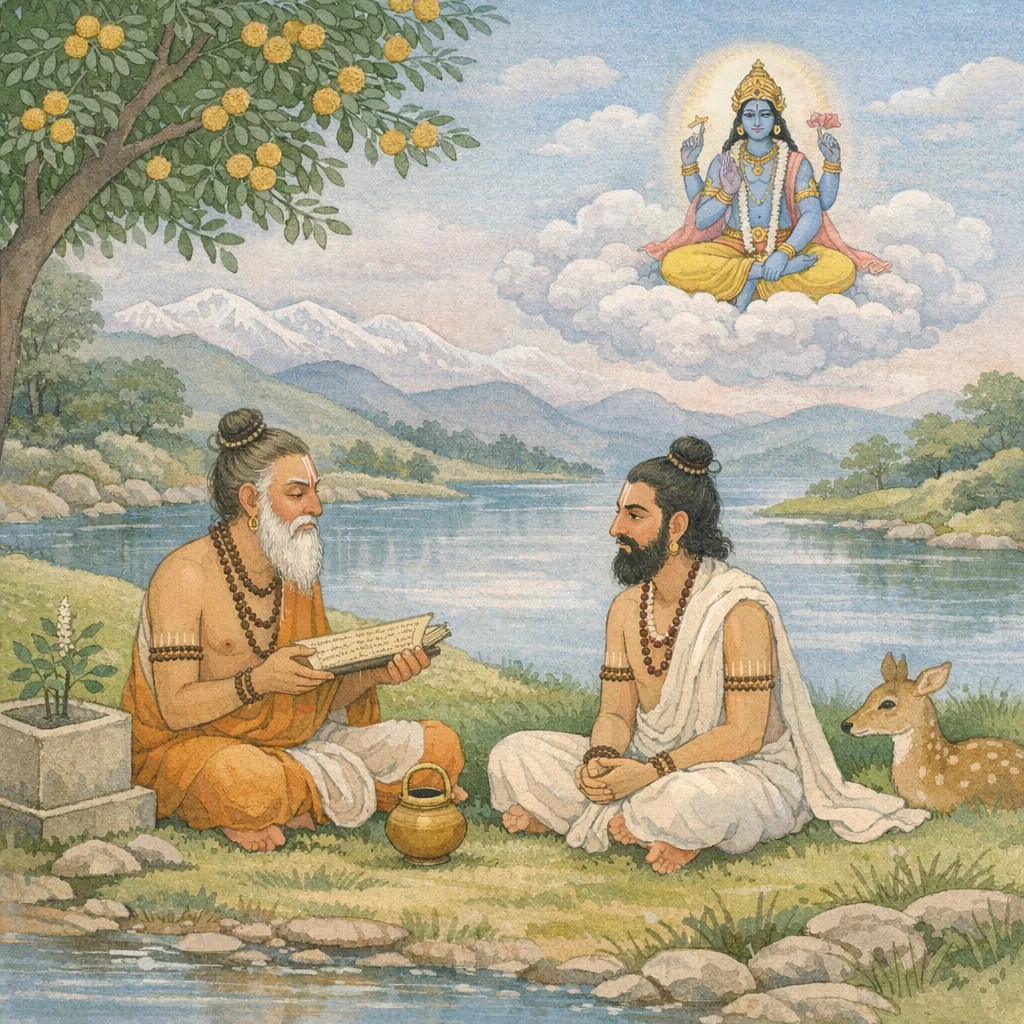
Adhyaya 1
Puṣkara Invocation, the Dharma-Wheel at Naimiṣa, and the Padma Purāṇa Prologue
The chapter opens with an auspicious praise of Puṣkara and its purifying waters, celebrated as a sacred means of removing impurity and gaining dharmic merit. It then turns to a layered account of transmission: Sūta (Ugraśravas), heir to Vyāsa’s disciplic line, is directed to approach the sages and answer their questions on dharma. At Naimiṣa the setting is sanctified through the Dharma-Wheel motif: the Lord (Hari/Viṣṇu) teaches that the land where the wheel’s rim wears away is supremely meritorious; then He becomes invisible, and the ṛṣis led by Śaunaka undertake a long sacrificial session. Sūta arrives, is honored, and the assembly requests the Padma Purāṇa, including an inquiry into creation— the lotus and the arising of Brahmā. The prologue also defines Sūta’s Purāṇic role, extols Vyāsa as Nārāyaṇa, and outlines the Padma Purāṇa’s divisions and core themes: creation, tīrthas, royal dharma, dynasties, and mokṣa.
Shlokas
Verse 1
स्वच्छं चंद्रावदातं करिकरमकरक्षोभसंजातफेनं । ब्रह्मोद्भूतिप्रसक्तैर्व्रतनियमपरैः सेवितं विप्रमुख्यैः । कारालंकृतेन त्रिभुवनगुरुणा ब्रह्मणा दृष्टिपूतं । संभोगाभोगरम्यं जलमशुभहरं पौष्करं वः पुनातु
May the water of Puṣkara purify you—clear and moon-bright, foaming from the churning raised by elephants and crocodiles; resorted to by foremost brāhmaṇas devoted to vows and disciplines, intent upon Brahmā’s manifestation; made holy by the gaze of Brahmā, teacher of the three worlds, adorned with radiant splendor; delightful for enjoyment and for renunciation alike, and a remover of all inauspiciousness.
Verse 2
सूतमेकांतमासीनं व्यासशिष्यं महामतिः । लोमहर्षणनामा वा उग्रश्रवसमाह तत्
Seeing Sūta, Vyāsa’s disciple, seated apart in solitude, the great sage addressed him, saying: “By name you are Lomaharṣaṇa, and you are also called Ugraśravas.”
Verse 3
ऋषीणामाश्रमांस्तात गत्वा धर्मान्समासतः । पृच्छतां विस्तराद्ब्रूहि यन्मत्तः श्रुतवानसि
O dear one, go to the hermitages of the ṛṣis and inquire concisely about dharma; and when they ask, explain to them in full detail what you have heard from me.
Verse 4
वेदव्यासान्मया पुत्र पुराणान्यखिलानि च । तवाख्यातानि प्राप्तानि मुनिभ्यो वद विस्तरात्
From Vedavyāsa, my son, I received all the Purāṇas; and since you have obtained them as I recounted, now expound them in detail to the munis.
Verse 5
प्रयागे मुनिवर्यैश्च यथापृष्टः स्वयं प्रभुः । पृष्टेन चानुशिष्टास्ते मुनयो धर्मकांक्षिणः
At Prayāga, when the Lord Himself was questioned by the foremost sages, He answered; and those sages, yearning for dharma, were instructed in accordance with what they asked.
Verse 6
देशं पुण्यमभीप्संतो विभुना च हितैषिणा । सुनाभं दिव्यरूपं च सत्यगं शुभविक्रमं
Desiring a holy land and guided by the mighty, benevolent Lord, they came upon Sunābha—of divine form—truthful in conduct and endowed with auspicious prowess.
Verse 7
अनौपम्यमिदं चक्रं वर्तमानमतंद्रिताः । पृष्टतो यातनियमात्पदं प्राप्स्यथ यद्धितम्
This incomparable cycle is in motion. Be diligent; follow from behind with disciplined restraint, and you will attain the beneficial state—your true welfare.
Verse 8
गच्छतो धर्मचक्रस्य यत्र नेमिर्विशीर्यते । पुण्यः स देशो मंतव्य इत्युवाच स्वयं प्रभुः
“Where the rim of the moving Wheel of Dharma wears away, that land should be regarded as supremely meritorious”—thus spoke the Lord Himself.
Verse 9
उक्त्वा चैवमृषीन्सर्वानदृश्यत्वमगात्पुनः । गंगावर्तसमाहारो नेमिर्यत्र व्यशीर्यत
Having thus addressed all the sages, he again became invisible. There is the confluence of the Ganges’ whirlpools—where the rim of the wheel (nemi) was shattered.
Verse 10
ईजिरे दीर्घसत्रेण ऋषयो नैमिषे तदा । तत्र गत्वा तु तान्ब्रूहि पृच्छतो धर्मसंशयान्
Then the sages performed a long sacrificial session (sattra) at Naimiṣa. Go there and address them, for they are asking questions and harbor doubts about dharma.
Verse 11
उग्रश्रवास्ततो गत्वा ज्ञानविन्मुनिपुंगवान् । अभिगम्योपसंगृह्य नमस्कृत्वा कृतांजलिः
Then Ugraśravā went to the foremost sages, abundant in knowledge; approaching them, he greeted them with reverence and, with hands joined, bowed in salutation.
Verse 12
तोषयामास मेधावी प्रणिपातेन तानृषीन् । ते चापि सत्रिणः प्रीताः ससदस्या महात्मने
The wise one pleased those sages by bowing down in reverence. And the officiating priests too—along with all the members of the assembly—were delighted with that great-souled person.
Verse 13
तस्मै समेत्य पूजां च यथावत्प्रतिपेदिरे । ऋषय ऊचुः । कुतस्त्वमागतः सूत कस्माद्देशादिहागतः
Approaching him, they offered due worship in the proper manner. The sages said: “O Sūta, from where have you come? From what land have you arrived here?”
Verse 14
कारणं चागमे ब्रूहि वृंदारकसमद्युते । सूत उवाच । पित्राहं तु समादिष्टो व्यासशिष्येण धीमता
“Also tell the reason for your coming, O one whose splendor equals that of the gods.” Sūta said: “I was instructed by my father, the wise disciple of Vyāsa.”
Verse 15
शुश्रूषस्व मुनीन्गत्वा यत्ते पृच्छंति तद्वद । वदंतु भगवंतो मां कथयामि कथां तु यां
“Go to the sages and attend upon them; whatever they ask you, answer. Let the venerable ones speak to me—then I shall narrate the sacred account that I know.”
Verse 16
पुराणं चेतिहासं वा धर्मानथ पृथग्विधान् । तां गिरं मधुरां तस्य शुश्रुवुरृषिसत्तमाः
Whether it was a Purāṇa or an Itihāsa, and whether it taught dharmas of many distinct kinds, the foremost sages listened to his sweet speech.
Verse 17
अथ तेषां पुराणस्य शुश्रूषा समपद्यत । दृष्ट्वा तमतिविश्वस्तं विद्वांसं लौमहर्षणिं
Then they became eager to listen attentively to that Purāṇa, having seen Lomaharṣaṇa’s son—an eminently trustworthy and learned sage.
Verse 18
तस्मिन्सत्रे कुलपतिस्सर्वशास्त्राविशारदः । शौनको नाम मेधावी विज्ञानारण्यके गुरुः
In that sacrificial session, the presiding sage—well-versed in all the scriptures—was the wise Śaunaka, the revered teacher of the assembly at Vijñānāraṇya.
Verse 19
इत्थं तद्भावमालंब्य धर्माञ्छुश्रूषुराह तम् । त्वया सूत महाबुद्धे भगवान्ब्रह्मवित्तमः
Thus, taking to that disposition and eager to hear of dharma, he said to him: “O Sūta, O great-minded one—through you the venerable one, the foremost knower of Brahman, shall speak.”
Verse 20
इतिहासपुराणार्थं व्यासः सम्यगुपासितः । दुदोहिथमतिं तस्य त्वं पुराणाश्रयां शुभां
Vyāsa, duly devoted to the meaning of the Itihāsas and Purāṇas, has served you well; and you, in turn, have drawn forth—like milk from a cow—his intellect into an auspicious understanding grounded in the Purāṇas.
Verse 21
अमीषां विप्रमुख्यानां पुराणं प्रति सम्प्रति । शुश्रूषाऽस्ते महाबुद्धे तछ्रावयितुमर्हसि
Now, O great-minded one, I long to hear this Purāṇa as taught by the foremost among the brāhmaṇas; therefore you should recite it.
Verse 22
सर्वे हीमे महात्मानो नानागोत्राः समागताः । स्वान्स्वानंशान्पुराणोक्ताञ्छृण्वन्तु ब्रह्मवादिनः
All these great souls, of diverse lineages, have assembled here. Let these expounders of Brahman now listen to the portions allotted to each, as declared in the Purāṇas.
Verse 23
संपूर्णे दीर्घसत्रेस्मिंस्तांस्त्वं श्रावय वै मुनीन् । पाद्मं पुराणं सर्वेषां कथयस्व महामते
When this long sacrificial session is completed, do recite it to those sages; O great-minded one, narrate the Padma Purāṇa for the benefit of all.
Verse 24
कथं पद्मं समुद्भूतं ब्रह्म तत्र कथं न्वभूत् । प्रोद्भूतेन कथं सृष्टिः कृता तां तु तथा वद
How did the lotus arise, and how indeed did Brahmā come to be there? And when he had arisen, how was creation brought about? Tell me that exactly as it happened.
Verse 25
एवं पृष्टस्ततस्तांस्तु प्रत्युवाच शुभां गिरम् । सूक्ष्मं च न्यायसंयुक्तं प्राब्रवीद्रौमहर्षणिः
Thus questioned, he then replied to them with auspicious words; and Raumaharṣaṇi spoke a subtle discourse, well-grounded in reason and propriety.
Verse 26
प्रीतोस्म्यनुगृहीतोस्मि भवद्भिरिह चोदनात् । पुराणार्थं पुराणज्ञैः सर्वधर्मपरायणैः
I am delighted; I have been shown favor here by your earnest urging—to declare the purport of the Purāṇa, as requested by those who know the Purāṇas and are devoted to all dharma.
Verse 27
यथाश्रुतं सुविख्यातं तत्सर्वं कथयामि वः । धर्म एष तु सूतस्य सद्भिर्दृष्टः सनातनः
Just as I have heard it, and as it is well renowned, I shall recount it all to you. This indeed is the eternal dharma of the Sūta, as recognized by the virtuous.
Verse 28
देवतानामृषीणां च राज्ञां चामिततेजसाम् । वंशानां धारणं कार्यं स्तुतीनां च महात्मनाम्
The lineages of the gods, the ṛṣis, and the kings of immeasurable splendor should be preserved, and so too the hymns of praise for the great-souled.
Verse 29
इतिहासपुराणेषु दृष्टा ये ब्रह्मवादिनः । न हि वेदेष्वधीकारः कश्चित्सूतस्य दृश्यते
In the Itihāsas and Purāṇas are seen those known as expounders of Brahman; for in the Vedas, no entitlement (adhikāra) for a Sūta is seen at all.
Verse 30
वैन्यस्य हि पृथोर्यज्ञे वर्त्तमाने महात्मनः । मागधश्चैव सूतश्च तमस्तौतां नरेश्वरम्
While the great-souled Pṛthu, son of Vena, was conducting his yajña, the Māgadha and the Sūta bards then praised that king of men.
Verse 31
तुष्टेनाथ तयोर्द्दत्तो वरो राज्ञा महात्मना । सूताय सूतविषयो मगधो मागधाय च
Then, pleased with them, the great-souled king granted a boon: to the Sūta he gave the Sūta-territory, and to the Māgadha he gave Magadha as well.
Verse 32
तत्र सूत्यां समुत्पन्नः सूतो नामेह जायते । ऐन्द्रे सत्रे प्रवृत्ते तु ग्रहयुक्ते बृहस्पतौ
There, from Sūtī was born one who came to be known here as Sūta, when Indra’s sacrificial session was underway and Bṛhaspati (Jupiter) stood in an auspicious conjunction with the planets.
Verse 33
तमेवेंद्रं बार्हस्पत्ये तत्र सूतो व्यजायत । शिष्यहस्तेन यत्पृक्तमभिभूतं गुरोर्हविः
There, in that rite connected with Bṛhaspati, a Sūta was born from Indra himself—because the oblation belonging to the guru was overpowered, having been mixed by a disciple’s hand.
Verse 34
अधरोत्तरधारेण जज्ञे तद्वर्णसंकरम् । येत्र क्षत्रात्समभवन्ब्राह्मण्याश्चैव योनितः
From the union of a lower and a higher line there arose that mixture of varṇas—wherein some were born of a Kṣatriya father and from the womb of a Brāhmaṇa woman.
Verse 35
पूर्वेणैव तु साधर्म्याद्वैधर्मास्ते प्रकीर्तिताः । मध्यमो ह्येष सूतस्य धर्मः क्षेत्रोपजीविनः
Indeed, because of its similarity with the former, their distinguishing features have been described. This, however, is the intermediate dharma of the Sūta—one who earns a living by serving the sacred kṣetras.
Verse 36
पुराणेष्वधिकारो मे विहितो ब्राह्मणैरिह । दृष्ट्वा धर्ममहं पृष्टो भवद्भिर्ब्रह्मवादिभिः
Here the Brahmins have vested me with authority over the Purāṇas. Seeing my steadfastness in Dharma, you—O expounders of Brahman—have questioned me.
Verse 37
तस्मात्सम्यग्भुवि ब्रूयां पुराणमृषिपूजितम् । पितॄणां मानसी कन्या वासवं समपद्यत
Therefore I shall rightly proclaim on earth this Purāṇa, revered by the sages. The Pitṛs’ mind-born daughter came to be united with Vāsava (Indra).
Verse 38
अपध्याता च पितृभिर्मत्स्यगर्भे बभूव सा । अरणीव हुताशस्य निमित्तं पुण्यजन्मनः
Neglected by the Pitṛs, she came to dwell within the womb of a fish; and, like the araṇi that brings forth fire, she became the instrumental cause of a holy, meritorious birth.
Verse 39
तस्यां बभूव पूतात्मा महर्षिस्तु पराशरात् । तस्मै भगवते कृत्वा नमः सत्याय वेधसे
From Parāśara was born a pure-souled great sage. Having offered obeisance to that Blessed Lord—true and all-ordaining Vedhas—he bowed in reverent devotion.
Verse 40
पुरुषाय पुराणाय ब्रह्मवाक्यानुवर्तिने । मानवच्छद्मरूपाय विष्णवे शंसितात्मने
Salutations to Viṣṇu—the Supreme Puruṣa, the Ancient One—who follows Brahmā’s words, who assumes a human guise as a veil, and whose very nature is praised by the wise.
Verse 41
जातमात्रं च यं वेद उपतस्थे ससंग्रहः । मतिमंथानमाविध्य येनासौ श्रुतिसागरात्
As soon as he was born, the Veda—together with its compendiums—attended upon him; and by churning the intellect as a churning-rod, he drew forth knowledge from the ocean of Śruti, revelation.
Verse 42
प्रकाशो जनितो लोके महाभारत चंद्रमाः । भारतं भानुमान्विष्णुर्यदि न स्युरमी त्रयः
Light is brought forth in the world—the Mahābhārata is the moon, and Bhārata is the sun, O Viṣṇu; if these three did not exist, such illumination would not be.
Verse 43
ततोऽज्ञानतमोंधस्य कावस्था जगतो भवेत् । कृष्णद्वैपायनं व्यासं विद्धि नारायणं प्रभुम्
Otherwise, what state would this world fall into, blinded by the darkness of ignorance? Know Vyāsa, Kṛṣṇa-Dvaipāyana, to be Lord Nārāyaṇa Himself.
Verse 44
को ह्यन्यः पुंडरीकाक्षान्महाभारतकृद्भवेत् । तस्मादहमुपाश्रौषं पुराणं ब्रह्मवादिनः
Who else, apart from the Lotus-eyed Lord, could be the author of the Mahābhārata? Therefore I have duly listened to this Purāṇa as taught by the expounders of Brahman, the knowers of sacred truth.
Verse 45
सर्वज्ञात्सर्वलोकेषु पूजिताद्दीप्ततेजसः । पुराणं सर्वशास्त्राणां प्रथमं ब्रह्मणा स्मृतम्
This Purāṇa—known to the Omniscient One, revered in all worlds, and radiant with splendor—was remembered by Brahmā as the first among all scriptures.
Verse 46
उत्तमं सर्वलोकानां सर्वज्ञानोपपादकम् । त्रिवर्गसाधनं पुण्यं शतकोटिप्रविस्तरम्
It is supreme for all worlds, the bestower of all knowledge; a holy means to the three aims of life, vast in extent—spreading over a hundred crores.
Verse 47
निःशेषेषु च लोकेषु वाजिरूपेण केशवः । ब्रह्मणस्तु समादेशाद्वेदानाहृतवानसौ
Then Keśava, taking the form of a horse and moving through all the worlds without exception, brought back the Vedas in accordance with Brahmā’s command.
Verse 48
अंगानि चतुरो वेदान्पुराणन्यायविस्तरम् । असुरेणाखिलं शास्त्रमपहृत्यात्मसात्कृतम्
The Vedāṅgas, the four Vedas, the Purāṇas, and the extensive body of Nyāya—indeed the entire corpus of sacred learning—was seized by an Asura and made his own.
Verse 49
मत्स्यरूपेणाजहार कल्पादावुदकार्णवे । अशेषमेतदवददुदकांतर्गतो विभुः
In the form of a fish, at the beginning of the aeon, the all-pervading Lord recovered it in the ocean of waters; and, while remaining within the waters, He explained all of this in full.
Verse 50
श्रुत्वा जगाद च मुनीन्प्रतिवेदांश्चतुर्मुखः । प्रवृत्तिस्सर्वशास्त्राणां पुराणस्याभवत्तदा
Having heard them, the four-faced one (Brahmā) then spoke to the sages and to those versed in each Veda; and at that time the transmission of all the śāstras—especially the Purāṇa—came into being.
Verse 51
कालेनाग्रहणं दृष्ट्वा पुराणस्य तदा विभुः । व्यासरूपस्तदा ब्रह्मा संग्रहार्थं युगे युगे
Seeing that, with the passage of time, the Purāṇa was no longer properly retained, the Lord Brahmā—assuming the form of Vyāsa—compiled it for preservation in every age.
Verse 52
चतुर्लक्षप्रमाणेन द्वापरे द्वापरे जगौ । तदाष्टादशधा कृत्वा भूलोकेस्मिन्प्रकाशितं
In every Dvāpara age, it was recited in a measure of four lakhs (of verses). Then, dividing it into eighteen parts, it was made manifest here in the human world.
Verse 53
अद्यापि देवलोकेषु शतकोटिप्रविस्तरम् । तदेवात्र चतुर्लक्षं संक्षेपेण निवेशितम्
Even now, in the worlds of the gods, it extends to a hundred crores in full detail; that very same teaching is presented here in brief, condensed into four lakhs (of verses).
Verse 54
प्रवक्ष्यामि महापुण्यं पुराणं पाद्मसञ्ज्ञितम् । सहस्रं पञ्चपञ्चाशत्पंचखण्डैस्समन्वितम्
I shall expound the supremely meritorious Purāṇa known as the Padma (Padma Purāṇa), consisting of fifty-five thousand verses and arranged into five sections (khaṇḍas).
Verse 55
तत्रादौ सृष्टिखण्डं स्याद्भूमिखण्डं ततः परम् । स्वर्गखण्डं ततः पश्चात्ततः पातालखण्डकम्
There, first is said to be the Sṛṣṭi-khaṇḍa; next comes the Bhūmi-khaṇḍa. After that is the Svarga-khaṇḍa, and then the Pātāla-khaṇḍa.
Verse 56
पञ्चमं च ततः ख्यातमुत्तरं खण्डमुत्तमम् । एतदेव महापद्ममुद्भूतं यन्मयं जगत्
Thereafter, the fifth section is renowned as the excellent Uttara-khaṇḍa. From this very Great Lotus (Mahāpadma) the universe has arisen, constituted of it.
Verse 57
तद्वृत्तान्ताश्रयं यस्मात्पाद्ममित्युच्यते ततः । एतत्पुराणममलं विष्णुमाहात्म्यनिर्मलम्
Because it rests upon that account, it is therefore called the Padma (Purāṇa). This Purāṇa is spotless—utterly pure through the glorification of Viṣṇu.
Verse 58
देवदेवो हरिर्यद्वै ब्रह्मणे प्रोक्तवान्पुरा । ब्रह्मणाभिहितं पूर्वं यावन्मात्रं मरीचये
Whatever the God of gods, Hari, formerly taught to Brahmā—Brahmā, in earlier times, conveyed only that much to Marīci.
Verse 59
एतदेव च वै ब्रह्मा पाद्मं लोके जगाद वै । सर्वभूताश्रयं तच्च पाद्ममित्युच्यते बुधैः
Indeed, Brahmā himself proclaimed this in the world as the “Pādma”; and because it is the support of all beings, the wise call it “Pādma.”
Verse 60
पाद्मं तत्पंचपंचाशत्सहस्राणीह पठ्यते । पंचभिः पर्वभिः प्रोक्तं संक्षेपाद्व्यासकारितात्
That Padma Purāṇa is recited here as consisting of fifty-five thousand verses; it has been taught in five sections, in concise form, as arranged by Vyāsa.
Verse 61
पौष्करं प्रथमं पर्व यत्रोत्पन्नः स्वयं विराट् । द्वितीयं तीर्थपर्व स्यात्सर्वग्रहगणाश्रयम्
Puṣkara is the first sacred division, for there the cosmic Virāṭ manifested of himself. The second is the division of the tīrthas, the holy fords, the refuge and support of all the hosts of planets.
Verse 62
तृतीयपर्वग्रहणा राजानो भूरिदक्षिणाः । वंशानुचरितं चैव चतुर्थे परिकीर्तितम्
In the third section are described the kings who undertook sacred observances and bestowed abundant dāna; and in the fourth are recounted the lineages of dynasties and their histories.
Verse 63
पंचमे मोक्षतत्वं च सर्वतत्वं निगद्यते । पौष्करे नवधा सृष्टिः सर्वेषां ब्रह्मकारिता
In the fifth section, the tattva of liberation (mokṣa) and the tattva of all realities are taught. At Puṣkara, creation is described as ninefold—brought about for all beings by Brahmā.
Verse 64
देवतानां मुनीनां च पितृसर्गस्तथापरः । द्वितीये पर्वताश्चैव द्वीपाः सप्त ससागराः
There is also the creation of the devas, the sages (munis), and the Pitṛs, the ancestral fathers. In the second section, the mountains are described, as well as the seven dvīpas together with their oceans.
Verse 65
तृतीये रुद्रसर्गस्तु दक्षशापस्तथैव च । चतुर्थे संभवो राज्ञां सर्ववंशानुकीर्त्तनम्
In the third section there is the creation connected with Rudra, and likewise the curse of Dakṣa. In the fourth, there is the origin of kings and the narration of all dynasties.
Verse 66
अन्त्येपवर्गसंस्थानं मोक्षशास्त्रानुकीर्त्तनम् । सर्वमेतत्पुराणेऽस्मित्कथयिष्यामि वो द्विजाः
I shall relate to you, O twice-born ones, in this Purāṇa everything: how final liberation is established, and the exposition of the śāstras of mokṣa.
Verse 67
इदं पवित्रं यशसो निधानमिदं पितॄणामतिवल्लभं स्यात् इदं च देवस्य सुखाय नित्यमिदं महापातकभिच्च पुंसाम्
This is sacred, a treasury of good repute. It becomes exceedingly dear to the ancestors. It is ever for the delight of the Deity, and for people it is also a destroyer of great sins.