Bhuvaneśī (Nidrā-Śakti) Mantra-vidhi, Nyāsa–Āvaraṇa Worship, Padma-homa Prayogas, and the Opening of Śrī-Mahālakṣmī Upāsanā
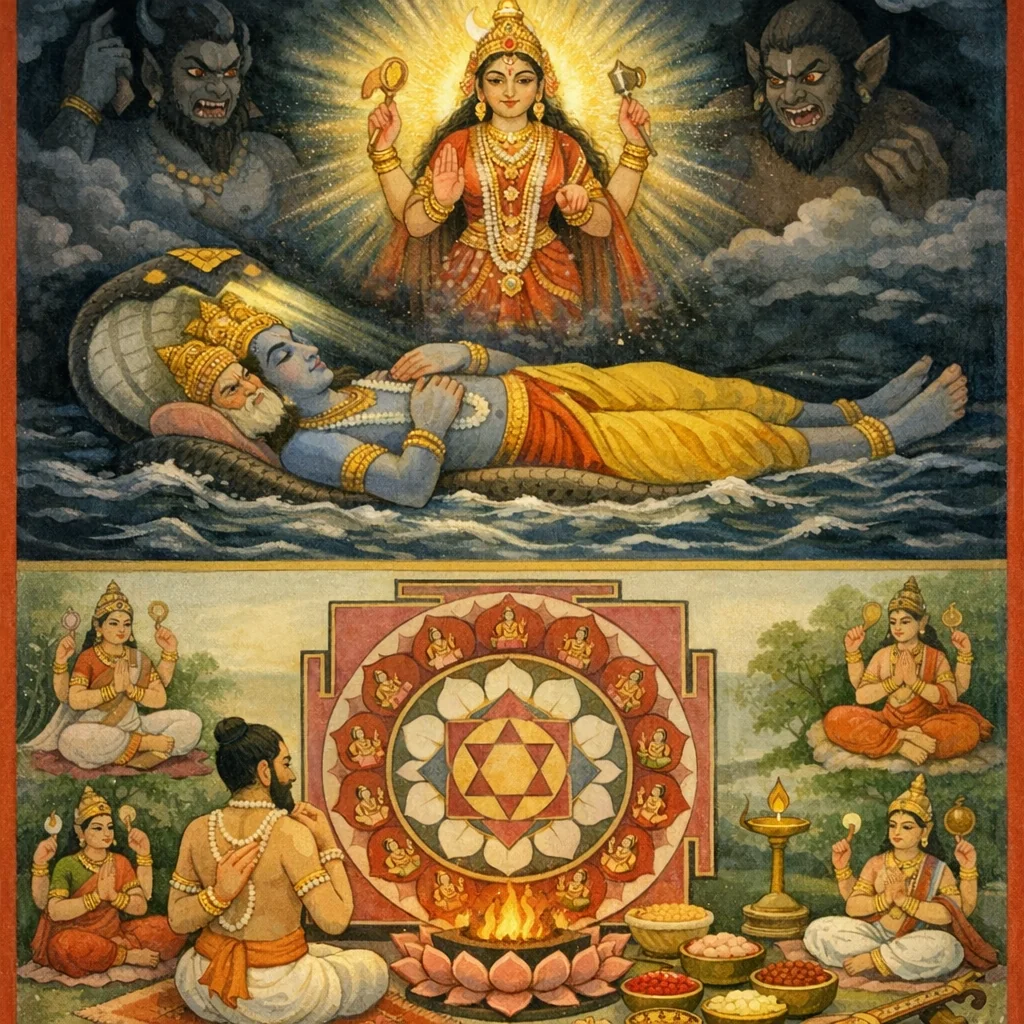
Sanatkumāra instructs a brāhmaṇa (in the Sanakādi-to-Nārada teaching stream) by first grounding the rite in a pralaya-era myth: Madhu and Kaiṭabha arise from impurity in Viṣṇu’s ear while Brahmā sits on the lotus, prompting praise of Jagadambikā as Nidrā-Śakti in Nārāyaṇa’s eyes. The chapter then presents a structured sādhana for Bhuvaneśvarī/Bhuvaneśī: bīja-mantra credentials (ṛṣi/chandas/devatā), ṣaḍaṅga-nyāsa and mātṛkā installation, mantra-nyāsa on bodily loci with associated deities (Brahmā, Viṣṇu, Rudra, Kubera, Kāma, Gaṇapati), dhyāna, japa count, and homa with prescribed dravyas. It describes a yantra/maṇḍala (lotus petals, hexagon, nine śaktis, āvaraṇas) and directional worship of paired deities with attendant śaktis. It concludes with practical prayogas (influence, prosperity, poetic intelligence, marriage, childbirth) and transitions to the Mahiṣāsura episode and Śrī-bīja mantra metadata (Bhṛgu as ṛṣi; Nivṛt as chandas; Śrī as devatā).
Shlokas
Verse 1
सनत्कुमार उवाच । कलिकल्पांतरे ब्रह्मन् ब्रह्मणोऽव्यक्तजन्मनः । लोकपद्मे तपस्थस्य सृष्ट्यर्थं संबभूवतुः ॥ १ ॥
Sanatkumāra said: O Brahmin, in another cycle of the Kali-kalpa, when Brahmā—whose origin is unmanifest—was performing austerities upon the lotus of the worlds, the two came into being for the purpose of creation.
Verse 2
विष्णुकर्णमलोद्भूतावसुरौ मधुकैटभौ । तौ जातमात्रौ पयसि लोकप्रलयलक्षणे ॥ २ ॥
From the impurity (like ear-wax) of Viṣṇu’s ear arose the two Asuras, Madhu and Kaiṭabha; and as soon as they were born, they were in the waters, when the world bore the marks of pralaya, cosmic dissolution.
Verse 3
जानुमात्रे स्थितौ दृष्ट्वा ब्रह्मणं कमलस्थितम् । प्रवृत्तावत्तुमालक्ष्य तुष्टाव जगदंबिकाम् ॥ ३ ॥
Seeing Brahmā seated upon the lotus, and noticing that he had begun to devour it, she praised Jagadambikā, the Mother of the universe.
Verse 4
ततो देवी जगत्कर्त्री शैवी शक्तिरनुत्तमा । नारायणाक्षिसंस्थाना निद्रा प्रीता बभूव ह ॥ ४ ॥
Then the Goddess—the supreme Śaiva power, the creatrix of the world—who abides in Nārāyaṇa’s eyes as Sleep (Nidrā), became pleased.
Verse 5
तस्या मंत्रादिकं सर्वं कथयिष्यामि तच्छृणु । सारुणा क्रोधनी शांतिश्चंद्रालंकृतशेखरा ॥ ५ ॥
Now listen: I shall set forth in full all her mantras and the rites allied to them. She is Sāruṇā, Krodhanī, and Śānti—the Goddess whose crest is adorned with the moon.
Verse 6
एकाक्षरीबीज मन्त्रऋषिः शक्तिरुदाहृता । गायत्री च भवेच्छन्दो देवता भुवनेश्वरी ॥ ६ ॥
For the one-syllable bīja (seed) mantra, the mantra’s seer (ṛṣi) is declared to be Śakti; its meter (chandas) is Gāyatrī; and its presiding deity is Bhuvaneśvarī.
Verse 7
षड्दीर्घयुक्तबीजेन कुर्यादंगानि षट् क्रमात् । संहारसृष्टिमार्गेण मातृकान्यस्तविग्रहः ॥ ७ ॥
With the seed-mantra joined to the six long vowels, he should perform in due order the six aṅga-nyāsas; and, having installed the mātṛkās upon the body, he should proceed by the method of withdrawal (saṃhāra) and emanation (sṛṣṭi).
Verse 8
मन्त्रन्यासं ततः कुर्याद्देवताभावसिद्धये । हृल्लेखां मूर्ध्नि वदने गगनां हृदयांबुजे ॥ ८ ॥
Then he should perform mantra-nyāsa in order to accomplish the realization of deity-presence (devatā-bhāva). He should place “Hṛllekhā” upon the head and face, and “Gaganā” upon the lotus of the heart.
Verse 9
रक्तां करालिकां गुह्ये महोच्छुष्मां पदद्वये । ऊर्द्ध्वप्राग्दक्षिणोदीच्यपश्चिमेषूत्तरेऽपि च ॥ ९ ॥
He should place these divine energies: Raktā, the Red One, and Karālikā in the secret part (guhya); Mahocchuṣmā in both feet; and likewise assign them in the upper region and in the directions—east, south, north, west, and also the northern quarter.
Verse 10
सद्यादिह्रस्वबीजाद्यान्वस्तव्या भूतसप्रभाः । अंगानि विन्यसेत्पश्चाज्जातियुक्तानि षट् क्रमात् ॥ १० ॥
One should perform nyāsa by placing the short seed-syllables beginning with “sadya” and the radiant mantras connected with the elements; thereafter, one should set in order the six aṅgas, each accompanied by its proper jāti.
Verse 11
ब्रह्माणं विन्यसेद्भाले गायत्र्या सह संयुतम् । सावित्र्या सहितं विष्णुं कपोले दक्षिणे न्यसेत् ॥ ११ ॥
By nyāsa one should place Brahmā upon the forehead, joined with the Gāyatrī; and one should place Viṣṇu upon the right cheek, together with the Sāvitrī.
Verse 12
वागीश्वर्या समायुक्तं वामगंडे महेश्वरम् । श्रिया धनपतिं न्यस्य वामकर्णाग्रके पुनः ॥ १२ ॥
Then, by nyāsa, one should place Maheśvara (Mahādeva), endowed with the power of speech as Vāgīśvarī, upon the left cheek; and, together with Śrī (prosperity), one should again place Dhanapati (Kubera) at the tip of the left ear.
Verse 13
रत्या स्मरं मुखे न्यस्य पुण्यागणपतिं न्यसेत् । सव्यकर्णोपरि निधाकर्णगंडांतरालयोः ॥ १३ ॥
Placing by nyāsa the mantra of Smara (Kāma) upon the mouth, one should then place the mantra of the auspicious Gaṇapati—upon the upper part of the left ear, and also in the region between the ear and the cheek.
Verse 14
न्यस्तव्यं वदने मूलं भूपश्चैत्रांस्ततो न्यसेत् । कण्ठमूले स्तनद्वंद्वे वामांसे हृदयांबुजे ॥ १४ ॥
One should perform nyāsa of the Mūla (root mantra) upon the mouth; then one should place the letters/mantras beginning with “bhūpa” and “caitrā” at the base of the throat, upon the pair of breasts, upon the left shoulder, and upon the lotus of the heart.
Verse 15
सव्यांसे पार्श्वयुगले नाभिदेशे च देशिकः । भालांश्च पार्श्वजठरे पार्श्वांसापरके हृदि ॥ १५ ॥
The preceptor (Deśika) is to be installed on the left shoulder, on both sides, and in the region of the navel; the Bhāla powers are to be placed on the flank and the belly; and the Pārśvāṃsa (side-limb) power is to be set in the heart on the other side.
Verse 16
ब्रह्माण्याद्यास्तनौ न्यस्य विधिना प्रोक्तलक्षणाः । मूलेन व्यापकं देहे न्यस्य देवीं विचिंतयेत् ॥ १६ ॥
Placing (the mantras beginning with) Brahmāṇī and the rest upon the two breasts, according to the prescribed rite and stated marks, one should then, by means of the root-mantra, install the all-pervading power throughout the body and meditate intently upon the Goddess.
Verse 17
उद्यद्दिवाकरनिभां तुंगोरोजां त्रिलोचनाम् । स्मरास्यामिंदुमुकुटां वरपाशांकुशाभयाम् ॥ १७ ॥
I shall meditate upon her—radiant like the rising sun, high-breasted, three-eyed—whose face is enchanting; who wears the moon as her crown, and whose excellent hands bear the noose (pāśa), goad (aṅkuśa), and the gesture of fearlessness (abhaya).
Verse 18
रदलक्षं जपेन्मंत्रं त्रिमध्वक्तैर्हुनेत्ततः । अष्टद्रव्यैर्दशांशेन ब्रह्मवृक्षसमिद्वरैः ॥ १८ ॥
One should repeat the mantra in japa one hundred thousand times. Thereafter, one should perform a fire-offering (homa) with a mixture of the three sweet substances and ghee; using the eight ritual ingredients, the oblations should be made as one-tenth of the number of japa, with excellent fuel-sticks from the brahma-tree.
Verse 19
द्राक्षाखर्जूरवातादशर्करानालिकेरकम् । तन्दुलाज्यतिलं विप्र द्रव्याष्टकमुदाहृतम् ॥ १९ ॥
Grapes, dates, almonds, sugar, coconut, rice, ghee, and sesame—O brāhmaṇa—these are declared to be the eight ritual substances.
Verse 20
दद्यादर्ध्यं दिनेशाय तत्र संचिन्त्य पार्वतीम् । पद्ममष्टदलं बाह्ये वृत्तं षोडशभिर्द्दलैः ॥ २० ॥
One should offer arghya, the reverent water-offering, to the Sun-god while meditating there upon Pārvatī. Then one should fashion a lotus of eight petals, and on the outside a circular enclosure of sixteen petals.
Verse 21
विलिखेत्कर्णिकामध्ये षट्कोणमतिसुन्दरम् । ततः संपूजयेत्पीठं नवशक्तिसमन्वितम् ॥ २१ ॥
In the center of the lotus-whorl one should draw a most beautiful hexagon. Then one should duly worship the sacred seat, the pīṭha, endowed with the nine Śaktis.
Verse 22
जयाख्या विजया पश्चादजिताह्वापराजिता । नित्या विलासिनी गोग्धीत्यघोरा मंगला नव ॥ २२ ॥
Next come the nine auspicious appellations: Jayākhyā, Vijayā; then Ajitāhvā and Aparājitā; Nityā, Vilāsinī, Gogdhī; and also Aghorā and Maṅgalā.
Verse 23
बीजाढ्यमासनं दत्त्वा मूर्तिं तेनैव कल्पयेत् । तस्यां संपूजयेद्देवीमावाह्यावरणैः क्रमात् ॥ २३ ॥
After offering an āsana enriched with seed-mantras, one should fashion the deity’s icon accordingly. Then, having invoked the Goddess into it, one should worship Her fully, step by step, together with the successive protective enclosures, the āvaraṇas.
Verse 24
मध्यपाग्याम्यसौम्येषु पूजयेदंगदेवताः । षट्कोणेषु यजेन्मंत्री पश्चान्मिथुनदेवताः ॥ २४ ॥
In the central region, and in the auspicious directions—the eastern and northern quarters—one should worship the aṅga-devatās, the limb-deities. In the six-angled sections (ṣaṭkoṇas), the mantra-knowing officiant should perform worship; thereafter he should worship the paired deities (mithuna-devatās).
Verse 25
इन्द्रकोणं लसद्दंडकुंडिकाक्षगुणाभयाम् । गायत्रीं पूजयेन्मन्त्री ब्रह्माणमपि तादृशम् ॥ २५ ॥
In the Indra quarter (the east), the mantra-practitioner should worship radiant Gāyatrī—holding a staff and a water-pot (kuṇḍikā), bearing a rosary, showing the teaching gesture, and granting fearlessness; and likewise he should worship Brahmā in the same manner.
Verse 26
रक्षः कोणे शंखचक्रगदापंकजधारिणीम् । सावित्रीं पीतवसनां यजेद्विणुं च तादृशम् ॥ २६ ॥
In the Rakṣas (protective) corner, one should worship Sāvitrī, clad in yellow garments and bearing the conch, discus, mace, and lotus; and one should also worship Viṣṇu in the same form.
Verse 27
वायुकोणे परश्वक्षमाला भयवरान्विताम् । यजेत्सरस्वतीमच्छां रुद्रं तादृशलक्षणम् ॥ २७ ॥
In the Vāyu corner (the northwest), one should worship the pure Sarasvatī, bearing an axe and a rosary and showing the gestures of fearlessness and boon-giving; likewise, one should worship Rudra with the same distinguishing marks.
Verse 28
वह्निकोणे यजेद्रत्नकुंभं मणिकरंडकम् । कराभ्यां बिभ्रतीं पीतां तुंदिलं धनदायकम् ॥ २८ ॥
In the fire corner (the southeast), one should worship the bearer of the jewel-pot and the jeweled casket—yellow-hued, pot-bellied, a bestower of wealth—holding them in both hands.
Verse 29
आलिंग्य सव्यहस्तेन वामे तांबूलधारिणीम् । धनदांकसमारूढां महालक्ष्मीं प्रपूजयेत् ॥ २९ ॥
Embracing her with his left arm, one should duly worship Mahālakṣmī—who holds tāmbūla (betel) in her left hand and is seated upon the lap of Dhanada (Kubera).
Verse 30
पश्चिमे मदनं बाणपाशांकुशशरासनाम् । धारयंतं जपारक्तं पूजयेद्रक्तभूषणम् ॥ ३० ॥
In the western quarter, one should worship Madana (Kāma), bearing the arrow, noose, goad, and bow—red like the hibiscus blossom and adorned with red ornaments.
Verse 31
सव्येन पतिमाश्लिष्य वामेनोत्पलधारिणीम् । पाणिना रमणांकस्थां रतिं सम्यक्समर्चयेत् ॥ ३१ ॥
With her left side embracing her husband and her left hand holding a lotus, one should duly worship Rati, seated upon her beloved’s lap, with the right hand in proper rite.
Verse 32
ऐशान्ये पूजयेत्सम्यक् विघ्नराजं प्रियान्वितम् । सृणिपाशधरं कांतं वरांगासृक्कलांगुलिम् ॥ ३२ ॥
In the north-eastern quarter, one should duly worship Vighnarāja (Gaṇeśa), accompanied by his beloved consort—charming in form, bearing the goad and noose, and marked with auspicious limbs and red-tinted features.
Verse 33
माध्वीपूर्णकपालाढ्यं विघ्नराजं दिगंबरम् । पुष्करे विगलद्रत्नस्फुरच्चषकधारिणम् ॥ ३३ ॥
I meditate upon Vighnarāja (Gaṇeśa), clad in the sky (naked), richly adorned with a skull-bowl filled with honey-wine, and holding in his lotus-hand a radiant cup, gleaming with jewels as though dripping with light.
Verse 34
सिंदूरसदृशाकारामुद्दाममदविभ्रमाम् । धृतरक्तोत्पलामन्यपाणिना तु ध्वजस्पृशाम् ॥ ३४ ॥
She appeared in a form like vermilion (sindūra), swaying with unrestrained, intoxicated grace; holding a red lotus, and with her other hand touching the banner (standard).
Verse 35
आश्लिष्टकांतामरुणां पुष्टिमर्चेद्दिगंबराम् । कर्णिकायां निधी पूज्यौ षट्कोणस्याथ पार्श्वयोः ॥ ३५ ॥
One should worship Puṣṭi—of reddish hue, “clad in space” (nude), and closely embracing her beloved. In the central pericarp (of the diagram) the two Nidhis (Treasures) are to be worshipped, and then placed on the two sides of the hexagon.
Verse 36
अंगानि केसरेष्वेताः पश्चात्पत्रेषु पूजयेत् । अनंगकुसुमा पश्चाद्द्वितीयानंगमेखला ॥ ३६ ॥
One should worship these aṅga-devatās first upon the filaments (kesara) and thereafter upon the petals. After that comes Anaṅgakusumā, and next the second, named Anaṅgamekhalā.
Verse 37
अनंगगमना तद्वदनंगमदनातुरा । भुवनपाला गगनवेगा षष्ठी चैव ततः परम् ॥ ३७ ॥
Anangagamanā; likewise Anangamadanāturā; Bhuvanapālā; Gaganavegā—these are the names; and thereafter comes the sixth in the sequence.
Verse 38
शशिलेखा गगनलेखा चेत्यष्टौ यत्र शक्तयः । खङ्गखेटकधारिण्यः श्यामाः पूज्याश्च मातरः ॥ ३८ ॥
There, in that sacred setting, are eight divine Śaktis—such as Śaśilekhā and Gaganalekhā—dark-hued Mother-goddesses, worthy of worship, bearing sword and shield.
Verse 39
पद्माद्बहिः समभ्यर्च्याः शक्तयः परिचारिकाः । प्रथमानंगद्वयास्यादनंगमदना ततः ॥ ३९ ॥
Outside the lotus (seat/diagram), the attendant Śaktis are to be duly worshipped. First is Anaṅgadvayāsyā; thereafter comes Anaṅgamadanā.
Verse 40
मदनातुरा भवनवेगा ततो भुवनपालिका । स्यात्सर्वशिशिरानंगवेदनानंगमेखला ॥ ४० ॥
Then she is afflicted by Kāma (desire), her movements becoming swift; the protectress of the worlds seems as though girdled by passion, tasting the pains of longing through the whole chilly season.
Verse 41
चषकं तालवृंतं च तांबूलं छत्रमुज्ज्वलम् । चामरे चांशुकं पुष्पं बिभ्राणाः करपंकजैः ॥ ४१ ॥
With lotus-like hands they bore a drinking cup, a palm-leaf fan, tāmbūla (betel), a radiant parasol, yak-tail fans (cāmara), garments, and flowers—standing in reverent service with these offerings.
Verse 42
सर्वाभरणसंदीप्तान् लोकपालान्बहिर्यजेत् । वज्रादीन्यपि तद्बाह्ये देवीमित्थं प्रपूजयेत् ॥ ४२ ॥
Outside (the inner altar/maṇḍala), one should worship the Lokapālas, radiant with every ornament; and outside that again, one should also set and worship the vajra and the other divine weapons. Thus should the Goddess be duly adored.
Verse 43
मंत्री त्रिमधुरोपेतैर्हुत्वाश्वत्थसमिद्वरैः । ब्राह्मणान्वशयेच्छीघ्रं पार्थिवान्पद्महोमतः ॥ ४३ ॥
A mantrin (ritual adept), offering into the fire with the finest aśvattha kindling accompanied by the “three sweets,” by means of the Padma-homa (lotus fire-offering) swiftly brings Brahmins and kings under his influence.
Verse 44
पलाशपुष्पैस्तत्पत्नीं मंत्रिणः कुसुदैरपि । पंचविंशतिधा जप्तैर्जलैः स्नानं दिने दिने ॥ ४४ ॥
The initiated knowers of mantra should bathe his wife each day with water over which the mantra has been recited twenty-five times, using palāśa blossoms and also kuśa flowers.
Verse 45
आत्मानमभिषिंचेद्यः सर्वसौभाग्यवान्भवेत् । पंचविंशतिधा जप्तं जलं प्रातः पिबेन्नरः ॥ ४५ ॥
Whoever performs the rite of sprinkling sanctified water upon oneself becomes endowed with every kind of good fortune. In the morning one should drink water over which the mantra has been recited twenty-five times.
Verse 46
अवाप्य महतीं प्रज्ञां कवीनामग्रणीर्भवेत् । कर्पूरागरुसंयुक्तकुंकुमं साधु साधितम् ॥ ४६ ॥
Having attained great intelligence, one becomes a foremost leader among poets. (This is achieved by) well-prepared saffron compounded with camphor and aloe-wood (aguru).
Verse 47
गृहीत्वा तिलकं कुर्याद्राजवश्यमनुत्तमम् । शालिपिष्टमयीं कृत्वा पुत्तलीं मधुरान्विताम् ॥ ४७ ॥
Having taken the tilaka-substance, one should apply it to accomplish an unsurpassed influence over the king. One should fashion a small figurine from rice-flour paste and endow it with sweet offerings.
Verse 48
जप्तां प्रतिष्ठितप्राणां भक्षयेद्रविवासरे । वशं नयति राजानं नारीं वा नरमेव च ॥ ४८ ॥
If, on a Sunday, one consumes the prepared item over which japa has been performed and into which life-breath has been ritually installed, one brings under control a king—or likewise a woman, or a man.
Verse 49
कण्ठमात्रोदके स्थित्वा वीक्ष्य तोयोद्गतं रविम् । त्रिसहस्रं जपेन्मंत्रं कन्यामिष्टां लभेत्ततः ॥ ४९ ॥
Standing in water up to the neck and gazing at the Sun as it rises from the water, one should repeat the mantra three thousand times; from that, one obtains the desired maiden (a suitable bride).
Verse 50
अन्नं तन्मंत्रितं मंत्री भुंजीत श्रीप्रसिद्धये । लिखितां भस्मना मायां ससाध्यां फलकादिषु ॥ ५० ॥
For prosperity and public renown, the practitioner should partake of food consecrated with that mantra. He should also inscribe the mantric “māyā”—together with its prescribed adjuncts—using ash upon fruits and similar objects.
Verse 51
तत्कालं दर्शयेद्यंत्रं सुखं सूयेत गर्भिणी । भुवनेशीयमाख्याता सहस्रभुजसंभवा ॥ ५१ ॥
At that very moment one should show her the yantra; the pregnant woman will then give birth with ease. This yantra is known as Bhuvaneśī, born from the power of the Thousand-armed Goddess.
Verse 52
भुक्तिमुक्तिप्रदा नॄणां स्मर्तॄणां द्विजसत्तम । ततः कल्पांतरे विप्र कदाचिन्महिषासुरः ॥ ५२ ॥
O best of the twice-born, to those who remember it, it grants both worldly enjoyment and liberation. Then, in another aeon, O brāhmaṇa, there once arose the asura Mahiṣāsura.
Verse 53
बभूव लोकपालांस्तु जित्वा भुंक्ते जगत्त्रयम् । ततस्त्पीडिता देवा वैकुंठं शरणं ययुः ॥ ५३ ॥
Having conquered the Lokapālas, the guardians of the worlds, he came to enjoy dominion over the three worlds. Then the gods, oppressed by him, went to Vaikuṇṭha seeking refuge.
Verse 54
ततो देवी महालक्ष्मीश्चक्राद्यांगोत्थतेजसा । श्रीर्बभूवमुनिश्रेष्ठ मूर्ता व्याप्तजगत्त्रया ॥ ५४ ॥
Then the Goddess Mahālakṣmī—Śrī herself—manifested in embodied form, born of the blazing splendor that arose from the divine limbs beginning with the discus; O best of sages, she pervaded the three worlds.
Verse 55
स्वयं सा महिषादींस्तु निहत्य जगदीश्वरी । अरविंदवनं प्राप्ता भजतामिष्टदायिनी ॥ ५५ ॥
Jagadīśvarī, the Sovereign Goddess, herself slew Mahiṣa and the others; then she reached Aravinda-vana, the lotus-forest, becoming the bestower of desired boons to those who worship her.
Verse 56
तस्याः समर्चनं वक्ष्ये संक्षेपेण श्रृणु द्विज । मृत्युक्रोधेन गुरुणा बिंदुभूषितमस्तका ॥ ५६ ॥
Now I shall describe, in brief, the proper method of worship for her—listen, O twice-born. Grave and formidable with the wrath of Death, her head is adorned with the sacred bindu.
Verse 57
बीजमन्त्रः श्रियः प्रोक्तो भजतामिष्टदायकः । ऋषिर्भृगुर्निवृच्छंदो देवता श्रीः समीरिता ॥ ५७ ॥
The seed-mantra of Śrī has been declared, bestowing desired aims upon those who worship. Its seer is Bhṛgu; its metre is Nivṛt; and its presiding deity is Śrī (Lakṣmī), as stated.
Frequently Asked Questions
The Purāṇic method anchors technical ritual in an authoritative sacred narrative: the pralaya setting and Nidrā-Śakti motif establish the Goddess as cosmically operative (creation/obstruction) and thus a valid devatā for upāsanā. Myth functions as pramāṇa and sets the theological identity of the mantra’s presiding power.
Mantra credentialing (ṛṣi/chandas/devatā), ṣaḍaṅga-nyāsa and mātṛkā-nyāsa, deity-bhāva through mantra placement, dhyāna, 100,000 japa, one-tenth homa with specified dravyas and fuel, yantra/maṇḍala construction (lotus–hexagon), and stepwise āvaraṇa-pūjā including directional deities and attendant śaktis.
After detailing Bhuvaneśī’s yantra and prayogas (bhukti-oriented benefits alongside liberation claims), the narrative pivots to the Mahiṣāsura episode and introduces Śrī-Mahālakṣmī as the world-pervading embodied splendor of the gods, concluding with the formal mantra-metadata of Śrī-bīja—marking a transition from one śakti-upāsanā cycle to the next.