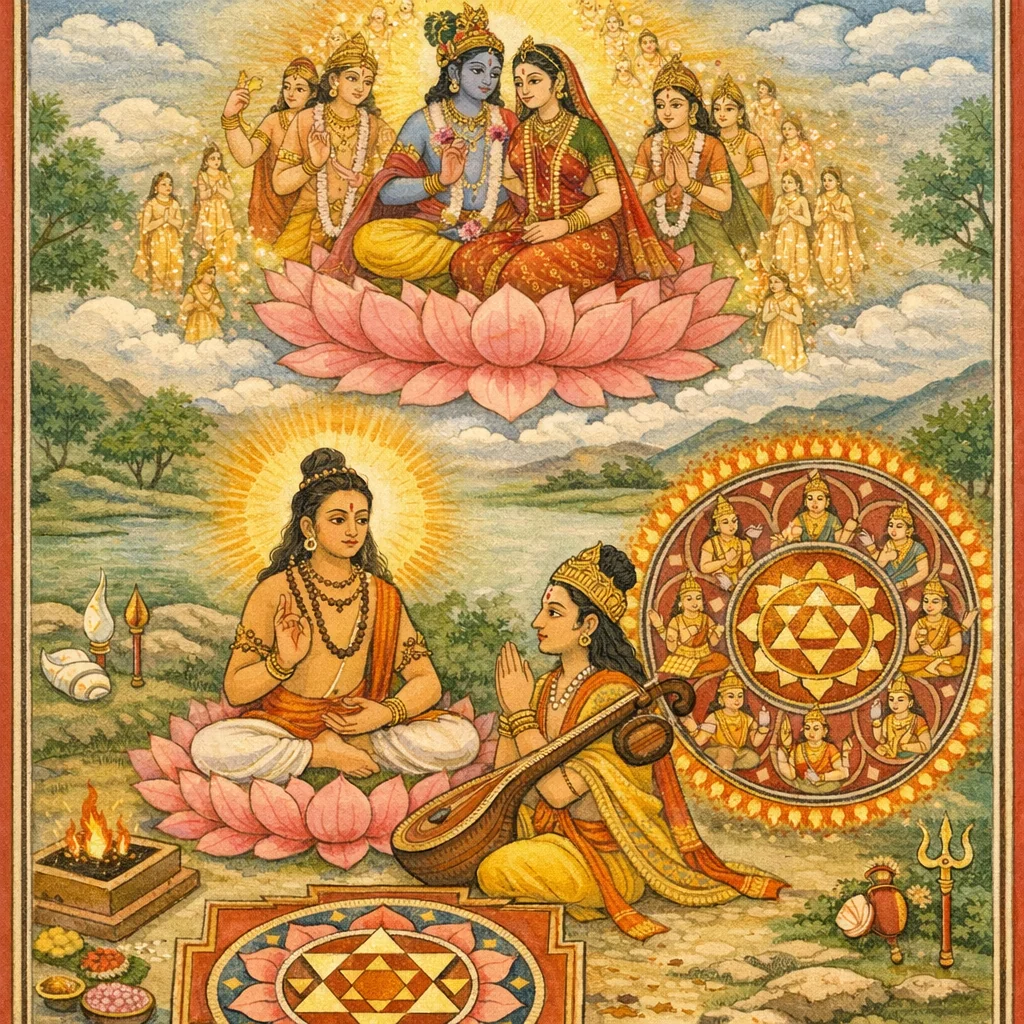
Pañca-prakṛti-nirūpaṇa and Mantra-vidhi: Rādhā, Mahālakṣmī, Durgā, Sarasvatī, Sāvitrī; plus Sāvitrī-Pañjara
Śaunaka praises Sūta for disclosing a rare Tantric procedure taught by the Kumāras. Nārada, after hearing a thousand paired names, bows to Sanatkumāra and seeks the distilled essence of the Śākta Tantras—especially Rādhā’s glory, her emanations, and the proper mantras. Sanatkumāra narrates a Goloka-centered theogony: Rādhā arises as Kṛṣṇa’s counterpart; Nārāyaṇa emerges from Kṛṣṇa’s left side; Mahālakṣmī from Rādhā’s left; gopas and gopīs manifest from the pores of Kṛṣṇa and Rādhā; Durgā appears as Viṣṇu’s eternal Māyā; Brahmā is born from Hari’s navel; Kṛṣṇa bifurcates into Śiva (left) and Kṛṣṇa (right); Sarasvatī arises and is sent to Vaikuṇṭha. The chapter then explains fivefold Rādhā and lays out sādhanā sequences (mantra, dhyāna, arcana), giving mantra parameters and complete ritual design for Rādhā, Mahālakṣmī, Durgā, Sarasvatī, and Sāvitrī—yantra/āvaraṇa schemes, deity lists, japa totals, homa materials, and siddhi uses (royal victory, fertility, relief from graha afflictions, longevity, prosperity, poetic mastery). It concludes with the Sāvitrī Pañjara, a directional protective enclosure with cosmological body-mapping, and a final list of Sāvitrī’s names and benefits.
Shlokas
Verse 1
श्रीशौनक उवाच । साधु सूत महाभागः जगदुद्धारकारकम् । महातंत्रविधानं नः कुमारोक्तं त्वयोदितम् ॥ १ ॥
Śaunaka said: Well done, O noble Sūta. You have narrated to us the great tantric procedure—taught by the Kumāras—which is capable of uplifting and delivering the world.
Verse 2
अलभ्यमेतत्तंत्रेषु पुराणेष्वपि मानद । यदिहोदितमस्मभ्यं त्वयातिकरुणात्मना ॥ २ ॥
O bestower of honor, this teaching is not easily found even in the Tantras and the Purāṇas. Yet here it has been spoken to us by you, whose very nature is great compassion.
Verse 3
नारदो भगवान्सूत लोकोद्धरणतत्परः । भूयः पप्रच्छ किं साधो कुमारं विदुषां वरम् ॥ ३ ॥
O Sūta, the blessed sage Nārada—ever intent on uplifting the worlds—once again questioned the noble Kumāra, the foremost among the learned.
Verse 4
सूत उवाच । श्रुत्वा स नारदो विप्राः युग्मनामसहस्रकम् । सनत्कुमारमप्याह प्रणम्य ज्ञानिनां वरम् ॥ ४ ॥
Sūta said: O brāhmaṇas, having heard that collection of a thousand paired names, Nārada then addressed Sanatkumāra also, bowing down to the best among the wise.
Verse 5
नारद उवाच । ब्रह्मंस्त्वया समाख्याता विधयस्तंत्रचोदिताः । तत्रापि कृष्णमंत्राणां वैभवं ह्युदितं महत् ॥ ५ ॥
Nārada said: O revered brāhmin, you have explained the rites and procedures as enjoined in the Tantras. And within that too, the great glory of the Kṛṣṇa-mantras has indeed been proclaimed.
Verse 6
या तत्र राधिकादेवी सर्वाद्या समुदाहृता । तस्या अंशावताराणां चरितं मंत्रपूर्वकम् ॥ ६ ॥
There, the Goddess Rādhikā is declared to be the foremost of all. The sacred narrative of her partial incarnations is to be recounted, preceded and accompanied by the proper mantras.
Verse 7
तंत्रोक्तं वद सर्वज्ञ त्वामहं शरणं गतः । शक्तेस्तंत्राण्यनेकानि शिवोक्तानि मुनीश्वर ॥ ७ ॥
Teach me what is laid down in the Tantras, O all-knowing one—for I have taken refuge in you. O lord among sages, there are many Tantras of Śakti, spoken by Śiva.
Verse 8
यानि तत्सारमुद्धृत्य साकल्येनाभिधेहि नः । तच्छ्रुत्वा वचनं तस्य नारदस्य महात्मनः ॥ ८ ॥
Having extracted the very essence of all that, tell us completely. Hearing these words of that great-souled Nārada,
Verse 9
सनत्कुमारः प्रोवाच स्मृत्वा राधापदांबुजम् । सनत्कुमार उवाच । श्रृणु नारद वक्ष्यामि राधांशानां समुद्भवम् ॥ ९ ॥
Sanatkumāra spoke, having remembered the lotus-feet of Rādhā. Sanatkumāra said: “Listen, Nārada; I shall explain to you the origin of the portions (emanations) of Rādhā.”
Verse 10
शक्तीनां परमाश्चर्यं मंत्रसाधनपूर्वकम् । या तु राधा मया प्रोक्ता कृष्णार्द्धांगसमुद्भवा ॥ १० ॥
Among all divine powers (śaktis), the most astonishing—attained through prior discipline in mantra-practice—is that Rādhā of whom I have spoken, who has arisen from Kṛṣṇa’s own half-body, as His very counterpart.
Verse 11
गोलोकवासिनी सा तु नित्या कृष्णसहायिनी । तेजोमंडलमध्यस्था दृश्यादृश्यस्वरूपिणी ॥ ११ ॥
She indeed dwells in Goloka, eternal and ever the helper of Kṛṣṇa; abiding in the midst of a circle of radiance, her nature is both visible and invisible.
Verse 12
कदाचित्तु तया सार्द्धं स्थितस्य मुनिसत्तम । कृष्णस्य वामभागात्तु जातो नारायणः स्वयम् ॥ १२ ॥
O best of sages, once, while He was standing together with her, Nārāyaṇa Himself was born from Kṛṣṇa’s left side.
Verse 13
राधिकायाश्च वामांगान्महालक्ष्मीर्बभूव ह । ततः कृष्णो महालक्ष्मीं दत्त्वा नारायणाय च ॥ १३ ॥
And from the left side of Rādhikā, Mahālakṣmī came into being. Thereupon Kṛṣṇa bestowed that Mahālakṣmī upon Nārāyaṇa as well.
Verse 14
वैकुंठे स्थापयामास शश्वत्पालनकर्मणि । अथ गोलोकनाथस्य लोम्नां विवरतो मुने ॥ १४ ॥
He established them in Vaikuṇṭha for the everlasting duty of protection. Then, O sage, from the pores among the hairs of the Lord of Goloka…
Verse 15
जातुश्चासंख्यगोपालास्तेजसा वयसा समाः । प्राणतुल्यप्रियाः सर्वे बभूवुः पार्षदा विभोः ॥ १५ ॥
At times, countless cowherd companions—equal in radiance and in age—came to be the Lord’s attendants, all of them dear to Him as His very life-breath.
Verse 16
राधांगलोमकूपेभ्ये बभूवुर्गोपकन्यकाः । राधातुल्याः सर्वतश्च राधादास्यः प्रियंवदाः ॥ १६ ॥
From the pores of Rādhā’s body arose the cowherd maidens. In every way they were like Rādhā—her devoted attendants, sweet of speech.
Verse 17
एतस्मिन्नंतरे विप्र सहसा कृष्णदेहतः । आविर्बभूव सा दुर्गा विष्णुमाया सनातनी ॥ १७ ॥
Meanwhile, O brāhmaṇa, suddenly from Kṛṣṇa’s very body there manifested that Goddess Durgā—the eternal Māyā of Viṣṇu.
Verse 18
देवीनां बीजरूपां च मूलप्रकृतिरीश्वरी । परिपूर्णतमा तेजः स्वरूपा त्रिगुणात्मिका ॥ १८ ॥
She is the sovereign Goddess—the primordial Nature (Mūla-Prakṛti), the seed-form underlying all goddesses; utterly complete, of the very essence of radiant tejas, and constituted of the three guṇas.
Verse 19
सहस्रभुजसंयुक्ता नानाशस्त्रा त्रिलोचना । या तु संसारवृक्षस्य बीजरूपा सनातनी ॥ १९ ॥
She is endowed with a thousand arms, bears many kinds of weapons, and is three‑eyed; she is the Eternal One who abides as the seed‑form of the tree of saṃsāra, worldly existence.
Verse 20
रत्नसिंहासनं तस्यै प्रददौ राधिकेश्वरः । एतस्मिन्नंतरे तत्र सस्त्रीकस्तु चतुर्मुखः ॥ २० ॥
Rādhikeśvara presented her with a jeweled throne. Meanwhile, at that very moment, the four‑faced Brahmā arrived there together with his consort.
Verse 21
ज्ञानिनां प्रवरः श्रीमान् पुमानोंकारमुच्चरन् । कमंडलुधरो जातस्तपस्वी नाभितो हरेः ॥ २१ ॥
That illustrious Person, foremost among the wise, uttering the syllable Oṃ, became a tapasvin bearing a water‑pot (kamaṇḍalu), arising from the navel of Hari (Viṣṇu).
Verse 22
स तु संस्तूय सर्वेशं सावित्र्या भार्यया सह । निषसादासने रम्ये विभोस्तस्याज्ञया मुने ॥ २२ ॥
Then he, having praised the Lord of all, sat down—together with his wife Sāvitrī—upon a lovely seat, O sage, in accordance with that mighty Lord’s command.
Verse 23
अथ कृष्णो महाभाग द्विधारूपो बभूव ह । वामार्द्धांगो महादेवो दक्षार्द्धो गोपिकापतिः ॥ २३ ॥
Then, O greatly fortunate one, Kṛṣṇa indeed assumed a twofold form: His left half became Mahādeva (Śiva), and His right half became the Lord of the gopīs (Kṛṣṇa).
Verse 24
पंचवक्त्रस्त्रिनेत्रोऽसौ वामार्द्धागो मुनीश्वः । स्तुत्वा कृष्णं समाज्ञप्तो निषसाद हरेः पुरः ॥ २४ ॥
That lord of sages—five-faced, three-eyed, with his left half in a feminine form—having praised Kṛṣṇa and received the command, sat down before Hari.
Verse 25
अथ कृष्णश्चतुर्वक्त्रं प्राह सृष्टिं कुरु प्रभो । सत्यलोके स्थितो नित्यंगच्छ मांस्मर सर्वदा ॥ २५ ॥
Then Kṛṣṇa said to the four-faced Lord (Brahmā): “O Lord, undertake the work of creation. Abide ever in Satyaloka; go forth, and remember Me at all times.”
Verse 26
एवमुक्तस्तु हरिणा प्रणम्य जगदीश्वरम् । जगाम भार्यया साकं स तु सृष्टिं करोति वै ॥ २६ ॥
Thus addressed by Hari, he bowed to the Lord of the universe and departed together with his wife; indeed, he then proceeds to carry out the work of creation.
Verse 27
पितास्माकं मुनिश्रेष्ठ मानसीं कल्पदैहिकीम् । ततः पश्चात्पंचवक्त्रं कृष्णं प्राह महामते ॥ २७ ॥
O best of sages, our father first brought forth a creation born of mind, and thereafter a creation shaped into bodily form. Then, O great-minded one, he addressed Kṛṣṇa, the five-faced one.
Verse 28
दुर्गां गृहाण विश्वेश शिवलोके तपश्वर । यावत्सृष्टिस्तदंते तु लोकान्संहर सर्वतः ॥ २८ ॥
O Lord of the universe, O supreme Lord of austerity—take up Durgā in Śiva’s realm; and until the end of creation, withdraw and dissolve the worlds entirely on every side.
Verse 29
सोऽपि कृष्णं नमस्तृत्य शिवलोकं जगाम ह । ततः कालांतरे ब्रह्मन्कृष्णस्य परमात्मनः ॥ २९ ॥
He too, having bowed in reverence to Kṛṣṇa, went to Śiva’s realm. Then, after some time had passed, O Brahman, the account continues concerning Kṛṣṇa, the Supreme Self (Paramātman).
Verse 30
वक्त्रात्सरस्वती जाता वीणापुस्तकधारिणी । तामादिदेश भगवान् वैकुंठं गच्छ मानदे ॥ ३० ॥
From (his) mouth Sarasvatī was born, bearing a vīṇā and a book. Then the Blessed Lord (Bhagavān) instructed her: “Go to Vaikuṇṭha, O bestower of honor.”
Verse 31
लक्ष्मीसमीपे तिष्ठ त्वं चतुर्भुजसमाश्रया । सापि कृष्णं नमस्कृत्य गता नारायणांतिकम् ॥ ३१ ॥
“Stay near Lakṣmī, taking refuge in the Four-armed Lord.” Having bowed to Kṛṣṇa, she too went into the presence of Nārāyaṇa.
Verse 32
एवं पञ्चविधा जाता सा राधा सृष्टिकारणम् । आसां पूर्णस्वरूपाणां मंत्रध्यानार्चनादिकम् ॥ ३२ ॥
Thus Rādhā has arisen in a fivefold form; she is the very cause of creation. For these complete manifestations, the disciplines beginning with mantra (recitation), dhyāna (meditation), and arcana (ritual worship) are to be undertaken.
Verse 33
वदामि श्रृणु विप्रेद्रं लोकानां सिद्धिदायकम् । तारः क्रियायुक् प्रतिष्ठा प्रीत्याढ्या च ततः परम् ॥ ३३ ॥
I shall declare it—listen, O best of Brahmins—what bestows success upon people. (First is) Tāra; then practice endowed with proper rites; then firm establishment; and thereafter, that which is rich in loving delight—beyond these lies the Supreme.
Verse 34
ज्ञानामृता क्षुधायुक्ता वह्निजायांतकतो मनुः । सुतपास्तु ऋषिश्छन्दो गायत्री देवता मनोः ॥ ३४ ॥
For the mantra beginning “jñānāmṛtā…”, the mantra-seer (Manu) is Vahnijāyāntakṛta; its ṛṣi is Sutapā; its metre is Gāyatrī; and its presiding deity is Manas (the Mind).
Verse 35
राधिका प्रणवो बीजं स्वाहा शक्तिरुदाहृता । षडक्षरैः षडंगानि कुर्याद्विन्दुविभूषितैः ॥ ३५ ॥
“Rādhikā” is to be taken as the principal mantra; the praṇava (Oṁ) is declared to be its seed (bīja), and “svāhā” is taught as its power (śakti). With the six syllables—adorned with bindu—one should perform the sixfold limb-installation (ṣaḍaṅga-nyāsa).
Verse 36
ततो ध्यायन्स्वहृदये राधिकां कृष्णभामिनीम् । श्वेतचंपकवर्णाभां कोटिचन्द्रसमप्रभाम् ॥ ३६ ॥
Then, meditating within his own heart on Rādhikā—the beloved of Kṛṣṇa—he beheld her with the hue of a white campaka flower, radiant like ten million moons.
Verse 37
शरत्पार्वणचन्द्रास्यां नीलेंदीवरलोचनाम् । सुश्रोणीं सुनितंबां च पक्वबिंबाधरांबराम् ॥ ३७ ॥
Her face is like the full moon of the autumn festival; her eyes are like blue lotuses. She has beautiful hips and well-shaped curves, and her lips are like a ripe bimba fruit—radiant and captivating.
Verse 38
मुक्ताकुंदाभदशनां वह्निशुद्धांशुकान्विताम् । रत्नकेयूरवलयहारकुण्डलशोभिताम् ॥ ३८ ॥
Her teeth were like pearls and jasmine buds; she was clad in garments purified like fire, and she shone adorned with jeweled armlets, bracelets, necklaces, and earrings.
Verse 39
गोपीभिः सुप्रियाभिश्च सेवितां श्वेतचामरैः । रासमंडलमध्यस्थां रत्नसिंहासनस्थिताम् ॥ ३९ ॥
Served by the beloved gopīs and fanned with white chowries, He abides in the midst of the circle of the rāsa-dance, seated upon a jeweled throne.
Verse 40
ध्यात्वा पुष्पांजलिं क्षिप्त्वा पूजयेदुपचारकैः । लक्षषट्कं जपेन्मंत्रं तद्दशांशं हुनेत्तिलैः ॥ ४० ॥
Having meditated and offered a handful of flowers, one should worship with the prescribed upacāras. One should repeat the mantra six lakhs of times, and then offer into the fire one-tenth of that number as homa-oblations with sesame seeds.
Verse 41
आज्याक्तैर्मातृकापीठे पूजा चावरणैः सह । षट्कोणेषु षडंगानि तद्बाह्येऽष्टदले यजेत् ॥ ४१ ॥
Upon the Mātṛkā-pīṭha, the seat of the Mother-goddesses, smeared with ghee, one should perform worship together with the attendant āvaraṇas. In the six triangles of the yantra one should install and worship the six ṣaḍ-aṅgas; and outside that, worship upon the eight-petalled lotus.
Verse 42
मालावतीं माधवीं च रत्नमालां सुशीलिकाम् । ततः शशिकलां पारिजातां पद्मावतीं तथा ॥ ४२ ॥
“(He mentioned) Mālāvatī, Mādhavī, Ratnamālā, and Suśīlikā; then (also) Śaśikalā, Pārijātā, and likewise Padmāvatī.”
Verse 43
सुंदरीं च क्रमात्प्राच्यां दिग्विदिक्षु ततो बहिः । इन्द्राद्यान्सायुधानिष्ट्वा विनियोगांस्तु साधयेत् ॥ ४३ ॥
Then, beginning from the eastern direction in due order, and thereafter in all the directions and intermediate quarters outwardly, one should worship the deities starting with Indra—together with their weapons—and thus accomplish the prescribed viniyogas (ritual applications).
Verse 44
राधा कृष्णप्रिया रासेश्वरी गोपीगणाधिपा । निर्गुणा कृष्णपूज्या च मूलप्रकृतिरीश्वरी ॥ ४४ ॥
Rādhā—beloved of Kṛṣṇa, sovereign of the rāsa-dance and leader of the gopīs—transcends the guṇas; even Kṛṣṇa worships Her, and She is the divine Īśvarī, the very root of primordial Nature (mūla-prakṛti).
Verse 45
सर्वेश्वरी सर्वपूज्या वैराजजननी तथा । पूर्वाद्याशासु रक्षंतु पांतु मां सर्वतः सदा ॥ ४५ ॥
May the Supreme Goddess—sovereign over all, worshipped by all, and mother of Virājā—protect me in the east and in every other direction; may She ever guard me from all sides.
Verse 46
त्वं देवि जगतां माता विष्णुमाया सनातनी । कृष्णमायादिदेवी च कृष्णप्राणाधिके शुभे ॥ ४६ ॥
O Goddess, You are the Mother of the worlds, the eternal Māyā of Viṣṇu; You are also the primal Goddess of Kṛṣṇa’s Māyā. O auspicious One, dearer than Kṛṣṇa’s very life-breath!
Verse 47
कष्णभक्तिप्रदे राधे नमस्ते मंगलप्रदे । इति सम्प्रार्थ्य सर्वेशीं स्तुत्वा हृदि विसर्जयेत् ॥ ४७ ॥
“O Rādhā, bestower of bhakti to Kṛṣṇa—obeisance to You, giver of auspiciousness.” Thus having earnestly prayed to the Supreme Goddess and praised Her, one should conclude the invocation by placing Her within the heart.
Verse 48
एवं यो भजते राधां सर्वाद्यां सर्वमंगलाम् । भुक्त्वेह भोगानखिलान्सोऽन्ते गोलोकमाप्नुयात् ॥ ४८ ॥
Thus, whoever worships Rādhā—the primal source of all and the embodiment of all auspiciousness—after enjoying every prosperity and delight in this world, in the end attains Goloka.
Verse 49
अथ तुभ्यं महालक्ष्म्या विधानं वच्मि नारद । यदाराधनतो भूयात्साधको भुक्तिमुक्तिमान् ॥ ४९ ॥
Now, O Nārada, I shall tell you the proper procedure for worshipping Mahālakṣmī—by whose adoration the practitioner becomes endowed with both worldly enjoyment and liberation.
Verse 50
लक्ष्मीमायाकामवाणीपूर्वा कमलवासिनी । ङेंता वह्निप्रियांतोऽयं मंत्रकल्पद्रुमः परः ॥ ५० ॥
Beginning with the seed-syllables of Lakṣmī, Māyā, Kāma, and Vāṇī, together with Kamalavāsinī (the Lotus-dwelling Goddess), and ending with “ṅeṃtā” and “vahnipriyā”, this supreme “Mantra-Kalpadruma” is thus declared.
Verse 51
ऋषिर्नारायणश्चास्य छन्दो हि जगती तथा । देवता तु महालक्ष्मीर्द्विद्विवर्णैः षडंगकम् ॥ ५१ ॥
For this mantra, the Ṛṣi is Nārāyaṇa; the metre is Jagatī; and the presiding deity is Mahālakṣmī. Its sixfold auxiliary application (ṣaḍaṅga-nyāsa) is to be performed with pairs of syllables.
Verse 52
श्वेतचंपकवर्णाभां रत्नभूषणभूषिताम् । ईषद्धास्यप्रसन्नास्यां भक्तानुग्रहकातराम् ॥ ५२ ॥
She shone with the fair hue of the white campaka blossom, adorned with jeweled ornaments; her face was serene with a gentle smile, and she was eager to bestow grace upon her devotees.
Verse 53
बिभ्रतीं रत्नमालां च कोटिचंद्रसमप्रभाम् । ध्यात्वा जपेदर्कलक्षं पायसेन दशांशतः ॥ ५३ ॥
Meditating on her who wears a jeweled garland and shines with the splendor of ten million moons, one should perform one lakh (100,000) japa of the Arka-mantra, and then offer a tenth part as oblations with pāyasa (rice pudding).
Verse 54
जुहुयादेधिते वह्नौ श्रीदृकाष्टैः समर्चयेत् । नवशक्तियुते पीठे ह्यंगैरावरणैः सह ॥ ५४ ॥
One should pour oblations into the sacred fire, well kindled, and then duly worship (the Deity) with the eightfold «Śrīdṛk». Upon the pedestal endowed with the nine Śaktis, one should perform worship together with the aṅga (limb-mantras) and the surrounding āvaraṇas (enclosures).
Verse 55
विभूतिरुन्नतिः कांतिः सृष्टिः कीर्तिश्च सन्नतिः । व्याष्टिरुत्कृष्टिर्ऋद्धिश्च संप्रोक्ता नव शक्तयः ॥ ५५ ॥
Vibhūti (sovereign glory), Unnati (exaltation), Kānti (splendor), Sṛṣṭi (creative power), Kīrti (renown), Sannati (humble reverence), Vyāṣṭi (manifest expansion), Utkṛṣṭi (excellence), and Ṛddhi (prosperous attainment)—these are declared to be the nine Śaktis.
Verse 56
अत्रावाह्य च मूलेन मूर्तिं संकल्प्य साधकः । षट् कोणेषु षडंगानि दक्षिणे तु गजाननम् ॥ ५६ ॥
Here, having invoked (the Deity) with the root-mantra (mūla-mantra) and having mentally formed the divine image, the practitioner should place the six limbs (ṣaḍaṅga) in the six corners; and on the southern side he should place Gajānana (Gaṇeśa).
Verse 57
वामे कुसुमधन्वानं वसुपत्रे ततो यजेत् । उमां श्रीं भारतीं दुर्गां धरणीं वेदमातरम् ॥ ५७ ॥
On the left, one should worship Kusumadhanvan (Kāma), placing him upon a vasu-leaf. Thereafter one should worship Umā, Śrī (Lakṣmī), Bhāratī (Sarasvatī), Durgā, Dharaṇī (the Earth), and the Mother of the Vedas.
Verse 58
देवीमुषां च पूर्वादौ दिग्विदिक्षु क्रमेण हि । जह्नुसूर्यसुते पूज्ये पादप्रक्षालनोद्यते ॥ ५८ ॥
Beginning in the east, and then in due order through the directions and intermediate directions, one should proceed with the worship; and for the venerable—such as Jahnu and the daughter of the Sun—one should undertake the washing of the feet (pādaprakṣālana) as an act of reverence.
Verse 59
शंखपद्मनिधी पूज्यौ पार्श्वयोर्घृतचामरौ । धृतातपत्रं वरुणं पूजयेत्पश्चिमे ततः ॥ ५९ ॥
One should worship the two treasure-deities, Śaṅkha and Padma, on the two sides, holding chowries anointed with ghee; then, on the western side, one should worship Varuṇa, bearing the royal parasol.
Verse 60
संपूज्य राशीन्परितो यथास्थानं नवग्रहान् । चतुर्दन्तैरावतादीन् दिग्विदिक्षु ततोऽर्चयेत् ॥ ६० ॥
Having duly worshipped the zodiacal signs all around in their proper places, and the nine planets (Navagraha) in their respective stations, one should then worship Airāvata and the other four-tusked elephants in the directions and intermediate directions.
Verse 61
तद्बहिर्लोकपालांश्च तदस्त्राणि च तद्बहिः । दूर्वाभिराज्यसिक्ताभिर्जुहुयादायुषे नरः ॥ ६१ ॥
Outside that inner rite, and again beyond it, a man should offer oblations for longevity—invoking the Lokapālas, the world-guardians, and the mantras of the divine weapons—using dūrvā grass moistened with ghee.
Verse 62
गुडूचीमाज्यसंसिक्तां जुहुयात्सप्तवासरम् । अषअटोत्तरसहस्रं यः स जीवेच्छरदां शतम् ॥ ६२ ॥
Whoever offers into the sacred fire, for seven days, gudūcī anointed with ghee—performing eight thousand and eight (8008) oblations—is said to live for a hundred autumns, that is, a full century.
Verse 63
हुत्वा तिलान्घृताभ्यक्तान्दीर्घमायुष्यमाप्नुयात् । आरभ्यार्कदिनं मंत्री दशाहं घृतसंप्लुतः ॥ ६३ ॥
By offering sesame seeds anointed with ghee into the sacred fire, one attains long life. Beginning on a Sunday, the mantra-reciter should remain sustained with ghee for ten days.
Verse 64
जुहुयादर्कसमिधः शरीरारोग्यसिद्धये । शालिभिर्जुह्वतो नित्यमष्टोत्तरसहस्रकम् ॥ ६४ ॥
For the attainment of bodily health, one should offer oblations into the sacred fire with arka samidh fuel-sticks; and one who offers with rice should do so daily, in the number of one thousand and eight.
Verse 65
अचिरादेव महती लक्ष्मी संजायते ध्रुवम् । उषाजा जीनालिकेररजोभिर्गृतमिश्रितैः ॥ ६५ ॥
Surely, very soon great prosperity—Lakṣmī’s favor—arises without fail. At dawn, one should use the pollen/dust of the jīnālikera (a kind of coconut/palm), mixed with ghee.
Verse 66
हुनेदष्टोत्तरशतं पायसाशी तु नित्यशः । मण्डलाज्जायते सोऽपि कुबेर इव मानवः ॥ ६६ ॥
Performing one hundred and eight offerings into the sacred fire, and regularly subsisting on pāyasa (rice-milk), a person is said to be born from that maṇḍala (ritual circle) as a human endowed with prosperity—like Kubera himself.
Verse 67
हविषा गुडमिश्रेण होमतो ह्यन्नवान्भवेत् । जपापुष्पाणि जुहुयादष्टोत्तरसहस्रकम् ॥ ६७ ॥
By offering oblations (havis) mixed with jaggery into the fire, one becomes endowed with abundant food (and prosperity). One should offer japā (hibiscus) flowers as oblations—one thousand and eight in number.
Verse 68
तांबूलरससंमिश्रं तद्भस्मतिलकं चरेत् । चतुर्णामपि वर्णानां मोहनाय द्विजोत्तमः ॥ ६८ ॥
Mixing it with the juice of tāmbūla (betel), one should apply that ash as a tilaka upon the forehead. The best of the twice-born (dvijottama) does so to attract people of all four varṇas.
Verse 69
एवं यो भजते लक्ष्मीं साधकेंद्रो मुनीश्वर । सम्पदस्तस्य जायंते महालक्ष्मीः प्रसीदति ॥ ६९ ॥
Thus, O lordly sage, the foremost sādhaka who worships Lakṣmī in this manner attains prosperity; Mahālakṣmī becomes gracious and well pleased with him.
Verse 70
देहांते वैष्णवं धाम लभते नात्र संशयः । या तु दुर्गा द्विजश्रेष्ठ शिवलोकं गता सती ॥ ७० ॥
At the body’s end one surely attains the Vaiṣṇava dhāma—of this there is no doubt. But she who is worshipped as Durgā, O best of the twice-born, that virtuous Satī has gone to Śiva’s world.
Verse 71
सा शिवाज्ञामनुप्राप्य दिव्यलोकं विनिर्ममे । देवीलोकेति विख्यातं सर्वलोकविलक्षणम् ॥ ७१ ॥
Having received Śiva’s command, she fashioned a divine celestial realm, famed as “Devī-loka,” a world distinct from all other worlds.
Verse 72
तत्र स्थिता जगन्माता तपोनियममास्थिता । विविधान् स्वावतारान्हि त्रिकाले कुरुतेऽनिशम् ॥ ७२ ॥
Abiding there, the Mother of the universe, steadfast in tapas and sacred discipline, unceasingly brings forth her many manifestations (avatāras) through the three times.
Verse 73
मायाधिका ह्लादिनीयुक् चन्द्राढ्या सर्गिणी पुनः । प्रतिष्ठा स्मृतिसंयुक्ता क्षुधया सहिता पुनः ॥ ७३ ॥
She is predominated by māyā; endowed with the bliss-giving power (hlādinī); rich in the moonlike, cool quality; and again, she is the bringer forth of creation. She is also “Pratiṣṭhā,” joined with memory (smṛti), and again she appears accompanied by hunger.
Verse 74
ज्ञानामृता वह्निजायांतस्ताराद्यो मनुर्मतः । ऋषिः स्याद्वामदेवोऽस्य छंदो गायत्रमीरितम् ॥ ७४ ॥
For this mantra, the accepted names are “Jñānāmṛtā” and “Vahnijāyānta,” with “Tārādya” regarded as its mantric designation. Its seer (ṛṣi) is Vāmadeva, and its metre is declared to be Gāyatrī.
Verse 75
देवता जगतामादिर्दुर्गा दुर्गतिनाशिनी । ताराद्येकैकवर्णेन हृदयादित्रयं मतम् ॥ ७५ ॥
The Goddess—Durgā, the primordial source of the worlds and the destroyer of misfortune—is declared to be the threefold set beginning with the “Hṛdaya,” each formed by single syllables starting with Tārā.
Verse 76
त्रिभिर्वर्मेक्षण द्वाभ्यां सर्वैरस्त्रमुदीरितम् । महामरकतप्रख्यां सहस्रभुजमंडिताम् ॥ ७६ ॥
By three (mantras) the protective armour is invoked; by two, the weapon; and by all of them together, the missile is proclaimed—radiant like a great emerald and adorned with a thousand arms.
Verse 77
नानाशस्त्राणि दधतीं त्रिनेत्रां शशिशेखराम् । कंकणांगदहाराढ्यां क्वणन्नूपुरकान्विताम् ॥ ७७ ॥
She bore many kinds of weapons; she was three-eyed and wore the moon as her crest. Adorned with bracelets, armlets, and necklaces, she was accompanied by anklets that jingled as she moved.
Verse 78
किरीटकुंडलधरां दुर्गां देवीं विचिंतयेत् ॥ ७८ ॥
One should meditate upon the Goddess Durgā—adorned with a crown and earrings.
Verse 79
वसुलक्षं जपेन्मंत्रं तिलैः समधुरैर्हुनेत । पयोंऽधसा वा सहस्रं नवपद्मात्मके यजेत् ॥ ७९ ॥
One should repeat the mantra in japa eight hundred thousand times and offer homa oblations with sesame mixed with sweetness. Or else, one should make a thousand offerings with milk and curds, worshipping in the rite arranged as a nine-lotus formation.
Verse 80
प्रभा माया जया सूक्ष्मा विशुद्धानं दिनी पुनः । सुप्रभा विजया सर्वसिद्धिदा पीठशक्तयः ॥ ८० ॥
Prabhā, Māyā, Jayā, Sūkṣmā, Viśuddhānandinī; and again Suprabhā, Vijayā, and Sarvasiddhidā—these are the Śaktis presiding over the sacred seats (pīṭhas).
Verse 81
अद्भिर्ह्रस्वत्रयक्लीबरहितैः पूजयेदिमाः । प्रणवो वज्रनखदंष्ट्रायुधाय महापदात् ॥ ८१ ॥
One should worship these with water, free from the three short vowels and from the neuter sound (klība). The praṇava “Oṃ” is to be applied to the deity whose weapons are the thunderbolt, claws, and fangs—arising from the great word-seat (mahā-pada).
Verse 82
सिंहाय वर्मास्त्रं हृञ्च प्रोक्तः सिंहमनुर्मुने । दद्यादासनमेतेन मूर्तिं मूलेन कल्पयेत् ॥ ८२ ॥
O sage, the seed-syllable “hr̥ṁ” is declared as the protective armour (varma) and the missile-mantra (astra) for the Lion form. With this one should offer a seat (āsana); and with the root (mūla) mantra one should duly install and configure the deity’s icon (mūrti).
Verse 83
अङ्गावृर्त्तिं पुराभ्यार्च्य शक्तीः पत्रेषु पूजयेत् । जया च विजया कीर्तिः प्रीतिः पश्चात्प्रभा पुनः ॥ ८३ ॥
After first worshipping the protective rite for the limbs (aṅgāvṛtti), one should then worship the Śaktis upon the offering-leaves (patras): Jayā, Vijayā, Kīrti, Prīti, and thereafter again Prabhā.
Verse 84
श्रद्धा मेधा श्रुतिश्चैवस्वनामाद्यक्षरादिकाः । पत्राग्रेष्वर्चयेदष्टावायुधानि यथाक्रमात् ॥ ८४ ॥
With sacred faith, keen understanding, and knowledge of the Śruti—and beginning from the first syllable of one’s own name—one should worship, in proper sequence, the eight divine weapons upon the tips of the leaves.
Verse 85
शंखचक्रगदाखङ्गपाशांकुशशरान्धनुः । लोकेश्वरांस्ततो बाह्ये तेषामस्त्राण्यनंतरम् ॥ ८५ ॥
Then, outside that inner arrangement, one should place the Lokapālas, the guardians of the worlds; and immediately after them arrange their weapons—conch, discus, mace, sword, noose, goad, arrows, and bow.
Verse 86
इत्थं जपादिभिर्मंत्री मंत्रे सिद्धे विधानवित् । कुर्यात्प्रयोगानमुना यथा स्वस्वमनीषितान् ॥ ८६ ॥
Thus, when the mantra has been perfected through japa and related disciplines, the mantra-practitioner—skilled in the prescribed rites—should employ that mantra in ritual applications according to each intended purpose.
Verse 87
प्रतिष्ठाप्य विधानेन कलशान्नवशोभनान् । रत्नहेमादिसंयुक्तान्घटेषु नवसु स्थितान् ॥ ८७ ॥
Having duly installed, according to the prescribed rite, nine splendid kalaśas—adorned with gems, gold, and the like—placed within nine vessels (ghaṭas).
Verse 88
मध्यस्थे पूजयेद्देवीमितरेषु जयादिकाः । संपूज्य गन्धपुष्पाद्यैरभिषिंचेन्नराधिपम् ॥ ८८ ॥
In the central position one should worship the Goddess; in the other positions, Jaya and the rest. Having duly honored them with fragrances, flowers, and the like, one should then perform the abhiṣeka—the ceremonial ablution—of the king.
Verse 89
राजा विजयते शत्रून्योऽधिको विजयश्रियम् । प्राप्नोत्रोगो दीर्घायुः सर्वव्याधिविवर्जितः ॥ ८९ ॥
Such a king conquers his enemies and attains an unsurpassed splendor of victory; he becomes free from disease, long-lived, and devoid of all ailments.
Verse 90
वन्ध्याभिषिक्ता विधिनालभते तनयं वरम् । मन्त्रेणानेन संजप्तमाज्यं क्षुद्रग्रहापहम् ॥ ९० ॥
A barren woman, when anointed according to the prescribed rite, obtains an excellent son. Clarified butter (ghee) duly consecrated by reciting this mantra removes afflictions caused by minor grahas (harmful astral or possessive influences).
Verse 91
गर्भिणीनां विशेषेण जप्तं भस्मादिकं तथा । जृंभश्वासे तु कृष्णस्य प्रविष्टेराधिकामुखम् ॥ ९१ ॥
Especially for pregnant women, ash and the like—after being sanctified by mantra-recitation—are to be used. And at the time of yawning or breathing, one should direct the act toward the open mouth, for then Kṛṣṇa’s entry is considered predominant.
Verse 92
या तु देवी समुद्भूता वीणापुस्तकधारिणी । तस्या विधानं विप्रेंद्र श्रृणु लोकोपकारकम् ॥ ९२ ॥
Now, as for the goddess who manifested bearing a vīṇā and a book—O best of brāhmaṇas, listen to the procedure for her worship, which is for the welfare of the world.
Verse 93
प्रणवो वाग्भवं माया श्रीः कामः शक्तिरीरिता । सरस्वती चतुर्थ्यंता स्वाहांतो द्वादशाक्षरः ॥ ९३ ॥
Praṇava (Oṁ), Vāgbhava (the seed of speech), Māyā, Śrī, Kāma, and the syllable called Śakti are declared; along with ‘Sarasvatī’ in the fourth case (dative), and concluded with ‘svāhā’—this forms a twelve-syllabled mantra.
Verse 94
मनुर्नारायण ऋषिर्विराट् छन्दः समीरितम् । महासरस्वती चास्य देवता परिकीर्तिता ॥ ९४ ॥
For this mantra/recitation, Manu–Nārāyaṇa is declared the seer (ṛṣi), Virāṭ is stated as the meter (chandas), and Mahā-Sarasvatī is proclaimed as its presiding deity (devatā).
Verse 95
वाग्भवेन षडंगानि कृत्वा वर्णान्न्यसेद् बुधः । ब्रह्मरंध्रे न्यसेत्तारं लज्जां भ्रूमध्यगां न्यसेत् ॥ ९५ ॥
Having performed the six-limbed nyāsa (ṣaḍ-aṅga nyāsa) with the Vāgbhava seed, the wise should place the mantra’s syllables upon the body. He should install Tārā in the brahma-randhra and place Lajjā in the space between the eyebrows.
Verse 96
मुखनासादिकर्णेषु गुदेषु श्रीमुखार्णकान् । ततो वाग्देवतां ध्यायेद्वीणापुस्तकधारिणीम् ॥ ९६ ॥
In the mouth, nose, ears, and also at the anus, one should mentally place the auspicious seed-syllables beginning with “śrī” (the letters of the sacred formula). Thereafter, one should meditate upon the Goddess of Speech (Vāgdevatā), who bears a vīṇā and a book.
Verse 97
कर्पूरकुंदधवलां पूर्णचंद्रोज्ज्वलाननाम् । हंसाधिरूढां भालेंदुदिव्यालंकारशोभिताम् ॥ ९७ ॥
Meditate upon her—radiant white like camphor and jasmine, her face shining like the full moon; seated upon a swan, and adorned with a divine crescent-moon ornament upon her forehead.
Verse 98
जपेद्द्वादशलक्षाणि तत्सहस्रं सितांबुजैः । नागचंपकपुष्पैर्वा जुहुयात्साधकोत्तमः ॥ ९८ ॥
The best of practitioners should perform japa for twelve lakhs (1,200,000 repetitions); and then offer a thousand oblations (homa) using white lotuses—or else with nāga-campaka flowers.
Verse 99
मातृकोक्ते यजेत्पीठे वक्ष्यमाणक्रमेण ताम् । वर्णाब्जेनासनं दद्यान्मूर्तिं मूलेन कल्पयेत् ॥ ९९ ॥
One should worship Her upon the pīṭha taught in the Mātr̥kā system, following the sequence that will be described. One should offer a seat by means of the lotus of letters, and establish (or visualize) the deity-form by means of the root-mantra.
Verse 100
देव्या दक्षिणतः पूज्या संस्कृता वाङ्मयी शुभा । प्राकृता वामतः पूज्या वाङ्मयीसर्वसिद्धिदा ॥ १०० ॥
To the Goddess’s right, the auspicious Vāṅmayī in her Sanskrit form should be worshipped; to her left, the Vāṅmayī in her Prākrit form should be worshipped—she who bestows all attainments.
Verse 101
पूर्वमंगानि षट्कोणे प्रज्ञाद्याः प्रयजेद्बहिः । प्रज्ञा मेधा श्रुतिः शक्तिः स्मृतिर्वागीश्वरी मतिः ॥ १०१ ॥
In the six-pointed hexagon, one should first worship the aṅgas (auxiliary limbs); and outside it one should worship the deities beginning with Prajñā—namely Prajñā (wisdom), Medhā (intellect), Śruti (sacred learning), Śakti (power), Smṛti (memory), Vāgīśvarī (mistress of speech), and Mati (discernment).
Verse 102
स्वस्तिश्चेति समाख्याता ब्रह्माद्यास्तदनंतरम् । लोकेशानर्चयेद्भूयस्तदस्त्राणि च तद्बहिः ॥ १०२ ॥
This is declared as the rite called “Svasti”; immediately after that, one should worship Brahmā and the other deities. Then again one should worship the Lokapālas (guardians of the worlds), and, outside that, one should worship the astrās—the weapons or mantric missiles belonging to that (deity/rite).
Verse 103
एवं संपूज्य वाग्देवीं साक्षाद्वाग्वल्लभो भवेत् । ब्रह्मचर्यरतः शुद्धः शुद्धदंतनखा दिकः ॥ १०३ ॥
Thus, having duly worshipped Vāgdevī, the Goddess of Speech, one becomes, as it were directly, beloved of Speech itself. Devoted to brahmacarya and purified—keeping teeth, nails, and the like clean—one attains this fitness.
Verse 104
संस्मरन् सर्ववनिताः सततं देवताधिया । कवित्वं लभते धीमान् मासैर्द्वादशभिर्ध्रुवम् ॥ १०४ ॥
Ever remembering all the divine feminine powers, with the mind fixed upon the Deity, the wise one surely attains mastery of poetry within twelve months.
Verse 105
पीत्वा तन्मंत्रितं तोयं सहस्रं प्रत्यहं मुने । महाकविर्भवेन्मंत्री वत्सरेण न संशयः ॥ १०५ ॥
O sage, by drinking each day a thousand sips of water consecrated with that mantra, the practitioner becomes within a year a great poet and a master of mantra—of this there is no doubt.
Verse 106
उरोमात्रोदके स्थित्वा ध्यायन्मार्तंडमंडले । स्थितां देवीं प्रतिदिनं त्रिसहस्रं जपेन्मनुम् ॥ १०६ ॥
Standing in water up to the chest and meditating upon Mārtāṇḍa’s solar orb, one should daily worship the Goddess abiding there and repeat the mantra three thousand times.
Verse 107
लभते मंडलात्सिद्धिं वाचामप्रतिमां भुवि । पालाशबिल्वकुसुमैर्जुहुयान्मधुरोक्षितैः ॥ १०७ ॥
By performing the maṇḍala rite, one attains siddhi and an unrivaled power of speech upon the earth. One should offer oblations with palāśa and bilva blossoms, sprinkled with honeyed sweetness.
Verse 108
समिद्भिर्वा तदुत्थाभिर्यशः प्राप्नोति वाक्पतेः । राजवृक्षसमुद्भूतैः प्रसूनैर्मधुराप्लुतैः ॥ १०८ ॥
By offering sacrificial fuel-sticks (samidh), or things produced from them, one attains fame and the favor of Vākpati, the Lord of Speech. Likewise, by offering sweet-fragrant flowers born of the royal tree, one gains renown.
Verse 109
सत्समिद्भिश्च जुहुयात्कवित्वमतुलं लभेत् । अथ प्रवक्ष्ये विप्रेंद्र सावित्रीं ब्रह्मणः प्रियाम् ॥ १०९ ॥
By offering oblations with pure and proper fuel-sticks, one attains incomparable poetic genius. Now, O best of brāhmaṇas, I shall expound the Sāvitrī—beloved of Brahmā.
Verse 110
यां समाराध्य ससृजे ब्रह्मा लोकांश्चराचरान् । लक्ष्मी माया कामपूर्वा सावित्री ङेसमन्विता ॥ ११० ॥
Having duly worshipped Her, Brahmā created the worlds—both moving and unmoving. She is known as Lakṣmī, Māyā, the power that precedes desire, and Sāvitrī—endowed with the sacred syllable of invocation.
Verse 111
स्वाहांतो मनुराख्यातः सावित्र्या वसुवर्णवान् । ऋषिर्ब्रह्मास्य गायत्री छंदः प्रोक्तं च देवता ॥ १११ ॥
The mantra is declared to be the one ending with “svāhā”; its ṛṣi is Brahmā; its metre is Gāyatrī; and the presiding deity is Sāvitrī, radiant like the Vasus.
Verse 112
सावित्री सर्वदेवानां सावित्री परिकीर्तिता । हृदंतिकैर्ब्रह्म विष्णुरुद्रेश्वरसदाशिवैः ॥ ११२ ॥
Sāvitrī is proclaimed as the very essence of all the gods; indeed, Sāvitrī is celebrated as supreme by Brahmā, Viṣṇu, Rudra, Īśvara, and Sadāśiva—those who abide in the innermost heart.
Verse 113
सर्वात्मना च ङेयुक्तैरंगानां कल्पनं मतम् । तप्तकांचनवर्णाभां ज्वलंतीं ब्रह्मतेजसा ॥ ११३ ॥
And it is held that the correct construction of the (Vedic) limbs is to be done wholly by those properly trained in the knowable disciplines—so that the sacred form appears like heated gold in color, blazing with the radiance of Brahman.
Verse 114
ग्रीष्ममध्याह्नमार्तंडसहस्रसमविग्रहाम् । ईषद्धास्यप्रसन्नास्यां रत्नभूषणभूषिताम् ॥ ११४ ॥
Her form shone with a splendor equal to a thousand summer midday suns; her face was serene with a gentle smile, and she was adorned with jeweled ornaments.
Verse 115
बह्निशुद्धांशुकाधानां भक्तानुग्रहकातराम् । सुखदां मुक्तिदां चैव सर्वसंपत्प्रदां शिवाम् ॥ ११५ ॥
Worshipped with garments purified by fire, ever eager to bestow grace upon devotees, she grants happiness and liberation, bestows every prosperity, and is the Auspicious One (Śivā).
Verse 116
वेदबीजस्वरूपां च ध्यायेद्वेदप्रसूं सतीम् । ध्यात्वैवं मण्डले विद्वान् त्रिकोणोज्ज्वलकर्णिके ॥ ११६ ॥
The learned practitioner should meditate upon the chaste Divine Mother, Satī, who is the very form of the Vedic seed and the one who gives birth to the Vedas. Having thus meditated, the wise should visualize her within the maṇḍala, upon the radiant pericarp shining as a triangle.
Verse 117
सौरे पीठे यजेद्देवीं दीप्तादिनवशक्तिभिः । मूलमंत्रेण क्लृप्तायां मूर्तौ देवीं प्रपूजयेत् ॥ ११७ ॥
Upon the Saura seat (the solar altar), one should worship the Goddess together with the nine powers beginning with Dīptā; and, having established the mūrti according to the root-mantra, one should duly perform full worship of the Goddess.
Verse 118
कोणेषु त्रिषु संपूज्या ब्राहृयाद्याः शक्तयो बहिः । आदित्याद्यास्ततः पूज्या उषादिसहिताः क्रमात् ॥ ११८ ॥
In the three corner-sections of the ritual diagram, the powers beginning with Brāhmī are to be worshipped on the outer side. Thereafter, the deities beginning with Āditya are to be worshipped in due order, together with Uṣā and the others.
Verse 119
ततः षडंगान्यभ्यर्च्य केसरेषु यथाविधि । प्रह्लादिनीं प्रभां पश्चान्नित्यां विश्वंभरां पुनः ॥ ११९ ॥
Then, having duly worshipped the six auxiliary limbs upon the filaments of the lotus according to rule, one should thereafter again worship Prahlādinī and Prabhā, and then Nityā and Viśvambharā.
Verse 120
विलासिनीप्रभावत्यौ जयां शांतां यजेत्पुनः । कांतिं दुर्गासरस्वत्यौ विद्यारूपां ततः परम् ॥ १२० ॥
Again one should worship Vilāsinī and Prabhāvatī; then Jayā and Śāntā. Thereafter one should worship Kānti, and Durgā and Sarasvatī, and beyond these the Goddess whose very form is Knowledge—Vidyā-rūpā.
Verse 121
विशालसंज्ञितामीशां व्यापिनीं विमलां यजेत् । तमोपहारिणीं सूक्ष्मां विश्वयोनिं जयावहाम् ॥ १२१ ॥
One should worship the Divine Sovereign known as Viśālā—all-pervading and stainless; subtle, the remover of darkness, the womb of the universe, and the bestower of victory.
Verse 122
पद्नालयां परां शोभां ब्रह्मरूपां ततोऽर्चयेत् । ब्राह्ययाद्याः शारणा बाह्ये पूजयेत्प्रोक्तलक्षणाः ॥ १२२ ॥
Then one should worship Padmālayā—of supreme splendor and of the nature of Brahman. Outside the main sanctified area, one should also worship the Śāraṇā deities beginning with Brāhyayā, in accordance with the characteristics already described.
Verse 123
ततोऽभ्यर्च्येद् ग्रहान्बाह्ये शक्राद्यानयुधैः सह । इत्थमावरणैर्देवीः दशभिः परिपूजयेत् ॥ १२३ ॥
Then, in the outer enclosure, one should worship the Grahas (planetary deities), together with Śakra (Indra) and the other gods along with their respective weapons. In this manner, by means of the ten āvaraṇas (ritual enclosures), one should fully worship the Devīs.
Verse 124
अष्टलक्षं जपेन्मंत्रं तत्सहस्रं हुनेत्तिलैः । सर्वपापुविनिर्मुक्तो दीर्घमायुः स विंदति ॥ १२४ ॥
One should repeat the mantra eight hundred thousand times, and then offer a thousand oblations in the homa-fire with sesame seeds. Freed from all sins, one attains a long life.
Verse 125
अरुणाब्जैस्त्रिमध्वक्तैर्जुहुयादयुतं ततः । महालक्ष्मीर्भवेत्तस्य षण्मासान्नात्र संशयः ॥ १२५ ॥
Then one should offer ten thousand oblations with red lotuses anointed with three kinds of honey. Within six months, Mahālakṣmī will surely manifest for that practitioner—of this there is no doubt.
Verse 126
ब्रह्मवृक्षप्रसूनैस्तु जुहुयाद्बाह्यतेजसे । बहुना किमिहोक्तेन यथावत्साधिता सती ॥ १२६ ॥
One should offer oblations with the blossoms of the brahma-tree to the external fire. But what is the use of saying much here? In this manner, the rite is properly accomplished.
Verse 127
साधकानामियं विद्या भवेत्कामदुधा मुने । अथ ते संप्रवक्ष्यामि रहस्यं परमाद्भुतम् ॥ १२७ ॥
O sage, for spiritual practitioners this knowledge becomes a wish-fulfilling cow (kāmadhenū). Now I shall fully explain to you a supremely wondrous secret.
Verse 128
सावित्रीपंजरं नाम सर्वरक्षाकरं नृणाम् । व्योमकेशार्लकासक्तां सुकिरीटविराजिताम् ॥ १२८ ॥
This is called the “Sāvitrī Pañjara,” a protective enclosure that grants every kind of safeguard to human beings—Sāvitrī, whose hair is like the sky, adorned with clustered ornaments, and shining with a splendid crown.
Verse 129
मेघभ्रुकुटिलाक्रांतां विधिविष्णुशिवाननाम् । गुरुभार्गवकर्णांतां सोमसूर्याग्निलोचनाम् ॥ १२९ ॥
I contemplate that sacred form: the brow is veiled with cloud-like curling lines; the face is venerable as Brahmā, Viṣṇu, and Śiva; the ears are adorned by Guru (Bṛhaspati) and Bhārgava (Śukra); and the eyes are the Moon, the Sun, and holy Fire.
Verse 130
इडापिंगलिकासूक्ष्मावायुनासापुटान्विताम् । संध्याद्विजोष्ठपुटितां लसद्वागुपजिह्विकाम् ॥ १३० ॥
Endowed with the subtle breath that moves through iḍā and piṅgalā and through the two nasal passages, speech is uttered at the junctions, shaped by lips and teeth; and the tongue, together with the radiant power of Vācā, works in close accord.
Verse 131
संध्यासूर्यमणिग्रीवां मरुद्बाहुसमन्वितान् । पर्जन्यदृदयासक्तां वस्वाख्यप्रतिमंडलाम् ॥ १३१ ॥
At her neck shines jewel-like the radiance of twilight and the Sun; she bears arms like the Maruts; her heart is intent on Parjanya, lord of rain; and she is encircled by the splendid sphere known as the Vasus.
Verse 132
आकाशोदरविभ्रांतां नाभ्यवांतरवीथिकाम् । प्रजापत्याख्यजघनां कटींद्राणीसमाश्रिताम् ॥ १३२ ॥
It moves within the “belly of the sky,” along the inner pathway of the navel; its loins are called “Prajāpatya,” and it rests upon the hips known as “Indrāṇī.”
Verse 133
ऊर्वोर्मलयमेरुभ्यां शोभमानां सरिद्वराम् । सुजानुजहुकुशिकां वैश्वदेवाख्यसंज्ञिकाम् ॥ १३३ ॥
He described the excellent river that shines between Urva and the Malaya and Meru mountains—also called Sujānu and Jahukūśikā—and bearing the sacred designation “Vaiśvadevā”.
Verse 134
पादांघ्रिनखलोमाख्यभूनागद्रुमलक्षिताम् । ग्रहराश्यर्क्षयोगादिमूर्तावयवसंज्ञिकाम् ॥ १३४ ॥
He described that cosmic form whose feet, ankles, nails, and body-hairs are indicated as the earth, the mountains, and the trees, and whose limbs are designated by the technical names of planets, zodiacal signs, lunar mansions (nakṣatra), yogas, and the like.
Verse 135
तिथिमासर्तुपक्षाख्यैः संकेतनिमिषात्मिकाम् । मायाकल्पितवैचित्र्यसंध्याख्यच्छदनावृताम् ॥ १३५ ॥
It is constituted of conventional designations such as tithi (lunar day), month, season, and fortnight, and is made up of momentary instants; it is veiled by a covering called “sandhyā” (twilight), whose variegated appearance is fashioned by Māyā.
Verse 136
ज्वलत्कालानलप्रख्यों तडित्कीटिसमप्रभाम् । कोटिसूर्यप्रतीकाशां शशिकोटिसुशीतलाम् ॥ १३६ ॥
She is said to resemble the blazing fire of Time, to shine like a lightning-flash; radiant as ten million suns, yet cooling and soothing like ten million moons.
Verse 137
सुधामंडलमध्यस्थां सांद्रानंदामृतात्मिकाम् । वागतीतां मनोऽगर्म्या वरदां वेदमातरम् ॥ १३७ ॥
I bow to the Mother of the Vedas—abiding in the midst of the orb of nectar, whose very essence is the dense ambrosia of bliss; who is beyond speech and inaccessible to the mind; the bestower of boons.
Verse 138
चराचरमयीं नित्यां ब्रह्माक्षरसमन्विताम् । ध्यात्वा स्वात्माविभेदेन सावित्रीपंजरं न्यसेत् ॥ १३८ ॥
Meditating on Sāvitrī as eternal, pervading all that moves and all that is unmoving, and as endowed with the imperishable syllables of Brahman, one should perform the protective placement (nyāsa) of the Sāvitrī-cage, seeing no difference between oneself and that inner Self.
Verse 139
पञ्चरस्य ऋषिः सोऽहं छंन्दो विकृतिरुच्यते । देवता च परो हंसः परब्रह्मादिदेवता ॥ १३९ ॥
For this ‘Pañcara’, I myself am the ṛṣi (seer); its metre (chandas) is called Vikṛti; and its presiding deity is the Supreme Haṃsa—Parabrahman, the primal divinity.
Verse 140
धर्मार्थकाममोक्षाप्त्यै विनियोग उदाहृतः । षडंगदेवतामन्त्रैरंगन्यासं समाचरेत् ॥ १४० ॥
For the attainment of dharma, artha, kāma, and mokṣa, the viniyoga (ritual application) is thus declared; then one should perform aṅga-nyāsa with the mantras of the presiding deities of the six limbs (ṣaḍaṅga).
Verse 141
त्रिधामूलेन मेधावी व्यापकं हि समाचरेत् । पूर्वोक्तां देवातां ध्यायेत्साकारां गुणसंयुताम् ॥ १४१ ॥
Using the threefold foundation, the intelligent practitioner should perform the all-pervading, comprehensive practice; and he should meditate on the previously described deity—endowed with form (sākāra) and possessed of divine qualities.
Verse 142
त्रिपदा हरिजा पूर्वमुखी ब्रह्मास्त्रसंज्ञिका । चतुर्विशतितत्त्वाढ्या पातु प्राचीं दिशं मम ॥ १४२ ॥
May the three-stepped divine power born of Hari, facing the east and known as the “Brahmāstra,” endowed with the twenty-four tattvas, protect my eastern direction.
Verse 143
चतुष्पदा ब्रह्मदंडा ब्रह्माणी दक्षिणानना । षड्विंशतत्त्वसंयुक्ता पातु मे दक्षिणां दिशम् ॥ १४३ ॥
May Brahmāṇī—four-stepped, bearing Brahmā’s staff, facing south, and endowed with the twenty-six tattvas—protect me in the southern direction.
Verse 144
प्रत्यङ्मुखी पञ्चपदी पञ्चाशत्तत्त्वरूपिणी । पातु प्रतीचीमनिशं मम ब्रह्मशिरोंकिता ॥ १४४ ॥
May the Goddess—turned inward, manifest as the five-stepped power (pañcapadī) and constituted of the fifty tattva—ever protect my western quarter; she bears the emblem of the Brahmā-head (brahmaśiras).
Verse 145
सौम्यास्या ब्रह्मतुर्याढ्या साथर्वांगिरसात्मिका । उदीचीं षट्पदा पातु षष्टितत्त्वकलात्मिका ॥ १४५ ॥
May the six-stepped (ṣaṭpadā), bee-like Divine Power—gentle-faced, enriched with Brahman’s fourth state (turīya), embodying the Atharva and Aṅgiras traditions, and formed of the sixty tattva and their portions—protect the northern direction.
Verse 146
पञ्चाशद्वर्णरचिता नवपादा शताक्षरी । व्योमा संपातु मे वोर्द्ध्वशिरो वेदांतसंस्थिता ॥ १४६ ॥
May Vyomā—composed of fifty syllables, arranged in nine feet, in a hundred-syllabled metre, established in Vedānta, and with her head uplifted—protect me.
Verse 147
विद्युन्निभा ब्रह्मसन्ध्या मृगारूढा चतुर्भुजा । चापेषुचर्मासिधरा पातु मे पावकीं दिशम् ॥ १४७ ॥
May the four-armed Goddess—radiant like lightning, the holy Brahma-sandhyā, mounted upon a deer and bearing bow, arrows, shield, and sword—protect for me the fiery quarter, the direction presided over by Agni.
Verse 148
ब्रह्मी कुमारी गायत्री रक्तांगी हंसवाहिनी । बिभ्रत्कमंडलुं चाक्षं स्रुवस्रुवौ पातु नैर्ऋतिम् ॥ १४८ ॥
May Brahmī—Kumārī, Gāyatrī, red-limbed and seated upon a swan—bearing the kamaṇḍalu and rosary, and holding the ladle (sruva) and offering-spoon—protect the south-western direction (Nairṛti).
Verse 149
शुक्लवर्णा च सावित्री युवती वृषवाहना । कपालशूलकाक्षस्रग्धारिणी पातु वायवीम् ॥ १४९ ॥
May Savitrī—fair-hued, youthful, bull-mounted, wearing a garland of rudrākṣa beads and bearing skull and trident—protect me from the windward quarter (Vāyavī).
Verse 150
श्यामा सरस्वती वृद्धा वैष्णवी गरुडासना । शंखचक्राभयकरा पातु शैवीं दिशं मम ॥ १५० ॥
May the dark-hued Goddess—Sarasvatī the venerable—who is Vaiṣṇavī, seated upon Garuḍa, bearing conch, discus, and the sign of fearlessness, protect my Śaiva quarter (Śiva’s direction).
Verse 151
चतुर्भुजा देवमाता गौरांगी सिंहवाहना । वराभयखङ्गचर्मभुजा पात्वधरां दिशम् ॥ १५१ ॥
May the four-armed Divine Mother, fair-limbed and lion-mounted—showing boon-giving and fearlessness, and holding sword and shield—protect the lower direction.
Verse 152
तत्तत्पार्श्वे स्थिताः स्वस्ववाहनायुधभूषणाः । स्वस्वदिक्षुस्थिताः पातुं ग्रहशक्त्यंगसंयुताः ॥ १५२ ॥
Stationed on their respective sides, each adorned with their own mounts, weapons, and ornaments, they abide in their appointed directions to protect, endowed with the limbs—manifest powers—of the planetary energies (graha-śakti).
Verse 153
मंत्राधिदेवतारूपा मुद्राधिष्ठातृदेवताः । व्यापकत्वेन पांत्वस्मानापादतलमस्तकम् ॥ १५३ ॥
May the deities who preside over the mantras, and the deities who preside over the mudrās, protect us in their all-pervading presence—from the soles of the feet up to the crown of the head.
Verse 154
इदं ते कथितं सत्यं सावित्रीपंजरं मया । संध्ययोः प्रत्यहं भक्त्या जपकाले विशेषतः ॥ १५४ ॥
This true “Sāvitrī-Pañjara” has been declared to you by me. It should be recited daily with bhakti at the two Sandhyās, especially at the time of japa (mantra-repetition).
Verse 155
पठनीयं प्रयत्नेन भुक्तिं मुक्तिं समिच्छता । भूतिदा भुवना वाणी महावसुमती मही ॥ १५५ ॥
One who seeks both bhukti (worldly enjoyment) and mukti (liberation) should recite it with diligent effort. It bestows prosperity; it is the voice that sustains the worlds; it is the great, treasure-bearing Earth itself.
Verse 156
हिरण्यजननी नन्दा सविसर्गा तपस्विनी । यशस्विनी सती सत्या वेदविच्चिन्मयी शुभा ॥ १५६ ॥
She is the mother of gold and prosperity, Nandā (joy), the source of emanation and creation, and the ascetic power of tapas. She is illustrious, virtuous, truthful, a knower of the Vedas, composed of pure consciousness, and auspicious.
Verse 157
विश्वा तुर्या वरेण्या च निसृणी यमुना भुवा । मोदा देवी वरिष्ठा च धीश्च शांतिर्मती मही ॥ १५७ ॥
Viśvā, Turyā, Vareṇyā, Nisṛṇī, Yamunā, Bhuvā; and also Modā, Devī, Variṣṭhā, Dhī, Śānti, Matī, and Mahī—these are the revered names being enumerated.
Verse 158
धिषणा योगिनी युक्ता नदी प्रज्ञाप्रचोदनी । दया च यामिनी पद्मा रोहिणी रमणी जया ॥ १५८ ॥
Dhīṣaṇā, Yoginī, Yuktā, Nadī, Prajñā-pracodanī; and also Dayā, Yāminī, Padmā, Rohiṇī, Ramaṇī, and Jayā—these are the names/titles being enumerated.
Verse 159
सेनामुखी साममयी बगला दोषवार्जिता । माया प्रज्ञा परा दोग्ध्री मानिनी पोषिणी क्रिया ॥ १५९ ॥
She is the vanguard of the divine hosts; she is formed of Sāman, the Vedic chant; she is Bagalā, free from every doṣa, every defect. She is Māyā; she is Wisdom; she is the Supreme. She is the Nourisher who “milks forth” boons and sustenance; the Honoured One; the Sustainer; and sacred, efficacious Action—Kriyā itself.
Verse 160
ज्योत्स्ना तीर्थमयी रम्या सौम्यामृतमया तथा । ब्राह्मी हैमी भुजंगी च वशिनी सुंदरी वनी ॥ १६० ॥
She is called Jyotsnā, Moonlight; Tīrthamayī, embodiment of the sacred tīrthas; Ramyā, the delightful; and Saumyāmṛtamayā, composed of gentle nectar. She is also Brāhmī of Vedic wisdom, Haimī the golden, Bhujaṅgī the serpentine, Vaśinī the enchanting subduer, Sundarī the beautiful, and Vanī of the forest wilds.
Verse 161
ॐकारहसिनी सर्वा सुधा सा षड्गुणावती । माया स्वधा रमा तन्वी रिपुघ्नी रक्षणणी सती ॥ १६१ ॥
She smiles through the sacred syllable Oṁ; she is all-pervading; she is Sudhā, nectar itself; she is endowed with the six divine excellences. She is Māyā; she is Svadhā; she is Ramā, Śrī. Slender and subtle, she destroys enemies, protects, and is Satī, ever-virtuous.
Verse 162
हैमी तारा विधुगतिर्विषघ्नी च वरानना । अमरा तीर्थदा दीक्षा दुर्धर्षा रोगहारिणी ॥ १६२ ॥
She is Haimī; Tārā; Vidhugati; Viṣaghnī, the destroyer of poison; Varānanā, of the most excellent countenance; Amarā; Tīrthadā, bestower of sacred tīrthas; Dīkṣā, holy initiation; Durdharṣā, the unconquerable; and Rogahāriṇī, remover of disease—revered names praised for granting protection, sanctity, and the dispelling of poison and illness.
Verse 163
नानापापनृशंसघ्नी षट्पदी वज्रिणी रणी । योगिनी वमला सत्या अबला बलदा जया ॥ १६३ ॥
She destroys manifold sins and cruel deeds; she is Ṣaṭpadī, the six-footed, bee-like one; she is Vajriṇī, bearer of the vajra; she is Raṇī, the warrior in battle. She is Yoginī; she is Vimalā, stainless; she is Satyā, truthful; she is Abalā, gentle yet not weak; she is Baladā, giver of strength; and she is Jayā, ever-victorious.
Verse 164
गोमती जाह्नवी रजावी तपनी जातवेदसा । अचिरा वृष्टिदा ज्ञेया ऋततंत्रा ऋतात्मिका ॥ १६४ ॥
Gomatī, Jāhnavī, Rajāvī, Tapanī, and Jātavedasā; also Acirā and Vṛṣṭidā—these are to be known as sacred streams. Ṛtatantṛā and Ṛtātmikā too are so named, being governed by Ṛta (cosmic order) and embodying Ṛta in their very nature.
Verse 165
सर्वकामदुधा सौम्या भवाहंकारवर्जिता । द्विपदा या चतुष्पदा त्रिपदा या च षट्पदा ॥ १६५ ॥
Gentle and auspicious, she yields the “milk” of all desired blessings, free from worldly becoming and egoism (ahaṅkāra). She abides as the two-footed, the four-footed, the three-footed, and the six-footed as well.
Verse 166
अष्टापदी नवपदी सहस्राक्षाक्षरात्मिका । अष्टोत्तरशतं नाम्नां सावित्र्या यः पठेन्नरः ॥ १६६ ॥
He who recites the one hundred and eight names of Savitrī—she who is eight-footed, nine-footed, and whose very form is of a thousand syllables—obtains the merit declared for such japa.
Verse 167
स चिरायुः सुखी पुत्री विजयी विनयी भवेत् । एतत्ते कथितं विप्र पंचप्रकृतिलक्षणम् ॥ १६७ ॥
He becomes long-lived and happy, blessed with sons, victorious, and well-disciplined. Thus, O brāhmaṇa, I have explained to you the characteristics of the five constitutional natures.
Verse 168
मंत्राराधनपूर्वं च विश्वकामप्रपूरणम् ॥ १६८ ॥
And, preceded by the proper worship of mantra, there arises the complete fulfillment of all desired aims.
Verse 169
इति श्रीबृहन्नारदीय पुराणे पूर्वभागे बृहदुपाख्याने तृतीयपादे पञ्चप्रकृतिमन्त्रादिनिरूपणं नाम त्र्यशीतितमोऽध्यायः ॥ ८३ ॥
Thus ends the eighty-third chapter, entitled “The Exposition of the Five Prakṛtis and Related Mantras,” in the Third Quarter of the Great Narrative of the Pūrva-bhāga of the Śrī Bṛhannāradīya Purāṇa.
Frequently Asked Questions
The chapter uses a Tantric-Purāṇic theology where the Supreme Goddess is both transcendent (nirguṇa in essence) and the causal root of manifestation (mūla-prakṛti as the source of guṇa-based creation). This allows devotion to Rādhā as the highest reality while still explaining how differentiated powers (Lakṣmī, Durgā, Sarasvatī, Sāvitrī) operate within cosmology and ritual practice.
Its method is Tantric: it specifies mantra-ṛṣi/chandas/devatā, bīja–śakti, ṣaḍaṅga-nyāsa, yantra triangles/lotuses, āvaraṇa worship, and japa–homa counts. Its purpose is Purāṇic: it frames these rites inside a sacred lineage narrative (Nārada–Sanatkumāra), ties results to dharma and loka-saṅgraha, and culminates in Vaiṣṇava destinations (Goloka/Vaikuṇṭha) rather than mere worldly siddhis.
It is prescribed as a daily protective recitation at the two sandhyās, especially during japa, employing nyāsa and directional guardianship (dik-bandhana) so the practitioner seeks both bhoga and mokṣa with an all-around kavaca grounded in a cosmological visualization of Sāvitrī.